
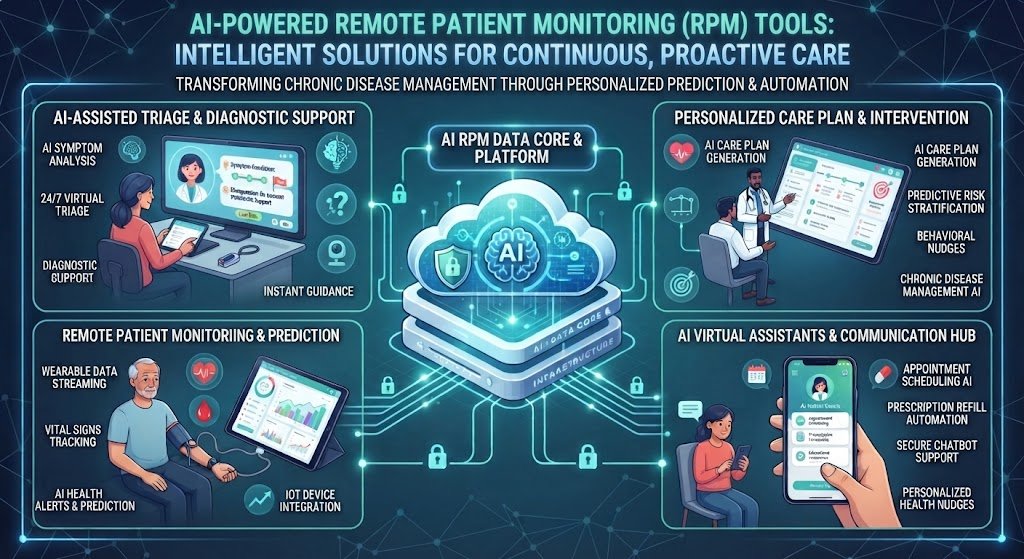
Primary topic: Artificial Intelligence in Remote Patient Monitoring (RPM) Tools
Research focus: AI-powered remote monitoring, wearable sensors, predictive analytics, machine learning, computer vision, vital-sign monitoring, chronic disease management, clinical alerts, remote rehabilitation, personalized monitoring, workflow automation, AI-assisted triage, data analytics, interoperability, and healthcare modernization.
AI in Remote Patient Monitoring: From Data Collection to Intelligent Care
Remote Patient Monitoring has become an important part of digital healthcare because it allows selected patient information to be collected outside the traditional clinical environment.
Instead of waiting for a patient to return for an appointment, healthcare organizations can receive information between visits. Depending on the condition and care program, this may include blood pressure, heart rate, oxygen saturation, blood glucose, body weight, temperature, respiratory rate, ECG signals, physical activity, sleep patterns, medication adherence, or other patient-generated information.
The important development is that modern RPM systems do not have to treat every measurement equally.
A patient may generate hundreds or thousands of data points over a period of time. A healthcare professional cannot realistically review every data point with the same level of attention. AI can help identify patterns, reduce unnecessary alerts, and prioritize information that may require professional review.
This changes the basic RPM model from collect → transmit → display toward collect → analyze → prioritize → review → act → measure.
A 2026 systematic review of machine learning for disease-outcome prediction from remote monitoring identified 76 prospective studies from an initial pool of 6,668 records. The review found that 73.7% of included studies were considered to have a high risk of bias, particularly because of methodological weaknesses in analysis. This is a major finding because it shows that the field is advancing rapidly while evidence quality remains uneven.
The implication is not that AI has failed in RPM.
Instead, it means healthcare organizations should distinguish between an AI model that performs well in a research environment and an AI system that has demonstrated meaningful clinical value after being integrated into real-world care.
Why AI Is Becoming Important for RPM
The volume of remote health data is increasing as smartphones, wearable devices, connected medical equipment, home monitoring kits, and other sensors become more common.
A traditional threshold-based system may generate an alert whenever a value crosses a predefined limit.
For example, a blood-pressure reading above a specific threshold may generate an alert.
This approach can be useful, but it has limitations.
A patient’s condition may deteriorate without crossing a single threshold. Conversely, a temporary abnormal measurement may trigger an alert even though the patient’s overall condition has not meaningfully changed.
AI can analyze trends instead of looking only at individual values.
For example, a system may recognize that a patient’s weight has gradually increased while activity has declined and heart rate has changed. Each individual signal might appear relatively unremarkable, but the combined pattern may deserve closer attention.
This is where Machine Learning becomes particularly valuable.
AI can examine multiple variables simultaneously and estimate whether a pattern resembles previous cases associated with a particular outcome.
A 2023 review of AI-enabled RPM described applications ranging from physical-activity classification and vital-sign monitoring to emergency-event detection and chronic-disease monitoring. The review also examined IoT devices, cloud and edge computing, federated learning, and other technologies used to build intelligent RPM architectures.
The future RPM platform is therefore likely to be less about collecting more data and more about extracting useful information from the data already being collected.
What AI Adds to a Traditional RPM Platform
Connected devices capture physiological and behavioral information from the patient.
Machine learning identifies patterns, trends, anomalies, and relationships across patient data.
The system can rank alerts according to predefined clinical criteria and model outputs.
Healthcare professionals evaluate the AI output together with the patient’s clinical context.
Approved workflows can trigger outreach, follow-up, escalation, or additional assessment.
The organization measures whether RPM actually improves care, safety, efficiency, or patient experience.
This layered approach is important because AI should not exist independently from the healthcare workflow.
A highly accurate model can still create little value if its alerts are ignored, if clinicians receive too many notifications, or if the result cannot be accessed inside the existing care system.
Research Evidence: Machine Learning and Remote Monitoring
Systematic Review of Disease-Outcome Prediction
A major 2026 systematic review examined prospective research involving machine learning and remote monitoring for chronic conditions.
Researchers initially identified 6,668 studies and ultimately included 76 studies that met the inclusion criteria.
The review covered multiple chronic conditions and examined different monitored parameters, datasets, algorithms, and health outcomes.
One of the most important conclusions was the high risk of bias identified across the literature.
73.7% of included studies were considered to have a high risk of bias.
This finding should directly influence how healthcare organizations evaluate AI vendors.
A vendor may advertise impressive accuracy based on a particular dataset. That number should not automatically be interpreted as evidence that the model will produce the same performance across different populations, devices, healthcare environments, and patient behaviors.
The review also found that Parkinson’s disease was the most frequently monitored condition among the included studies, followed by diabetes and chronic obstructive pulmonary disease.
This shows where remote monitoring research is already concentrating.
At the same time, it highlights the need for additional evidence across other conditions and broader populations.
Source: [Predicting disease outcomes from remote monitoring using machine learning: a 2026 systematic review](https://link.springer.com/article/10.1186/s12911-026-03495-0?utm_source=chatgpt.com)
Earlier Systematic Review and Meta-Analysis of RPM Algorithms
A 2021 systematic review and meta-analysis examined 89 articles covering algorithms used in remote monitoring of chronic conditions.
The research evaluated algorithmic performance as well as effects on healthcare processes and patient outcomes.
The findings were mixed.
The review found no statistically significant evidence of improved healthcare utilization or mortality in the analyzed studies. However, it identified positive effects for generic health status and diabetes control.
The study also identified an important difference between diagnostic algorithms and algorithms designed to predict future events.
Algorithms focused on diagnosing a current condition generally demonstrated stronger performance than algorithms attempting to predict future events.
ECG-based detection of arrhythmia and ischemia was identified as a particularly promising area.
This distinction is extremely important for AI RPM development.
Detecting a current abnormality can be a more defined technical problem than predicting a future clinical event several hours or days in advance.
Prediction requires stronger assumptions about time, patient behavior, disease progression, and the completeness of available data.
Source: [Predictive performance and impact of algorithms in remote monitoring of chronic conditions: systematic review and meta-analysis](https://pubmed.ncbi.nlm.nih.gov/34700194/?utm_source=chatgpt.com)
Research on AI, IoT, and Real-Time Health Prediction
A 2026 systematic review examined AI-assisted Internet of Things systems for real-time health-condition prediction.
The research describes how AI and IoT are increasingly being combined for disease detection, early diagnosis, and ongoing remote monitoring.
The combination is important because IoT devices provide the continuous data stream while AI provides the analytical layer.
A sensor without an analytical system may simply create more data.
AI can potentially turn that stream into alerts, predictions, classifications, or trends that are easier for healthcare professionals to interpret.
The research also highlights the importance of real-time processing, which creates opportunities for edge computing and other architectures where some analysis can occur closer to the data source.
Source: [AI-assisted Internet of Things systems for real-time health-condition prediction: systematic review](https://link.springer.com/article/10.1007/s43926-026-00415-6?utm_source=chatgpt.com)
AI for Chronic Disease Monitoring
Chronic disease management is one of the strongest use cases for AI-enabled RPM.
Conditions such as hypertension, diabetes, heart failure, COPD, and neurological disorders often require long-term monitoring rather than a single clinical intervention.
RPM can provide information between appointments.
AI can then help identify changes that may require attention.
| Condition Area | Potential RPM Data | AI Opportunity | Clinical Workflow |
|---|---|---|---|
| Hypertension | Blood pressure, heart rate, activity | Trend analysis and risk prioritization | Review and follow-up |
| Diabetes | Glucose, activity, meals, medication data | Pattern recognition and prediction | Care-team intervention |
| Heart Failure | Weight, heart rate, blood pressure, symptoms | Deterioration-risk detection | Clinical assessment |
| COPD | Oxygen saturation, respiratory data, symptoms | Change detection and risk scoring | Remote intervention |
| Neurological Conditions | Movement, activity, sleep, patient reports | Behavior and movement-pattern analysis | Specialist review |
These applications can help transform RPM from passive observation into proactive care support.
The important word is support.
AI-generated risk scores should be interpreted with clinical context rather than treated as automatic diagnoses.
AI for Heart Failure and Cardiovascular RPM
Cardiovascular monitoring is particularly suited to AI because patients can generate continuous physiological signals.
ECG devices, wearable sensors, blood-pressure monitors, weight scales, activity trackers, and other connected technologies can provide multiple data streams.
Machine learning can analyze these signals for patterns associated with abnormal rhythm or possible deterioration.
The 2021 systematic review discussed earlier found promising performance for arrhythmia and ischemia detection using ECG data.
The opportunity becomes even more interesting when multiple signals are combined.
A system could potentially examine changes in heart rate, activity, weight, blood pressure, symptoms, and other available information instead of evaluating one measurement in isolation.
For heart-failure programs, the broader objective is to identify meaningful deterioration early enough for a care team to evaluate the patient.
However, the system must account for false alarms.
An RPM program that produces excessive alerts can overwhelm nurses and physicians.
This creates the concept of intelligent alert management.
Instead of sending every abnormal measurement to a clinician, AI can help categorize alerts according to urgency, confidence, trend, patient history, and predefined clinical rules.
AI for Diabetes Remote Monitoring
Diabetes is another major RPM application because glucose measurements can be collected frequently.
AI can analyze glucose patterns alongside activity, medication information, meal-related data, and other available variables.
The objective is not simply to report the current glucose level.
The greater opportunity is identifying patterns.
For example, a patient may experience repeated glucose changes at a similar time of day. An AI system can identify the recurring pattern and present it to the clinical team.
Machine learning can also be used to estimate future glucose trends, although predictive performance depends heavily on data quality, population, sensor reliability, and model design.
The 2021 RPM algorithm meta-analysis found a positive effect on diabetes control among the studies included in its analysis, although the authors noted important limitations and high risk of bias in some diabetes studies.
This means AI-enabled diabetes RPM should be evaluated through real clinical outcomes rather than model accuracy alone.
AI for COPD and Respiratory Monitoring
Respiratory conditions create another opportunity for remote monitoring.
Patients can potentially transmit oxygen saturation, respiratory rate, activity information, symptom reports, and other measurements.
AI can analyze changes across time.
A single oxygen-saturation measurement may not provide the complete picture.
A trend combined with reduced activity and worsening symptoms could provide a stronger signal for clinical review.
AI can also help prioritize patients in large RPM programs.
This becomes increasingly important as the number of enrolled patients increases.
A healthcare team managing 50 monitored patients has a different operational challenge from a team managing 5,000.
Automation and prioritization become essential at scale.
AI for Wearable Devices and Continuous Monitoring
Wearables are becoming an important source of remote health data.
A 2026 systematic review of wearable devices for chronic-disease monitoring reviewed 1,160 articles and selected 61 studies covering cardiovascular, cancer, neurological, metabolic, respiratory, and other diseases.
Wearables can collect information through sensors positioned on different parts of the body.
Depending on the device, this can include heart-related signals, movement, activity, sleep, temperature, oxygen-related measurements, and other physiological parameters.
The major AI opportunity is to convert continuous sensor data into meaningful clinical information.
Continuous physiological and behavioral data collection.
Cleaning, filtering, normalization, and quality assessment.
Pattern recognition, classification, anomaly detection, and prediction.
Prioritized information presented to authorized healthcare professionals.
This architecture can support continuous monitoring without requiring a clinician to manually inspect every raw measurement.
AI-Powered Anomaly Detection
Anomaly detection is one of the most practical AI applications for RPM.
Traditional systems often rely on fixed thresholds.
AI can potentially identify deviations from an individual’s normal pattern.
This is important because healthcare is highly individualized.
A heart rate that is normal for one person may be unusual for another.
Similarly, a change in activity or sleep may be more meaningful when compared with the patient’s own baseline rather than a universal threshold.
Personalized anomaly detection can therefore become an important feature of future RPM platforms.
The model can learn an individual’s normal range and identify meaningful departures from that baseline.
This does not mean every deviation is clinically dangerous.
It means the system can create a signal for professional review.
AI and Remote Rehabilitation
Remote Patient Monitoring is not limited to vital signs.
Movement can also become a measurable health signal.
Smartphones, cameras, wearable sensors, and motion-analysis systems can capture information related to mobility and physical activity.
AI can classify exercises, identify movement patterns, and monitor rehabilitation behavior.
The 2023 review of AI-enabled RPM identified physical-activity classification among the areas where AI can be applied to remote monitoring.
This creates opportunities for remote rehabilitation programs.
A patient can perform an exercise at home while a computer-vision system analyzes movement.
The resulting information can be presented to a therapist or healthcare professional.
The platform can also track progress across sessions.
This can create a longitudinal picture that is difficult to obtain through occasional clinic visits alone.
AI for Personalized Monitoring
One of the strongest future applications is personalized RPM.
Traditional monitoring programs often use the same rules for large groups of patients.
AI can potentially learn from individual patterns and adapt monitoring intensity.
A high-risk patient may require closer observation.
A stable patient may need less intensive review.
The exact approach depends on the condition, clinical protocol, regulatory requirements, and evidence supporting the model.
Federated learning is another technology discussed in AI-enabled RPM research.
It can allow models to learn across distributed datasets without necessarily centralizing all raw patient data in one location.
This may become increasingly important as healthcare organizations attempt to collaborate while maintaining privacy and data-governance requirements.
AI Alert Management and Clinical Workflow Automation
Alert fatigue is one of the biggest operational challenges in RPM.
If every unusual measurement generates an alert, healthcare professionals can quickly become overwhelmed.
The result may be delayed responses or reduced attention to genuinely important alerts.
AI can help prioritize alerts.
A practical system could classify information into categories such as:
- Routine: No immediate action indicated under the approved monitoring protocol.
- Review: Information should be reviewed by an authorized healthcare professional.
- Priority: The pattern meets predefined criteria for faster professional review.
- Escalation: The workflow meets an approved escalation pathway requiring prompt action.
The exact thresholds and actions should be defined by the healthcare organization and clinical governance process.
AI should not independently invent clinical escalation rules.
The value comes from helping staff manage information more efficiently within approved workflows.
Generative AI in RPM Platforms
Generative AI introduces another layer of functionality.
Traditional machine learning is well suited to prediction and classification.
Generative AI is particularly useful for language-heavy tasks.
An RPM platform could use Generative AI to summarize a patient’s recent monitoring history for professional review.
Instead of reading hundreds of measurements, the clinician could receive a structured summary describing important trends, abnormal readings, missing data, recent alerts, and relevant patient-reported information.
The clinician can then review the underlying data before making a decision.
Generative AI can also assist with:
- Patient communication drafts.
- Monitoring summaries.
- Care-team handoff summaries.
- Follow-up instructions.
- Patient education material.
- Documentation drafts.
- Translation support.
- Administrative communication.
- RPM program reports.
The key requirement is controlled use.
Generated healthcare information should be reviewed according to the organization’s clinical and governance requirements before it is used for patient care.
AI and RPM Data Quality
AI cannot compensate for consistently poor-quality data.
This is one of the most important practical lessons for RPM developers.
A machine-learning model may be technically advanced, but if a wearable produces noisy measurements or a patient uses a device incorrectly, the model may receive unreliable input.
The 2026 RPM research literature continues to highlight methodological and implementation limitations, while the broader wearable literature shows how diverse devices and measurement approaches can complicate standardization.
A strong RPM platform should therefore include a data-quality layer.
The quality-check stage can identify missing measurements, impossible values, sensor failures, inconsistent readings, or other problems before the information is interpreted.
Interoperability and AI Integration
RPM platforms rarely operate alone.
Healthcare organizations may already use EHRs, patient portals, scheduling software, billing platforms, telehealth applications, pharmacy systems, laboratory systems, and clinical dashboards.
AI-enabled RPM should connect to the existing healthcare environment.
This can allow relevant information to move between the patient’s device, RPM platform, clinical dashboard, and healthcare record.
Integration also reduces the need for clinicians to work across multiple disconnected applications.
The technical architecture may include APIs, standardized healthcare data formats, identity management, authentication, audit logging, cloud services, edge processing, and secure data transmission.
The specific architecture should depend on the clinical use case and organization’s requirements.
Cloud, Edge AI, and Real-Time RPM
Cloud computing can provide scalable processing and centralized analytics.
Edge AI can process certain information closer to the device or patient.
This can be useful when latency, connectivity, bandwidth, or privacy requirements make centralized processing less desirable.
An RPM system could therefore use a hybrid architecture.
Sensors and connected medical devices
Fast local processing and quality checks
Scalable storage, analytics, and model processing
Dashboards, alerts, records, and workflows
AI can operate across these layers depending on the requirements of the application.
Research on Patient Experience and RPM
RPM is ultimately a patient-facing technology, so technical performance is not enough.
A systematic review examining patient expectations and experiences of remote monitoring for chronic diseases included 16 qualitative studies involving 307 participants.
The review found that patients associated remote monitoring with increased disease-specific knowledge, earlier clinical assessment, improved self-management, and shared decision-making.
At the same time, patients raised concerns about learning new technology, trust, additional costs, and potentially losing interpersonal connections with healthcare professionals.
This provides an important design lesson.
The best RPM platform is not necessarily the one with the largest number of sensors.
It is the platform that patients can understand and consistently use.
Patient engagement should therefore be treated as a core product requirement.
The interface should make it clear what the patient needs to do, why the information matters, and when professional help should be sought according to the approved care process.
Economic and Operational Value of AI-Enabled RPM
RPM is often evaluated partly because of its potential effect on healthcare utilization and cost.
A systematic review of 34 economic evaluations found that RPM can be cost-effective for chronic disease management, but cost-effectiveness depends on factors including capital investment, clinical context, willingness-to-pay thresholds, and organizational implementation processes.
This is particularly relevant to AI.
Adding AI creates another technology cost.
The business case therefore should not simply be:
AI is accurate → therefore AI is valuable.
A better evaluation is:
AI improves the workflow → the workflow improves measurable outcomes → the organization receives enough value to justify the investment.
Potential operational metrics include:
- Time spent reviewing RPM data.
- Number of alerts generated per patient.
- Percentage of alerts requiring intervention.
- Clinician response time.
- Patient adherence to monitoring.
- Missed monitoring sessions.
- Unplanned healthcare utilization.
- Hospital or emergency escalation where clinically appropriate to measure.
- Patient satisfaction.
- Staff workload.
AI Opportunity Matrix for RPM Tools
| RPM Area | AI Capability | Primary Value | Key KPI |
|---|---|---|---|
| Vital Signs | Anomaly detection | Earlier identification of unusual trends | Validated detection performance |
| ECG | Signal classification | Prioritized rhythm review | Sensitivity and specificity |
| Diabetes | Pattern prediction | Better understanding of glucose trends | Clinical outcome |
| Wearables | Behavior analysis | Continuous patient insights | Adherence and useful-data rate |
| Rehabilitation | Computer vision | Movement monitoring | Movement-analysis accuracy |
| Clinical Dashboard | Risk prioritization | Reduced information overload | Alert workload |
| Documentation | Generative AI | Lower administrative workload | Documentation time |
| RPM Operations | Predictive analytics | Better resource planning | Response and staffing efficiency |
AI Workflow for a Modern RPM Platform
↓
Connected Device
↓
Secure Data Collection
↓
Data Quality Assessment
↓
AI + Machine Learning Analysis
↓
Risk and Alert Prioritization
↓
Clinical Dashboard
↓
Professional Review
↓
Approved Intervention
↓
Follow-Up
↓
Outcome Measurement
This workflow demonstrates why AI development and AI integration should be planned together.
The model is only one component of the complete product.
A healthcare organization also needs reliable data collection, identity management, user permissions, clinical dashboards, alert routing, auditability, communication tools, and outcome tracking.
Future Role of AI Agents in RPM
The next phase of RPM may involve AI agents that coordinate multiple workflow steps.
An agent could monitor incoming data, identify a predefined pattern, summarize the patient’s recent information, prepare a review task, and route it to the appropriate healthcare professional.
The agent could also prepare a patient communication draft after an authorized professional reviews the case.
This is different from allowing AI to independently practice medicine.
The practical opportunity is workflow orchestration.
AI can manage repetitive information-handling tasks while clinicians retain responsibility for clinical interpretation and decisions.
Future Predictions for AI in Remote Patient Monitoring
Continuous monitoring will become more intelligent
RPM will increasingly move from periodic measurements toward continuous or near-continuous monitoring where clinically appropriate.
AI will help interpret the resulting data volume.
The competitive advantage will not simply be collecting more measurements.
It will be identifying which measurements matter.
Personal baselines will become more important
Future systems are likely to compare patients against their own historical patterns rather than relying entirely on population-level thresholds.
This can create more individualized monitoring.
The challenge will be determining how much historical data is needed before a reliable personal baseline can be established.
Multimodal RPM will grow
Future RPM systems will combine physiological measurements with patient-reported symptoms, activity, sleep, medication information, clinical records, and potentially visual or audio information.
This could provide a broader picture of patient status.
However, combining more data also increases complexity, privacy requirements, and validation needs.
Edge AI will support faster monitoring
Some AI analysis will increasingly occur closer to the patient or device.
This can reduce latency and potentially reduce the amount of raw information that must be transmitted.
The most appropriate architecture will depend on the use case and security requirements.
RPM will become increasingly predictive
The industry is moving beyond asking whether a measurement is abnormal.
The larger question is whether the pattern suggests an increased risk of deterioration.
Research is already exploring this area, although the 2026 systematic review demonstrates that substantial evidence-quality problems remain.
Human-AI collaboration will remain essential
Healthcare is unlikely to become fully autonomous simply because AI models become more capable.
The consequences of incorrect clinical decisions are too important.
Future RPM systems will therefore likely combine AI recommendations with professional review, governance, audit trails, and continuous monitoring.
What RPM Companies Should Build Next
RPM companies should focus on solving workflow problems rather than simply adding AI features.
A useful product strategy can begin with one high-value clinical workflow.
For example, a company could develop intelligent alert prioritization for heart-failure monitoring.
Another could focus on glucose-pattern analysis.
Another could build movement analysis for remote rehabilitation.
Another could specialize in wearable-data quality assessment.
Another could build an AI layer that summarizes thousands of patient measurements for RPM nurses.
Each of these problems has a clearer product boundary than attempting to build a universal healthcare AI platform.
The most valuable products can then expand after demonstrating measurable results.
AI Technology Stack for RPM Platforms
Connected blood-pressure monitors, glucose systems, ECG devices, pulse oximeters, wearables, and other monitoring technologies.
Secure ingestion, normalization, storage, validation, and processing of remote patient data.
Risk prediction, classification, anomaly detection, and personalized monitoring.
Movement analysis, rehabilitation monitoring, and visual health applications where appropriate.
Clinical summaries, patient communication, documentation, and information organization.
RPM performance dashboards, population insights, operational metrics, and outcome measurement.
APIs and healthcare-system connectivity for records, dashboards, scheduling, and workflow systems.
Authentication, authorization, auditability, privacy controls, monitoring, and responsible AI processes.
Where AI in RPM Can Fail
AI-enabled RPM must be designed around failure conditions.
The most important risks include:
- Poor sensor data.
- Missing measurements.
- Incorrect device use.
- False-positive alerts.
- False-negative results.
- Model bias.
- Population differences.
- Data drift.
- Changes in device hardware.
- Connectivity problems.
- Alert fatigue.
- Weak interoperability.
- Privacy and cybersecurity risks.
- Overreliance on AI-generated recommendations.
- Unclear responsibility when an AI alert is missed or incorrect.
A 2026 systematic review found a high risk of bias in a large proportion of machine-learning studies for remote-monitoring outcome prediction.
That evidence reinforces the need for external validation, prospective testing, and real-world monitoring before organizations depend heavily on predictive models.
The regulatory environment is also evolving.
The FDA maintains dedicated guidance for digital-health products and has issued guidance covering AI-enabled device software functions, clinical decision-support software, cybersecurity, and lifecycle management.
Source: [FDA Digital Health Guidance](https://www.fda.gov/medical-devices/digital-health-center-excellence/guidances-digital-health-content?utm_source=chatgpt.com)
Recommended Evaluation Framework for AI RPM
Healthcare organizations should evaluate AI RPM products across several dimensions instead of focusing only on advertised accuracy.
| Evaluation Area | Questions to Ask |
|---|---|
| Clinical validity | Has the model been validated for the intended clinical task? |
| Population | Does the validation population resemble the intended patient population? |
| Data quality | How does the system handle missing, noisy, or incorrect measurements? |
| Workflow | Who receives the alert and what happens afterward? |
| Integration | Can the system connect with existing healthcare software? |
| Security | How are patient data, identities, access, and audit records protected? |
| Monitoring | How is model performance monitored after deployment? |
| Patient usability | Can patients reliably use the devices and understand the workflow? |
| Economic value | Does the system produce measurable operational or clinical value? |
A Practical AI Adoption Framework for RPM Providers
Start with the clinical problem.
Identify a workflow where additional intelligence could create measurable value.
Define the data.
Determine which measurements are available, how frequently they are collected, and how reliable they are.
Choose the appropriate AI approach.
A simple threshold system may be enough for some workflows. Other problems may require anomaly detection, machine learning, computer vision, or generative AI.
Validate before scaling.
Test the system using representative data and, where appropriate, prospective clinical evaluation.
Integrate with the care workflow.
The AI output should appear where authorized healthcare professionals already work.
Define human oversight.
Determine which decisions require professional review and what happens when the AI is uncertain.
Monitor performance continuously.
AI performance can change when patient populations, devices, workflows, or data patterns change.
Measure outcomes.
The final evaluation should consider patient outcomes, staff workload, operational efficiency, safety, patient experience, and financial value.
Frequently Asked Questions
What is AI in Remote Patient Monitoring?
AI in Remote Patient Monitoring refers to the use of artificial intelligence and machine learning to analyze patient-generated data collected outside traditional healthcare settings. The technology can support anomaly detection, risk prediction, pattern recognition, alert prioritization, clinical summaries, and workflow automation.
How is AI used in RPM tools?
AI can analyze vital signs, ECG signals, glucose measurements, wearable data, activity patterns, symptoms, and other remote-monitoring information. It can identify trends, detect unusual patterns, prioritize alerts, and provide structured information for professional review.
Can AI predict patient deterioration through RPM?
AI can be developed to estimate risk of future clinical events using remote-monitoring data. Research is actively exploring this area, but evidence quality varies substantially. A 2026 systematic review found that 73.7% of included prospective machine-learning studies had a high risk of bias, showing why validation is essential.
What devices can be used with AI-enabled RPM?
Depending on the clinical program, RPM can incorporate blood-pressure monitors, glucose-monitoring devices, ECG devices, pulse oximeters, thermometers, weight scales, activity trackers, smartwatches, smartphones, motion sensors, and other connected medical devices.
How does AI reduce RPM alert fatigue?
AI can analyze patterns and help prioritize alerts rather than treating every abnormal measurement equally. The exact prioritization logic should be clinically validated and integrated with approved organizational workflows.
Can AI RPM replace doctors or nurses?
AI should generally be treated as a support technology rather than a replacement for qualified healthcare professionals. RPM requires clinical interpretation, patient context, escalation decisions, and accountability that depend on the intended use and level of clinical risk.
How does Generative AI help RPM programs?
Generative AI can assist with monitoring summaries, documentation drafts, patient communication, care-team handoffs, educational content, and administrative workflows. Human review remains important for healthcare-related content.
What is anomaly detection in RPM?
Anomaly detection identifies measurements or patterns that differ from expected behavior. Instead of looking only at fixed thresholds, an AI system can potentially examine trends and individual baselines to identify information that deserves professional review.
Why is data quality important for AI RPM?
AI models depend on the quality of their input data. Incorrect device use, missing measurements, sensor errors, poor connectivity, and noisy signals can affect the reliability of AI outputs.
What is the biggest opportunity for AI in RPM?
One of the strongest opportunities is turning large volumes of remote patient data into prioritized, actionable information. Intelligent alert management, personalized monitoring, chronic-disease risk analysis, and clinical summarization are particularly promising areas.
What should healthcare organizations measure after implementing AI RPM?
Organizations should measure clinical outcomes, alert volume, clinician workload, response time, patient adherence, patient experience, workflow efficiency, safety events, and financial impact where appropriate.
Credible Research Sources and References
- 2026 Machine Learning and RPM Systematic Review: A systematic review identified 76 prospective studies examining machine learning for predicting disease outcomes from remote monitoring and reported substantial methodological limitations across the literature. Source: [BMC Medical Informatics and Decision Making research](https://link.springer.com/article/10.1186/s12911-026-03495-0?utm_source=chatgpt.com)
- 2026 RPM Technology Review: A scoping review examined remote patient-monitoring technologies and their relationship with AI, IoT, telemedicine, medication optimization, pharmacovigilance, and virtual care. Source: [2026 scoping review of RPM technologies](https://link.springer.com/article/10.1007/s44163-026-01177-4?utm_source=chatgpt.com)
- 2021 RPM Algorithm Meta-Analysis: A systematic review and meta-analysis included 89 articles and evaluated predictive performance and the clinical and patient-reported impact of algorithms used in remote monitoring of chronic conditions. Source: [PubMed: Predictive performance and impact of algorithms in remote monitoring](https://pubmed.ncbi.nlm.nih.gov/34700194/?utm_source=chatgpt.com)
- 2024 RPM Outcomes Review: A systematic review evaluated the effects of remote patient monitoring on safety, adherence, quality of life, and cost-related outcomes. Source: [npj Digital Medicine: RPM outcomes systematic review](https://www.nature.com/articles/s41746-024-01182-w?utm_source=chatgpt.com)
- RPM Economic Evidence: A systematic review examined 34 economic evaluations of noninvasive RPM for chronic disease management and found that cost-effectiveness depends on clinical and organizational factors. Source: [Economic Evaluations of Remote Patient Monitoring for Chronic Disease](https://www.sciencedirect.com/science/article/pii/S1098301521032241?utm_source=chatgpt.com)
- Patient Experience Research: A systematic review examined patient expectations and experiences with remote monitoring for chronic diseases, including benefits and concerns related to technology burden and interpersonal care. Source: [Patient expectations and experiences of remote monitoring](https://www.sciencedirect.com/science/article/pii/S1386505618309821?utm_source=chatgpt.com)
- AI in RPM Review: A comprehensive review examined AI-enabled RPM architectures, IoT, wearable sensors, cloud, edge and fog computing, federated learning, emergency monitoring, chronic disease management, and implementation challenges. Source: [Wiley: Remote patient monitoring using artificial intelligence](https://wires.onlinelibrary.wiley.com/doi/full/10.1002/widm.1485?utm_source=chatgpt.com)
- 2026 Wearable Devices Review: A systematic review evaluated wearable technologies for remote monitoring across cardiovascular, cancer, neurological, metabolic, respiratory, and other chronic diseases. Source: [PubMed: Wearable Devices for Remote Monitoring of Chronic Diseases](https://pubmed.ncbi.nlm.nih.gov/41671558/?utm_source=chatgpt.com)
- 2026 AI + IoT Review: A systematic review examined AI-assisted IoT systems for real-time health-condition prediction, early diagnosis, and ongoing remote monitoring. Source: [AI-assisted IoT systems for real-time health prediction](https://link.springer.com/article/10.1007/s43926-026-00415-6?utm_source=chatgpt.com)
- FDA Digital Health Guidance: The FDA maintains guidance covering digital-health products, including clinical decision-support software and AI-enabled device software functions, with emphasis on regulatory and lifecycle considerations. Source: [FDA Digital Health Guidance](https://www.fda.gov/medical-devices/digital-health-center-excellence/guidances-digital-health-content?utm_source=chatgpt.com)
Final Outlook
AI in Remote Patient Monitoring is moving the industry toward a more intelligent model of connected healthcare.
The first generation of RPM primarily focused on collecting patient measurements and making those measurements available to healthcare professionals.
The next generation is focused on understanding those measurements.
AI can help identify patterns, recognize anomalies, prioritize alerts, summarize patient histories, personalize monitoring, support remote rehabilitation, and improve the way care teams interact with continuously generated health data.
The research, however, also shows that the industry must be careful about moving from promising algorithms to clinical claims.
The 2026 systematic review of machine-learning outcome prediction demonstrates that methodological quality remains a major concern.
The earlier meta-analysis also identified a gap between algorithm performance studies and studies demonstrating real clinical impact.
That gap represents one of the biggest opportunities for the RPM industry.
The future winners will not necessarily be the companies with the most complex models.
They will be the companies that can demonstrate that AI works reliably in real workflows, with real patients, real devices, real clinicians, and measurable outcomes.
Leave a Reply