Primary topic: AI in E-Pharmacies
Research focus: Artificial intelligence in online pharmacies, prescription processing, medication safety, dispensing, drug information, personalization, adherence, fraud detection, inventory management, logistics, customer support, clinical decision support, telepharmacy, generative AI, computer vision, predictive analytics, and the future of digital pharmacy.
AI in E-Pharmacies: How Artificial Intelligence Is Changing Online Pharmacy
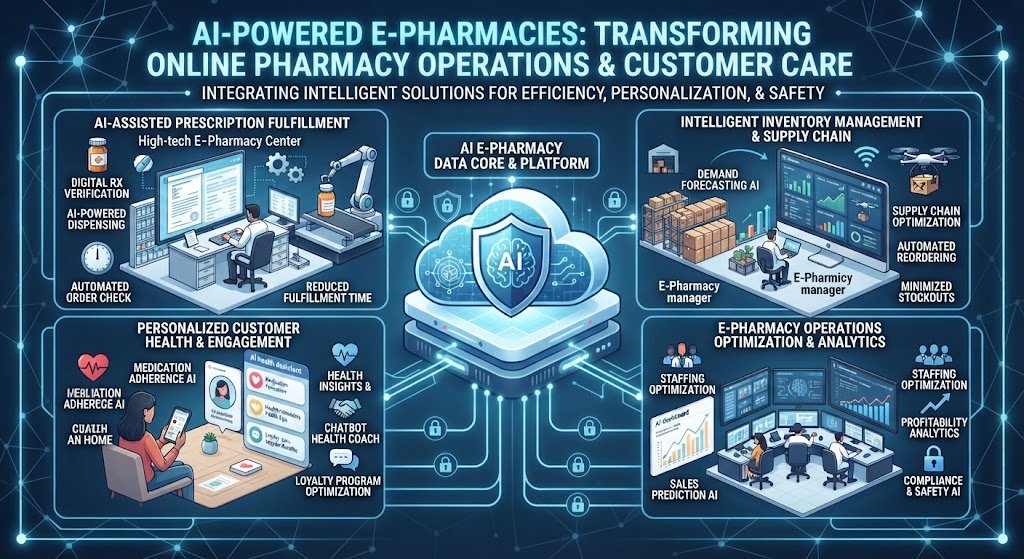
E-pharmacies have changed the way patients search for medicines, upload prescriptions, compare products, request refills, communicate with pharmacists, and receive medications. Unlike a traditional pharmacy, an e-pharmacy operates through a digital journey in which a large part of the customer and medication workflow happens before the medicine reaches the patient.
That digital structure creates a large opportunity for artificial intelligence.
Every online pharmacy can generate useful operational and clinical data through prescription submissions, medicine searches, refill requests, order histories, customer questions, delivery information, stock levels, pharmacist interventions, and medication-adherence patterns. AI can analyze these signals to identify patterns that would be difficult to process manually at large scale.
The most valuable opportunity is not simply adding a chatbot to an e-pharmacy website. The stronger approach is to connect AI to the pharmacy workflow so that intelligence is generated at the right point and followed by an appropriate action.
For example, an AI system can identify a possible problem in a prescription direction before an order reaches the dispensing stage. A pharmacist can then review the alert. The same platform can use historical refill behavior to identify patients who may need an adherence intervention.
This creates a broader model:
This workflow-oriented approach is becoming increasingly important because recent pharmacy research shows that AI applications are concentrated around medication safety, medication errors, medication-order review, dispensing, adherence, and drug-interaction detection. A 2026 scoping review identified 36 relevant publications and found that drug interactions and adverse drug effects represented 33.3% of included studies, while medication errors and potentially inappropriate medications represented 30.6%.
Why E-Pharmacies Are a Strong Environment for AI
E-pharmacies naturally operate through structured digital workflows. A prescription arrives electronically, patient information is entered into a system, medicines are selected from a catalog, payment and insurance information may be processed, pharmacists review the order, fulfillment takes place, and delivery is coordinated.
Because many of these activities generate structured data, AI can be introduced at multiple points.
The biggest advantage is scale. A pharmacist can manually review a limited number of cases at one time, while software can continuously screen thousands of records for predefined risk patterns.
AI can therefore act as a first layer of analysis.
The pharmacist remains responsible for interpreting clinically important information and deciding whether an intervention is required.
| E-Pharmacy Area | AI Capability | Potential Value |
|---|---|---|
| Prescription processing | NLP and rule-based AI | Detect errors and missing information |
| Medication safety | Risk detection and classification | Additional safety checks |
| Customer support | Generative AI and NLP | Faster information handling |
| Adherence | Predictive analytics | Identify potential adherence gaps |
| Inventory | Demand forecasting | Better stock planning |
| Fraud prevention | Anomaly detection | Identify unusual activity |
| Delivery | Predictive optimization | Improve fulfillment efficiency |
Research Evidence: AI Can Reduce Medication-Direction Errors
One of the most directly relevant studies for e-pharmacies examined the use of large language models to prevent medication-direction errors in an online pharmacy.
The researchers developed a system called MEDIC, or Medication Direction Copilot. Instead of asking a general-purpose language model to freely generate prescription directions, the system was designed around pharmacy-specific logic and safety guardrails.
This distinction is extremely important.
Medication directions contain clinically important components such as dosage, frequency, route, and other instructions. A small wording error can change how a patient interprets a prescription.
The researchers evaluated MEDIC against other AI-based approaches using 1,200 expert-reviewed prescriptions.
The study found that the comparison systems generated more near-miss events than MEDIC. More importantly, when MEDIC was deployed experimentally within an online pharmacy’s production system, near-miss events were reduced by 33%, with a confidence interval of 26% to 40%.
A near miss is an error that is identified and corrected before reaching the patient.
The finding demonstrates an important principle for e-pharmacy AI.
The best system is not necessarily the model that produces the most sophisticated text. It is the system that combines language understanding with domain knowledge and safety controls.
Reduction in near-miss medication-direction events during experimental production deployment of MEDIC.
Source: Large Language Models for Preventing Medication Direction Errors in Online Pharmacies.
AI for Prescription Processing and Clinical Review
Prescription processing is one of the most important AI opportunities for e-pharmacies because every prescription must pass through several checks before fulfillment.
AI can help extract information from electronic prescriptions, scanned documents, images, and other structured or unstructured inputs.
Natural language processing can identify medication names, dosage instructions, frequencies, quantities, and other prescription components.
Computer vision can also assist when prescription information is presented in image form.
The important point is that extraction is only the beginning.
Once the information has been structured, AI can compare it against predefined rules and patient information.
Possible checks can include:
- Missing prescription information.
- Unusual dosage instructions.
- Potential duplicate therapy.
- Possible medication interactions.
- Potentially inappropriate medications.
- Age-related or condition-related risk signals.
- Conflicting directions.
- Unusual refill patterns.
- Possible data-entry discrepancies.
The pharmacist can then receive prioritized alerts instead of manually investigating every order with the same level of attention.
This can be especially valuable for high-volume e-pharmacies.
A 2025 scoping review of AI applications in pharmacy practice found that identifying prescriptions requiring pharmacist intervention was the most common application among the included studies. The review identified three major areas: inappropriate or atypical medication-order identification, improving screening-service efficiency, and improving adherence and quality use of medicines.
Source: Applications of Artificial Intelligence in Current Pharmacy Practice: A Scoping Review.
AI for Medication Safety
Medication safety is one of the strongest reasons to consider AI in e-pharmacy infrastructure.
Online pharmacy platforms process large numbers of prescriptions, and safety checks can involve medication history, patient characteristics, prescription instructions, previous orders, and pharmacist review.
AI can support this process by ranking potential risks.
A simple workflow might look like this:
Received
Extraction
Screening
Review
Fulfillment
AI can also help identify look-alike and sound-alike medication risks, unusual labeling patterns, and discrepancies between prescription data and fulfillment information.
Recent systems research on AI and dispensing errors emphasizes that AI should be embedded into the wider pharmacy system. The research highlights people, interoperability, human-centered design, uncertainty communication, bias assessment, monitoring, and safety assurance as important parts of an AI-enabled dispensing environment.
Source: The Role of Artificial Intelligence in Reducing Dispensing Errors for Patient Safety and Quality.
AI for Medication Adherence
Medication adherence is another major opportunity for e-pharmacies because online pharmacy platforms can observe refill behavior over time.
A patient who repeatedly delays refills may represent a potential adherence problem.
AI can analyze historical patterns and identify patients who may benefit from pharmacist outreach.
The system does not need to assume why the patient is missing medication.
Instead, it can identify the signal and allow a pharmacist or care team to investigate.
Possible reasons for an adherence gap include cost, forgetfulness, side effects, confusion about instructions, access problems, changes in treatment, or other personal circumstances.
AI can help prioritize outreach while leaving the explanation and intervention to a professional.
A 2025 multicenter evaluation of a clinical pharmacist-led, AI-supported medication-adherence program provides useful evidence.
The program was deployed across 10,477 patients and generated 2,762 actionable medication-adherence gaps.
After implementation, adherence improved across hypertension, cholesterol, and diabetes measures by 5.9%, 7.9%, and 6.4%, respectively.
The percentage of patients with diabetes reaching their A1c goal increased from 75.5% to 81.7%.
The researchers also reported lower healthcare expenditures among adherent patients compared with nonadherent patients for the conditions studied.
| Measure | Reported Result |
|---|---|
| Patients reached by program | 10,477 |
| Actionable adherence gaps | 2,762 |
| Hypertension adherence improvement | 5.9% |
| Cholesterol adherence improvement | 7.9% |
| Diabetes adherence improvement | 6.4% |
| Patients with diabetes reaching A1c goal | 75.5% → 81.7% |
Source: Clinical Pharmacist-Led, AI-Supported Medication Adherence Program.
AI-Powered Personalized Medicine Information
Patients frequently ask questions after ordering or receiving medicines.
They may want to understand how to take a medicine, what common side effects are, what to avoid, how to store it, or when to contact a healthcare professional.
Generative AI can help e-pharmacies organize and draft responses to these questions.
However, medicine information is a high-risk area for uncontrolled AI generation.
A 2026 scoping review examined AI-generated medicines information and found that AI tools showed promise but had limitations in accuracy, particularly for complex clinical queries. The review also found that pharmacists were the healthcare professionals most commonly involved in evaluating AI-generated medicines information.
This supports a controlled model in which AI retrieves or generates information from approved sources and pharmacists or other qualified professionals remain responsible for high-risk clinical content.
AI Chatbots and Virtual Pharmacy Assistants
An AI assistant can become the first digital layer between an e-pharmacy and its customers.
It can help answer routine questions and guide users through administrative workflows.
Useful applications include:
- Order-status questions.
- Prescription-upload guidance.
- Refill requests.
- Medication availability questions.
- Delivery updates.
- General medicine-information navigation.
- Appointment or pharmacist-consultation requests.
- Frequently asked questions.
- Store and pharmacy-policy information.
- Multilingual customer communication.
The strongest architecture does not allow the chatbot to invent clinical answers.
Instead, the assistant can retrieve information from an approved knowledge base and escalate sensitive questions to a pharmacist.
For example, if a patient asks a general question about delivery, AI can answer directly.
If the patient asks whether two medicines can safely be taken together, the system can recognize the clinical nature of the question and route it into a validated medication-information or pharmacist-review workflow.
This creates a risk-based AI architecture rather than treating every question equally.
AI for Telepharmacy and Pharmacist Support
E-pharmacies can combine AI with telepharmacy to create a more complete digital pharmacy experience.
Telepharmacy allows pharmacists to provide pharmaceutical care through telecommunications.
AI can support the pharmacist by organizing patient questions, summarizing relevant information, identifying potential medication-related issues, and preparing documentation.
Research examining ChatGPT in telepharmacy found that AI could participate in medication-related interactions, but the study also demonstrates why accuracy and evaluation are necessary before such systems are relied upon for real clinical use.
Source: Utilizing ChatGPT in Telepharmacy.
A mature telepharmacy workflow could therefore look like:
Digital intake
Classify request
Approved information
Clinical review
This approach can improve responsiveness without removing professional judgment.
AI for Inventory Forecasting and Demand Prediction
Inventory management is a major operational challenge for e-pharmacies.
Too much inventory can increase carrying costs and expiry risk.
Too little inventory can create stockouts and delay treatment.
AI and machine learning can analyze historical sales, seasonal demand, prescription patterns, product availability, geographic trends, supplier lead times, and other operational variables.
The resulting forecasts can help pharmacy operators plan stock levels.
For an e-pharmacy serving multiple regions, the opportunity becomes even more significant.
Demand may vary between locations because of population characteristics, local prescribing patterns, seasonal illnesses, weather, promotions, and healthcare access.
AI can potentially forecast demand at product, category, warehouse, or geographic levels.
A practical inventory intelligence system could include:
- Demand forecasting.
- Stockout-risk prediction.
- Expiry-risk prediction.
- Reorder recommendations.
- Supplier lead-time analysis.
- Warehouse allocation.
- Seasonal demand modeling.
- Slow-moving inventory identification.
- Product substitution analysis.
- Distribution planning.
The result is a transition from reactive inventory management toward predictive inventory management.
AI for Delivery and Fulfillment Optimization
Medicine delivery creates another data-rich environment.
An e-pharmacy may need to coordinate warehouses, pharmacies, couriers, delivery windows, temperature requirements, prescription status, patient availability, and geographic constraints.
AI can analyze these variables to improve fulfillment decisions.
Predictive systems can estimate delivery delays before they occur.
Optimization systems can select better warehouse or fulfillment options.
Machine learning can identify patterns that lead to failed deliveries.
For temperature-sensitive medicines, the system can also support monitoring and exception management when connected to appropriate logistics data.
The important distinction is that AI should support logistics decisions using reliable operational data.
It should not make assumptions about medicine handling requirements without validated rules.
AI for Fraud, Abuse, and Suspicious Transactions
Digital pharmacy platforms also face fraud and abuse risks.
AI can identify unusual behavior by analyzing transaction patterns across orders, accounts, payment activity, prescription submissions, and other approved signals.
Possible indicators include:
- Unusual ordering frequency.
- Multiple accounts showing similar behavior.
- Unexpected geographic patterns.
- Repeated payment anomalies.
- Unusual prescription-upload activity.
- High-frequency attempts involving restricted products.
- Patterns inconsistent with normal customer behavior.
Anomaly detection does not prove that a customer is engaging in fraud.
It should instead create a risk signal for additional review.
This distinction is essential because automated fraud systems can generate false positives.
Human review remains important when an action could affect a legitimate patient’s access to medication.
AI and Online Pharmacy Safety
The growth of online medicine purchasing creates a serious safety challenge.
The WHO reports that substandard and falsified medical products are frequently sold online or through informal markets. It estimates that at least one in ten medicines in low- and middle-income countries are substandard or falsified.
The organization also highlights the role of increasingly complex supply chains and e-commerce in expanding the opportunity for unauthorized sellers.
Source: WHO: Substandard and Falsified Medical Products.
For legitimate e-pharmacies, AI can support safety monitoring across the digital supply chain.
Potential capabilities include:
- Supplier-risk monitoring.
- Product-data consistency checks.
- Suspicious listing detection.
- Package-image comparison.
- Batch and expiry monitoring.
- Unusual pricing detection.
- Customer complaint analysis.
- Counterfeit-risk investigation.
- Product-recall workflow support.
- Adverse-event signal detection.
The FDA also warns consumers about unsafe online pharmacies and recommends purchasing prescription medicines only from appropriately licensed pharmacies. Its guidance identifies risks including counterfeit or unapproved medicines, incorrect ingredients, improper dosing, and inadequate storage.
Source: FDA: How to Buy Medicines Safely From an Online Pharmacy.
AI for Detecting Counterfeit and Suspicious Medicines
Computer vision provides an interesting opportunity for e-pharmacy safety.
Images of medicine packaging can potentially be analyzed for inconsistencies.
AI could compare submitted images against known product information and identify unusual characteristics that deserve human investigation.
Possible signals include:
- Packaging differences.
- Label inconsistencies.
- Unusual typography.
- Missing information.
- Unexpected packaging layouts.
- Barcode or product-data mismatches.
- Visual differences between batches or known authentic products.
This should not be treated as a universal counterfeit detector.
Counterfeit detection can involve laboratory testing, supply-chain investigation, regulatory databases, packaging analysis, and professional assessment.
AI can serve as an additional screening layer.
The WHO published research in 2025 examining technologies used to screen and detect substandard and falsified medical products, demonstrating the growing importance of technology-assisted detection.
Source: WHO: Technologies Used to Screen and Detect Substandard and Falsified Medical Products.
AI for Customer Experience and Personalization
E-pharmacy customers expect digital services to remember preferences, simplify repeat orders, and reduce unnecessary steps.
AI can analyze permitted customer interactions to personalize the experience.
For example, an e-pharmacy could recognize that a customer frequently orders maintenance medicines and provide a more streamlined refill journey.
The system could surface relevant reminders, explain order status, and organize frequently used products.
Personalization should remain within appropriate privacy, consent, and clinical boundaries.
AI should not make sensitive assumptions simply because a user previously searched for a particular medicine.
A safer personalization strategy is based on explicit account preferences, legitimate transaction history, and clearly defined business rules.
AI for Patient Adherence and Engagement
AI can turn the e-pharmacy from a transaction platform into a continuous medication-support platform.
A traditional online pharmacy may simply process an order.
An AI-enabled pharmacy can potentially recognize patterns between orders and identify opportunities for engagement.
For example, a patient may repeatedly refill a medication late.
The system can flag the pattern.
A pharmacist can then determine whether the patient needs education, a refill reminder, a medication review, or another form of support.
Research on AI-supported adherence programs suggests that this model can have measurable benefits when AI analytics are combined with pharmacist-led intervention.
The important component is the human connection.
AI identifies patterns at scale.
Pharmacists interpret those patterns in context.
Generative AI for E-Pharmacy Operations
Generative AI can reduce the administrative burden associated with pharmacy operations.
It is particularly useful for language-heavy tasks where the underlying information already exists in trusted systems.
Examples include:
- Drafting customer-support responses.
- Summarizing pharmacist interventions.
- Creating internal workflow notes.
- Preparing patient education drafts.
- Summarizing prescription histories.
- Organizing customer conversations.
- Translating approved communication.
- Generating internal operational reports.
- Creating FAQ content from approved information.
- Preparing follow-up communication for pharmacist review.
The strongest architecture uses retrieval and approved information sources rather than allowing the model to freely invent medical information.
This reduces the risk of unsupported clinical claims.
AI Analytics for E-Pharmacy Business Intelligence
E-pharmacies generate large amounts of operational information.
AI can transform this information into business intelligence.
Management teams can analyze order volumes, product demand, repeat purchases, cancellation patterns, delivery performance, customer support volumes, and pharmacist workload.
Predictive analytics can then identify trends before they become obvious.
For example, a sudden increase in searches for a medicine category could signal changing demand.
An increase in abandoned prescription submissions could indicate friction in the ordering process.
Longer pharmacist-review times could reveal workflow bottlenecks.
AI can connect these signals into an operational dashboard.
Forecast future product needs
Identify workflow bottlenecks
Understand engagement patterns
Prioritize medication-related signals
AI Capability Map for E-Pharmacies
| AI Capability | E-Pharmacy Application | Main Outcome |
|---|---|---|
| Natural Language Processing | Prescription and medication-direction analysis | Safer information processing |
| Generative AI | Customer communication and documentation | Lower administrative workload |
| Machine Learning | Adherence and demand prediction | Proactive decisions |
| Computer Vision | Prescription and packaging analysis | Additional verification |
| Anomaly Detection | Fraud and suspicious activity | Risk identification |
| Predictive Analytics | Inventory and delivery forecasting | Operational efficiency |
| AI Integration | EHR, pharmacy, CRM, logistics systems | Connected workflows |
Responsive AI Architecture for an E-Pharmacy
A modern e-pharmacy should not treat AI as a single feature.
A stronger architecture connects multiple AI capabilities through a controlled application layer.
Website, app, chatbot, portal
Prescription, pharmacist, dispensing
ML, NLP, vision, GenAI
Orders, prescriptions, inventory
Security, audit, validation
This architecture allows an organization to introduce AI incrementally.
A company can begin with prescription processing and later add adherence analytics, inventory forecasting, customer support, and logistics optimization.
Implementation Roadmap for E-Pharmacy AI
The first step should be identifying a workflow where AI can produce measurable value.
The organization should document the existing process, the data required, the people involved, the current error rate or workload, and the desired outcome.
The next step is validation.
The AI system should be tested against representative data before it is used in production.
For clinical applications, validation should include appropriate clinical stakeholders.
The next stage is integration.
The AI should connect to the systems that already contain the relevant information.
After integration, the organization can begin controlled deployment.
Performance should be monitored continuously rather than assuming that a model will remain reliable forever.
| Stage | Main Question | Output |
|---|---|---|
| Identify | Which workflow needs improvement? | Defined use case |
| Prepare | Is the data reliable and sufficient? | Validated data pipeline |
| Validate | Does the system work for the intended task? | Performance evidence |
| Integrate | Can staff use it inside the workflow? | Connected AI workflow |
| Deploy | Can it operate safely in production? | Controlled deployment |
| Monitor | Does performance remain acceptable? | Ongoing evaluation |
What E-Pharmacies Should Measure
AI implementation should be evaluated using business, operational, and safety metrics.
Model accuracy alone does not prove that an e-pharmacy has improved.
A system may produce accurate predictions but fail to create useful action.
The complete workflow should therefore be measured.
| Area | Useful Metrics |
|---|---|
| Safety | Near misses, dispensing discrepancies, pharmacist interventions |
| Clinical | Adherence, intervention completion, medication-related outcomes |
| Operations | Processing time, fulfillment time, workload, throughput |
| Customer | Response time, satisfaction, repeat usage, abandoned orders |
| Inventory | Stockouts, expiry losses, forecast accuracy, inventory turnover |
| Financial | Cost per order, labor savings, fulfillment cost, AI ROI |
Major Risks of AI in E-Pharmacies
The biggest mistake would be to treat AI as automatically reliable because it produces confident answers.
Healthcare systems require a higher standard.
AI can make errors when data is incomplete, when the model encounters an unfamiliar situation, when an image is poor quality, when a clinical question is complex, or when the underlying information changes.
Generative AI introduces an additional problem because it can produce fluent but unsupported statements.
Important risks include:
- Incorrect medication information.
- Incorrect prescription interpretation.
- False-positive safety alerts.
- False-negative safety alerts.
- AI hallucinations.
- Biased predictions.
- Privacy violations.
- Security vulnerabilities.
- Incorrect product identification.
- Supply-chain manipulation.
- Automation bias among staff.
- Insufficient pharmacist oversight.
- Model performance degradation after deployment.
- Patient misunderstanding of automated information.
These risks become more serious when an AI system is allowed to take action without human review.
The safest design is usually risk-based.
Low-risk administrative tasks can have greater automation.
Higher-risk medication and clinical decisions should have stronger controls and professional review.
AI Governance for E-Pharmacies
Governance should be designed before large-scale AI deployment.
An e-pharmacy should define which AI systems are approved, what information they can access, what actions they can take, and when human review is mandatory.
Access controls should limit AI systems to the minimum information necessary for the task.
Audit logs should record important AI-generated actions and recommendations.
Organizations should also establish procedures for monitoring performance and investigating unexpected events.
A governance framework should cover:
- Approved AI use cases.
- Data-access permissions.
- Privacy and security controls.
- Human-review requirements.
- Model validation.
- Accuracy monitoring.
- Incident reporting.
- Vendor management.
- Model updates and change management.
- Patient communication policies.
- Record retention.
- Auditability.
The WHO’s work on digital transformation and falsified medical products also emphasizes connected digital systems, governance, interoperability, monitoring, and evaluation.
Source: WHO Digital Transformation Handbook for Reporting Substandard and Falsified Medical Products.
Future of AI in E-Pharmacies
The future e-pharmacy will likely become more predictive and integrated.
Instead of responding only after a customer places an order, AI systems can increasingly anticipate operational and medication-support needs.
A customer may receive a reminder when a refill is approaching.
A pharmacist may receive a prioritized medication-review queue.
A warehouse may receive an early warning about future demand.
A delivery system may predict a fulfillment problem before the customer is affected.
A quality system may identify a suspicious product record before it reaches fulfillment.
These capabilities can operate together.
↓
AI ANALYSIS
↓
PREDICTION + RISK SIGNALS
↓
PHARMACIST / STAFF REVIEW
↓
AUTOMATED WORKFLOW
↓
PATIENT OUTCOME
↓
CONTINUOUS LEARNING
AI Agents Will Manage Multi-Step Pharmacy Workflows
The next stage of e-pharmacy automation is likely to involve AI agents capable of coordinating multiple tasks.
Instead of answering one customer question, an AI agent could identify the customer’s request, retrieve account information, check approved workflow rules, prepare a response, create a task for a pharmacist, and update the workflow after approval.
The system would still need defined permissions.
An AI agent should not be given unrestricted authority simply because it can technically perform an action.
Personalized Medication Support Will Become More Sophisticated
AI can analyze refill patterns, engagement signals, and approved patient information to create more targeted adherence workflows.
Rather than sending every patient the same reminder, an e-pharmacy could identify which patients require additional attention.
The objective should be better support rather than excessive messaging.
AI Will Become More Multimodal
Future pharmacy platforms will increasingly work with text, images, structured medication data, documents, and potentially audio.
A prescription image, medication label, patient question, and pharmacy record could become part of one connected workflow.
This will make AI more capable, but it will also make validation and governance more important.
Pharmacists Will Become More Important in AI Workflows
AI does not remove the need for pharmacy expertise.
Instead, it can change where pharmacists spend their time.
Routine screening and administrative tasks can increasingly be automated.
Pharmacists can then focus more attention on complex cases, medication counseling, clinical review, and patient care.
The 2026 pharmacy literature supports this direction because pharmacists remain central to the evaluation and validation of AI-generated medicines information.
Opportunities for E-Pharmacy Startups
Healthcare startups can build specialized AI products around specific pharmacy problems rather than attempting to create one system that does everything.
Strong product opportunities include:
- AI prescription-quality checking.
- Medication-direction verification.
- AI-powered pharmacist work queues.
- Medication adherence prediction.
- AI medicine-information assistants.
- Pharmacy inventory forecasting.
- Delivery-risk prediction.
- Counterfeit-risk screening.
- Customer-support automation.
- Pharmacist documentation assistance.
- AI-powered medication reconciliation.
- Drug-interaction decision support.
The strongest products will combine AI with domain rules and workflow integration.
A generic chatbot may be easy to build.
A validated pharmacy workflow that integrates with prescription systems, pharmacist review, audit trails, and operational data is much harder to build and potentially much more valuable.
AI Product Development Strategy for E-Pharmacies
A practical development strategy should begin with the workflow rather than the technology.
The team should identify a specific problem and define the expected result.
For example, if the problem is prescription-direction errors, the goal might be reducing near misses.
If the problem is adherence, the goal might be increasing completed refills or pharmacist interventions.
If the problem is inventory, the goal might be reducing stockouts and expiry losses.
The development cycle can be represented as:
This approach reduces the risk of building an impressive AI demonstration that does not solve a real pharmacy problem.
What This Means for E-Pharmacy Businesses
The competitive advantage of an e-pharmacy will increasingly depend on more than product catalogs and delivery speed.
Digital intelligence can become part of the overall customer experience and pharmacy operation.
An AI-enabled e-pharmacy can potentially make prescription processing safer, help pharmacists prioritize work, improve medication adherence, predict inventory requirements, personalize customer interactions, and identify unusual operational patterns.
However, technology alone will not create these benefits.
The organization needs reliable data, strong pharmacy workflows, appropriate clinical oversight, secure infrastructure, regulatory awareness, and continuous evaluation.
The most mature strategy is therefore not “automate everything.”
It is “automate the right tasks while strengthening professional oversight where the risk is highest.”
Frequently Asked Questions
What is AI in e-pharmacies?
AI in e-pharmacies refers to the use of artificial intelligence technologies such as machine learning, natural language processing, computer vision, predictive analytics, and generative AI to improve online pharmacy operations and patient-support workflows.
How can AI improve online pharmacy safety?
AI can help identify prescription-direction discrepancies, unusual medication patterns, potential interactions, labeling inconsistencies, and other signals that require pharmacist review.
Can AI check prescriptions in an e-pharmacy?
AI can assist with prescription information extraction, classification, and risk screening. High-risk medication decisions should remain subject to appropriate professional review and validated clinical workflows.
How can AI help with medication adherence?
AI can analyze refill and engagement patterns to identify possible adherence gaps. Pharmacists can then investigate the reason and provide an appropriate intervention.
Can AI replace pharmacists in e-pharmacies?
AI can automate selected repetitive tasks, but it should not be treated as a universal replacement for pharmacists. Clinical judgment, counseling, exception handling, and high-risk medication decisions require appropriate professional oversight.
How is generative AI used in e-pharmacies?
Generative AI can assist with customer communication, documentation, summaries, approved educational content, and internal workflows. Clinical information should be generated or retrieved through controlled systems and reviewed when appropriate.
Can AI detect counterfeit medicines?
AI can potentially support screening through image analysis, product-data checks, anomaly detection, and supply-chain monitoring. It should be considered an additional detection layer rather than definitive proof that a medicine is authentic or counterfeit.
How can AI improve e-pharmacy inventory?
Machine learning can analyze historical demand, seasonal patterns, inventory levels, supplier information, and other operational signals to forecast demand and support stock planning.
How can AI improve medicine delivery?
AI can help predict delivery delays, optimize fulfillment decisions, identify failed-delivery patterns, and improve coordination between pharmacies, warehouses, and delivery operations.
What are the biggest risks of AI in e-pharmacies?
Major risks include incorrect medication information, hallucinated content, false alerts, missed safety issues, privacy problems, security vulnerabilities, bias, poor integration, and excessive reliance on automated recommendations.
Why is pharmacist involvement important in e-pharmacy AI?
Pharmacists understand medication safety, clinical context, patient needs, and pharmacy workflows. Their involvement can help determine whether an AI-generated signal is clinically meaningful and what action should follow.
What is the best AI use case for an e-pharmacy?
The strongest starting point is usually a repetitive workflow with reliable data and a measurable outcome. Prescription review, medication-direction checking, adherence support, customer-service automation, and inventory forecasting are strong areas to evaluate.
Research Summary
The current evidence suggests that AI has moved beyond theoretical discussions in pharmacy technology.
Research has demonstrated practical applications in online medication-direction checking, medication adherence, pharmacy workflow prioritization, medicines information, dispensing support, and medication safety.
The MEDIC study is particularly relevant because it tested an AI system in an online pharmacy production environment and reported a 33% reduction in near-miss events during the experimental deployment.
The medication-adherence study provides another important signal, showing that AI-supported analytics combined with pharmacist intervention can improve adherence measures and selected chronic-disease outcomes.
At the same time, recent reviews emphasize that AI-generated medicines information can have accuracy limitations, particularly with complex questions.
This creates a clear direction for the industry.
The future of AI in e-pharmacies will not be determined only by how powerful the underlying model is.
It will depend on how effectively AI is connected to pharmacy knowledge, clinical rules, trusted data, professional oversight, patient communication, and measurable outcomes.
Credible Research Sources
- Online Pharmacy Medication Safety: Research on MEDIC, an LLM-based medication-direction copilot, found a 33% reduction in near-miss events during experimental deployment within an online pharmacy. Source: Nature Medicine / PMC.
- Medication Adherence: A multicenter evaluation of an AI-supported, pharmacist-led adherence program included 10,477 patients and reported improvements across hypertension, cholesterol, and diabetes adherence measures. Source: PubMed.
- Clinical Pharmacy AI: A 2026 scoping review analyzed 36 publications and mapped AI applications across medication-order review, dispensing, adherence, medication-error prevention, and drug-interaction detection. Source: PMC.
- Pharmacy AI Practice: A scoping review identified prescription intervention, screening, adherence, and quality-use-of-medicines applications as important areas of AI use in pharmacy practice. Source: PubMed.
- AI Medicines Information: A 2026 scoping review evaluated AI-driven medicines information and identified accuracy limitations, regulatory concerns, and digital-health inequality issues. Source: PMC.
- Telepharmacy: Research evaluated the potential use of ChatGPT in telepharmacy scenarios and assessed its responses to medication-related questions. Source: PMC.
- Dispensing Safety: Research on AI and dispensing errors describes opportunities for near-real-time discrepancy detection and emphasizes human-AI collaboration, interoperability, monitoring, and governance. Source: PMC.
- WHO Online Medicine Safety: WHO explains the global risk of substandard and falsified medical products and notes that such products are often sold online or through informal markets. Source: World Health Organization.
- FDA Online Pharmacy Safety: FDA provides guidance on safe online pharmacies and identifies warning signs including lack of prescriptions, lack of licensing, and potentially unsafe medicines. Source: U.S. Food and Drug Administration.
- FDA BeSafeRx: FDA’s BeSafeRx program provides resources for evaluating online pharmacies and purchasing medicines safely. Source: FDA BeSafeRx.
- WHO Detection Technology: WHO published a report examining existing technologies used to screen and detect substandard and falsified medical products. Source: World Health Organization.
- WHO Digital Transformation: WHO’s 2026 digital transformation handbook discusses interoperable digital systems, governance, monitoring, and evaluation for reporting substandard and falsified medical products. Source: World Health Organization.
- AI and Online Pharmacy Search Risks: Research evaluating AI-generated search recommendations found that some recommendations could direct users toward illegal online pharmacies, highlighting the importance of verified sources and safeguards. Source: JMIR / PMC.

Leave a Reply