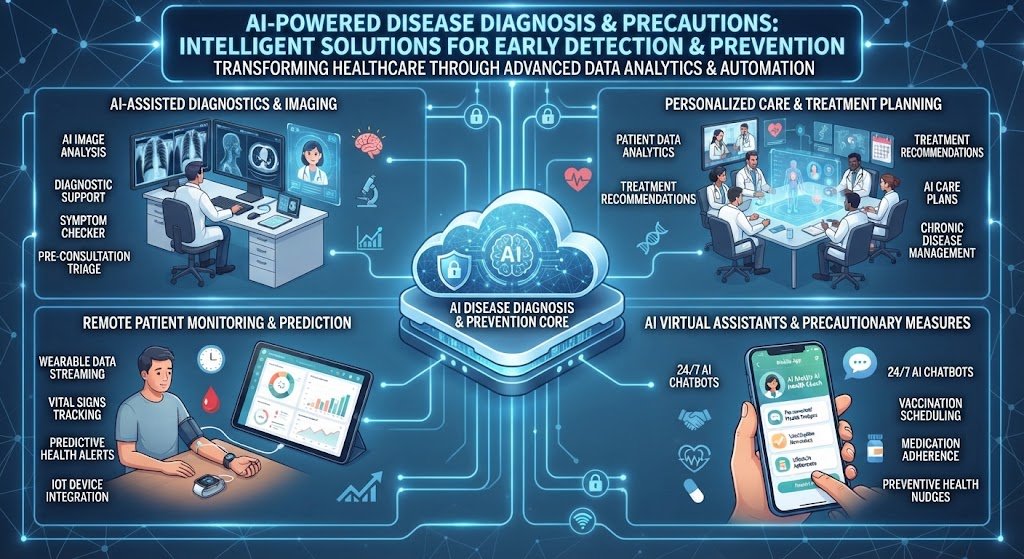
Primary topic: Artificial Intelligence in Disease Diagnosis & Precautions
Research focus: AI-assisted diagnosis, early disease detection, medical imaging, clinical decision support, predictive analytics, risk stratification, disease screening, preventive healthcare, computer vision, machine learning, generative AI, multimodal AI, clinical workflow automation, and responsible healthcare AI.
AI in Disease Diagnosis: From Detection to Prevention
Artificial intelligence is becoming an important component of modern healthcare because medicine generates large amounts of information that can be difficult to interpret consistently and quickly. Medical images, ECG recordings, laboratory results, pathology slides, clinical notes, medication histories, wearable-device measurements, and patient-reported symptoms can all contain signals related to disease.
Traditional diagnosis depends heavily on clinical expertise and established diagnostic pathways. AI does not remove that process, but it can add another analytical layer that helps healthcare professionals identify patterns that may otherwise take more time to recognize.
The difference is particularly important in diseases where early detection can change the available treatment options or reduce the risk of complications. AI can screen large numbers of images, identify patients who may require additional testing, estimate risk, and support clinicians during time-sensitive decisions.
The technology is already appearing in regulated medical products. The U.S. Food and Drug Administration maintains a list of AI-enabled medical devices that have received marketing authorization and notes that the listed devices have met applicable premarket requirements. The FDA also describes AI applications across image processing, early disease detection, diagnosis, prognosis, risk assessment, and personalized diagnostics.
Source: FDA AI-Enabled Medical Devices
The most important shift is that AI is moving from a laboratory concept toward real clinical workflows. However, the evidence also shows that an AI model can perform differently when it encounters new populations, new equipment, poor-quality images, or clinical situations that were not adequately represented in its development data.
This makes validation as important as model accuracy.
What AI Actually Does in Disease Diagnosis
AI can support several different stages of the diagnostic journey. It can detect abnormalities, classify findings, estimate risk, compare current information with previous records, prioritize patients, summarize evidence, and help clinicians decide which cases require closer attention.
Different AI technologies are appropriate for different tasks. Computer vision is particularly useful for medical images, while machine learning can identify patterns in structured clinical data. Generative AI is more useful for language-heavy activities such as clinical summaries and documentation, while multimodal AI can combine several forms of information.
Find abnormal patterns in images, signals, records, or measurements.
Group findings into diagnostic or risk categories.
Estimate future disease risk or likely clinical outcomes.
Help teams identify cases that may require faster review.
Provide information that clinicians can consider alongside other evidence.
A mature healthcare AI workflow therefore looks more like a decision-support system than an automated diagnosis machine.
Our Key Research Findings
AI is strongest when the clinical problem is clearly defined
Disease diagnosis is a broad concept, but successful AI systems usually solve a much narrower problem. Instead of attempting to diagnose every possible disease, a system may be designed to identify suspected stroke on a specific imaging modality, detect referable diabetic retinopathy from retinal photographs, or identify polyps during colonoscopy.
This focused approach makes it easier to define the required data, establish a reference standard, measure performance, and determine what the clinician should do with the output.
AI can improve diagnostic sensitivity, but false positives remain important
A system designed to find more disease may also flag more healthy cases. This trade-off is visible in multiple research areas.
For example, AI-assisted dental research has demonstrated improved detection of some carious lesions while also increasing false-positive findings. In disease screening, a false positive can create unnecessary testing, anxiety, cost, and clinical workload.
The goal should therefore not be maximum sensitivity at any cost. The correct balance depends on the disease, the consequences of missing it, the consequences of additional testing, and the intended clinical use.
AI can help clinicians rather than simply compete with them
Several studies demonstrate that AI assistance can improve human performance.
The value comes from combining computational pattern recognition with clinical reasoning, patient history, physical examination, and professional judgment.
This human-AI model is especially important when a disease diagnosis requires information that is not visible in a single image.
External validation is essential
A major issue in healthcare AI is the difference between internal testing and real-world performance.
A model may perform extremely well on data collected from the same hospital or research dataset used during development. Its performance can fall when the same model is used in another hospital, another country, another demographic group, or with a different imaging device.
Research in stroke, dermatology, diabetic retinopathy, and other fields repeatedly highlights this issue.
Image quality can become a hidden diagnostic problem
AI cannot reliably interpret information that is not captured properly.
A blurred retinal photograph, poorly positioned skin image, low-quality chest X-ray, or incomplete scan can create an unreliable output.
Image-quality assessment should therefore be considered a core component of many Computer Vision Development projects.
AI can support precautions by identifying risk before disease becomes severe
Diagnosis and prevention are increasingly connected.
Instead of waiting for a disease to become clinically obvious, AI can analyze risk factors and historical data to identify patients who may benefit from screening, monitoring, lifestyle intervention, or additional clinical evaluation.
This is especially relevant to chronic diseases and conditions where early intervention can influence outcomes.
Research Evidence: AI for Disease Detection and Prevention
AI and Ischemic Stroke Detection
Stroke is one of the clearest examples of why diagnostic speed matters. Acute stroke evaluation often depends on rapid imaging, and delays can affect treatment decisions.
A 2025 systematic review and meta-analysis evaluated AI for ischemic stroke detection on non-contrast CT. The review included 38 studies and extracted 74 trials from 32 studies.
The pooled sensitivity and specificity for AI during internal validation were 91.2% and 96.0%, respectively. However, external validation produced a much lower pooled sensitivity of 59.8%, while specificity remained high at 97.3%.
This difference is extremely important.
It shows that a model can appear highly accurate during controlled validation but perform less consistently when evaluated on external data. The study also found that 58% of the included studies were judged to have a high risk of bias.
Clinicians receiving AI assistance showed improved pooled sensitivity and specificity compared with unaided clinicians, reaching 83.7% and 86.7% in the analyzed evidence.
The practical lesson is that AI may be valuable as a rapid second layer of analysis, but healthcare organizations should not interpret benchmark accuracy as a guarantee of real-world performance.
Source: PubMed: Artificial Intelligence for Ischemic Stroke Detection in Non-contrast CT
AI and MRI-Based Stroke Detection
MRI provides another opportunity for AI-assisted stroke diagnosis.
A systematic review and meta-analysis of AI for ischemic stroke detection using MRI reported sensitivity and specificity of approximately 93% and 93% for the analyzed AI detection evidence.
The review also highlighted an important limitation: clinical usability still required further investigation, and evidence for hemorrhagic lesion detection was more limited.
This distinction matters because detecting a lesion in an image is not identical to improving patient outcomes.
A clinically useful system must fit into emergency workflows, produce understandable outputs, operate within acceptable time limits, and support appropriate clinical action.
Source: PubMed: Artificial intelligence for MRI stroke detection
AI for Emergency Stroke Imaging
A 2025 systematic review examined AI in emergency stroke imaging and assessed its role in detection, scoring, prognostication, and workflow implementation.
The growing use of AI in stroke imaging is connected to the time-sensitive nature of the disease. AI can potentially flag important findings and accelerate communication between imaging teams and clinicians.
The most useful implementation is not necessarily an autonomous diagnosis. It can be an alerting and prioritization layer that helps the right clinical team review a potentially important case sooner.
Source: PubMed: The Role of Artificial Intelligence in Stroke Imaging in Emergency Settings
AI for Diabetic Retinopathy Screening
Diabetic retinopathy provides a strong example of AI being used for screening rather than only diagnosis after symptoms appear.
A large prospective multicenter study conducted across 155 diabetes centers in China enrolled 47,269 patients.
The researchers evaluated a deep-learning system for diabetic retinopathy classification using fundus photographs.
For detection of referable diabetic retinopathy, the system achieved 83.3% sensitivity and 92.5% specificity in the validation population.
The scale of this research is important because it demonstrates how AI can potentially support screening across large populations.
A conventional specialist-only screening pathway can be difficult to scale when the number of people requiring assessment is large. AI can act as a first screening layer, allowing specialists to concentrate on patients who require further evaluation.
Source: PubMed: Artificial intelligence-enabled screening for diabetic retinopathy
Prospective Data and Local Validation in Diabetic Retinopathy
More recent research shows why prospective data collection matters.
A 2026 study evaluated AI diabetic retinopathy screening using prospectively curated data in a resource-limited setting. The prospective dataset included 12,698 additional images from 3,096 patients.
For the model assessing vision-threatening diabetic retinopathy, prospective performance included an AUC of 0.949, with sensitivity in the range of 0.86 to 0.89 and specificity between 0.85 and 0.89.
The study emphasized that locally curated datasets aligned with regional populations, imaging equipment, and workflows can help produce more reliable systems.
This provides a practical roadmap for healthcare AI development.
Rather than assuming that a model trained somewhere else will automatically work everywhere, developers can build prospective validation around the population and equipment where the system will actually operate.
Source: PubMed: Prospective Data Curation Enables High-Performance AI for Diabetic Retinopathy Screening
AI-Assisted Skin Cancer Diagnosis
Dermatology has become a major field for computer vision because skin lesions can be photographed and analyzed digitally.
A randomized controlled trial evaluated whether AI assistance could improve the diagnostic accuracy of physicians assessing suspicious skin lesions.
The study compared AI-assisted and unaided physicians in a real-world tertiary-care setting.
The AI-assisted group achieved higher diagnostic accuracy than the unaided group. The research also showed that less-experienced physicians could benefit substantially from AI assistance.
However, the study also demonstrated a safety concern: incorrect AI recommendations could influence clinician decisions in the wrong direction.
This means that AI interfaces need to be designed carefully. Clinicians should understand that an AI output is evidence to consider rather than an unquestionable answer.
Source: PubMed: Evaluation of Artificial Intelligence-Assisted Diagnosis of Skin Neoplasms
AI in Real-World Dermatology
A real-world dermatology study further demonstrates the difference between controlled testing and practical deployment.
Researchers evaluated an AI-based smartphone application for skin cancer detection using 1,458 participants and 1,904 lesions of concern.
The study identified 185 skin cancers, including 32 melanomas.
One of the most important findings was related to image capture. Even under optimal conditions, image capture failed for 16.6% of lesions.
For successfully captured lesions, the AI system achieved 82.5% sensitivity and 76.8% specificity.
This research shows that a healthcare AI product needs more than a good classification model. It needs reliable image capture, quality assessment, user guidance, appropriate clinical escalation, and monitoring.
Source: PubMed: Prospective smartphone AI study for skin cancer detection
AI for Pneumonia Detection on Chest X-Rays
Chest X-rays are widely used to evaluate respiratory disease, but interpretation can be challenging and subject to variation.
A systematic review and meta-analysis of deep learning for pneumonia detection found pooled sensitivity of 98% and specificity of 94% in the included research.
The results demonstrate the technical potential of deep learning for identifying pneumonia patterns.
However, the researchers also identified methodological concerns that must be addressed before translating such systems directly into routine clinical practice.
This distinction should remain central to healthcare AI adoption.
High diagnostic performance in published datasets is encouraging, but it does not automatically establish clinical effectiveness for every hospital, patient population, or imaging workflow.
Source: PubMed: Accuracy of deep learning for automated detection of pneumonia
AI for Tuberculosis Screening
Tuberculosis demonstrates another important use of AI in disease precautions because screening can help identify patients who need further diagnostic evaluation.
A 2025 systematic review and meta-analysis evaluated AI software for tuberculosis detection using chest X-ray imaging.
The review included 21 references and examined five AI software solutions.
Reported sensitivity and specificity varied across systems. For example, qXR showed 90% sensitivity and 64% specificity, while CAD4TB showed 91% sensitivity and 60% specificity in the analysis.
The variation demonstrates why threshold selection is important.
A screening system may prioritize sensitivity when the cost of missing disease is high, while a different clinical environment may need a different balance to control unnecessary referrals.
AI screening should therefore be configured around the intended population, disease prevalence, available confirmatory testing, and clinical pathway.
Source: PubMed: AI software for tuberculosis diagnosis using chest X-ray imaging
AI and Colorectal Disease Prevention
Colonoscopy provides an especially interesting example because disease prevention can begin with identifying and removing precancerous lesions.
A 2024 systematic review and meta-analysis examined 28 randomized controlled trials involving 23,861 participants.
AI-assisted colonoscopy was associated with a 20% increase in adenoma detection rate and a 55% decrease in adenoma miss rate.
A more recent 2026 meta-analysis included 46 randomized controlled trials involving 37,206 participants. It found that AI-assisted colonoscopy significantly increased adenoma detection and reduced adenoma miss rates.
These findings demonstrate how AI can contribute to prevention indirectly.
The AI does not prevent colorectal cancer by itself. Instead, it can help clinicians detect lesions that may otherwise be missed, potentially improving the effectiveness of a screening procedure.
Source: PubMed: Use of artificial intelligence improves colonoscopy performance
Source: PubMed: The role of AI in adenoma detection during colonoscopy
AI for Cardiovascular Disease Diagnosis and Risk Detection
Cardiovascular disease creates another major opportunity because ECGs are widely available and generate structured physiological signals.
Traditional ECG interpretation depends on clinical expertise and can be affected by subtle findings, time pressure, and variability between readers.
Machine learning can analyze large numbers of ECG signals and identify patterns associated with cardiovascular disease or future risk.
A systematic review published in 2024 examined AI, machine learning, and deep learning approaches for ECG analysis and highlighted their potential for predictive diagnostics and treatment support.
More recent systematic research has expanded the scope toward cardiovascular risk prediction, including the possibility of extracting prognostic information from ECG signals that may not be obvious through conventional interpretation.
This creates an important preventive application.
Instead of using an ECG only to identify an existing abnormality, AI can potentially use the signal as one part of a broader risk-assessment workflow.
Source: PubMed: Systematic review on AI and electrocardiograms in cardiology
Source: PubMed: AI Applied to ECG-Based Cardiovascular Risk Assessment
How AI Supports Disease Precautions
Disease precautions should not be interpreted as a single technology. In healthcare, prevention can involve screening, risk identification, monitoring, early intervention, medication adherence, lifestyle support, and follow-up.
AI can contribute to these activities by identifying patterns in patient data.
For example, a predictive model can identify a patient with a higher probability of deterioration. A screening model can flag a retinal image for specialist review. A computer vision system can identify a suspicious lesion. A clinical decision-support system can highlight a combination of symptoms and risk factors that warrants further assessment.
The objective is to move healthcare from a purely reactive model toward earlier identification of potential problems.
Identify people who may need further evaluation.
Estimate the likelihood of future disease or deterioration.
Track changes over time and identify concerning trends.
Route higher-risk patients toward appropriate clinical review.
Major AI Use Cases in Disease Diagnosis
Medical Image Analysis
Computer vision is one of the most mature AI capabilities in medical diagnosis.
It can be used for radiographs, CT scans, MRI, ultrasound, retinal photographs, pathology slides, dermatology images, dental images, and other validated image types.
Common functions include:
- Abnormality detection.
- Lesion classification.
- Image segmentation.
- Organ measurement.
- Risk scoring.
- Image-quality assessment.
- Comparison with previous studies.
- Case prioritization.
The strongest implementations connect image analysis to a clinical action.
Clinical Decision Support
AI can summarize patient information and highlight patterns that may deserve clinical attention.
A clinician may need to review symptoms, medications, previous diagnoses, laboratory findings, imaging reports, and other records before making a decision.
AI can organize this information into a structured view.
This can reduce the time required to locate relevant information, but the system should clearly distinguish source data from generated interpretation.
Differential Diagnosis Support
AI can potentially generate or rank possible diagnostic considerations based on symptoms and available clinical information.
This can be useful when several conditions produce similar presentations.
The output should remain a decision-support aid because a differential diagnosis requires clinical context, examination, testing, and professional judgment.
Predictive Analytics
Machine learning can analyze historical patient information to estimate future risk.
Possible applications include:
- Risk of hospitalization.
- Risk of disease progression.
- Risk of cardiovascular events.
- Risk of clinical deterioration.
- Risk of treatment failure.
- Risk of missed follow-up.
- Risk of complications.
- Screening prioritization.
Predictive models become more useful when the predicted risk is connected to a predefined response.
Clinical Documentation
Generative AI can help clinicians prepare draft notes, summarize medical records, organize patient histories, and structure documentation.
This can indirectly improve diagnostic workflows because clinicians may spend less time on repetitive administrative tasks.
The generated documentation should be reviewed before becoming part of the official medical record.
Patient Symptom Intake
AI can collect information before a consultation.
It can organize symptoms, duration, previous diagnoses, medications, and relevant history.
The information can then be presented to the healthcare professional in a structured format.
This can improve the efficiency of the consultation without turning the intake tool into an autonomous diagnostic system.
AI Diagnostic Capability Matrix
| Capability | Typical Data | Diagnostic Role | Potential Value |
|---|---|---|---|
| Computer Vision | X-ray, CT, MRI, photographs | Detection and classification | Faster image review |
| Machine Learning | Clinical and physiological data | Risk prediction | Earlier intervention |
| Generative AI | Clinical text and records | Information organization | Lower documentation burden |
| Multimodal AI | Images, text, signals, records | Combined clinical reasoning support | Richer patient context |
| Predictive Analytics | Longitudinal patient data | Future risk estimation | Proactive care |
Where Disease-Diagnosis AI Creates the Greatest Value
The strongest opportunities usually occur when five conditions exist at the same time: there is a large volume of relevant data, the clinical task is clearly defined, the outcome can be measured, the current workflow has meaningful limitations, and an appropriate professional can review the AI output.
This explains why medical imaging has become such an active area.
Images are naturally suited to computer vision, and many diagnostic tasks already have established reference standards.
Screening is another strong area because AI can process large populations faster than specialist capacity can scale.
However, the system should be designed around the entire screening pathway rather than the algorithm alone.
Large numbers of images, records, or signals.
A specific diagnostic or screening objective.
Performance can be evaluated objectively.
A trained professional remains responsible for care.
AI and Personalized Disease Risk
Personalized medicine is another major direction for healthcare AI.
Patients with the same diagnosis may have very different risk profiles. Age, medical history, genetics, medications, lifestyle, previous treatment response, laboratory findings, and physiological measurements can all influence disease progression.
Machine learning can identify combinations of variables that are difficult to evaluate manually at scale.
A future clinical risk platform could combine longitudinal information and produce a continuously updated risk profile.
For example, rather than evaluating a patient’s risk only during an annual visit, a system could continuously analyze new information and notify the care team when predefined risk thresholds are reached.
This concept is particularly relevant to chronic diseases.
AI and Multimodal Disease Diagnosis
Many diseases cannot be reliably understood through one data source.
A doctor may combine an image with symptoms, laboratory findings, age, medical history, medications, and physical examination results.
Multimodal AI is designed to work across multiple information types.
The WHO’s guidance on large multimodal models recognizes the potential for these systems across healthcare, research, public health, and drug development while emphasizing the need for appropriate governance and responsible implementation.
Source: WHO Guidance on Large Multimodal Models
The future opportunity is therefore broader than image recognition.
A multimodal system could potentially connect medical images with structured patient information and clinical text, producing a more complete decision-support view.
However, combining more data also creates more opportunities for errors.
A multimodal system must therefore identify where each conclusion came from and avoid presenting generated interpretations as established clinical facts.
AI Workflow Automation Around Diagnosis
Diagnosis creates many administrative activities before and after the clinical decision.
AI can help automate these supporting processes.
Useful workflows include:
- Collecting patient information before appointments.
- Preparing structured clinical summaries.
- Organizing diagnostic test results.
- Identifying missing information.
- Prioritizing cases for review.
- Preparing referral summaries.
- Generating patient-friendly explanations.
- Creating follow-up reminders.
- Tracking diagnostic turnaround times.
- Identifying patients who have not completed recommended follow-up.
- Monitoring workflow bottlenecks.
- Generating operational analytics for healthcare managers.
These applications may have lower clinical risk than autonomous diagnosis and can therefore provide a practical starting point for healthcare organizations beginning their AI journey.
AI for Early Warning and Disease Prevention
Early warning systems are designed to identify deterioration or risk before a serious event becomes obvious.
Machine learning can analyze combinations of vital signs, laboratory results, clinical observations, and historical information.
The purpose is to identify patients who may need closer monitoring.
This approach can be useful in hospitals, emergency departments, outpatient care, chronic disease management, and remote monitoring.
The quality of an early-warning system depends heavily on how the alert is handled.
An alert that produces no useful action can increase alarm fatigue.
An alert that is too sensitive can overwhelm clinical teams.
The most effective systems should therefore define clear thresholds and escalation pathways.
Major Risks and Limitations
AI disease diagnosis has significant potential, but healthcare organizations should understand its limitations before deployment.
- Dataset bias: A model may perform differently across populations that were not adequately represented during training.
- Data shift: Clinical environments, equipment, patient characteristics, and disease prevalence can change over time.
- False negatives: A missed disease signal can delay diagnosis or treatment.
- False positives: Incorrect alerts can increase testing, cost, anxiety, and clinical workload.
- Automation bias: Clinicians may place excessive confidence in an AI recommendation.
- Generative AI errors: Language models can produce plausible but incorrect clinical information.
- Image-quality problems: Poor input data can reduce the reliability of computer-vision systems.
- Model drift: Performance can change after deployment as populations, equipment, and workflows change.
- Privacy risks: Medical information requires strong security and appropriate data governance.
- Cybersecurity: AI systems become another component of the healthcare technology environment that must be protected.
- Explainability: Clinicians may need understandable information about why a system produced an alert.
- Workflow disruption: A technically strong model can fail if it creates unnecessary steps for clinicians.
Research-to-Workflow Visual Model
Evidence and validation
Relevant clinical information
AI analysis
Professional assessment
Clinical or preventive response
Real-world performance
Regulatory and Governance Considerations
Healthcare AI requires stronger governance than ordinary consumer software because errors can directly affect patient care.
The FDA maintains an AI-enabled medical device list and states that listed devices have met applicable premarket requirements. The agency also emphasizes research around AI and machine-learning medical devices, including safety, effectiveness, and real-world performance.
Source: FDA Artificial Intelligence-Enabled Medical Devices
The WHO recommends placing ethics and human rights at the center of AI design, deployment, and use.
Its guidance highlights principles including human autonomy, safety, transparency, accountability, inclusiveness, equity, and sustainability.
Source: WHO Ethics and Governance of Artificial Intelligence for Health
Healthcare organizations should establish governance before scaling AI across multiple diagnostic workflows.
Important governance areas include:
- Approved clinical use cases.
- Data access and privacy controls.
- Model validation requirements.
- Human review requirements.
- Performance thresholds.
- Incident reporting.
- Audit logs.
- Cybersecurity controls.
- Model update procedures.
- Post-deployment monitoring.
- Patient communication.
- Vendor responsibility.
How Healthcare Organizations Should Evaluate AI
Healthcare organizations should avoid evaluating AI using a single accuracy number.
A better evaluation examines the complete clinical pathway.
| Evaluation Area | Important Questions | Example Metrics |
|---|---|---|
| Clinical | Does the system improve the intended clinical task? | Sensitivity, specificity, AUC, missed findings |
| Safety | What happens when the model is wrong? | False positives, false negatives, incidents |
| Workflow | Does AI improve or disrupt clinical work? | Time saved, turnaround time, adoption |
| Equity | Does performance remain reliable across relevant groups? | Subgroup performance |
| Technical | Does the system remain reliable in production? | Uptime, latency, drift, error rate |
| Financial | Does the solution create measurable value? | Cost per case, productivity, ROI |
Five-Stage AI Adoption Framework for Disease Diagnosis
Identify the clinical problem
The first step is to identify a specific diagnostic or preventive problem.
The organization should understand where delays, missed findings, repetitive work, or limited specialist capacity currently exist.
Validate the available data
The next step is to determine whether sufficient high-quality data exists.
The data should represent the intended population, equipment, clinical environment, and use case.
Test the model clinically
Technical validation should be followed by appropriate clinical evaluation.
External validation and prospective testing can provide more meaningful evidence than relying exclusively on retrospective internal datasets.
Integrate AI into the workflow
The AI system should connect with existing clinical software wherever practical.
Relevant systems may include EHRs, imaging platforms, laboratory systems, scheduling platforms, referral systems, and patient portals.
Monitor continuously
Deployment is not the end of AI evaluation.
Healthcare organizations should continue monitoring performance, user behavior, data quality, false alerts, unexpected failures, and changes in patient populations.
Future Predictions for AI in Disease Diagnosis
Multimodal diagnosis will become more important
Future AI systems are likely to combine medical images, laboratory data, clinical notes, physiological signals, and patient history.
This can provide a broader clinical context than image-only systems.
AI will increasingly focus on early disease detection
The next stage of healthcare AI will not be limited to identifying existing disease.
Models will increasingly support risk prediction and earlier intervention.
This could move healthcare toward more proactive monitoring, particularly for chronic and progressive diseases.
AI will become embedded in diagnostic equipment
Instead of requiring clinicians to open a separate AI application, AI functionality will increasingly appear directly inside imaging, monitoring, and diagnostic systems.
This can reduce workflow friction.
Real-time clinical alerts will expand
AI can continuously analyze incoming information and identify cases requiring attention.
The challenge will be preventing excessive alerts.
Systems that prioritize clinically meaningful signals will be more valuable than systems that simply generate large numbers of notifications.
Personalized screening will grow
Traditional screening programs often apply broad rules to large populations.
AI can potentially support more individualized risk assessment by combining patient-specific factors.
This may allow healthcare organizations to identify which patients need closer monitoring or earlier evaluation.
AI validation will become a competitive advantage
As healthcare organizations become more experienced with AI, marketing claims alone will become less persuasive.
Providers will increasingly ask for evidence about validation, intended use, limitations, population performance, safety, and post-deployment monitoring.
This means companies building healthcare AI should treat clinical evidence as part of the product rather than an optional marketing asset.
AI Opportunity Map for Disease Diagnosis & Precautions
| Healthcare Area | AI Opportunity | Technology | Potential Outcome |
|---|---|---|---|
| Radiology | Abnormality detection | Computer Vision | Faster prioritization |
| Neurology | Stroke detection and triage | Computer Vision + ML | Faster emergency review |
| Ophthalmology | Retinal disease screening | Computer Vision | Expanded screening capacity |
| Dermatology | Lesion assessment | Computer Vision + ML | Earlier review of suspicious lesions |
| Cardiology | ECG analysis and risk prediction | Machine Learning | Risk identification |
| Gastroenterology | Polyp detection | Computer Vision | Improved lesion detection |
| Respiratory Care | Pneumonia and TB screening | Computer Vision | Screening support |
| Primary Care | Risk stratification | Machine Learning | Earlier preventive intervention |
What This Means for Healthcare Startups
Healthcare startups have an opportunity to build focused AI products around specific diagnostic and preventive workflows.
The strongest product ideas do not necessarily require a completely new foundation model.
A startup can combine existing AI capabilities with healthcare-specific datasets, workflow software, clinical interfaces, analytics, and integration infrastructure.
Potential product areas include:
- AI radiology decision support.
- Retinal screening platforms.
- Skin lesion assessment systems.
- AI-assisted ECG interpretation.
- Stroke imaging triage.
- AI-supported pathology analysis.
- Colonoscopy lesion detection.
- Population risk stratification.
- Preventive screening prioritization.
- Clinical documentation automation.
- AI-powered referral prioritization.
- Diagnostic follow-up tracking.
The product should begin with the clinical problem, not the AI technology.
A useful development pathway is:
This approach helps ensure that the AI solution produces measurable healthcare value.
What This Means for Hospitals and Healthcare Organizations
Hospitals and healthcare networks have a major advantage because they already generate clinical data and operate established diagnostic workflows.
Their biggest challenge is often integration.
An organization may have imaging software, EHR systems, laboratory platforms, patient portals, scheduling tools, and clinical communication systems.
AI should connect to these systems instead of creating another isolated application whenever possible.
A radiology AI system can return findings into an existing imaging workflow.
A risk model can feed a care-management dashboard.
A screening system can create a review queue.
A generative AI system can prepare a draft clinical summary.
A predictive model can trigger an approved follow-up workflow.
The objective is to make AI part of healthcare operations rather than creating another disconnected technology layer.
Measuring the Real Impact of AI
Healthcare leaders should measure more than model accuracy.
A model can be technically accurate but operationally useless if clinicians do not trust it, if alerts arrive too late, or if integration creates additional work.
Useful performance measurements include:
- Diagnostic sensitivity.
- Diagnostic specificity.
- Area under the ROC curve.
- Positive predictive value.
- Negative predictive value.
- False-positive rate.
- False-negative rate.
- Time to diagnosis.
- Time to clinical review.
- Screening throughput.
- Referral completion.
- Follow-up completion.
- Clinician adoption.
- Patient experience.
- Cost per screened patient.
- Cost per diagnostic encounter.
- Unexpected AI-related incidents.
The most meaningful measurement is whether the complete workflow produces better outcomes.
Final Research Assessment
The evidence reviewed across stroke, diabetic retinopathy, dermatology, pneumonia, tuberculosis, colorectal screening, and cardiovascular disease shows that AI has moved beyond theoretical discussion.
AI can already perform useful functions in selected diagnostic and screening workflows.
The strongest evidence is concentrated in focused applications where the data type and clinical task are clearly defined. Medical imaging is particularly suited to computer vision because large amounts of visual information can be analyzed consistently and rapidly.
Screening is another important opportunity because AI can help healthcare systems evaluate larger populations and prioritize patients for professional review.
Predictive analytics adds another layer by helping identify future risk rather than simply detecting current disease.
The most important limitation is that AI performance is not universal.
A model that performs well in one dataset may perform differently in another environment. External validation, prospective evaluation, population diversity, image quality, equipment differences, and workflow design all affect real-world performance.
For this reason, healthcare AI should be implemented as a controlled clinical capability rather than treated as an automatic replacement for professional diagnosis.
The future of AI in disease diagnosis will likely involve a combination of computer vision, machine learning, generative AI, multimodal models, predictive analytics, and workflow automation.
These technologies can work together to create a more proactive diagnostic environment.
The strongest healthcare organizations will not simply ask whether AI can diagnose a disease.
They will ask whether AI can help detect the disease earlier, identify the right patients, reduce diagnostic delays, support clinicians, improve screening capacity, and create a safer and more measurable care pathway.
Frequently Asked Questions
How is AI used in disease diagnosis?
AI can analyze medical images, ECGs, laboratory information, clinical records, symptoms, and other healthcare data to detect abnormalities, classify findings, estimate risk, prioritize cases, and support clinical decision-making.
Can AI diagnose diseases without a doctor?
Some AI-enabled medical technologies are designed for specific intended uses, including certain screening and diagnostic applications. However, whether autonomous use is appropriate depends on the technology, intended use, regulatory status, clinical evidence, and healthcare setting.
How does AI help with early disease detection?
AI can analyze screening images, physiological signals, and patient data to identify patterns associated with disease or elevated risk. This can help healthcare teams prioritize patients for further evaluation.
How can AI help prevent diseases?
AI can support prevention through risk prediction, screening prioritization, early warning systems, patient monitoring, follow-up management, and identification of patients who may benefit from preventive interventions.
What is the role of computer vision in disease diagnosis?
Computer vision allows AI systems to analyze visual information such as X-rays, CT scans, MRI images, retinal photographs, skin images, pathology slides, and other medical imagery.
What is machine learning used for in healthcare diagnosis?
Machine learning can be used for classification, prediction, risk stratification, outcome forecasting, anomaly detection, patient prioritization, and analysis of structured clinical information.
Can generative AI diagnose diseases?
Generative AI can assist with information organization, clinical summaries, documentation, and decision-support workflows. Its output should not automatically be treated as a confirmed diagnosis because generative models can produce incorrect or unsupported information.
Why is external validation important for healthcare AI?
External validation tests whether a model continues to perform reliably on data different from the data used during development. This can reveal problems caused by population differences, equipment differences, clinical workflows, or changes in disease prevalence.
What are the biggest risks of AI diagnosis?
Important risks include false positives, false negatives, biased datasets, poor-quality input data, automation bias, privacy problems, cybersecurity threats, model drift, inadequate validation, and unclear clinical responsibility.
Can AI detect cancer?
AI can assist with selected cancer detection and screening tasks. Research has demonstrated applications in skin cancer assessment, lung nodule detection, colorectal lesion detection, breast imaging, and other areas. Performance depends on the specific system and intended use.
How can AI help stroke diagnosis?
AI can analyze CT and MRI images to identify stroke-related findings, support lesion assessment, prioritize urgent cases, and provide decision-support information to clinicians.
How does AI help diabetic retinopathy screening?
AI can analyze retinal photographs and identify patterns associated with diabetic retinopathy. Large prospective research has demonstrated the potential of AI-enabled screening to support high-volume diabetic eye-care programs.
How can AI support preventive healthcare?
AI can analyze risk factors and longitudinal health information to identify patients who may require screening, monitoring, follow-up, or preventive intervention.
Is AI accurate enough for healthcare?
Some AI systems have demonstrated strong performance for specific clinical tasks, but accuracy varies significantly between applications. Healthcare organizations should evaluate clinical evidence, external validation, safety, workflow impact, and intended use rather than relying on a single accuracy claim.
Credible Research Sources and References
- FDA: FDA’s AI-Enabled Medical Device List provides information about AI-enabled medical devices authorized for marketing in the United States and describes the applicable regulatory review context. Source: FDA
- WHO: WHO guidance explains ethical and governance principles for AI in healthcare, including autonomy, safety, transparency, accountability, equity, and sustainability. Source: WHO
- Stroke AI: A 2025 systematic review and meta-analysis evaluated AI for ischemic stroke detection on non-contrast CT and compared AI performance with clinician performance. Source: PubMed
- Stroke MRI: A systematic review and meta-analysis evaluated AI for ischemic stroke detection using MRI and reported pooled diagnostic performance. Source: PubMed
- Emergency Stroke Imaging: A systematic review examined AI applications for emergency stroke imaging, including detection, triage, scoring, and prognostication. Source: PubMed
- Diabetic Retinopathy: A prospective multicenter study across 155 diabetes centers evaluated AI-enabled diabetic retinopathy screening in 47,269 patients. Source: PubMed
- Prospective Retinopathy Validation: A 2026 study evaluated prospectively curated data for AI diabetic retinopathy screening in a resource-limited setting. Source: PubMed
- Dermatology: A randomized controlled trial evaluated AI assistance for diagnosis of suspicious skin lesions and its effect on physician accuracy. Source: PubMed
- Real-World Dermatology: A prospective smartphone-based study evaluated AI-assisted skin cancer detection using 1,458 participants and 1,904 lesions. Source: PubMed
- Pneumonia: A systematic review and meta-analysis evaluated deep-learning performance for pneumonia detection using chest X-rays. Source: PubMed
- Tuberculosis: A systematic review and meta-analysis evaluated AI software for tuberculosis diagnosis using chest X-ray imaging. Source: PubMed
- Colonoscopy: A 2024 systematic review and meta-analysis of 28 randomized controlled trials evaluated AI-assisted colonoscopy and adenoma detection. Source: PubMed
- Colorectal Screening: A 2026 meta-analysis of randomized controlled trials evaluated AI-assisted adenoma and polyp detection during colonoscopy. Source: PubMed
- Cardiology: A systematic review evaluated the impact of AI, machine learning, and deep learning on ECG analysis for cardiovascular diagnosis and treatment support. Source: PubMed
- Cardiovascular Risk: A 2026 systematic review examined AI applied to ECG-based cardiovascular risk assessment and prediction. Source: PubMed
- WHO Multimodal AI: WHO guidance examines large multimodal models and their potential applications and governance requirements in healthcare. Source: WHO

Leave a Reply