
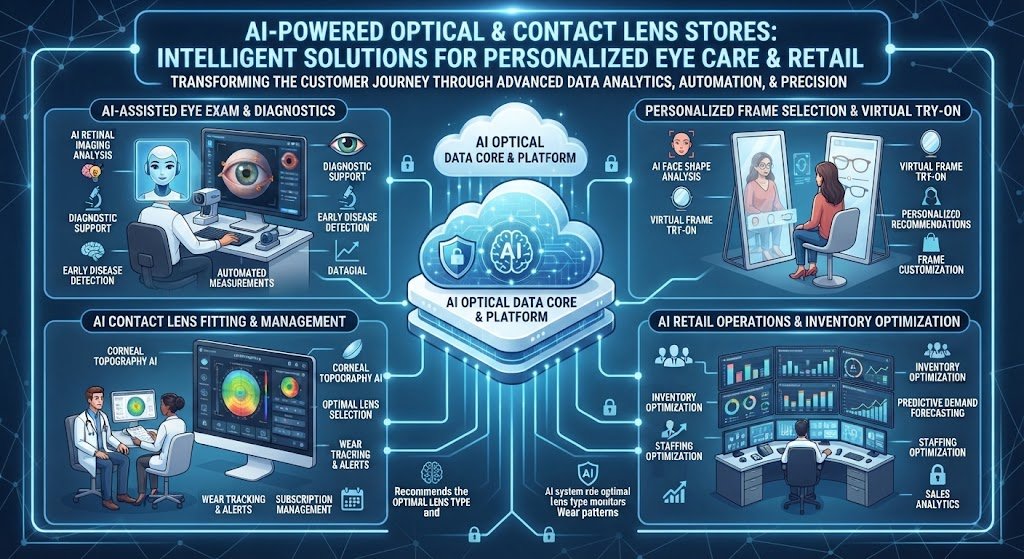
Primary topic: AI in Optical & Contact Lens Stores
Research focus: Artificial intelligence in optical retail, optometry workflows, contact lens fitting, spectacle recommendations, computer vision, corneal topography, myopia management, virtual try-on, inventory intelligence, customer personalization, workflow automation, predictive analytics, and AI-enabled vision care.
AI in Optical & Contact Lens Stores
Optical stores are changing from traditional product-focused retail environments into increasingly data-driven vision-care businesses. A modern optical business may handle prescriptions, frame measurements, lens specifications, contact lens parameters, customer preferences, digital photographs, purchase history, inventory data, appointment information, and communication records. This creates a large opportunity for artificial intelligence to assist both the clinical and commercial sides of the business.
AI can be particularly valuable because optical workflows combine structured data with visual information. A prescription contains numerical measurements, while frame selection depends heavily on face shape, proportions, style preferences, and product dimensions.
Contact lens fitting can require corneal measurements, topography, lens parameters, previous fitting history, and patient feedback. These different data types create opportunities for machine learning and computer vision systems that can support professionals while keeping final clinical decisions under appropriate human control.
Research in optometry is already expanding beyond disease diagnosis into refractive error, spectacle prescriptions, contact lenses, orthokeratology, corneal analysis, myopia management, and workflow support.
A 2025 review of AI in optometry examined 66 studies and found that image-based research commonly used convolutional neural networks and transfer learning, while clinical-data studies frequently used methods such as random forests, support vector machines, and XGBoost. The review also found important limitations in dataset size and validation, demonstrating that AI adoption needs to be based on evidence rather than marketing claims.
Source: Artificial Intelligence in Optometry: Current and Future Perspectives
Why Optical Stores Are a Strong Environment for AI
Optical businesses have a unique combination of clinical information, visual products, repeat customers, and measurable transactions. This means AI can potentially improve several connected parts of the customer journey instead of being limited to one isolated function.
A customer may enter an optical store with a prescription and a general preference for a certain style. The business can use AI to organize suitable frames, estimate which lens options may fit the prescription and lifestyle requirements, identify products currently in stock, and help staff explain the available choices. The professional still makes the final recommendation, but AI can reduce the amount of repetitive searching required.
The same principle applies to contact lenses. A fitting process may involve multiple parameters and iterative adjustments. AI can analyze historical fitting information and biometric measurements to suggest appropriate candidates for professional review. Recent research has demonstrated this potential particularly clearly in orthokeratology and rigid contact lens fitting.
Support prescription, fitting, screening, measurements, and clinical decision-making.
Analyze faces, frames, corneal maps, retinal images, and other visual information.
Improve recommendations, inventory planning, personalization, and customer experience.
Automate repetitive communication, scheduling, follow-up, and administrative work.
Research Evidence: AI for Contact Lens and Optical Workflows
The most important development for optical businesses is that research is beginning to address real fitting and measurement problems rather than focusing exclusively on theoretical AI applications. Several studies provide useful evidence for organizations considering AI-enabled contact lens and optical workflows.
AI-Assisted Orthokeratology Lens Fitting
A 2025 study published in Contact Lens and Anterior Eye evaluated an artificial intelligence-assisted method for orthokeratology lens fitting using corneal topography outcomes. The researchers retrospectively analyzed 797 eyes that had been successfully fitted with CRT lenses and used information including spherical refraction, keratometry, eccentricity, corneal astigmatism, horizontal visible iris diameter, and several corneal-surface indices.
The researchers compared AI-predicted lens parameters with the final ordered lens parameters. The comprehensive AI model showed strong correlations for several important parameters, including base curve radius, return zone depths, landing-zone angles, and total lens diameter. The correlation for base curve radius reached 0.958, while several other parameters also showed meaningful relationships with the final lens orders.
The study concluded that AI-predicted parameters showed less disparity and improved accuracy compared with the conventional method evaluated in the research. This is important for specialty contact lens businesses because fitting is often an iterative process that requires professional experience and careful interpretation of corneal data. AI could potentially reduce repetitive parameter-selection work and provide an additional decision-support layer. Source: AI-assisted fitting method using corneal topography for orthokeratology
Large-Scale Multimodal AI for Orthokeratology
A more recent study explored a multimodal, multitask AI model for orthokeratology contact lens fitting using data from 3,529 myopic eyes. The system combined corneal topography information with numerical clinical data and was designed to perform several related tasks, including lens-parameter recommendation, post-fitting topography classification, and prediction of axial-length growth.
The study reported topography classification accuracies of approximately 95% to 96% across the evaluated model architectures. Axial-growth prediction accuracy was approximately 88%. The model was also designed to rank potential lens candidates and estimate the probability of future axial growth.
This research is particularly relevant to optical businesses involved in myopia management because it illustrates a shift from simple product recommendation toward broader clinical decision support. Instead of asking only which lens might fit a particular cornea, future systems could potentially combine fitting information with longitudinal measurements and treatment-response information.
The study was retrospective, however, and its findings should be understood within the specific dataset and clinical environment used by the researchers. External validation remains important before such systems are treated as universally reliable.
Source: A Multimodal Multitask AI Model for Orthokeratology Contact Lens Fitting
AI for Rigid Contact Lens Fitting in Keratoconus
Another study examined artificial intelligence against conventional methods for rigid gas-permeable contact lens fitting in keratoconus. The research included 197 keratoconus eyes from 135 patients and evaluated machine-learning, multilayer-perceptron, and convolutional-neural-network approaches using corneal topography data.
The best-performing approach used an EfficientNetB0 convolutional neural network with three topographic maps and achieved an R² value of 0.80 for predicting the posterior curvature radius of the best-fitted rigid lens. Several other AI approaches also performed better than the reference method based on mean keratometry.
This finding matters because specialty lens fitting is one of the areas where optical expertise and complex biometric information intersect. Keratoconus fitting can require customized lens selection and repeated evaluation. AI may help transform topographic measurements into useful fitting suggestions, allowing the professional to focus more attention on patient evaluation and final clinical judgment.
The study also demonstrates why optical AI products should be developed around specific clinical tasks. A model trained specifically for corneal topography and rigid-lens fitting may provide more practical value than a generic AI system that simply claims to understand eye care.
Source: Artificial intelligence versus conventional methods for RGP lens fitting in keratoconus
Deep Learning for Corneal Topography
Research has also investigated deep learning for interpreting corneal topography. One study analyzed data from 1,302 myopic subjects and used neural-network methods to segment important regions of corneal topography.
The system achieved precision of 0.9587 and recall of 0.9459 for treatment-zone segmentation. For pupil segmentation, precision reached 0.9771 and recall reached 0.9712.
These results illustrate an important role for computer vision in optical workflows. Instead of treating a corneal map as a static image that must be interpreted manually from beginning to end, AI can identify relevant areas and calculate structured measurements that support professional interpretation.
Source: Evaluation of corneal topography based on deep learning
AI in Optical Frame Selection
Frame selection is one of the most visible areas where AI can transform optical retail. Traditional frame selection depends on the customer’s preferences, staff experience, facial proportions, current inventory, price range, brand preference, and intended use.
Computer vision can potentially analyze facial geometry and connect it with frame dimensions. A recommendation engine can then rank available products according to defined criteria.
A practical AI frame-recommendation system could consider:
- Face shape and facial proportions.
- Frame width and bridge dimensions.
- Lens height and usable optical area.
- Existing prescription requirements.
- Customer age group.
- Color and style preferences.
- Previous purchases.
- Current inventory.
- Price range.
- Frame material preferences.
- Work, driving, sports, or lifestyle requirements.
The strongest retail implementation would not simply show a visually attractive frame. It would connect the recommendation to actual stock and appropriate optical constraints.
For example, if a customer needs a particular lens thickness or has a high prescription, the recommendation engine could prioritize frames that are more suitable for those requirements while still considering appearance.
This turns AI from a simple shopping assistant into a product-selection system connected to the optical workflow.
Virtual Try-On and Computer Vision
Virtual try-on is another major AI opportunity for optical stores. A smartphone camera can capture the customer’s face while software overlays digital frames onto the image.
The experience becomes more useful when AI can accurately estimate facial landmarks, maintain frame alignment as the user moves, and account for proportions rather than simply placing a flat image over the face.
A more advanced virtual try-on platform could combine computer vision with recommendation algorithms.
The commercial value comes from reducing choice overload. An optical store may have hundreds or thousands of frames, but customers do not want to examine every product.
AI can narrow the selection before the customer spends time physically trying products.
This could be especially useful for online optical businesses, where customers cannot physically interact with frames before purchase.
AI in Lens Recommendation
Lens selection can be more complex than frame selection because the recommendation depends on prescription, visual requirements, occupation, lifestyle, age, previous lens experience, and other professional considerations.
AI can organize these variables and present structured options to staff.
Potential AI-supported lens recommendations include:
- Single-vision lens options.
- Progressive-lens product matching.
- Blue-light-related product information where appropriate.
- High-index lens options.
- Photochromic lens options.
- Occupational and computer-use lens categories.
- Sports and outdoor eyewear categories.
- Lens-coating recommendations based on predefined business rules.
- Previous-purchase analysis.
- Price-sensitive product ranking.
The AI system should operate within rules established by the optical business and qualified professionals. It should not invent optical specifications or make unsupported medical recommendations.
AI in Contact Lens Recommendation
Contact lens recommendation is one of the most promising areas because fitting involves measurable parameters and patient-specific feedback.
An AI system could analyze previous fitting attempts, corneal measurements, lens parameters, comfort feedback, visual acuity results, wearing time, and other available information to rank potential lens options for professional consideration.
Specialty lenses provide an even more interesting opportunity because fitting can be technically demanding.
These include:
- Rigid gas-permeable lenses.
- Scleral lenses.
- Orthokeratology lenses.
- Toric lenses.
- Multifocal contact lenses.
- Custom specialty designs.
- Keratoconus-related lens options.
Research already supports the feasibility of AI-assisted parameter prediction in orthokeratology and keratoconus fitting. The important next step is moving from isolated research models toward validated systems that integrate into real clinical workflows.
Source: Orthokeratology AI fitting research Source: AI-assisted RGP fitting research
AI in Myopia Management
Myopia management creates an important intersection between optical retail and long-term eye care. Optical businesses increasingly participate in the delivery and monitoring of interventions such as specialty spectacle lenses and orthokeratology.
AI can potentially support risk prediction, progression monitoring, treatment selection, and longitudinal analysis.
A 2026 study developed a Transformer-based model called the Myopia Progression Predictive Model. The model used 1,109,827 refractive records from 304,353 children and adolescents to predict future spherical equivalent and axial length. Internal testing reported R² values of 0.94 for spherical-equivalent prediction and 0.91 for axial-length prediction, with external validation producing comparable performance.
The study also developed a module designed to estimate progression under several interventions, including low-dose atropine, orthokeratology, peripheral-defocus spectacles, and repeated low-level red-light therapy.
This is a significant direction for AI because it moves beyond identifying current measurements toward forecasting possible future outcomes. For optical businesses involved in myopia management, such systems could eventually support more personalized monitoring conversations with qualified eye-care professionals.
Source: AI-guided personalized predictions on myopia progression and interventions
AI for Optical Store Customer Personalization
Retail AI does not have to be clinical to create meaningful value. Optical stores generate valuable customer-behavior data that can be used to improve personalization.
An AI recommendation engine can analyze previous purchases and identify patterns in product preferences.
For example, a customer who repeatedly purchases lightweight frames may receive recommendations that prioritize similar materials and designs. Another customer may consistently purchase premium lenses and could be shown products within the same category.
Useful personalization applications include:
- Personalized frame recommendations.
- Personalized lens-product suggestions.
- Customer-specific promotions.
- Reorder reminders for eligible products.
- Contact lens replacement reminders.
- Appointment reminders.
- Follow-up communication.
- Product recommendations based on previous purchases.
- Seasonal eyewear recommendations.
- Personalized educational content.
The objective should be relevance rather than excessive marketing. AI becomes valuable when it helps customers find appropriate products faster and helps staff understand customer needs before the consultation begins.
AI Inventory Management for Optical Stores
Inventory is a major operational challenge in optical retail. Stores must balance product variety against capital tied up in stock.
Some frames may sell quickly while others remain on shelves for long periods. Contact lenses also require careful inventory planning because different prescriptions and parameters create many possible combinations.
Predictive analytics can analyze historical sales, seasonality, location, customer demographics, supplier lead times, and current inventory.
A predictive system can estimate which products are likely to experience increased demand.
| Inventory Data | AI Analysis | Potential Action |
|---|---|---|
| Historical sales | Demand patterns | Adjust stock levels |
| Frame performance | Slow and fast movers | Optimize assortment |
| Seasonality | Future demand | Plan purchasing |
| Supplier lead time | Reorder timing | Reduce stockouts |
| Customer preferences | Product affinity | Improve product mix |
AI can therefore support the commercial side of an optical business while reducing unnecessary manual analysis.
AI for Contact Lens Demand Forecasting
Contact lens inventory creates a particularly interesting forecasting problem because demand can be fragmented across prescription parameters, brands, modalities, replacement schedules, and customer groups.
A machine-learning system could identify which products are likely to be reordered and when.
For example, historical transactions could help estimate expected replacement timing for eligible customers. The system could then alert staff when a customer is approaching a normal reorder period.
The workflow could combine inventory intelligence with customer communication.
This type of automation can help businesses improve retention while making inventory planning more predictable.
AI for Optical Customer Service
Generative AI can handle many repetitive customer-service questions before they reach staff. It can explain store policies, appointment procedures, product categories, order status, general lens-care information, and other approved information.
The system can also help staff draft responses.
Useful applications include:
- Appointment scheduling assistance.
- Order-status communication.
- Basic product information.
- Contact lens replacement reminders.
- Store policy questions.
- Returns and exchange information.
- General preparation instructions.
- Multilingual customer communication.
- Post-purchase follow-up.
- Frequently asked questions.
A strong implementation should use controlled information sources rather than allowing a general-purpose model to invent medical or product information.
AI for Optical Staff Assistance
AI can also work behind the counter rather than directly with customers. Staff members often spend time searching product catalogs, checking specifications, reviewing customer history, preparing messages, and handling repetitive administrative tasks.
An internal AI assistant could retrieve approved information from the business’s product catalog and customer-management system.
For example, an employee could ask the system to identify available frames that meet certain size and price criteria. The system could return matching inventory and product information without requiring the employee to manually search multiple systems.
The same assistant could summarize a customer’s previous purchases before a consultation, subject to appropriate access controls and privacy requirements.
AI in Optical Practice Documentation
Generative AI can reduce documentation workload by transforming structured inputs or clinician-approved conversations into draft documentation.
Potential uses include:
- Drafting examination summaries.
- Preparing structured consultation notes.
- Summarizing previous fitting attempts.
- Organizing patient history.
- Preparing referral information.
- Creating patient education drafts.
- Generating follow-up reminders.
The benefit is greatest when AI produces a draft that is easy for a qualified professional to verify and edit.
The system should preserve traceability so staff can understand which information came from the original record and which content was generated or transformed by AI.
AI and Optical E-Commerce
Online optical businesses can combine AI with digital commerce to create highly personalized shopping journeys.
A customer could upload a photograph, enter a prescription, describe preferred styles, and answer a few questions about their lifestyle. AI could then narrow the catalog to relevant products.
The experience could look like this:
↓
AI PRODUCT MATCHING
↓
FRAME + LENS OPTIONS
↓
VIRTUAL TRY-ON
↓
OPTICAL PROFESSIONAL REVIEW WHERE REQUIRED
↓
ORDER
↓
FOLLOW-UP
This model can reduce the number of products a customer needs to browse manually.
It can also create opportunities for businesses to understand which products perform well for different customer segments.
AI for Sales Forecasting and Business Intelligence
Optical businesses can use machine learning to identify patterns across sales and operations.
Important variables may include:
- Daily and weekly sales.
- Frame category performance.
- Lens category performance.
- Contact lens reorder rates.
- Average order value.
- Customer retention.
- Appointment conversion.
- Seasonal demand.
- Store-level performance.
- Supplier performance.
- Promotion performance.
- Product return patterns.
A dashboard can convert these signals into management insights.
For example, instead of simply reporting that sales decreased, AI could identify that a specific product category experienced declining demand while another category grew among a particular customer segment.
This makes AI more useful for business decisions because it moves from reporting what happened toward explaining patterns and estimating what may happen next.
AI Capability Map for Optical & Contact Lens Stores
| AI Capability | Optical Application | Primary Value | Human Role |
|---|---|---|---|
| Computer Vision | Face and frame analysis | Personalized selection | Confirm suitability |
| Machine Learning | Demand and customer prediction | Better forecasting | Business decision |
| Custom AI Models | Specialty lens fitting | Fitting support | Clinical validation |
| Generative AI | Customer and staff assistance | Lower admin workload | Review important outputs |
| Predictive Analytics | Inventory and demand | Stock optimization | Purchasing decisions |
| Workflow Automation | Reminders and follow-ups | Operational efficiency | Exception handling |
Research Findings and Practical Interpretation
The research reviewed in this report points toward a clear pattern. AI is technically capable of supporting several optical and contact-lens tasks, but the maturity of evidence varies significantly between applications.
The strongest evidence currently appears in specialized, measurable problems such as corneal-topography analysis and contact-lens parameter prediction. These tasks have structured inputs and defined outputs, which makes them easier to evaluate scientifically.
Retail personalization and virtual try-on have a different evidence structure. Their success is often measured through conversion, customer engagement, product discovery, or satisfaction rather than clinical sensitivity and specificity.
This distinction is important when evaluating AI products.
A system designed to recommend frames should not be evaluated using the same criteria as an AI system supporting contact-lens fitting.
Important Limitations in Current Optometry AI Research
A 2025 review of AI in optometry identified several limitations that should influence purchasing and development decisions. The researchers reviewed 66 articles and found that 28% of studies were trained on fewer than 500 samples, while 18% used fewer than 200 samples. More than half of the studies validated models using fewer than 500 samples, and 38% used fewer than 200 validation samples.
The review also reported that some studies used the same data for training and validation, creating a risk of overfitting. Importantly, 20% of the included studies reported accuracy below 80%.
These findings do not mean that AI is unsuitable for optical businesses. Instead, they show why businesses should evaluate the evidence behind an AI product instead of accepting a single accuracy figure.
A strong evaluation should consider:
- Size and diversity of the training dataset.
- Independent external validation.
- Performance across different devices.
- Performance across different patient populations.
- Image-quality limitations.
- False-positive and false-negative rates.
- Explainability of important outputs.
- Regulatory status when applicable.
- Real-world performance after deployment.
- Integration with existing clinical workflows.
Source: 2025 review of AI in optometry
AI Chatbots and Contact Lens Information
Generative AI creates a useful customer-service opportunity, but research also shows why medical information requires caution.
A 2024 study evaluated three open-access AI chatbots by asking them common questions about contact lenses in English and Spanish. The researchers found differences between systems and languages, and the study reported that chatbots did not always account for local contact-lens legislation.
The conclusion was that some AI chatbots may be useful for general contact-lens questions, but they cannot replace an eye-care professional.
For optical businesses, this suggests that customer-facing AI should be connected to approved information and carefully controlled.
An optical store chatbot can be useful for answering questions about store services, order status, appointment preparation, product availability, and general approved educational information.
It should not independently diagnose eye conditions, determine whether a patient can safely wear a lens, or override professional advice.
Source: AI chatbots and contact-lens information study
AI Governance for Optical Businesses
AI governance becomes especially important when optical stores combine retail data with healthcare information.
A business may hold prescriptions, patient histories, examination information, contact-lens parameters, photographs, and purchase records. These datasets require appropriate privacy and security controls.
An AI implementation should define which information can be processed, who can access it, where it is stored, and how long it is retained.
Businesses should also distinguish between low-risk retail AI and higher-risk clinical AI.
For example, recommending frame styles based on customer preferences is fundamentally different from predicting contact-lens parameters from corneal topography.
The risk profile, validation requirements, professional oversight, and regulatory considerations can therefore be very different.
The FDA maintains an AI-enabled medical-device list and provides guidance covering AI-enabled medical-device software and related lifecycle considerations. This is particularly relevant when an optical or contact-lens product moves beyond retail functionality into regulated medical-device territory.
Source: FDA AI-Enabled Medical Devices
AI Integration with Existing Optical Software
Most optical businesses already use multiple technology systems. These may include point-of-sale platforms, inventory management, appointment systems, practice-management software, electronic health records, lens catalogs, supplier systems, and e-commerce platforms.
The best AI strategy is usually not to replace every system.
Instead, AI can be added as an intelligence layer around existing infrastructure.
↓
INTEGRATION LAYER
↓
AI MODELS + COMPUTER VISION + ANALYTICS
↓
RECOMMENDATION OR INSIGHT
↓
OPTICAL PROFESSIONAL / STAFF REVIEW
↓
CUSTOMER OR BUSINESS ACTION
↓
OUTCOME DATA
This approach allows businesses to introduce AI incrementally.
An organization could begin with inventory forecasting, then introduce personalized product recommendations, followed by customer-service automation and eventually specialty contact-lens decision support.
AI Implementation Roadmap for Optical Stores
Start with the Business Problem
The first step should be identifying the workflow that creates the greatest measurable cost or friction. A store may have excessive time spent searching inventory, poor contact-lens reorder rates, long customer-service queues, or inconsistent product recommendations.
AI should be selected after the problem is defined.
Prepare the Data
AI quality depends heavily on data quality. Optical businesses should identify which data sources are available and determine whether the information is complete, accurate, standardized, and legally appropriate to use.
For clinical applications, data preparation should receive particular attention because errors in measurements or labels can affect model performance.
Choose the Appropriate AI Technology
Different problems require different technologies.
- Computer vision is appropriate for image and visual-analysis tasks.
- Machine learning is useful for prediction and classification.
- Generative AI is useful for language-heavy tasks.
- Predictive analytics is useful for forecasting demand and business outcomes.
- Custom AI models are useful when the problem requires specialty-specific behavior.
- Workflow automation is useful for repetitive operational tasks.
Run a Controlled Pilot
A pilot allows the organization to measure performance before broad deployment.
The pilot should establish a baseline and compare outcomes after AI is introduced.
Measure Real-World Results
The organization should track technical, clinical, operational, customer, and financial outcomes.
| Area | Useful Metrics |
|---|---|
| Clinical | Fitting accuracy, referral quality, missed findings, professional agreement |
| Customer | Conversion rate, satisfaction, repeat purchases, engagement |
| Operations | Staff time, response time, stockouts, workflow completion |
| Inventory | Inventory turnover, excess stock, stock availability, reorder accuracy |
| Financial | Revenue per customer, gross margin, AI cost, productivity, ROI |
Future Predictions for AI in Optical & Contact Lens Stores
AI Will Become Embedded in Optical Software
AI is likely to become less visible as a standalone tool and more integrated into existing optical applications. Staff may receive recommendations directly inside the systems they already use instead of opening separate AI platforms.
Virtual Try-On Will Become More Personalized
Future systems can combine facial analysis with product dimensions, customer preferences, purchase history, and inventory availability.
The result could be a highly personalized optical shopping experience that begins before the customer enters the store.
Specialty Lens Fitting Will Become More Data Driven
Research into orthokeratology and keratoconus already demonstrates the potential of machine learning and computer vision for lens-parameter prediction. Larger datasets and better external validation could make these systems increasingly practical.
Myopia Management Will Become More Predictive
AI models may increasingly combine refractive history, axial length, age, treatment information, and longitudinal measurements to estimate progression.
This could help professionals identify patients who require closer monitoring.
AI Will Connect Retail and Clinical Data
The separation between optical retail and clinical workflow may become less rigid.
A customer’s prescription, fitting history, product preferences, inventory information, and follow-up schedule could potentially be connected through a secure AI-enabled platform.
AI Agents Will Automate Multi-Step Tasks
Instead of automating one reminder or one customer-service message, future AI agents may coordinate complete workflows.
For example, an agent could identify customers approaching a routine reorder period, check eligible inventory, prepare a personalized message, place the task into a staff queue, and record the completed action after approval.
Evidence Will Become a Competitive Advantage
As more optical businesses adopt AI, the difference between a credible AI product and a marketing-driven product will increasingly depend on evidence.
Products supported by transparent validation, clear limitations, monitoring procedures, and appropriate professional oversight will have a stronger foundation for adoption.
AI Opportunity Matrix for Optical Businesses
| Opportunity | Technology | Maturity Potential | Business Value |
|---|---|---|---|
| Frame recommendations | Computer Vision + ML | High | Personalization and conversion |
| Virtual try-on | Computer Vision | High | Digital shopping experience |
| Inventory forecasting | Machine Learning | High | Lower excess stock |
| Contact-lens fitting | ML + Computer Vision | Emerging | Clinical workflow support |
| Myopia prediction | Machine Learning + Transformers | Emerging | Personalized monitoring |
| Customer service | Generative AI | High | Faster communication |
| Staff assistant | Generative AI + Retrieval | High | Lower search workload |
| Specialty lens prediction | Custom AI + Computer Vision | Emerging | Specialized fitting support |
Recommended AI Architecture for Optical Stores
A scalable AI architecture should separate customer-facing functionality, clinical data, AI models, business systems, and professional review.
Prescriptions, product catalogs, inventory, fitting records, customer preferences, measurements, and approved clinical information.
Computer vision, machine learning, recommendation engines, predictive analytics, and generative AI.
POS, inventory, EHR or practice systems, e-commerce, appointment systems, supplier systems, and customer platforms.
Staff dashboards, customer portals, virtual try-on, recommendations, alerts, reports, and communication tools.
The architecture should also include authentication, permissions, audit logging, monitoring, data protection, model-performance monitoring, and appropriate human-review controls.
What Optical Businesses Should Prioritize First
Not every AI project needs to begin with a complex clinical model. Businesses can often achieve useful results by starting with lower-risk operational and customer-experience applications.
A practical starting point could include:
- AI-powered customer support.
- Inventory demand forecasting.
- Personalized frame recommendations.
- Virtual try-on.
- Contact-lens reorder reminders.
- Staff knowledge assistants.
- Sales and customer analytics.
- Automated follow-up workflows.
After the organization develops experience with AI governance and integration, more specialized applications can be evaluated.
These could include corneal-topography analysis, specialty contact-lens fitting support, myopia progression prediction, and other clinical decision-support capabilities.
This staged approach reduces implementation risk while allowing the business to learn how customers and staff respond to AI.
What AI Developers Should Build for the Optical Industry
The strongest opportunities for AI developers are likely to come from specialized products rather than generic healthcare chatbots.
A useful optical AI platform could combine several capabilities into one workflow.
For example, computer vision could analyze a customer’s face and recommend frames. A recommendation engine could filter the available inventory. Generative AI could explain product differences in simple language. Predictive analytics could identify the likelihood of purchase. Workflow automation could then handle follow-up communication.
A specialty contact-lens platform could use corneal topography and clinical measurements to generate candidate parameters for professional review.
A myopia-management platform could combine longitudinal measurements with predictive models and create structured monitoring reports.
These products have a stronger value proposition because they solve defined workflow problems.
Five-Stage AI Adoption Framework
Identify
Select a specific workflow with a measurable problem. Avoid starting with the technology itself.
Prepare
Collect and standardize the data required for the AI application. Determine data quality, availability, privacy requirements, and access controls.
Validate
Test the system against appropriate benchmarks. For clinical applications, evaluate performance using clinically meaningful metrics and independent validation whenever possible.
Integrate
Connect the AI capability with existing optical software, inventory systems, clinical platforms, e-commerce tools, and customer workflows.
Measure and Improve
Monitor performance after deployment and evaluate whether the complete workflow creates measurable value. Update processes when evidence shows that changes are required.
Frequently Asked Questions
How is AI used in optical stores?
AI can support frame recommendations, virtual try-on, inventory forecasting, customer personalization, contact-lens workflows, staff assistance, customer communication, sales analytics, and selected clinical decision-support tasks.
Can AI recommend eyeglass frames?
Yes. Computer vision and recommendation algorithms can analyze facial characteristics and combine them with frame dimensions, customer preferences, and available inventory to rank suitable products.
Can AI help with contact lens fitting?
Research indicates that AI can support contact-lens parameter prediction using information such as corneal topography and clinical measurements. Studies have specifically investigated orthokeratology and rigid contact-lens fitting.
Can AI fit orthokeratology lenses?
AI can potentially assist with orthokeratology fitting by predicting lens parameters from corneal topography and other clinical measurements. Recent research has reported strong correlations between AI-predicted and final lens parameters, but professional evaluation remains important.
Can AI help with keratoconus contact lenses?
Research has investigated machine-learning and convolutional-neural-network approaches for predicting rigid contact-lens parameters in keratoconus. Some AI approaches performed better than conventional reference methods in the study population.
AI can analyze longitudinal refractive information and other measurements to estimate future myopia progression. A 2026 study developed a large-scale Transformer-based model for predicting refractive and axial-length progression and estimating intervention effects.
Can AI replace optometrists or optical professionals?
AI should generally be treated as an assistive technology. The appropriate role depends on the application, risk level, validation, regulation, and clinical workflow. Research on AI in optometry emphasizes the need for professional evaluation and careful appraisal of AI systems.
What is computer vision in optical retail?
Computer vision is an AI technology that processes visual information. In optical retail, it can support face analysis, virtual try-on, frame matching, corneal-image analysis, and other visual tasks.
What is generative AI useful for in optical stores?
Generative AI is especially useful for customer communication, staff assistance, product explanations, documentation drafts, FAQs, appointment communication, and other language-based workflows.
What is the biggest AI opportunity in optical retail?
The strongest opportunity depends on the business model. Retail-focused businesses may benefit most from personalization, virtual try-on, inventory intelligence, and customer automation, while specialty practices may gain more value from contact-lens fitting, corneal analysis, myopia management, and clinical decision support.
Why is AI data quality important in optometry?
AI performance can change when datasets are small, biased, poorly labeled, or collected under different conditions. A 2025 review found substantial variation in dataset sizes and validation practices across optometry AI research, making independent validation an important consideration.
Credible Research Sources and References
- Artificial Intelligence in Optometry: Current and Future Perspectives: A 2025 review of 66 studies covering AI applications in optometry, including contact lenses, spectacle prescriptions, screening, detection, prediction, and management. Source
- AI-Assisted Orthokeratology Fitting: Research using corneal topography and clinical parameters to predict orthokeratology lens parameters. Source
- Multimodal AI for Orthokeratology: Research using 3,529 myopic eyes to develop a multimodal model for lens-parameter recommendation, topography classification, and axial-growth prediction. Source
- AI Versus Conventional RGP Fitting in Keratoconus: Research comparing machine-learning and CNN approaches with conventional fitting methods using corneal topography. Source
- Deep Learning for Corneal Topography: Research evaluating neural-network segmentation and interpretation of corneal topography in myopic subjects. Source
- AI-Guided Myopia Progression Prediction: A 2026 study developing a Transformer-based model using more than one million refractive records for personalized prediction of myopia progression and intervention effects. Source
- Artificial Intelligence-Aided Diagnosis and Treatment in Optometry: Review covering AI applications in myopia, strabismus, amblyopia, optical glasses, contact lenses, and related optometric workflows. Source
- AI Appraisal Guide for Optometrists: Review discussing clinical use, regulatory considerations, limitations, explainability, and evaluation of AI systems in optometry. Source
- AI Chatbots and Contact Lens Information: Research evaluating chatbot accuracy for common contact-lens questions and identifying differences by language and system. Source
- AI in Retinal OCT: Review explaining how AI is applied to OCT imaging for screening, diagnosis, management, and prognosis. Source
- FDA AI-Enabled Medical Devices: FDA resource covering authorized AI-enabled medical devices and regulatory considerations for safe and effective deployment. Source
- FDA Digital Health Guidance: FDA guidance resources covering clinical decision-support software, AI-enabled device software, lifecycle management, and related digital-health topics. Source
Final Perspective
AI is likely to become an important technology across optical retail, optometry, and contact-lens businesses because these environments combine visual information, structured measurements, repeat customer interactions, specialized products, and increasingly digital workflows.
The most practical opportunity is not to automate every part of the optical experience. It is to identify the tasks where AI can reliably reduce repetitive work, improve product discovery, organize complex information, or provide additional decision support.
Retail businesses can begin with virtual try-on, personalized frame recommendations, inventory forecasting, customer communication, and staff assistants. Specialty contact-lens businesses can explore more advanced applications involving corneal topography, parameter prediction, orthokeratology, keratoconus fitting, and longitudinal myopia management.
The research base is encouraging, but it also provides an important warning. AI performance depends on the quality and diversity of data, validation methods, clinical environment, imaging equipment, and intended use. Strong results in one dataset do not automatically mean that a model will perform equally well in every optical store or patient population.
The most valuable future systems will therefore combine AI with reliable data, professional expertise, secure integration, transparent workflows, and continuous performance measurement.
Leave a Reply