
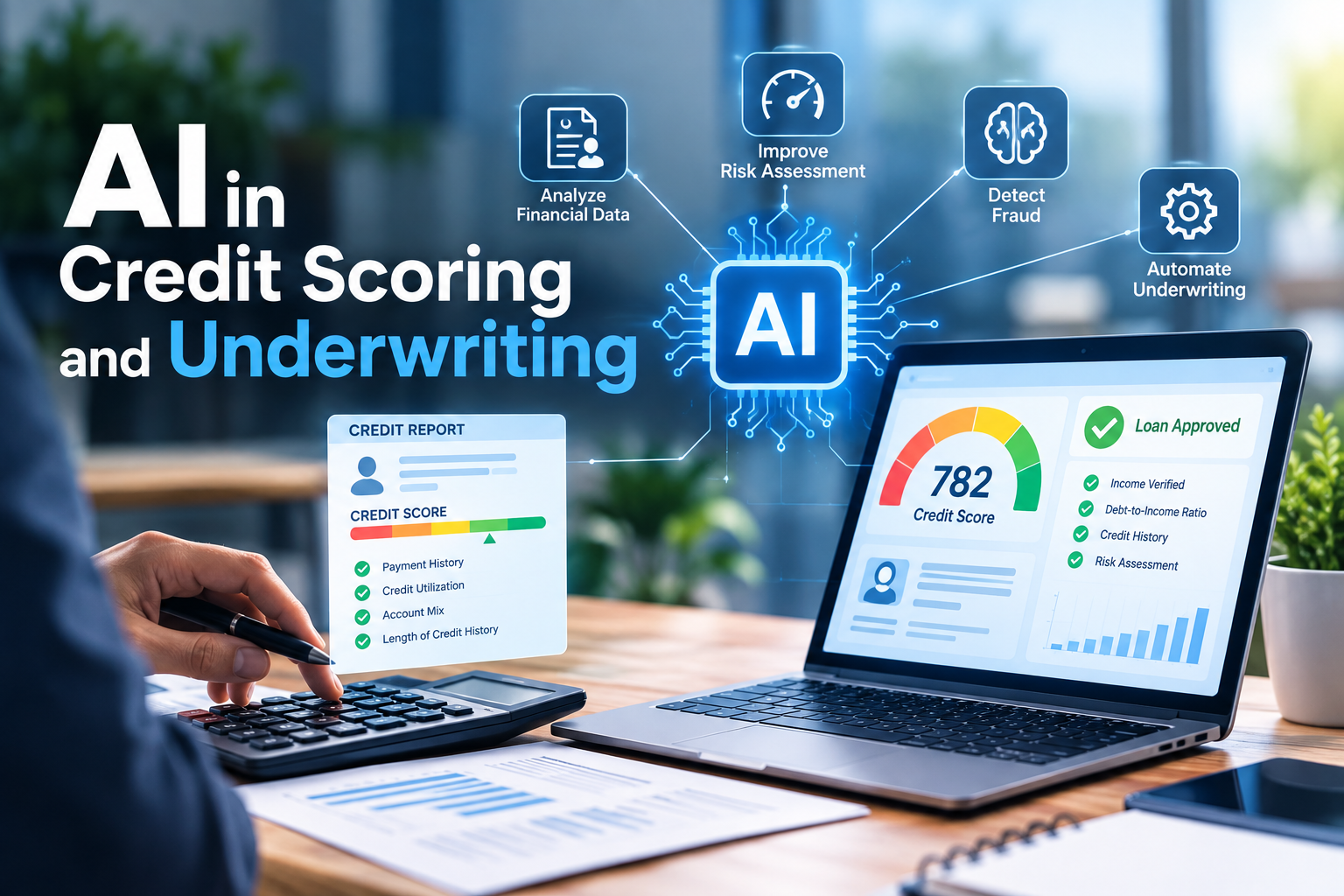
Primary topic: AI in Credit Scoring and Underwriting
Research focus: Machine learning credit scoring, AI underwriting, alternative data, risk prediction, default prediction, financial inclusion, explainable AI, fairness, bias, automated lending, model risk management, human oversight, regulatory requirements, and the future of intelligent credit decisions.
What Is AI in Credit Scoring and Underwriting?
Credit scoring estimates how likely a borrower is to repay a loan. Underwriting is the broader process of evaluating an applicant, determining risk, deciding whether credit should be offered, and establishing appropriate terms.
Traditional lending models often rely on structured information such as credit history, income, debt, repayment records, loan-to-value ratios, and debt-to-income ratios.
AI can extend this process by analyzing much larger datasets and finding relationships that may not be obvious through conventional scoring methods.
The Bank for International Settlements reports that financial institutions are using AI for areas including credit scoring, while AI-based tools can incorporate alternative data such as bank-account transactions, rent, utility payments, telecommunications payments, education history, and other information.
Source: Bank for International Settlements, Annual Economic Report 2024
The difference is important because AI does not simply make the existing credit score faster. It can change the information used to understand credit risk.
Why AI Matters in Modern Lending
The traditional credit process works well when borrowers have reliable credit histories and standardized financial information.
The problem becomes more difficult when applicants have thin or incomplete credit files.
A person may have stable income and consistently pay rent and utility bills but have little traditional borrowing history. A small business may have strong cash flow but limited conventional financial history. A new immigrant may have a good repayment history in another country that is not fully represented in a local credit file.
AI can potentially identify useful signals in these situations.
A 2025 BIS paper examining AI adoption in credit scoring and relationship lending found that AI can process hard, codifiable information at scale while complementing traditional relationship-based information.
Source: BIS Working Paper 1244, Artificial Intelligence and Relationship Lending
Why lenders are exploring AI
Analyze structured and alternative information.
Identify complex borrower patterns.
Automate repetitive underwriting steps.
Evaluate some thin-file applicants more effectively.
Research Evidence on Machine Learning Credit Scoring
A systematic literature review published in Artificial Intelligence Review in 2025 synthesized research on machine-learning-powered financial credit scoring. The review examined the strengths and limitations of machine learning methods and highlighted recurring issues involving interpretability, bias, high-dimensional data, computational complexity, and implementation.
A separate systematic review published in February 2026 analyzed 43 peer-reviewed studies published between 2020 and 2025 specifically around performance, fairness, and explainability in AI-based credit scoring.
The review found that these three dimensions are frequently studied separately rather than being jointly optimized for real-world regulated deployment. It also identified explainability as an increasingly important research focus.
This matters because a model can be highly predictive but difficult to explain, or highly interpretable but less predictive. Production lending systems have to manage both the statistical and operational sides of the problem.
Traditional Credit Scoring vs AI Credit Scoring
| Area | Traditional approach | AI-assisted approach |
|---|---|---|
| Data | Mostly structured credit information | Structured + alternative + behavioral data |
| Scoring | Statistical scorecards | ML and advanced analytics |
| Risk analysis | Predefined variables | Complex patterns and interactions |
| Underwriting | More manual review | More automated workflows |
| Monitoring | Periodic reassessment | Potential for continuous monitoring |
| Explainability | Usually easier to describe | Requires dedicated explainability controls |
How AI Credit Scoring Works
An AI credit-scoring system is not simply a model that returns an approval or rejection.
A mature architecture usually contains multiple stages.
Application + financial information + consented data↓Data Layer
Credit history + income + cash flow + repayment behavior + approved alternative data↓
Feature Engineering
Debt ratios + payment patterns + cash-flow stability + behavioral indicators
↓
AI Risk Model
Probability of default + affordability + risk classification
↓
Decision Engine
Approve + refer + request information + decline
↓
Human Review
Exception handling + complex cases + quality control
↓
Monitoring
Performance + fairness + drift + complaints + portfolio outcomes
This layered design is important because the model itself is only one part of a credit decision.
AI for Probability of Default
One of the core objectives of credit scoring is estimating the probability that a borrower will default.
Traditional statistical models have been used for decades to estimate default risk.
Machine learning can model nonlinear relationships and interactions between variables.
Common approaches include:
- Logistic regression
- Decision trees
- Random forests
- Gradient boosting
- XGBoost-type models
- Support vector machines
- Neural networks
- Deep learning
The 2025 systematic review of machine-learning credit scoring research identifies these families of methods as important areas of research while also highlighting the trade-offs between predictive capability, computational complexity, interpretability, and deployment requirements.
Source: Systematic review of machine-learning-powered financial credit scoring
AI for Loan Underwriting
Underwriting includes much more than calculating a credit score.
A lender may need to assess:
- Identity
- Income
- Employment
- Debt obligations
- Cash flow
- Existing credit
- Collateral
- Loan purpose
- Affordability
- Repayment capacity
- Fraud indicators
AI can help automate parts of this process by extracting information from documents, validating data, calculating ratios, identifying inconsistencies, and routing applications according to risk.
This can reduce repetitive manual work while allowing underwriters to focus on cases that require deeper judgment.
AI-Powered Document Processing
Loan applications often contain documents such as:
- Bank statements
- Salary slips
- Tax documents
- Business financial statements
- Invoices
- Identity documents
- Property documents
- Employment records
Optical character recognition, natural language processing, computer vision, and document AI can extract relevant information from these documents.
For example, a system could identify monthly income, recurring liabilities, account balances, unusual cash deposits, and other underwriting variables.
The extracted information can then be checked against application data.
This creates a useful workflow:
AI and Alternative Data
Alternative data is one of the most important areas of AI-driven lending.
The BIS explains that AI-based credit assessment can incorporate information such as bank-account transactions, rental payments, utility payments, telecommunications payments, education history, and online activity.
The purpose is not simply to collect more information.
The objective is to find information that provides a useful and legally appropriate signal about repayment ability.
Examples include:
- Bank-account cash flow
- Rent payment history
- Utility payment history
- Telecommunications payment history
- Business transaction records
- Invoice payment patterns
- Recurring income stability
The BIS has reported that alternative data can improve credit assessment for borrowers who are underserved by traditional scoring systems, while its 2025 work on financial inclusion also describes cash-flow and bill-payment information as potential tools for evaluating borrowers with limited traditional histories.
Source: BIS, Expanding financial inclusion
Thin-File and No-File Borrowers
Traditional credit scores depend heavily on historical borrowing data.
That creates a challenge for:
- Young borrowers
- New-to-credit consumers
- New immigrants
- Some low-income consumers
- Small businesses
- Informal or irregular-income workers
AI can potentially evaluate other legitimate signals to create a more complete picture.
This does not mean every alternative signal should be used.
A responsible lender must establish whether the information is relevant, reliable, lawful, proportionate, and appropriate for the credit decision.
AI and Financial Inclusion
Financial inclusion is one of the potential benefits of AI-based underwriting.
The BIS has highlighted the possibility that AI and alternative data can help identify borrowers whose traditional credit scores provide an incomplete picture of their actual creditworthiness. It describes these borrowers as “invisible primes” when they may be higher-quality borrowers than their conventional scores suggest.
However, inclusion should be measured using real portfolio outcomes rather than assumed from model sophistication.
A lender should examine:
- Approval rates across customer segments
- Default rates across customer segments
- Pricing differences
- Adverse-action reasons
- Model error rates
- Access for thin-file borrowers
- Customer complaints
AI for Small Business Credit Scoring
Small businesses can be difficult to evaluate using conventional underwriting because financial histories may be limited or inconsistent.
AI can analyze business cash flow, transaction records, invoices, repayment behavior, and other business-level information.
The BIS has documented how big-tech lending models can use large quantities of transaction and business information, including sales volumes, seasonality, demand trends, and other business characteristics.
Source: BIS, Big tech in finance: opportunities and risks
A small-business AI underwriting system could therefore evaluate:
Sales volume and consistency
Incoming and outgoing patterns
Concentration and payment behavior
Business cycles and demand changes
AI for Mortgage Underwriting
Mortgage underwriting involves large amounts of financial and property information.
AI can assist with:
- Income verification
- Document extraction
- Debt analysis
- Affordability calculations
- Property information processing
- Application completeness checks
- Risk classification
- Exception routing
AI can also help identify missing information before an application reaches a human underwriter.
The objective should be to make the underwriting workflow more consistent and efficient without turning a complex lending decision into an unexplained automated output.
AI for Credit Card Underwriting
Credit card issuers already use data-driven risk models to manage approval and pricing.
The CFPB’s 2025 Consumer Credit Card Market Report discusses the growing use of alternative data and AI-enhanced underwriting, including bank-account cash-flow and bill-payment information, particularly in connection with consumers who have limited credit histories.
Source: CFPB, Consumer Credit Card Market Report 2025
AI applications can include:
- Application risk scoring
- Credit-limit decisions
- Risk-based pricing
- Line-increase decisions
- Early-warning monitoring
- Customer-level risk changes
AI for Personal Loans
Personal lending can benefit from automated data processing because many applications involve standardized information.
An AI underwriting workflow can combine:
Identity → income → existing obligations → transaction behavior → credit history → affordability → risk model → decision.
This can make the process faster, but the system still needs controls for incorrect information, data quality, fraud, model errors, and fairness.
AI for Consumer Credit Risk Monitoring
Credit risk does not stop after loan approval.
A borrower may experience changes in income, cash flow, debt, repayment behavior, or financial stress.
AI can monitor portfolio data to identify changes that may require attention.
Potential signals include:
- Repeated missed payments
- Increasing utilization
- Declining cash flow
- Unusual account activity
- Increasing debt obligations
- Changes in repayment patterns
This can support early-warning systems and portfolio management.
AI and Credit Risk Segmentation
AI can help lenders segment portfolios according to risk characteristics.
Instead of one broad category, the lender can identify groups with different behavioral patterns.
| Segment | Potential signal | Potential use |
|---|---|---|
| Stable | Consistent repayment and cash flow | Standard monitoring |
| Emerging risk | Recent behavioral deterioration | Early intervention |
| Thin file | Limited conventional history | Alternative-data review |
| High uncertainty | Conflicting or incomplete information | Human underwriting |
Explainable AI in Credit Decisions
Explainability is one of the biggest issues in AI credit scoring.
A lender cannot simply say:
“The model gave the applicant a low score.”
That does not explain the actual reason for the decision.
The CFPB has stated that creditors using complex algorithms must still provide specific and accurate reasons when taking adverse action. The fact that an algorithm is complicated or difficult to interpret does not remove this obligation.
Source: CFPB Circular 2022-03, Adverse Action Notification Requirements
Possible explanations might relate to:
- Insufficient verified income
- High existing debt obligations
- Recent repayment problems
- High utilization
- Insufficient credit history
- Cash-flow instability
The actual explanation must correspond to the factors genuinely used by the decision system.
SHAP, LIME and Other Explainability Methods
Techniques such as SHAP and LIME can help provide explanations for individual model predictions.
The 2025 systematic review of ML credit scoring discusses explainability methods as an important part of making complex models more understandable. It also notes that explainability methods themselves have limitations and should not automatically be treated as perfect representations of model reasoning.
A 2025 systematic review of model-agnostic explainable AI in finance similarly identifies transparency, trust, scalability, and regulatory compliance as major issues in financial AI.
Source: Artificial Intelligence Review, Model-agnostic explainable AI methods in finance
Fairness and Bias in AI Credit Scoring
AI does not automatically remove bias.
If historical data contains unequal outcomes or structural differences, a model can reproduce or amplify them.
Bias can enter through:
- Training data
- Missing data
- Proxy variables
- Historical lending patterns
- Sampling decisions
- Label definitions
- Feature engineering
- Model thresholds
- Deployment decisions
The 2026 systematic review of AI credit scoring specifically identifies fairness as one of the three central dimensions of responsible credit-scoring research alongside predictive performance and explainability.
Proxy Variables and Hidden Bias
A lender may exclude a protected characteristic from a model and still produce unequal outcomes if other variables act as proxies.
For example, geographic, behavioral, employment, or socioeconomic variables can sometimes correlate with protected characteristics.
This means fairness testing should not stop at checking whether protected attributes were directly included.
A responsible model-development process should examine:
Who is represented?
What signals are being used?
Who is approved or declined?
Who is misclassified?
Regulation and AI Credit Scoring
Credit scoring is a heavily regulated area because credit decisions affect access to financial resources.
In the European Union, AI systems intended to evaluate the creditworthiness of natural persons or establish their credit score are classified as high-risk under the AI Act, with an exception for certain financial-fraud detection systems.
The EU AI Act framework reflects concerns about discrimination and the potential impact of automated credit decisions on access to important services and financial resources.
Source: EUR-Lex, Regulation (EU) 2024/1689
The European Commission’s AI Act Service Desk provides examples including AI systems used for consumer lending and mortgages when they establish or support a natural person’s creditworthiness assessment.
Source: European Commission AI Act Service Desk, Essential Services
Model Risk Management for AI Lending
Credit models can fail even when the underlying technology works as designed.
A model may be trained on outdated data, applied to a different population, incorrectly implemented, or used outside its intended purpose.
U.S. banking regulators updated interagency model-risk guidance in April 2026. The revised guidance emphasizes a risk-based approach tailored to the institution’s model risk profile and usage.
Source: Federal Reserve, SR 26-2 Revised Guidance on Model Risk Management
The revised guidance supersedes the earlier SR 11-7 framework.
For AI underwriting, model governance should include:
- Model development documentation
- Independent validation
- Data-quality controls
- Performance monitoring
- Model limitations
- Change management
- Version control
- Human oversight
- Auditability
AI Model Validation in Credit Scoring
Validation should examine whether the model performs as expected before and after deployment.
Important evaluation areas include:
- Discrimination and ranking performance
- Calibration
- Default prediction
- Population stability
- Out-of-sample performance
- Stress performance
- Fairness metrics
- Explainability
- Data integrity
- Operational performance
The objective is not to prove that the model is permanently correct.
The objective is to understand where the model works, where it can fail, and how those failures will be detected.
Credit Model Drift
Borrower behavior changes over time.
Economic conditions also change.
A model trained during one economic period may behave differently during another.
For example:
- Interest rates can change.
- Unemployment can change.
- Household expenses can change.
- Business revenue can change.
- Consumer spending patterns can change.
- Default behavior can change.
This is why AI underwriting systems need continuous monitoring rather than a one-time validation exercise.
Credit AI lifecycle
Develop → Validate → Pilot → Deploy → Monitor → Detect drift → Revalidate → Update
Human-in-the-Loop Underwriting
Automation should not mean that every application receives a completely automated decision.
A practical lending architecture can divide applications into different workflows.
Automated processing when policy and model conditions are satisfied.
AI recommendation followed by review.
Human underwriting with AI decision support.
This structure allows automation where the process is standardized while preserving human judgment for unusual cases.
AI for Underwriter Productivity
AI can also improve lending without making the final credit decision.
This distinction is important.
Some of the safest early applications are workflow-support tools such as:
- Document summarization
- Application completeness checks
- Income extraction
- Financial statement analysis
- Risk-factor summaries
- Customer communication
- Policy retrieval
- Case prioritization
These applications can reduce administrative workload while leaving the final decision within established underwriting controls.
Generative AI in Credit Underwriting
Generative AI can become a natural-language interface for underwriting information.
An underwriter could ask:
- “Summarize the applicant’s financial position.”
- “What information is missing from this application?”
- “Compare current income with the information provided in the application.”
- “Summarize the main risk factors.”
- “Show the evidence supporting each risk factor.”
- “Explain the policy requirements relevant to this application.”
The system should retrieve information from controlled sources rather than inventing facts.
For credit decisions, a generative AI assistant should not be allowed to silently fabricate income, financial history, risk factors, or policy requirements.
AI and Credit Fraud Detection
Credit underwriting and fraud detection can share data but should remain conceptually distinct.
Fraud models may look for:
- Identity inconsistencies
- Application manipulation
- Document anomalies
- Device patterns
- Repeated applications
- Suspicious application networks
The credit-risk model asks a different question:
How likely is this applicant to meet the repayment obligations?
Combining the two carefully can prevent a fraud signal from being incorrectly treated as a credit-risk signal.
AI and Open Banking Data
Open banking and account-transaction data can provide a richer picture of cash flow.
Instead of looking only at declared income, an authorized system can potentially analyze:
- Income consistency
- Recurring expenses
- Debt payments
- Cash-flow volatility
- Account balances
- Payment regularity
The BIS has identified bank-account transaction data and other alternative financial information as important inputs that AI can use in credit assessment.
The key requirement is appropriate consent, lawful processing, data minimization, and careful interpretation.
AI Credit Scoring Architecture
Credit bureau + application + verified income + authorized account data↓Data Governance
Consent + quality + lineage + privacy + security↓
Feature Layer
Cash flow + repayment + debt + affordability + behavioral indicators
↓
Model Layer
Scorecard + ML + anomaly detection + calibration
↓
Explainability Layer
Decision factors + reason codes + evidence
↓
Decision Engine
Approve + refer + request information + decline
↓
Human Oversight
Underwriter review + exceptions + appeals
↓
Monitoring
Drift + fairness + defaults + complaints + model performance
AI Credit Scoring Maturity Model
Traditional scorecards
Structured data and manual underwriting
ML-assisted scoring
Advanced risk prediction
Alternative-data underwriting
Cash flow and additional approved data
Intelligent underwriting
AI + explainability + workflow automation
Continuous credit intelligence
Real-time monitoring + adaptive risk management
Benefits of AI in Credit Scoring and Underwriting
| Benefit | Potential impact |
|---|---|
| Automation | Reduces repetitive underwriting work |
| Speed | Can shorten application processing |
| Predictive modeling | Identifies complex risk patterns |
| Alternative data | Can improve assessment for some thin-file applicants |
| Consistency | Applies defined rules and policies systematically |
| Monitoring | Supports continuous portfolio-risk analysis |
Risks of AI in Credit Scoring
AI can improve lending processes, but incorrect implementation can create serious problems.
| Risk | Potential problem | Control |
|---|---|---|
| Bias | Unequal credit outcomes | Fairness testing and monitoring |
| Black-box decisions | Cannot explain decisions properly | Explainability and reason codes |
| Data quality | Incorrect risk assessment | Validation and data-quality controls |
| Model drift | Performance deteriorates | Continuous monitoring |
| Privacy | Sensitive financial data exposure | Data minimization and security |
| Over-automation | Complex cases handled incorrectly | Human escalation paths |
| Proxy variables | Indirect discriminatory effects | Feature review and fairness analysis |
AI Credit Scoring and Customer Privacy
The ability to analyze more data creates a corresponding privacy responsibility.
A lender should not assume that more data automatically creates better underwriting.
Every data source should be evaluated for:
- Legal basis
- Customer consent where required
- Purpose relevance
- Data accuracy
- Retention requirements
- Security requirements
- Potential discriminatory effects
A strong credit AI platform should collect the minimum information necessary for its legitimate purpose rather than creating an unrestricted data-collection system.
AI and Adverse Action Notices
This is one of the most important operational requirements for AI lenders.
If an application is denied or credit terms are changed adversely, the lender may need to provide specific reasons.
The CFPB states that complex algorithms do not remove the obligation to provide accurate and specific reasons for adverse actions under applicable U.S. requirements.
This means the architecture should be designed so that the decision process can produce reliable reason codes.
Decision explanation workflow
AI model produces decision
↓
Identify actual decision factors
↓
Validate reason codes
↓
Generate applicant-facing explanation
↓
Store decision evidence and model version
A generic statement such as “you did not meet our internal score” may not satisfy requirements where specific reasons are required.
AI and Credit Underwriting Governance
A production lending platform needs governance across the full lifecycle.
| Governance area | Key questions |
|---|---|
| Data governance | Is the data accurate, relevant and authorized? |
| Model governance | Was the model independently validated? |
| Fairness | Does the model create unacceptable disparities? |
| Explainability | Can decisions be explained accurately? |
| Security | Is sensitive financial information protected? |
| Monitoring | Is model performance tracked after deployment? |
| Auditability | Can decisions and model versions be reconstructed? |
AI Credit Underwriting for Fintech Startups
Fintech companies can build AI underwriting systems without recreating every component of a traditional bank.
A modern fintech platform could combine:
- Digital onboarding
- Open-banking connections
- Automated document processing
- Alternative-data analysis
- Machine-learning risk scoring
- Fraud detection
- Explainable decisions
- Automated customer communication
- Human underwriting for exceptions
The challenge is that a startup must build governance alongside the product.
Credit AI should not be treated as a simple SaaS recommendation engine because the output can directly affect a person’s access to credit.
AI Credit Scoring for Banks and Legacy Lenders
Banks with established lending infrastructure may already have:
- Credit bureaus
- Traditional scorecards
- Loan-origination systems
- Underwriting platforms
- Document-management systems
- Risk-management platforms
- Customer relationship systems
Replacing these systems is often unnecessary.
A more practical modernization strategy is to create an AI layer that works with existing systems.
Existing LOS + scorecards + credit bureau + underwriting↓AI Modernization Layer
Document AI + alternative data + ML scoring + explainability↓
Human Decision Layer
Underwriters + compliance + risk teams
↓
Monitoring
Portfolio performance + fairness + model drift
This allows AI capabilities to be introduced without immediately replacing the core lending infrastructure.
Startup Opportunities in AI Credit Scoring
The market opportunity extends beyond building another credit score.
Summarizes applications and highlights relevant risk factors.
Analyzes authorized cash-flow and payment information.
Generates evidence-backed decision explanations.
Tracks drift, performance and fairness.
Extracts and validates underwriting information.
Uses business cash flow and transaction information for underwriting support.
AI Credit Scoring Implementation Roadmap
Review current underwriting, data, models, approval workflow, complaints and regulatory requirements.
Build a governed data layer and validate the quality of existing and alternative inputs.
Test AI alongside existing underwriting without immediately replacing production decisions.
Add reason codes, audit trails, fairness testing and human-review workflows.
Expand automation while continuously monitoring risk, fairness, drift and portfolio outcomes.
What Should Be Measured?
AI lending should not be evaluated only by how accurately it predicts default.
A broader measurement framework should include:
- Default prediction performance
- Approval rates
- Processing time
- Underwriter productivity
- False-positive rates
- False-negative rates
- Portfolio performance
- Fairness metrics
- Customer complaints
- Adverse-action explanation quality
- Model stability
- Data quality
This creates a more complete picture of whether AI is actually improving the lending process.
High-Value and High-Risk AI Use Cases
| Use case | Potential value | Main concern |
|---|---|---|
| Document extraction | High automation potential | Extraction errors |
| Application completeness | Faster processing | Missing information |
| Risk scoring | Improved risk prediction potential | Bias and explainability |
| Underwriting copilot | Higher analyst productivity | Incorrect summaries |
| Automated approval | Very fast decisions | High decision impact |
| Continuous monitoring | Early risk detection | Privacy and model drift |
Future of AI in Credit Scoring and Underwriting
The next generation of credit systems is likely to become more data-rich, continuously monitored, explainable, and integrated with digital financial infrastructure.
Alternative data will remain important. Cash flow, payment history, and other authorized financial signals can provide information that traditional credit files may not capture.
AI will increasingly support thin-file lending. More sophisticated analysis can potentially identify reliable borrowers who are poorly represented by conventional scoring.
Underwriting will become more automated. Document processing, verification, risk assessment, and application routing are natural areas for automation.
Explainability will become a core product requirement. Credit systems need to produce decision reasons that correspond to the actual factors used.
Fairness testing will become continuous. Lenders will need to monitor outcomes rather than testing fairness only before deployment.
Model risk management will become more adaptive. The 2026 U.S. interagency model-risk guidance emphasizes risk-based governance tailored to model use and institutional risk.
European credit AI will face high-risk AI requirements. Under the EU AI Act, natural-person creditworthiness and credit-scoring systems fall within a high-risk category, subject to the applicable framework.
Key Takeaways
- AI can analyze more complex credit-risk patterns than many traditional scoring approaches.
- Machine learning can support default prediction, risk classification and underwriting decisions.
- Alternative data can help assess some applicants with limited traditional credit histories.
- AI can automate document processing and repetitive underwriting tasks.
- Small-business lending can benefit from transaction and cash-flow analysis.
- Generative AI can support underwriters through document summaries and evidence retrieval.
- Explainability is essential for high-impact credit decisions.
- AI does not automatically eliminate discrimination or bias.
- Fairness should be evaluated across data, models, decisions and outcomes.
- Credit models require continuous monitoring for drift and changing economic conditions.
- Human review remains important for complex and exceptional cases.
- Model risk management should cover development, validation, deployment and monitoring.
- Privacy and data governance become more important as lenders use alternative data.
- Financial institutions can modernize legacy underwriting systems incrementally.
Frequently Asked Questions
What is AI credit scoring?
AI credit scoring uses machine learning and related technologies to estimate credit risk and support lending decisions. Models can analyze traditional credit information as well as authorized alternative data.
How is AI different from traditional credit scoring?
Traditional scorecards often rely on predefined variables and statistical relationships. AI models can analyze more complex interactions and larger datasets, although they introduce additional requirements around explainability, validation, governance and monitoring.
Can AI improve credit access for people with thin credit files?
It can potentially help. Research from the BIS indicates that alternative data and AI can provide additional signals for borrowers who are poorly represented by conventional credit scores.
Can AI replace human underwriters?
AI can automate standardized tasks and support risk assessment, but human review remains valuable for complex, unusual, disputed, or high-impact cases.
What alternative data can AI use for credit scoring?
Depending on the legal and business context, examples can include authorized bank-account cash flow, rent payments, utility payments, telecommunications payments, and business transaction information.
Why is explainability important in AI lending?
Borrowers and regulators may require specific explanations for adverse credit decisions. The CFPB has stated that complex algorithms do not remove applicable adverse-action explanation requirements.
Is AI credit scoring regulated?
Yes. Requirements depend on jurisdiction and use case. For example, the EU AI Act classifies certain AI systems used to evaluate the creditworthiness or credit score of natural persons as high-risk. U.S. lenders also remain subject to existing credit and consumer-protection requirements when using AI.
What is the biggest risk of AI underwriting?
There is no single risk. Major concerns include biased outcomes, poor data quality, lack of explainability, model drift, privacy problems, incorrect automation, and inadequate governance.
Original Research Sources
- Artificial Intelligence Review: Machine learning powered financial credit scoring: a systematic literature review
- 2026 Systematic Review: Performance, Fairness, and Explainability in AI-Based Credit Scoring
- BIS Annual Economic Report 2024
- BIS Working Paper 1244: Artificial Intelligence and Relationship Lending
- BIS Working Paper 834: Machine Learning and Non-Traditional Data in Credit Scoring
- BIS: Expanding Financial Inclusion
- BIS: Big Tech in Finance: Opportunities and Risks
- CFPB Circular 2022-03: Adverse Action Notification Requirements
- CFPB: Credit Denials by Lenders Using Artificial Intelligence
- CFPB Consumer Credit Card Market Report 2025
- Federal Reserve: SR 26-2 Revised Guidance on Model Risk Management
- OCC Bulletin 2026-13: Model Risk Management
- EUR-Lex: Regulation (EU) 2024/1689, Artificial Intelligence Act
- European Commission AI Act Service Desk: Creditworthiness and Credit Scoring
- Artificial Intelligence Review: Explainable AI Methods in Finance
Final Perspective
AI is moving credit scoring and underwriting toward a more data-driven and automated model of lending.
The most important change is not simply the replacement of traditional scorecards with machine learning. The larger shift is the ability to combine credit history, cash-flow information, alternative data, document intelligence, behavioral signals, and portfolio information within a governed decision system.
The evidence also shows why AI credit scoring cannot be treated as a normal prediction problem. Credit decisions affect access to financial resources, so performance must be considered alongside fairness, explainability, privacy, consumer protection, model risk, and human oversight. Recent research specifically identifies the interaction between these dimensions as an important unresolved challenge in practical AI credit scoring.
For banks and established lenders, the practical path is often incremental modernization: keep proven underwriting infrastructure while adding AI for document processing, alternative-data analysis, risk scoring, explainability, and workflow automation.
For fintech companies and startups, opportunities exist in AI underwriting copilots, alternative-data engines, SME credit intelligence, explainable scoring, document AI, and continuous model monitoring.
The future of intelligent lending is therefore not simply automated approval. It is a governed system where better data + predictive models + explainability + fairness testing + human oversight + continuous monitoring work together to support responsible credit decisions.
Leave a Reply