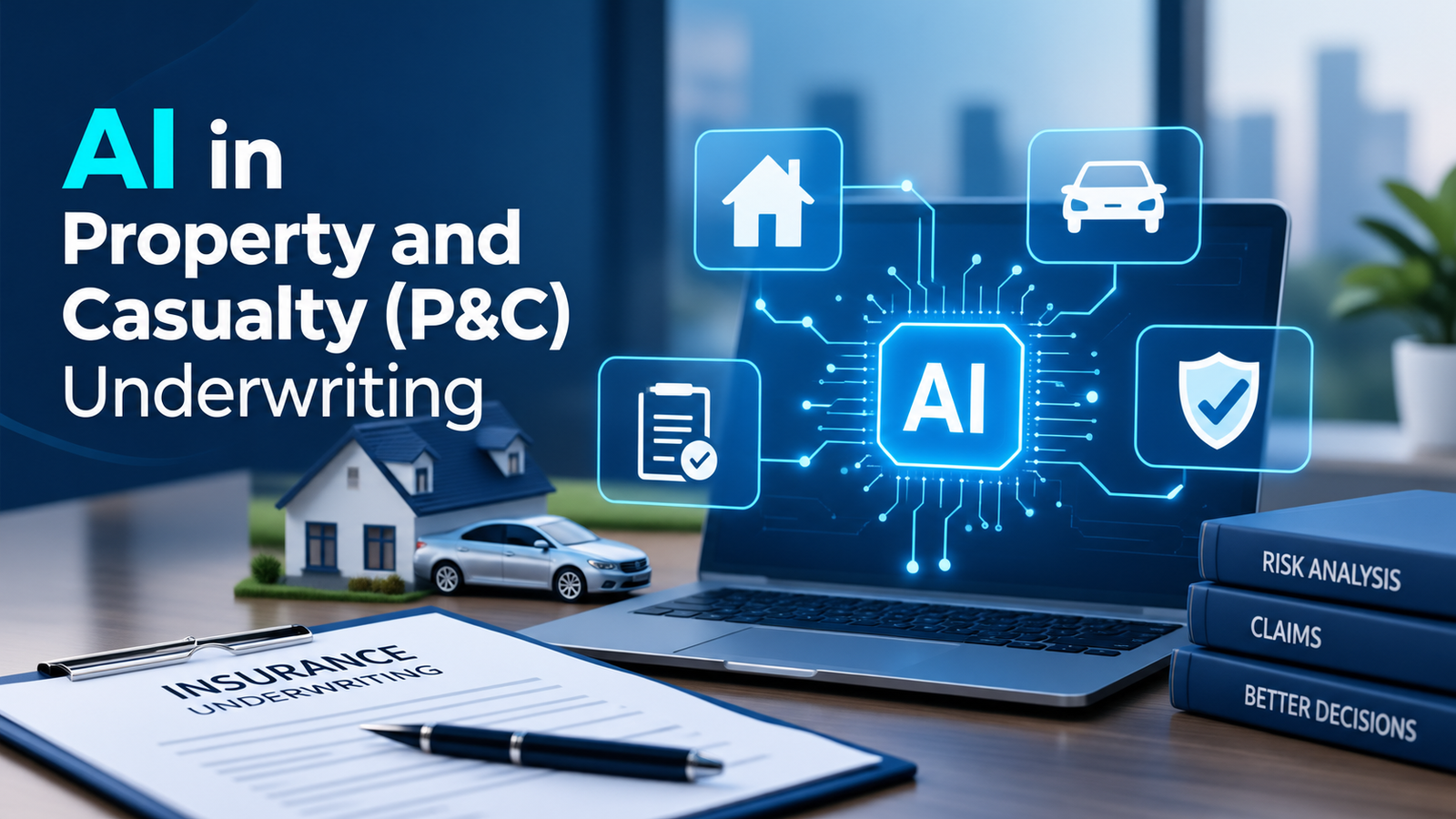
Primary topic: AI in Property and Casualty (P&C) Underwriting
Research focus: Machine learning, risk assessment, commercial property, personal lines, predictive underwriting, external data, computer vision, climate risk, automation, explainable AI, governance, legacy modernization, and the future of AI-powered underwriting
What Is AI in P&C Underwriting?
Property and Casualty underwriting is the process of evaluating whether an insurer should accept a risk, what terms should apply, how much coverage should be offered, and what premium or risk conditions are appropriate. It covers areas such as homeowners insurance, commercial property, commercial general liability, automobile insurance, workers’ compensation, specialty insurance, and many other P&C products.
Traditional underwriting depends heavily on applications, historical claims, actuarial models, inspections, loss runs, financial information, broker submissions, and the professional experience of underwriters. AI adds another layer by allowing insurers to process much larger volumes of structured and unstructured information and identify patterns that may be difficult to detect manually.
The National Association of Insurance Commissioners reports that AI and machine learning are already being used across P&C insurance. In its insurer surveys, 88% of responding private passenger auto insurers and 70% of responding homeowners insurers said they use, plan to use, or plan to explore AI/ML models. The NAIC also reports applications in underwriting, pricing, claims, inspections, risk scoring, and fraud detection.
Source: NAIC, Artificial Intelligence in Insurance
| Traditional underwriting | AI-assisted underwriting |
|---|---|
| Manual document review | AI extraction and document classification |
| Limited risk variables | Large and diverse data sources |
| Periodic inspection | Continuous or event-triggered risk signals |
| Rules and human judgment | Rules + predictive models + human judgment |
| Reactive risk assessment | Predictive and proactive risk assessment |
Why AI Matters in P&C Underwriting
P&C underwriting is particularly suitable for AI because insurers process large amounts of historical and real-time information. A single commercial property submission can contain applications, financial documents, inspection reports, engineering documents, photographs, maps, loss histories, policy wording, business descriptions, and broker correspondence.
The challenge is not simply finding more data. The challenge is turning that data into useful underwriting insight without introducing hidden bias, unreliable predictions, privacy problems, or excessive automation.
AI can combine structured and unstructured information from multiple sources.
Submission triage and document analysis can happen before an underwriter opens every file.
Models can apply the same analytical process across large volumes of risks.
External data can reveal risk characteristics that traditional applications may miss.
Research Study: Machine Learning in P&C Insurance
One of the most useful academic reviews of this field was published by Blier-Wong, Cossette, Lamontagne, and Marceau. The researchers reviewed nearly 100 articles and case studies involving machine learning in P&C insurance, covering areas such as ratemaking, telematics, reserving, and actuarial modeling.
The review found that machine learning can model nonlinear relationships and interactions that traditional linear approaches may struggle to capture. It also highlighted an important division between structured and unstructured insurance data. Tree-based models such as gradient boosting are particularly useful for structured problems, while neural networks can become more useful when insurers work with images, text, time-series data, and other unstructured information.
The study is important because it shows that AI does not necessarily mean replacing actuarial methods. Instead, modern insurance analytics can combine traditional actuarial approaches with machine learning.
Original research: Machine Learning in P&C Insurance: A Review for Pricing and Reserving
Research interpretation:
- Traditional GLMs remain useful because they are familiar and comparatively interpretable.
- Machine learning can capture nonlinear relationships and interactions.
- Gradient boosting is particularly relevant for structured insurance data.
- Neural networks can process complex data such as images and sequential information.
- The strongest insurance architecture can combine actuarial knowledge, machine learning, and human judgment.
Research Study: 2026 Machine Learning Risk Modeling in Motor Insurance
A 2026 study published in Machine Learning with Applications examined risk modeling using a large real-world Motor Third-Party Liability dataset covering 2016 to 2024. The researchers specifically addressed problems that are highly relevant to AI underwriting: class imbalance, temporal drift, calibration, and interpretability.
The study found that temporal drift substantially reduced model discrimination. Across the tested models, ROC AUC was approximately 0.62 to 0.63 on the out-of-time evaluation. HistGradientBoosting produced better probability calibration, with a Brier score of approximately 0.026 and an expected calibration error of approximately 0.04. The research also proposed a hybrid architecture combining anomaly-style profiling with calibrated machine learning.
This is an important lesson for insurers. A model that performs well on historical data can lose effectiveness when customer behavior, economic conditions, vehicle technology, fraud patterns, weather, or claims behavior changes. Underwriting AI therefore needs continuous monitoring rather than one-time validation.
What this means for P&C insurers:
- Out-of-time validation is essential.
- Probability calibration can matter more than raw accuracy.
- Risk models should be monitored for drift.
- Hybrid statistical and machine learning systems can provide a practical balance between flexibility and transparency.
Research Study: AI and Insurance Research Across Property, Auto and Health
A 2025 systematic review published in Frontiers in Artificial Intelligence examined AI applications across automotive, health, and property insurance. The review identified major opportunities but also highlighted several risks directly relevant to underwriting.
The researchers identified data quality, biased risk assessment, regulatory compliance, ethical issues in automated decisions, and explainability as important challenges. These concerns are especially relevant when AI is used to influence who receives coverage, how risk is classified, or what price or terms are offered.
The finding reinforces a central principle for P&C underwriting: better prediction is not enough. An underwriting model must also be defensible, monitored, explainable where required, and tested for inappropriate discrimination.
Original research: AI Revolution in Insurance: Bridging Research and Reality
Research Study: Interpretable Deep Learning for General Insurance Pricing
A 2026 research paper in Insurance: Mathematics and Economics examined interpretable deep learning for general insurance pricing. The researchers noted that deep learning can provide strong predictive flexibility but that limited interpretability remains one of the main barriers to insurance adoption.
The importance of this research goes beyond pricing. Underwriting and pricing are closely connected because underwriting decisions determine the characteristics of risks entering an insurance portfolio. If a model becomes too difficult to explain, insurers may face challenges when validating decisions internally or explaining model behavior to regulators and other stakeholders.
The direction of current research is therefore not simply “make the model more powerful.” It is increasingly “make the model powerful while preserving interpretability.”
Original research: An Interpretable Deep Learning Model for General Insurance Pricing
Research Study: Big Data and Machine Learning for Insurance Risk
Research published in Risk Sciences in 2026 examined data-enriched prediction of insurance risk. The study found that adding large-scale data to traditional insurance policy and demographic information can improve predictive performance, although the research was conducted in the health insurance context rather than P&C.
The broader underwriting lesson is important: additional data can provide predictive information that conventional underwriting variables do not contain. For P&C insurers, this principle can translate into property characteristics, geospatial information, weather history, telematics, business information, satellite imagery, claims history, and other external signals.
However, insurers should not assume that every additional data source improves underwriting. Each new variable introduces questions about data quality, privacy, stability, fairness, availability, and regulatory acceptability.
Original research: Data-Enriched Prediction of Insurance Risk
Research Study: Property Insurance Machine Learning
A 2024 property insurance case study examined machine learning for predicting property insurance claims. The researchers addressed imbalanced claim data using the SMOTE technique and compared machine learning approaches with logistic regression.
Random forest produced a recall of 96% in the reported experiment. The study demonstrates why machine learning can be useful for property risk analysis, but its results should not be interpreted as a universal performance benchmark for every insurer. Model performance depends heavily on the dataset, target definition, geography, product, claims process, and validation method.
Original research: Optimizing Claim Assessment Processes in Property Insurance: A Case Study
Research Evidence Dashboard
| Research | Main evidence | Underwriting implication |
|---|---|---|
| P&C ML review | Nearly 100 articles and case studies reviewed | ML can complement actuarial modeling |
| 2026 MTPL study | Temporal drift reduced discrimination | Continuous validation is necessary |
| 2025 AI insurance review | Data quality and explainability remain major issues | Governance must be built into AI systems |
| 2026 interpretable DL | Deep learning creates interpretability challenges | Explainability should be part of model design |
| 2026 data-enriched risk study | Additional data can improve prediction | External data can expand underwriting insight |
| 2024 property insurance study | Random forest achieved high recall in the tested dataset | ML can support property risk screening |
AI Data Sources for P&C Underwriting
The future of underwriting depends increasingly on combining internal insurance data with carefully selected external information. The goal is not to collect everything. The goal is to collect information that has a defensible relationship with the risk being insured.
Internal data
- Claims history
- Policy history
- Loss runs
- Premium history
- Inspection records
Property data
- Building characteristics
- Construction type
- Age and condition
- Location
- Replacement cost
External data
- Weather
- Geospatial information
- Satellite imagery
- Flood and wildfire signals
- Economic indicators
Unstructured data
- Broker submissions
- Inspection reports
- Emails
- Photos
- Policy documents
AI-Powered Submission Intake
One of the easiest places to introduce AI is submission intake. Commercial P&C submissions can contain hundreds of pages of documents and attachments. Instead of requiring an underwriter to manually locate every relevant fact, AI can extract information, classify documents, identify missing fields, summarize exposure characteristics, and prepare a structured underwriting view.
↓
Document Classification
↓
OCR + NLP + Data Extraction
↓
Risk Attribute Normalization
↓
AI Risk Screening
↓
Underwriter Review
↓
Quote / Refer / Decline Decision
Generative AI can also summarize long submissions, identify missing information, compare current and previous submissions, and retrieve relevant policy or underwriting guidelines. McKinsey reports that AI is increasingly being used to accelerate and personalize insurance intake and submission processes, while early agentic underwriting systems are beginning to handle simpler policies with limited intervention.
Source: McKinsey, Understanding AI in Insurance for Investors
AI Risk Scoring
Risk scoring is one of the core AI applications in P&C underwriting. Instead of treating every submission as equally complex, an AI system can estimate characteristics such as expected loss, claim probability, severity, underwriting complexity, fraud risk, or the likelihood that additional information will be required.
A practical system should not reduce the entire underwriting decision to one opaque number. A better architecture produces a risk profile containing multiple signals that the underwriter can understand and challenge.
Example AI underwriting risk profile
- Property risk: Medium
- Historical claims signal: Low
- Weather exposure: High
- Construction vulnerability: Medium
- Data completeness: 82%
- Model confidence: 91%
- Recommended action: Underwriter review
- Key reasons: Roof age, wildfire exposure, prior loss frequency
Computer Vision for Property Underwriting
Computer vision can allow insurers to extract information from property photographs, inspection images, aerial imagery, satellite imagery, and other visual sources. Instead of relying exclusively on a manual inspection report, an AI system can identify visible characteristics that may affect risk.
- Roof condition
- Exterior deterioration
- Vegetation near structures
- Building materials
- Potential fire hazards
- Visible water damage
- Property maintenance issues
- Solar panels and other structural features
For commercial property, computer vision can become particularly useful when combined with geospatial and building information. AI can help prioritize which properties require human inspection and which can be handled through remote assessment.
Climate Risk and AI Underwriting
Climate-related hazards create a major challenge for property underwriting because historical claims data may not fully represent future exposure. Wildfire, flood, hurricane, extreme heat, severe storms, and other hazards can change the risk profile of a property over time.
AI can combine historical claims with geospatial information, weather models, satellite observations, property characteristics, and catastrophe data to produce more dynamic risk assessments. McKinsey notes that P&C insurers are increasingly combining claims data with external data to identify new risk factors, including climate-related damage estimates.
Source: McKinsey, The Future of AI for the Insurance Industry
Climate-aware underwriting workflow
Property characteristics → Geospatial exposure → Historical weather → Current weather signals → Catastrophe model → AI risk assessment → Human underwriting decision
AI for Commercial P&C Underwriting
Commercial underwriting is particularly attractive for AI because commercial submissions can be large, complex, and highly variable. An AI system can help an underwriter understand a business before the detailed review begins.
| Commercial line | Potential AI role | Human role |
|---|---|---|
| Commercial property | Property risk extraction and scoring | Complex exposure judgment |
| General liability | Historical risk pattern analysis | Coverage and legal judgment |
| Workers’ compensation | Claims and exposure analysis | Complex account assessment |
| Commercial auto | Fleet and driver risk analysis | Account strategy |
| Specialty P&C | Research and document analysis | Expert judgment |
AI for Personal P&C Underwriting
Personal lines can be more suitable for higher levels of automation because many policies follow relatively standardized underwriting structures. Auto and homeowners insurers can use machine learning for risk scoring, renewal evaluation, inspection support, fraud signals, and pricing-related analytics.
According to the NAIC’s insurer survey, P&C companies reported AI use in underwriting for activities such as renewal evaluations and inspections to verify policy characteristics. Machine learning is also used in pricing for risk scoring and rate-factor analysis.
Source: NAIC P&C AI/ML insurer survey findings
Generative AI and the Underwriter Copilot
Generative AI has a different role from traditional predictive models. A predictive model may estimate risk, while a generative AI system can help an underwriter understand information and interact with the underwriting knowledge base.
- Summarize broker submissions.
- Extract important risk characteristics.
- Compare policy versions.
- Find relevant underwriting guidelines.
- Draft follow-up questions.
- Summarize claims history.
- Explain model-generated risk factors.
- Prepare preliminary underwriting notes.
- Identify missing documents.
- Generate a structured account briefing.
Swiss Re provides a useful real-world example. Its AI strategy uses AI across underwriting, claims, portfolio management, and operations. The company states that AI is designed to amplify expert judgment rather than replace it. Swiss Re also reports approximately 80% active AI usage across its organization and describes AI-powered capabilities supporting underwriting workflows.
Source: Swiss Re, AI at Swiss Re
AI Underwriting Architecture
A production-grade AI underwriting platform should not be built as one model connected directly to a quote button. A safer architecture separates data ingestion, normalization, model scoring, explainability, business rules, human review, audit logs, and policy administration.
Claims • Policies • Loss Runs • Pricing • Inspections↓
External Data Layer
Weather • Geospatial • Property • Satellite • Economic Data
↓
Data Quality + Identity Resolution
↓
AI / ML Layer
Risk Scoring • NLP • Computer Vision • Anomaly Detection • Forecasting
↓
Explainability + Governance
↓
Underwriter Workbench
↓
Quote / Refer / Decline / Request Information
↓
Policy Administration + Continuous Monitoring
Rules-Based Underwriting vs AI Underwriting
AI should not automatically replace underwriting rules. Rules remain useful for regulatory requirements, eligibility conditions, hard constraints, referral thresholds, and business policies. Machine learning is better suited to identifying complex patterns and estimating risk within those boundaries.
| Capability | Rules | Machine learning |
|---|---|---|
| Hard eligibility rules | Strong | Limited role |
| Complex patterns | Limited | Strong |
| Explainability | Very high | Model dependent |
| Changing relationships | Requires manual updates | Can learn from new data |
| Best architecture | Governance layer | Decision-support layer |
Explainable AI in Underwriting
Explainability is particularly important when AI influences insurance decisions. An underwriter should be able to understand why a system has identified a property or account as higher risk.
Useful explanations should focus on actionable factors rather than simply exposing technical model details. For example, “high wildfire exposure combined with combustible roof characteristics and recent property deterioration” is more useful to an underwriter than a generic model score of 0.87.
- Top risk factors
- Direction of influence
- Confidence or uncertainty
- Relevant historical patterns
- Data freshness
- Missing information
- Comparison with similar risks
- Recommended human review
AI Bias and Fairness
Insurance underwriting has always involved risk segmentation. AI can make that segmentation more sophisticated, but it can also make problematic patterns harder to detect if the model learns from biased historical data or inappropriate external variables.
The NAIC’s AI framework emphasizes that AI-supported insurance decisions must comply with applicable insurance laws and regulations. The NAIC has also been developing tools for regulators to evaluate insurer AI systems, including governance, risk mitigation, high-risk models, and data inputs.
Source: NAIC Artificial Intelligence regulatory overview
AI fairness checks should include:
- Input-variable review
- Proxy-variable testing
- Segment-level performance
- Outcome disparity analysis
- Data quality testing
- Historical bias analysis
- Human override analysis
- Ongoing monitoring after deployment
AI Model Drift
Insurance risk changes continuously. Inflation can change repair costs. Weather patterns can change catastrophe exposure. Vehicle technology can change claims behavior. New fraud techniques can appear. Economic conditions can change commercial losses.
For this reason, an AI underwriting model should be treated as a living production system rather than a finished software feature.
The input population changes.
The relationship between variables and risk changes.
Prediction quality deteriorates.
Human workflows change around the model.
Human-in-the-Loop Underwriting
The most practical model for complex P&C underwriting is human-in-the-loop AI. AI handles repetitive analytical work while the underwriter retains decision authority for cases that require context, negotiation, judgment, or additional investigation.
| AI can handle | Underwriter should handle |
|---|---|
| Document extraction | Complex judgment |
| Submission triage | Exceptions |
| Risk scoring | Final underwriting decision |
| Data comparison | Broker negotiation |
| Missing-data detection | Unusual or emerging risks |
Regulation and Governance
Insurance AI governance is becoming a central part of underwriting transformation. In the United States, the NAIC adopted its Model Bulletin on the Use of Artificial Intelligence Systems by Insurers in December 2023. The bulletin establishes expectations around governance, risk management, compliance, and regulatory examination of AI-supported insurance activities.
In 2026, the NAIC continued developing its AI Systems Evaluation Tool. The organization stated that the tool was being piloted by 12 participating states and was intended to help regulators assess AI use, governance, risk mitigation, high-risk models, and data inputs.
Source: NAIC, Model Bulletin on Use of AI by Insurers
Source: NAIC Big Data and Artificial Intelligence Working Group
The regulatory environment is continuing to evolve. In September 2026, the NAIC was also exposing an AI Risk Evaluation Supplement version 5.0 for comment, demonstrating that regulatory evaluation of insurance AI is still developing.
Source: NAIC Exposure Drafts, AI Risk Evaluation Supplement
AI Risk Matrix for P&C Underwriting
| Risk | Potential impact | Recommended control |
|---|---|---|
| Biased data | Unfair risk segmentation | Bias testing and data governance |
| Model drift | Declining accuracy | Continuous monitoring |
| Poor explainability | Regulatory and operational difficulty | Explainable models and audit trails |
| External data errors | Incorrect risk assessment | Source validation and confidence scoring |
| Overautomation | Bad decisions on complex risks | Human referral thresholds |
| Cybersecurity | Data exposure and model manipulation | Security controls and monitoring |
AI Maturity Model for P&C Insurers
Mostly document-driven underwriting with limited analytics.
Dashboards, predictive models, and rules support decisions.
AI performs intake, scoring, document analysis, and recommendations.
AI is embedded across underwriting, pricing, claims, and portfolio workflows.
Continuous data, monitoring, agentic workflows, and human governance operate together.
Expert Recommendations for Insurers
Insurance companies should resist the temptation to begin with the most technically impressive AI model. The better starting point is a clearly defined underwriting problem where better data processing or prediction can produce measurable business value.
- Start with workflow bottlenecks. Identify where underwriters spend the most time on repetitive work.
- Build the data foundation first. Poorly structured historical data can undermine even advanced models.
- Use AI as a decision-support layer. Keep clear human accountability for material underwriting decisions.
- Use different models for different tasks. Document extraction, computer vision, risk scoring, forecasting, and generative AI have different requirements.
- Measure calibration, not only accuracy. Underwriting systems need reliable probabilities and useful risk ranking.
- Monitor model drift. A model should be continuously evaluated against current portfolio outcomes.
- Make explainability part of product design. Do not add explanations after deployment.
- Govern external data. Every important third-party signal should have documented provenance, quality checks, and appropriate legal review.
- Keep a human escalation path. Complex, unusual, low-confidence, or high-impact cases should reach experienced underwriters.
- Track business outcomes. Measure quote time, hit ratio, loss ratio, referral rate, manual effort, data completeness, and customer experience.
Legacy Modernization Strategy
Many insurers cannot replace their core policy administration systems immediately. That does not mean they must wait before introducing AI. AI can be introduced as an intelligence layer around existing systems through APIs, data platforms, event pipelines, and underwriting workbenches.
↓
API / Integration Layer
↓
Insurance Data Platform
↓
AI Services
NLP • ML • Computer Vision • GenAI
↓
Underwriter Experience Layer
↓
Existing Policy Administration System
This approach allows insurers to modernize incrementally. A carrier can begin with document extraction or submission triage, then introduce risk scoring, computer vision, climate signals, and eventually more advanced workflow automation.
High-Value AI Use Cases
| Use case | Potential value | Complexity |
|---|---|---|
| Submission summarization | High | Low–Medium |
| Document extraction | High | Medium |
| Risk scoring | Very high | High |
| Computer vision inspection | High | High |
| Climate risk modeling | Very high | Very high |
| AI underwriting copilot | Very high | High |
Startup Opportunities in AI P&C Underwriting
The insurance AI market also creates opportunities for startups that do not want to build a complete insurance carrier platform. A startup can focus on one difficult underwriting problem and provide that capability through an API or workflow product.
- AI commercial submission ingestion
- Property inspection computer vision
- AI roof and building condition assessment
- Climate risk intelligence APIs
- AI underwriting copilots
- Broker submission quality scoring
- Automated loss-run analysis
- AI policy comparison
- Commercial property risk scoring
- Insurance data normalization
- AI underwriting quality assurance
- Model governance and monitoring platforms
- Explainable underwriting decision systems
Future Predictions: 2027–2030
The direction of current research and industry development suggests that P&C underwriting will become increasingly AI-assisted, data-rich, and continuous. The following are forward-looking scenarios based on current research and industry developments rather than guaranteed outcomes.
AI copilots become common for document analysis, submission triage, and underwriting research.
More insurers combine property, geospatial, claims, weather, and image data in underwriting workflows.
Agentic workflows may handle more routine underwriting processes while escalating exceptions to experts.
Continuous risk assessment could become more important than one-time policy underwriting for selected products.
McKinsey’s longer-term insurance research has previously projected that underwriting for many personal and small-business products could become heavily automated by 2030. More recent McKinsey research describes the emergence of agentic underwriting “work cells” that can quote and bind simpler policies with limited intervention. These developments suggest that automation will likely expand first in standardized, high-volume products rather than in highly complex specialty risks.
Source: McKinsey, Insurance 2030
Source: McKinsey, AI in Insurance and Underwriting
The Shift From Risk Assessment to Continuous Risk Intelligence
The biggest long-term change may not be automation itself. It may be the transition from a one-time underwriting event to continuous risk intelligence.
Today, an insurer may assess a property when a policy is issued and then reassess it during renewal or after a claim. AI-enabled systems can potentially monitor relevant risk signals throughout the policy lifecycle. When significant changes occur, the system can notify an insurer or underwriter for review.
Traditional model
Application → Underwriting → Policy → Renewal → Re-underwriting
AI-enabled model
Application → AI risk profile → Underwriting → Continuous monitoring → Event detection → Human review → Updated risk assessment
This approach could become especially important for property risks exposed to changing weather, construction conditions, business operations, or other dynamic factors. It also creates new governance requirements because continuous monitoring must remain proportionate, accurate, transparent, and legally appropriate.
What AI Should Not Do in P&C Underwriting
AI should not be treated as an unquestionable authority. The strongest underwriting systems will deliberately define situations where the model must stop and request human review.
- Do not automatically trust a low-confidence prediction.
- Do not use poorly understood external variables simply because they improve model accuracy.
- Do not allow generative AI to invent missing underwriting facts.
- Do not remove human review from complex or unusual risks without strong validation.
- Do not evaluate models only on historical training performance.
- Do not treat explainability as an optional reporting feature.
- Do not deploy AI without monitoring data drift and outcome performance.
Key KPIs for AI Underwriting
| KPI category | Example metrics |
|---|---|
| Speed | Quote turnaround time, submission processing time |
| Risk | Loss ratio, claim frequency, claim severity |
| Model | AUC, calibration, precision, recall, drift |
| Operations | Manual touch rate, referral rate, automation rate |
| Governance | Override rate, audit findings, fairness metrics |
| Customer | Quote completion, response time, broker satisfaction |
Final Perspective
AI in P&C underwriting is moving beyond experimentation. The strongest evidence shows that machine learning can capture complex patterns, process large volumes of insurance information, support risk segmentation, and improve analytical workflows. Industry adoption is also expanding across underwriting, pricing, claims, inspection, and portfolio management.
However, the research also makes the limitations clear. Model performance can decline under temporal drift. External data can introduce new risks. Historical data can reproduce existing biases. Deep learning can be difficult to explain. Regulatory expectations are developing. For these reasons, the future of P&C underwriting is unlikely to be defined simply by “AI replacing underwriters.”
A more realistic direction is AI-augmented underwriting: machines analyze large amounts of information, identify patterns, prepare risk intelligence, and automate routine workflows, while human underwriters retain responsibility for complex decisions and exceptions.
The insurers most prepared for this future will not necessarily be those with the largest AI models. They will be the organizations that combine high-quality data, modern integration architecture, strong actuarial expertise, responsible AI governance, effective human workflows, and continuous model monitoring.
Frequently Asked Questions
What is AI in P&C underwriting?
AI in P&C underwriting refers to the use of machine learning, predictive analytics, natural language processing, computer vision, generative AI, and related technologies to analyze insurance risks and support underwriting decisions.
How is AI used in property underwriting?
AI can analyze property characteristics, claims history, inspection reports, photographs, satellite imagery, geospatial information, weather data, and other risk signals to help insurers evaluate property risk.
Can AI replace P&C underwriters?
AI can automate parts of underwriting, especially repetitive and standardized tasks, but complex underwriting still requires human judgment. Current industry approaches increasingly emphasize AI as a decision-support and productivity tool rather than an autonomous replacement for expert underwriters.
How does AI help commercial insurance?
AI can process long broker submissions, extract risk information, analyze claims history, identify missing information, score risks, compare policy documents, and prepare underwriting recommendations.
What are the biggest risks of AI underwriting?
The major risks include biased data, inappropriate external variables, model drift, poor explainability, data privacy issues, cybersecurity risks, incorrect predictions, and excessive automation.
What is the future of AI underwriting?
The likely direction is toward AI-assisted and increasingly continuous underwriting, where predictive models, external data, computer vision, generative AI, and human underwriting expertise operate together.
Original Research and Industry Sources
- Machine Learning in P&C Insurance: A Review for Pricing and Reserving
- Advanced Risk Modeling in MTPL Insurance: Using Statistical Methods and Machine Learning
- AI Revolution in Insurance: Bridging Research and Reality
- An Interpretable Deep Learning Model for General Insurance Pricing
- Data-Enriched Prediction of Insurance Risk
- Optimizing Claim Assessment Processes in Property Insurance
- NAIC: Artificial Intelligence in Insurance
- NAIC: Model Bulletin on the Use of AI by Insurers
- NAIC: AI Risk Evaluation Supplement
- Swiss Re: AI at Swiss Re
- Swiss Re: Underwriting Curiosity Can Take AI to the Next Level
- McKinsey: The Future of AI for the Insurance Industry
- McKinsey: Understanding AI in Insurance for Investors
- McKinsey: Insurance 2030
Leave a Reply