
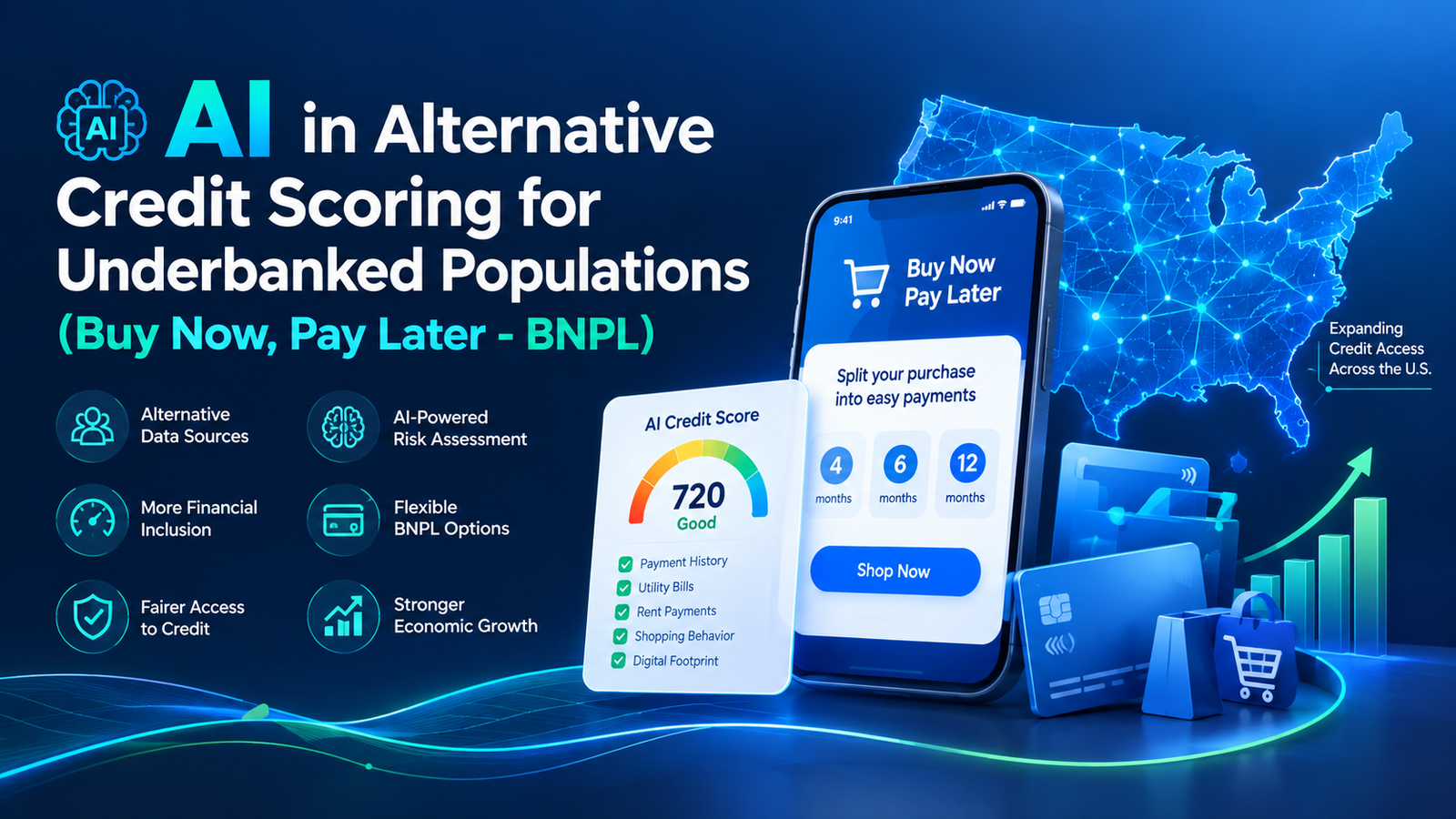
Primary topic: AI in Alternative Credit Scoring for Underbanked Populations (Buy Now, Pay Later – BNPL)
Research focus: Alternative credit data, machine learning credit scoring, thin-file and credit-invisible borrowers, BNPL risk assessment, financial inclusion, behavioral data, digital payments, explainable AI, fairness, responsible lending, real-time underwriting, and the future of AI-powered credit decisions.
Why Alternative Credit Scoring Matters for Underbanked Consumers
Traditional credit scoring was designed around formal financial relationships. Credit cards, bank loans, mortgages, repayment records, credit utilization, and other reported accounts provide lenders with a structured picture of a borrower’s past behavior.
That model becomes less useful when a consumer has little or no formal credit history. A young adult may have stable income but no credit card. A gig worker may have regular digital income but irregular monthly pay. A small business owner may receive thousands of digital payments but have limited borrowing history. A rural consumer may use mobile payments and utility services without having a conventional bank relationship.
This creates what is commonly called a thin-file or credit-invisible borrower.
BNPL creates an interesting opportunity because the transaction itself can generate useful repayment information. Instead of asking only whether the borrower has a traditional credit history, a BNPL provider can evaluate the applicant using permitted alternative signals and then continuously learn from actual repayment behavior.
The CFPB describes BNPL as an installment credit product that commonly divides a purchase into four or fewer payments. Many pay-in-four products do not use hard credit inquiries, although practices differ across products and providers.
Source: CFPB: What is a Buy Now, Pay Later loan?
Why BNPL Creates a Special Credit-Scoring Problem
BNPL decisions are often made at the point of purchase. The lender may have only seconds to decide whether to approve a customer, how much credit to offer, and whether additional verification is required.
This creates a different underwriting environment from a conventional bank loan.
Longer application and underwriting process
Fast point-of-sale credit decision
Limited conventional credit history
Combine multiple permitted data signals
The lender therefore needs a system that can work with incomplete information without turning missing information into automatic rejection.
That distinction is critical.
No credit history does not necessarily mean bad credit.
AI can potentially help distinguish between the two.
Research Evidence: Six Important Studies
Study 1: Machine Learning Powered Financial Credit Scoring Systematic Review
A major 2025 systematic literature review published in Artificial Intelligence Review examined machine-learning approaches to financial credit scoring.
The researchers initially identified 330 research papers published between 2018 and 2024 and selected 63 papers for detailed review.
The study examined different machine-learning methods, their strengths and weaknesses, evaluation methods, and implementation challenges. It found that machine learning can improve credit-risk prediction by capturing nonlinear relationships that traditional statistical models may miss.
However, the review also identifies important limitations. High-dimensional data can increase overfitting and computational complexity. Interpretability, bias, and feature selection remain important challenges.
For BNPL, the research supports a hybrid strategy. Machine learning can provide stronger predictive capabilities, while simpler models, rules, and explainability mechanisms can remain important for transparency and governance.
The research is especially relevant to underbanked populations because the value of machine learning increases when the lender has many different signals but lacks a complete conventional credit history.
Source: Artificial Intelligence Review: Machine learning powered financial credit scoring
Study 2: Alternative Data and Financial Inclusion in India
Research by Agarwal, Alok, Ghosh and Gupta examined the role of alternative data and machine learning in financial inclusion using proprietary data from a large fintech lender in India.
The study investigated digital information from mobile phones, including the number and types of applications installed, social connections, and deeper digital footprints derived from call-log information.
The researchers found that alternative digital information could substitute for traditional credit-bureau scores in credit-risk evaluation and could expand credit access for financially excluded individuals without adversely affecting default outcomes in their analysis.
This is one of the most important pieces of evidence for alternative credit scoring because it moves beyond the simple argument that “more data is better.” It examines whether nontraditional information can actually provide useful credit-risk signals.
For BNPL, the lesson is that a consumer’s financial behavior can sometimes provide information even when the consumer does not have a conventional credit score.
However, this does not mean that every type of personal digital data should automatically be used for underwriting. Data must have a legitimate purpose, appropriate consent and legal basis, and a demonstrated relationship with repayment risk.
Source: Indian School of Business: Financial Inclusion and Alternate Credit Scoring
Study 3: AI-Enhanced Credit Scoring Using Alternative Data in Pakistan
A 2025 study specifically examined AI-enhanced credit scoring using alternative data for financial inclusion in Pakistan.
The research used a dataset of 10,000 borrowers reflecting microfinance clients and compared Logistic Regression, Random Forest, and XGBoost models.
The study considered digital footprints such as telecom usage, mobile-wallet activity, and online transactions as potentially useful signals for borrowers who lack extensive formal credit histories.
This research is particularly relevant to emerging markets because the formal financial footprint of a consumer may not fully reflect their real economic activity. A person may receive mobile payments, pay bills electronically, conduct online transactions, or operate a small informal business without having a large traditional banking record.
For Pakistani fintech and BNPL providers, this creates an important technology opportunity. AI can potentially transform fragmented digital behavior into a structured risk profile.
At the same time, alternative-data scoring must be designed carefully. If the model simply learns socioeconomic differences rather than repayment behavior, it can reproduce existing inequalities instead of reducing them.
Source: AI-Enhanced Credit Scoring Using Alternative Data for Financial Inclusion in Pakistan
Study 4: Alternative Data in Micro-Enterprise Credit Risk Assessment
A 2026 empirical study published in the Journal of Behavioral and Experimental Finance examined alternative data for micro-enterprise credit-risk assessment in China using machine learning.
The study found that alternative data contains meaningful credit information and that expanding the dimensions of alternative data can improve prediction. An especially important finding was that behavioral data performed better than historical credit data in assessing micro-enterprise creditworthiness in the study.
The researchers also found that economic transaction data generally provided stronger credit information than social-stability data.
This distinction matters for responsible BNPL and alternative credit scoring.
A lender should prioritize data that has a clear economic relationship with the ability or willingness to repay. Transaction behavior, cash-flow patterns, repayment history, and income consistency may have a stronger direct relationship with credit risk than unrelated personal characteristics.
The study also demonstrates why feature engineering is becoming central to AI credit systems. The value of alternative data is not simply in collecting more information. It is in identifying which signals actually improve prediction.
Study 5: AI Credit Assessment in Digital Lending and BNPL
A 2026 review in Expert Systems with Applications examined AI-based credit assessment in digital lending, specifically highlighting the growth of online lending and BNPL.
The review describes a fundamental problem with traditional credit models: digital lending environments generate heterogeneous information and require real-time decisions.
AI models can process multiple forms of information and update risk assessments more dynamically than traditional scorecards.
However, the study also emphasizes concerns about fairness, privacy, transparency, and regulatory compliance.
This is particularly important for BNPL because the speed of approval can create a temptation to optimize only for conversion and repayment prediction. A responsible system must also ask whether the model is treating different groups fairly and whether consumers can understand important decisions.
The study supports the development of credit systems that combine predictive performance with transparency and continuous learning.
Study 6: Fairness and Explainability in AI Credit Scoring
A 2026 systematic literature review published in the Journal of Risk and Financial Management analyzed 43 peer-reviewed studies published between 2020 and 2025 that addressed performance, fairness, or explainability in AI-based credit scoring.
The review highlights an important tension.
AI can improve predictive performance, particularly for thin-file borrowers, but high predictive performance alone does not guarantee fair lending.
A model can be statistically accurate while still producing unequal outcomes across different groups.
This can happen because historical data may contain existing inequalities, because some populations have less data available, or because seemingly neutral variables can act as proxies for sensitive characteristics.
For BNPL providers, fairness testing therefore needs to become part of model development rather than an afterthought.
A responsible credit model should be tested for:
- Approval-rate differences.
- Default-rate differences.
- False-positive and false-negative differences.
- Performance across income groups.
- Performance across geographic populations.
- Performance for thin-file and no-file customers.
- Changes in fairness after model updates.
Research Evidence Dashboard
| Study | Data / Scope | Main finding | BNPL implication |
|---|---|---|---|
| 2025 ML credit-scoring review | 63 selected studies | ML captures complex credit-risk relationships | Use ML alongside governance and explainability |
| India alternative-data study | Fintech lender data | Digital footprints can substitute for some traditional credit signals | Expand access for thin-file consumers |
| Pakistan study | 10,000 borrowers | Telecom, wallet and online data can support credit scoring | Strong emerging-market use case |
| China micro-enterprise study | Internet-bank data | Behavioral data can improve risk prediction | Prioritize economically relevant signals |
| 2026 digital-lending review | AI, alternative data and BNPL literature | Real-time AI can improve assessment but raises governance issues | Combine speed with responsible lending |
| 2026 fairness review | 43 peer-reviewed studies | Performance does not guarantee fairness | Build fairness testing into the ML lifecycle |
What Counts as Alternative Credit Data?
Alternative data should not be interpreted as simply collecting every available piece of consumer information.
A strong credit model separates data into useful categories and evaluates whether each category has a defensible relationship with repayment risk.
Income deposits, recurring payments and account activity
Repayment timing, missed payments and transaction consistency
Wallet activity, merchant payments and recurring purchases
Account consistency, verification and device information
Credit bureau records and current obligations where available
The model should then determine which variables genuinely improve prediction.
AI Credit Scoring Architecture for BNPL
↓
Identity + Consent + Data Eligibility
↓
Traditional Credit Data + Alternative Data + Transaction Data
↓
Feature Engineering + Data Quality Checks
↓
ML Credit-Risk Models + Rules + Affordability Checks
↓
Risk Score + Probability of Default + Confidence
↓
Approve / Reduce Limit / Step-Up Verification / Decline
↓
Repayment Monitoring
↓
Model Feedback + Drift Monitoring + Fairness Testing
This architecture creates an important feedback loop.
The lender does not stop learning after approving a customer. Actual repayment behavior becomes evidence for future model improvement.
AI for Thin-File and Credit-Invisible Borrowers
The strongest potential benefit of alternative credit scoring is its ability to reduce dependence on a single traditional credit score.
Consider two applicants.
Applicant A has a long credit history, several credit accounts, stable reported repayment behavior, and a conventional credit score.
Applicant B has no traditional credit score but has stable digital income, regular utility payments, consistent wallet activity, low payment volatility, and a history of successfully completing small digital transactions.
A traditional scorecard may have substantially more information about Applicant A.
An alternative-data model can potentially build a meaningful risk profile for Applicant B.
The important point is not that Applicant B should automatically receive credit. The point is that absence of traditional data should not automatically be treated as evidence of high risk.
This is where AI can potentially support financial inclusion.
BNPL and Real-Time Underwriting
BNPL is particularly suited to AI because the decision often happens directly inside an e-commerce transaction.
The model can evaluate the purchase context at the time of application.
Relevant signals can include:
- Requested purchase amount.
- Existing BNPL exposure.
- Current repayment obligations.
- Recent repayment behavior.
- Account age.
- Transaction frequency.
- Income or cash-flow consistency where legally and appropriately available.
- Existing credit obligations.
- Merchant and transaction characteristics.
- Device and identity risk signals.
The result can be a dynamic credit decision rather than a simple binary approval.
BNPL Loan Stacking Is a Major AI Challenge
One of the biggest problems in BNPL is that consumers can hold several short-term loans simultaneously.
CFPB research found that approximately 63% of BNPL borrowers originated multiple simultaneous BNPL loans at some point during 2022, while approximately 33% took out loans from multiple BNPL providers. The same research found that more than one-fifth of consumers with a credit record used BNPL in 2022.
This creates a problem that a single-provider credit model may not see.
A customer may look affordable when one BNPL provider considers its own exposure. The same customer may have several other active obligations elsewhere.
Provider B → $150 outstanding
Provider C → $200 outstanding
New BNPL Request → $250
Total short-term exposure = $700
This is why alternative credit scoring should eventually move toward a broader view of affordability and indebtedness, subject to lawful access to relevant information.
Source: CFPB: Consumer Use of Buy Now, Pay Later and Other Unsecured Debt
BNPL Can Expand Access, but Access Alone Is Not the Goal
Financial inclusion should not be measured simply by the number of people receiving credit.
A responsible system should ask whether the credit is affordable and whether the borrower is better served by the product.
CFPB research found that BNPL borrowers often had higher balances and more signs of financial stress across other credit products. In 2022, more than three-fifths of BNPL borrowers had multiple simultaneous BNPL loans. The CFPB also reported that most BNPL originations went to consumers with subprime or deep-subprime credit scores.
At the same time, the CFPB’s matched-data research found that deep-subprime borrowers and borrowers without a FICO score still repaid BNPL loans at high rates in the dataset studied. The report states that these groups repaid BNPL loans 96% of the time, while noting that lower-score borrowers had higher default rates than borrowers with stronger scores.
These findings illustrate why AI can be useful.
Traditional credit scores may not tell the entire story.
But neither should alternative data be treated as a guarantee of repayment.
Explainable AI for BNPL Decisions
Credit decisions are high-impact decisions.
If an AI model declines an applicant, the system should be able to provide a meaningful explanation rather than simply returning a hidden numerical score.
A useful explanation might look like:
Key factors:
- Limited repayment history.
- Multiple recent credit applications.
- High existing short-term obligations.
- Recent income volatility.
- Requested amount is significantly above recent purchase behavior.
Next step: Verify additional information or request a lower financing amount.
The goal is not to expose proprietary model logic. The goal is to provide a useful, accurate explanation of the material factors behind the decision.
The 2026 fairness and explainability review reinforces the importance of this issue across AI credit-scoring systems.
AI and Fairness in Alternative Credit Scoring
Alternative data can reduce exclusion, but it can also create new forms of exclusion.
For example, suppose a model uses digital transaction activity.
A consumer with limited smartphone access may have less digital data than a consumer who uses multiple financial applications every day.
If the model interprets “less data” as “higher risk,” it could disadvantage people who are already underserved.
This creates a critical principle:
Missing data should not automatically become negative data.
Fairness testing should therefore examine the difference between:
- A borrower who has negative repayment evidence.
- A borrower who simply has insufficient data.
- A borrower whose data is incomplete because of limited digital access.
These are different situations and should not automatically receive the same treatment.
Privacy and Data Governance
Alternative credit scoring requires careful data governance because the system may process highly personal information.
BNPL providers should establish clear rules for:
- What data is collected.
- Why the data is collected.
- How the data is obtained.
- Whether consumers understand its use.
- How long the data is retained.
- Who can access the data.
- How models use the data.
- How consumers can challenge inaccurate information.
The CFPB has previously raised concerns about data harvesting within BNPL business models and the use of consumer data for models, product features, and marketing.
Source: CFPB: Buy Now, Pay Later Market Trends and Consumer Impacts
Alternative Data Should Be Economically Relevant
Not all available data should become credit data.
A responsible system should prioritize information that has a reasonable relationship with repayment ability or repayment behavior.
| Data category | Potential value | Key concern |
|---|---|---|
| Repayment history | Direct evidence of credit behavior | Incomplete cross-provider visibility |
| Cash flow | Can indicate income stability | Privacy and data access |
| Wallet transactions | Shows payment behavior | Potential behavioral bias |
| Utility payments | Potential payment consistency signal | Availability differs across populations |
| Device information | Identity and fraud-risk support | Can create proxy effects |
| Social or unrelated personal data | Potentially weak or indirect signal | High privacy and fairness risk |
AI Credit Limit Optimization
AI can do more than approve or reject a BNPL application.
It can help determine an appropriate credit limit.
For example, rather than:
Approved: $500
a system could determine:
Approved: $150 initially, with the possibility of a higher limit after successful repayment.
This creates a progressive-credit model.
The customer receives access to credit, while the lender learns from actual repayment behavior.
This can be particularly useful for credit-invisible customers because the system does not need to estimate everything from day one.
It can learn gradually.
AI for Dynamic Affordability Assessment
A conventional credit decision may be made once.
An AI-powered BNPL platform can continuously monitor affordability signals where lawful and appropriate.
This could include changes in repayment behavior, current BNPL exposure, missed payments, and other permitted financial indicators.
The goal should not be to continuously restrict customers. It should be to prevent the system from approving additional credit without considering significant changes in repayment risk.
BNPL Risk Scoring Model
Repayment behavior
Affordability and cash flow
Existing obligations
Transaction behavior
Identity and fraud risk
Important: The percentages above are an illustrative architecture, not a recommended production weighting or a validated credit model. Actual feature weights should be learned and validated using appropriate data, regulation, fairness testing, affordability requirements, and independent model governance.
AI Versus Traditional Credit Scoring
| Capability | Traditional scoring | AI + alternative data |
|---|---|---|
| Credit history | Strong dependence | Can supplement with other signals |
| Thin-file borrowers | Limited information | Potentially richer behavioral profile |
| Real-time decisions | Limited depending on architecture | Strong potential |
| Complex relationships | Limited | Can model nonlinear relationships |
| Explainability | Generally easier | Requires deliberate design |
| Adaptation | Slower | Can continuously learn |
Expert Recommendation
The strongest strategy for BNPL providers serving underbanked populations is to build an alternative-data credit system with guardrails, not an unrestricted AI approval engine.
The first priority should be high-quality repayment data. If the lender does not know whether previous customers repaid on time, no sophisticated model can solve the fundamental data problem.
The second priority should be affordability. Credit scoring should not become a competition to approve more consumers. The objective should be to identify appropriate credit amounts for consumers who can reasonably repay them.
The third priority should be progressive lending. For thin-file consumers, smaller initial limits can create a safer path toward establishing a repayment history.
The fourth priority should be explainability. A customer should not receive a mysterious “AI decision” without meaningful information about the factors that affected the decision.
The fifth priority should be fairness monitoring. Models should be tested across relevant populations and monitored after deployment because model behavior can change as customer behavior and data distributions change.
The sixth priority should be privacy. Alternative data should be collected because it serves a legitimate credit-risk purpose, not simply because technology makes the information available.
An important principle from the CFPB’s BNPL research is that BNPL is a rapidly growing form of credit and that consumers can accumulate multiple obligations. That means AI underwriting should consider the borrower’s broader financial position rather than optimizing only for an individual transaction.
Expert Quotation
The statement captures an important point for AI credit-scoring systems: BNPL should be treated as a meaningful form of consumer credit rather than merely a checkout feature.
Source: CFPB: Study Details the Rapid Growth of Buy Now, Pay Later Lending
Implementation Roadmap for Fintech and BNPL Companies
| Phase | Focus | Key output |
|---|---|---|
| Phase 1 | Data foundation | Clean repayment, application and transaction datasets |
| Phase 2 | Baseline underwriting | Traditional scorecard and rule benchmark |
| Phase 3 | Alternative data | Validated behavioral and cash-flow features |
| Phase 4 | ML modeling | Predictive credit-risk model |
| Phase 5 | Explainability and fairness | Decision explanations and fairness validation |
| Phase 6 | Controlled deployment | Limited production rollout |
| Phase 7 | Continuous monitoring | Drift, fairness and default monitoring |
Startup Opportunities
The combination of AI, alternative data and BNPL creates several opportunities for fintech startups.
- Alternative credit scoring APIs: APIs that convert permitted financial and behavioral signals into explainable risk features.
- Thin-file underwriting platforms: Specialized models for customers without conventional credit histories.
- BNPL affordability engines: Systems that estimate whether a new installment plan fits a customer’s current obligations.
- Credit limit optimization: AI that dynamically adjusts limits based on repayment evidence.
- Explainable credit decision platforms: Human-readable explanations for automated underwriting decisions.
- Fairness monitoring: Continuous testing of approval, default and error rates across relevant customer groups.
- Alternative-data governance: Platforms that track data provenance, consent, permitted use and model dependencies.
- Cross-provider exposure intelligence: Systems designed to help lenders understand broader short-term credit exposure where lawful data-sharing arrangements exist.
AI Credit Scoring Maturity Model
Traditional scorecard
ML-enhanced scoring
Alternative-data scoring
Real-time adaptive underwriting
Responsible autonomous credit intelligence
Level 1 depends mainly on traditional credit history. Level 2 introduces machine learning. Level 3 adds alternative data. Level 4 continuously evaluates risk and repayment behavior. Level 5 combines adaptive AI with affordability, explainability, fairness, privacy and strong human governance.
Future Predictions: 2027–2030
2027: Thin-File Credit Scoring Becomes More Data-Driven
By 2027, more fintech lenders are likely to use alternative data to supplement conventional credit reports, particularly in markets where formal credit histories cover only part of the population.
The key change will be a shift from “no credit history” to “limited traditional history plus alternative evidence.”
2028: BNPL Underwriting Becomes More Dynamic
BNPL providers are likely to move further toward dynamic limits and transaction-level affordability decisions.
Instead of giving every approved consumer the same maximum amount, AI systems will increasingly adjust limits according to repayment history, current exposure and risk.
2029: Cash-Flow Underwriting Expands
Cash-flow information is likely to become increasingly important for thin-file consumers.
Income consistency, recurring obligations, payment timing and spending patterns can provide a more current view of financial behavior than an older credit score alone.
The challenge will be ensuring that access to cash-flow data is transparent, secure and appropriately consented.
2030: Credit Scores Become More Dynamic
The traditional idea of a single static credit score is likely to coexist with richer, continuously updated risk profiles.
AI systems will increasingly evaluate:
- Current affordability.
- Recent repayment behavior.
- Short-term credit exposure.
- Cash-flow stability.
- Transaction behavior.
- Historical credit information.
- Model confidence.
This could make credit decisions more responsive to a consumer’s current financial situation.
Key KPIs for AI-Powered Alternative Credit Scoring
| KPI | What it measures |
|---|---|
| Approval rate | Share of applications approved |
| Default rate | Credit losses among approved borrowers |
| Thin-file approval rate | Access provided to customers with limited traditional history |
| Model AUC / discrimination | Ability to distinguish different levels of credit risk |
| Calibration | Whether predicted risk corresponds to observed outcomes |
| Fairness metrics | Differences in outcomes and model errors across relevant groups |
| Customer affordability | Whether approved credit remains manageable |
| Loan stacking | Multiple concurrent short-term obligations |
| Decision latency | Time needed for underwriting |
Frequently Asked Questions
What is alternative credit scoring?
Alternative credit scoring uses nontraditional financial and behavioral information alongside or instead of conventional credit-bureau information to evaluate creditworthiness. Examples can include permitted cash-flow, payment, transaction and other digital financial signals.
Why is alternative scoring useful for underbanked populations?
Underbanked consumers may have limited formal credit histories even when they have regular income, payment activity or other evidence of financial behavior. Alternative data can provide additional information for evaluating those consumers.
Can AI improve BNPL credit decisions?
AI can identify complex relationships across large datasets and make rapid decisions. Research supports its potential to improve credit-risk prediction, but production performance depends on data quality, validation, regulation, model monitoring and the population being assessed.
Can alternative data eliminate credit risk?
No. Alternative data can provide additional evidence, but it cannot guarantee repayment. Borrower behavior changes, data can be incomplete, and models can make errors.
Can BNPL help consumers build credit?
It depends on the product and provider. The CFPB notes that most pay-in-four BNPL products generally have not reported payment history to major consumer reporting companies, although practices vary and some products may report.
Source: CFPB: Will a BNPL loan impact my credit scores?
What is the biggest risk of AI credit scoring?
There is no single risk. Important concerns include biased data, unfair outcomes, lack of explainability, privacy problems, poor model calibration, data drift and excessive reliance on automated decisions.
Should BNPL providers use social media data for credit scoring?
There is no universal answer. Any data source should be assessed for legal permissibility, consumer expectations, predictive value, privacy, security, fairness and potential proxy discrimination before being used for credit decisions.
What is the best AI model for alternative credit scoring?
There is no universally best model. Research includes logistic regression, random forests, gradient boosting, neural networks and other approaches. Model selection should depend on the data, performance, explainability, latency, governance requirements and the consequences of errors.
Final Perspective
AI-powered alternative credit scoring could change the relationship between financial inclusion and credit history.
Traditional lending often asks a simple question:
“What does the borrower’s existing credit history tell us?”
Alternative AI underwriting can ask a broader question:
“What evidence do we have about this person’s current financial behavior and ability to repay?”
That distinction is especially important for underbanked and thin-file consumers.
The research base provides evidence that machine learning can capture complex credit-risk relationships and that alternative digital information can provide useful signals when conventional credit data is limited. Studies in India, Pakistan and China also demonstrate why alternative data is particularly relevant in emerging markets.
BNPL adds another dimension because credit decisions occur rapidly and consumers can potentially hold several short-term obligations at the same time. CFPB research shows that simultaneous BNPL borrowing and broader unsecured debt exposure are important parts of the market.
The future therefore should not be about using AI simply to approve more people.
It should be about using AI to make better-informed, faster, more inclusive and more responsible credit decisions.
The strongest BNPL platform will combine traditional credit information where available, alternative financial data, real-time transaction signals, affordability analysis, machine learning, explainable decisions, fairness monitoring, privacy controls and continuous repayment feedback.
For underbanked consumers, this can create a path from credit invisibility → small responsible credit → verified repayment history → stronger risk evidence → potentially broader financial access.
That is the real opportunity of AI in alternative credit scoring.
Research Sources
- Artificial Intelligence Review: Machine Learning Powered Financial Credit Scoring
- Indian School of Business: Financial Inclusion and Alternate Credit Scoring
- AI-Enhanced Credit Scoring Using Alternative Data for Financial Inclusion in Pakistan
- Journal of Behavioral and Experimental Finance: Alternative Data in Micro-Enterprise Credit Risk Assessment
- Expert Systems with Applications: AI-Based Credit Assessment in Digital Lending
- Journal of Risk and Financial Management: Performance, Fairness, and Explainability in AI Credit Scoring
- CFPB: Consumer Use of Buy Now, Pay Later and Other Unsecured Debt
- CFPB: The Buy Now, Pay Later Market
- CFPB: Buy Now, Pay Later Market Trends and Consumer Impacts
- CFPB: Consumer Use of Buy Now, Pay Later
Leave a Reply