
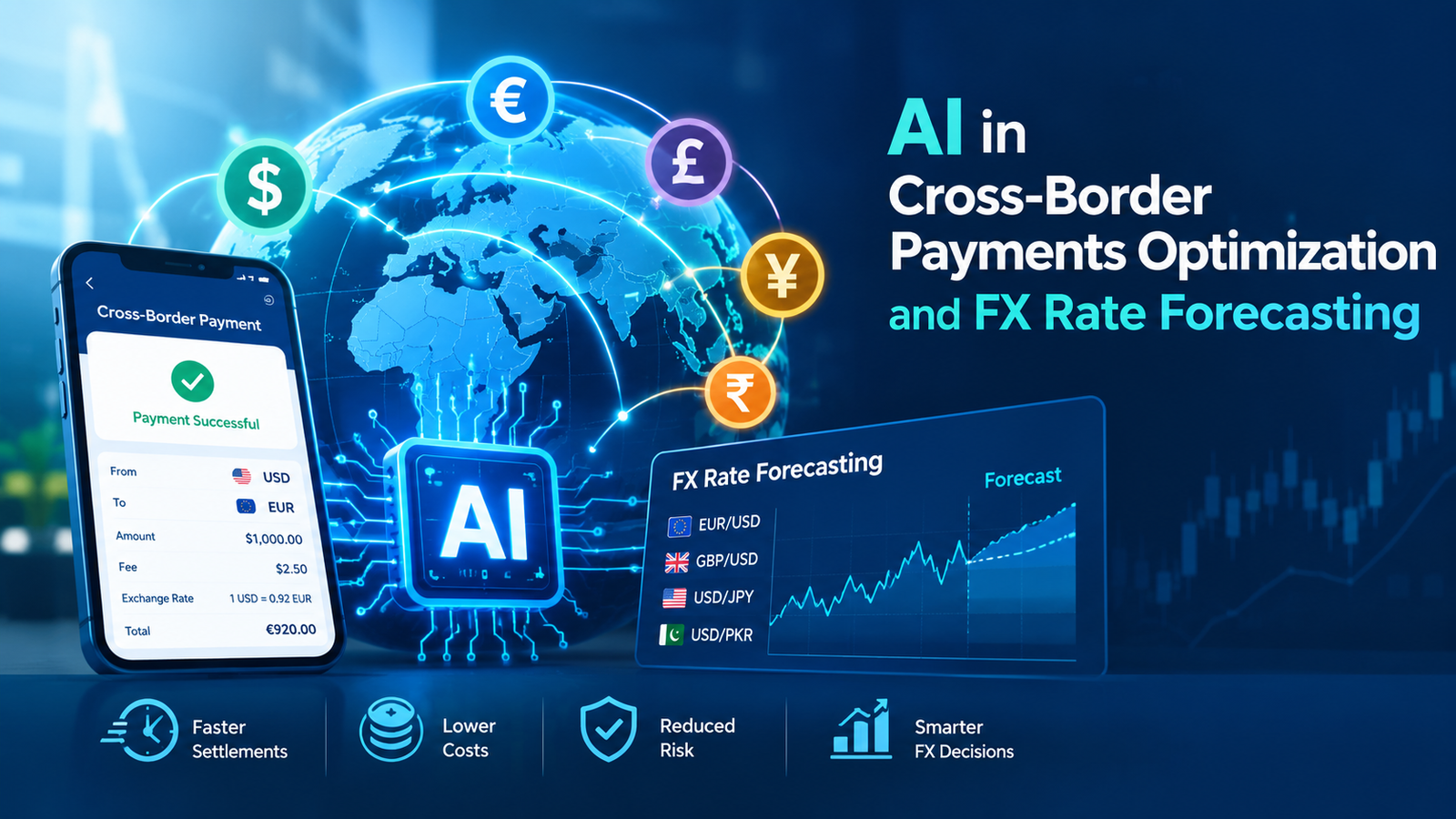
Primary topic: AI in Cross-Border Payments Optimization and FX Rate Forecasting
Research focus: AI-powered payment routing, FX rate forecasting, transaction cost optimization, liquidity management, currency conversion, payment interoperability, fraud and compliance, remittance optimization, real-time settlement, machine learning, explainable AI, and the future of intelligent cross-border financial infrastructure.
Why Cross-Border Payments Need AI Optimization
Cross-border payments are fundamentally more difficult than domestic payments. A domestic transaction can often move through one payment system, one currency, one regulatory environment, and a relatively simple settlement process. An international transaction may cross several institutions, currencies, jurisdictions, messaging standards, settlement systems, and compliance regimes before reaching the recipient.
The Bank for International Settlements identifies four long-standing problems in cross-border payments: cost, speed, transparency, and access. The G20 roadmap aims to improve these areas while maintaining safety and financial integrity.
The problem is not only the payment itself. Foreign exchange can represent a significant part of the total cost.
The World Bank’s Remittance Prices Worldwide data shows that the total cost of a remittance includes both the explicit fee and the exchange-rate margin. In South Asia, its September 2025 data showed average digital-service fees of 2.65% and an average FX margin of 1.70%. For the Middle East, North Africa, Afghanistan and Pakistan region, the corresponding figures were 2.27% and 1.39%.
That means an apparently cheap transfer can still be expensive if the exchange rate is unfavorable.
AI creates an opportunity to optimize both sides of the transaction:
- Payment routing: Select the appropriate payment rail, correspondent bank, or settlement route.
- FX conversion: Decide where and when currency conversion should occur.
- FX forecasting: Estimate short-term or medium-term currency movements.
- Liquidity: Predict currency balances and funding requirements.
- Compliance: Identify transactions that require additional review.
- Fraud detection: Detect unusual payment behavior before settlement.
- Reconciliation: Match incoming and outgoing payments automatically.
- Exception management: Predict failed, delayed, or rejected payments.
The Economics of an International Payment
A cross-border payment should not be evaluated only by its visible transaction fee.
A more realistic optimization model considers:
Explicit cost charged by the provider
Difference between reference and applied rate
Cost of maintaining currency balances
Funding and settlement exposure
Screening and manual-review overhead
Returns, delays and failed transactions
An AI system can optimize these variables simultaneously.
This is important because the lowest-fee route is not always the cheapest route overall. A slightly more expensive payment rail may produce faster settlement, fewer intermediary deductions, better FX pricing, and lower failure risk.
Research Evidence: Six Important Studies and Industry Research Findings
Study 1: AI-Driven Multibank Payment Orchestration
A 2026 open-access study in Discover Artificial Intelligence proposed an AI-driven multibank payment-orchestration framework designed for secure, real-time and compliance-aware financial transactions.
The research addresses a major weakness in many payment infrastructures: fraud detection, compliance, and payment routing are often treated as separate functions.
The proposed framework combines three elements:
- Federated fraud-risk modeling.
- Compliance-conscious admissibility screening.
- Adaptive routing using reinforcement learning.
The important idea is that routing should not happen independently of risk.
For example, an AI system might have five potential payment routes between two countries. One route could be cheaper but have a higher predicted failure probability. Another might be faster but require more liquidity. A third could offer better settlement reliability but have a higher transaction cost.
An intelligent orchestration system can evaluate these variables together rather than selecting the route using a single static rule.
This architecture is highly relevant to cross-border payment providers because it moves AI from a back-office analytics tool into the actual payment-decision layer.
Source: Discover Artificial Intelligence: AI-driven multibank payment orchestration
Study 2: AI and Agentic Optimization of Cross-Border Payments
The International Monetary Fund’s 2026 note, How Agentic AI Will Reshape Payments, provides a broader framework for understanding how AI agents could interact with payment infrastructure.
The IMF describes a three-layer structure:
What payment objective should be achieved?
↓
Authorization
Is the transaction permitted and properly controlled?
↓
Settlement
How should the payment actually move and settle?
This framework is particularly useful for cross-border payments.
An AI agent could potentially receive an objective such as:
“Send the equivalent of $50,000 to the supplier in euros, minimize total cost, complete settlement today, and remain within our risk policy.”
The agent could then evaluate FX rates, payment rails, liquidity positions, compliance requirements, and settlement conditions before recommending or executing an appropriate route.
The IMF also highlights a fundamental limitation: payment infrastructure requires deterministic controls, while AI systems are probabilistic. This means AI should not simply be given unrestricted authority to move money.
The institution argues that governance, traceability, authorization controls, cybersecurity, and legal design are as important as AI capability.
Source: IMF: How Agentic AI Will Reshape Payments
Study 3: Machine Learning and Economic Theory for FX Forecasting
A 2025 study in Economic Modelling examined whether economic theory can improve machine-learning exchange-rate forecasts.
The researchers analyzed 10 currency pairs and introduced monotonic constraints based on economic theory into tree-based machine-learning models.
The results are particularly interesting because they challenge a common assumption about AI forecasting.
The researchers found that constrained models that incorporated economic theory often outperformed unconstrained models in statistical accuracy. Portfolios constructed from the model predictions also produced better risk-adjusted performance than commonly used strategies in their experiments.
The lesson is important for financial institutions.
More complex AI does not automatically mean better forecasting.
A model that combines domain knowledge with machine learning can sometimes outperform a completely unconstrained black-box system.
For cross-border payment providers, this means FX forecasting models should incorporate economic variables and financial-market relationships rather than relying only on historical price patterns.
Study 4: Comprehensive Ensemble Forecasting with Macroeconomic Data
A 2026 study in the Journal of International Money and Finance developed an ensemble approach for exchange-rate forecasting.
The research combines economic theory, technical indicators, frequency decomposition, and macroeconomic information to capture both high-frequency and low-frequency currency movements.
One especially relevant finding was that import and export data materially improved prediction accuracy and reliability in the researchers’ experiments.
This matters because FX rates are influenced by real economic activity.
A currency model that looks only at historical prices may miss important changes in trade flows, monetary policy, inflation, commodity markets, or external balances.
For a cross-border payment platform, this creates a useful distinction between:
- Very short-term FX prediction: seconds, minutes, or hours.
- Operational forecasting: one to several days.
- Treasury forecasting: weeks or months.
Each horizon requires different information.
A model designed for treasury planning should not necessarily be used to determine an FX conversion decision that occurs in milliseconds.
Source: Journal of International Money and Finance: Exchange rate forecasting with macroeconomic data
Study 5: Deep Learning and Reinforcement Learning for Exchange Rates
A 2025 Scientific Reports study examined a deep-neural-network approach combined with reinforcement learning for exchange-rate forecasting.
The research addresses a major challenge in FX markets: relationships are nonlinear and can change over time.
Traditional models such as ARIMA can struggle when the underlying market relationship changes. Deep-learning models can capture more complex relationships, while reinforcement learning can introduce feedback into the optimization process.
The study is relevant to real-world FX systems because payment providers operate in changing environments.
A model trained during one period may become less effective after:
- A central-bank policy change.
- A geopolitical shock.
- A major commodity-price movement.
- A liquidity event.
- A change in market structure.
An adaptive model therefore needs continuous evaluation and controlled retraining rather than indefinite deployment.
Study 6: Limit Order Book Data and Short-Term FX Predictability
A 2026 study in the International Journal of Forecasting examined cross-currency predictability using detailed foreign-exchange limit-order-book data.
The research focused on short forecasting horizons from approximately one minute to one hour.
The results provide an important warning for AI developers.
Overall predictability was generally low across the tested models, supporting the idea that FX markets are difficult to predict consistently. However, some microstructure variables, particularly order-flow information, provided short-term predictive power in the study.
This suggests that AI forecasting may work differently at different time horizons.
A model using macroeconomic data may be useful for longer-term treasury planning, while a payment-execution engine might use market microstructure information for short-term decisions.
The research also reinforces the need for realistic expectations. AI can identify temporary patterns without creating a permanently reliable crystal ball for currency prices.
Source: International Journal of Forecasting: Assessing cross-currency predictability in forex markets
What the Research Really Says About FX Forecasting
The six studies produce a consistent but nuanced picture.
AI can improve FX forecasting under the right conditions, but forecasting performance depends heavily on:
- Forecast horizon.
- Currency pair.
- Market regime.
- Input data.
- Model architecture.
- Retraining frequency.
- Transaction costs.
- Market liquidity.
- Economic shocks.
One 2026 study using monthly forecasts for five major currencies found that machine-learning models could outperform a random walk, but the improvement was small. It also concluded that continuous retraining becomes important as new data arrives.
That finding is important for payment providers.
The objective should not be:
“Predict the exact exchange rate.”
A more practical objective is:
“Estimate the range of plausible FX outcomes and select the payment and conversion strategy with the best expected total cost and risk.”
AI-Powered Cross-Border Payment Architecture
↓
Identity + Compliance + Transaction Validation
↓
Real-Time FX Rates + Market Data + Liquidity Data
↓
AI FX Forecasting Engine
↓
Payment Route Optimization Engine
↓
Cost + Speed + Risk + Liquidity Optimization
↓
Best Route / Conversion Decision
↓
Settlement and Confirmation
↓
Monitoring + Reconciliation + Model Feedback
The architecture should be modular.
The FX forecasting engine should not directly control settlement without risk controls. Similarly, the fraud model should not independently block legitimate payments without appropriate escalation logic.
A production system should maintain clear boundaries between prediction, recommendation, authorization, and execution.
AI Payment Routing Optimization
Cross-border payments can travel through different rails.
Depending on the corridor, a transaction might use:
- Correspondent banking.
- Interlinked instant payment systems.
- Money-transfer networks.
- Bank-to-bank APIs.
- Local payment systems.
- Wallet networks.
- Tokenized settlement infrastructure.
The optimization problem is therefore similar to a routing problem.
The AI system can estimate:
Total route cost = transaction fee + FX spread + liquidity cost + expected failure cost + compliance cost + settlement cost.
It can then compare available routes.
This is where reinforcement learning could become particularly useful because routing decisions can be treated as sequential optimization problems.
The AI does not simply select a route once. It can learn from the outcomes of previous routing decisions.
AI and FX Conversion Timing
Suppose a company needs to convert USD 5 million into EUR over the next 24 hours.
The organization has several options:
- Convert everything immediately.
- Convert gradually.
- Set predefined FX thresholds.
- Use multiple liquidity providers.
- Hedge part of the exposure.
- Wait for a specific liquidity window.
AI can estimate expected market conditions and compare the cost and risk of each strategy.
This does not mean the model knows the future.
Instead, it can calculate a probability distribution and evaluate possible outcomes.
Expected FX cost
+ Execution cost
+ Liquidity cost
+ Volatility risk
+ Settlement risk
+ Policy constraints
= Total expected cost
This is much more useful than a simple “buy” or “sell” prediction.
AI for Liquidity Management
Cross-border payment providers need liquidity in multiple currencies.
A provider may need USD, EUR, GBP, AED, SAR, PKR, INR, SGD, and many other currencies depending on its payment corridors.
Holding too much liquidity creates opportunity cost.
Holding too little creates settlement risk.
AI can forecast:
- Expected payment volumes.
- Currency demand by corridor.
- Intraday liquidity requirements.
- Peak settlement windows.
- Seasonal transaction patterns.
- Unexpected volume changes.
- Potential liquidity shortages.
A strong treasury AI system can therefore connect payment forecasting with FX management.
AI and Remittance Optimization
Remittances are one of the clearest use cases for cross-border payment optimization because even small percentage differences can materially affect recipients.
For example, the World Bank’s September 2025 data shows that both fees and FX margins contribute to remittance costs. In the South Asia region, the average digital-service FX margin was 1.70%.
For a $500 transfer, a 1.70% FX margin represents approximately $8.50 before considering other costs.
That means improving FX execution by even a fraction of a percentage point can matter.
For large remittance providers processing millions of transactions, small improvements can become significant at aggregate scale.
Example: AI-Optimized Remittance Route
| Route | Fee | FX spread | Speed | Failure risk |
|---|---|---|---|---|
| Route A | Low | High | Fast | Medium |
| Route B | Medium | Low | Fast | Low |
| Route C | Very low | Medium | Slow | High |
A static system may always choose Route C because it has the lowest fee.
An AI orchestration engine can recognize that Route B may have a lower total expected cost because its FX spread, failure probability and settlement speed are better.
AI and ISO 20022 Data
AI systems become more useful when payment data is structured.
The BIS says ISO 20022 can provide more consistent and structured information for cross-border payments. Harmonized data requirements can support faster, cheaper, more accessible and more transparent payments.
Structured data also creates better inputs for machine learning.
AI can analyze:
- Payment purpose.
- Originator information.
- Beneficiary information.
- Transaction amount.
- Currency.
- Payment corridor.
- Historical routing outcomes.
- Compliance indicators.
This allows payment providers to build more intelligent routing and risk systems.
The BIS also notes that richer ISO 20022 data can improve screening, compliance checks, fraud controls and operational reporting.
Source: BIS: The future of financial messaging and ISO 20022
AI and Instant Cross-Border Payments
The payment infrastructure itself is changing.
BIS Project Nexus focuses on interlinking instant payment systems across countries. The project demonstrates how domestic instant-payment systems can potentially be connected to enable faster international transactions.
Project Rialto similarly explored how instant payment systems, automated FX mechanisms, and tokenized central-bank money could work together to address FX and settlement frictions. The BIS reported that its proof of concept successfully tested transactions between different jurisdictions and currencies.
This creates an important future architecture:
↕
AI Routing + FX Optimization Layer
↕
Domestic Instant Payment System B
↓
Fast Cross-Border Settlement
AI becomes the intelligence layer while the payment networks remain the execution infrastructure.
AI for Payment Failure Prediction
A failed international payment is expensive.
It can create:
- Customer complaints.
- Refund processing.
- Manual investigation.
- Additional bank charges.
- Delayed supplier payments.
- Liquidity disruption.
- Reconciliation problems.
AI can learn from historical failed transactions and identify patterns associated with failure.
For example, the model may detect that particular combinations of:
- Currency.
- Destination bank.
- Payment method.
- Transaction type.
- Cut-off time.
- Compliance information.
have higher failure rates.
The system can then recommend another route before the transaction is submitted.
This is often more valuable than predicting failure after the money has already moved.
AI and Compliance-Aware Payment Routing
Cross-border payments cannot be optimized solely for cost.
A route must also satisfy regulatory and compliance requirements.
This means an optimization engine should consider:
Applicable screening requirements
Transaction monitoring and risk assessment
Jurisdiction-specific data requirements
Permitted payment activity
Applicable thresholds and controls
The 2026 BIS work on cross-border payment fraud emphasizes that safety must develop alongside improvements in speed, cost and transparency.
This means AI optimization should be compliance-aware by design, not optimized first and checked later.
FX Forecasting: Where AI Can Work and Where It Can Fail
| Forecast horizon | Potential AI inputs | Primary use | Main limitation |
|---|---|---|---|
| Seconds to minutes | Order flow, market depth, prices | Execution optimization | Very low predictability |
| Hours | Market data, liquidity, volatility | Conversion timing | Rapid regime changes |
| Days | Technical + macro signals | Treasury decisions | Unexpected news |
| Weeks/months | Rates, inflation, trade, policy | Liquidity and hedging planning | Structural economic changes |
The evidence therefore supports using different models for different horizons rather than forcing one AI model to forecast everything.
Human-in-the-Loop AI Architecture
The most appropriate architecture for regulated financial infrastructure is not unrestricted automation.
A safer model is:
↓
AI Recommendation
↓
Policy and Risk Engine
↓
Authorization Controls
↓
Human Escalation When Required
↓
Payment Execution
Low-risk, routine transactions may be automatically processed.
High-value, unusual, high-risk, or ambiguous transactions should be escalated.
This structure combines the speed of AI with the control required for financial infrastructure.
Risk Matrix for AI Cross-Border Payments
| Risk | Potential impact | AI control |
|---|---|---|
| FX model error | Higher conversion cost | Forecast ranges and confidence thresholds |
| Model drift | Declining performance | Continuous monitoring and retraining |
| Routing error | Delay or failed payment | Fallback routes and deterministic rules |
| Compliance error | Regulatory exposure | Hard policy controls around AI |
| Data outage | Incorrect decisions | Fallback pricing and routing systems |
| AI hallucination | Incorrect operational instruction | Deterministic execution layer and structured APIs |
Why Agentic AI Will Not Replace Payment Infrastructure
Agentic AI may become an important interface for financial operations, but it should not be confused with the underlying payment infrastructure.
The IMF’s 2026 analysis highlights the tension between probabilistic AI and the deterministic requirements of payment systems. Payment finality, authorization, compliance and settlement cannot depend solely on an AI model’s probabilistic output.
The likely architecture is therefore:
AI decides or recommends → deterministic controls validate → payment infrastructure executes.
That separation is likely to remain important even as AI agents become more capable.
Expert Recommendation
The strongest strategy for banks, fintechs, payment processors and remittance providers is to treat AI as an optimization layer across the payment lifecycle rather than as a standalone FX prediction product.
Start with payment routing.
Routing can produce measurable benefits even if FX forecasts are imperfect. An AI system can compare fees, settlement speed, liquidity, failure probability, compliance requirements and FX spreads without needing to predict the exact future currency price.
Second, build FX forecasting as a probabilistic service.
Do not ask the model for one exact exchange rate. Ask it for a distribution, confidence interval, scenario range, or probability of movement.
Third, connect forecasting to treasury.
An FX prediction that is not connected to actual liquidity and payment requirements has limited operational value. The model should understand how much currency the organization actually needs and when.
Fourth, use structured financial data.
ISO 20022 and API-based payment infrastructure provide better machine-readable information. This improves the foundation on which AI models operate.
Fifth, create deterministic safety controls around AI.
The AI should never be allowed to bypass sanctions screening, authorization limits, transaction policies, or settlement controls merely because its optimization model predicts a lower cost.
Finally, measure the system using business outcomes rather than AI metrics alone.
The important questions are:
- Did the average total payment cost decrease?
- Did FX spreads improve?
- Did payment failures decrease?
- Did settlement times improve?
- Did liquidity requirements become more predictable?
- Did compliance efficiency improve?
- Did customer transparency improve?
Expert Quotation
The observation remains central to the AI opportunity: technology has value when it reduces the real frictions experienced by users, not simply when it makes financial systems more technically sophisticated.
Source: BIS: Digitalisation of payments in a globalised world
Implementation Roadmap
| Phase | Implementation focus | Main outcome |
|---|---|---|
| Phase 1 | Payment data foundation | Unified transaction and FX dataset |
| Phase 2 | Route analytics | Cost, speed and failure benchmarks |
| Phase 3 | FX forecasting | Currency forecasts with confidence ranges |
| Phase 4 | AI routing | Dynamic payment-route recommendations |
| Phase 5 | Treasury integration | Liquidity and FX decisions connected |
| Phase 6 | Controlled automation | Low-risk transactions automatically optimized |
| Phase 7 | Continuous monitoring | Model drift, cost and risk monitoring |
AI Maturity Model for Cross-Border Payments
Manual payment operations
Analytics and dashboards
AI forecasting
Dynamic route optimization
Agentic payment orchestration with governance
The progression matters because organizations should not jump directly from manual operations to autonomous financial agents.
A strong foundation in data, APIs, payment connectivity, compliance and monitoring should come first.
Future Predictions: 2027–2030
2027: AI Becomes a Payment-Routing Layer
As payment systems become more interoperable, AI will increasingly decide which available route should be used for a particular transaction.
The model will evaluate more than price. It will consider speed, FX spread, liquidity, settlement reliability and compliance requirements.
This direction aligns with the G20 roadmap, although the BIS reported in late 2025 that achieving the roadmap’s end-2027 targets on schedule was unlikely and that improvements for end users had so far been modest.
2028: Real-Time FX Optimization Becomes More Common
Payment providers will increasingly use AI to compare multiple FX liquidity sources in real time.
Instead of applying a fixed currency-conversion rule, platforms will dynamically evaluate available rates and expected execution costs.
The main competitive advantage will shift from simply offering international transfers to optimizing the total economics of each transaction.
2029: AI Treasury and Payments Converge
Treasury systems and payment systems are likely to become more closely connected.
AI will forecast:
- Expected payment demand.
- Currency balances.
- FX exposure.
- Liquidity requirements.
- Potential settlement stress.
This could reduce the gap between payment operations and corporate treasury.
2030: Agentic Payment Orchestration Expands
Agentic AI could eventually receive a high-level financial objective and coordinate multiple systems to achieve it.
For example:
“Pay this supplier in EUR today at the lowest expected total cost within our approved risk limits.”
The AI could evaluate FX providers, payment routes, settlement windows, liquidity, compliance and transaction risk.
However, the execution layer will likely remain governed by deterministic controls, authorization policies and human escalation.
Key KPIs for AI Cross-Border Payment Systems
| KPI | What it measures |
|---|---|
| Total cost per transaction | Combined fee, FX and operational cost |
| FX spread | Difference between reference and applied rate |
| Settlement time | Time from initiation to recipient availability |
| Payment success rate | Share of transactions completed without failure |
| Route optimization gain | Cost or performance improvement against baseline routing |
| FX forecast error | Difference between forecast and realized exchange rate |
| Liquidity forecast accuracy | Accuracy of currency funding predictions |
| Manual intervention rate | Transactions requiring human intervention |
| Compliance false-positive rate | Unnecessary compliance escalations |
Startup Opportunities
The convergence of AI, payment orchestration and FX creates several opportunities for fintech startups.
- AI payment-routing APIs: APIs that compare payment rails and select routes based on cost, speed, FX and risk.
- FX forecasting APIs: Currency forecasts designed for operational treasury and payment applications rather than speculative trading.
- Multi-provider FX optimization: Platforms that compare liquidity providers in real time.
- AI treasury platforms: Systems that connect currency forecasts with payment obligations and liquidity management.
- Cross-border payment observability: Platforms that identify payment failures, delays and expensive routes.
- Compliance-aware orchestration: Routing systems that integrate regulatory constraints before execution.
- Remittance optimization: Systems that minimize total cost for specific currency corridors.
- Agentic finance infrastructure: Controlled AI agents that execute approved treasury and payment workflows.
Frequently Asked Questions
What is AI-powered cross-border payment optimization?
It is the use of AI to improve decisions across international payment processing, including route selection, FX conversion, liquidity management, compliance, fraud detection, settlement and reconciliation.
Can AI accurately predict exchange rates?
AI can improve forecasting in some datasets and time horizons, but there is no universal model that reliably predicts FX movements. Recent research shows both improvements over benchmarks and cases where gains are small. The practical objective should therefore be probabilistic forecasting and decision optimization rather than exact prediction.
How can AI reduce cross-border payment costs?
AI can compare payment routes, FX spreads, liquidity costs, settlement risks and failure probabilities. It can then select a route based on total expected cost rather than simply choosing the lowest transaction fee.
Why is FX spread important?
The FX spread is the difference between the market reference rate and the exchange rate actually applied to the customer. The World Bank includes this FX margin as part of the total cost of sending remittances.
Can AI replace banks or payment networks?
AI is more likely to operate as an intelligence and orchestration layer across existing and emerging payment infrastructure. Payment networks, settlement systems, banks and regulated intermediaries still provide the infrastructure and legal framework needed to move money.
What is the role of ISO 20022?
ISO 20022 provides structured financial messaging that can improve interoperability, automation, screening, reconciliation and payment transparency. The BIS identifies harmonized ISO 20022 requirements as an important part of the cross-border payments roadmap.
Will agentic AI automatically execute international payments?
Some controlled forms of agentic execution are likely to emerge, but high-value financial transactions require authorization, compliance, security and audit controls. The IMF specifically highlights the tension between probabilistic AI and deterministic payment infrastructure.
Final Perspective
AI has the potential to change cross-border payments from a largely rule-based process into an intelligent optimization system.
The biggest opportunity is not simply predicting whether USD will rise against EUR tomorrow.
It is connecting multiple decisions that currently operate separately.
A future payment engine could understand:
- Which payment rail is available.
- Which route has the lowest expected total cost.
- Which FX provider offers the best executable rate.
- Whether the organization has sufficient currency liquidity.
- Whether the transaction presents elevated compliance risk.
- Whether a payment is likely to fail.
- When human approval is required.
The technology is moving in this direction. BIS research and projects are exploring instant payment interoperability, automated FX mechanisms, tokenized settlement and structured payment data.
At the same time, the research on FX prediction provides an important reality check.
Some machine-learning systems outperform traditional benchmarks. Economic constraints can improve nonlinear models. Ensemble methods can benefit from macroeconomic and trade data. Short-term order-flow information can contain predictive signals.
But other research finds only modest forecasting gains and generally low short-term predictability.
Therefore, the strongest financial AI strategy is not to build a system that assumes it can consistently predict the currency market.
It is to build a system that can make better decisions under uncertainty.
That means combining:
AI forecasting + payment routing + FX optimization + liquidity management + compliance + fraud controls + structured financial data + deterministic execution.
This combination could become one of the most important technology layers in the next generation of international payments.
Research Sources
- Springer Nature: AI-driven multibank payment orchestration
- International Monetary Fund: How Agentic AI Will Reshape Payments
- Economic Modelling: Should economic theories guide the machine learning model in forecasting exchange rate?
- Journal of International Money and Finance: Exchange rate forecasting with macroeconomic data
- Scientific Reports: Deep neural network and reinforcement learning for exchange-rate forecasting
- International Journal of Forecasting: Cross-currency predictability using limit order book data
- Expert Systems with Applications: Multi-scale residual LSTM and dual-task FX forecasting
- Finance Research Letters: Dynamic forecasting of exchange-rate spillovers
- BIS: Enhancing cross-border payments, state of play and way forward
- BIS: Cross-border payment technologies, innovations and challenges
- BIS: 2025 monitoring survey on cross-border payments
- BIS: The future of financial messaging and ISO 20022
- BIS Project Rialto: Improving instant cross-border payments
- BIS Project Nexus: Enabling instant cross-border payments
- World Bank: Remittance Prices Worldwide, Issue 54
- World Bank: UK to Pakistan Remittance Pricing Data
Leave a Reply