
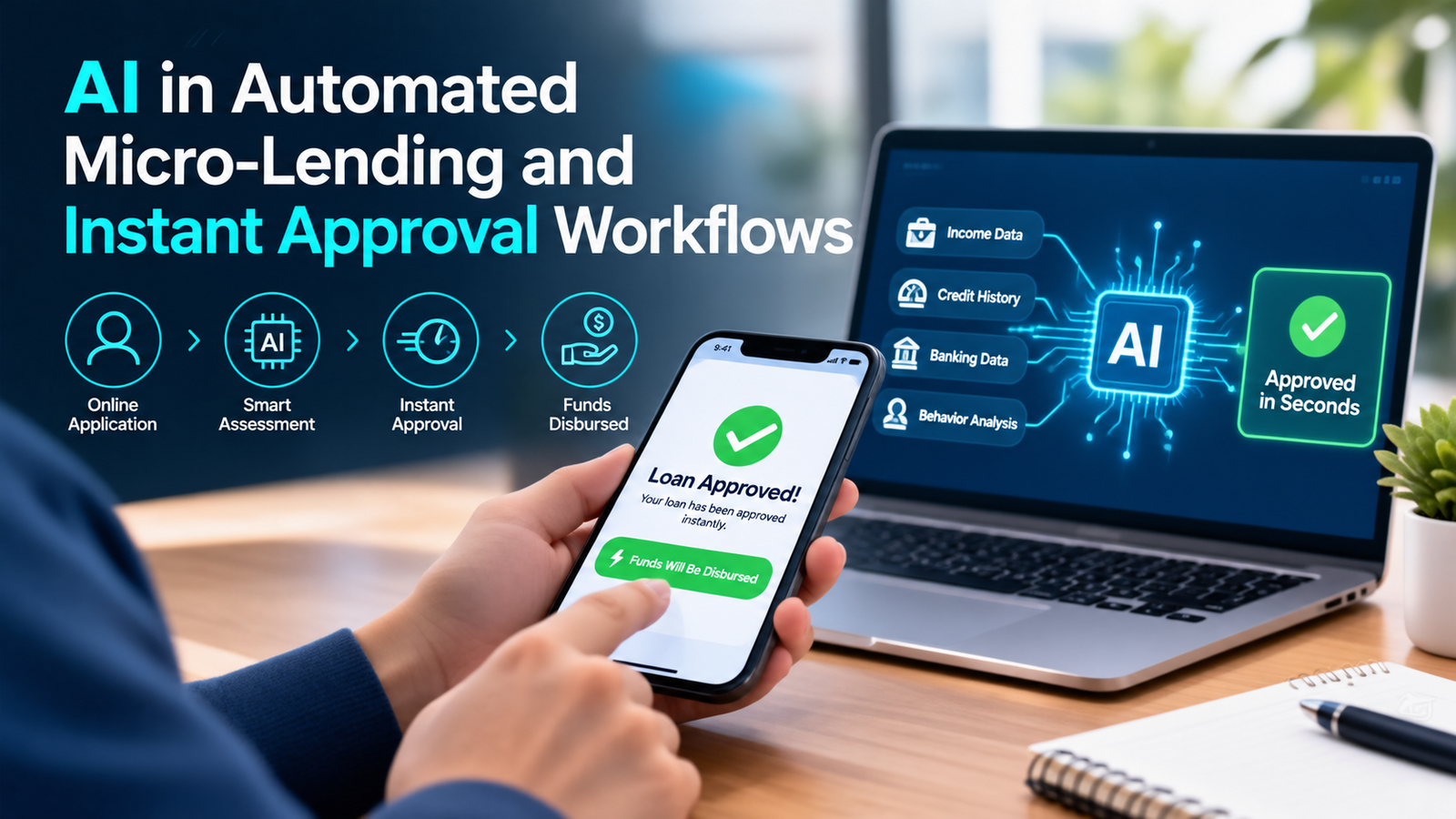
Primary topic: AI in Automated Micro-Lending and Instant Approval Workflows
Research focus: AI-powered micro-lending, digital credit, instant loan approval, automated underwriting, alternative data, machine learning credit scoring, affordability assessment, fraud detection, financial inclusion, explainable AI, responsible lending, and real-time credit decisioning.
What Is Automated Micro-Lending?
Automated micro-lending refers to the use of digital technology, automated credit assessment, and increasingly AI or machine learning to originate relatively small loans with minimal manual intervention.
The World Bank describes digital microcredit as short-term, low-value credit that is commonly accessed through mobile devices and may use automated credit scoring or fast approval. Applications can be approved almost instantly or within a very short period, often using alternative data.
Micro-lending can serve different customer groups depending on the market.
These may include:
- Individuals with limited formal credit histories.
- Low-income consumers needing small emergency loans.
- Gig workers with irregular income.
- Small merchants and micro-enterprises.
- Rural borrowers with limited branch access.
- Customers using mobile wallets and digital payment platforms.
- Consumers seeking short-term financing for essential purchases.
The defining feature is not simply the size of the loan.
The major difference is the operating model.
A traditional small loan may require an application, document collection, credit review, branch interaction, manual verification, and approval.
An automated micro-loan can potentially follow this process:
Digital Application
↓
Identity Verification
↓
Data Collection
↓
AI Credit Assessment
↓
Fraud & Affordability Checks
↓
Automated Decision
↓
Digital Disbursement
↓
Repayment Monitoring
The entire process can potentially happen within seconds or minutes.
Why Instant Approval Changes Lending
Instant approval changes the economics of small-dollar lending.
For a large loan, manual underwriting costs can be justified because the expected revenue from the loan is relatively large.
For a small loan, the same manual process can become economically inefficient.
If a lender spends too much employee time reviewing a $100 or $300 loan, operational costs can consume a large part of the potential return.
Automation changes this equation.
AI can evaluate thousands of applications without requiring an employee to manually inspect every application.
This can reduce processing time and potentially reduce the cost of underwriting.
However, automation also creates a new challenge.
When decisions become extremely fast, mistakes can also happen extremely fast.
That means an automated lender must optimize not only for:
- Approval speed
- Model accuracy
- Operational cost
It must also optimize for:
- Affordability
- Fairness
- Fraud prevention
- Explainability
- Data privacy
- Consumer protection
- Portfolio stability
Traditional Micro-Lending vs AI-Powered Micro-Lending
| Factor | Traditional micro-lending | AI-powered automated lending |
|---|---|---|
| Application | Paper or assisted application | Digital application |
| Underwriting | Human-led | Automated model plus policy engine |
| Data | Application and traditional credit data | Credit, transaction, behavioral and other permitted data |
| Decision time | Hours or days | Seconds or minutes |
| Scalability | Limited by staff | Highly scalable digital workflow |
| Monitoring | Periodic | Continuous or near real-time |
| Risk | Manual inconsistency | Model bias, drift, data and automation risks |
Research Study 1: 2026 Systematic Review of AI Credit Assessment
One of the most relevant recent studies is a 2026 systematic literature review published in Expert Systems with Applications.
The researchers analyzed 118 peer-reviewed studies published between 2018 and 2025 covering AI-based credit assessment in digital lending.
The review organized the research into five major areas:
- Machine learning and hybrid models
- Alternative and behavioral data
- Real-time and adaptive learning
- Explainable AI
- Fairness and governance
The review found that ensemble and hybrid deep-learning models dominate much of the recent research and generally show strong predictive performance.
However, the researchers also identified major gaps.
Real-time learning is still relatively immature. Many papers describe systems as “real-time” without clearly distinguishing between fast prediction and continuous model learning.
The review also found that SHAP and LIME are widely used for explainability, but questions remain about the stability and practical usefulness of explanations.
Alternative data can help thin-file borrowers, but the research highlights unresolved concerns around:
- Bias
- Privacy
- Data quality
- Cultural transferability
- Representativeness
This is highly relevant to automated micro-lending.
A lender cannot simply connect a machine-learning model to a mobile application and call the system intelligent.
The research suggests that the next generation of digital lending must improve the complete decision architecture, including adaptive learning, explainability, fairness, and governance.
Research Study 2: Machine Learning and Non-Traditional Data in Fintech Lending
A major study by researchers including Leonardo Gambacorta, Yiping Huang, Han Qiu and Jingyi Wang examined machine learning and non-traditional data using transaction-level information from a leading Chinese fintech company.
The researchers compared machine-learning credit models with traditional loss and default models.
One particularly important part of the study examined what happened when credit conditions deteriorated following a regulatory shock.
The researchers found that machine-learning models using non-traditional data were better able to predict losses and defaults than traditional models during the negative credit-supply shock.
This matters because automated micro-lending portfolios can change quickly.
A model trained during stable economic conditions may not behave the same way during:
- Rising unemployment
- Inflationary pressure
- Income shocks
- Changes in consumer spending
- Credit-market tightening
AI can help detect complex patterns, but the study also reinforces an important principle:
Historical accuracy does not guarantee stability during a changing economic environment.
For an instant lending platform, model monitoring must therefore be part of the core architecture.
Research Study 3: Machine Learning for Airtime Micro-Loans
A 2020 study published in the Journal of Risk and Financial Management examined machine learning for airtime lending.
The research analyzed more than 3 million loans belonging to more than 41,000 customers, with repayment periods of three months.
The researchers compared Logistic Regression, Decision Trees and Random Forest models.
Random Forest performed best among the models evaluated.
The study also found that the economic value of machine-learning scoring depends strongly on the underlying default rate.
When default rates were below 2%, the study found that lending to everyone could be economically preferable under its assumptions. At higher default rates, the machine-learning model substantially improved profitability.
The study reported that the model increased the tolerable default rate for breaking even from 8% to 32%.
This is a valuable lesson for automated micro-lending.
AI does not create value simply because it predicts defaults accurately.
The model must improve the economics of the lending portfolio.
A good production system therefore needs to optimize several variables:
Research Study 4: Rural Micro-Credit Assessment
A 2021 study examined machine-learning-based rural microcredit assessment at a Peruvian microfinance institution.
The research compared multiple machine-learning approaches, including:
- Artificial Neural Networks
- Logistic Regression
- Random Forest
- Support Vector Machine
- Decision Tree
- k-Nearest Neighbor
The Artificial Neural Network achieved an estimated accuracy of 93.72% in the study, compared with 76.81% for the institution’s traditional methodology.
The study reported an improvement of 16.91 percentage points in its measured default-customer assessment index.
The research is particularly relevant to micro-lending because rural borrowers can have very different financial characteristics from customers in conventional urban banking systems.
Income can be irregular.
Formal documentation can be limited.
Traditional credit histories may be incomplete.
That means automated lending systems must be designed around the actual population being served.
A model trained on conventional urban banking customers may not automatically transfer successfully to rural or thin-file borrowers.
The study therefore demonstrates both the opportunity and the limitation of AI:
Machine learning can improve risk assessment, but the model must be trained and validated for the population and lending environment in which it will operate.
Research Study 5: AI, Alternative Data and Financial Inclusion
A 2024 study published in Technological Forecasting and Social Change examined how fintech lenders use AI and alternative data.
The researchers conducted qualitative research with 26 experts from fintech lending, AI, machine learning, data science and academia.
The study found that AI and alternative data can improve risk management, support real-time creditworthiness assessment and potentially extend credit access to previously underserved populations.
However, the researchers also highlighted serious concerns around:
- Consent
- Algorithmic transparency
- Data quality
- Data misuse
- Representativeness
- Traceability
- Responsibility
- Bias and discrimination
This is important because financial inclusion is one of the biggest arguments for automated micro-lending.
AI can potentially help a borrower who does not have a traditional credit history.
But the use of alternative data can also create new forms of exclusion.
For example, a customer with limited digital activity may appear risky simply because the system has less information about them.
The absence of data should not automatically be treated as evidence of bad creditworthiness.
Research Study 6: Digital Credit and Consumer Welfare
Research on digital credit also shows why approval automation must be combined with responsible lending.
A randomized evaluation in Nigeria, published in Economic Development and Cultural Change in 2025, examined the welfare effects of digital credit.
The study found that being randomly approved for a digital loan increased subjective well-being after three months.
However, being approved for a larger loan did not produce an additional improvement in the measured outcomes.
The researchers also found no significant effects from the interventions on several other welfare measures, including income, expenditures, resilience and women’s economic empowerment.
This finding is important for AI lending design.
The goal should not simply be to maximize loan size or approval rates.
A system that automatically offers larger loans because a customer qualifies may increase portfolio exposure without producing corresponding benefits for the borrower.
Responsible AI lending should therefore consider:
- Whether the customer needs the loan
- Whether the repayment amount is affordable
- Whether the proposed amount is appropriate
- Whether the borrower has existing obligations
- Whether repeated borrowing indicates financial stress
Research Evidence Dashboard
118 studies
Included in the 2026 systematic review of AI credit assessment in digital lending.
3+ million loans
Analyzed in the airtime-loan machine-learning study.
41,000+ customers
Represented in the airtime lending dataset.
93.72%
Reported ANN accuracy in the rural microcredit study.
26 experts
Interviewed in the fintech AI and alternative-data study.
Real-time lending
Identified as a major direction in AI-powered digital credit.
How an AI Instant-Approval Workflow Works
1. Customer Application
↓
2. Identity & KYC Verification
↓
3. Data Aggregation
↓
4. Credit Risk Model
↓
5. Fraud Detection
↓
6. Affordability Assessment
↓
7. Policy Engine
↓
8. Explainability & Compliance Check
↓
9. Approve / Decline / Review
↓
10. Digital Disbursement
↓
11. Repayment Monitoring
The most important design principle is to avoid making the AI model responsible for every decision.
The model should estimate risk.
The policy engine should determine what actions are permitted.
The governance layer should verify that the decision complies with applicable requirements.
AI Credit Scoring for Micro-Lending
A micro-lending platform can use several different predictive models instead of one universal score.
| AI model | Main purpose | Typical output |
|---|---|---|
| Credit-risk model | Estimate repayment risk | Probability of default |
| Delinquency model | Predict late payments | Delinquency probability |
| Fraud model | Identify suspicious activity | Fraud risk score |
| Affordability model | Estimate payment capacity | Affordability indicator |
| Exposure model | Evaluate existing obligations | Exposure risk |
| Early-warning model | Detect deterioration | Early risk alert |
Alternative Data for Automated Micro-Lending
Alternative data is one of the most important technologies behind automated lending.
Traditional credit underwriting may depend heavily on:
- Credit-bureau history
- Income
- Employment
- Existing debt
- Previous loan repayment
Thin-file borrowers may not have enough of this information.
Digital lending can potentially evaluate additional permitted information such as:
- Digital payment behavior
- Transaction history
- Mobile-wallet activity
- Repayment patterns
- Account activity
- Business transaction information
- Cash-flow patterns
- Application behavior
The World Bank describes alternative-data-based automated scoring as a central feature of digital credit, while also warning that these systems can introduce risks of bias and data misuse. Source: World Bank, Screening and Approving the Customer
The key principle should be:
More data is not automatically better data.
Every data source should be tested for:
- Predictive value
- Accuracy
- Stability
- Fairness
- Legal permissibility
- Privacy impact
- Explainability
AI for Instant Affordability Assessment
Creditworthiness and affordability are not identical.
A customer can have a reasonable credit history and still be unable to comfortably manage a new loan.
An AI affordability engine can potentially combine available financial information to estimate whether a proposed payment fits the customer’s financial situation.
A simplified conceptual architecture is:
+
Existing Obligations
+
Repayment History
+
Proposed Loan
+
Current Financial Signals↓
Estimated Payment Capacity
This is especially important in micro-lending because small loans can be repeatedly taken.
The individual loan may look small.
The cumulative repayment burden may not be small.
AI and Repeat Borrowing
Automated micro-lending creates a unique feedback loop.
A borrower receives a loan
The borrower repays
The repayment data becomes a new signal
The lender may then increase the customer’s credit limit
This creates a dynamic lending relationship
Loan 1
↓
Repayment Behavior
↓
AI Risk Update
↓
Loan 2 / Revised Limit
↓
New Repayment Data
↓
Continuous Risk Assessment
This can improve personalization.
It can also create a dangerous cycle if the system interprets repeated borrowing as evidence that the customer should receive progressively larger loans.
A responsible system should therefore distinguish between:
- Successful repayment
- Healthy repeat borrowing
- Borrowing driven by financial stress
- Increasing dependence on short-term credit
AI for Fraud Detection in Micro-Lending
Instant lending creates strong incentives for fraud because decisions happen quickly and funds may be disbursed digitally.
Fraud models can analyze:
- Identity inconsistencies
- Device characteristics
- Application anomalies
- Unusual transaction behavior
- Repeated applications
- Account takeover signals
- Velocity patterns
Credit risk and fraud risk should remain separate.
A customer can have low credit risk but still submit a fraudulent application.
A customer can also have high credit risk without being fraudulent.
This distinction improves model governance and decision quality.
AI Architecture for Automated Micro-Lending
Customer Layer
Mobile app, web application, merchant checkout or embedded-finance interface
Identity Layer
KYC, identity verification and account validation
Data Layer
Credit data, transaction data, cash-flow information and other permitted alternative data
AI Risk Layer
Credit risk, fraud, affordability, exposure and behavioral models
Decision Layer
Rules, limits, eligibility criteria and policy engine
Explainability Layer
Decision reasoning and adverse-action support
Disbursement Layer
Bank account, wallet or other approved payment channel
Monitoring Layer
Repayment, delinquency, fraud, model drift and portfolio monitoring
Governance Layer
Validation, audit, fairness, privacy, security and compliance
Why Explainable AI Matters in Instant Lending
Speed does not remove the need for explanation.
In the United States, the CFPB has stated that lenders using complex algorithms and AI must still provide specific and accurate reasons for certain adverse credit decisions.
The CFPB specifically states that a lender cannot avoid these requirements simply because its algorithm is complex or difficult to interpret. Source: CFPB Circular 2022-03
For an automated micro-lender, explainability should therefore be designed before deployment.
The system should be capable of answering:
- Why was the application approved?
- Why was it declined?
- Which principal factors influenced the decision?
- What information was used?
- Which model version produced the decision?
- Can the decision be reconstructed later?
Expert Quotation
“Consumers must receive accurate and specific reasons for credit denials.”
The Consumer Financial Protection Bureau emphasized this principle when discussing lenders using artificial intelligence and other complex models.
The statement captures a central requirement for automated lending: AI should not become an excuse for decisions that the lender cannot explain.
Source: Consumer Financial Protection Bureau
Instant Approval Decision Engine
A practical decision engine can separate prediction from policy.
| Layer | Question | Output |
|---|---|---|
| Identity | Is the applicant genuine? | Verified / review |
| Fraud | Does the application look suspicious? | Fraud risk |
| Credit | How likely is repayment? | Probability of default |
| Affordability | Can the customer reasonably manage the payment? | Affordability assessment |
| Policy | Does the application satisfy lending rules? | Eligible / ineligible |
| Decision | What action should be taken? | Approve / decline / review |
Human-in-the-Loop Lending
Not every loan should necessarily be decided entirely by an AI model.
A strong automated platform can use three decision paths:
Low-risk
Automated approval within defined policy limits
Medium-risk
Additional verification or restricted terms
High-risk / uncertain
Manual or specialized review
This approach allows automation to handle high-volume straightforward cases while creating an escalation route for ambiguous cases.
The objective is not to eliminate people from lending.
The objective is to use automation where it is reliable and reserve human judgment for situations where context matters.
Risk Matrix for Automated Micro-Lending
| Risk | Example | AI control | Governance control |
|---|---|---|---|
| Default | Borrower fails to repay | Default prediction | Credit limits and validation |
| Fraud | Synthetic or stolen identity | Anomaly detection | KYC and investigation |
| Over-indebtedness | Repeated short-term borrowing | Exposure and behavior monitoring | Affordability policy |
| Bias | Unequal model outcomes | Fairness monitoring | Compliance review |
| Model drift | Economic conditions change | Drift detection | Periodic validation |
| Privacy | Excessive alternative data | Access and data controls | Privacy governance |
Model Drift in Instant Lending
One of the biggest technical challenges in automated lending is model drift.
A model learns from historical data, but the surrounding environment is constantly evolving:
-
Borrower behavior shifts
-
Economic conditions fluctuate
-
Financial products and interest rates change
-
Merchant behavior adapts
-
Fraudsters constantly refine their techniques
Consequently, a model that performs exceptionally well today can rapidly lose reliability over time.
To combat this, a modern micro-lending platform should continuously monitor:
-
Population stability
-
Feature distribution
-
Default and approval rates
-
Model calibration and confidence
-
Fraud rates
-
Fairness indicators
-
Prediction latency
Highlighting this industry-wide challenge, a 2026 systematic review specifically identified concept drift and large-scale adaptive learning as underdeveloped areas in current research.
Source: Expert Systems with Applications, 2026 systematic review
AI and Financial Inclusion
One of the strongest arguments for automated micro-lending is financial inclusion.
Traditional credit systems can struggle with people who have limited formal credit histories.
A digital lender can potentially evaluate other forms of financial behavior.
This creates a pathway for:
Limited Credit History
↓
Permitted Digital Financial Signals
↓
AI Risk Assessment
↓
More Complete Borrower Profile
↓
Potential Access to Formal Credit
However, inclusion should not be measured only by the number of people approved.
A responsible lender should also evaluate:
- Default outcomes
- Affordability
- Repeat borrowing
- Consumer complaints
- Cost of credit
- Financial stress
- Outcome differences between customer groups
AI Micro-Lending and Responsible Automation
The World Bank describes digital credit as capable of expanding access but also notes that the characteristics of these products create specific consumer-protection risks.
The combination of low-value loans, automated scoring, rapid approval and repeated borrowing can make responsible design especially important.
Source: World Bank Digital Finance Inclusion
The strongest platform should therefore place safeguards directly into the workflow.
Affordability
Check whether the proposed payment is appropriate.
Exposure
Monitor existing and repeated borrowing.
Explainability
Maintain understandable decision reasons.
Fairness
Test outcomes across relevant groups.
Privacy
Use only appropriate and governed data.
Implementation Roadmap
Phase 1: Build the Data Foundation
Before developing an advanced AI model, the lender should create a reliable data foundation.
This includes:
- Customer identity data
- Application information
- Credit history
- Repayment history
- Transaction data
- Fraud signals
- Permitted alternative data
Every important field should have clear ownership and data lineage.
Phase 2: Develop a Baseline Credit Model
Start with a transparent statistical model.
This provides a benchmark for evaluating whether more complex machine-learning models actually improve performance.
Phase 3: Introduce Machine Learning
Test models such as:
- Random Forest
- Gradient Boosting
- XGBoost
- Neural Networks
- Other validated machine-learning approaches
The most complex model should not automatically be selected.
The model should demonstrate measurable improvement on appropriate validation data.
Phase 4: Add Fraud and Affordability Models
Credit risk should not be the only decision signal.
Build separate risk engines for:
- Fraud
- Affordability
- Exposure
- Identity
Phase 5: Create the Instant Decision Engine
Connect the models to a policy engine that determines:
- Approval
- Decline
- Loan amount
- Term
- Additional verification
- Manual review
Phase 6: Add Explainability
Build accurate reason generation into the production architecture.
Do not depend on an explanation system added after the lending model is already live.
Phase 7: Continuous Monitoring
Monitor both model performance and customer outcomes.
The system should be capable of detecting when:
- Default rates increase
- Customer behavior changes
- Fraud patterns change
- Model predictions become poorly calibrated
- Data distributions shift
- Fairness metrics deteriorate
AI Micro-Lending Maturity Model
| Stage | Capability | Main characteristic |
|---|---|---|
| 1. Manual | Human underwriting | Slow and staff-intensive |
| 2. Rule-based | Automated eligibility rules | Basic automation |
| 3. ML scoring | Machine-learning risk prediction | Data-driven underwriting |
| 4. Instant lending | Real-time automated decisions | Seconds-level decisioning |
| 5. Adaptive lending | Continuous monitoring and dynamic risk | Context-aware lending |
| 6. AI-native lending | Integrated risk, fraud, affordability and monitoring | End-to-end intelligent lending infrastructure |
Expert Recommendation
The best way to build automated micro-lending is not to start with an extremely complex AI model.
Start with a reliable lending architecture.
The recommended approach is:
- Use AI for prediction: Estimate default, delinquency, fraud and behavioral risk.
- Use a policy engine for decisions: Keep business and regulatory rules separate from model predictions.
- Use affordability controls: Do not treat creditworthiness as the same thing as ability to repay.
- Use alternative data carefully: Validate every data source for accuracy, legality, fairness and predictive value.
- Use explainability from day one: Every automated adverse decision should have accurate principal reasons where required.
- Use human escalation: Route uncertain or high-risk cases to additional verification or review.
- Monitor the portfolio continuously: Economic conditions and borrower behavior change.
- Optimize for sustainable lending: Approval volume should not be the only business objective.
The most important design principle is simple:
Automate the decision process, not the responsibility.
The lender remains responsible for the outcomes produced by its technology.
Key KPIs for Automated Micro-Lending
| KPI | Why it matters |
|---|---|
| Approval rate | Measures access to credit |
| Decision latency | Measures speed of the lending workflow |
| Default rate | Measures credit losses |
| Delinquency rate | Measures repayment deterioration |
| Fraud loss | Measures fraud-related losses |
| Expected loss | Measures portfolio economics |
| Model stability | Tracks performance over time |
| Complaint rate | Measures customer-impact problems |
| Fairness metrics | Monitors differences in model outcomes |
Future Predictions: 2027–2030
2027: Instant Lending Will Become More Context-Aware
Automated micro-lending will increasingly move beyond static credit scores.
Decision engines will combine:
Customer + cash flow + transaction + credit history + exposure + fraud + affordability.
The result will be more contextual underwriting.
2028: Cash-Flow Underwriting Will Expand
For borrowers with limited traditional credit histories, cash-flow information can become increasingly important where legally permitted.
Instead of asking only:
“What is this person’s credit score?”
the system will increasingly ask:
“How does money actually move through this customer’s financial life?”
This can be particularly relevant to gig workers, freelancers, micro-business owners and thin-file consumers.
2029: AI Will Move From Approval to Continuous Credit Management
The lending relationship will become dynamic.
AI will monitor repayment behavior and detect changes in risk after origination.
The system may automatically trigger:
- Risk reassessment
- Customer support
- Payment reminders
- Fraud investigation
- Credit-limit review
- Human intervention
2030: Multi-Model Lending Platforms Will Become Standard
Instead of one universal credit model, lenders are likely to use specialized models.
+
Fraud AI
+
Credit AI
+
Affordability AI
+
Exposure AI
+
Early-Warning AI↓
Unified Lending Decision Engine
This modular approach can make models easier to test, replace and govern.
Potential Startup Opportunities
The growth of automated micro-lending creates opportunities beyond traditional loan applications.
- AI Credit Scoring APIs: Real-time risk scoring for digital lenders.
- Instant Underwriting APIs: Automated lending decisions for fintech applications.
- AI Affordability Engines: Cash-flow and payment-capacity assessment.
- Alternative Data Platforms: Secure data aggregation for thin-file borrowers.
- Explainable Credit APIs: Decision explanations and adverse-action support.
- AI Fraud Platforms: Identity and application anomaly detection.
- Model Monitoring Platforms: Credit-model drift and stability monitoring.
- AI Collections Platforms: Early-warning and repayment-risk prediction.
- Embedded Lending Infrastructure: APIs connecting merchants, lenders and risk engines.
- Fairness Monitoring Platforms: Continuous testing of AI lending outcomes.
Frequently Asked Questions
What is automated micro-lending?
Automated micro-lending uses digital platforms, automated underwriting and increasingly AI or machine learning to evaluate and originate small loans with limited manual intervention.
What is instant loan approval?
Instant approval is a lending workflow where the application is assessed automatically and a credit decision can be generated within seconds or minutes.
How does AI approve micro-loans?
AI can evaluate credit history, repayment behavior, transaction information, permitted alternative data, fraud signals and other risk factors to estimate repayment and other risks. A separate policy engine can then convert those predictions into an approval, decline or review decision.
Can AI help people without credit histories?
Potentially. Alternative data and transaction-based signals can provide additional information about thin-file borrowers. However, alternative data must be tested for accuracy, fairness, privacy and legal compliance.
Is instant approval always better for borrowers?
Not necessarily. Faster decisions can improve convenience and access, but speed can also increase the risk of unsuitable lending if affordability, existing obligations and responsible-lending controls are weak.
What data can AI use for micro-lending?
Depending on the product and jurisdiction, systems may use credit information, application data, repayment history, transaction information, cash-flow information, and other permitted alternative data.
Why is explainability important in AI lending?
Credit decisions can significantly affect consumers. In the United States, applicable requirements include providing specific and accurate reasons for certain adverse actions, even when complex AI or machine-learning systems are used.
Can AI eliminate human underwriters?
AI can automate many routine decisions, but a strong lending platform can still maintain human escalation for uncertain, complex or high-risk cases.
What is model drift in digital lending?
Model drift occurs when the relationship between input data and credit outcomes changes over time. Economic conditions, customer behavior, fraud patterns and product changes can all reduce model performance.
What is the biggest opportunity in AI micro-lending?
One major opportunity is creating faster and more scalable credit assessment for customers who are poorly served by traditional underwriting, while maintaining strong affordability, fairness, explainability and risk controls.
Final Perspective
AI is transforming micro-lending from a document-heavy credit process into a real-time decision system.
The traditional lending question was:
“Does this customer meet the basic requirements for a loan?“
An AI-enabled lending system can ask a much broader set of questions:
“What is this customer’s current repayment risk, affordability, fraud risk, financial behavior, and expected ability to manage this specific loan?“
This creates significant opportunities:
-
A small loan that once required manual processing can now be evaluated automatically
-
A borrower with limited traditional credit history may be assessed using additional permitted financial signals
-
A lender can monitor risk after approval instead of waiting for a customer to become seriously delinquent
-
A digital platform can serve thousands or millions of applications without increasing manual underwriting staff at the same rate
However, these benefits depend entirely on the quality of the underlying system.
The research reviewed in this report shows that machine learning can improve credit-risk prediction across multiple lending environments. Studies on airtime lending, rural microcredit, fintech transaction data, and digital credit all demonstrate the potential of data-driven underwriting. At the same time, the evidence shows why raw accuracy alone is not enough:
-
The 2026 systematic review identified major gaps in real-time learning, concept-drift management, explainability, fairness, and governance
-
The World Bank highlights both the financial inclusion opportunity and the consumer-protection risks of digital credit
-
The CFPB has emphasized that AI does not remove the legal requirement to provide accurate and specific reasons for credit denials
Consequently, the future of automated micro-lending should not be built around one enormous black-box model. A much stronger architecture integrates multiple components:
-
AI credit scoring for repayment-risk prediction
-
AI fraud detection for suspicious activity
-
AI affordability assessment for payment capacity
-
Exposure monitoring for repeated borrowing
-
Explainability layers for understandable decisions
-
Policy engines for strict lending rules
-
Human escalation workflows for uncertain cases
-
Continuous monitoring for model and portfolio changes
The most important principle is that instant approval should mean instant intelligent assessment, rather than instant lending without safeguards. Ultimately, the strongest micro-lending platforms will be those that combine speed with disciplined risk management, rather than treating speed as their primary objective.
Research Sources
- Expert Systems with Applications: A comprehensive literature review on AI-based credit assessment in digital lending
- Financial Innovation: How do machine learning and non-traditional data affect credit scoring?
- Journal of Risk and Financial Management: Use of Machine Learning Techniques to Create a Credit Score Model for Airtime Loans
- Procedia Computer Science: Rural Micro Credit Assessment using Machine Learning in a Peruvian microfinance institution
- Technological Forecasting and Social Change: Who gets the money? AI, alternative data and fintech lending
- Economic Development and Cultural Change: Welfare Effects of Digital Credit: A Randomized Evaluation in Nigeria
- World Bank: Digital Credit
- World Bank: Screening and Approving the Customer
- Consumer Financial Protection Bureau: Adverse Action Notification Requirements for Complex Algorithms
- Consumer Financial Protection Bureau: Guidance on Credit Denials Using Artificial Intelligence
- Consumer Financial Protection Bureau: AI/ML and Adverse Action Notices
Leave a Reply