Primary topic: AI-powered cloud infrastructure optimization for startups
Research focus: Cloud cost forecasting, intelligent autoscaling, Kubernetes optimization, AI workload management, cloud waste detection, FinOps automation, infrastructure reliability, unit economics, and scalable cloud architecture
Why Cloud Infrastructure Optimization Matters for Startups
Cloud platforms allow startups to launch products without buying physical servers or building their own data centers. Teams can deploy applications quickly, add capacity when traffic increases, and use managed databases, serverless services, containers, and AI infrastructure as needed.
That flexibility can become expensive when infrastructure grows faster than the company’s ability to understand and manage it. A startup may begin with a few virtual machines and a managed database, then add Kubernetes, background workers, analytics pipelines, observability tools, object storage, and GPU-based AI services. Each new component creates additional usage patterns, billing dimensions, and opportunities for waste.
The FinOps Foundation’s 2026 survey shows how much the discipline has expanded. It reports that 98% of respondents now manage AI spending, while 90% manage SaaS or plan to do so within the coming year. The report also describes a shift from reviewing historical bills toward influencing technology decisions before costs are committed.
Source: FinOps Foundation, State of FinOps 2026
For startups, this shift is particularly relevant. Cloud decisions made during product development can affect margins for years. Choosing an expensive architecture, over-provisioning infrastructure, or failing to track costs by product can create a cost structure that becomes difficult to change later.
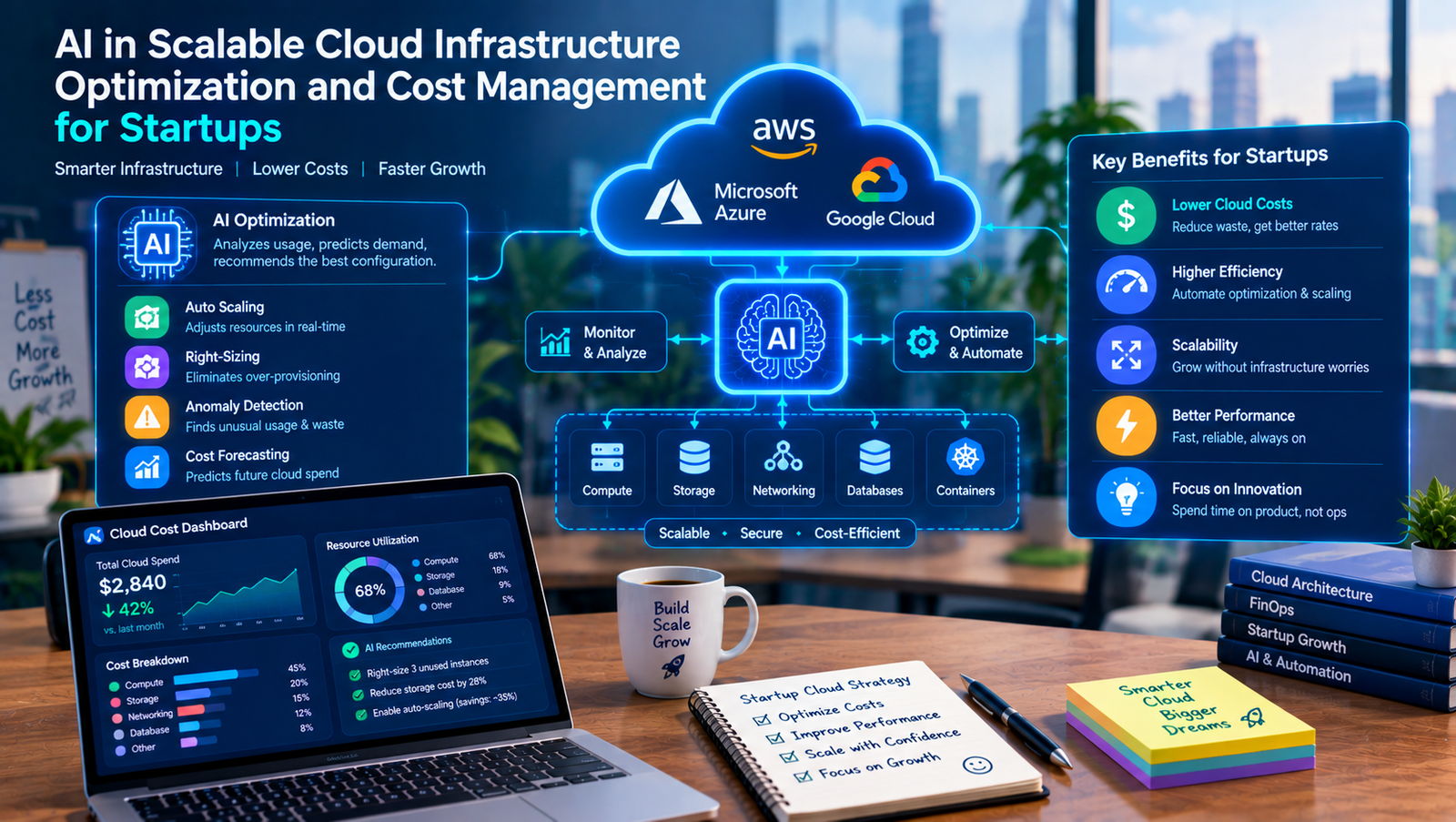
AI-powered infrastructure optimization helps address these problems by turning operational and billing data into predictions, recommendations, and controlled actions.
What AI Cloud Optimization Actually Does
AI cloud optimization uses machine learning, forecasting, anomaly detection, optimization algorithms, and, increasingly, AI agents to improve how infrastructure is provisioned, operated, and paid for.
It can support several connected decisions:
- Forecasting: Predicting future compute, storage, network, and AI workload demand
- Right-sizing: Matching instance sizes, container requests, and database capacity to actual workload needs
- Autoscaling: Adding or removing resources as demand changes
- Cost anomaly detection: Identifying unexpected increases in usage or billing
- Workload placement: Selecting suitable regions, instance types, and execution environments
- Commitment planning: Estimating whether reserved capacity or committed-use discounts are appropriate
- Cost allocation: Connecting infrastructure expenses to products, teams, customers, and features
- Operational recommendations: Suggesting infrastructure changes and preparing reviewable implementation plans
The key distinction is that AI can help decide what should change, while infrastructure controls determine whether and how that change is applied.
Usage, billing, latency, errors
Demand and cost forecasts
Resource and workload choices
Approval and safe execution
Savings, reliability, unit cost
The loop repeats as workloads, prices, product features, and customer demand change. Every optimization should be measured against both financial and service-quality outcomes.
The Cloud Cost Problem: Waste Is Often an Engineering Problem
Cloud waste commonly comes from resources that are too large, remain active when they are not needed, or are allocated without a clear owner. Kubernetes can make this harder because teams may reserve CPU and memory for containers that use only a fraction of the requested capacity.
The FinOps Foundation continues to identify workload optimization and waste reduction as important priorities, while its 2026 findings emphasize that cost management increasingly covers AI, SaaS, data platforms, and other technology spending.
Source: FinOps Foundation, State of FinOps 2026
A 2026 cloud waste report from LevelFour cites external industry research indicating that 27% of cloud spend is self-reported as wasted in the Flexera 2025 State of the Cloud report. It also summarizes a CNCF survey in which 49% of respondents said Kubernetes increased their cloud bill, with over-provisioning identified as a leading reason. These figures describe survey findings, not a guaranteed waste rate for every startup.
Source: LevelFour, The State of Cloud Waste 2026
For an early-stage company, the correct response is not to assume that a fixed percentage of the bill can be removed. The company should measure its own usage, identify the largest cost drivers, and estimate savings without compromising service quality.
Research Study: AI-Driven Resource Allocation in Cloud Computing
A 2026 systematic review published in the journal Computing examined AI-driven resource allocation in cloud environments. The researchers selected 63 studies from an initial collection of 485 papers using a PRISMA-based review process.
The review compared AI-based approaches with traditional resource-management methods across performance, cost, and energy objectives. Among the studies with quantifiable results, the authors reported an average latency reduction of approximately 45% across 10 studies, cost savings averaging 32% across six studies, and energy-efficiency improvements averaging 35% across 16 studies.
These figures should be interpreted carefully. They are averages across selected studies, and the cost result came from only six studies with quantifiable cost data. The reported ranges also varied substantially. A startup should not treat these results as a forecast of its own savings.
The study is valuable because it connects infrastructure optimization to several objectives at once. AI resource allocation is not only about lowering the bill; it can also improve response times and energy use when the model and deployment environment are appropriate.
For startups, the practical lesson is to evaluate optimization strategies using a balanced scorecard that includes cost, latency, reliability, and resource utilization rather than measuring savings alone.
Research Study: Bridging FinOps Practice and Machine Learning Research
A 2026 systematic review in PeerJ Computer Science examined how machine learning research maps to real FinOps capabilities. The author reviewed academic and grey-literature sources and included 75 academic studies alongside four grey-literature sources in the final synthesis.
The review found that research is concentrated in the “Inform” stage of FinOps, including cost forecasting, anomaly detection, reporting, and cost allocation. Forty-two unique articles, representing 56% of the reviewed research corpus, addressed these information-oriented capabilities.
By comparison, fewer studies addressed rate optimization, such as planning reserved instances, choosing spot instances, or optimizing committed-use discounts. The review also found that many automation studies were evaluated in simulated environments, while real production deployment raises additional safety and operational concerns.
This is a significant finding for startups. A dashboard that predicts next month’s cloud bill can help with planning, but it does not automatically reduce costs. The operational value appears when the organization can turn predictions into safe engineering actions.
The review also highlights a measurement problem: many studies do not report business-oriented outcomes consistently. For a startup, an AI optimization project should therefore define measurable results before deployment, including verified savings, implementation cost, time to value, and any change in service quality.
Research Study: Machine Learning-Based Autoscaling for Cloud Orchestration
A 2024 open-access study in the Journal of Grid Computing examined machine-learning-based autoscaling for cloud resource orchestration. The researchers focused on the difficulty of balancing resource consumption with quality-of-service requirements.
Traditional autoscaling often reacts to thresholds such as CPU utilization. That approach is straightforward, but it can respond too late when demand rises quickly or keep unnecessary capacity running after demand falls.
Machine-learning-based autoscaling can use workload history and observed patterns to estimate upcoming demand. The system can then prepare capacity before a traffic increase or reduce resources when demand is expected to decline.
For a startup, predictive scaling may be useful when traffic follows recurring patterns, such as business-hour usage, scheduled data processing, or predictable product launches. It is less reliable when traffic is highly irregular or when the system has little historical data.
The key implementation lesson is to introduce predictive scaling alongside existing safety controls. A model should not be allowed to remove capacity simply because its forecast predicts lower demand. Minimum capacity, scaling limits, health checks, and rollback procedures remain necessary.
Research Study: Predictive Resource Scaling for Cloud Cost Optimization
A 2024 IEEE conference paper, Optimizing Cloud Costs with Machine Learning: Predictive Resource Scaling Strategies, explored predictive resource scaling in an AWS context.
The work discusses using historical workload data to estimate future resource requirements and automate scaling decisions. It identifies over-provisioning, complex pricing, and limited cost visibility as practical problems that predictive scaling can help address.
The relevance to startups is direct: infrastructure should be provisioned according to expected demand rather than relying entirely on fixed capacity. However, forecasts need to be connected to the application’s actual operating constraints.
For example, a web application may need enough compute capacity to absorb a traffic spike, while a batch-processing workload may be able to wait for cheaper capacity. Treating both workloads in the same way can lead to unnecessary expense or poor performance.
The study supports the use of predictive analytics as part of cost-aware cloud management, but it does not establish a universal savings percentage for all startups. Each company should validate the approach against its own workload and billing structure.
Research Study: Intelligent Resource Allocation Using Machine Learning
A 2025 preprint on arXiv proposed a cloud resource-allocation approach combining LSTM-based demand prediction with a Deep Q-Network for dynamic scheduling.
The authors reported improvements in resource utilization, response time, and operating cost in their experimental setting. Specifically, the abstract reports a 32.5% increase in resource utilization, a 43.3% reduction in average response time, and a 26.6% reduction in operating costs.
These results are promising, but they should not be treated as independently verified production benchmarks. The work is a preprint, and its reported outcomes depend on its workload, baseline, experimental design, and evaluation environment.
The research illustrates a useful architecture: one model predicts demand, while a separate decision-making component determines how resources should be allocated. Separating forecasting from resource decisions can make the system easier to evaluate and debug.
A startup considering this approach should test it first in a controlled environment, compare it with its existing autoscaler, and measure whether the improvements persist under realistic traffic patterns.
Research Study: A Systematic Review of AI for Cloud Cost, Resource Management, and Security
A systematic review published in 2026 examined AI and machine learning for cloud cost optimization, resource management, and security. The researchers used a structured review process covering literature from 2020 to 2025 and selected 18 primary studies from an initial pool of 216 records.
The review discusses predictive provisioning, intelligent load balancing, and optimization algorithms as methods for improving resource use. It also connects resource optimization with security, which matters because cost controls can introduce operational risk if they are implemented without appropriate safeguards.
For example, aggressive resource limits may lower compute expenses but increase latency or cause service failures. Similarly, automated infrastructure changes may create security or availability problems if they bypass deployment controls.
The study reinforces a practical principle: infrastructure optimization should be designed as a controlled engineering process, not as an isolated finance exercise. Cost, reliability, security, and operational complexity should be evaluated together.
The numerical results summarized by the review span different methods and experimental settings, so startups should examine the underlying studies before using any particular percentage as a business forecast.
Research Study: Workload Forecasting for Cloud Resource Planning
A 2026 survey in Computer Networks reviewed workload forecasting techniques used in cloud computing. It emphasizes that accurate demand forecasting is central to resource allocation because cloud workloads vary by application type, time, and operating conditions.
Forecasting can help a startup anticipate compute demand, schedule background jobs, plan capacity, and estimate future spending. Different methods may be suitable for different workloads. Time-series models can capture recurring demand, while more complex machine-learning models may help when several signals influence usage.
The survey also highlights the challenge of workload heterogeneity. A model trained on one service may not transfer well to another service with different traffic patterns, latency requirements, or scaling behavior.
For startups, the implication is to forecast at the workload level where possible. A single company-wide prediction may hide important differences between an API, a database, a batch pipeline, and an AI inference service.
Where AI Can Reduce Startup Cloud Costs
Compute and Virtual Machine Right-Sizing
Startups often choose larger instances than they need because capacity is difficult to estimate during early development. AI can analyze CPU, memory, request volume, latency, and historical peaks to recommend instance sizes that better match real demand.
Recommendations should account for peak usage, not only average usage. A service that normally uses 20% of its CPU may still need additional headroom during traffic spikes or deployment events.
Kubernetes Resource Optimization
Kubernetes creates opportunities for optimization because container resource requests and limits influence scheduling and cluster capacity. If teams consistently request far more CPU or memory than applications use, the cluster may need more nodes than necessary.
AI can compare requested resources with observed usage, identify workloads that appear over-provisioned, and recommend safer settings. Any automated adjustment should respect minimum capacity, workload criticality, and service-level objectives.
Database Cost Management
Database costs can rise through oversized instances, unnecessary replicas, inefficient queries, storage growth, and excessive read or write operations. AI can help identify patterns in database utilization and correlate cost changes with application behavior.
The system should not automatically reduce database capacity based only on average utilization. Database performance can depend on memory, I/O, connection counts, query complexity, and workload bursts.
Storage Lifecycle Optimization
AI can classify storage usage patterns and identify data that may be suitable for lower-cost storage tiers. It can also help detect duplicate data, unused snapshots, and abandoned storage resources.
Before moving or deleting data, the system must consider retention requirements, recovery objectives, access frequency, and compliance obligations.
Network and Data Transfer Costs
Data transfer can become a significant expense when applications communicate across regions, availability zones, or external services. AI can help identify unexpected egress growth and recommend architecture changes, caching, or data-locality improvements.
Network recommendations should be evaluated carefully because moving workloads to reduce transfer costs may affect availability, latency, and disaster recovery.
AI and GPU Workload Optimization
Startups building AI products face a different cost profile. Training, fine-tuning, embedding generation, and inference can consume expensive compute resources. The most effective optimization may involve choosing the right model, batching requests, caching repeated outputs, routing simple tasks to smaller models, or scheduling non-urgent jobs during cheaper capacity windows.
The relevant metric is not simply GPU utilization. A startup should measure cost per successful task, response quality, latency, and customer value.
Visual: A Startup Cloud Cost Optimization Map
Measure: Cost per request
Measure: Cost per workload
Measure: Cost per transaction
Measure: Cost per retained GB
Measure: Cost per successful task
Measure: Forecast accuracy and verified savings
Cost Forecasting and Cloud Budget Alerts
Traditional budgets often rely on last month’s bill plus an estimated growth rate. This can be misleading when a startup is launching a new feature, adding customers, running a large model-training job, or changing its data architecture.
AI forecasting can combine several signals:
- Historical spending and usage
- Customer growth and product activity
- Planned releases and infrastructure changes
- Seasonal traffic patterns
- Compute and storage utilization
- Known pricing changes and contract commitments
A useful forecasting system should produce a range rather than a single number. It should also explain the factors behind a forecast, such as expected traffic growth, increased GPU use, or a change in database consumption.
For a startup, forecasts become more useful when they connect to business planning. The company can estimate how infrastructure costs may change as customer count, transactions, or AI usage increases.
Cost Per Customer: The Metric Startups Should Track
A lower cloud bill does not necessarily mean a healthier business. If the bill falls because the product serves fewer customers, the apparent saving may hide a commercial problem.
Startups should connect infrastructure spending to product usage and revenue.
| Metric | Calculation | Why it matters |
|---|---|---|
| Cloud cost per customer | Relevant cloud cost ÷ active customers | Shows whether customer growth is becoming more efficient |
| Cost per transaction | Service cost ÷ completed transactions | Useful for transaction-heavy products |
| Cost per API request | API infrastructure cost ÷ requests | Helps track service efficiency |
| Cost per AI task | Model and infrastructure cost ÷ successful tasks | Connects AI usage to unit economics |
| Cloud cost as a share of revenue | Cloud cost ÷ revenue | Shows how infrastructure affects gross margin |
These metrics require consistent allocation. Shared infrastructure should be assigned using a documented method, such as usage, requests, storage, or compute time. Otherwise, teams may compare numbers that are not calculated in the same way.
AI Agents for Cloud Cost Management
AI agents can extend cost optimization beyond dashboards and recommendations. An agent may investigate a cost spike, identify the services responsible, inspect recent infrastructure changes, and prepare a proposed fix.
For example, an agent could detect a sharp increase in storage costs, identify a large number of old snapshots, check the relevant retention policy, and prepare a change for an engineer to review.
A safe agent workflow should separate analysis from execution.
↓
Agent gathers billing and usage evidence
↓
Agent proposes a change
↓
Policy and impact checks
↓
Human approval for material changes
↓
Controlled deployment and monitoring
For startups, the first useful agent is usually one that explains and prepares changes rather than one that has unrestricted permission to modify production infrastructure.
FinOps Automation and Cloud Cost Governance
FinOps connects engineering, finance, product, and leadership around the value of technology spending. AI can help by improving forecasting, identifying anomalies, and translating complex billing data into explanations that non-engineering teams can understand.
The FinOps Foundation’s 2026 report describes the discipline as moving beyond cloud bills toward broader technology value management. It also highlights growing interest in applying AI to FinOps itself, alongside the need to manage the cost of AI workloads.
Source: FinOps Foundation, State of FinOps 2026
A startup does not need a large FinOps department to adopt the core practices. It can begin with clear ownership, consistent tags, budgets, alerts, and a monthly review of major cost changes.
AI becomes more useful once the data is organized. Poor tagging, inconsistent service names, and missing ownership can make even sophisticated models produce weak recommendations.
Recommended AI Cloud Architecture for Startups
This architecture keeps AI recommendations connected to operational evidence and business outcomes. It also makes it easier to replace a model without rebuilding the entire cost-management system.
Risks of AI-Based Cloud Optimization
| Risk | Possible impact | Control |
|---|---|---|
| Incorrect demand forecast | Under-provisioning or unnecessary capacity | Forecast ranges, minimum capacity, and fallback scaling |
| Unsafe automation | Outages or degraded performance | Approval gates, staged rollouts, and rollback plans |
| Bad cost allocation | Incorrect product or customer economics | Consistent tagging and documented allocation rules |
| Model drift | Recommendations become less reliable | Monitoring and periodic revalidation |
| Savings overestimated | Misleading business cases | Measure realized savings against a baseline |
| Security and access risk | Unauthorized infrastructure changes | Least-privilege permissions and auditable actions |
Expert Recommendation
Startups should treat AI cloud optimization as an engineering and financial discipline, not as a tool purchase.
The recommended approach is to establish cost visibility first, then automate the decisions that are both measurable and reversible. AI should be introduced where it improves a defined process, such as forecasting demand, finding anomalies, or recommending resource sizes.
Practical recommendations:
- Begin with the largest three cost drivers instead of trying to optimize every service at once
- Track cloud cost per customer, transaction, or successful AI task
- Use existing cloud billing exports and monitoring data before building a custom AI platform
- Apply rightsizing recommendations in stages and compare them with a baseline
- Keep minimum capacity and service-level objectives outside the model’s control
- Require approval for high-impact changes to databases, networking, security, and production capacity
- Measure realized savings after the cost of the optimization tool and engineering work
- Review commitment discounts only after demand and architecture are sufficiently stable
- For AI products, optimize model selection, inference volume, caching, and batching alongside infrastructure
- Review cost and reliability together so that savings do not hide product degradation
The FinOps Foundation’s 2026 direction is a useful guiding principle: technology cost management should help organizations understand and improve the value they receive from technology, not simply minimize spending.
Source: FinOps Foundation, State of FinOps 2026
Expert Perspective
The FinOps Foundation’s updated mission reflects a broader goal than reducing cloud bills. For startups, the practical interpretation is to connect infrastructure spending with product performance, customer outcomes, and sustainable growth.
Implementation Roadmap for Startups
Foundation: Establish Visibility
Start by exporting billing data and connecting it to usage metrics. Standardize resource tags for environment, service, team, and product. Identify unallocated costs and create a baseline for the current month.
Measurement: Define Business Metrics
Choose a small set of metrics that match the business model. A SaaS startup may track cost per active customer and cost per tenant, while an AI startup may track cost per inference or completed workflow.
Optimization: Apply Low-Risk Changes
Begin with idle resources, oversized development environments, unnecessary storage, and workloads that can be scheduled outside peak periods. These changes are easier to validate than automated modifications to critical production systems.
Prediction: Introduce AI Forecasting
Use historical usage to forecast spending and capacity. Compare the model with a simple baseline, such as a moving average or existing threshold policy. Keep the model only if it provides measurable value.
Automation: Add Guarded Execution
Automate only actions that have clear limits and reliable rollback procedures. For example, a system may safely scale a stateless service within predefined minimum and maximum capacity while requiring approval for a database class change.
Continuous Improvement: Review Value
Review savings, reliability, performance, and unit economics every month. Update the model and policies when the product, customer mix, or infrastructure architecture changes.
Key Performance Indicators
| KPI | What it measures | Review frequency |
|---|---|---|
| Cloud cost per customer | Infrastructure efficiency as the customer base grows | Monthly |
| Forecast error | Difference between predicted and actual spend | Weekly or monthly |
| Verified savings | Real reduction compared with a defined baseline | Monthly |
| Latency and availability | Whether optimization affects service quality | Continuous |
| Resource utilization | How effectively provisioned resources are used | Daily or weekly |
| Optimization rollback rate | How often changes need to be reversed | Monthly |
Future Predictions: 2027–2030
2027: Cost-Aware Engineering Becomes More Automated
Cloud tools will increasingly connect cost recommendations to infrastructure-as-code workflows. Rather than simply displaying an oversized resource, platforms will prepare a proposed change that engineers can review, test, and merge.
For startups, this could make cost management part of normal development rather than a separate monthly finance task.
2028: AI Workload Economics Become a Core FinOps Function
As startups deploy more AI features, cloud cost management will need to account for model inference, GPU utilization, vector databases, data pipelines, and model-routing decisions. Cost per successful task will become more useful than infrastructure spend alone.
2029: Predictive Infrastructure Planning Becomes More Contextual
Forecasting systems will increasingly combine infrastructure metrics with product usage, release schedules, and business forecasts. This should help teams estimate the financial impact of launching a feature or onboarding a large customer before the associated infrastructure is deployed.
2030: Guarded Autonomous Optimization Expands
AI agents may handle more routine infrastructure tasks, including anomaly investigation, resource recommendations, cost allocation, and selected low-risk changes. However, production autonomy will depend on reliable policies, observability, testing, and rollback mechanisms.
The likely direction is not unrestricted AI control of cloud infrastructure. It is controlled autonomy for well-defined tasks, with human approval for changes that carry material reliability, security, or financial risk.
Frequently Asked Questions
What is AI cloud infrastructure optimization?
AI cloud infrastructure optimization uses machine learning and related techniques to improve resource allocation, forecasting, autoscaling, workload placement, and cloud cost management. The goal is to reduce unnecessary spending while maintaining performance, availability, and security.
How can AI reduce cloud costs for startups?
AI can identify oversized resources, predict workload demand, detect unexpected spending, recommend storage changes, and improve autoscaling. The actual savings depend on the startup’s architecture, usage patterns, pricing, and ability to implement recommendations safely.
Can AI automatically manage cloud infrastructure?
AI can automate selected tasks, but production changes should operate within strict limits. Startups should use least-privilege permissions, monitoring, approval gates, and rollback procedures, particularly for databases, security settings, and critical services.
Is AI cloud optimization useful for small startups?
Yes, but the approach should match the company’s size. Early-stage startups can begin with billing alerts, tagging, simple forecasting, and a few targeted optimizations before investing in a custom AI platform.
What is the difference between FinOps and AI cloud optimization?
FinOps is the broader practice of connecting technology spending with business value through collaboration between engineering, finance, and product teams. AI cloud optimization is a set of technologies that can support FinOps through forecasting, anomaly detection, resource recommendations, and automation.
How should a startup measure cloud cost optimization?
Measure verified savings alongside cost per customer, cost per transaction, latency, availability, resource utilization, and rollback rates. A lower bill is not a successful outcome if it causes service degradation or prevents the product from scaling.
Should startups build their own AI cloud cost management system?
Most startups should first use native cloud billing tools and established FinOps practices. A custom system becomes more attractive when the company has complex workloads, significant AI infrastructure costs, multi-cloud requirements, or cost-allocation needs that existing tools cannot address.
Final Perspective
AI-powered cloud optimization can help startups build infrastructure that scales with demand without allowing costs to grow unchecked. Its value comes from connecting operational signals, financial data, and engineering decisions.
The research points to real opportunities in predictive resource allocation, autoscaling, cost forecasting, and intelligent workload management. At the same time, the evidence shows that results vary across environments, many studies use simulated or narrowly defined workloads, and business outcomes are not always measured consistently.
Startups should therefore avoid treating published savings percentages as guaranteed results. The more reliable approach is to establish a baseline, select a specific cost problem, test an intervention, and measure its effect on both spending and service quality.
The most effective strategy combines:
For an early-stage company, this may begin with simple billing alerts and resource rightsizing. As the product grows, the same foundation can support predictive scaling, AI workload optimization, automated recommendations, and carefully controlled execution.
The objective is not to make infrastructure as cheap as possible. It is to make infrastructure economically sustainable, operationally reliable, and ready to support the next stage of growth.
Research Sources
- AI-Driven Resource Allocation in Cloud Computing: A Systematic Review Revealing Critical Sustainability and Evaluation Gaps, Computing, 2026
- Anjum, Bridging FinOps Practice and Machine Learning Research: A Systematic Review of Cloud Cost Optimization, PeerJ Computer Science, 2026
- Pintye, Kovács and Lovas, Enhancing Machine Learning-Based Autoscaling for Cloud Resource Orchestration, Journal of Grid Computing, 2024
- IEEE, Optimizing Cloud Costs with Machine Learning: Predictive Resource Scaling Strategies, 2024
- Wang and Yang, Intelligent Resource Allocation Optimization for Cloud Computing via Machine Learning, arXiv, 2025
- AI-Driven Optimization in Cloud Computing: A Systematic Review of Cost, Resource Management, and Security, 2026
- Kaviani, Asghari and Sabeti, A Comprehensive Survey and Taxonomy of Workload Forecasting Techniques in Cloud Computing, Computer Networks, 2026
- FinOps Foundation, State of FinOps 2026
- LevelFour, The State of Cloud Waste 2026

Leave a Reply