
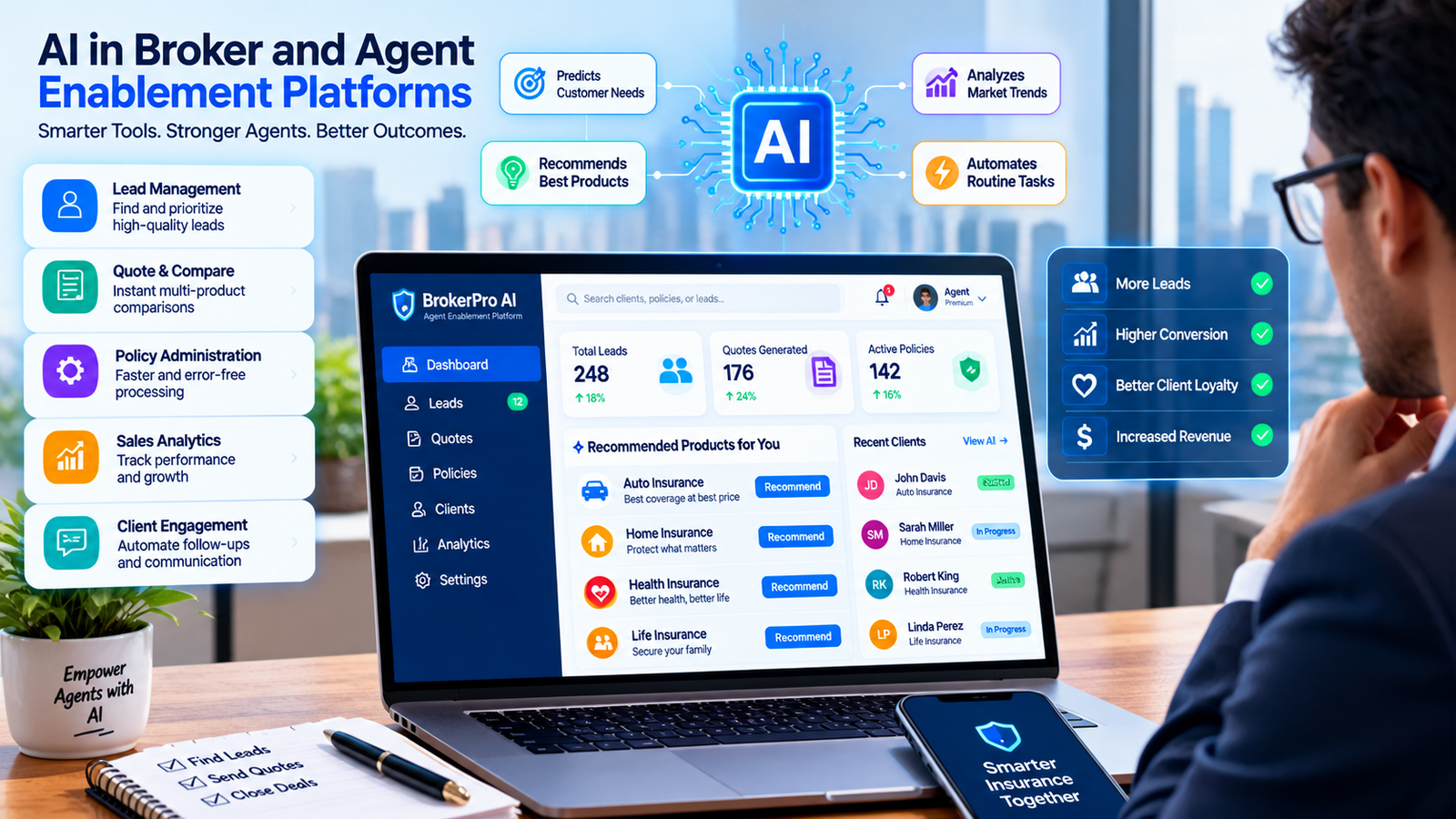
Primary topic: AI in Broker and Agent Enablement Platforms
Research focus: AI-powered broker and agent CRM, lead qualification, product matching, insurance quoting, client intelligence, sales enablement, renewal management, commission analytics, workflow automation, compliance support and agent productivity
What Are AI-Powered Broker and Agent Enablement Platforms?
Broker and agent enablement platforms help professionals manage the work involved in finding clients, understanding their needs, recommending products, preparing proposals, completing applications and maintaining long-term relationships. Depending on the industry, users may include insurance agents, insurance brokers, mortgage brokers, investment advisers, financial product distributors and other regulated intermediaries.
Traditional platforms commonly provide customer relationship management, lead tracking, document storage, communication history, quoting tools, sales pipelines and reporting. AI adds capabilities that help users interpret information, predict likely outcomes and complete tasks across these systems.
For example, an insurance broker may receive a large collection of policy documents, emails, renewal records and customer messages before preparing a recommendation. An AI-enabled platform can extract relevant information, compare coverage terms, identify missing details and prepare a structured summary. The broker can then verify the findings and discuss suitable options with the customer.
The difference is important: a traditional CRM records what happened, while an AI-enabled platform can help the professional understand what happened, decide what needs attention and prepare the next action.
Why Broker and Agent Workflows Need AI
Many brokers and agents spend a significant part of their working day on activities that do not directly involve advising customers. These include copying information between systems, reviewing lengthy documents, preparing quotations, updating CRM records, chasing missing information and checking renewal dates. When these tasks are spread across disconnected tools, even experienced professionals can lose time and overlook important details.
AI can help reduce this friction, but the opportunity varies by workflow. Document extraction and meeting summaries are generally easier to automate than suitability decisions, complex coverage recommendations or regulated financial advice.
Find opportunities
Identify promising leads, dormant accounts and upcoming renewals
Understand clients
Summarize conversations, needs, documents and previous interactions
Prepare recommendations
Compare products and surface relevant differences for professional review
Manage relationships
Support follow-ups, renewals, service requests and retention
The business objective is not to maximize the number of AI features. It is to improve the quality and speed of important work while maintaining appropriate controls.
Research Study: AI Adoption in Insurance Distribution and Agent Workflows
A 2026 research report from Cake & Arrow, titled The Connective Thread: From Agent and Broker Research to a New Design Vision for AI-Enabled Insurance Work, examined the experiences of 16 insurance agents and brokers across 13 US states. Participants represented different roles, business environments, and levels of professional experience.
The research identified four recurring themes: AI was spreading without a clear organizational roadmap, users were seeing efficiency gains but often using AI in limited ways, agents wanted better integration rather than simply more automation, and human expertise remained central to the work.
The sample was qualitative and relatively small, so it should not be treated as a representative estimate of AI adoption across the entire insurance industry. Its value lies in explaining why adoption can fail even when the underlying technology is capable. A tool that requires agents to leave their CRM, copy customer information into another application and manually transfer the results may add work instead of removing it.
For platform developers, the implication is to design around the agent’s existing workflow. AI should appear where the user already reviews a client, prepares a quote or handles a renewal. It should also preserve the context of the customer relationship instead of generating isolated outputs that must be manually re-entered.
What this research means for product teams:
- Connect AI to the systems agents already use
- Reduce duplicate data entry and repeated searches
- Make recommendations available inside the relevant workflow
- Keep the agent in control of customer-facing decisions
- Measure adoption and completed work, not just AI feature usage
Source: Cake & Arrow, 2026 research on AI for insurance agents and brokers
Research Study: Generative AI and CRM Performance
A 2026 study published in the Journal of Innovation & Knowledge examined generative AI-enabled CRM and sales-unit performance. The researchers collected survey data from 127 CRM professionals in France who had direct experience with generative AI-enabled CRM systems.
The study did not find a direct association between the implementation of generative AI CRM and sales-unit performance. Instead, the relationship operated indirectly through users’ perceptions of system quality and their acceptance and use of the technology. The authors also explored whether adoption duration and firm size changed the relationship, but some of those findings were limited or inconclusive.
This is a useful result for broker enablement platforms because it challenges the assumption that adding generative AI automatically improves sales. An AI assistant may be technically impressive but deliver little value if its answers are unreliable, its recommendations lack context or agents do not trust it enough to use it.
The study was based on a specific professional sample and self-reported, cross-sectional data. It therefore does not prove that the same effects will occur in every brokerage or establish a universal return on investment. However, it provides a clear product-design lesson: perceived quality and actual adoption are important links between AI implementation and business performance.
Practical implications:
- Measure whether AI-generated summaries and recommendations are accurate
- Track repeat usage by workflow and user group
- Collect feedback when agents reject or edit AI outputs
- Improve the underlying CRM data before expanding AI features
- Connect usage metrics to business outcomes such as response time and quote completion
Source: Journal of Innovation & Knowledge, GAI-enabled CRM and sales unit performance, 2026
Research Study: AI Agents in Financial Services Customer Engagement
Gartner’s March 2026 research, Drive Customer Engagement and Product Discovery With AI Agents in Financial Services, examined the emerging role of AI agents in helping customers discover and consume financial products.
Its central strategic observation is that customers will increasingly use agents to explore financial products and services. Financial institutions may therefore need to make their products understandable and discoverable by third-party AI agents. Gartner also noted that the business case for building proprietary customer-facing agents may be stronger for the largest institutions than for every provider.
For broker and agent platforms, this creates two related opportunities. First, internal AI assistants can help professionals search product information and prepare client recommendations. Second, structured product information can make a brokerage’s offerings easier for external digital assistants and discovery systems to interpret.
The distinction between these two uses matters. An internal agent works with authorized customer records and business systems. A public-facing product discovery experience must rely on approved product information and should not expose private client data.
Product implications:
- Make product eligibility, fees, exclusions and key terms available in structured formats
- Maintain current product information and clear source references
- Separate public product discovery from private client servicing
- Require suitability checks before turning product discovery into a recommendation
- Build controls for how third-party agents access product information
Research Study: Agentic AI Adoption Across Financial Institutions
An August 2026 analysis from S&P Global Market Intelligence reported findings from a survey of 628 global financial institutions. It stated that 52% of respondents were already piloting agentic AI or had reached a more advanced deployment stage.
This finding concerns financial institutions broadly, rather than broker and agent platforms alone. It should not be interpreted as meaning that 52% of brokers are using autonomous AI in production. Nevertheless, it signals that financial organizations are exploring systems that can do more than generate text.
For broker platforms, agentic AI could coordinate a sequence of bounded tasks. For example, after a customer requests a renewal review, an AI workflow might retrieve the current policy, gather recent service history, identify missing information, prepare a comparison and create a review task for the broker.
The critical design decision is where the AI’s authority ends. Retrieving documents and preparing a draft are different from changing coverage, submitting an application, binding a policy or communicating a regulated recommendation. These actions should have distinct permissions and approval requirements.
What platform builders should take from this research:
- Use AI agents for coordinated, multi-step workflows with clear boundaries
- Give each agent only the system permissions needed for its task
- Require approval for consequential customer or financial actions
- Record the inputs, tool calls, outputs and approvals associated with each workflow
- Provide a reliable way to stop, reverse or escalate an action
Source: S&P Global Market Intelligence, Data’s Radical New Role in the Era of Agentic AI, August 2026
Research Study: AI and Adviser Productivity in Financial Services
Deloitte’s 2026 analysis of agentic AI in wealth management explored how AI can change the amount of work financial advisers can handle. It described different stages of adoption, from basic assistive tools to copilots embedded in workflows and systems that allow bounded delegation.
The analysis estimated productivity uplift of roughly 32% in an early stage and around 57% in a more developed stage. These figures are Deloitte’s modeled estimates for wealth-management adviser capacity, not universal measured results for insurance brokers or all agent platforms. They should be treated as scenario-based evidence rather than a guaranteed productivity improvement.
The more important insight is that productivity depends on several factors working together. Advisers need to adopt the technology, firms need to redesign workflows and controls, and the technology stack must support integration. AI tools operating on fragmented records and disconnected systems may struggle to deliver the same benefits as tools embedded in the adviser workflow.
For broker platforms, the lesson is to improve the entire process rather than optimize one isolated task. A meeting summary has limited value if the resulting actions are not added to the CRM, assigned to the right person and tracked through completion.
Platform design implications:
- Connect meeting notes, tasks, client records and follow-up workflows
- Measure end-to-end completion time, not only time saved on one activity
- Track whether AI creates more capacity for client-facing work
- Give managers visibility into quality and exceptions, not just activity volume
- Keep advice, suitability and other consequential decisions under appropriate professional control
Source: Deloitte, Agentic AI Boosts Wealth Management, 2026
Research Study: AI Agents, Reliability and Financial Decision-Making
A 2025 paper presented at the ACM International Conference on AI in Finance reviewed large language model agents for investment management. The authors examined applications such as portfolio optimization, risk management, information retrieval and automated strategy generation, alongside architectural approaches including multi-agent collaboration, reflection and tool-augmented pipelines.
The paper identified ongoing challenges involving robustness, explainability and real-world deployment. Although investment management is not identical to insurance or general brokerage, the findings are relevant to platforms that use AI to interpret financial information or support regulated professional decisions.
A language model can produce a fluent explanation while misunderstanding a product term, relying on outdated information or overlooking a constraint. In a broker workflow, that can lead to an inaccurate comparison, an unsuitable product shortlist or a misleading customer communication.
The appropriate response is not to avoid language models. It is to pair them with controlled data retrieval, structured calculations, clear permissions and verification steps. The model should explain information from approved sources rather than invent product details or calculate important financial values without a reliable tool.
Practical controls:
- Retrieve policy and product terms from approved, current sources
- Use deterministic software for premiums, fees, commissions and financial calculations
- Show citations or document references beside material claims
- Test outputs against realistic edge cases and difficult customer scenarios
- Require human review when a mistake could affect customer rights or financial outcomes
Where AI Creates the Most Value in Broker and Agent Platforms
The research points toward workflow integration, reliable information and controlled delegation. Those principles become more concrete when applied to specific brokerage tasks.
| Workflow | AI capability | Expected operational value | Human control |
|---|---|---|---|
| Lead qualification | Summarize lead details and identify missing information | Faster prioritization | Agent validates priority and outreach |
| Product matching | Compare customer needs with approved product criteria | More consistent shortlists | Professional suitability review |
| Quoting | Extract application data and prepare quote requests | Less manual entry | Verify inputs and carrier results |
| Client meetings | Transcribe, summarize and create follow-up tasks | Better continuity | Review notes and commitments |
| Renewals | Detect upcoming renewals and prepare account summaries | Earlier, more consistent outreach | Approve retention strategy |
| Compliance | Check files for missing records and inconsistent fields | Fewer avoidable omissions | Compliance team resolves exceptions |
| Commission reconciliation | Match statements against policy and payment records | Faster discrepancy detection | Finance confirms adjustments |
AI Lead Scoring and Opportunity Prioritization
Brokerages often receive leads from websites, referrals, comparison services, marketing campaigns and existing customers. Not every lead has the same needs, urgency or likelihood of converting. AI can combine information such as the requested product, customer interactions, response history, renewal dates and previous outcomes to help agents decide which opportunities need attention.
A useful lead-scoring system should do more than assign a number. It should explain the main factors behind a recommendation and identify what information is missing. For example, a lead may be marked as high priority because the customer has requested a quote, supplied the required details and asked for a callback. Another may need a clarification before an accurate quote can be prepared.
The system should avoid using sensitive or protected characteristics in ways that create unfair treatment. It should also be tested for differences in performance across relevant customer groups and lead sources.
Illustrative AI lead-priority model
This is a conceptual example, not a validated scoring formula.
The bar lengths are illustrative only. Actual feature weights must be established through testing and governance.
AI Product Matching and Recommendation Support
Product matching is one of the most commercially important but sensitive uses of AI in brokerage. A customer may care about price, coverage, exclusions, eligibility, service quality, flexibility and long-term cost. A system that ranks products only by price can miss the reason the customer needs advice in the first place.
An AI-enabled platform should translate customer requirements into a structured set of needs, retrieve current product information and compare the relevant terms. It should distinguish confirmed facts from missing information and explain why a product appears in the shortlist.
For insurance, this could include coverage limits, exclusions, deductibles, waiting periods, renewal conditions and eligibility rules. For mortgage or investment brokers, the relevant factors will differ, but the underlying design principle remains the same: recommendations must be grounded in accurate product data and the customer’s stated circumstances.
A responsible workflow looks like this:
↓
Structured Needs Profile
↓
Approved Product Data
↓
Eligibility and Constraint Checks
↓
AI-Assisted Comparison
↓
Broker Review and Explanation
↓
Customer Decision
AI should not silently fill gaps in a customer’s profile or present an unverified product as suitable. When the available information is incomplete, asking a follow-up question is often the correct next action.
AI-Powered Quoting and Application Preparation
Quoting often involves extracting information from forms, emails, existing policies, spreadsheets and customer documents. AI can reduce manual work by converting unstructured information into fields that quoting systems can use.
For example, an AI document-processing workflow could extract the customer’s address, coverage requirements, property details or business information from an application. A validation layer could then compare those fields with required inputs and flag inconsistencies before the quote request is submitted.
The most reliable architecture separates language understanding from calculations and carrier decisions. AI can interpret a document and prepare the request, while the quoting engine or carrier system calculates the premium and returns the actual terms.
This division reduces the risk of a language model inventing a premium, miscalculating a fee or presenting a hypothetical quote as an official offer.
AI for Renewal Management and Customer Retention
Renewals are especially suitable for workflow intelligence because they involve dates, policy records, customer history and repeated service tasks. AI can identify accounts approaching renewal, summarize recent customer interactions, highlight changes in coverage and prepare a checklist for the broker.
The platform can also detect signals that an account may need attention, such as unresolved service requests, repeated complaints, missing documents or a customer who has not responded to renewal communications. These signals should prompt a review rather than automatically label a customer as likely to leave.
A renewal assistant could prepare a short account brief containing:
- Current product and renewal date
- Changes in price, coverage or terms, where verified data is available
- Recent customer requests and unresolved issues
- Missing information needed for a renewal review
- Suggested next steps for the assigned broker
This is a more useful approach than sending automated messages to every customer on the same schedule. AI can help make the timing and content of outreach more relevant while allowing the broker to decide how to handle the relationship.
AI Commission Analytics and Revenue Operations
Broker and agent platforms can also use AI to reconcile commission statements, policy records and expected payments. This is a different problem from generating customer-facing content. It depends on accurate data extraction, matching rules and reliable financial calculations.
AI can extract values from commission statements and suggest matches with policy records. A deterministic reconciliation engine should then calculate discrepancies and apply the relevant business rules. Unmatched or unusual entries can be routed to finance staff for review.
Useful capabilities include:
- Extracting commission data from carrier statements
- Matching payments with policies and producers
- Identifying missing or duplicated entries
- Flagging unexpected changes in renewal commissions
- Explaining why a record failed to reconcile
- Maintaining an audit trail for adjustments
The system should never change financial records solely because an AI model predicts that a value is incorrect. It should show the evidence, explain the discrepancy and route the proposed correction through the appropriate approval process.
AI Architecture for Broker and Agent Enablement
A robust platform needs more than a language model connected to a CRM. It needs a data layer, integration services, controlled AI tools, workflow orchestration and governance.
CRM, inbox, client timeline and task panel
Permissions, approvals, task routing and audit logs
Summarization, extraction, classification
Quotes, calculations and eligibility
Approved products and policy documents
CRM, carrier APIs, document storage, communication and commission systems
Identity, access controls, monitoring, retention and model evaluation
The architecture should enforce access controls at the data and tool layers, not merely instruct the AI model to behave safely. A user should only retrieve customer records they are authorized to access, and an AI agent should not gain broader permissions than the user or workflow requires.
Implementation Roadmap
Start With One High-Frequency Workflow
Begin with a task that occurs often, has measurable effort and can be checked against a reliable source of truth. Meeting summaries, document extraction, renewal preparation and CRM updates are useful candidates because their outputs can be reviewed before consequential actions occur.
Connect the Data Before Adding More Models
Map the systems that hold customer information, product terms, quote results, communication history and policy records. Define which system is authoritative for each field. Resolve duplicate customer records and establish rules for handling outdated or conflicting information.
Introduce AI With Clear Boundaries
Start with read-only retrieval and draft generation. Add write actions only when the platform can validate the output, record the change and support approval or rollback. Keep pricing calculations and eligibility decisions in the systems designed to perform them.
Run a Controlled Pilot
Compare the AI-assisted workflow with the existing process. Measure completion time, correction rates, missed fields, user adoption and customer impact. Include difficult cases, not only straightforward examples, and test performance across different user groups.
Scale Based on Evidence
Expand to additional workflows only when the pilot demonstrates reliable results. Maintain ongoing monitoring because product terms, carrier integrations, customer behavior and model performance can change over time.
KPIs for AI Broker and Agent Platforms
| KPI | What it measures | Why it matters |
|---|---|---|
| Time to prepare a quote | Elapsed time from complete information to quote request | Measures workflow efficiency |
| AI correction rate | Share of outputs requiring material correction | Measures reliability |
| Lead response time | Time between lead arrival and meaningful response | Measures responsiveness |
| Renewal completion rate | Share of eligible renewals completed within the target period | Measures process consistency |
| Agent adoption | Repeat use of relevant AI workflows | Measures practical acceptance |
| Customer outcome | Relevant service, retention or satisfaction measure | Checks whether efficiency improves service |
| Compliance exception rate | Share of cases requiring correction or escalation | Measures control effectiveness |
Targets should be set using a baseline from the organization’s own operations. Generic claims about time saved or conversion improvements should not be used as guaranteed business outcomes.
Risks and Governance Requirements
AI can introduce errors into customer records, misinterpret product terms, produce misleading summaries or prioritize customers in ways that are difficult to explain. These risks become more serious when a system can send communications, change records, submit applications or influence regulated recommendations.
A responsible platform should include the following controls:
- Data privacy: Limit access to personal and financial information, apply retention rules and prevent unauthorized use of customer data
- Accuracy: Ground answers in current approved sources and show where important information came from
- Fairness: Test lead scoring and recommendations for unjustified differences across customer groups
- Human oversight: Require appropriate review for suitability, coverage, financial and other consequential decisions
- Security: Protect integrations, credentials, model tools and customer records from unauthorized access
- Auditability: Record relevant inputs, outputs, approvals and changes to customer or financial records
- Model monitoring: Track errors, drift, complaints and changes in workflow performance
For US-facing insurance platforms, the applicable requirements depend on the product, state, distribution model and activity being performed. Organizations should assess relevant insurance, privacy, consumer-protection and recordkeeping obligations rather than assume that one AI policy covers every use case.
Expert Recommendation
Build an AI-enabled broker workspace around the customer relationship and the complete task, not around a collection of disconnected AI features.
The first priority should be reliable access to customer, product and workflow data. The second should be a small set of high-frequency tasks where AI can produce verifiable outputs. The third should be controlled automation that moves work between systems while preserving human approval for important decisions.
A practical product strategy is to organize capabilities into three levels:
AssistSummarize records, search approved documents, extract fields and draft communications
Initial priority
RecommendCompare products, prioritize leads, identify renewal risks and explain suggested next steps
Require review
ExecuteUpdate records, create tasks, send approved messages and coordinate multi-step workflows
Use bounded permissions
This staged approach gives the organization a way to build trust before allowing AI to take more consequential actions. It also makes it easier to evaluate each capability against a clear business outcome.
Expert Quotation
In discussing AI for insurance distribution, Cake & Arrow’s research emphasizes the importance of designing technology around how agents actually work. Its published discussion states:
“Technology doesn’t roll itself out.”
Source: Cake & Arrow, research on AI-enabled insurance work, 2026
The point is that AI value does not come from installation alone. Teams need useful workflows, reliable information, training, clear ownership and controls. A platform can have advanced models and still fail if agents do not trust the results or cannot fit them into their daily work.
Future Predictions for 2027–2030
2027: AI Moves From Separate Assistant to Embedded Workspace
Broker platforms are likely to place AI directly inside customer records, quote preparation, policy review and renewal workflows. The main product differentiator will increasingly be how well the platform connects data and actions, rather than which model it uses.
2028: Bounded AI Agents Coordinate Multi-Step Work
More platforms are likely to introduce agents that can retrieve documents, prepare comparisons, create tasks and update records across connected systems. High-impact actions such as binding coverage, changing financial instructions or issuing regulated recommendations will continue to require stronger permissions and review.
2029: Product Data Quality Becomes a Competitive Advantage
As AI assistants become better at answering product questions, platforms with structured, current and well-governed product data will have an advantage. Incomplete or inconsistent carrier data will limit the quality of recommendations regardless of model capability.
2030: Financial Product Discovery Becomes More Agent-Mediated
Customers may increasingly use general-purpose AI assistants to research products before contacting a broker. Broker platforms will need clear, machine-readable product information and reliable ways to distinguish general product education from personalized recommendations. Gartner’s 2026 research points to this direction, although the pace and commercial impact remain uncertain.
Startup Opportunities
The market offers opportunities for specialized products that solve a defined brokerage problem rather than attempting to replace every system at once.
- AI Broker Copilot: A workspace assistant that summarizes client history, prepares meetings and creates follow-up tasks
- AI Quoting Assistant: A document extraction and application preparation layer connected to carrier quoting systems
- Policy Comparison Engine: A source-grounded tool that compares coverage, exclusions, fees and renewal terms
- Renewal Intelligence Platform: A system that identifies upcoming renewals, missing information and accounts needing attention
- Commission Reconciliation AI: A tool that extracts statements, matches records and flags payment discrepancies
- Brokerage Workflow Agent: A permission-controlled agent that coordinates approved tasks across CRM, email and document systems
- AI Compliance File Checker: A platform that identifies missing records, inconsistent fields and incomplete application files
- Product Data Infrastructure: APIs that normalize product terms and make them searchable by internal and external AI systems
A particularly practical entry point is a vertical-specific copilot for one brokerage segment. A product focused on commercial insurance submissions, mortgage document preparation or employee-benefits renewals can use domain-specific data and workflows to deliver more useful results than a generic assistant.
Frequently Asked Questions
What is an AI broker and agent enablement platform?
An AI broker and agent enablement platform combines customer relationship management, product information, workflow automation and AI tools to help professionals manage leads, prepare quotes, support client conversations, handle renewals and complete administrative tasks
How does AI help insurance brokers?
AI can summarize policy documents, extract application details, compare product terms, prepare quote requests, prioritize follow-ups and identify upcoming renewals. The broker should verify important information and remain responsible for regulated recommendations and consequential customer decisions
Can AI replace brokers and agents?
AI can automate or assist with many repetitive tasks, but complex customer needs, product suitability, negotiation, relationship management and professional accountability still require human involvement. The likely direction is a mix of automation and human expertise rather than a single model replacing every role
What is the difference between an AI copilot and an AI agent?
An AI copilot primarily helps a user by searching, summarizing, drafting or recommending. An AI agent can also execute a sequence of tasks through connected tools. Agents therefore need stronger permission controls, monitoring, audit trails and approval rules
What data does an AI broker platform need?
Depending on the workflow, it may need customer records, communication history, product terms, policy documents, quote results, renewal dates, carrier information and commission records. Access should be limited to data required for the task
How should a brokerage measure AI ROI?
Measure the change in end-to-end task time, correction rates, lead response time, quote completion, renewal completion, customer outcomes and compliance exceptions. Compare results with a reliable pre-AI baseline and include implementation, integration and ongoing operating costs
What is the biggest challenge in implementing AI for brokers?
A major challenge is connecting fragmented systems and maintaining reliable data. Poor integration can create duplicate work, while inaccurate product information or weak controls can make AI outputs unsafe to use
Final Perspective
AI is changing broker and agent enablement from a record-keeping function into a more active layer of professional work. It can help agents understand customer needs, prepare information, compare products, manage renewals and coordinate tasks across the systems they already use.
The research reviewed here points to a consistent conclusion. AI performance depends on more than model capability. Qualitative research with agents and brokers highlights the need for integration and human expertise. A study of generative AI-enabled CRM suggests that perceived quality and user adoption are important links to performance. Gartner’s financial-services analysis points toward AI-mediated product discovery, while broader financial-institution research shows growing interest in agentic systems. Deloitte’s wealth-management analysis further illustrates how workflow redesign and technology readiness influence potential productivity gains.
These findings do not establish one universal productivity figure for broker platforms. The evidence spans different populations, methods and business contexts. Each platform should validate its own results through controlled pilots and ongoing monitoring.
The most durable product strategy is to build around a few principles:
The strongest platforms will not be those with the largest number of AI features. They will be those that help professionals complete important work accurately, serve customers consistently and make better use of their time, while keeping financial and customer decisions appropriately controlled.
Research Sources
- Cake & Arrow, The Connective Thread: Research on AI for Insurance Agents and Brokers, 2026
- Journal of Innovation & Knowledge, GAI-Enabled CRM and Sales Unit Performance, 2026
- Gartner, Drive Customer Engagement and Product Discovery With AI Agents in Financial Services, March 2026
- S&P Global Market Intelligence, Data’s Radical New Role in the Era of Agentic AI, August 2026
- Deloitte, Agentic AI Boosts Wealth Management, 2026
- ACM International Conference on AI in Finance, Large Language Model Agents for Investment Management, 2025
- FINRA, Artificial Intelligence in the Securities Industry
- NIST, AI Risk Management Framework

Leave a Reply