
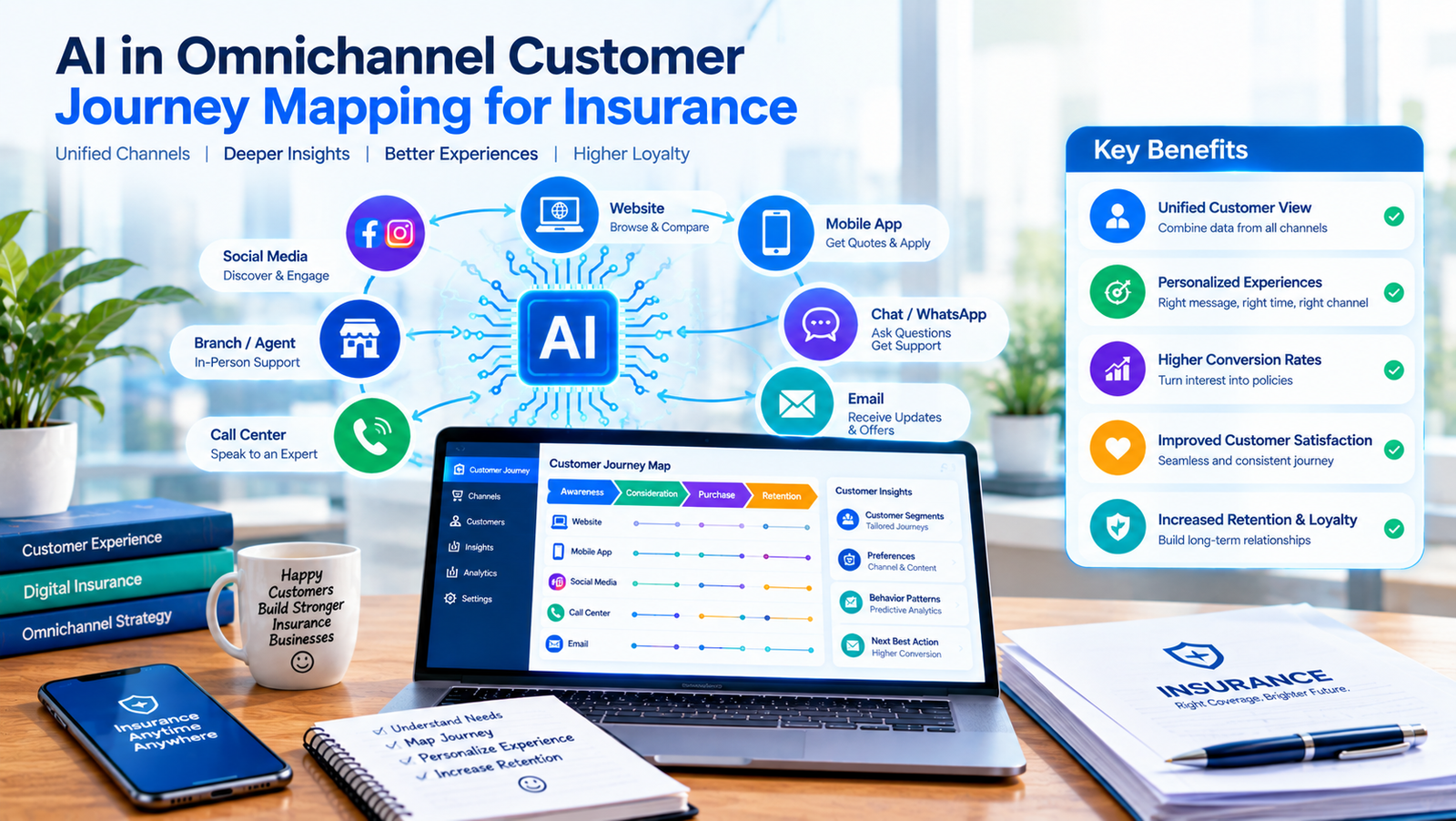
Primary Topic: AI in Omnichannel Customer Journey Mapping for Insurance
Research Focus: Customer journey analytics, cross-channel identity resolution, policyholder behavior, AI-powered journey orchestration, claims experience, insurance personalization, customer retention, predictive analytics, generative AI, journey attribution, and responsible use of customer data
What Is AI in Omnichannel Customer Journey Mapping?
Omnichannel customer journey mapping is the process of understanding how customers move between different channels while interacting with an insurer. These channels may include websites, mobile apps, comparison platforms, email, call centers, insurance agents, messaging services, customer portals, and claims systems.
Traditional journey maps are often built from customer interviews, surveys, website analytics, CRM records, and service-team feedback. They can explain what a typical customer experience looks like, but they may not capture every interaction or reveal how journeys change over time.
AI makes journey mapping more dynamic. Machine learning can identify recurring behavioral patterns, estimate the likelihood of abandonment, group customers according to their needs, and detect points where a journey becomes unnecessarily difficult. Natural language processing can analyze call transcripts, emails, chatbot conversations, reviews, and survey responses to understand the reasons behind customer actions.
For insurers, this creates a more complete view of the relationship, from initial research and quote comparison to onboarding, policy servicing, renewal, claims, and long-term retention.
Visual: The insurance customer journey
Search, ads, referrals
Quotes, coverage, advice
Application, payment
Changes, questions
Resolution, retention
Why Insurance Needs Journey-Level Intelligence
Insurance is different from many routine online purchases. Customers may buy a policy once a year but interact with the insurer during stressful or financially important events. A customer may spend weeks comparing home insurance, complete a purchase in a few minutes, and then have little contact with the insurer until a claim occurs.
This makes it difficult to evaluate customer experience using a single metric such as website conversion or call-center satisfaction. A customer who purchases quickly may later discover that the coverage does not match their expectations. Another customer may take longer to purchase because they carefully compare policy terms, but remain loyal for years.
AI-powered journey mapping helps insurers connect these stages and understand the context behind behavior.
Key insurance-specific challenges include:
- Fragmented customer records: Policy administration, CRM, claims, billing, and digital analytics platforms may store separate versions of the customer relationship
- Channel switching: Customers often research digitally but seek human help before making a decision
- Complex products: Exclusions, deductibles, limits, endorsements, and eligibility rules can create confusion
- High-stress interactions: Claims and coverage disputes require clear communication and appropriate human support
- Long customer lifecycles: Renewal decisions may depend on experiences that occurred months earlier
- Regulatory sensitivity: Customer data and AI-generated recommendations must be handled under applicable privacy, insurance, and consumer-protection requirements
Research Study: Generative AI in the Insurance Customer Journey
The Geneva Association published Gen AI in the Insurance Customer Journey in November 2025. The research included an online survey of 6,000 insurance customers across China, France, Germany, Japan, the United Kingdom, and the United States, with 1,000 respondents from each market.
The study found that more than 80% of surveyed customers were either favorable or neutral toward insurers using generative AI in customer interactions. Around half said these tools had made interactions more efficient and intuitive, while approximately one-third considered them somewhat helpful. The report also found that customers were already using general-purpose AI tools to research insurance, compare coverage, and clarify policy terms before contacting an insurer.
This matters for journey mapping because the insurer may no longer be the first place where a customer begins their decision process. A customer might ask an external AI assistant to compare coverage options, arrive at an insurer’s website with a shortlist, and then contact an agent to confirm a specific exclusion.
The journey map must therefore account for customer activity that takes place outside the insurer’s own channels. Insurers will not always have direct access to those interactions, but they can use customer research, consent-based preference data, and the questions customers ask once they arrive.
The report identifies four important customer expectations: access to a human when needed, data privacy, accurate information, and transparency about AI use. These expectations should be built into the journey itself rather than treated as a separate technology policy.
What this research means for insurers
- Map the questions customers ask before they reach an insurer’s website
- Use AI to explain policy language and coverage differences in clear terms
- Preserve conversation context when customers move from a chatbot to an agent
- Make it easy to reach a human for complex or sensitive decisions
- Explain when AI is being used and how customer information is handled
Source: The Geneva Association, Gen AI in the Insurance Customer Journey, November 2025
Research Study: AI and the Insurance Claims Experience
In July 2026, Deloitte published an analysis of nearly 4,000 customer responses across 12 property-and-casualty insurance carriers. The research examined the relationship between claims experiences, customer sentiment, and future purchase intentions.
The analysis found that the claims process had an above-average influence on future purchase intentions, while ranking lowest among the factors examined for generating positive customer sentiment. Customer support, employee knowledge, communication, and attitude were among the leading drivers of positive sentiment.
The finding has direct implications for omnichannel journey mapping. A claims journey should not be measured only by the time taken to close a claim. Customers may also care about whether they understand the next step, whether they have to repeat information, whether updates arrive through their preferred channel, and whether they can reach someone who can explain a decision.
AI can help identify these friction points by combining claim-status data with customer messages, call reasons, complaints, and interaction histories. For example, a pattern of repeated calls after a document request may indicate that the request is unclear or that the upload process is difficult to use.
The model should not automatically assume that every repeated contact indicates dissatisfaction. Some claims naturally require more communication. Instead, it should identify patterns for investigation and compare them with the claim’s complexity and stage.
What this research means for insurers
- Map the claims journey from first notification through settlement and follow-up
- Identify stages associated with repeat calls, missing documents, and unclear status updates
- Combine operational measures with customer feedback rather than relying on speed alone
- Use AI to help claims staff prepare for customer conversations, not to remove human accountability
- Measure whether improvements in the claims journey are associated with renewal and retention outcomes
Source: Deloitte, P&C Insurance Claims Process and AI, July 2026
Research Study: Customer Acceptance of AI in Insurance
Deloitte’s 2026 Swiss insurance research surveyed 1,291 policyholders aged 18–79. The findings show that customer familiarity with AI does not automatically translate into acceptance of AI making important insurance decisions.
The survey reported that 62% accepted AI helping explain policy wording and clarify what is covered, while 58% supported AI-generated loss-prevention tips. Around 57% accepted AI identifying suspicious claims patterns for further review. In contrast, 61% rejected the idea of AI deciding whether an insurance application should be accepted or rejected, and 86% said important decisions should ultimately be made by a human.
These results are specific to the surveyed Swiss market and should not be assumed to represent every country. However, they offer a useful design lesson: customers may be more comfortable with AI that helps them understand a process than with AI that makes a consequential decision about them.
For journey mapping, this distinction means that AI interventions should be matched to the purpose and sensitivity of each stage. An automated assistant explaining a deductible is different from a model influencing a premium or claim outcome.
What this research means for insurers
- Prioritize AI that clarifies coverage, explains next steps, and helps customers prepare information
- Keep human review available for consequential decisions and disputes
- Show customers when AI is involved and provide a route to challenge or clarify an outcome
- Track trust and perceived fairness alongside conversion and efficiency
Source: Deloitte, AI in Insurance: Customers Set Clear Conditions for Acceptance, April 2026
Research Study: Human and AI Intermediaries in Insurance Decisions
A September 2025 study published in the Journal of Behavioral and Experimental Finance examined how human and AI intermediaries affect insurance purchasing behavior. The researchers used an experiment involving insurance decisions and found that both human and AI intermediaries significantly encouraged insurance uptake. Overall, they did not find a general difference in effectiveness between the two types of intermediary.
The study’s subgroup analysis revealed a more nuanced result. Participants with higher risk aversion showed greater trust in human intermediaries, while participants with lower risk aversion showed no significant difference in trust between human and AI intermediaries.
This is relevant to journey mapping because customers do not all need the same type of support. A customer who is comfortable with digital self-service may prefer a fast, AI-supported comparison. Another customer may want to speak with an experienced adviser before choosing a policy that protects their family or business.
AI can help identify where customers request human assistance, which questions precede a handoff, and whether the handoff resolves the issue. It should not infer sensitive psychological traits from weak behavioral signals or use them to manipulate purchasing decisions.
What this research means for insurers
- Offer customers a choice between digital guidance and human support
- Analyze which journey stages generate requests for an adviser
- Evaluate whether human handoffs improve understanding and completion
- Avoid treating one channel preference as a permanent customer characteristic
Research Study: Omnichannel Customer Journeys in Motor Insurance
A study published in the Journal of Retailing and Consumer Services in 2020 examined multichannel behavior in motor insurance. Based on 338 valid survey responses, the researchers identified four customer journeys that combined digital and personal channels.
The study found that most respondents used multiple channels during their search. Digital channels played an important role in gathering information, but they often had low search-to-purchase conversion rates. Many journeys were completed through personal channels, such as insurance agents. The authors described a webrooming effect in which customers research online before completing a purchase through a human intermediary.
Although the research predates the current wave of generative AI, it addresses a core problem that AI journey mapping must solve: the channel where a customer researches a product may not be the channel where they buy it.
A digital analytics platform that attributes the sale only to the final agent interaction may undervalue the website, quote tool, or comparison experience that helped the customer make a decision. Conversely, attributing the entire sale to the first digital touchpoint may overlook the role of the agent in explaining coverage and resolving concerns.
What this research means for insurers
- Connect digital research activity with later agent and call-center interactions where lawful and technically possible
- Measure assisted conversions rather than evaluating each channel in isolation
- Distinguish information gathering from purchase completion
- Use journey-level analysis to improve coordination between agents and digital teams
Research Study: Understanding Interaction Choices Across the Insurance Journey
Research published in the Journal of Interactive Marketing in 2018 investigated why motor insurance customers choose particular channels at different stages. The researchers used focus groups, expert interviews, and 40 semi-structured interviews with customers.
The study found that customer journeys are individual and are influenced by the purpose of an interaction, the sequence of earlier interactions, and the broader pattern of activity. Customers may choose channels based on the value they expect from the interaction, not simply because they prefer digital or physical service in general.
This is important for AI journey mapping because channel preference is contextual. A customer may use a mobile app to check a policy document, a website to compare coverage, and an agent to discuss a complex claim. Treating that customer as exclusively “digital” would miss the reason for each choice.
AI can help discover these patterns by examining journey sequences and the outcomes associated with them. However, the model should distinguish observed behavior from inferred motivation. A channel switch can suggest that a customer needs additional help, but it does not prove why the customer switched.
What this research means for insurers
- Analyze sequences of interactions rather than isolated channel visits
- Separate the customer’s task from the channel used to complete it
- Use customer feedback to validate inferred reasons for channel switching
- Design journeys that allow customers to move between channels without restarting
How AI Builds a Unified Insurance Journey Map
A useful AI journey map requires more than connecting website analytics to a CRM. Insurers need a data model that can represent customer interactions, policy events, service requests, claims, and outcomes while preserving the context of each interaction.
Visual: AI journey intelligence architecture
Website, app, email, phone, agent, claims portal
CRM, policy administration, billing, claims, analytics
Identity resolution, timestamps, journey stages, consent
Journey clustering, intent detection, friction analysis, prediction
Personalized help, agent handoff, service recovery, process improvement
Customer outcomes, fairness, model monitoring, audit trail
AI Use Cases Across the Insurance Customer Lifecycle
| Journey stage | AI application | Customer outcome to measure |
|---|---|---|
| Discovery | Search-intent analysis and content recommendations | Relevant information found |
| Comparison | Policy explanation and coverage comparison | Customer understanding |
| Quote | Abandonment-risk detection and form assistance | Successful quote completion |
| Onboarding | Document guidance and next-step recommendations | Fewer avoidable delays |
| Policy servicing | Intent classification and contextual assistance | Issue resolution |
| Claims | Journey friction detection and status explanations | Clarity and resolution quality |
| Renewal | Retention-risk analysis and coverage review prompts | Appropriate renewal and retention |
Predictive Journey Analytics: Finding Friction Before Customers Leave
Predictive journey analytics estimates what may happen next based on a customer’s current interactions and relevant historical patterns. In insurance, the aim should be to identify avoidable friction and provide useful support, not to pressure customers into purchasing or renewing a policy.
A quote-abandonment model, for example, might identify that customers frequently leave after being asked to provide a document they do not have readily available. The useful response is to improve the document instructions, offer a save-and-resume option, or explain alternative ways to complete the application.
The model should not assume that every abandoned quote represents a lost sale. Customers may be comparing options, waiting for a decision, or discovering that a policy is unsuitable.
Useful predictive applications include:
- Quote completion: Identify application steps associated with avoidable abandonment
- Service demand: Forecast which questions are likely to generate calls or messages
- Claims friction: Detect claim stages associated with repeated contact or unresolved questions
- Renewal support: Identify customers who may need a coverage explanation before renewal
- Journey recovery: Recommend a helpful next step when a process is interrupted
Sentiment and Conversation Analytics
Insurance customers communicate through many formats, including phone calls, emails, chat sessions, surveys, complaints, and social media. Natural language processing can classify the topics and sentiment expressed in these interactions.
However, sentiment should not be treated as a direct measure of customer loyalty. A customer may express frustration because a legitimate claim requires additional evidence, while a satisfied customer may still switch providers because of price.
A stronger approach combines sentiment with the journey context.
For example, an insurer could analyze whether negative sentiment rises after a claim-status message, a premium change, or a request for additional documentation. The purpose is to identify a process that may need improvement, not to label a customer as difficult.
A practical conversation analytics model can classify:
- Reason for contact
- Question or problem being raised
- Whether the issue was resolved
- Whether the customer had to repeat information
- Whether the interaction required a human handoff
- Whether the customer requested clarification
These signals can help journey owners understand where the experience is breaking down.
Personalization Without Creating Unfair Customer Treatment
AI can personalize insurance communications by using relevant information such as the customer’s policy type, current journey stage, communication preferences, and previous service requests. For example, a customer who has started a home insurance quote may receive a clear explanation of deductibles, while a policyholder preparing for renewal may receive a summary of coverage changes.
Personalization becomes more sensitive when it influences pricing, eligibility, underwriting, or claims outcomes. A journey model should not quietly become a mechanism for making consequential decisions based on behavioral proxies.
Insurers should establish clear boundaries between service personalization and regulated decisions. Customer-facing recommendations should be accurate, explainable, and consistent with the policy terms. Sensitive data should only be used where there is a valid legal basis and a clearly defined purpose.
Expert Recommendation: Build Around Moments That Matter
Insurers should begin with a small number of high-impact journeys instead of attempting to map every customer interaction at once. Claims, quote completion, onboarding, and renewal are practical starting points because each has a defined business process and measurable customer outcomes.
The recommended approach is to:
- Choose a specific journey: Start with one product and one customer objective, such as completing a motor insurance quote
- Map the real process: Include digital and human interactions, delays, repeat contacts, and handoffs
- Connect the data: Link relevant CRM, policy, claims, and interaction records using appropriate access controls
- Find the friction: Use analytics and customer feedback to identify the stages that create confusion or unnecessary effort
- Test a targeted intervention: Improve one step, such as document guidance or claim-status communication
- Measure customer outcomes: Track completion, resolution, complaints, satisfaction, and downstream retention
- Keep humans involved: Provide escalation paths for complex, sensitive, or disputed situations
- Expand only after validation: Reuse proven data and governance components for the next journey
The central recommendation is to treat AI as a way to make the customer journey more coherent. A system that generates a personalized message but cannot see the customer’s latest claim status may create more confusion rather than less.
Expert Perspective
This is a useful principle for journey design: the objective is not to remove human contact from insurance. It is to make each interaction more relevant and ensure that customers can move smoothly between automated and human assistance.
Responsive Journey Performance Dashboard
A journey dashboard should connect customer experience with operational performance. The following framework can help insurance teams monitor whether AI is improving the experience rather than merely increasing automation.
| Metric | What it reveals | Interpretation caution |
|---|---|---|
| Journey completion rate | Share of customers completing the intended process | A completed sale is not proof of suitable coverage |
| Repeat-contact rate | How often customers contact the insurer again about the same issue | Some complex cases naturally need several contacts |
| Resolution time | Time needed to resolve a request or claim stage | Fast closure must not reduce accuracy or fairness |
| Customer effort | Difficulty customers experience while completing a task | Combine behavioral data with direct feedback |
| Human handoff success | Whether customers receive effective help after escalation | A handoff count alone does not measure quality |
| Renewal and retention | Longer-term relationship outcomes | Control for price, coverage, and market changes |
| Complaint rate | Potential issues with clarity, service, or outcomes | Review complaint severity and subject |
Implementation Roadmap for Insurers
Select a high-value customer journey and document its stages, channels, handoffs, pain points, and intended outcome
Connect relevant customer, policy, claims, and interaction data while defining identity, consent, access, and retention rules
Use journey analytics, text classification, and process analysis to identify where customers experience avoidable friction
Test a focused improvement, such as clearer claim updates, a simpler quote form, or better agent handoff
Compare results with a baseline or suitable control group, review customer feedback, and expand only when outcomes are supported
Data Privacy, Governance, and Model Risk
Omnichannel journey mapping can bring together highly sensitive information, including policy details, claims records, contact histories, and behavioral data. Insurers should define which data is necessary for each use case and avoid collecting or retaining information simply because it is available.
Important safeguards include:
- Purpose limitation and data minimization
- Appropriate consent or other lawful basis where required
- Role-based access to customer and claims information
- Encryption and secure data transfer
- Retention and deletion rules
- Testing for unfair outcomes across customer groups
- Documentation of model purpose, limitations, and validation
- Human review for consequential decisions
- Clear complaint, correction, and escalation routes
For US insurers, the NAIC’s work on AI and insurance regulation is relevant to governance planning. Its 2026 research reviews insurer AI/ML use, state-level regulatory approaches, and considerations for future AI-related guidance. Requirements differ by jurisdiction and line of business, so insurers should assess the rules that apply to their operations rather than assume a single global standard.
Future Predictions: 2027–2030
2027: Journey Maps Become More Continuous
Insurers are likely to move from periodic journey-mapping workshops toward continuously updated journey intelligence. Customer interactions, service outcomes, and operational events will feed dashboards that help teams detect new friction points. The value will depend on data quality and whether teams can act on the findings.
2028: AI Coordinates More Cross-Channel Handoffs
More insurers may use AI to preserve context when a customer moves between chat, phone, an agent, and a claims team. Rather than asking customers to repeat information, systems will summarize the issue, the steps already taken, and the outstanding question. Human staff will still need to verify important details.
2029: Journey Personalization Becomes More Contextual
Personalization is likely to move beyond demographic segments toward the customer’s immediate task and journey stage. A customer comparing deductibles may receive a different explanation from someone checking a claim or changing a beneficiary. Insurers will need to demonstrate that personalization is useful, accurate, and fair.
2030: Journey Orchestration Connects Service and Operations
More mature platforms may connect journey analytics with policy administration, claims, billing, and workforce systems. This could allow insurers to identify a customer problem and route it to the team that can resolve it. The main challenge will be maintaining reliable data, clear accountability, and appropriate human oversight as automation expands.
Visual: The direction of insurance journey intelligence
Channel reports and separate customer records
Connected journeys and predictive friction alerts
Context-aware service orchestration with human oversight
Frequently Asked Questions
What is AI-powered omnichannel customer journey mapping in insurance?
It uses AI and connected customer data to understand how policyholders move between websites, apps, agents, call centers, and claims channels. It helps insurers identify friction, understand customer needs, and improve the experience across the full relationship.
How does AI improve insurance customer journey mapping?
AI can analyze large volumes of interactions, identify common journey patterns, classify customer questions, detect possible abandonment, and reveal stages associated with repeat contacts or complaints. Teams can use these findings to improve processes and provide more relevant assistance.
Why is omnichannel journey mapping important for insurance companies?
Customers often research policies through digital channels but complete purchases or resolve complex issues with a person. Mapping the full journey helps insurers understand how these channels work together instead of measuring each one in isolation.
Can AI predict insurance customer churn?
AI can estimate the likelihood of churn using relevant behavioral and service data, but predictions are uncertain. Insurers should validate models and use them to identify service needs or improve customer experience rather than pressure customers into staying.
How can AI improve the insurance claims journey?
AI can identify repeated contact, unclear status updates, document-related delays, and common sources of customer confusion. It can help staff prepare responses and provide timely explanations, while claim decisions remain subject to appropriate controls and review.
What data is needed for AI customer journey analytics?
Depending on the use case, insurers may use CRM records, website and app events, policy data, claims milestones, call-center records, customer feedback, and service outcomes. Data should be limited to what is necessary and handled under applicable privacy and security requirements.
What are the main risks of AI in insurance journey mapping?
The main risks include fragmented or inaccurate data, incorrect identity matching, privacy violations, biased predictions, opaque recommendations, and excessive automation in sensitive situations. Human oversight and continuous validation are important safeguards.
How should an insurer start implementing AI journey mapping?
Start with one well-defined journey, such as quote completion or claims communication. Map the existing process, connect the relevant data, identify a measurable problem, test a targeted improvement, and expand after evaluating the results.
Final Perspective
AI in omnichannel customer journey mapping gives insurers a way to understand the customer relationship as a connected sequence rather than a collection of separate interactions. This matters because customers may research a policy online, ask an agent to explain an exclusion, complete the purchase through an app, and later judge the insurer based on how a claim is handled.
The research points to a consistent practical direction. The Geneva Association’s 2025 survey found broad openness to generative AI in insurance interactions, while emphasizing privacy, accuracy, transparency, and access to human help. Deloitte’s 2026 claims analysis showed that the claims experience is closely connected to future purchase intentions. Its Swiss insurance survey also found stronger acceptance for AI that explains or supports than for AI making important decisions. Studies of motor insurance journeys show why digital and personal channels must be understood together.
For insurers, the opportunity is to connect these findings to real operational improvements. AI can help explain coverage, reduce repeated information requests, detect confusing process steps, improve agent handoffs, and identify where customers need additional support. These applications are most valuable when they improve the customer’s ability to make informed decisions and resolve problems.
The most effective strategy is not to automate every interaction. It is to identify the moments that matter, use AI where it can genuinely reduce friction, and preserve human judgment where customers need empathy, explanation, or accountability.
Connected data + journey analytics + contextual AI + human support + responsible governance can help insurers build customer experiences that are more coherent, measurable, and trustworthy.
Research Sources
- The Geneva Association, Gen AI in the Insurance Customer Journey, 2025
- Deloitte, P&C Insurance Claims Process and AI, 2026
- Deloitte, AI in Insurance: Customers Set Clear Conditions for Acceptance, 2026
- Journal of Behavioral and Experimental Finance, Empowering Consumers: An Experimental Study of Human and AI Intermediary in Insurance Decision-Making, 2025
- Journal of Retailing and Consumer Services, Multichannel Customer Journeys and Their Determinants: Evidence from Motor Insurance, 2020
- Journal of Interactive Marketing, Understanding the Omnichannel Customer Journey: Determinants of Interaction Choice, 2018
- National Association of Insurance Commissioners, Artificial Intelligence and Insurance Regulation, 2026
- Deloitte, Transforming Customer Experience in Insurance with Generative AI

Leave a Reply