
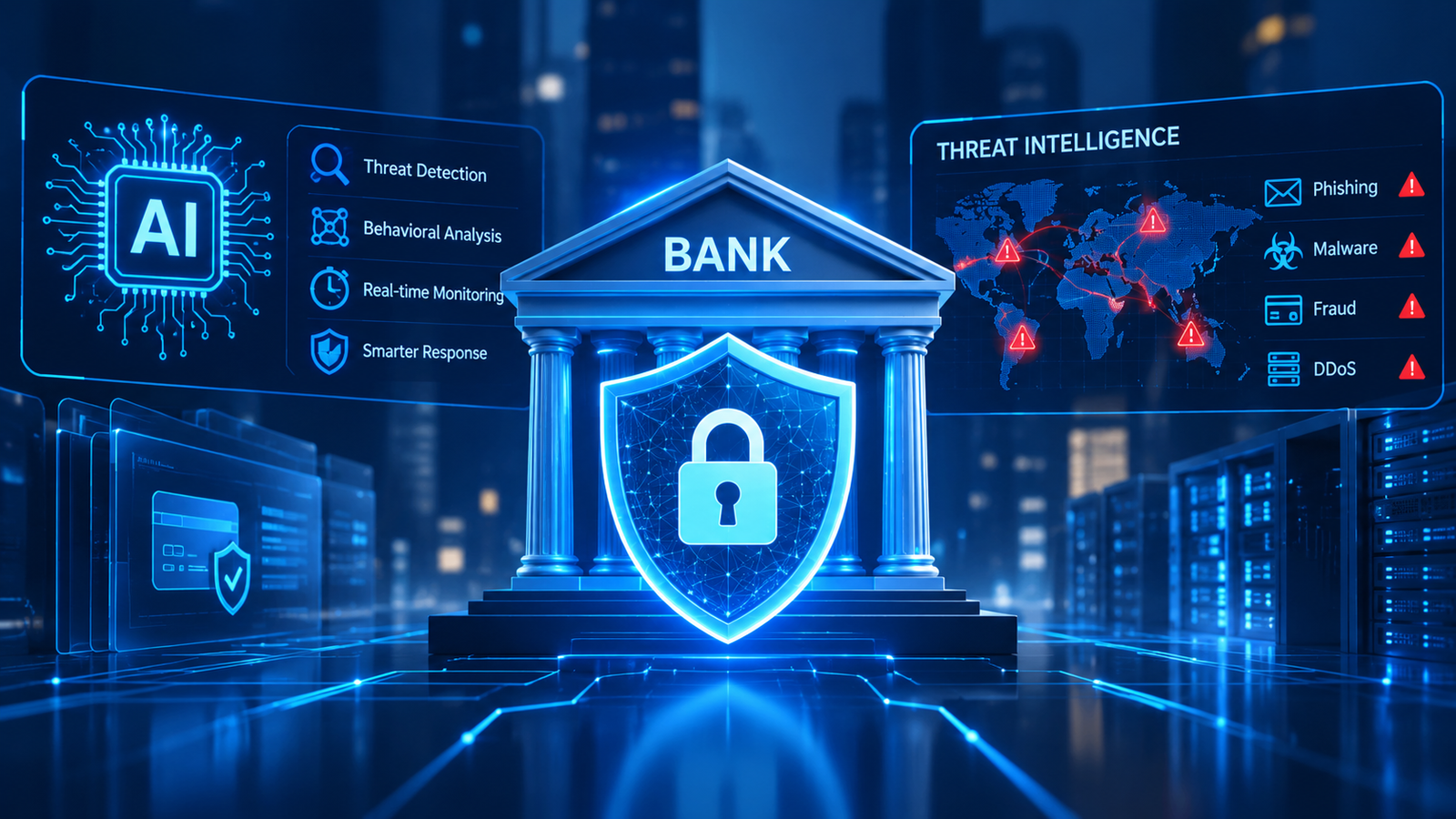
Primary topic: AI in Cybersecurity and Threat Intelligence in Banking
Research focus: AI-powered threat detection, banking fraud and cyberattack prevention, threat intelligence, core banking security, behavioral analytics, anomaly detection, vulnerability management, incident response, identity threats, third-party risk and financial-sector cyber resilience
Why AI Cybersecurity Matters Specifically to Banks
Banks operate a connected environment of high-value accounts, payment systems, customer identities, mobile applications, APIs, cloud services, employee workstations and third-party technology. A cyber incident can therefore affect more than the confidentiality of information. It can interrupt payments, prevent customers from accessing funds, expose sensitive financial data, disrupt trading or settlement, and damage confidence in a financial institution.
AI is particularly relevant because modern attacks generate more data than security teams can manually review. A bank may need to correlate authentication logs, endpoint alerts, network traffic, payment events, threat-intelligence feeds, software vulnerabilities and customer reports. Each signal may appear ordinary in isolation, while the combined sequence reveals a coordinated attack.
The technology also changes the threat itself. In its September 2026 paper, the Bank for International Settlements’ Financial Stability Institute describes frontier AI models as increasingly capable of identifying vulnerabilities, developing exploits and conducting complex, multi-step cyber operations. The paper highlights compressed remediation windows and increased third-party dependencies as important risks for financial institutions.
For banks, this creates a practical requirement: AI must improve both the speed of detection and the ability to contain incidents without causing unnecessary disruption to critical services.
Detect account takeover, payment manipulation, malware and unauthorized access before losses spread
Keep payments, customer channels and critical banking services operating during incidents
Reduce exposure of customer information and provide evidence-backed security decisions
Find vulnerabilities, coordinate remediation and manage risks from shared providers
What AI Adds to Banking Cybersecurity
Traditional security controls remain important. Firewalls, access management, endpoint protection, encryption, secure software development and tested recovery plans provide essential safeguards. AI adds analytical capabilities that can help security teams identify relationships, recognize deviations from normal behavior and process unstructured intelligence at scale.
Different AI methods solve different problems. Supervised machine learning can classify events using previously labeled examples. Unsupervised methods can identify unusual behavior without requiring every attack type to be labeled in advance. Graph analytics can connect accounts, devices, IP addresses, identities and infrastructure. Natural language processing can extract indicators and tactics from security reports, while generative AI can help analysts summarize evidence and query complex security data.
| AI capability | Banking application | Important limitation |
|---|---|---|
| Supervised machine learning | Classifying malware, phishing, suspicious logins and known attack patterns | Performance depends on representative, correctly labeled data |
| Anomaly detection | Finding unusual employee, device, account or network behavior | Legitimate changes can look suspicious |
| Graph analytics | Connecting related accounts, devices, domains and attack infrastructure | Incorrect links can misdirect investigations |
| Natural language processing | Extracting indicators, tactics and threat actor details from reports | Source quality and context must be checked |
| Generative AI | Summarizing incidents, explaining alerts and assisting analyst queries | Can produce incorrect explanations or unsafe actions |
| AI-assisted vulnerability analysis | Finding weaknesses, prioritizing patches and reviewing code | Findings require validation and controlled remediation |
Research Study: Machine Learning for Threat Detection in Core Banking Systems
A September 2026 paper in Scientific Reports focuses directly on the gap between machine-learning cybersecurity prototypes and production use in commercial banking. Its subject is a machine-learning framework for enhancing threat detection in core banking systems, making it especially relevant to institutions that must protect transaction processing and other essential banking workloads.
The study’s central problem is operational as much as technical. A model may identify suspicious activity in a test environment, but a bank must integrate that capability with legacy applications, existing monitoring tools, access controls and incident-response processes. It must also handle changing workloads without disrupting legitimate banking activity.
This distinction matters because core banking systems have strict availability and integrity requirements. An AI alert that is technically accurate but arrives too late, lacks evidence or cannot be acted on safely may provide limited operational value. Conversely, an automated response that blocks a legitimate service could itself create a serious incident.
The practical implication is to evaluate AI detection as part of an end-to-end security workflow. Banks should measure whether a model helps analysts identify meaningful threats, whether alerts arrive quickly enough to matter, and whether the response can be completed without introducing unacceptable operational risk.
Research Study: AI for Cyber Threat Intelligence
A 2025 IEEE conference paper, Artificial Intelligence in Cyber Threat Intelligence: A Systematic Review of Techniques and Applications, reviewed 15 peer-reviewed studies on the use of AI in cyber threat intelligence. It examined machine learning, deep learning, natural language processing and knowledge graphs as ways to process threat information and identify relationships that may be difficult to detect manually.
Threat intelligence is more than collecting lists of malicious IP addresses or domains. Security teams need to understand which indicators are connected, which tactics are being used, how a threat may affect their own environment and whether an alert requires immediate action. AI can help extract structured information from reports, group related indicators and connect external intelligence to internal telemetry.
The paper reports promising results across the studies it reviewed, including improvements in detection and reductions in false alarms. Those figures should not be treated as a guaranteed result for every bank. The studies may use different datasets, threat definitions, baselines and evaluation conditions, and results from a research setting do not automatically transfer to a live security operations center.
The review also identifies risks such as adversarial attacks, data poisoning and model bias. For a bank, this means threat-intelligence models need source validation, traceable evidence and testing against misleading or manipulated inputs.
Research Study: AI Cybersecurity Barriers in Banking
A 2026 systematic literature review published in Cybernetics and Systems examined barriers to adopting AI for cybersecurity in banking. Using a PRISMA-based process, the authors selected 65 articles covering research published from 2018 through November 2024. The review identified 23 barriers and 12 mitigation strategies, organizing them through technological, organizational and environmental factors.
This framing is useful because banks rarely fail to adopt AI simply because an algorithm is unavailable. The obstacles often sit around the model: fragmented data, legacy infrastructure, shortage of specialized staff, limited explainability, integration costs, governance uncertainty and resistance to changing established security processes.
The organizational dimension is especially important. A bank may purchase an AI-enabled security product, but its value depends on whether analysts trust its alerts, whether teams understand how to investigate them, and whether the institution has clear authority for containment and recovery. A model that produces too many low-value alerts can increase workload rather than reduce it.
The study supports treating AI cybersecurity as a change to the operating model. Technology selection should be accompanied by data governance, analyst training, integration planning, model validation and clear accountability.
Research Study: AI Techniques, Datasets and Weaknesses in Financial Cybersecurity
A 2025 IEEE systematic review examined 67 peer-reviewed articles published between 2021 and 2025 on AI techniques, datasets and weaknesses in financial cybersecurity. It covered methods such as support vector machines, random forests, neural networks, recurrent architectures and privacy-preserving approaches including federated learning.
The review identifies several recurring strengths of AI-based approaches, including real-time monitoring, anomaly detection and the ability to process large volumes of data. It also emphasizes weaknesses that directly affect banking deployments: dependence on high-quality and representative datasets, computational requirements, integration with legacy systems and the difficulty of sustaining reliable performance as threats change.
The dataset issue deserves particular attention. Security data is often imbalanced: ordinary activity is common, while confirmed examples of serious attacks are relatively rare. A model can therefore appear highly accurate while missing a meaningful share of the events a bank most needs to detect. Evaluation should include precision, recall, false-negative analysis and performance across different environments, rather than relying on accuracy alone.
The review also discusses privacy-preserving approaches. Federated learning may help institutions collaborate on model improvement without pooling all raw data in one central repository, although it introduces its own challenges around governance, data quality, security and model consistency.
Research Study: AI and Cybersecurity Risk Across the Financial Sector
The International Monetary Fund’s June 2026 note, Artificial Intelligence and Cybersecurity in the Financial Sector, examines how AI affects both cyber defense and financial stability. It argues that AI can accelerate vulnerability discovery and exploitation, while also strengthening defensive capabilities.
The note’s key contribution is its focus on scale and interconnectedness. A weakness in a widely used service provider, software component or shared technology platform can affect multiple financial institutions. AI may increase the speed at which vulnerabilities are found, but institutions still need time to assess, test and safely deploy fixes. This creates a risk that remediation capacity may become a bottleneck.
The IMF emphasizes controls that limit the “blast radius” of breaches, alongside response and recovery capabilities and international coordination. For banks, this translates into practical measures such as network segmentation, least-privilege access, isolation of critical systems, tested backups, resilient payment operations and plans for operating when a supplier is unavailable.
The note also highlights that cyber risk is not only an individual-bank problem. Common providers and shared infrastructure can create correlated exposures across the financial system.
Source: IMF, “Artificial Intelligence and Cybersecurity in the Financial Sector,” June 2026
Research Study: Frontier AI and the Changing Cyber Threat Landscape
The Bank for International Settlements’ Financial Stability Institute published a paper in September 2026 examining frontier AI models and cyber threats in the financial sector. It describes how more capable models can support vulnerability identification, exploit development and complex multi-step operations, while also offering defensive uses such as faster vulnerability discovery and incident response.
The paper is particularly relevant to vulnerability management. Historically, a bank might have had a relatively predictable window between a vulnerability becoming known and attackers exploiting it. More capable automation can compress that window. Security teams may have to assess more findings, prioritize more patches and coordinate more frequent changes across critical systems.
The challenge is not solved by telling teams to patch faster. Banks must verify that a vulnerability affects their environment, understand the business services at risk, test the fix, coordinate deployment and confirm that the change has not caused an outage. Poorly tested emergency changes can create operational problems of their own.
The paper also draws attention to third-party dependencies. A bank may have strong internal controls but remain exposed through software suppliers, managed service providers or common infrastructure. AI-enabled vulnerability discovery can make these shared dependencies more consequential.
From Threat Intelligence to a Banking Security Decision
A useful threat-intelligence system must connect external information to the bank’s actual assets and exposure. A report about a newly exploited software vulnerability matters more if the bank runs the affected software on a customer-facing service, uses it in a payment environment or depends on a supplier that has not yet patched it.
The process should move through a repeatable sequence.
Threat feeds, logs, reports and vulnerability data
Resolve entities, indicators and timestamps
Connect intelligence to bank assets
Estimate exposure and urgency
Investigate, contain, remediate and verify
AI can assist at each stage, but the workflow should preserve the underlying evidence. Analysts need to see which source reported an indicator, when it was observed, how it was matched to internal assets and which factors influenced the priority.
AI Use Cases Across Banking Security Operations
Behavioral Detection and Account Takeover
AI can learn patterns associated with normal employee, customer and service-account behavior. A login from a new device may not be suspicious by itself, but a sequence involving unusual access time, a new location, repeated authentication failures and a sensitive transaction may deserve closer review.
Banks should combine behavioral signals with strong authentication, device security and transaction controls. A model’s risk score should support decisions such as step-up authentication or analyst review, rather than automatically treating every unusual customer action as malicious.
Threat Hunting and Network Detection
AI can help identify unusual connections, communication patterns and endpoint behavior across large volumes of telemetry. Graph-based methods can connect a suspicious domain, endpoint, account and internal server into a broader incident hypothesis.
Threat hunters should be able to test that hypothesis against raw logs and known network behavior. This helps prevent a model from turning a weak correlation into an assumed attack narrative.
Phishing and Social Engineering
Natural language models can classify suspicious messages, identify impersonation patterns and extract links or domains for analysis. They can also help detect changes in writing style or unusual requests involving payment details.
However, AI-generated phishing can be grammatically correct and tailored to a recipient. Banks therefore need layered defenses, including email authentication, safe link handling, identity verification for sensitive requests and employee awareness.
Vulnerability Prioritization
AI can help combine vulnerability severity with asset criticality, exploit intelligence, internet exposure and business impact. This is more useful than treating every vulnerability with the same urgency.
The system should distinguish between a theoretical weakness on an isolated test system and an actively exploited vulnerability affecting a critical payment service. Security teams should retain a documented process for exceptions, compensating controls and verification after patching.
Incident Investigation and Generative AI
Generative AI can summarize alert histories, draft incident timelines, translate technical logs into analyst-friendly explanations and help query security information. These capabilities may reduce repetitive work, particularly during incidents involving many data sources.
The model should not be treated as the source of truth. Its summaries must link to the original evidence, identify uncertainty and avoid inventing events. Sensitive incident data should only be sent to AI services approved for that information.
Banking Cybersecurity Architecture for AI
An enterprise design should separate data collection, model inference, decision support and high-impact response actions. This reduces the chance that a model error or compromised AI component can directly affect critical banking operations.
Security information and event management, endpoint telemetry, identity logs, network flows, payment alerts, vulnerability inventories and vetted threat feeds
Intelligence layer
Entity resolution, threat knowledge graphs, feature engineering, data quality checks and time alignment
AI layer
Anomaly detection, supervised classifiers, graph analytics, NLP extraction and analyst-assistance models
Decision layer
Risk scoring, evidence summaries, alert prioritization, recommended actions and confidence indicators
Controlled response layer
Analyst approval, playbooks, access restrictions, endpoint isolation, patch workflows and recovery procedures
For high-impact actions, the default should be controlled automation. Low-risk, reversible actions may be automated after testing, while actions that could interrupt payments, lock out large customer groups or alter core banking infrastructure should require stricter approval and rollback procedures.
Risks of Using AI in Banking Cybersecurity
| Risk | Banking impact | Control |
|---|---|---|
| False positives | Legitimate customers or employees may be blocked | Threshold testing, review paths and rapid reversal |
| False negatives | A real attack may remain undetected | Layered controls and adversarial testing |
| Data poisoning | Training or feedback data may distort model behavior | Data provenance, access controls and validation |
| Model drift | Changing systems and attack patterns reduce performance | Monitoring, periodic evaluation and retraining controls |
| Sensitive data exposure | Customer or incident information may reach unauthorized services | Data minimization, approved environments and access logging |
| Unsafe automation | An incorrect action may disrupt a critical service | Approval gates, least privilege and rollback plans |
| Third-party concentration | A shared vendor failure can affect several services | Supplier mapping, exit plans and resilience testing |
Expert Recommendation
Banks should begin with a specific security problem rather than adopting AI as a general transformation initiative. A good first deployment has measurable operational pain, accessible data, a clear owner and a response process that can be tested safely.
A practical sequence is:
- Choose one use case, such as alert triage, phishing analysis or vulnerability prioritization
- Establish a baseline using current detection quality, analyst workload and response times
- Validate data quality and identify gaps before selecting a model
- Run the model in shadow mode before allowing it to influence live decisions
- Compare results across attack types, business units and relevant customer or system groups
- Require evidence-linked explanations for alerts that lead to consequential action
- Define which responses can be automated and which require human approval
- Test model failure, vendor outage, data corruption and rollback procedures
- Monitor performance continuously and maintain a documented change process
The most important architectural recommendation is to keep the AI decision layer separate from the authority to execute high-impact actions. AI can recommend isolating a device or blocking a transaction, but the response should follow pre-approved policies, access controls and safeguards. This allows banks to gain speed without giving an opaque model unrestricted control over critical services.
Expert Quote and Its Implications
The Bank for International Settlements’ September 2026 paper describes frontier AI as capable of reducing the expertise, time and resources needed for sophisticated cyber operations. This is a useful summary of why banks must plan for both defensive gains and faster-moving threats.
Source: BIS Financial Stability Institute, September 2026
The operational lesson is that banks should not assume attackers will always move at human speed. They need vulnerability inventories, clear remediation ownership, tested incident playbooks and reliable recovery processes. AI can support those controls, but it cannot compensate for unknown assets, unsupported systems or unclear accountability.
Implementation Roadmap
KPIs for AI Cybersecurity in Banking
| Metric | What it measures | How to interpret it |
|---|---|---|
| Mean time to detect | Time between an incident beginning and detection | Compare by incident type and severity |
| Mean time to contain | Time required to limit incident spread | Include approval and operational delays |
| Alert precision | Share of alerts judged actionable | Review alongside missed threats |
| False-negative rate | Share of relevant threats not detected | Test with representative attack scenarios |
| Patch remediation time | Time from validated finding to verified fix | Segment by criticality and exposure |
| Analyst time per case | Work required to investigate an alert | Ensure efficiency does not reduce investigation quality |
| Service disruption | Operational impact of security actions | Track unintended blocks and failed changes |
Future Outlook: 2027–2030
AI-Assisted Vulnerability Management Will Become More Important
As AI improves software analysis and vulnerability discovery, banks will need stronger processes for validating findings, prioritizing exposed assets and deploying fixes safely. The differentiator will be the ability to move from discovery to verified remediation without creating avoidable outages.
Threat Intelligence Will Become More Contextual
Security platforms are likely to connect external threat reports more directly to internal asset inventories, identity systems and business-service maps. This should help teams distinguish a broadly reported threat from one that presents a material risk to their own environment.
Security Operations Will Use More AI Agents, With Guardrails
AI agents may increasingly handle bounded tasks such as collecting evidence, grouping alerts, drafting incident timelines and recommending playbooks. Wider autonomy will depend on reliable testing, access restrictions, traceability and the ability to stop or reverse actions.
Third-Party and Shared-Infrastructure Risk Will Receive More Attention
Banks depend on cloud platforms, software vendors, payment networks and managed service providers. As AI increases the speed of vulnerability discovery, mapping these dependencies and testing contingency plans will become more important.
Model Governance Will Become Part of Security Governance
Banks will need to track model versions, training and evaluation data, permissions, performance changes and dependencies on external AI providers. Security teams will also need to test whether an AI system can be manipulated through malicious inputs or compromised data sources.
These are evidence-informed outlooks rather than guaranteed predictions. The pace of adoption will depend on model capability, regulation, vendor maturity, institutional budgets and the ability of banks to integrate AI without weakening established controls.
Startup Opportunities in Banking AI Cybersecurity
The market offers opportunities for products that solve specific operational problems rather than simply adding a chatbot to an existing security dashboard.
- Core Banking Anomaly Detection: Models tailored to transaction-processing and banking application telemetry
- AI Threat Intelligence Enrichment: Tools that extract, validate and connect indicators from reports and feeds
- Vulnerability Prioritization: Risk engines that combine exploit evidence, asset exposure and business criticality
- Security Operations Copilot: Evidence-linked investigation summaries and natural-language security queries
- Third-Party Cyber Risk Graph: Dependency mapping across vendors, software components and critical services
- AI Model Security Testing: Tools for evaluating poisoning, prompt injection, data leakage and unsafe actions
- Incident Response Automation: Policy-controlled playbooks with approval gates and rollback support
- Privacy-Preserving Threat Collaboration: Systems that support intelligence sharing while limiting exposure of sensitive raw data
A focused product could help smaller banks and fintech firms that lack large threat-intelligence teams. However, buyers will expect reliable integrations, clear evidence, security certifications where relevant, robust data handling and proof that the product reduces workload without increasing operational risk.
Frequently Asked Questions
How is AI used in banking cybersecurity?
AI can detect unusual activity, classify security alerts, identify relationships between threat indicators, prioritize vulnerabilities and help analysts investigate incidents. It works alongside controls such as access management, encryption, endpoint protection and incident-response procedures.
Can AI prevent cyberattacks on banks?
AI can help identify and respond to threats, but it cannot guarantee prevention. Effective protection also depends on secure architecture, timely patching, strong identity controls, staff training, tested recovery plans and oversight of third-party providers.
What is AI-powered cyber threat intelligence?
It is the use of AI to collect, structure, analyze and connect information about threats, such as malicious infrastructure, attack techniques, vulnerabilities and threat-actor activity. The goal is to turn large volumes of intelligence into relevant, evidence-backed actions.
Can generative AI replace a bank’s security operations center?
No. Generative AI can assist with repetitive analysis and documentation, but security analysts remain necessary to validate evidence, understand business context, make consequential decisions and coordinate incident response.
What is the biggest risk of AI in banking cybersecurity?
There is no single risk for every institution. Important concerns include AI-enabled attacks, incorrect alerts, missed threats, data exposure, model manipulation, unsafe automated actions and reliance on shared technology providers.
How should a bank measure the success of AI cybersecurity?
It should track detection and containment times, alert precision, false negatives, patch remediation time, analyst workload and unintended service disruption. These measures should be compared with a baseline and reviewed across different incident types.
Should banks build their own cybersecurity AI models?
The decision depends on data sensitivity, available expertise, integration needs, cost and control requirements. Some institutions may use vendor products, while others may develop specialized models. In either case, the bank should validate performance in its own environment and retain control over security decisions.
Final Perspective
AI is becoming an important part of banking cybersecurity because the volume, speed and interconnected nature of modern threats place pressure on traditional, manually intensive workflows. It can help security teams find patterns in large datasets, connect external intelligence to internal systems, prioritize vulnerabilities and investigate incidents more efficiently.
The research also makes clear that model performance is only one part of the problem. Studies focused on core banking and banking adoption highlight production integration, data quality, organizational readiness and operational controls. Broader financial-sector analysis points to the risks created by rapidly discovered vulnerabilities and shared technology dependencies.
For banks, the practical goal should be to build a security operation that can detect, understand, contain and recover from threats at a pace appropriate to the changing environment. AI can improve that operation when it is connected to reliable data, clear accountability and carefully controlled response workflows.
The most durable approach combines:
The future of banking cybersecurity will not be defined only by which institution uses the most advanced model. It will also depend on which institutions can validate their tools, act on findings quickly, protect critical services and recover safely when prevention fails.
Research Sources
- Scientific Reports: A machine learning framework for enhancing threat detection in core banking systems, 2026
- IEEE: Artificial Intelligence in Cyber Threat Intelligence: A Systematic Review of Techniques and Applications, 2025
- Artificial Intelligence for Cybersecurity in Banking: A Taxonomy of Barriers and Possible Mitigation Strategies, 2026
- IEEE: Systematic Review of Artificial Intelligence Techniques, Datasets and Weaknesses in Finance Cybersecurity, 2025
- International Monetary Fund: Artificial Intelligence and Cybersecurity in the Financial Sector, June 2026
- BIS Financial Stability Institute: When Machines Attack: Frontier AI Cyber Threats and Policy Responses in the Financial Sector, September 2026
- Bank of England, FCA and HM Treasury: Joint Statement on Frontier AI Models and Cyber Resilience, May 2026
- U.S. Government Accountability Office: Artificial Intelligence: Use and Oversight in Financial Services, May 2025

Leave a Reply