
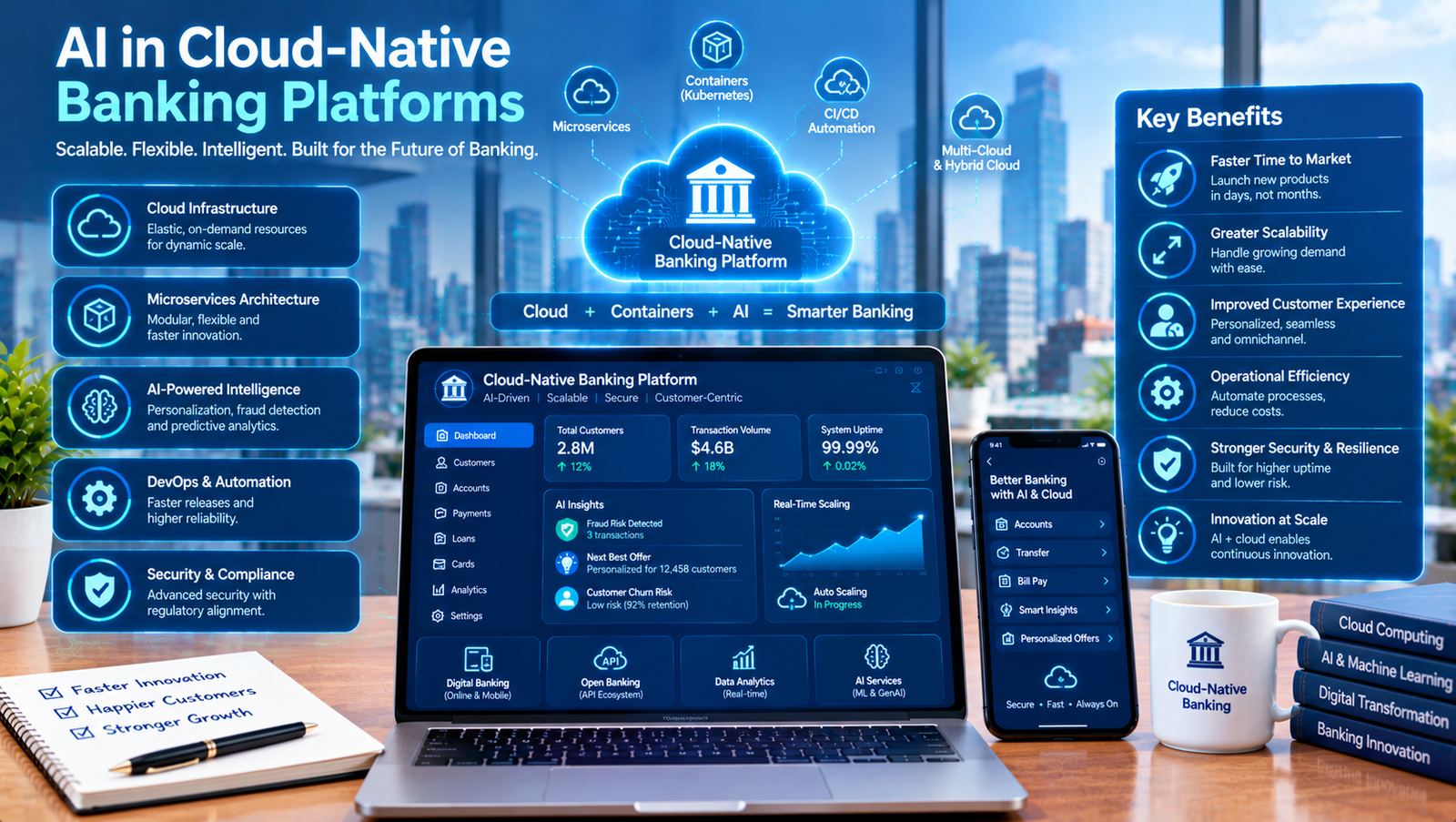
AI in Cloud-Native Banking Platforms: Building Scalable, Intelligent and Resilient Banking Systems
Primary topic: AI in Cloud-Native Banking Platforms
Research focus: AI-ready banking architecture, cloud-native core banking, microservices, real-time fraud detection, intelligent payment processing, predictive operations, data platforms, cybersecurity, operational resilience, regulatory governance and legacy modernization
Understanding AI in Cloud-Native Banking
Cloud-native banking platforms use technologies such as containers, microservices, APIs, automated deployment pipelines, distributed databases and cloud-based infrastructure to deliver financial services. Instead of building every banking capability into one large application, the platform separates functions into services that can be developed, deployed, scaled and maintained independently.
AI adds an intelligence layer to this architecture. Machine learning models can evaluate transaction patterns, estimate operational risks, detect unusual customer behavior and forecast demand. Generative AI can help employees search policies, summarize operational incidents and retrieve information from internal knowledge systems. More advanced AI agents may coordinate selected tasks, but they require strict permissions and controls when interacting with financial systems.
The distinction matters because a bank cannot treat a payment, balance update or credit decision like an ordinary software request. Financial operations require accurate records, controlled access, traceability and predictable failure handling. A cloud-native architecture must preserve those properties even when AI services are unavailable, delayed or incorrect.
Modular services
Separate banking capabilities so teams can update services without rebuilding the entire platform.
Real-time data
Make transaction, customer and operational signals available to authorized systems quickly.
Embedded intelligence
Use AI to support detection, prediction and decisions within governed workflows.
Resilience by design
Keep essential banking functions reliable when individual services or models fail.
Why Banks Are Moving Toward Cloud-Native Platforms
Traditional banking systems often contain decades of business logic, tightly connected applications and data structures that were not designed for frequent change. Even a small product update can require extensive testing because several systems depend on the same components. This makes it difficult to introduce new payment services, personalized experiences or AI-driven capabilities at the speed customers expect.
Cloud-native architecture can reduce some of these constraints by separating capabilities and automating infrastructure management. A bank may update its customer notification service independently from its card authorization service, provided that the interfaces and dependencies are properly designed. It can also scale selected workloads when demand increases instead of expanding the entire application.
The business case is not automatic. Distributed systems introduce new challenges involving network latency, service dependencies, observability, data consistency and cloud costs. Moving a poorly understood legacy application into containers does not, by itself, make the application modular or resilient.
Where cloud-native architecture changes banking operations
| Banking capability | Cloud-native contribution | AI opportunity |
|---|---|---|
| Payments | Scalable services and API-based integrations | Fraud detection and transaction anomaly analysis |
| Core banking | Modular product and account services | Operational forecasting and decision support |
| Customer service | Shared APIs and event-driven workflows | Service copilots and intent classification |
| Risk and compliance | Centralized telemetry and traceable workflows | Risk signals, anomaly detection and alert prioritization |
| Technology operations | Automated deployment and infrastructure management | Incident prediction and root-cause assistance |
Research Study: AI-Enhanced Microservice Architecture in the Financial Domain
A 2026 IEEE conference publication, AI-Enhanced Microservice Architecture in the Financial Domain: A Systematic Review of Security and Performance, examines the intersection of AI, zero-trust architecture and microservice-based financial systems. Its central question is how financial platforms can apply continuous authentication and contextual authorization between services rather than relying only on traditional network boundaries.
This is directly relevant to cloud-native banking because a single customer operation may involve multiple services. A mobile banking request could pass through an API gateway, authentication service, account service, transaction engine, fraud model and notification service. Each connection creates a potential security boundary.
The review identifies AI-assisted risk scoring, graph-based approaches and hybrid scoring as relevant methods, while highlighting the difficulty of balancing security controls with transaction latency. It also notes that fully integrated policy enforcement across financial microservices remains an area where further work is needed.
The practical lesson is that banks should not add AI security as a separate dashboard that operates after an incident. Identity, authorization, telemetry and policy enforcement should be built into the service architecture. AI can provide contextual risk signals, but deterministic authorization rules should remain responsible for enforcing access permissions.
Research Study: Cloud-Ledger Railways for Regulated Banking Microservices
A September 2026 paper published in the Journal of Electrical Systems and Information Technology presents a cloud-native blueprint for regulated banking workflows. It models transactions, KYC checks and payment orchestration as verifiable trace graphs across microservices operating in hybrid and multicloud environments.
The paper is relevant because banking transactions rarely remain inside one service. A payment can depend on customer verification, account status, fraud screening, limits, ledger posting and external payment rails. If a dispute occurs, the bank must be able to reconstruct what happened, which services participated and which decisions were applied.
The trace-graph approach focuses on preserving relationships between events and services. That can support auditability, operational troubleshooting and investigation of failures. It also creates a useful foundation for AI because models need reliable event histories to identify unusual sequences or predict operational problems.
However, an architectural proposal is not the same as proof of production performance. Banks should test the approach against realistic transaction volumes, failure scenarios, recovery requirements and audit needs before relying on it for critical workflows.
Research Study: Cloud-Native Architectures for Secure and Compliant Digital Banking
A 2025 paper, Cloud-Native Architectures for Secure and Compliant Digital Banking: Leveraging AI, Deep Learning, and Governance Policies, examines how cloud-native banking platforms can combine scalability with security, privacy and regulatory controls.
The proposed architecture brings together governance policies, embedded security, data protection, observability and risk management. This is an important framing because AI cannot be evaluated independently from the environment in which it operates. A fraud model may be technically accurate but still create risk if it receives incomplete data, has excessive access or cannot explain why it blocked a transaction.
The paper’s focus on governance also highlights a key implementation requirement: controls need to follow data and workloads across the platform. A bank should know which datasets train or inform a model, who can access the model, where decisions are logged and how a faulty model can be disabled.
As with other architecture-focused publications, the proposed framework should be treated as a design contribution rather than conclusive evidence that a particular deployment will improve financial outcomes. Production validation remains essential.
Research Study: Gartner’s 2026 Technology Trends for Cloud in Banking
Gartner’s February 2026 research on cloud technology trends in banking examines changing modernization priorities, including budget allocation, multicloud strategy, critical workloads and geopolitical considerations. These issues matter because banks cannot select cloud architecture solely on the basis of engineering convenience.
Data residency, concentration risk, vendor dependency and the location of critical workloads can affect architecture decisions. A bank may use public cloud for selected digital services while keeping particular workloads in private infrastructure or a controlled hybrid environment. The appropriate choice depends on regulatory obligations, risk appetite, service requirements and the bank’s existing capabilities.
For AI, these decisions influence where models run, which data they can access and how easily the bank can move workloads between environments. A model that depends on a cloud-specific data service may be harder to migrate than a model deployed behind a portable interface.
The useful takeaway is to treat cloud strategy as a banking operating-model decision, not simply a hosting decision. AI workloads should be included in the same assessment of portability, resilience, security and supplier dependency.
Research Study: KPMG 2026 Banking Technology Survey
KPMG’s 2026 Banking Technology Survey examines how banks are investing in technology as AI, data, cybersecurity and payments reshape the industry. The survey’s themes connect cloud modernization with the need to build the capabilities required to scale AI across banking operations.
This is significant because AI deployment often exposes weaknesses in the data and technology foundations beneath it. A bank may run a successful fraud-detection pilot, but expanding it across cards, transfers, digital wallets and international payments requires consistent data definitions, dependable event delivery, model monitoring and integration with existing case-management systems.
The survey is an industry study rather than a controlled experiment. It provides a view of banking technology priorities, not proof that cloud-native architecture alone causes better financial performance. Its value for technology planning is that it places AI investment alongside data foundations, enterprise transformation, cybersecurity and resilience.
For banking leaders, this means AI budgets should include the platform capabilities required for reliable deployment, not just model development and licensing.
Source: KPMG, 2026 Banking Technology Survey
Research Study: McKinsey on Core Banking in the Age of AI
McKinsey’s August 2026 analysis, Core Banking in the Age of AI: Crafting Intelligent Financial Engines, argues that legacy core systems can constrain the use of real-time data, AI and modern digital capabilities. It describes a shift toward modular banking platforms in which the core evolves from a rigid system of record into a more adaptable foundation for products, operations and intelligence.
This perspective is particularly relevant to banks that want to introduce AI without replacing every core system at once. A staged approach can expose selected capabilities through APIs, build governed data services and introduce AI into workflows where the surrounding controls are mature.
The article also emphasizes that core modernization is an organizational and economic transformation, not just a software migration. Banks need to align product teams, architecture, risk, operations and technology delivery around the new platform.
The implication is not that every bank should replace its core immediately. Rather, modernization should be driven by specific constraints, such as slow product delivery, high integration costs, limited data access or difficulty meeting resilience requirements.
Source: McKinsey, Core Banking in the Age of AI: Crafting Intelligent Financial Engines, August 2026
Where AI Creates Specific Value in Cloud-Native Banking
AI-powered fraud detection at transaction speed
Cloud-native platforms can stream transaction events to fraud-detection services without requiring every application to maintain its own separate detection logic. AI models can assess transaction amount, device signals, customer history, merchant characteristics, location patterns and relationships between accounts.
The architecture must respect the latency budget of the transaction. A model that takes too long to respond can create a poor customer experience or delay payment processing. Banks should therefore distinguish between models that must return a decision during authorization and models that can analyze activity asynchronously.
A practical design uses a fast, bounded decision path for immediate controls and a separate analytics path for deeper investigation. If the model is unavailable, the platform should follow a documented fallback policy rather than allowing an uncontrolled failure.
Predictive infrastructure operations
Cloud-native banking environments generate telemetry from applications, databases, containers, networks and payment services. AI can analyze this information to identify unusual latency, rising error rates, resource saturation or changes in service behavior.
For example, a model may detect that a payment service is showing a pattern associated with previous incidents. It can alert the operations team, identify related dependencies and suggest where to investigate. This can reduce the time spent manually correlating logs across distributed systems.
Predictive operations should not mean allowing a model to make unrestricted infrastructure changes. Actions such as scaling a service may be safely automated within limits, while changes to access permissions, ledger infrastructure or production data should require stronger approval and control.
Personalized banking experiences
A cloud-native data platform can make authorized customer and transaction information available to personalization services. AI can then help categorize spending, identify relevant product features, predict service needs and tailor financial guidance.
These capabilities require careful consent and privacy design. Customer data should not be copied into every service merely because it is technically accessible. Banks should define which data each model needs, how long it is retained and whether the use is consistent with customer permissions and applicable law.
Intelligent customer support
Generative AI can assist service teams by retrieving approved product information, summarizing customer interactions and preparing responses. A cloud-native architecture can connect these tools to controlled APIs for account information, service status and case management.
The model should not invent account balances, promise that a payment has cleared or disclose information without proper authentication. For sensitive requests, it should retrieve verified information from authoritative systems and escalate when the available evidence is insufficient.
Visual Architecture: An AI-Ready Cloud-Native Banking Platform
Balances and customer records
Transfers and authorization
Applications and servicing
Controls and transactions
Transaction risk
Anomaly and incident signals
Service and personalization
Conceptual architecture. Actual service boundaries, data flows and control placement depend on the bank’s products, infrastructure and regulatory requirements.
Modernizing Legacy Banking Without Replacing Everything
A bank does not need to replace its entire core banking system before it can benefit from cloud-native engineering. In many cases, a gradual modernization strategy is more practical because it allows the institution to reduce risk while building new capabilities.
One approach is to place an API layer around existing systems. This gives digital channels a consistent interface while the bank gradually separates business functions. Another approach is to extract a capability, such as customer notifications or document processing, into an independently deployable service. The bank can then introduce event streaming and analytics around that capability.
The most important step is to understand the existing system before changing it. Hidden dependencies, batch jobs, reconciliation processes and undocumented business rules can create unexpected failures during migration.
| Modernization approach | When it fits | Main concern |
|---|---|---|
| API enablement | Existing core remains operational but needs better connectivity | Preserving security and interface consistency |
| Strangler pattern | A business capability can be moved gradually | Managing old and new systems together |
| Event-driven integration | Services need timely updates and analytics | Duplicate events, ordering and reconciliation |
| Core replacement | Legacy constraints justify a broader transformation | Migration, data integrity and business continuity |
Security and Operational Resilience
Cloud-native architecture changes the bank’s security boundaries. Instead of protecting one large application, teams must secure identities, APIs, containers, workloads, data pipelines, deployment systems and connections between services.
AI can help identify suspicious access patterns and unusual data movement, but the platform still needs foundational security controls. These include least-privilege access, strong authentication, encryption, secrets management, vulnerability management, network segmentation and reliable audit logging.
The threat environment also makes identity security particularly important. Google Cloud’s 2026 Threat Horizons report, based on incident-response and threat-defense engagements from the second half of 2025, found that attackers exploited identity issues for initial access in 83% of incidents involving major cloud and SaaS-hosted environments. This figure applies to the report’s observed incident set, not to all cloud incidents worldwide. It nevertheless reinforces the need to protect identities and permissions across cloud-native banking systems.
Source: Google Cloud, Cloud Threat Horizons Report H1 2026
Essential controls for AI-enabled banking platforms
- Workload identity: Give each service a specific identity and only the permissions it needs
- Data access controls: Restrict sensitive customer and transaction data by purpose and role
- Model governance: Track model versions, training data, validation results and deployment approvals
- Immutable audit trails: Preserve evidence of important decisions and system changes
- Resilient dependencies: Prevent a failure in an AI service from bringing down essential banking functions
- Incident response: Prepare tested procedures for isolating compromised services and recovering operations
- Third-party oversight: Assess cloud, model and software suppliers for concentration and operational risks
AI Governance and Regulatory Considerations
Banks operate under regulatory requirements that vary by jurisdiction and product. A cloud-native platform must therefore support the institution’s obligations for data protection, operational resilience, outsourcing, record keeping, model risk and customer treatment.
AI governance should be connected to the platform’s normal engineering process. A model should have a documented purpose, an accountable owner, defined access permissions, validation evidence and a monitoring plan. Changes to a model or its data pipeline should be traceable in the same way as changes to other production systems.
The bank should also distinguish between AI used for internal assistance and AI that affects customer outcomes. A model that summarizes an internal incident report has a different risk profile from a model that blocks a payment, changes a credit limit or influences a lending decision.
For higher-impact uses, the institution should define clear limits, escalation paths and human review requirements. Generative AI should not be given unrestricted authority to modify customer balances, approve financial transactions or change production infrastructure.
Implementation Roadmap for Banks
- Inventory applications and interfaces
- Identify critical services
- Set resilience and data requirements
- Standardize identity and secrets
- Build CI/CD controls
- Establish data quality checks
- Choose a bounded workflow
- Run offline and shadow tests
- Measure errors and latency
- Monitor production outcomes
- Test failure scenarios
- Review cost and risk regularly
KPIs for Cloud-Native Banking and AI
| KPI | What it measures | Why it matters |
|---|---|---|
| Service availability | Availability of critical banking services | Customer access and operational continuity |
| Transaction latency | Time required to complete key transaction steps | Payment experience and processing performance |
| Change failure rate | Share of deployments requiring remediation | Software delivery quality |
| Mean time to recovery | Time needed to restore service after disruption | Resilience and incident readiness |
| Fraud model precision | Share of flagged cases that meet the defined positive criteria | Alert quality and investigation workload |
| Model drift | Change in input patterns or model performance | Early detection of declining reliability |
| Cost per transaction | Infrastructure and processing cost for a defined workload | Unit economics and capacity planning |
Expert Recommendation
Banks should build cloud-native capability around business-critical outcomes rather than treating cloud migration as the final goal. Start by identifying the services where legacy constraints create measurable problems, such as slow product releases, fragile integrations, limited transaction visibility or costly manual operations. Modernize those capabilities in stages, with clear ownership and measurable service-level objectives.
AI should be introduced where it can improve a defined workflow and where the bank has enough reliable data to validate the result. Fraud detection, operational anomaly analysis, employee knowledge retrieval and customer-service assistance can be useful starting points, but each requires different controls.
The most important architectural principle is to keep essential banking decisions dependable even when AI is not. Use AI to generate signals, predictions and recommendations, while authoritative banking services enforce account rules, transaction limits, access permissions and ledger integrity. For high-impact actions, require appropriate approval, clear evidence and a tested recovery path.
Expert Quote
“Resilience must be built into the architecture, not bolted on later.”
— Katherine Yeung, Chief Risk Officer, 10x Banking
This principle is especially important when AI is integrated into distributed banking services. Resilience cannot depend on a single model, cloud region, data pipeline or external provider. The platform must be able to detect failures, isolate affected components and preserve essential banking functions.
Future Outlook: 2027–2030
2027: AI moves closer to core operations
Banks are likely to focus on moving proven AI capabilities from isolated pilots into established workflows. The emphasis will be on monitoring, controlled access, integration with existing systems and evidence that models work under real operating conditions. AI-assisted operations may become more common, particularly for incident triage, fraud analysis and employee support.
2028: Event-driven intelligence becomes more mature
As banks improve their data foundations, more AI services will consume event streams instead of relying exclusively on delayed batch data. This can support faster fraud signals, operational anomaly detection and more timely customer interactions. The challenge will be maintaining data quality, event ordering, privacy and predictable latency across distributed systems.
2029: Hybrid and multicloud architecture receives greater attention
Banks will continue evaluating how to balance cloud flexibility with data residency, supplier concentration, resilience and cost. Some institutions may use multiple cloud environments or hybrid deployment models for specific workloads. AI portability, model-serving dependencies and data movement costs will become more important parts of architecture decisions.
2030: Governed AI agents may coordinate selected workflows
AI agents may increasingly help coordinate tasks such as collecting evidence for an operational incident, preparing compliance documentation, routing customer-service cases or recommending remediation steps. In banking, the likely constraint will not be whether an agent can perform a task, but whether it can do so within approved permissions, traceable workflows and reliable controls.
- AI models connected to governed, high-quality data
- Clear separation between recommendations and authoritative financial decisions
- Service-level objectives that cover AI dependencies
- Continuous monitoring of model, infrastructure and business outcomes
- Portable interfaces and tested recovery procedures
- Auditable controls for human and automated actions
These are directional expectations based on current architecture and industry research, not guaranteed predictions or fixed adoption dates.
Startup and Product Opportunities
Cloud-native banking creates opportunities for technology providers that solve specific modernization and operational problems. The most useful products will integrate into existing banking environments instead of requiring institutions to replace their entire technology stack.
- AI operations platform for banks: Correlate logs, traces and alerts to help teams identify the likely cause of incidents
- Cloud-native fraud decisioning: Provide low-latency risk signals through APIs with clear explanations and monitoring
- Banking data quality platform: Detect missing, delayed or inconsistent records across banking services
- AI model governance toolkit: Manage model versions, validation evidence, approvals and production monitoring
- Legacy modernization accelerator: Map dependencies and help teams expose existing banking capabilities through controlled APIs
- Cloud cost intelligence for financial services: Connect infrastructure spending with service-level and transaction-level costs
- Banking service resilience testing: Simulate failures across payment, identity, data and AI dependencies
For startups, a focused product with a clear integration path may be easier for a bank to evaluate than a broad platform promising to modernize every system at once. Security documentation, deployment flexibility, auditability and measurable outcomes should be part of the product from the beginning.
Frequently Asked Questions
What is a cloud-native banking platform?
A cloud-native banking platform uses modular software, APIs, automated infrastructure and cloud-based services to deliver banking capabilities. It is designed to support independent deployment, scaling, monitoring and recovery rather than relying entirely on one tightly coupled application.
How does AI improve cloud-native banking?
AI can support fraud detection, operational anomaly analysis, customer-service automation, predictive monitoring and selected risk workflows. Its effectiveness depends on data quality, integration, latency, model validation and the controls surrounding each use case.
Does cloud-native banking require replacing the core banking system?
No. Banks can begin with API enablement, event-driven integration or the gradual extraction of selected capabilities. A full core replacement may be appropriate in some cases, but it is a separate strategic decision with substantial migration and operational considerations.
Is cloud-native banking automatically more secure?
No. Cloud-native architecture can improve automation, visibility and isolation, but it also introduces distributed identities, APIs, dependencies and configuration risks. Security depends on architecture, access controls, monitoring, governance and operational discipline.
Can generative AI directly process banking transactions?
Generative AI can assist with workflows around transactions, but authoritative systems should enforce financial rules and maintain the official ledger. Any AI-driven action that affects money or customer rights needs strict permissions, validation, traceability and appropriate oversight.
What should banks modernize first?
The starting point should be a clearly defined business or operational constraint. Banks should assess service criticality, dependencies, data readiness, regulatory requirements and expected outcomes before selecting a modernization project.
Final Perspective
AI in cloud-native banking is best understood as the combination of a modern software foundation and carefully governed intelligence. Cloud-native architecture can make banking services more modular, observable and adaptable. AI can then help those services identify patterns, anticipate problems and support better decisions.
The research points to several connected priorities. The 2026 IEEE review highlights the relationship between AI, zero-trust controls and microservice security. The cloud-ledger research emphasizes traceable workflows across distributed banking services. The 2025 cloud-native banking paper brings governance and data protection into the architecture. Gartner’s 2026 cloud research places modernization within broader questions of critical workloads, multicloud strategy and sovereignty. KPMG’s 2026 survey connects AI investment with data foundations and resilience, while McKinsey’s core-banking analysis frames modernization as a broader operating-model transformation.
Together, these sources support a practical conclusion: banks should not pursue cloud migration, AI adoption and resilience as separate programs. They are interdependent parts of the same technology strategy.
A mature AI-enabled banking platform should combine:
The objective is not to automate every banking decision. It is to create a platform where new capabilities can be introduced safely, essential services remain reliable, and AI improves measurable outcomes without weakening financial controls.
For banks, fintech companies and technology providers, the opportunity lies in building systems that are modular enough to evolve, intelligent enough to support better decisions and controlled enough to earn lasting trust.
Research Sources
- IEEE, AI-Enhanced Microservice Architecture in the Financial Domain: A Systematic Review of Security and Performance, 2026
- Journal of Electrical Systems and Information Technology, Cloud-Ledger Railways for Regulated Banking Microservices, 2026
- International Journal of Research Publications in Engineering, Technology and Management, Cloud-Native Architectures for Secure and Compliant Digital Banking, 2025
- Gartner, Top Technology Trends for Cloud in Banking That Will Change Your Modernization Strategy, 2026
- KPMG, 2026 Banking Technology Survey
- McKinsey, Core Banking in the Age of AI: Crafting Intelligent Financial Engines, 2026
- Google Cloud, Cloud Threat Horizons Report H1 2026
- 10x Banking, Core Banking Trends 2026: AI, Resilience and Real-Time Transformation
- Deloitte, AI Architecture in Banking: Architecture Before Agents, 2026

Leave a Reply