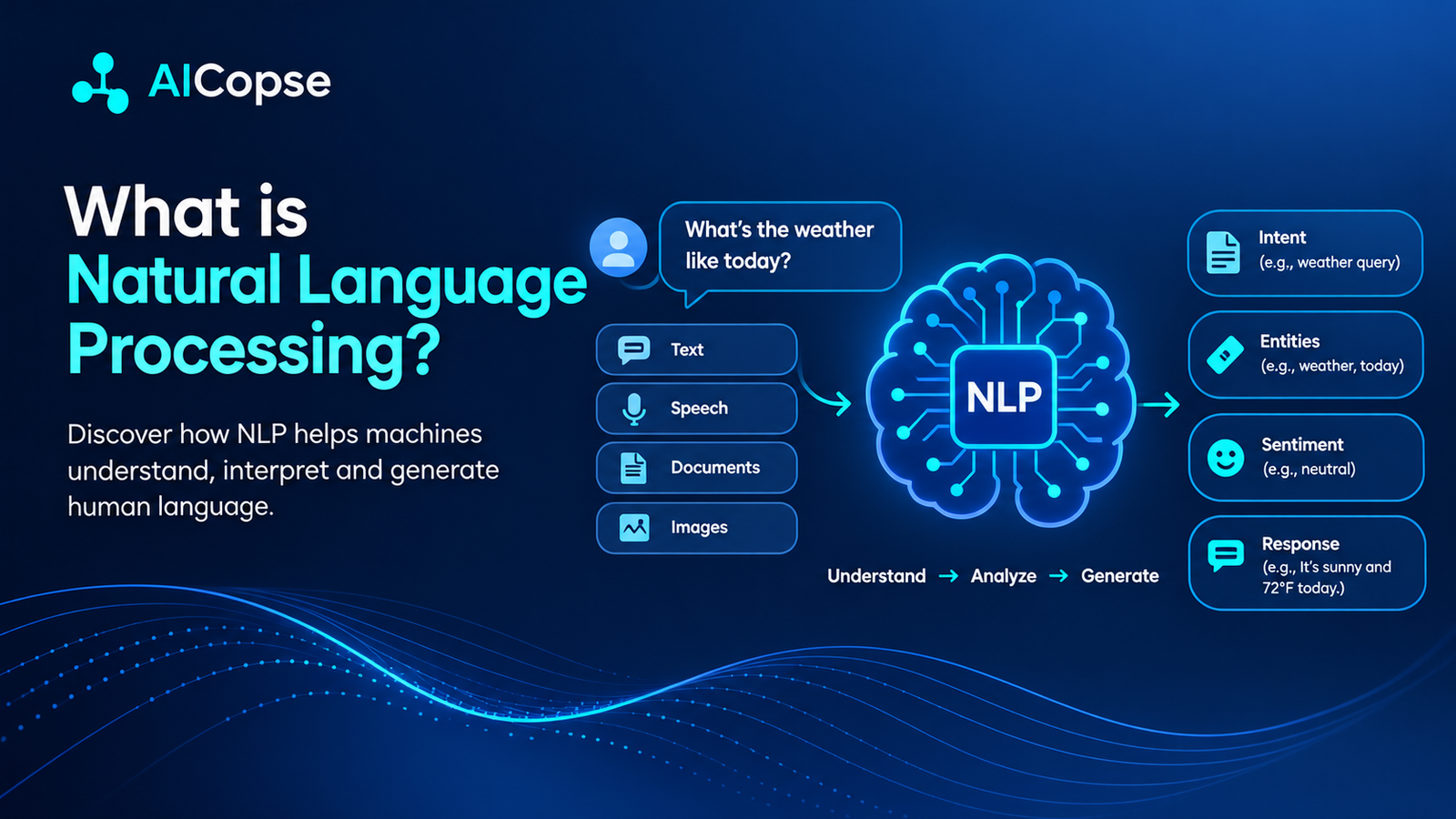
Every time your phone finishes your sentence, an email lands in the spam folder, or you ask a voice assistant for directions, natural language processing is doing the work. It is one of the oldest and most useful parts of AI, and one of the hardest, because human language is full of ambiguity, slang and context that people handle without effort and computers do not.
This guide explains NLP in plain language for technical and non-technical readers. You will see how it works step by step, run three small working examples, learn how NLP relates to machine learning and large language models, and understand where it still fails, including a challenge many readers know first-hand: languages written in mixed or romanized forms, like Roman Urdu. We built this guide around the fundamentals that change slowly, so it stays useful as tools and model names come and go.
What Is Natural Language Processing?
Natural language processing is the field of computer science and AI that lets machines work with human language. “Natural” language means the languages people speak and write every day, such as English, Urdu or Spanish, as opposed to programming languages like Python, which follow strict rules.
NLP sits where three fields meet: linguistics (how language works), computer science (how to process data) and machine learning (how to learn patterns from examples). Its goal is a computer that can interpret the contents of text and speech, including the shades of meaning inside them, and then extract information, answer questions, translate or write a reply.
A simple way to picture it
A computer sees the sentence “I’m starving, let’s grab pizza” as a string of characters, nothing more. A person instantly knows the speaker is hungry, wants to eat soon and is suggesting a specific food. NLP is everything we build to close that gap between characters and meaning.
Why Human Language Is So Hard for Computers
Language looks simple because we use it from childhood. For a machine, nearly every sentence hides a puzzle:
| Challenge | Example | Why it is hard |
|---|---|---|
| Word ambiguity | “I deposited cash at the bank” vs “We sat on the river bank“ | The same word has different meanings depending on context. |
| Sentence ambiguity | “I saw her duck” | It could mean a bird or the act of bending down. |
| Sarcasm and tone | “Great, another Monday.” | Positive words, negative meaning. |
| Negation | “Not good” vs “good” | One small word reverses the meaning. |
| Slang and new words | Internet slang, abbreviations, emoji | Language changes faster than dictionaries. |
| Mixed languages and scripts | Roman Urdu, Hinglish, Spanglish | People switch languages mid-sentence and spell words in many ways (“acha,” “achha,” “accha”). |
How NLP Works, Step by Step
Most NLP systems follow the same basic pipeline. The core idea is always the same: turn text into numbers, then find patterns in the numbers.
Embeddings deserve a special mention. They represent words as lists of numbers so that words with similar meanings end up close together, which lets a model treat “car” and “automobile” as related even though the spellings share nothing. Understanding this single idea explains most of modern NLP.
Try It Yourself: 3 Working Examples
You do not need to be a programmer to follow these. Each example is a few lines of Python. We ran all of them, and the outputs shown are the real results.
Example 1: Tokenize, clean and count words
import re
from collections import Counter

text = "NLP helps computers read text. Computers read text fast, and NLP makes text useful."
tokens = re.findall(r"[a-z']+", text.lower())      # lowercase + split into words
stop = {"and", "the", "a", "to", "of", "in"}        # tiny stop-word list
words = [w for w in tokens if w not in stop]

print(Counter(words).most_common(3))
# [('text', 3), ('nlp', 2), ('computers', 2)]
What happened: we lowercased the text, split it into tokens, removed filler words (stop words) and counted what remained. The most frequent words hint at the topic. This is the oldest trick in NLP and it still powers keyword extraction and word clouds.
Example 2: A tiny search engine (TF-IDF)
from sklearn.feature_extraction.text import TfidfVectorizer
from sklearn.metrics.pairwise import cosine_similarity

docs = ["How to reset your account password",
        "Our refund policy for cancelled orders",
        "Shipping times for international delivery",
        "Steps to change your email address"]

vec = TfidfVectorizer(stop_words="english")
D = vec.fit_transform(docs)
q = vec.transform(["I forgot my password"])

scores = cosine_similarity(q, D)[0]
print(docs[scores.argmax()])        # How to reset your account password
print(scores.round(2))              # [0.58 0.   0.   0.  ]
What happened: TF-IDF gives each word a weight based on how distinctive it is, then compares the query with every document. The password page won because it shares the word “password.” The limit: a query like “I can’t log in” would score zero, because it shares no words. Fixing that is exactly why embeddings were invented: they match meaning, not just spelling.
Example 3: A tiny sentiment classifier (and where it breaks)
from sklearn.feature_extraction.text import TfidfVectorizer
from sklearn.linear_model import LogisticRegression

reviews = ["great food and friendly staff", "loved it, wonderful service",
           "excellent quality, very happy", "fast delivery and perfect packaging",
           "good food, good service", "really good, would order again",
           "terrible service and rude staff", "awful food, very disappointed",
           "slow delivery and broken item", "worst experience, never again",
           "bad food, bad service", "really bad, would not order again"]
labels = ["positive"] * 6 + ["negative"] * 6

vec = TfidfVectorizer()
clf = LogisticRegression().fit(vec.fit_transform(reviews), labels)

for t in ["loved the wonderful food", "rude staff and terrible delivery",
          "not good", "bohat acha khana tha"]:
    print(t, "->", clf.predict(vec.transform([t]))[0])

# loved the wonderful food          -> positive   (correct)
# rude staff and terrible delivery  -> negative   (correct)
# not good                          -> positive   (WRONG)
# bohat acha khana tha              -> positive   (a guess: score 0.50)
What happened: the first two are right. The third is wrong because this simple method counts words and ignores word order, so “not good” looks like “good.” The fourth is Roman Urdu, which means “the food was very good,” and the model got it “right” only by luck: none of those words appeared in training, its positive score was exactly 0.50, and that is a coin flip, not understanding. Two lessons follow. Negation needs smarter models, and a model only knows the language it was trained on.
The Main NLP Tasks
| Task | What it does | Everyday example |
|---|---|---|
| Text classification | Puts text into categories | Spam vs not spam, topic tagging |
| Sentiment analysis | Detects positive, negative or neutral opinion | Analysing product reviews |
| Named entity recognition | Finds names, places, dates and amounts | Pulling a date and city out of a booking email |
| Machine translation | Converts text between languages | Translating a web page |
| Summarization | Shortens long text while keeping the key points | Meeting or article summaries |
| Question answering | Answers questions from text or knowledge | Customer-support bots, search answers |
| Speech recognition | Turns spoken audio into text | Voice typing, captions |
| Text-to-speech | Turns text into spoken audio | Screen readers, navigation voices |
| Text generation | Writes new text from a prompt | Chatbots, email drafting, autocomplete |
| Information retrieval | Finds the most relevant documents | Web and site search |
Four Generations of NLP
NLP has moved through four overlapping generations. Each solved problems the previous one could not, and none disappeared completely: many real systems still mix several.
| Generation | How it works | Strength | Weakness |
|---|---|---|---|
| 1. Rule-based | Experts write grammar and pattern rules by hand | Transparent and precise in narrow areas | Breaks on anything unexpected |
| 2. Statistical | Learns word counts and probabilities from data | Handles variety better, cheap to run | Ignores order and deeper meaning |
| 3. Neural | Neural networks learn word embeddings and sequences | Captures similarity and context | Needs lots of data, struggles with long text |
| 4. Transformers and large language models | Attention lets the model weigh every word against every other, pretrained on huge amounts of text | One model handles many tasks, writes fluent text | Costly, can state falsehoods confidently, hard to explain |
A Short History of NLP
The lesson history teaches: in 1954 experts promised machine translation within five years, and it took decades. Bold timelines in NLP have been wrong before, which is a good reason to judge any new system by testing it, not by its marketing.
NLP vs NLU vs NLG vs LLMs vs Machine Learning
These terms overlap, and they are often used as if they meant the same thing. They do not.
| Term | What it means | How it relates to NLP |
|---|---|---|
| Artificial intelligence | Machines doing tasks that need human intelligence | NLP is one branch of AI. |
| Machine learning | Systems that learn patterns from data | The main engine of modern NLP, though rule-based NLP also exists. |
| NLU (understanding) | Working out the meaning and intent of language input | The “reading” half of NLP. |
| NLG (generation) | Producing natural language output from data or an internal representation | The “writing” half of NLP. |
| Large language model (LLM) | A very large neural network trained on huge amounts of text | One powerful approach to NLP, not the whole field. |
| Computational linguistics | Studying language with computational methods | The scientific sibling of NLP; the two overlap heavily. |
| Text mining | Extracting useful information from large amounts of text | An application area that uses NLP techniques. |
The key point: LLMs did not replace NLP. They became its most powerful tool. A spam filter, a spell-checker and a chatbot are all NLP, but only the chatbot is likely to run on an LLM.
Where NLP Is Used
Limits and Risks
| Problem | What happens | Usual mitigation |
|---|---|---|
| Confident mistakes | Generative systems can produce fluent text that is false | Verify facts, give the model trusted sources, keep humans in review |
| Bias | Models repeat stereotypes found in their training text | Audit data and outputs across groups |
| Low-resource languages | Languages with less digital text, such as Urdu, Pashto or Swahili, usually get weaker results than English | Build local datasets and test in the real language, not only in English |
| Mixed and romanized text | Roman Urdu, Hinglish and similar mixes confuse models trained on one clean language | Train and evaluate on real mixed-language examples |
| Privacy | Text often contains personal information | Anonymise data, collect less, follow data-protection law |
| Hard to evaluate | There is rarely one correct translation or summary | Use several metrics plus human judgement |
What Stays True and What Will Change
Tools and model names in NLP change every year. The ideas underneath change slowly. Learn the left column below, and look up the right column only when you need it.
- Language is ambiguous and depends on context
- Text must become numbers before a model can use it
- Output quality depends on data quality
- Always test on text the model has not seen
- Judge any system on your own language and use case
- Model names, sizes and rankings
- Benchmark scores
- Libraries and their versions
- Prices and hardware needs
- Which languages are well supported
How to Start Learning NLP
| Stage | Learn | Goal |
|---|---|---|
| 1. Python and text basics | Strings, lists, dictionaries, regular expressions | Reproduce Example 1 and extend it |
| 2. Classic text ML | Bag of words, TF-IDF, scikit-learn classifiers | Build Examples 2 and 3 on your own data |
| 3. NLP libraries | NLTK or spaCy for tokenizing, tagging and entities | Extract names and places from news text |
| 4. Embeddings | How words and sentences become vectors | A search that finds meaning, not just keywords |
| 5. Transformers | Pretrained models through the Hugging Face ecosystem | Fine-tune or use a model for your own task |
| 6. Projects | Spam filter, review analyser, FAQ search, Roman Urdu vs English detector | Three projects on GitHub with clear READMEs |
Build the Python foundations first. NLP makes far more sense once loops, dictionaries and string handling feel natural. For daily plain-language AI coverage while you learn, follow the AICopse AI Updates section.
Common Myths About NLP
| Myth | Reality |
|---|---|
| “NLP and ChatGPT are the same thing.” | ChatGPT is one NLP application built on a large language model. NLP is the whole field. |
| “The computer understands language like a person.” | It finds statistical patterns in text. That can look like understanding without being human understanding. |
| “NLP works equally well in every language.” | Quality follows the amount of good data, so widely used written languages are served best. |
| “You need an LLM for every NLP job.” | Many tasks, such as spam filtering or keyword search, are solved faster and cheaper with simple methods. |
| “Fluent text means correct text.” | Generative models can write smoothly and still be wrong. |
| “NLP is brand new.” | The field began in the 1950s. What changed since then is the scale and quality. |
Mini Glossary
- Token: a small unit of text, such as a word or part of a word.
- Tokenization: splitting text into tokens.
- Stop words: very common words (like “the” or “and”) often removed in simple methods.
- Corpus: a large collection of text used for training or study.
- TF-IDF: a score that rates how important a word is to a document within a collection.
- Embedding: a list of numbers representing a word or sentence so that similar meanings sit close together.
- Named entity recognition (NER): finding names, places, dates and amounts in text.
- Transformer: a neural network design built on attention, behind modern language models.
- Large language model (LLM): a very large neural network trained on huge amounts of text to predict and generate language.
- Hallucination: a fluent but false statement produced by a generative model.
Frequently Asked Questions About NLP
What is natural language processing in simple words?
It is teaching computers to understand and use human language. NLP lets software read text, listen to speech, translate, summarise and write replies.
What are examples of NLP in everyday life?
Spell-check and autocomplete, spam filters, translation apps, voice assistants, web search, automatic captions and customer-service chatbots all use NLP.
How does NLP work?
It cleans text, splits it into tokens, converts those tokens into numbers (counts, weights or embeddings) and uses a model to classify, translate, answer or generate language from those numbers.
What is the difference between NLP and an LLM?
NLP is the entire field of making computers work with language. A large language model is one very powerful tool inside that field. Many NLP systems do not use an LLM at all.
What is the difference between NLU and NLG?
Natural language understanding (NLU) is about interpreting the meaning of language input. Natural language generation (NLG) is about producing language as output. Together they make up most of NLP.
Is NLP a part of AI or machine learning?
Both. NLP is a branch of AI, and most modern NLP uses machine learning, although older rule-based NLP systems use no learning at all.
Does NLP work for Urdu and Roman Urdu?
Yes, but usually with weaker results than English, because there is less high-quality digital text and Roman Urdu has no standard spelling. Always test any NLP tool on real examples in your own language before relying on it.
Is NLP hard to learn?
The basics are accessible to anyone who knows beginner Python. The examples in this guide use only a few lines each. Advanced topics such as Transformers take longer, but they build on the same foundation.
Key Takeaways
- NLP is the field that lets computers read, understand and generate human language.
- Language is hard for machines because of ambiguity, context, sarcasm, negation and mixed languages.
- Every NLP pipeline turns text into numbers, then finds patterns in those numbers.
- The field moved from rules to statistics to neural networks to Transformers, and many systems still combine them.
- Large language models are one powerful tool inside NLP, not the whole field.
- Models are only as good as their data and only reliable in the languages they were trained on.
- The fundamentals in this guide change slowly; tool names and rankings change fast.
Keep this guide bookmarked and follow AICopse for plain-language AI explainers.
- Natural language processing (Wikipedia): definition, history and major tasks
- arXiv 2502.18205: historical paradigms of NLP, from Georgetown–IBM 1954 and ELIZA to Transformers
- arXiv 2408.10210: milestones from the Turing test and Shannon (1950) to word2vec and the Transformer
- scikit-learn documentation
- Hugging Face Transformers documentation

Leave a Reply