
In May 2026 OpenAI launched a company with more than $4 billion behind it whose entire job is to embed forward deployed engineers inside other businesses. Google Cloud opened 59 FDE roles in a single week. In June, AWS announced a $1 billion unit to embed engineers with customers. A job title that hardly existed outside Palantir three years ago is now one of the most discussed roles in tech.
This guide explains what a forward deployed engineer really does, where the role came from, how AI forward deployed engineers differ from software forward deployed engineers, what the role pays, how to get hired, and whether the hype matches reality. It is written for engineers, career changers and non-technical readers alike. We track AI hiring and enterprise AI daily at AICopse, and every figure below is date-stamped and attributed.
What Is a Forward Deployed Engineer?
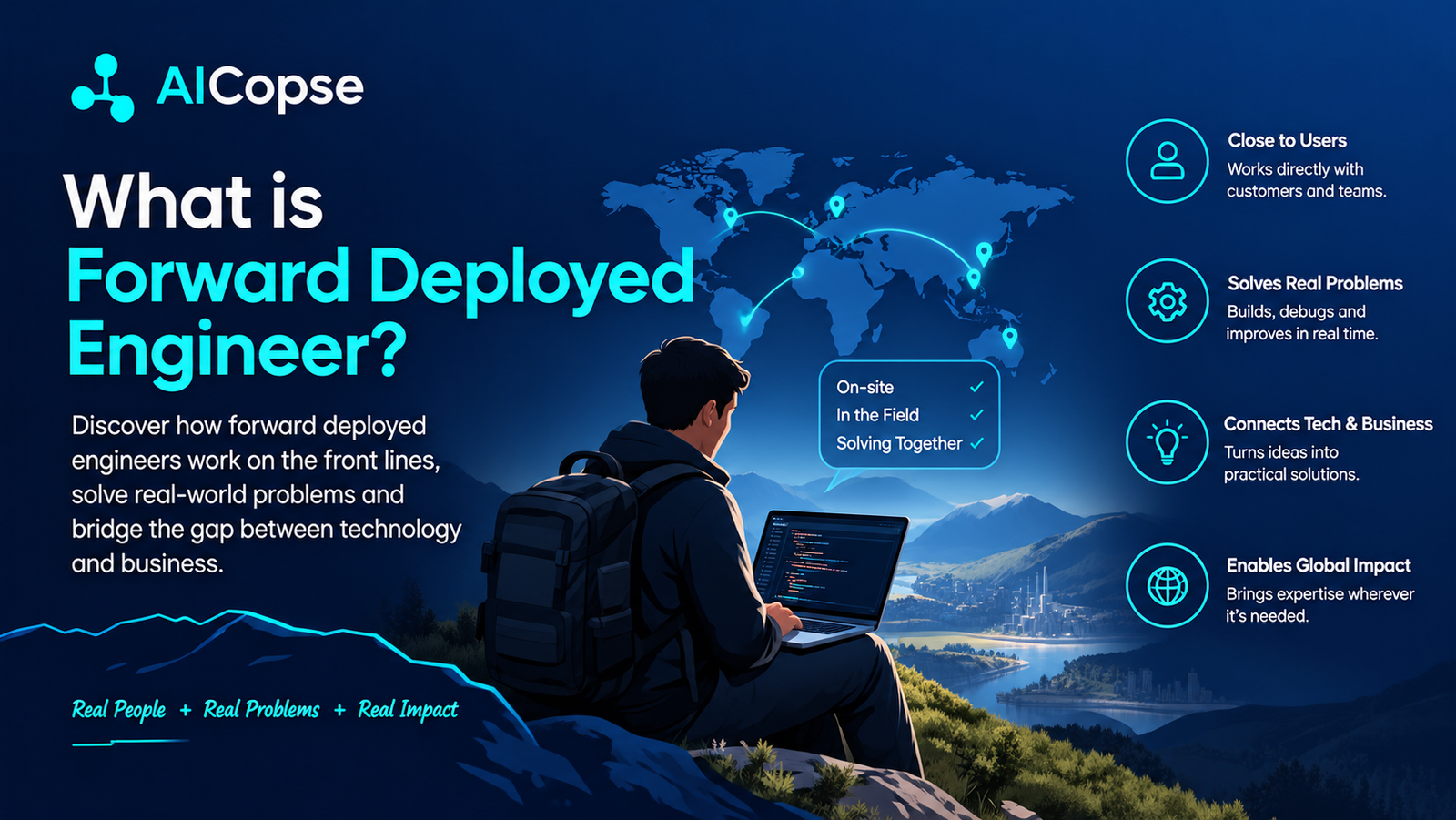
A forward deployed engineer is a customer-facing software engineer who builds, deploys and operates software inside a client’s own environment, often working alongside the client’s staff for a defined period. The role is also called a forward deployed software engineer (FDSE). The name comes from military jargon, where “forward deployed” means stationed close to the action instead of at headquarters.
Palantir’s own explanation is the sharpest one-line definition. A regular product engineer works on one capability for many customers, while a forward deployed engineer works on one customer across many capabilities. The product team builds the platform. The FDE makes it work in a specific organisation with messy data, old systems and real deadlines.
A simple analogy
Think of a company that sells high-end kitchen equipment. The product team designs the oven. The forward deployed engineer is the person who visits your restaurant, fits the oven into your actual kitchen, connects it to your gas line and power, teaches your cooks, fixes what breaks in week one, and tells the factory what the design missed. The oven is the product; the FDE makes it work where it matters.
Where the Role Came From
Why the Role Exploded
The short answer is the last-mile problem: AI models are powerful, but they do not deploy themselves. A widely cited MIT NANDA report found that about 95% of enterprise generative AI pilots showed no measurable business impact. The reason was rarely the model. It was messy company data, unclear requirements, security rules and processes nobody had written down.
An FDE closes that gap. Accenture’s own research, cited in industry coverage, found that only about a third of enterprise leaders report sustained enterprise-wide AI impact. Box CEO Aaron Levie argued that deploying agents is far more technical than most people expect and often harder than deploying ordinary software. A software product ships once to everyone. An AI deployment has to be fitted to each company’s data, permissions and workflows, and that fitting is exactly what an FDE does.
What an FDE Actually Does
Employer postings describe the same loop again and again. It is a cycle, not a straight line:
A real example: Anthropic and FIS
FIS, a financial-technology company, announced an agentic anti-money-laundering platform co-built with embedded Anthropic engineers. The engineers worked with FIS to design a Financial Crimes Agent, with Bank of Montreal and Amalgamated Bank among the first institutions slated to deploy it. The announcement stressed knowledge transfer, so that FIS could build more agents independently afterwards. That is the FDE pattern in one sentence: embed, build, hand over.
A typical week
| Day | What the work looks like |
|---|---|
| Monday | Meet the customer team, review last week’s usage, agree what ships this week. |
| Tuesday | Discover that the data does not match the description. Spend the day tracing where it really comes from. |
| Wednesday | Build and test the integration in the customer’s environment, with their security review in the loop. |
| Thursday | Demo to the people who will actually use it, collect corrections, adjust the plan. |
| Friday | Write up findings for the product team, document the handover, plan next week. |
The scoping step never really stops. Colin Jarvis, then head of OpenAI’s FDE team, told The Pragmatic Engineer newsletter in 2025 that what customers describe at the start often does not match the data and systems on the ground. Ramp’s FDE team turned this into a motto: always be scoping.
AI Forward Deployed Engineer vs Software Forward Deployed Engineer
This is the question the market has not answered clearly. In practice, “software FDE” and “AI FDE” are not two official job families. They are two ends of a spectrum. The software FDE is the original Palantir-style role: deploy and customise a platform with code, data pipelines and integrations. The AI FDE does the same job, but the thing being deployed is a model or an agent, and that changes the engineering in important ways.
| Dimension | Software FDE | AI FDE |
|---|---|---|
| What you deploy | A software platform and the apps and pipelines on top of it | Models, agents and AI workflows inside the customer’s processes |
| Typical stack | Python or Java, TypeScript and React, SQL, APIs, cloud, data integration | All of that plus LLM APIs, retrieval (RAG), agent frameworks, MCP servers, observability |
| Behaviour | Deterministic: same input, same output | Probabilistic: same input can give different outputs |
| How you test | Unit and integration tests that pass or fail | Evals: golden datasets, regression suites, scoring, human review |
| Main risks | Wrong data model, broken integrations, low adoption | Confident wrong answers, drift, cost and latency, data leakage, prompt injection |
| Success metric | The system is live, trusted and used | Production adoption, measurable workflow impact and eval scores |
| Data work | Cleaning, joining and modelling the customer’s data | Same, plus deciding what context the model sees and who is allowed to see it |
| Feedback to HQ | Feature requests and platform fixes | Product and model feedback, new eval cases, failure patterns |
| Typical employers | Palantir, Salesforce, Ramp, Scale AI public sector | OpenAI, Anthropic, Google Cloud, Cohere, Mistral, and AI-first start-ups |
| Best-fit background | Full-stack, data or backend engineer who likes customers | Software engineer who has shipped an LLM or agent system to real users |
What the employers’ own postings say
The language in AI-lab postings shows the difference clearly. Anthropic’s London posting asks its FDEs to build production applications with Claude inside customer systems and to deliver MCP servers, sub-agents and agent skills for production workflows. Scale AI’s postings ask for golden datasets, regression suites and LLM-as-a-judge evaluation. Google Cloud calls its Applied AI FDE an “Agent Engineer” and asks for evaluation pipelines and observability for agentic workloads. OpenAI measures its FDEs on production adoption, measurable workflow impact and eval-driven feedback.
A Bloomberry analysis of 1,000 FDE job postings from January to October 2025 found that 35% mentioned AI agents, 31% mentioned LLM experience and 12% mentioned RAG, while classic model-training work such as fine-tuning older language models featured far less. Companies hiring AI FDEs want people who can deploy a model into a critical system and make it work, not people who train models from scratch.
The difference in one code example
The biggest daily change is how you know your work is correct. Software has exact tests. A model needs an eval set that measures how often it is right. The example below uses a simple rule-based stand-in for the model call, so it runs anywhere. We ran it, and the output shown is real.
# Software FDE style: deterministic code, exact tests
def parse_invoice_total(text):
    amount = text.split("$")[1].replace(",", "")
    return float(amount)

assert parse_invoice_total("Total: $1,250.50") == 1250.5   # passes, every time

# AI FDE style: the model's answers vary, so measure them on the customer's real cases
def classify_ticket(text):
    """Stand-in for an LLM call that routes support tickets."""
    t = text.lower()
    if "refund" in t or "charged" in t:
        return "billing"
    if "password" in t or "login" in t:
        return "account"
    return "other"

golden = [  # real tickets, labelled by the customer's own experts
    ("I was charged twice this month", "billing"),
    ("Please refund my last order", "billing"),
    ("I forgot my password", "account"),
    ("Cannot login after update", "account"),
    ("The app crashes when I upload a photo", "technical"),
    ("Where is my invoice for March?", "billing"),
]
results = [(t, exp, classify_ticket(t)) for t, exp in golden]
correct = sum(1 for _, e, g in results if e == g)
print(f"eval accuracy: {correct}/{len(golden)} = {correct/len(golden):.0%}")
for t, e, g in results:
    if e != g:
        print("FAIL:", repr(t), "expected", e, "got", g)

# eval accuracy: 4/6 = 67%
# FAIL: 'The app crashes when I upload a photo' expected technical got other
# FAIL: 'Where is my invoice for March?' expected billing got other
What this shows: the unit test is either right or wrong. The eval gives a score (67%) and a list of failures, and the FDE’s job becomes improving that score on the customer’s own data until the customer trusts it. Two of the six real tickets failed, which is exactly the kind of gap a demo hides and a deployment exposes.
Which one are you?
| If you enjoy… | You lean toward |
|---|---|
| Untangling messy databases and building apps for operations teams | Software FDE |
| Designing how a model should behave and proving it works | AI FDE |
| Government, defence or heavy-compliance clients | Software FDE, with AI skills added as platforms add AI features |
| Building agents, retrieval systems and tool integrations | AI FDE |
| You are unsure | Start as a strong software engineer with customer exposure, then add the LLM stack. Both paths accept it. |
Our read: the line between the two is blurring. Palantir’s own platform now includes AI tooling, and postings at AI labs still ask for classic software engineering first. Read the posting, not the title: the deployed thing (platform or model) and the success metric (adoption or eval score) tell you which job it is.
FDE vs Solutions Engineer, Consultant and Other Roles
The FDE overlaps with several jobs, which is why the title attracts debate. Andreessen Horowitz has called the FDE title a form of “title arbitrage,” meaning a fresh label for roles once called solutions or integration engineering. The practical test is simple: an FDE writes production code inside the customer’s systems and answers for the result after go-live.
| Role | Main job | Writes production code in customer systems? |
|---|---|---|
| Software engineer (product) | Builds one capability used by many customers | No, builds the platform they run |
| Forward deployed engineer | Builds and runs a solution for one customer | Yes |
| Solutions architect / pre-sales engineer | Advises before the deal and designs the proposed solution | Rarely |
| Sales engineer | Runs demos and technical sales conversations | No, demo environments |
| Consultant | Delivers analysis, recommendations or a project | Less engineering, per Palantir’s own comparison |
| Implementation / integration engineer | Configures and integrates a product for a customer | Often, but narrower; many FDE roles grew from here |
| ML / AI engineer | Builds and improves models and AI systems, usually inside one company | No, builds in the employer’s own systems |
| Deployment Strategist (Palantir “Echo”) | Works with the customer on strategy and operations, closer to product management | Not primarily |
Anthropic’s own postings show the split. Its Applied AI Architect role is pre-sales and advisory with occasional travel, while its FDE role sits with post-sales, product and engineering teams and travels 25 to 50% of the time. Salesforce runs FDEs in pods of two FDEs and one Deployment Strategist, the same pairing Palantir uses.
Skills You Need to Become an FDE
| Skill | Why it matters | How to prove it |
|---|---|---|
| Production coding (Python, TypeScript, SQL) | You ship real code under time pressure; Python appears in nearly every posting | A deployed project with tests and a README |
| Data and integration | Customer data is messy, and the project usually lives or dies on it | A pipeline that cleans and joins an ugly real dataset |
| Cloud and security basics | You deploy inside customer clouds and regulated environments | A project deployed with proper secrets handling and access control |
| LLM apps: RAG, agents, MCP (AI FDE) | The core of AI deployments today | An agent or retrieval app used by real people |
| Evals and observability (AI FDE) | The way you prove a probabilistic system is good enough | A golden dataset, a scoring script and a before-and-after improvement |
| Scoping and problem decomposition | Customers rarely know what they want until they see it | A one-page scope document for a vague problem |
| Writing and communication | You explain trade-offs to executives and users, and hand work over | Clear design notes and demo videos |
| Comfort with ambiguity | Requirements change weekly and nobody hands you a spec | A story of a project that changed direction and how you handled it |
Forward Deployed Engineer Salary and Demand
Posted salary ranges (October 2026)
These are annual base-salary ranges printed in employer postings as read on October 2, 2026, compiled by consultant Szymon Paluch. Equity is mentioned by most employers but rarely given as a number, so total pay is higher than shown.
| Employer and role | Location | Base range printed |
|---|---|---|
| Palantir, Forward Deployed Software Engineer | New York | $135,000 – $200,000 |
| OpenAI, Forward Deployed Engineer | San Francisco | $185,000 – $300,000 |
| OpenAI Deployment Company, FDE | New York | $170,000 – $400,000 |
| Google Cloud, FDE III, Applied AI | US | $174,000 – $252,000 (plus bonus target) |
| Ramp, Software Engineer, Forward Deployed | San Francisco, New York | $189,000 – $330,000 |
| Cohere, FDE, Agentic Platform | California, New York, Washington State | $140,000 – $325,000 |
| Anthropic, Forward Deployed Engineer | London | £225,000 – £255,000 |
| OpenAI Deployment Company, FDE | London / Paris | £90,000 – £150,000 / €115,000 – €200,000 |
The market averages: Indeed puts the average FDE base salary at $171,911, and Bloomberry’s analysis of job postings found a median of $173,816, with 70% of postings mentioning equity. Google’s published bands run from about $127,000 to $183,000 for Applied FDE roles up to $183,000 to $265,000 for FDE IV, before bonus and equity. Experience asked for ranges from 1 year at Palantir to 5 years at OpenAI and Google, and Palantir also hires new graduates.
How fast is demand really growing?
| Source | Finding |
|---|---|
| Indeed (April 2026) | Postings rose from 643 in April 2025 to 5,330 in April 2026, up 729% in a year |
| Indeed and Financial Times | Monthly listings up more than 800% between January and September 2025 |
| Bloomberry | Up 1,165% from January to October 2025 versus the same period of 2024 |
| Paraform | Postings on its platform up 350% from Q1 2025 to Q1 2026 |
How to read these numbers: the estimates range from 350% to 1,165% because each source counts different postings over different periods. Indeed’s figure measures a title that barely registered in early 2025, so a large percentage can still describe a small market. For comparison, KDnuggets notes that overall software-development postings on Indeed remain well below their pre-pandemic level. The honest conclusion is that FDE hiring grew very fast from a small base and is now a real, large category, but the percentage headlines overstate the number of jobs.
Who Is Hiring FDEs
| Employer | What the FDE role looks like (October 2026) |
|---|---|
| Palantir | The originator. FDSE (Delta) and Deployment Strategist (Echo) roles, with new-grad entry routes. |
| OpenAI | Around two dozen FDE-titled postings across the US, Europe and Asia, with sector variants such as healthcare, legal and financial services. |
| OpenAI Deployment Company | Launched May 11, 2026 with more than $4 billion; embeds FDEs inside client organisations and invites small established teams to apply together. |
| Anthropic | FDEs sit in the Applied AI team, embed with strategic customers and build production applications with Claude. |
| Google Cloud | Opened 59 FDE roles in one week in May 2026, with a career ladder from FDE II to FDE IV and plans to hire hundreds. |
| AWS | A $1 billion AI unit to embed engineers with customers, reported by CNBC on June 30, 2026. |
| Salesforce | Dozens of FDE postings, organised in pods of two FDEs and one Deployment Strategist. |
| Cohere, Mistral AI, Scale AI, Ramp | Applied-AI and platform FDE roles; Scale AI’s public-sector roles require a security clearance or eligibility for one. |
| Accenture and ServiceNow | A joint programme embedding engineers from both firms inside customers to build agentic workflows. |
Titles vary, so search every variant: forward deployed engineer, forward deployed software engineer, applied AI engineer, agent engineer, customer engineer and implementation engineer. Locations also vary. Most FDE work happens close to customers, so check whether a posting is on-site, hybrid or remote before you apply.
How to Become a Forward Deployed Engineer
There is no single degree or certification. Employers hire for shipped work and customer judgement. A proven path:
| Step | What to do | Outcome |
|---|---|---|
| 1. Get strong at software | Python and TypeScript, SQL, APIs, Git, testing, one cloud platform | You can ship a working service alone |
| 2. Learn the data layer | Data modelling, pipelines, cleaning messy real datasets | You can trace why numbers disagree |
| 3. Add the AI stack | LLM APIs, RAG, agents, MCP servers, evals and observability | You can ship and measure an AI feature |
| 4. Get customer exposure | Build for a real user, even internal: a team, a local business, a client | You have scoping and handover stories |
| 5. Build a portfolio | Three deployed projects with write-ups of the problem, decisions and results | Evidence a recruiter can read in five minutes |
| 6. Apply through adjacent roles | Solutions engineer, implementation engineer, startup generalist, applied ML | A way in even without the exact title |
Three portfolio projects that signal FDE skills
- A document question-answering system for a real organisation (a clinic, a school, a small firm) with retrieval, permissions and a measured accuracy score on 30 or more real questions.
- An MCP server that connects an AI assistant to a business tool such as a CRM or spreadsheet, with logging and error handling.
- An eval harness for any LLM feature: a golden dataset, a scoring script and a short report showing how you improved the score. The code example above is the starting shape.
If you are early in your coding journey, build the foundations first and treat the AI stack as the second layer. Follow the AICopse AI Updates section for the tools and platform changes that shape this path.
The Interview Process
FDE interviews test more than algorithms. Candidates and recruiters report a common pattern: a coding round, a system-design or decomposition round, and a behavioural or customer-scenario round.
| Round | What it tests | How to prepare |
|---|---|---|
| Coding | Clean, working code under time pressure | Practise realistic tasks: parsing, APIs, data transformation |
| Decomposition (Palantir) | Breaking a vague, complex problem into practical pieces | Talk through ambiguous business problems out loud |
| Learning (Palantir) | How quickly you pick up an unfamiliar system | Learn a new tool in a weekend and explain what you learned |
| Customer scenario (AI labs) | Scoping, communication and deployment judgement under ambiguity | Rehearse the scenario below |
Practice scenario
Prompt: “A hospital group wants an AI assistant that summarises clinical notes. Walk me through how you would take it to production.”
A strong answer covers, in order: who the real users are and what a good summary means to them; what data exists, where it lives and who may see it; privacy and compliance limits; a small labelled test set built with clinicians; a first version measured against that set; the failure cases that matter most (a missed allergy is worse than an awkward sentence); a limited pilot with human review; success measured by time saved and error rate, not by the demo; and a handover plan so the hospital’s team can run it.
Pros and Cons of the FDE Role
- Pay at or above typical senior engineering levels, with equity at most employers
- Fast learning from real business problems and many industries
- Direct visibility with customers and leadership
- Strong foundation for senior engineering, product or founding a company
- Work whose impact you can see and measure
- Travel of roughly 20 to 50% in many postings
- Pressure to solve customer problems in short timeframes, which some engineers find draining
- Constant ambiguity and shifting requirements
- Less time on deep product engineering
- Some “FDE” jobs are professional services under a new title, so check the work
Is the FDE Role Here to Stay?
| The case for durability | The case for a fade |
|---|---|
| Enterprise AI keeps failing at deployment without people who can fit it to messy reality | Enterprises may bring the work in-house as their own engineers become AI-fluent, a point The New Stack’s editor raises |
| The biggest AI labs, cloud providers and consultancies are all investing billions in it | Investors such as a16z call parts of it a relabelled professional-services role |
| Palantir has run the model for more than a decade | The growth percentages start from a very small base, as KDnuggets points out |
Our read: the title may change and the headcount will rise and fall, but the work is durable. As long as companies hold messy data and need AI fitted to their own workflows, someone has to scope the problem, ship the solution and measure the result inside a real organisation. If you build those skills, you stay valuable whether the title is FDE, applied AI engineer or something new.
Common Myths About FDEs
| Myth | Reality |
|---|---|
| “An FDE is just a consultant.” | FDEs write and ship production code and stay accountable after launch. Some jobs with the title are closer to consulting, so judge the work. |
| “FDEs are salespeople with a technical badge.” | Pre-sales is a separate role. FDEs work post-sale, building inside customer systems. |
| “You need to be an AI researcher.” | Postings ask for deployment skills (agents, retrieval, evals, integrations), not model research. |
| “FDEs earn a million dollars.” | Posted bases mostly fall between roughly $135,000 and $330,000, with a few security-focused variants higher and equity on top. |
| “It is only an AI job.” | The role began at Palantir a decade before the AI boom. AI made it famous. |
| “FDE means the same thing everywhere.” | Scope, travel and seniority vary widely by employer, so read each posting closely. |
Glossary
- FDE: forward deployed engineer; a customer-embedded engineer who builds and runs software in the customer’s environment.
- FDSE: forward deployed software engineer; Palantir’s formal title for the role.
- Delta: Palantir’s internal name for its forward deployed software engineers.
- Echo (Deployment Strategist): Palantir’s customer-facing strategy and operations role, paired with Deltas.
- Last-mile problem: the gap between a working product and a working deployment inside a specific organisation.
- Scoping: working out what the customer actually needs before and during the build.
- Eval: a repeatable test that scores an AI system’s quality on a set of cases.
- Golden dataset: a set of real examples with correct answers, used to measure an AI system.
- RAG: retrieval-augmented generation; giving a model relevant documents to answer from.
- MCP: Model Context Protocol, a standard way to connect AI assistants to tools and data.
- Agent: an AI system that takes multi-step actions using tools toward a goal.
- Handover: transferring ownership and knowledge so the customer can run the system alone.
Frequently Asked Questions About Forward Deployed Engineers
What is a forward deployed engineer in simple words?
A software engineer who works inside a customer’s business to make a company’s product or AI work in that customer’s real systems, then stays until it runs well.
What does FDE stand for?
Forward deployed engineer. Palantir’s formal title is Forward Deployed Software Engineer (FDSE), and its 2020 stock-market filing used the acronym FDE.
What is the difference between an AI forward deployed engineer and a software forward deployed engineer?
Both embed with customers and write production code. A software FDE deploys a platform and its apps, pipelines and integrations, and tests it with exact pass-or-fail checks. An AI FDE deploys models and agents, whose outputs vary, so they build retrieval, tool connections, guardrails and eval sets to measure quality. Many roles combine both, so read the posting.
Do forward deployed engineers write code?
Yes. They write production code inside the customer’s systems. Python is named in nearly every FDE posting, alongside TypeScript, SQL and cloud skills.
Is a forward deployed engineer the same as a solutions engineer?
No. Solutions engineers and architects usually work before the sale, advising and demonstrating. FDEs work after the sale, building and running the solution in the customer’s environment. Titles overlap at some companies.
Is a forward deployed engineer a consultant?
Palantir says no, arguing that consultants deliver a one-time analysis or recommendation while FDEs build long-term solutions. Some investors say parts of the role are professional services under a new name. The test is whether you ship production code and own the result.
How much do forward deployed engineers make?
Posted base salaries in October 2026 mostly ranged from about $135,000 to $330,000 in the US, with averages near $172,000 to $174,000 from Indeed and Bloomberry. Equity comes on top at most employers.
How much do FDEs travel?
Postings list between roughly 20% and 50%, for example up to 25% at Palantir and Salesforce and up to 50% at OpenAI.
Do you need a degree or AI experience to become an FDE?
No specific degree is required. Employers look for strong software engineering, evidence of shipped work and customer judgement. For AI FDE roles, hands-on experience with LLM applications, retrieval, agents and evals is expected.
Is “Frontier Deployed Engineer” the same as a forward deployed engineer?
No. Anthropic’s Claude Frontier Academy, announced October 2, 2026, uses the same letters for a different thing: a nomination-based training track. The forward deployed engineer is a job.
Key Takeaways
- A forward deployed engineer builds and runs software inside a customer’s environment; the title comes from Palantir.
- Demand surged because AI models do not deploy themselves; most enterprise pilots fail at the last mile.
- Software FDEs deploy platforms with deterministic code; AI FDEs deploy models and agents and measure them with evals.
- Posted base salaries mostly run from about $135,000 to $330,000 in the US, plus equity.
- Growth figures vary from 350% to 1,165% depending on the source, and they start from a small base.
- Travel of 20 to 50% and ambiguity are the main costs of the job.
- The fastest route in is strong software engineering, an AI stack with evals, and proof you have shipped for a real user.
We update this guide as the market moves. Bookmark it and follow AICopse for daily AI jobs and industry coverage.
Sources and further reading:
- Wikipedia: Forward deployed engineer
- Palantir Blog: Dev versus Delta (April 2019)
- Palantir Technologies Form S-1, SEC (August 2020)
- The New Stack: Forward deployed engineer is AI’s hottest job (May 2026)
- OpenAI: Launch of the OpenAI Deployment Company (May 11, 2026)
- CNBC: AWS puts $1 billion into new AI unit to embed engineers with customers (June 30, 2026)
- KDnuggets: Forward Deployed Engineer, AI’s hottest new career or consulting with a better title?
- Bloomberry: Analysis of 1,000 forward deployed engineer jobs
- Paraform: Forward-deployed engineer demand and salary data (April 2026)
- Szymon Paluch: What is a forward deployed engineer? Posted salaries and employer postings (October 2026)
- The Pragmatic Engineer: What are Forward Deployed Engineers? (August 2025)
- a16z: Trading Margin for Moat (June 2025)
- Anthropic: Claude Frontier Academy announcement (October 2, 2026)

Leave a Reply