
AICOPSE Research Report | 2026–2027
Multimodal AI in 2026–2027: Current Developments, Trends and Future Predictions
How AI systems combine text, images, audio, video and real-world signals, what current research reveals, and how developers, startups and businesses can turn multimodal capabilities into measurable results.
2026 Industry Updates
2027 Forecasts
Business and Developer Guide
Executive Summary
Multimodal AI is becoming one of the most important directions in artificial intelligence because people and businesses rarely work with text alone. A doctor may need to review an image alongside a patient history. A factory operator may need to combine a camera feed with sensor readings and maintenance records. A customer may want to show a damaged product, explain the problem aloud and receive a useful answer in one conversation.
Multimodal systems are designed to work across these different forms of information. They can combine language, images, audio, video and structured data to understand a situation and generate a response or action. In 2026, progress is visible in real-time voice and vision models, long-context processing, multimodal agents and models that can operate across more than one step of a task.
However, better demonstrations do not automatically mean reliable business performance. A model may identify an object correctly in a simple image but fail when the image is blurry, the object is partially hidden or several images must be compared. It may summarize a short video well but miss a detail that appears briefly near the end. It may describe a chart convincingly while reading one of its values incorrectly.
The practical lesson for 2026–2027 is clear: businesses should evaluate multimodal AI on real workflows, not only public benchmark rankings. Accuracy, latency, cost, privacy, failure recovery and human oversight all matter.
Sources: Microsoft Research, Scientific Reports, ACL Anthology and Google Cloud.
What Is Multimodal AI?
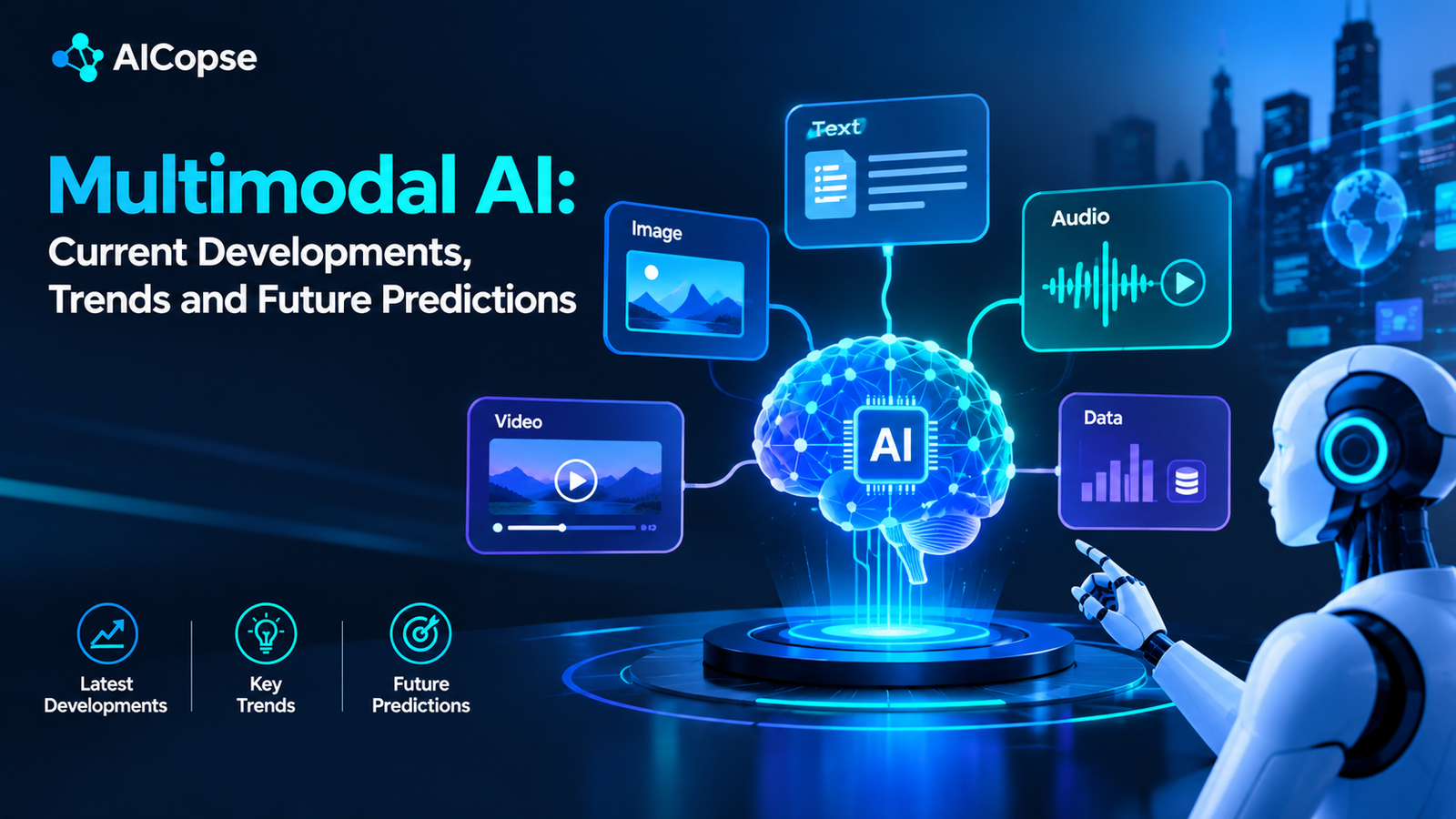
Multimodal AI is a category of artificial intelligence that can process, connect or generate more than one type of information. The word “modality” refers to a form of information, such as text, images, sound or video. A multimodal model may accept several of these inputs and use their relationships to produce a single answer.
A text-only system might answer a question about a product using a written description. A multimodal system could examine the product photograph, listen to the customer’s spoken complaint, read the order receipt and explain which replacement part is needed. The benefit is not simply accepting more file types. It is connecting evidence across those inputs.
Text
Documents, emails, questions, policies, code and structured instructions.
Images
Photographs, screenshots, charts, scans, diagrams and visual inspections.
Audio
Speech, conversations, environmental sounds, music and voice commands.
Video
Sequences of frames, movement, timing, events and audio-video relationships.
Sensors and Data
Telemetry, time series, measurements, device states and business records.
Multimodal AI Versus Traditional AI
| Capability | Traditional Single-Modal System | Multimodal AI System |
|---|---|---|
| Input | Usually one primary data type | Multiple connected data types |
| Customer support | Reads a typed question | Can analyze a spoken complaint and an uploaded image |
| Manufacturing | Separate visual inspection or sensor model | Can connect visual evidence with sensor data and maintenance records |
| Main challenge | Limited coverage of other data types | Cross-modal errors, integration complexity and higher evaluation demands |
| Best fit | Narrow, stable tasks | Tasks where different kinds of evidence improve the decision |
Multimodal AI does not make every workflow better. If a task requires extracting a number from a clean text field, a simple database query may be cheaper and more accurate. The strongest business case exists when combining modalities provides information that a single input cannot provide.
How Multimodal AI Works
Multimodal systems commonly use a combination of input encoders, shared or connected representations, a reasoning model and output components. The exact architecture varies. Some models are trained to handle multiple modalities natively, while other applications connect separate specialist models through an orchestration layer.
A Practical Multimodal AI Pipeline
1. Inputs
Text, image, audio, video, sensor data
2. Encoding
Convert inputs into model-readable representations
3. Fusion
Connect evidence across modalities
4. Reasoning
Answer, classify, compare or plan
5. Output
Text, speech, structured result or controlled action
Simplified conceptual diagram. Production systems may repeat stages, use several specialist models or ask a human to approve a proposed action.
The Main Technical Components
- Encoders: Convert text, pixels, audio or video frames into representations the model can process.
- Fusion and alignment: Help the model connect a spoken phrase to an image, a video event to a timestamp or a chart to a written question.
- Reasoning layer: Interprets the combined evidence and produces a response, classification or plan.
- Retrieval and tools: Connect the model to approved documents, databases, calculators, business APIs or search systems.
- Guardrails and validation: Check whether the answer is supported, whether an action is allowed and whether a human must review the result.
- Monitoring: Records latency, failure types, cost, user feedback and changes in performance over time.
Consider a warehouse assistant that receives a short video of a damaged package, a photograph of its shipping label and a spoken question from a worker. The system must identify the package, connect the damage to the correct shipment, check the delivery record and recommend a next step. If it gets the shipment number wrong, fluent reasoning cannot repair the underlying error. Reliable multimodal AI therefore requires checks at both the input and decision stages.
Major Developments and Events in 2026
By October 2026, multimodal AI development is moving beyond isolated image-question-answering demonstrations. Current releases increasingly emphasize native multimodal interaction, longer context, voice and vision in real time, and the ability to use tools. The following timeline highlights developments that matter to developers and business buyers.
Gemini 3.1 Flash Live and Real-Time Voice-Vision Workflows
Google introduced Gemini 3.1 Flash Live with a focus on real-time voice and vision interactions. The broader trend is toward systems that can interpret ongoing interaction instead of waiting for a user to submit a separate text prompt for every step.
More Specialized Voice Intelligence
OpenAI announced additional voice capabilities, including GPT-Realtime-2, Realtime-Translate and Realtime-Whisper. This reflects a wider architecture choice: developers can use an integrated audio model or combine specialized components for transcription, translation and response generation.
Real-World Use Becomes a Research Focus
Microsoft Research published an analysis of more than 40,000 de-identified image-upload conversations, studying how people use multimodal assistants in practice. The findings suggest that users often combine multiple tasks instead of simply asking a model to recognize an object.
A New Visual-Reasoning Meta-Analysis
A Scientific Reports meta-analysis examined 21 multimodal models across seven standardized benchmarks. Its results highlight the importance of model differences and training methods, while showing substantial variation in performance across systems.
Open-Weight and Real-Time Competition Intensifies
Meta announced Muse Spark Open, describing it as a natively multimodal open-weight model with 816 billion total parameters, 42 billion active parameters and a one-million-token context window. These are vendor-reported specifications, not proof that it is the best choice for every business task.
The competitive advantage is shifting from simply supporting more modalities toward handling them with lower latency, better alignment, more useful reasoning and safer tool use. Buyers should still test model availability, regional access, API terms, privacy controls and real-world accuracy before committing to a provider.
Market Demand and Business Trends
Multimodal AI is not one isolated market. It overlaps with generative AI, computer vision, speech technology, enterprise search, video analytics, robotics and AI agents. As a result, market-size reports use different definitions. Some measure foundation models, some measure AI software and services, and others measure specific applications. A single universal market figure would therefore be misleading.
For businesses, demand is being driven by the need to interpret unstructured information. Organizations already hold large volumes of images, PDFs, recordings, camera footage and operational records. Multimodal systems offer a way to make this information searchable and actionable, provided that the output can be validated.
Generative AI use cases from organizations, compiled by Google Cloud in April 2026.
Real-world image-upload conversations analyzed to better understand multimodal user needs.
Standardized tests included in a 2026 meta-analysis of visual reasoning.
Where Demand Is Likely to Grow
Enterprise document intelligence
Combining page images, tables, charts, scanned records and text-based retrieval.
Voice and video interfaces
Natural conversations, live assistance, visual troubleshooting and meeting analysis.
Industrial inspection
Connecting camera images, equipment signals and maintenance history.
Healthcare support
Supporting clinicians with medical images and patient records under strict oversight.
Commerce and product discovery
Using a product photo, spoken preferences and catalog information in one search.
Robotics and physical AI
Connecting visual perception, instructions, spatial reasoning and actions.
These are demand signals and opportunity areas, not a guarantee that every sector will adopt the technology at the same speed. Regulated industries face additional validation requirements, while organizations with low-quality source data may need substantial data preparation before an AI project becomes viable.
How to Measure Multimodal AI Accuracy
A model’s benchmark score is meaningful only when the benchmark tests the task that matters to the business. Image captioning, chart reading, video understanding, speech recognition and multi-image comparison are different capabilities. Strong performance on one does not establish strong performance on all the others.
Core Benchmark Categories
| Task | What to Measure | Business Failure Example |
|---|---|---|
| Image understanding | Object accuracy, attribute accuracy, visual grounding | Incorrectly identifies a damaged component |
| Document AI | Field accuracy, table extraction, numerical consistency | Reads an invoice amount incorrectly |
| Video understanding | Event recall, temporal order, timestamp accuracy | Misses a short but important safety event |
| Audio understanding | Word error rate, speaker attribution, intent accuracy | Misunderstands a customer name or request |
| Cross-modal reasoning | Evidence consistency and conflict detection | Uses a photo that does not match the written record |
| Agentic task completion | End-to-end success, policy compliance, recovery rate | Takes the wrong action after interpreting an image |
A Better Business Accuracy Scorecard
Rather than reporting one overall percentage, businesses should measure several dimensions separately. The following is a suggested internal scorecard, not a published industry benchmark.
Check text, labels, numbers and relevant visual details against ground truth.
Test whether the model detects contradictions across image, audio and text.
Measure whether the correct business outcome occurs, not merely whether the answer sounds plausible.
The bar lengths are illustrative visual elements, not measured performance results or recommended universal thresholds.
Important: do not compare scores across different benchmarks as if they were interchangeable. Dataset size, difficulty, scoring method, model version, prompting, access to tools and contamination controls can all affect results. A business should use public benchmarks to narrow the shortlist, then run a private evaluation using its own representative examples.
Six Research Studies That Explain the Direction of Multimodal AI
The following studies are useful because they examine different parts of the problem: real user behavior, visual reasoning, medical multi-image understanding, long-form video, and the gap between laboratory benchmarks and practical tasks. They should not be treated as one combined score because their datasets, methods and research questions differ.
From Images to Tasks: Characterizing Multimodal LLM Interactions in the Wild
Research team: Microsoft Research, including Jinyi Ye, Scott Counts, Gaurav Verma, Kate Lytvynets and Weiwei Yang.
What researchers studied: The team analyzed more than 40,000 de-identified image-upload conversations from Microsoft Copilot. The purpose was to understand what people actually try to accomplish when they upload images to a multimodal assistant. The research also compared observed user needs with 253 existing benchmarks and validated its task framework against an independent ChatGPT dataset.
Key finding: most image-upload tasks involved multiple capabilities rather than a single isolated act of perception. The researchers also found that common user workflows were not always well represented by existing benchmarks. In particular, tasks involving text, code and data generation were comparatively under-tested.
Why this matters: a benchmark might ask a model to name an object, but a real user may ask it to inspect a screenshot, diagnose a problem, extract information and create a usable output. Businesses should evaluate complete workflows and not only the first visual recognition step.
Practical application: startups should create test cases from real support tickets, product images, screenshots and document workflows. Label not only whether the model recognized the image correctly, but also whether it completed the user’s full task.
Source: Microsoft Research, September 2026.
A Multilevel Meta-Analysis of Visual Reasoning in Multimodal Large Language Models
Publication: Scientific Reports. The study examined 21 models across seven standardized benchmarks, producing 102 model-benchmark observations.
Key findings: the analysis reported substantial variation between models, with an intraclass correlation coefficient of 0.801. It also found a positive association between model scale and standardized performance, with beta = 0.73 and p = 0.016. Training methodology was associated with performance differences as well. The paper cautioned that some training-method groups were small, limiting definitive conclusions.
The authors also reported strong correlations between several reliably estimated benchmark pairs, with correlations ranging from 0.63 to 0.95. However, the aggregate sensitivity analysis showed extreme heterogeneity, with I² = 96.3%. This matters because a pooled average can conceal large differences between models, datasets and evaluation settings.
Why this matters: larger models may have advantages, but size alone is not a guarantee of superior results. Training, alignment, data quality and the exact task also matter. A model that ranks highly on one visual reasoning test may still perform poorly on a company’s specific images.
Practical application: benchmark at least two model sizes or providers on the same evaluation set. Track both average performance and the categories where each model fails. A smaller model may be preferable if it provides sufficient accuracy at a much lower cost or latency.
Beyond Single View: MedMultiBench and Medical Multi-Image Understanding
Publication: Proceedings of the 64th Annual Meeting of the Association for Computational Linguistics, 2026.
What the benchmark measures: joint reasoning, comparative analysis, comprehensive perception and in-context learning across medical images. Unlike tasks that provide one image at a time, multi-image evaluation asks whether a model can reason across several related views or pieces of visual evidence.
Key finding: the study reported that models often performed better on single-view tasks than on multi-image contexts. It also observed performance degradation among open-source models as visual loads increased, while closed-source models showed better scalability in the tested setting. This is a finding from that evaluation, not a universal rule that closed models always outperform open models.
Why this matters: many business problems are comparative. A clinician may need to compare scans taken at different times; an insurance reviewer may need to compare several damage photographs; a quality inspector may need to check multiple views of one component. Single-image accuracy does not measure these tasks adequately.
Practical application: when multiple images affect a decision, test whether the model preserves image identity, recognizes contradictions and explains which image supports each conclusion. In healthcare, use the model only within an appropriate clinical validation and professional oversight process.
Source: ACL Anthology, MedMultiBench, 2026.
Video-MME: Comprehensive Evaluation of Multimodal Models in Video Analysis
Publication: Proceedings of the IEEE/CVF Conference on Computer Vision and Pattern Recognition, 2025.
Video-MME was designed to address a gap in multimodal evaluation: models that perform well on static images may still struggle to understand how events unfold over time. The benchmark covers six major video domains and 30 subfields. It includes videos from 11 seconds to one hour and considers visual frames, subtitles and audio.
Key findings: the paper reported that adding subtitle and audio information could improve video understanding. It also found that model performance declined as video duration increased. In the paper’s evaluated setting, Gemini 1.5 Pro achieved 75% average accuracy and GPT-4o achieved 71.9%. These are historical results from the benchmark and models tested in that study, not a current 2026 leaderboard.
Why this matters: a video is not just a large image. Timing, event order, brief actions and spoken explanations can change the answer. A model may describe a scene correctly while failing to identify the exact moment when a safety violation occurred.
Practical application: test video systems on short and long clips, with and without subtitles, and with important events near the beginning, middle and end. Measure timestamp precision and missed-event rate, not just the quality of the generated summary.
Source: CVPR 2025, Video-MME.
The 2026 AI Index: Capability Progress and the Need for Better Measurement
Stanford University’s Institute for Human-Centered Artificial Intelligence published its 2026 AI Index coverage in April. The report examines broader AI progress, including model capabilities, adoption, costs, transparency and the effects of AI on society. It is not a multimodal-only benchmark, but it provides important context for interpreting rapid changes in the model market.
Why it matters for multimodal AI: model capability is advancing alongside changes in cost, availability and deployment options. Businesses must therefore consider more than a headline score. A system’s usefulness depends on whether its performance is reproducible, whether the model can be deployed safely, and whether its cost and operating requirements fit the workflow.
Practical application: treat model selection as a recurring review rather than a one-time decision. Re-run the same internal evaluation when a provider changes a model version, pricing, context limit or API behavior. Keep a record of the exact model version and configuration used for each test.
Limit: the AI Index covers the broader AI ecosystem. Its overall findings should not be presented as a direct measure of image, audio or video accuracy.
Source: Stanford HAI, April 2026.
1,302 Real-World Generative AI Use Cases from Industry Leaders
In April 2026, Google Cloud published a collection of 1,302 real-world generative AI use cases from organizations. The collection offers a broad view of how companies are applying AI to operations, customer experiences, information access and knowledge work.
Knowledge retrieval
Document processing
Employee productivity
Workflow automation
Key lesson: use-case breadth can help teams discover where AI may be useful, but a collection of examples does not establish a universal return on investment. Case studies may vary in scope, measurement methods and level of independent verification.
Practical application: use examples to develop a shortlist, then calculate the expected value of one specific workflow. For example, estimate how much time staff spend reviewing incoming photos and documents, how often errors occur, what a correction costs and how many cases can be safely automated.
Source: Google Cloud, April 2026.
What the Six Studies Collectively Tell Us
| Research | Main Lesson | Business Response |
|---|---|---|
| Microsoft Research, 2026 | Real users perform multi-step tasks | Evaluate complete workflows |
| Visual reasoning meta-analysis, 2026 | Model and training differences matter | Benchmark several candidate systems |
| MedMultiBench, 2026 | Multiple-image reasoning is difficult | Test comparative tasks and conflicts |
| Video-MME, 2025 | Longer videos introduce difficulty | Measure timing and missed events |
| Stanford AI Index, 2026 | Capability is only one part of deployment | Track costs, versions and governance |
| Google Cloud use cases, 2026 | Business applications are broad | Prioritize a measurable workflow |
Competitor and Platform Landscape in 2026–2027
The multimodal market includes foundation-model providers, open-weight model developers, cloud platforms and specialist computer-vision vendors. They compete on different dimensions: reasoning quality, modality support, context, latency, cost, deployment options, ecosystem and operational controls.
There is no single provider that is best for every multimodal workload. A model optimized for real-time voice may not be the most cost-effective option for processing thousands of scanned documents. An open-weight model may provide deployment flexibility but require more infrastructure, evaluation and maintenance.
| Provider or Family | Competitive Strength | Potential Fit | What to Verify |
|---|---|---|---|
| OpenAI | Multimodal reasoning and real-time audio capabilities across its model and API ecosystem | Assistants, document workflows, voice-enabled applications and tool-using systems | Supported input types, API limits, data handling and task-specific accuracy |
| Google Gemini | Multimodal model development, long-context applications and real-time interaction | Video, image-heavy workflows and cloud-integrated products | Model-specific limits, regional availability, pricing and output quality |
| Meta Muse Spark Open | Open-weight access and natively multimodal design, according to Meta’s announcement | Teams seeking more control over deployment and model experimentation | License, hardware needs, inference cost, benchmark reproducibility and support |
| Anthropic Claude | Document-oriented reasoning and image-supported workflows, depending on model | Knowledge work, document review and analysis | Specific visual capabilities, file constraints and task-level accuracy |
| NVIDIA ecosystem | Inference infrastructure, deployment tools and specialized model options | Enterprise and industrial AI deployments | Hardware cost, performance per workload and model compatibility |
| Specialist vision and document platforms | Task-specific extraction, OCR, inspection or analytics | Stable, narrow workflows that need predictable outputs | Coverage of edge cases and integration requirements |
Provider capabilities change rapidly. Product names, model versions and release availability should be checked against official documentation before publishing a purchasing decision or building a production dependency.
How to Compare Competitors Fairly
- Use the same test set: submit the same inputs, instructions and expected outputs to each candidate.
- Keep the configuration consistent: record model version, image resolution, video sampling, context limits, tools and decoding settings.
- Separate task types: report image understanding, audio transcription, video reasoning and multi-image comparison independently.
- Measure total cost: include input processing, output generation, storage, retries, human review and infrastructure.
- Test failure behavior: check whether the model admits uncertainty, requests a clearer image or invents a confident answer.
- Check portability: understand how much of the application can move to another provider without a complete rewrite.
Industry-Wise Multimodal AI Use Cases
The most valuable use cases connect multiple data sources to a decision. The examples below show where this may be useful and what teams must validate before moving from a pilot to production.
Healthcare and Life Sciences
Assist with medical image review, clinical document summarization, voice-based note capture and comparison of records over time.
Validation: clinical accuracy, privacy, bias, professional oversight and relevant regulatory requirements.
Banking and Insurance
Read forms, compare identity documents, assess submitted damage images and connect customer conversations with approved records.
Validation: fraud controls, audit trails, data retention and human review for consequential decisions.
Retail and E-Commerce
Enable visual product search, image-based returns, catalog enrichment and voice-plus-image shopping assistants.
Validation: product match accuracy, return fraud, accessibility and catalog consistency.
Manufacturing and Logistics
Connect inspection photos, equipment sounds, sensor alerts, work orders and maintenance records to identify likely faults.
Validation: missed-defect rate, false alarms, safety impact and reliability under changing conditions.
Education and Training
Explain diagrams, provide feedback on recorded presentations, generate accessible learning materials and answer questions about instructional videos.
Validation: factual accuracy, age-appropriate responses, accessibility and learning outcomes.
Media and Marketing
Search video libraries, create captions, summarize meetings, classify assets and adapt approved content into multiple formats.
Validation: rights management, speaker attribution, brand accuracy and human editorial review.
Software and IT
Analyze screenshots of errors, connect logs with screen recordings, explain UI behavior and assist with visual regression testing.
Validation: reproducibility, code security, regression coverage and false diagnosis rate.
Travel and Hospitality
Support voice-based itinerary planning, visual identification of amenities, document processing and multilingual guest support.
Validation: live information accuracy, booking confirmation and escalation to staff.
A Practical Example: Multimodal Customer Support
A customer contacts a retailer about a damaged appliance. They upload two photographs, send a short video and explain the issue using voice. A well-designed workflow could:
- Extract the product label and order reference from the photographs.
- Summarize the spoken complaint and preserve relevant details.
- Inspect the video for visible damage without treating the model’s interpretation as definitive proof.
- Retrieve the order, warranty terms and return policy from approved systems.
- Check that the images and order refer to the same product.
- Suggest a return or repair option, then request human approval when the case is uncertain or high-value.
This workflow can reduce repeated questions and manual review, but the benefit must be measured. The team should track time per case, incorrect classifications, avoidable escalations, customer satisfaction and total cost per resolved request.
Major Risks, Failures and Incidents Businesses Must Understand
Multimodal AI creates new failure paths because an error in one input can affect every later stage. A misleading photograph, incorrect transcript or malicious instruction embedded in an image may change the final answer. Businesses should separate documented research findings from risk scenarios: the risks below are important failure classes, but they should not be interpreted as claims that a particular company suffered a new breach in 2026.
1. Hallucinated Visual Details
A model may invent text in a blurry image, misread a chart or infer a defect that is not visible. This is especially dangerous when the output drives financial, safety or medical decisions.
2. Cross-Modal Contradictions
The written description may conflict with the image or the audio may identify a different item. A reliable system should flag disagreement instead of silently selecting one source.
3. Prompt Injection in Media
An image, screenshot, document or video frame may contain instructions designed to manipulate the model. Treat external content as data, not as permission to override system rules.
4. Deepfakes and Identity Fraud
Synthetic audio or video can be used to impersonate a person. Visual or voice similarity alone should not authorize payments, account recovery or sensitive changes.
5. Privacy Leakage
Images and recordings may reveal faces, addresses, health details, credentials or confidential business information. Collect only what the workflow needs.
6. Automation Without Verification
An incorrect interpretation can trigger a refund, dispatch, deletion or machine action. Consequential actions need permissions, validation and an appropriate approval step.
Security Controls for Production Systems
- Scan uploads and restrict file formats, size and duration.
- Separate user-provided content from trusted system instructions.
- Do not let a model execute unrestricted tools based only on an image or recording.
- Require explicit authorization for payments, account changes, data deletion and physical actions.
- Log the evidence and model version used for consequential decisions, subject to privacy requirements.
- Use confidence thresholds carefully. A model’s verbal confidence is not a calibrated probability of correctness.
- Provide an easy human escalation path when inputs are unclear, conflicting or high risk.
- Red-team with misleading images, altered documents, background noise, unusual accents, conflicting descriptions and hidden instructions.
Businesses operating in the United States should assess relevant privacy, consumer protection, sector-specific and state-level requirements. Healthcare, financial services and employment use cases may require additional controls. Legal obligations depend on the use case, the data and the jurisdiction; a general AI policy is not a substitute for qualified legal and security review.
Future Predictions for 2027
The following predictions are evidence-informed outlooks, not confirmed future facts. They are based on current research about real-world usage, model evaluation, multi-image reasoning, long-video limitations and the rapid development of real-time multimodal systems.
Real-Time Voice and Vision Will Become More Common
Interfaces will increasingly allow users to speak, show a live view and ask follow-up questions in one session. This should benefit field service, accessibility and customer support.
What could slow it down: latency, network reliability, privacy concerns and errors in live interpretation.
Task-Level Evaluation Will Matter More Than Leaderboards
Organizations will build private benchmark sets based on their own documents, photos, video clips and customer workflows. Generic scores will remain useful for initial screening but insufficient for procurement.
What could slow it down: lack of high-quality labels and the cost of expert evaluation.
Hybrid Model Architectures Will Remain Important
Many production applications will combine a general multimodal model with OCR, retrieval, speech recognition, computer vision or rules-based checks. A single model will not be the cheapest or safest answer to every task.
What could slow it down: integration complexity and maintenance across multiple services.
Long-Video Understanding Will Improve, but Remain Uneven
Better temporal processing and retrieval over video segments should help monitoring, training and media search. However, long-duration reasoning will continue to need evaluation for missed events and incorrect timestamps.
What could slow it down: compute cost, sampling choices and difficult temporal relationships.
Open-Weight Multimodal Options Will Attract More Teams
Some organizations will evaluate open-weight models to gain deployment flexibility, customize performance and reduce dependence on one provider. The total cost will depend on infrastructure and operations.
What could slow it down: hardware needs, licensing restrictions, security work and lower accuracy on some tasks.
Governance Will Become a Product Requirement
Enterprise buyers will increasingly demand audit logs, access controls, provenance, data retention options and clear human escalation paths as part of the deployment.
What could slow it down: inconsistent controls across providers and legacy systems.
Expected Direction by Use Case
| Use Case | Likely 2027 Direction | Main Constraint |
|---|---|---|
| Document processing | More cross-page and image-plus-text workflows | Numerical accuracy and auditability |
| Customer support | More voice, screen and image interaction | Escalation and correct action execution |
| Video analytics | More natural-language search across footage | Temporal recall, privacy and cost |
| Healthcare | More clinician-support experiments | Clinical validation and regulation |
| Industrial operations | More image, sensor and maintenance-data integration | Safety, false alarms and environmental variation |
Practical Guide for Developers, Startups and Businesses
For Developers: Build for Reliability, Not Just a Demo
- Define the task precisely. Decide whether the application needs object recognition, document extraction, audio transcription, temporal video reasoning or a combination.
- Choose the simplest workable architecture. Use a native multimodal model when integrated reasoning matters. Use specialist components when the task requires predictable extraction or a well-established narrow capability.
- Create a representative test set. Include ordinary cases, edge cases, low-quality media, unusual formats, contradictory inputs and examples that should trigger refusal or human review.
- Keep source evidence available. Preserve relevant page numbers, image references, timestamps or transcript segments so users can verify an answer.
- Validate structured outputs. Check dates, IDs, currency amounts and required fields with deterministic code or authoritative data sources.
- Build graceful failure paths. Ask for a clearer image, request missing information, retry safely or escalate instead of fabricating a result.
- Track versions and regressions. Model updates can change behavior. Re-run the evaluation set before deploying a new version.
For Startups: Select a Narrow, Valuable First Workflow
A startup does not need to build a general-purpose multimodal platform to create value. A specific workflow with clear inputs and a measurable outcome is usually easier to test, sell and improve.
- Choose a painful task that currently requires repeated manual review.
- Interview users and collect representative examples with permission.
- Measure the current process before introducing AI.
- Build a baseline with a simple model or existing service before fine-tuning a large model.
- Test whether the multimodal inputs add value compared with a text-only or rules-based approach.
- Charge for the business outcome, reliability or workflow improvement rather than the novelty of the model.
- Keep a human fallback until error rates and the consequences of failure are well understood.
For Businesses: Calculate ROI Before Scaling
Multimodal AI can reduce handling time, improve access to information or increase the number of cases an employee can process. But the business case should include all costs, not just the model’s API price.
Illustrative ROI Calculation
Assume a business processes 10,000 cases per month. Each case currently takes 6 minutes of manual work. A multimodal system reduces average handling time by 2 minutes, and 70% of the cases can use that improvement safely.
Estimated time saved: 10,000 × 70% × 2 minutes = 14,000 minutes, or about 233.3 hours per month.
If the fully loaded labor cost is $30 per hour, the theoretical gross labor capacity value is approximately $7,000 per month. This is not automatically cash savings. The actual benefit depends on whether staff capacity is redeployed productively or paid hours are reduced.
Net value formula: realized labor benefit + error reduction value + additional revenue − model cost − infrastructure − human review − integration and maintenance costs.
This example is illustrative, not a reported industry result. A credible ROI assessment should also include incorrect outputs, refunds, rework, escalation costs, security review and the cost of monitoring the system after launch.
A 90-Day Implementation Roadmap
Discovery and Baseline
- Choose one workflow
- Collect approved sample data
- Define ground truth
- Measure current time and error rates
Prototype and Evaluation
- Compare two or more approaches
- Test difficult examples
- Measure cost and latency
- Add approval and fallback paths
Controlled Pilot
- Deploy to a limited user group
- Review failures regularly
- Measure realized value
- Decide whether to scale
Expert Recommendations for 2026–2027
The research points to a practical strategy: start with a business problem, evaluate the right capability, and put controls around the decision that follows. The recommendations below are grounded in the patterns found across the research studies and current product direction.
1. Benchmark the Complete Workflow
Do not stop at “the model recognizes the image.” Test whether the system extracts the right information, connects it with other evidence and produces the correct business outcome. The Microsoft Research study shows why real-world multimodal tasks often involve several capabilities.
2. Design for Conflicting Evidence
Images, audio and text can disagree. Build explicit checks for mismatched product IDs, inconsistent amounts, conflicting timestamps and missing evidence. When sources conflict, the system should flag the case or request clarification instead of hiding the disagreement.
3. Use the Right Model for Each Stage
A general model may be useful for interpreting complex situations, while OCR or a deterministic validator may be better for extracting exact numbers. Hybrid architectures can improve reliability, but they need clear interfaces, monitoring and end-to-end testing.
4. Make Human Review Risk-Based
Not every output needs manual approval. A low-risk product description may be published after automated checks, while a medical interpretation, financial decision or physical safety action needs stronger controls. Set review rules according to the impact of a mistake.
5. Measure Cost Per Successful Outcome
Compare systems using the total cost of a correctly completed task. Include failed attempts, retries, storage, inference, human review, maintenance and downstream errors. The lowest API price is not necessarily the lowest operational cost.
6. Treat Data Governance as Part of Product Design
Define which media can be uploaded, how long it is retained, who can access it, whether it can be used for training and how users can request deletion. Review provider terms and applicable laws before sending sensitive data to external services.
7. Re-Test After Every Material Model Change
Model updates may improve one task and weaken another. Preserve a versioned evaluation set and compare results before production rollout. Maintain a rollback plan for changes that create unacceptable regressions.
For developers and organizations following the broader AI landscape, AICOPSE provides an editorial starting point for AI news, technology and industry insights. Readers can also learn more about the site’s coverage through the AICOPSE About page.
Frequently Asked Questions
What is multimodal AI in simple terms?
Multimodal AI is artificial intelligence that can work with multiple forms of information, such as text, images, audio and video. It can connect these inputs to answer questions, create content or support a workflow.
Why is multimodal AI important in 2026?
Organizations hold important information in documents, images, recordings and videos. Multimodal AI can help make this information easier to search, interpret and use in business processes, provided that its output is validated.
Which multimodal AI model is the most accurate?
There is no universal winner across all tasks. Accuracy depends on the modality, dataset, benchmark, model version, context and evaluation method. Businesses should compare candidates on the same representative test set.
Can multimodal AI understand long videos?
Some models can analyze long videos, but performance may decline as duration and complexity increase. Teams should test event recall, timestamps, audio-video alignment and important moments that appear only briefly.
Can startups build multimodal AI products without training a model?
Yes. Many startups can begin with an existing API or open-weight model and focus on data quality, workflow design, user experience, evaluation and integration. Training a foundation model from scratch is not necessary for most first products.
How should a business calculate multimodal AI ROI?
Measure the time saved, error reduction and additional value created, then subtract model, infrastructure, integration, review and maintenance costs. Use real pilot results instead of assuming that all automated cases produce cash savings.
What are the biggest risks of multimodal AI?
Major risks include hallucinated visual details, incorrect transcription, cross-modal contradictions, privacy leakage, prompt injection, deepfake-enabled fraud and unsafe actions triggered by a mistaken interpretation.
What is the most important multimodal AI trend for 2027?
A likely trend is the move toward integrated, real-time systems that combine voice, vision, retrieval and tool use. The business value will depend on reliable task completion, cost and appropriate human oversight rather than on the number of supported modalities alone.
Research Sources and Further Reading
The following primary research papers, research organizations and official product announcements provide further detail on the developments discussed in this report.
- Microsoft Research. From Images to Tasks: Characterizing Multimodal LLM Interactions in the Wild, September 2026.
- Scientific Reports. A Multilevel Meta-Analysis of Visual Reasoning in Multimodal Large Language Models, published 26 September 2026.
- Association for Computational Linguistics. Beyond Single View: A Comprehensive Benchmark for Medical Multimodal Large Language Models on Multi-Image Understanding, ACL 2026.
- IEEE/CVF CVPR. Video-MME: The First-Ever Comprehensive Evaluation Benchmark of Multimodal LLMs in Video Analysis, 2025.
- Stanford Institute for Human-Centered Artificial Intelligence. Inside the AI Index: 12 Takeaways from the 2026 Report, April 2026.
- Google Cloud. 1,302 Real-World Generative AI Use Cases from the World’s Leading Organizations, April 2026.
- Google. Build with Gemini 3.1 Flash Live, March 2026.
- OpenAI. Advancing Voice Intelligence with New Models in the API, May 2026.
- Meta AI. Introducing Muse Spark Open, October 2026.
- Google. Gemini 3.8 Live and Gemini 3.8 Live Extended Thinking, September 2026.
- AICOPSE. AI News, Research, Technology and Industry Insights.
- AICOPSE. About AICOPSE.
Research Note and Disclaimer
This report synthesizes published research, official announcements and industry examples available at the time of preparation. Model capabilities and availability can change quickly. Vendor-reported specifications are identified as such, and study results apply to the datasets and methods used by the researchers. Forecasts are informed projections, not guarantees. This report is for general informational purposes and is not medical, legal, financial or security advice.

Leave a Reply