
AICOPSE Research Report | 2026 Edition
Artificial Intelligence in Manufacturing: Trends and Future Predictions 2027–2030
How industrial AI, smart factories, robotics, digital twins, predictive maintenance and autonomous production are reshaping manufacturing, with current research, major incidents and practical forecasts through 2030.
2027 Trends
2030 Predictions
USA and Global Industry
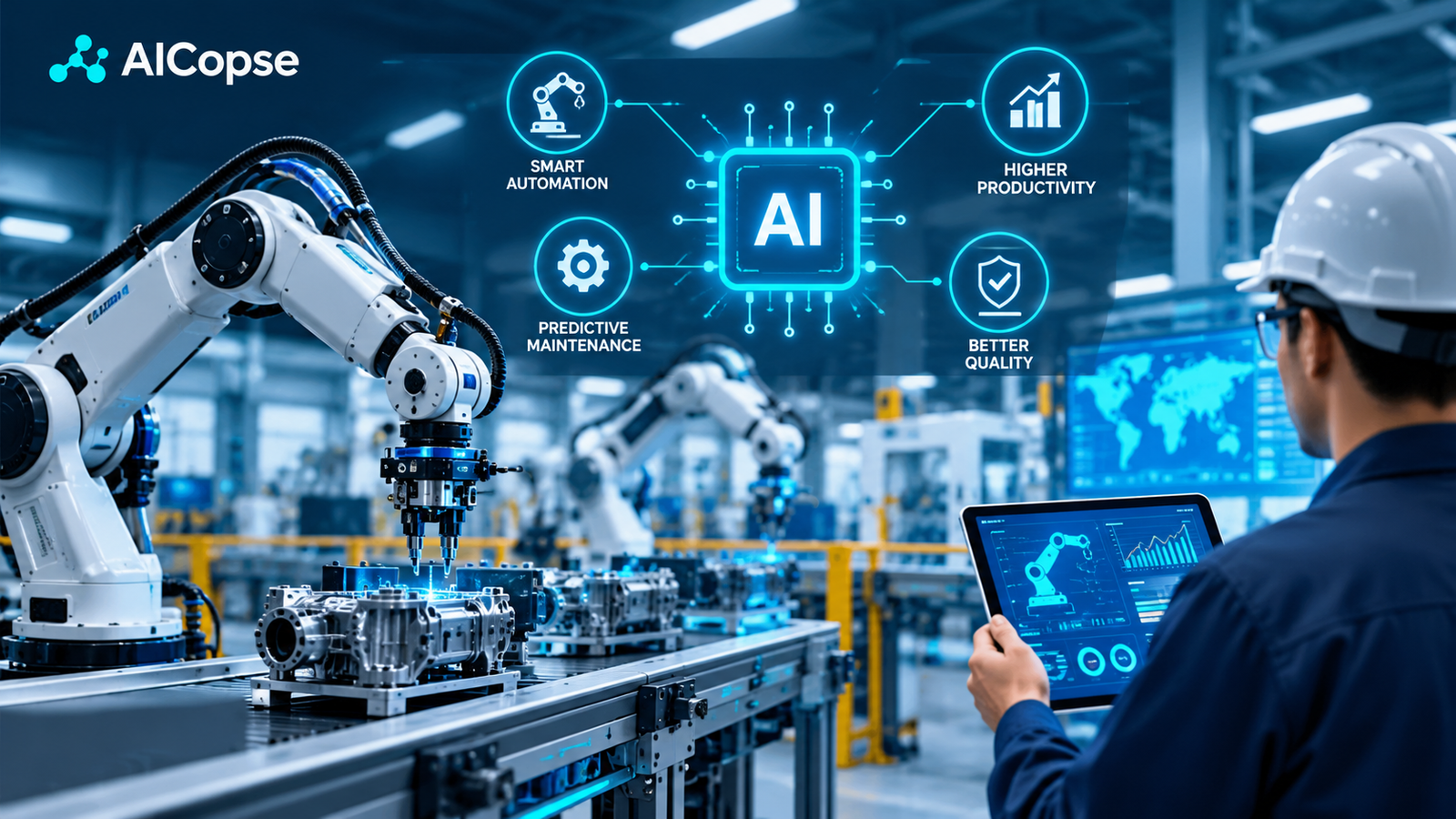
Artificial intelligence in manufacturing is moving from isolated experiments to a broader industrial transformation. Manufacturers are using AI to identify defects, predict equipment failures, optimize production schedules, improve energy efficiency, assist engineers and coordinate increasingly complex supply chains. The next phase will combine conventional machine learning with generative AI, industrial robotics, digital twins and AI agents that can help workers make decisions across entire production systems.
However, the opportunity is not as simple as installing an AI model and expecting a factory to become autonomous. Manufacturing environments depend on physical equipment, reliable sensors, carefully controlled processes, product specifications and worker safety. A model that produces an incorrect answer in an office application may waste time. A model that sends an unsafe instruction to an industrial machine can damage equipment, interrupt production or put people at risk.
The most important question for 2027–2030 is therefore not whether manufacturers will use AI. It is whether they can turn individual AI projects into reliable, secure and measurable operational improvements.
Central finding: The evidence points to a growing gap between AI adoption and AI at scale. Companies that combine clean production data, industrial integration, workforce training and measurable business outcomes are better positioned to benefit than companies that invest in AI without changing how operations are managed.
Executive Summary
Research published in 2026 shows strong interest in industrial AI, but it also reveals practical barriers involving data quality, skills, integration, security and scaling. These findings matter because manufacturing AI must work within real production constraints, not just in demonstrations or controlled tests.
- Investment is increasing: Deloitte’s 2026 manufacturing outlook reports that 80% of 600 surveyed manufacturing executives planned to allocate at least 20% of their improvement budgets to smart manufacturing initiatives.
- Scaling remains difficult: Deloitte’s separate 2026 AI in Manufacturing survey found that 84% of respondents reported measurable value from AI, while only 20% of use cases were scaled consistently.
- AI adoption varies by measurement: A 2026 American Economic Association paper using data from approximately 28,500 US establishments found that 22.8% of manufacturing plants reported some AI use as of 2021. This is a historical baseline, not a measure of adoption in 2026.
- Quality control remains practical: Vision systems can identify surface defects, missing components, incorrect labels and assembly errors. Their business value depends on reliable detection, false-alarm rates and integration with production workflows.
- Predictive maintenance is becoming more useful: Sensor data and machine-learning models can identify patterns associated with equipment degradation, allowing maintenance teams to investigate problems before a failure stops production.
- Digital twins are gaining attention: They can help engineers simulate production changes, evaluate machine behavior and compare possible operating conditions before making expensive physical changes.
- Physical AI is an emerging direction: Robots, autonomous mobile robots and AI-assisted machines may become more adaptable, but safety controls and deterministic machine logic will remain essential.
- Cybersecurity is a production concern: The March 2026 Stryker cyber incident disrupted order processing, manufacturing and shipping. An August 2026 US government advisory also warned of targeted reconnaissance involving Siemens programmable logic controllers.
- 2030 will not mean fully autonomous factories everywhere: A more realistic expectation is a mixture of automated production cells, AI-assisted workers, semi-autonomous material handling and human-supervised decision systems.
Key Statistics at a Glance
80%
Smart manufacturing investment intent
Deloitte survey of 600 executives; 2025 survey findings used in the 2026 outlook.
84%
Respondents reporting measurable AI value
Deloitte’s 2026 AI in Manufacturing survey of more than 140 organizations.
20%
AI use cases scaled consistently
Deloitte’s 2026 survey, highlighting the gap between value and scale.
201
Global Lighthouse Network sites
World Economic Forum network total reported in September 2025.
These numbers measure different things. Investment intentions are not actual expenditure, reported value is not necessarily independently audited, and a historical adoption rate cannot be compared directly with a newer survey without accounting for different years and definitions.
Table of Contents
- What AI in Manufacturing Means
- Major AI Manufacturing Trends in 2026
- Six Research Studies Explained
- Competitor and Research Landscape
- Major Events and Incidents
- Manufacturing AI Trends in 2027
- Future Predictions for 2028–2030
- Practical Guidance for Businesses, Startups and Developers
- ROI, Metrics and Implementation Roadmap
- Risks, FAQs and Research Sources
What Is Artificial Intelligence in Manufacturing?
Artificial intelligence in manufacturing refers to computer systems that use data, statistical models and learned patterns to support or automate tasks involved in designing, producing, inspecting, maintaining and distributing physical products.
Unlike general-purpose office AI, industrial AI must often respond to machine conditions, production deadlines, safety limits and quality standards. Its performance depends on the equipment and data available, the production environment, and how decisions are verified and applied.
Predictive AI
Forecasts machine failures, demand, quality problems and production delays using historical and live data.
Computer Vision
Analyzes images or video to detect defects, verify assembly, read labels and monitor process conditions.
Generative AI
Helps workers search manuals, summarize maintenance history, draft procedures and retrieve technical knowledge.
Physical AI and Robotics
Combines perception, planning and robotics to support flexible material handling, inspection and production tasks.
Digital Twins
Connects a virtual representation of a machine, process or factory with data to analyze behavior and test changes.
AI Agents
Can coordinate multi-step tasks such as reviewing a fault, retrieving procedures and preparing a maintenance recommendation.
How an AI-Enabled Factory Works
Sensors and Machines
Temperature, vibration, images, machine states
Industrial Data
Historian, MES, ERP, quality records
AI Analysis
Detect, predict, compare and recommend
Verified Action
Worker approval, controlled automation
Safety-critical control must remain within appropriately engineered and validated control systems. An AI recommendation should not bypass machine interlocks or approved operating limits.
Major Artificial Intelligence in Manufacturing Trends in 2026
AI Is Moving from Pilots to Operational Scale
Manufacturers are increasingly evaluating AI against production outcomes instead of judging success by the number of demonstrations or prototypes completed. A successful pilot may prove that a model can identify defects on one production line, but enterprise deployment introduces different products, lighting conditions, machine configurations, staff routines and data systems.
The next step is to build repeatable deployment processes. That includes reusable data pipelines, model monitoring, approval workflows, security controls, version management and a clear owner for the business result.
- Standardize how production data is collected and labeled.
- Track model performance across shifts, product variants and equipment changes.
- Define how operators can challenge, override or escalate an AI recommendation.
- Measure savings and quality improvements after deployment, not just during testing.
Predictive Maintenance Is Becoming More Context-Aware
Traditional preventive maintenance often follows a calendar or machine-hour schedule. Predictive maintenance uses machine condition data to estimate when performance is deteriorating or a failure risk is increasing.
Modern approaches combine vibration, temperature, acoustic signals, motor current, maintenance logs and operating conditions. Rather than relying on one sensor threshold, an AI system can learn patterns associated with different failure modes. Engineers still need to validate whether those patterns are meaningful and whether the maintenance action is justified.
In 2026, the practical direction is toward condition-based maintenance that prioritizes equipment by failure risk, production criticality, spare-parts availability and the cost of downtime. AI can support that prioritization, but unreliable sensors or incomplete failure histories can undermine the result.
Computer Vision Is Expanding Beyond Final Inspection
Computer vision is one of the most accessible AI applications in manufacturing because many quality tasks already depend on visual inspection. Cameras and machine-learning models can inspect surfaces, verify assembly, read serial numbers, detect missing parts and flag packaging errors.
The next stage is not simply adding more cameras. Manufacturers are connecting inspection results to upstream process information. If a defect rate rises, a system may help engineers compare the change with a tool replacement, material batch, temperature variation or machine adjustment.
This creates a feedback loop between quality inspection and process improvement. The model should still be evaluated for false negatives, false positives, product variation and changing conditions. In high-risk products, AI inspection should complement validated quality procedures rather than replace them without evidence.
Generative AI Is Helping Workers Find Industrial Knowledge
Factories often depend on technical knowledge stored in machine manuals, maintenance records, standard operating procedures, engineering documents and the experience of long-serving employees. Finding the right information during an equipment fault can be slow, especially when documentation is fragmented.
Generative AI can make these resources easier to search. A controlled assistant can retrieve the relevant manual section, summarize a maintenance history, explain an alarm code or prepare a draft shift handover. Retrieval-augmented generation can ground responses in approved documents and show the source used.
Manufacturers should not treat a fluent answer as proof of correctness. Access controls, document versioning, source citations and clear escalation rules are essential. The assistant should distinguish between an approved instruction and a generated suggestion.
Digital Twins Are Connecting Simulation with Live Operations
A digital twin can represent a machine, production line, facility or product. When connected to operational data, it can help engineers understand how a process behaves under different conditions. AI can add anomaly detection, forecasting or optimization to this representation.
Possible applications include testing production schedules, evaluating bottlenecks, estimating the effect of a new machine, planning maintenance and analyzing energy use. A digital twin is only as trustworthy as its assumptions, input data and validation. A visually impressive simulation can still produce misleading results if its physical model is inaccurate.
The NIST Digital Twins Workshops Summary Report, published in July 2026, identifies interoperability, verification and validation, uncertainty quantification, cybersecurity and workforce readiness as important issues for trustworthy manufacturing digital twins.
AI Agents Are Emerging in Production Support
AI agents can combine language models with tools, databases and defined workflows. In manufacturing, a maintenance-support agent might read a machine alarm, retrieve the relevant procedure, check recent work orders and prepare a recommended inspection plan.
That is different from allowing an agent to control a production machine without oversight. A sensible deployment begins with read-only access and recommendations. Later, low-risk actions can be automated through approved systems, with logging, permissions and rollback procedures.
- Lower-risk tasks: searching manuals, summarizing shift reports and preparing maintenance tickets.
- Moderate-risk tasks: recommending schedule changes or prioritizing work orders for a supervisor.
- Higher-risk tasks: changing machine parameters, modifying safety-related settings or directly controlling hazardous equipment.
Industrial Cybersecurity Is Becoming an AI Deployment Requirement
Connecting operational technology to analytics platforms creates new paths for data movement and potential attack. Manufacturing systems may include programmable logic controllers, industrial PCs, remote maintenance tools, engineering workstations and enterprise applications. These systems can have different security requirements and patching constraints.
AI does not remove these risks. A compromised account, insecure integration or malicious input could influence recommendations or expose sensitive production data. AI-generated attack scripts also make it important for operators to strengthen existing industrial security practices.
Manufacturers should segment networks, control remote access, maintain asset inventories, monitor unusual activity, test recovery plans and ensure that AI systems cannot bypass safety controls. The August 2026 advisory from the NSA and partner agencies highlights targeted reconnaissance involving Siemens S7 programmable logic controllers and risks to critical industrial processes.
Energy Efficiency and Production Optimization Are Converging
Manufacturing AI can improve energy management by analyzing equipment loads, idle periods, compressed-air systems, heating and cooling, production schedules and electricity tariffs. The goal is not only to reduce energy use but also to avoid unnecessary consumption while maintaining product quality and delivery commitments.
For example, an optimization system might identify machines running without productive output or detect that a process uses more energy than usual under comparable conditions. Engineers can then investigate the cause and verify whether a change reduces energy use without creating defects or bottlenecks.
Human Skills Remain a Major Constraint
Manufacturing AI requires more than data scientists. Plants need people who understand production processes, industrial networks, maintenance, quality engineering, cybersecurity and change management. A model can identify a statistical anomaly, but an experienced engineer may be needed to determine whether it reflects a genuine failure or a normal process change.
Companies that train operators and technicians to work with AI are more likely to identify useful applications and catch model errors. Workforce planning should therefore include technical training, clear accountability and opportunities for employees to improve the system.
Six Research Studies That Explain the Future of Manufacturing AI
The following studies combine recent surveys, academic research, government technical work and real-world industrial case examples. They use different methodologies, so their results should not be combined into one universal adoption rate or treated as directly comparable experiments.
Study 1 | 2026
Deloitte: AI in Manufacturing 2026
Research focus: Whether manufacturing organizations are generating value from AI and whether they can scale successful use cases.
Deloitte’s 2026 survey included more than 140 manufacturing organizations across industries, regions and company sizes. It found that 84% of respondents reported measurable value from AI, while only 20% of use cases had been scaled consistently across sites or across the enterprise. The study also reported average improvement potential across core operational KPIs of around 20%.
84%
Measurable value reported
20%
Use cases scaled
140+
Organizations surveyed
What the results mean: A company may have a successful predictive maintenance pilot but still lack the data infrastructure, deployment process or operational ownership needed to repeat it across ten factories. The gap between proving value and scaling it is a central business problem.
Business implication: Manufacturers should assess their ability to standardize data, integrate models with existing systems and monitor outcomes before expanding the number of AI projects.
Important limitation: The survey reflects participating organizations and self-reported outcomes. It does not establish that every manufacturer will achieve the same results or that AI alone caused every reported improvement.
Study 2 | 2026
American Economic Association: The Adoption of Industrial AI in America
Research focus: Which US manufacturing establishments adopted AI and which organizational characteristics were associated with adoption.
The paper by Kristina McElheran, Mu-Jeung Yang, Zachary Kroff and Erik Brynjolfsson appeared in the May 2026 issue of AEA Papers and Proceedings. It uses a purpose-designed US Census Bureau survey of approximately 28,500 establishments. The study found that 22.8% of manufacturing plants reported some AI use as of 2021, while intensity-weighted adoption was much lower.
Historical baseline: AI use reported by US manufacturing plants in 2021
22.8% reported any AI use. This is not a 2026 adoption estimate.
The study found that adoption was associated with more recent digital infrastructure, including cloud computing and predictive analytics, rather than simply having legacy on-premises systems or descriptive analytics. Structured production-process management and establishment size were also important predictors. Cost, lack of applicable use cases and limited expertise were among the main barriers.
Why this matters: Buying AI software is not the same as being ready to use it. Factories need reliable digital records, consistent production processes and a defined problem that AI can solve. Organizations that lack these foundations may struggle even when a model performs well in a demonstration.
Practical lesson: Before choosing a model, assess whether the plant records machine states, defects, maintenance actions and production conditions in a consistent and usable way.
Important limitation: The adoption data describes 2021. It provides a useful academic baseline but should not be presented as the share of US plants using AI in 2026.
Study 3 | 2026
NIST and IOP Publishing: Roadmap on AI and Machine Learning for Smart Manufacturing
Research focus: The technical foundations and research priorities needed to make industrial AI reliable, adaptable and scalable.
Published in July 2026, the roadmap examines industrial big data, advanced sensing, autonomous systems, additive manufacturing, digital twins, robotics, logistics and sustainable manufacturing. It also discusses emerging directions including physics-informed AI, explainable AI, industrial foundation models, reliability and safety.
The key message is that manufacturing AI is an engineering discipline, not just a software feature. Industrial data can be noisy, incomplete or inconsistent. Machines and sensors may use different interfaces. A model can behave differently when products, materials or operating conditions change.
Data quality
Reliable measurements and meaningful labels
Interoperability
Systems that can exchange data safely
Trustworthiness
Explainability, validation and safe operation
Adaptability
Handling changing equipment and products
Why this matters: Factories cannot assume that a model validated on one machine will remain accurate after equipment replacement, sensor drift or a new product variant. Model monitoring and revalidation must be part of normal operations.
Practical lesson: Developers should version datasets and models, record operating conditions, test edge cases and create a process for reviewing performance after any major production change.
Study 4 | 2025
World Economic Forum: Global Lighthouse Network
Research focus: How leading manufacturing sites use digital technologies to improve productivity, quality, resilience and sustainability.
In September 2025, the World Economic Forum announced 12 new Lighthouse sites, bringing the network total to 201 production facilities and value chains. The newly recognized cohort reported an average 40% increase in labour productivity and a 48% reduction in lead time. The announcement also reported that AI and generative AI enabled up to 50% of implemented top use cases at these sites.
40%
Average labour productivity increase
48%
Lead-time reduction
201
Network sites at announcement
The report illustrates the potential of combining technologies rather than deploying AI in isolation. Computer vision, analytics, digital workflows and connected supply-chain systems can work together to reduce defects and improve production decisions.
Why this matters: A factory may achieve limited value from an isolated model if workers still depend on manual reporting, disconnected planning tools and slow escalation processes. Larger gains can require redesigning the workflow around the new capability.
Practical lesson: Study industrial leaders for repeatable methods, not as a promise that every plant will achieve the same percentages. Benchmark the original conditions, investment, production mix and measurement period before comparing results.
Study 5 | 2025–2026 outlook
Deloitte: 2026 Manufacturing Industry Outlook
Research focus: Smart manufacturing investment, competitiveness, supply-chain uncertainty and workforce preparation.
Deloitte’s outlook draws on a 2025 survey of 600 manufacturing executives. It reports that 80% planned to allocate 20% or more of their improvement budgets to smart manufacturing initiatives. In the same survey, 92% viewed smart manufacturing as a main driver of competitiveness, up from 86% in 2019. Another 93% expected it to transform how products are made, up from 83% in 2019.
Reported average improvement ranges after smart manufacturing implementation
Bars are illustrative visual comparisons, not a common statistical scale. These are reported ranges, not guaranteed outcomes or universal AI-only effects.
The report also points toward agentic AI in supply chains, production and aftermarket services. It notes that 22% of manufacturers planned to use physical AI within two years, compared with 9% at the time of the survey.
Why this matters: Investment decisions are being shaped by more than labor savings. Manufacturers want flexible capacity, faster response to demand changes, improved quality and greater resilience to supply disruptions.
Practical lesson: Build an AI business case around the bottleneck that matters most to the plant. Increasing output has little value if demand is weak, while improving inspection may be valuable even if total production volume stays the same.
Study 6 | 2026
NIST: Digital Twins Workshops Summary Report
Research focus: Standards, interoperability, trust and implementation barriers for manufacturing digital twins.
The NIST report, published in July 2026, summarizes a three-part workshop series that brought together industry, academic and government participants. The discussions emphasized the potential of digital twins across design, production and lifecycle management, while identifying barriers involving interoperability, verification, validation, uncertainty quantification, cybersecurity and workforce readiness.
This is important because digital twins often combine multiple engineering tools, data feeds and physical models. Two systems may use different units, data formats or assumptions. If a virtual representation does not accurately reflect the physical process, an AI optimization system can recommend a change that looks attractive in simulation but performs poorly on the factory floor.
Verify
Check that the model and data represent the real system.
Validate
Compare simulated outputs with measured behavior.
Quantify uncertainty
Show where results are reliable and where assumptions remain weak.
Business implication: Digital twins will be most valuable where engineering decisions are expensive, production changes are risky or system interactions are difficult to understand using spreadsheets alone.
Practical lesson: Begin with a bounded use case such as a bottleneck machine or a production line. Validate the model against observed data before allowing it to influence operational decisions.
Competitor and Research Landscape: What Different Sources Tell Us
Manufacturing AI research is spread across consulting firms, standards organizations, academic researchers, industrial technology providers and manufacturing case-study networks. Each group answers a different question. A strong industry report should compare these perspectives instead of repeating one vendor survey as if it described the whole sector.
| Research source | Primary focus | What it contributes | Main caution |
|---|---|---|---|
| Deloitte | Investment and scaling | Budget priorities, reported value and deployment gaps | Survey findings may not represent every plant |
| American Economic Association | Academic adoption evidence | Large US establishment sample and adoption correlates | Adoption data is from 2021 |
| NIST | Technical reliability and standards | Interoperability, validation, security and trustworthy systems | Roadmaps identify needs rather than guarantee outcomes |
| World Economic Forum | Advanced manufacturing case studies | Examples of combined digital transformation and operational outcomes | Leading sites are not a random sample of all factories |
| Rockwell Automation | Smart manufacturing survey | Technology investment, workforce and security priorities | Industry survey from a technology provider |
| Cisco | Industrial networking and AI | Connectivity, network readiness and industrial AI expectations | Respondent expectations are not measured production outcomes |
The 2026 State of Smart Manufacturing coverage reports a survey of 1,560 respondents across 17 countries. It highlights data utilization, security, workforce skills and integration between manufacturing execution systems and other enterprise platforms. The Cisco 2026 State of Industrial AI report adds a networking perspective based on more than 350 manufacturing professionals across 19 countries.
What the research landscape misses when viewed in isolation: adoption rates do not show whether a plant can scale a model; technical roadmaps do not establish ROI; and leading-factory case studies do not prove that the same approach will work in a smaller factory with different products, equipment and workforce capabilities.
A more useful analysis connects five questions: Is the use case valuable? Is the data good enough? Can the model integrate with production? Can the result be validated and secured? Can the business sustain the system after the pilot ends?
Major Events and Incidents Shaping Manufacturing AI
Manufacturing AI is being shaped by both technology announcements and operational disruptions. The following timeline separates documented security incidents from research releases and policy developments. Not every event was caused by AI; several demonstrate why resilient industrial operations are necessary as factories become more connected.
MARCH 11, 2026
Stryker Reports a Cybersecurity Disruption
Stryker reported a cyberattack that disrupted its Microsoft environment and affected order processing, manufacturing and shipping. The company said the incident was contained to its internal environment and reported no indication of malware or ransomware at the time of its update.
Lesson for manufacturers: Enterprise IT disruption can affect production even when the attack does not directly compromise a machine controller. Incident response, backup procedures, manual workarounds and recovery testing are essential.
JULY 3, 2026
NIST and IOP Publishing Release an AI Roadmap
The 2026 roadmap on AI and machine learning for smart manufacturing highlighted industrial data, sensing, digital twins, robotics, explainability, reliability and safety. It reinforced the need to treat trustworthy AI as an engineering and integration challenge.
JULY 21, 2026
NIST Publishes Digital Twin Workshop Findings
The report focused on interoperability, model verification, uncertainty quantification, cybersecurity and workforce readiness. These issues are important for factories considering AI-assisted simulation and optimization.
AUGUST 19, 2026
US Agencies Warn of Threats to Industrial Controllers
The NSA and partner agencies published an advisory about active threats involving reconnaissance and capability development against US-based Siemens S7 programmable logic controllers, including the use of AI-generated exploitation scripts disguised as legitimate monitoring tools. The advisory warned of potential disruption to industrial processes and risks involving equipment, safety and sensitive information.
Lesson for manufacturers: Restrict network exposure, patch where feasible, control engineering access, monitor abnormal behavior and prepare an incident response plan specific to operational technology.
SEPTEMBER 2025, WITH RELEVANCE THROUGH 2026
World Economic Forum Expands the Lighthouse Network
The World Economic Forum announced 12 new Lighthouse sites, bringing the total network to 201. The results demonstrated how AI and connected digital systems can support productivity, quality and lead-time improvements when deployed as part of broader operational transformation.
These events do not prove that AI itself caused a factory shutdown. They show that manufacturing depends on interconnected digital and physical systems, and that AI adoption must be accompanied by security, resilience, validated processes and clear accountability.
Manufacturing AI Trends in 2027
Based on the 2026 research, the most plausible direction for 2027 is broader use of AI within established industrial workflows. Some applications will become more autonomous, but safety-critical decisions and production control will continue to require strong engineering constraints.
TREND 01
AI Copilots for Maintenance
Technicians will increasingly use assistants that retrieve machine manuals, review fault histories and prepare inspection recommendations.
TREND 02
More AI-Based Quality Inspection
Factories will connect visual inspection with traceability and process data to investigate recurring defects more quickly.
TREND 03
Controlled AI Agents
Agents will help coordinate documentation, planning and work-order workflows with role-based permissions and human approval.
TREND 04
Digital Twin Integration
More manufacturers will test production changes virtually before committing time and capital to physical changes.
TREND 05
AI-Ready Industrial Data
Data engineering, equipment connectivity and consistent asset records will receive more attention as companies scale use cases.
TREND 06
Human-Supervised Robotics
Robotic systems may become more adaptable for material handling, inspection and repetitive tasks, with safety limits still enforced.
What Will Change First?
In 2027, the most accessible gains are likely to come from applications that assist existing workers rather than replace entire production systems. Examples include improved defect detection, faster troubleshooting, better scheduling recommendations and automated document retrieval.
These applications can often be deployed incrementally. They still require testing, but they generally create fewer physical risks than allowing an AI agent to make direct, unreviewed changes to machine controls.
2027 planning priority: Build repeatable AI deployment capability. A manufacturer that can reliably deploy, monitor and improve one model across several lines may gain more value than a company running dozens of disconnected pilots.
Future Predictions for Artificial Intelligence in Manufacturing: 2028–2030
The following forecasts are evidence-based projections, not confirmed future events. They combine the 2026 research landscape with known engineering and operational constraints. Confidence labels describe the likelihood of a broad direction, not a guaranteed date for every company or industry.
| Period | Prediction | Confidence | Evidence and condition |
|---|---|---|---|
| 2027 | More AI copilots in maintenance, quality and production planning | High | Existing use cases and growing emphasis on operational value |
| 2027–2028 | More factories connect AI with manufacturing execution and enterprise systems | High | Scaling requires integration and consistent data |
| 2028 | Digital twins and simulation support more production and investment decisions | Medium to high | Depends on model validation, data quality and interoperability |
| 2028–2029 | More bounded AI agents coordinate maintenance and planning workflows | Medium | Requires permissions, reliable tools and auditability |
| 2029 | AI-assisted robots become more useful for selected flexible tasks | Medium | Physical reliability and safety validation remain barriers |
| 2030 | Leading plants operate integrated, human-supervised AI systems across multiple workflows | Medium to high | Depends on sustained investment, workforce skills and measurable returns |
Prediction 1: AI Will Become Part of Routine Production Decisions
By 2030, leading manufacturers are likely to use AI in routine decisions involving inspection, maintenance, production scheduling, inventory planning and energy management. These systems will not necessarily run the whole factory autonomously. More commonly, AI will make recommendations or carry out bounded tasks within established workflows.
The important change will be integration. Instead of asking a separate AI tool for an answer, workers may receive model-supported recommendations directly inside maintenance, quality or production applications.
Prediction 2: AI Adoption Will Split into Leaders and Late Movers
Manufacturers with modern data infrastructure, standardized processes and strong operational leadership may scale AI more quickly than organizations with fragmented systems and limited technical capacity. The gap may become visible in defect rates, equipment availability, lead times and the speed with which new products move into production.
However, company size alone will not determine success. Smaller manufacturers can compete by selecting focused use cases, using established software and working with specialist partners instead of building every capability internally.
Prediction 3: Digital Twins Will Move from Engineering Projects into Operations
By 2028–2030, digital twins may become more common in production planning, equipment design, process troubleshooting and capacity planning. AI could help identify unusual behavior or evaluate possible adjustments within the simulated environment.
Adoption will depend on whether companies can maintain accurate models and prove that their recommendations match physical reality. Digital twins will be less useful when data is stale, equipment has changed or critical assumptions are undocumented.
Prediction 4: Physical AI Will Expand, but Not Uniformly
Robots and autonomous mobile systems will likely become more capable in selected environments, particularly where tasks are repetitive but layouts or product mixes change. Improved perception and planning can make these systems easier to adapt to new work.
Yet general-purpose physical automation will face constraints that software AI does not. Robots must handle real-world variation, collision risks, unpredictable materials and equipment wear. Highly structured tasks may automate faster than work requiring delicate manipulation or complex human judgment.
Prediction 5: AI Governance Will Become Part of Factory Operations
As AI systems influence more production decisions, manufacturers will need clear rules for model approval, data access, performance monitoring, incident response and human intervention. Governance will increasingly be treated as an operational responsibility rather than a document produced only for compliance.
Companies will need to know which models are deployed, what data they use, which systems they can access, who approves updates and how to revert to a safe operating state if a model becomes unreliable.
Prediction 6: Industrial AI Will Be Evaluated by Business Outcomes, Not Model Size
The strongest long-term value may come from a relatively small model that detects a specific defect reliably, predicts a known failure mode or improves a production schedule. A larger general-purpose model is not automatically better for a narrow industrial task.
Manufacturers will increasingly compare systems using cost per inspected unit, avoided downtime, false-reject rate, energy per good product, production yield and time required to resolve a fault.
Prediction 7: Human Expertise Will Remain Essential in 2030
AI may reduce repetitive analysis and help workers find information more quickly, but people will remain important for diagnosing unusual failures, approving high-impact decisions, improving processes and maintaining safety. The role of the workforce is likely to change rather than disappear across many industrial settings.
Training will need to cover both technical use and judgment: when to trust a recommendation, how to verify its source, when to escalate a problem and how to recognize a system that is operating outside its validated conditions.
What a Leading Factory Could Look Like in 2030
- AI-supported inspection detects and classifies quality problems during production.
- Predictive maintenance helps prioritize inspections based on machine condition and production risk.
- Digital twins support selected engineering, scheduling and capacity decisions.
- AI assistants help technicians find approved procedures and document work.
- Robots and autonomous mobile systems handle suitable material movement and repetitive tasks.
- Production managers see connected quality, energy, inventory and downtime indicators.
- Safety systems, access controls and human approval remain in place for high-impact actions.
Expert Recommendations for Manufacturers
For Manufacturing Businesses
- Start with one costly problem: Choose a clear bottleneck such as repeated defects, unplanned downtime, scrap, long changeovers or production scheduling delays.
- Establish a baseline: Record current performance for enough time to capture normal shifts, product mixes and seasonal variation.
- Use the simplest suitable technology: A statistical model, rules-based system or computer-vision model may outperform a complex generative AI solution for a narrow task.
- Involve operators early: Workers understand real production conditions and can identify false alarms, missing context and impractical recommendations.
- Plan for integration: Check whether the solution works with existing PLCs, sensors, historians, MES, ERP, quality systems and maintenance software.
- Protect production: Keep safety interlocks independent of AI and test manual fallback procedures before deployment.
- Scale only after validation: Confirm the result on more than one production condition before expanding to other lines or sites.
For Startups Building Manufacturing AI Products
Industrial AI startups should avoid treating factories as ordinary software customers. Procurement, testing and deployment often involve operations leaders, plant managers, quality engineers, IT, operational technology teams, cybersecurity staff and finance stakeholders.
- Choose a narrow market: A focused solution for one production process is easier to validate than a platform that claims to optimize every factory function.
- Demonstrate measurable value: Show the baseline, the test conditions, the false-positive rate, the integration effort and the actual operational result.
- Design for existing equipment: Support realistic legacy environments and avoid requiring a complete factory modernization before delivering value.
- Make deployment repeatable: Document connectors, installation steps, data requirements, model updates and rollback procedures.
- Build security into the product: Use least-privilege access, tenant separation, audit logs, encryption and controlled remote support.
- Offer a human workflow: Give operators a way to review, explain and correct recommendations instead of requiring blind trust.
- Be clear about limitations: State which products, machine types, sensors and operating conditions have been tested.
For Developers and AI Engineers
- Build data pipelines that preserve timestamps, machine identifiers, units and operating context.
- Separate training, validation and test data to reduce leakage and overly optimistic performance claims.
- Test performance across different shifts, product variants, machines and environmental conditions.
- Monitor drift, missing sensor values, abnormal inputs and changes in defect patterns.
- Use retrieval and approved documentation for industrial language-model applications, and show source references where possible.
- Keep model inference separate from safety-critical control unless the entire design has undergone the required engineering and safety validation.
- Record model versions, deployment configuration, operator overrides and production outcomes.
- Design systems that can fail safely and return control to approved procedures when inputs are unreliable.
For Investors and Technology Buyers
- Distinguish a successful demonstration from a repeatable commercial deployment.
- Ask how many production sites use the product in daily operations, not just how many pilots have been announced.
- Request evidence about deployment time, ongoing maintenance, integration costs and customer retention.
- Evaluate whether a vendor has manufacturing expertise and reliable support, not only AI research capabilities.
- Check data ownership, intellectual-property rights, cybersecurity responsibilities and exit options before signing a long-term agreement.
How to Measure ROI from AI in Manufacturing
Manufacturers should calculate value using business outcomes that matter to the plant. A model with high technical accuracy may still deliver poor financial results if it is expensive to operate, generates too many false alarms or does not lead to a useful action.
Basic AI Project ROI Formula
ROI (%) = (Annual Net Benefit ÷ Total Project Cost) × 100
Annual net benefit should account for verified savings and additional contribution after subtracting recurring operating costs.
- Downtime avoided, measured against a credible baseline
- Scrap and rework reduction, adjusted for production volume
- Labor time saved where that time can be productively reused
- Additional good units produced and actually sold
- Cloud, software, integration, equipment, maintenance and training costs
Illustrative ROI Example
Suppose a factory spends $100,000 implementing an AI-assisted quality inspection system. The following figures are hypothetical and are used only to show how a business case can be calculated.
| Initial implementation cost | $100,000 |
| Annual verified scrap and rework savings | $70,000 |
| Annual labor time and inspection savings | $35,000 |
| Annual software and support costs | $15,000 |
| Annual net benefit | $90,000 |
| Simple first-year ROI on initial cost | 90% |
This example assumes that the full annual net benefit is realized during the first year. Real projects may have a phased rollout, ramp-up period, additional maintenance costs or lower-than-expected savings. Finance teams should calculate payback and ROI using actual cash flows and avoid counting the same benefit twice.
Key Performance Indicators to Track
Quality
Defect rate, false rejects, false negatives, scrap and rework cost
Reliability
Unplanned downtime, mean time to repair and maintenance compliance
Productivity
Good units per hour, cycle time, throughput and changeover duration
Energy and Materials
Energy per good unit, material waste and process yield
AI Performance
Model precision, recall, drift, latency and human override rate
Business Value
Payback period, net savings, capacity used and delivery performance
A Practical 90-Day AI Implementation Roadmap
Companies do not need to automate an entire factory to begin. A disciplined 90-day plan can help validate a focused use case before committing to a large rollout. The timeline below is a suggested planning framework, not a guarantee that every industrial deployment can be completed within three months.
DAYS 1–30
Select and Baseline
- Choose one high-value problem.
- Measure current performance.
- Map available data and systems.
- Define safety and security constraints.
- Agree on success criteria.
DAYS 31–60
Build and Validate
- Prepare and label data.
- Build a baseline model.
- Test against unseen data.
- Run in shadow or advisory mode.
- Review errors with operators.
DAYS 61–90
Pilot and Decide
- Run a controlled production pilot.
- Track business and model metrics.
- Test fallback procedures.
- Calculate costs and benefits.
- Decide to scale, revise or stop.
At the end of the pilot, the company should have a documented result, known limitations, an owner for ongoing performance and a clear decision about whether to continue. Stopping a project that does not create value is a valid outcome.
Major Risks That Could Slow Manufacturing AI Through 2030
Poor Data and Fragmented Systems
AI models cannot reliably infer information that the factory does not record. Inconsistent timestamps, missing machine identifiers, unlabelled defects and incomplete maintenance histories can make a system unreliable. Data integration may take more time than model development.
Overpromising and Weak Business Cases
Some projects are launched because AI is a strategic priority rather than because a clear operational problem exists. Without a baseline and measurable success criteria, a company may spend heavily on technology without proving that it improved production.
Cybersecurity and Operational Technology Exposure
Connecting industrial equipment to new data platforms can create security risks. Companies must protect remote access, engineering workstations, controllers, production data and the systems used to manage models. AI tools should have only the permissions needed for their approved tasks.
Unsafe Automation and Unclear Accountability
AI recommendations can be wrong, incomplete or outside the model’s validated operating conditions. Every deployment should specify who approves high-impact decisions, how errors are detected and how operations return to a safe state.
Skills Shortages and Workforce Resistance
Workers may reject a system that produces unexplained alarms or adds work without improving outcomes. Training, operator participation and clear communication are essential. AI adoption should make it easier for people to perform their jobs safely and effectively.
Model Drift and Changing Production Conditions
A model trained on one product mix or machine configuration may become less accurate after a change in materials, tooling, suppliers or environmental conditions. Monitoring and revalidation are required throughout the system’s useful life.
Vendor Dependence and Integration Costs
Proprietary data formats, difficult migrations and unclear ownership can make a successful pilot expensive to maintain. Buyers should review integration requirements, service agreements, data export options, ongoing fees and the ability to move to another provider.
Frequently Asked Questions
How is AI used in manufacturing in 2026?
Manufacturers use AI for visual quality inspection, predictive maintenance, production planning, energy optimization, inventory analysis, robotics, document retrieval and decision support. The level of deployment varies by industry, plant size and digital readiness.
What are the biggest manufacturing AI trends for 2027?
Likely trends include AI maintenance assistants, more connected inspection systems, digital twin integration, controlled AI agents, better industrial data infrastructure and wider use of human-supervised robotics. Adoption will depend on measurable value and operational reliability.
Will factories be fully autonomous by 2030?
Some highly structured production environments may operate with substantial autonomy, but fully autonomous factories will not be a realistic expectation for every manufacturer. Many plants will use a combination of automated cells, AI-assisted workers, robotics and human-supervised decisions.
Which AI application should a small manufacturer implement first?
Start with a specific, measurable problem such as repeated defects, costly equipment downtime or time-consuming document searches. Choose the application that has sufficient data, a clear owner and a practical path to testing. The best first project is not necessarily the most advanced one.
Is generative AI useful in factories?
Yes, particularly for searching approved manuals, summarizing maintenance records, preparing shift reports and helping engineers retrieve technical information. Responses should be grounded in trusted sources, with access controls and human review for important decisions.
What is the difference between AI and a digital twin?
AI identifies patterns, makes predictions or generates recommendations. A digital twin is a virtual representation of a physical asset or process. The two can work together when AI analyzes data from a validated digital twin or helps evaluate simulated operating conditions.
What is the biggest barrier to scaling industrial AI?
There is no single barrier for every company. Common challenges include data quality, legacy system integration, unclear use cases, cybersecurity, skills shortages, organizational change and difficulty proving ROI. Deloitte’s 2026 research specifically highlights the gap between reported value and scaled use cases.
Can AI replace manufacturing workers?
AI can automate selected tasks and change how people perform their jobs, but the impact varies by role and factory. Maintenance, engineering, quality oversight, exception handling and safety management still require human expertise. Workforce planning should focus on task changes, reskilling and safe collaboration.
How can a business calculate the ROI of manufacturing AI?
Compare verified annual benefits with implementation and operating costs. Include integration, training, software, equipment, maintenance and the cost of errors. Use a credible baseline and measure whether the change improved quality, uptime, throughput or another business outcome.
Conclusion:
Artificial intelligence in manufacturing is entering a phase in which implementation quality matters as much as technical innovation. The 2026 research points to growing investment, promising industrial use cases and a continuing challenge: scaling AI reliably across real production environments.
By 2027, manufacturers are likely to expand AI-supported maintenance, inspection, planning and technical knowledge retrieval. Between 2028 and 2030, more companies may connect these capabilities with digital twins, industrial robotics and carefully controlled AI agents. The pace will vary widely because manufacturing systems differ in complexity, data readiness, safety requirements and available investment.
The companies most likely to succeed will not necessarily be those with the largest AI budgets. They will be those that select valuable problems, measure outcomes, prepare their data, protect their industrial systems and involve the people who understand the production process.
For developers and startups, the opportunity is to build dependable solutions that fit real factory workflows. For established manufacturers, the priority is to turn successful pilots into repeatable capabilities. For business leaders, the most important measure of progress is whether AI creates sustained improvements in quality, reliability, productivity, safety and cost.
Explore More AI Research and Updates
Follow the latest developments in artificial intelligence, emerging technologies and industry research through AICOPSE.
Research Sources and Further Reading
The following primary and industry sources support the report’s research findings and provide additional technical detail.
Deloitte — AI in Manufacturing 2026: From Pilot Value to Scaled Industrial Impact
Survey of more than 140 manufacturing organizations, with findings on measurable AI value and scaling challenges.
https://www.deloitte.com/de/de/Industries/industrial-construction/research/ai-in-manufacturing.html
American Economic Association — The Adoption of Industrial AI in America
Academic research using a purpose-designed survey of approximately 28,500 US establishments.
https://topcat.aeaweb.org/articles?id=10.1257%2Fpandp.20261033
NIST and IOP Publishing — 2026 Roadmap on Artificial Intelligence and Machine Learning for Smart Manufacturing
Technical roadmap covering industrial data, robotics, digital twins, explainability, reliability and safety.
NIST — Digital Twins Workshops Summary Report
Research priorities for digital twin interoperability, validation, cybersecurity and workforce readiness.
https://www.nist.gov/publications/digital-twins-workshops-summary-report
Deloitte — 2026 Manufacturing Industry Outlook
Analysis of smart manufacturing investment, competitiveness, supply chains and workforce challenges.
World Economic Forum — Global Lighthouse Network 2025
Examples of digital transformation and reported operational improvements at advanced manufacturing sites.
Rockwell Automation State of Smart Manufacturing Report, 2026
Global manufacturing survey covering AI, automation, workforce transformation and operational priorities.
https://ottomotors.com/resources/ebooks/11th-annual-state-of-smart-manufacturing-report/
Cisco — 2026 State of Industrial AI Report for Manufacturing
Industrial networking, AI adoption expectations and operational connectivity research.
NSA and Partner Agencies — Advisory on Threats to Programmable Logic Controllers
Government warning about targeted reconnaissance and risks involving industrial control systems, published August 19, 2026.
Stryker — March 2026 Customer Update on Network Disruption
Company statement describing the effects of a cybersecurity incident on order processing, manufacturing and shipping.
https://www.stryker.com/eg/en/about/news/a-message-to-our-customers-03-2026.html
Research note: Survey results reflect the populations, dates and methodologies used by their publishers. Reported outcomes at leading sites are not guarantees for other factories. Predictions for 2027–2030 are analytical projections, not confirmed future events. Manufacturing companies should validate technical, safety, legal and financial decisions against their own operating conditions and applicable requirements.
Published by AICOPSE | AI News, Research, Technology, and Industry Insights

Leave a Reply