
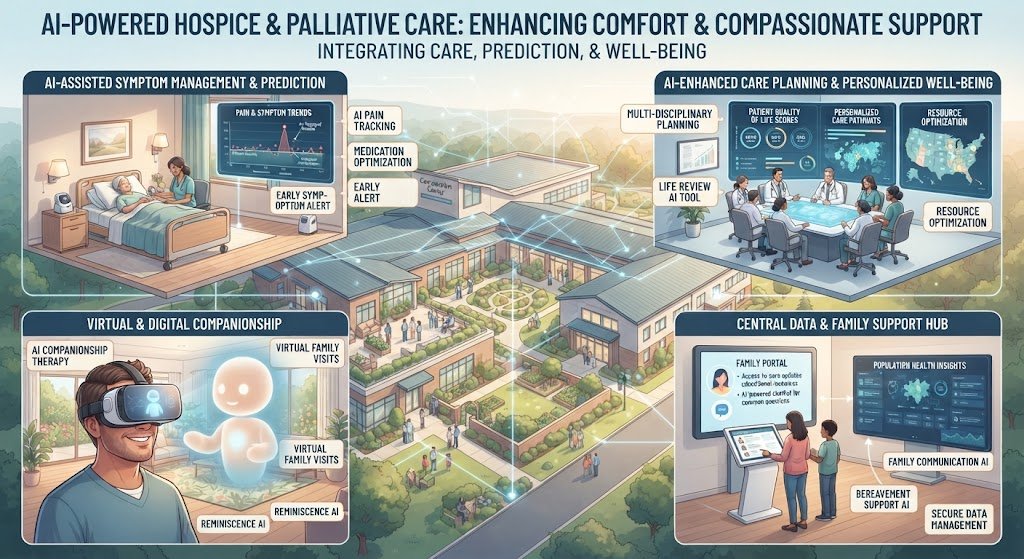
Primary topic: Artificial Intelligence in Hospice & Palliative Care Centers
Research focus: AI adoption, machine learning, mortality prediction, symptom monitoring, advance care planning, clinical decision support, natural language processing, generative AI, patient communication, care coordination, resource allocation, remote monitoring, workflow automation, explainable AI, and responsible healthcare AI implementation.
AI in Hospice & Palliative Care: From Prediction to Patient-Centered Support
Hospice and palliative care have a very different objective from many other areas of healthcare. The focus is not simply on diagnosing disease or extending life. Palliative care aims to relieve suffering and improve quality of life for patients and families dealing with serious or life-threatening illness.
The World Health Organization estimates that approximately 56.8 million people worldwide need palliative care each year. Yet access remains limited, particularly in low- and middle-income countries. WHO identifies inadequate integration into health systems, limited professional training, and insufficient access to essential pain medicines among major barriers.
Source: WHO Palliative Care Fact Sheet
This environment creates an important opportunity for artificial intelligence.
Hospice and palliative teams often work with complex patients whose conditions can change rapidly. Clinicians may need to review laboratory results, medications, diagnoses, hospitalizations, symptoms, functional status, clinical notes, caregiver concerns, and previous goals-of-care conversations.
AI can help organize this information and identify patterns that might otherwise be difficult to detect.
The technology can also monitor large populations and identify patients who may benefit from earlier palliative involvement.
This is especially important because palliative care is often introduced later than would be ideal. Earlier identification can create more time for symptom management, advance care planning, family support, and coordination between care teams.
The emerging research therefore suggests that AI may be most valuable when it improves the timing and organization of care rather than attempting to make autonomous end-of-life decisions.
Why Hospice and Palliative Care Are Strong Candidates for AI
Hospice and palliative care generate several types of information that are suitable for artificial intelligence.
Electronic health records contain diagnoses, medications, laboratory results, admissions, emergency visits, clinical notes, and procedure history. Palliative teams also document symptoms, functional status, psychosocial concerns, caregiver needs, goals of care, and advance care planning information.
This creates opportunities for several AI technologies to work together.
Predicts mortality, palliative-care need, utilization, and other outcomes from structured clinical data.
Extracts symptoms, goals, preferences, caregiver concerns, and advance-care information from clinical notes.
Supports summaries, documentation drafts, communication, education, and information organization.
Helps care organizations identify trends, high-risk patients, workload patterns, and resource needs.
The key advantage is that these technologies can address different stages of the care journey.
A predictive model may identify a patient who could benefit from palliative care. Natural language processing may extract the patient’s previous goals-of-care discussion. Generative AI may summarize the relevant information for the clinician. Workflow automation may then create a referral or review task.
This creates a connected AI workflow instead of an isolated AI feature.
What Current Research Says About AI in Palliative Care
One of the most comprehensive recent reviews mapped 125 studies involving AI in adult hospice and palliative care.
The review found that 63 studies focused on mortality prediction, making prognosis the largest research area. Advance care planning appeared in 18 studies, while symptom assessment appeared in 17.
The review also found that 86% of the studies were retrospective proof-of-concept investigations. Only seven were randomized controlled trials and six were prospective evaluations.
These numbers are important because they show both the potential and the current limitation of the field.
There is a substantial amount of research activity, but much of it has not yet reached the level of real-world clinical validation required for widespread deployment.
A separate 2026 integrative review examined 70 studies published from 2018 through 2024.
It found that AI applications supported mortality prediction, symptom monitoring, patient-needs identification, communication, care planning, and resource allocation.
The review also identified a shift in the technology itself.
Earlier research frequently relied on structured clinical data and traditional prediction models. Newer work increasingly incorporates unstructured clinical notes, wearable devices, and multimodal data.
Source: Exploring Artificial Intelligence in Hospice and Palliative Care
The direction is clear.
AI research in this field is moving from simple risk prediction toward more comprehensive systems that combine clinical data, patient information, communication, and real-time monitoring.
AI for Early Identification of Patients Who Need Palliative Care
One of the most important AI applications is identifying patients who may benefit from palliative care before their needs become urgent.
Traditional referral processes can depend heavily on clinician awareness, local protocols, available specialists, and the timing of conversations.
An AI system can continuously analyze information within an electronic health record and generate a notification when predefined risk patterns appear.
This does not mean that the system decides that a patient should receive hospice or palliative care.
Instead, it can tell the appropriate clinical team that the patient may warrant consideration.
A randomized clinical trial at Mayo Clinic evaluated an AI/ML decision-support tool designed to predict the need for palliative care consultation among hospitalized patients.
The trial included 3,183 patient hospitalizations. Patients assigned to the AI-supported intervention experienced a statistically significant increase in palliative care consultation compared with usual care.
The reported incidence rate ratio was 1.44, with a 95% confidence interval of 1.11 to 1.92.
The researchers also reported exploratory evidence of reduced 60-day and 90-day hospital readmissions.
| Research measure | Result |
|---|---|
| Patient hospitalizations enrolled | 3,183 |
| AI-supported vs usual-care consultation effect | IRR 1.44 |
| 60-day readmission | OR 0.75 |
| 90-day readmission | OR 0.72 |
The study is particularly valuable because it moved beyond algorithm development and evaluated AI inside a clinical workflow.
AI for Predicting Palliative Care Needs in Cancer
Cancer is one of the most frequently studied populations in AI-supported palliative care.
Machine learning can analyze treatment history, diagnoses, laboratory values, previous healthcare utilization, metastatic disease, symptoms, and other variables to estimate the likelihood of near-term mortality or high palliative-care need.
One research study developed a machine learning system to optimize palliative care consultations during cancer treatment.
The dataset included 560,210 treatments received by 54,628 patients.
The system identified a threshold that could increase early palliative care by approximately 8.5% overall without increasing the total number of palliative care consultations.
Among patients who lived more than six months beyond their first treatment, the estimated improvement in early palliative care reached 15.3%.
The first-alert positive predictive value was 69.7%, while outcome-level sensitivity was 74.9%.
These findings suggest that AI can potentially improve how scarce specialist resources are allocated.
Research signal
Estimated increase in early palliative care overall in one cancer-treatment modeling study without requiring more total consultations.
Source: Machine Learning to Allocate Palliative Care Consultations During Cancer Treatment
However, prognosis alone is not enough.
A patient can have a high predicted mortality risk while having completely different personal goals, family circumstances, symptom burden, and treatment preferences.
This is why AI should identify opportunities for conversation rather than determine the outcome of that conversation.
AI for Advance Care Planning
Advance care planning is another important area for AI.
Advance care planning can involve identifying a patient’s goals, documenting preferences, discussing future medical decisions, recording surrogate decision-makers, and ensuring that relevant information is available when needed.
Much of this information exists inside clinical notes.
That makes Natural Language Processing particularly valuable.
An AI system can search large volumes of notes and identify references to goals of care, advance directives, code status, treatment preferences, or previous conversations.
A 2025 scoping review identified 41 studies examining AI-based approaches for advance care planning.
Most studies focused on identifying people who might benefit from advance care planning. Fewer studies addressed initiating conversations or documenting and sharing advance-care information.
The review found that many models showed promising performance, but data and code transparency remained major limitations.
Source: Artificial intelligence-based approaches for advance care planning: a scoping review
Another study examined large language models for identifying advance care planning information in patients with advanced cancer.
The dataset included 60 patients and 528 clinical notes.
Across different advance-care-planning domains, LLM prompts produced sensitivity ranging from 0.85 to 1.00, specificity from 0.80 to 0.91, and accuracy from 0.81 to 0.91.
The study suggests that LLMs can identify complex information such as goals of care from clinical documentation.
Source: Large Language Models to Identify Advance Care Planning in Patients With Advanced Cancer
The practical use case is straightforward.
Instead of asking clinicians to manually search hundreds of previous notes, an AI system can prepare a structured summary of documented preferences.
The clinician can then review the source information and determine whether it is current and appropriate.
AI for Symptom Monitoring and Symptom Burden
Symptom management is central to palliative care.
Patients may experience pain, breathlessness, nausea, fatigue, anxiety, sleep problems, confusion, appetite changes, and other forms of distress.
The challenge is that symptoms can change quickly and may be described differently by patients, caregivers, nurses, and physicians.
AI can help identify patterns across this information.
Natural Language Processing can search clinical notes for symptom mentions.
Machine learning can identify patients at higher risk of uncontrolled symptoms.
Time-series models can analyze repeated observations.
Wearable devices can potentially provide additional physiological information.
A 2021 study examined the use of NLP and machine learning to identify uncontrolled symptoms in hospitalized cancer patients.
The researchers developed models for pain, nausea/vomiting, and dyspnea.
The pain model achieved 69% sensitivity and 46% specificity.
The nausea/vomiting model achieved 21% sensitivity and 90% specificity.
The dyspnea model achieved 22% sensitivity and 88% specificity.
These results demonstrate feasibility, but they also show why clinical deployment requires careful validation.
Source: Identification of Uncontrolled Symptoms in Cancer Patients Using Natural Language Processing
More recent work has explored smaller language models for symptom detection.
One 2025 study used a Phi-3 Small language model to identify symptom-driven nonscheduled visits in palliative care.
The model reported 99.4% sensitivity and 95.3% accuracy for identifying symptom-driven nonscheduled visits in the study setting.
The research also found that 85.7% of the nonscheduled visits analyzed were driven by symptoms.
Source: Leveraging Artificial Intelligence to Uncover Symptom Burden in Palliative Care
This type of technology could eventually help care teams identify emerging symptom problems before they result in an emergency visit.
AI for Hospice Care Pathway Selection
Hospice care can be delivered through different models depending on patient needs, local resources, and the care environment.
Determining the appropriate service model can be complex.
A recent study developed machine learning models to predict appropriate hospice care models using health assessment data.
The dataset contained 3,468 hospice patients from National Cheng Kung University Hospital covering 2005 through 2020.
The machine learning models achieved a macro-F1 score of 0.88 and an area under the precision-recall curve of 0.95.
The researchers also used knowledge distillation to transfer information from a high-performing model into a decision-tree format to improve interpretability.
This is an important direction because hospice AI needs to be understandable to clinicians.
A future hospice platform could combine patient assessment data with clinical history and operational information to support decisions about the most appropriate care pathway.
The system should provide evidence and reasoning rather than simply displaying a black-box recommendation.
AI for Clinical Documentation
Documentation consumes a significant amount of healthcare professionals’ time.
Hospice and palliative care documentation can be particularly complex because notes may include physical symptoms, emotional concerns, family discussions, goals of care, medication changes, social circumstances, spiritual concerns, and care coordination.
Generative AI can assist with documentation by turning structured information or approved conversation transcripts into draft notes.
A potential workflow could look like this:
↓
CLINICAL INFORMATION CAPTURE
↓
AI ORGANIZATION & SUMMARY
↓
DRAFT DOCUMENTATION
↓
CLINICIAN REVIEW
↓
FINAL CLINICAL RECORD
The value is not simply faster writing.
A structured AI workflow can help ensure that important information from a long interaction is easier to organize.
The clinician can also spend more time communicating with the patient rather than focusing on administrative formatting.
However, the system needs strong controls around patient information, access permissions, audit trails, retention, and review.
AI for Communication With Patients and Families
Communication is one of the most sensitive areas of hospice and palliative care.
Patients and families may need explanations about symptoms, medications, care options, appointments, home support, and what to expect from the care process.
Generative AI can help create clearer patient-facing information from clinician-approved content.
It can also support multilingual communication and simplify complex terminology.
Potential applications include:
- Appointment preparation instructions.
- Medication information written in plain language.
- Care-plan summaries.
- Home-care instructions.
- Family education materials.
- Frequently asked questions.
- Follow-up reminders.
- Care-team communication drafts.
- Multilingual administrative communication.
- Bereavement-resource information.
The most useful design is a controlled communication system connected to approved clinical information.
A general chatbot that independently generates medical advice is a very different and much higher-risk application.
Hospice organizations should prioritize systems that help staff communicate accurately and compassionately while keeping the clinical team responsible for sensitive decisions.
AI for Family Caregiver Support
Family caregivers are an important part of hospice and palliative care.
They may monitor symptoms, administer medications, coordinate appointments, communicate with care teams, and provide emotional support.
AI can help organize caregiver information and identify situations that require staff attention.
For example, an AI-enabled platform could collect structured caregiver reports about pain, breathing difficulty, sleep, appetite, medication adherence, or changes in function.
The system could identify predefined escalation signals and notify the appropriate care team according to established protocols.
This creates a useful bridge between home-based care and professional monitoring.
The objective is not to make the caregiver responsible for interpreting medical predictions.
The objective is to make important changes easier for the care team to detect.
AI for Remote Hospice Monitoring
Remote monitoring is likely to become increasingly important as hospice and palliative services expand beyond traditional facility settings.
Patients may receive care at home, in assisted living environments, or through community-based services.
Connected devices can potentially provide additional information between visits.
Depending on the clinical context, monitoring systems may collect:
- Heart rate.
- Respiratory rate.
- Oxygen saturation.
- Activity patterns.
- Sleep-related measurements.
- Medication-related information.
- Patient-reported symptoms.
- Functional changes.
- Caregiver observations.
- Changes in daily behavior.
AI can analyze these time-series signals and identify changes from an individual’s normal pattern.
This can create a more continuous picture of patient status.
The strongest approach is likely to combine sensor information with patient-reported outcomes and clinical documentation.
This creates a multimodal view instead of relying on a single data source.
AI and Multimodal Palliative Care
Multimodal AI is especially relevant to hospice and palliative care because no single data source fully represents a patient’s condition.
A patient record can contain structured information, free-text notes, medication history, symptom scores, caregiver observations, laboratory data, and healthcare-utilization patterns.
AI systems can increasingly combine these sources.
Clinical history
Clinical narrative
Patient-reported data
Time-series data
Home observations
The future system can bring these data streams together.
This could allow a care team to see not only what has happened, but also how the patient’s condition is changing.
Research on AI for Palliative Care Decision Support
A 2026 systematic review examined AI specifically through the lens of interprofessional shared decision-making.
Fourteen empirical studies were included after searches across six databases through January 2026.
The research found that AI applications primarily supported early palliative-care identification, advance care planning, serious-illness communication, and referral processes.
Most interventions operated at the organizational or workflow level rather than directly participating in the deliberative part of shared decision-making.
The review also found that improvements in process measures did not consistently translate into improved downstream patient-centered outcomes.
This is a critical finding.
A healthcare organization should not define success simply as more alerts, more referrals, or more documentation.
The ultimate question is whether patients and families experience better care.
AI for Palliative Care Resource Allocation
Hospice and palliative organizations operate under staffing and resource constraints.
AI can help organizations understand where resources are needed most.
Predictive analytics can potentially forecast:
- Expected patient volume.
- Visit demand.
- Clinician workload.
- Home-visit requirements.
- High-risk patient populations.
- Potential urgent-care demand.
- Medication or supply requirements.
- Referral volumes.
- Care-coordination workload.
- Staffing requirements.
This can help organizations plan resources before demand becomes a problem.
The technology becomes especially useful when connected to operational systems.
For example, a hospice provider could combine historical visit data with current patient census and predicted care intensity.
The resulting model could help managers plan schedules and allocate available staff.
AI for Understanding Patient Trajectories
Palliative patients do not always follow a predictable clinical path.
Some decline gradually.
Others experience periods of stability followed by sudden deterioration.
Machine learning can analyze large datasets to identify different trajectories.
A recent Australian study used national palliative-care data covering 261,290 adults who died between 2014 and 2023.
Researchers used clustering techniques to identify symptom and functional-status groups and then examined how these groups related to palliative-care episode duration.
This type of research is important because prognosis is not only about survival.
Understanding patient trajectories can help healthcare organizations understand symptom burden, functional decline, healthcare utilization, and patterns of care.
AI and Explainability in End-of-Life Care
Explainability is particularly important in palliative care.
A clinician may be reluctant to act on a prediction if the system provides only a risk percentage without explaining what influenced the prediction.
A 2025 systematic review examined explainable AI in palliative-care research.
The review found that explainable AI remains underexplored and emphasized the need for transparent and interpretable models in this sensitive clinical environment.
A practical AI interface could therefore show the clinician the major factors contributing to a prediction.
For example:
Example AI Risk Summary
Predicted need for palliative review: High
Important contributing factors:
- Recent increase in hospital utilization.
- Advanced disease indicators.
- Increasing symptom burden.
- Declining functional status.
- Recent treatment changes.
Suggested workflow: Review patient for possible palliative-care needs.
This is more useful than displaying a score without context.
Research-to-Workflow AI Model
The research suggests that successful AI implementation should connect prediction to action.
| Stage | AI activity | Human role |
|---|---|---|
| Data | Collect EHR, notes, symptoms, utilization, and approved monitoring data. | Ensure data quality and appropriate use. |
| Analysis | Identify patterns, risk, symptoms, or care needs. | Interpret the output in clinical context. |
| Insight | Generate a risk score, summary, alert, or recommendation. | Assess relevance and limitations. |
| Action | Trigger an approved workflow. | Make the appropriate clinical decision. |
| Outcome | Track performance and patient outcomes. | Review results and improve the workflow. |
This model keeps AI connected to a measurable healthcare process.
Major AI Use Cases for Hospice & Palliative Care Centers
Mortality and Prognosis Prediction
Machine learning can estimate short-term or medium-term mortality risk using clinical and administrative data.
The main value is earlier recognition of patients who may need additional conversations or services.
The output should support planning rather than determine an individual patient’s future.
Early Palliative Referral
AI can continuously monitor patient records and identify people who may benefit from specialist palliative review.
This can help reduce dependence on manually recognized referral opportunities.
Symptom Detection
NLP can identify symptoms mentioned in clinical notes.
Machine learning can then prioritize patients according to symptom patterns or risk.
Advance Care Planning
AI can locate existing advance-care information and identify patients who may need an updated conversation.
This can be especially useful when information is distributed across multiple clinical notes.
Clinical Documentation
Generative AI can prepare structured documentation drafts from approved clinical information.
This can reduce repetitive documentation work.
Patient and Family Communication
AI can help create patient-friendly educational and administrative content.
Staff can review sensitive communications before they are delivered.
Remote Monitoring
Connected devices and patient-reported information can provide additional observations between visits.
AI can analyze trends and identify changes that may deserve professional attention.
Care Coordination
AI can summarize relevant information for multidisciplinary teams.
This can help physicians, nurses, social workers, pharmacists, therapists, chaplains, and other professionals work from a more consistent information set.
Resource Planning
Predictive analytics can help forecast staffing, visits, referrals, and operational demand.
Quality Improvement
AI can analyze organizational data to identify patterns in referrals, hospital utilization, documentation, symptom management, and care transitions.
AI Capability Map for Hospice and Palliative Care
| AI capability | Primary application | Potential value | Key evaluation area |
|---|---|---|---|
| Machine Learning | Mortality and risk prediction | Earlier identification | Calibration and external validation |
| NLP | Symptoms and goals-of-care extraction | Information retrieval | Sensitivity and specificity |
| Generative AI | Documentation and summaries | Administrative efficiency | Factual accuracy and human review |
| Predictive Analytics | Resource and demand forecasting | Operational planning | Forecast accuracy |
| Remote Monitoring | Home-based patient monitoring | Earlier awareness | Signal quality and clinical usefulness |
| AI Workflow Automation | Referrals, alerts, follow-up | Faster coordination | Workflow completion |
Research Evidence at a Glance
| Research area | Evidence | Main implication |
|---|---|---|
| AI palliative-care literature | 125 studies | Large research interest, but limited prospective validation. |
| AI referral trial | 3,183 hospitalizations | AI increased palliative consultation activity. |
| Cancer treatment allocation | 54,628 patients | ML could increase early palliative access without increasing total consultations. |
| Advance care planning | 41 studies | AI shows promise for identification and documentation support. |
| Hospice pathway prediction | 3,468 hospice patients | Interpretable ML can support care-model prediction. |
Important research pattern:
Where AI Can Create the Greatest Operational Value
The highest-value AI projects are not necessarily the most technically sophisticated.
A hospice organization may gain more value from a reliable referral-identification system than from a complex generative AI platform.
Similarly, automated documentation may provide greater immediate operational value than an experimental prognosis model.
The best opportunities usually have four characteristics.
- The organization already has usable data.
- The workflow occurs frequently.
- The problem creates measurable operational or clinical friction.
- The outcome can be measured after implementation.
This makes referral management, documentation, symptom surveillance, care coordination, patient communication, and resource planning strong starting points.
Challenges With AI in Hospice and Palliative Care
The sensitivity of end-of-life care creates challenges that are different from ordinary administrative AI.
Limited Generalizability
Many published models were developed using retrospective data from one institution or one healthcare system.
A model trained in one population may not perform equally well elsewhere.
Differences in demographics, clinical documentation, disease patterns, healthcare access, coding practices, and care models can change model performance.
Limited Prospective Evidence
The 2025 scoping review found that most studies remained retrospective proof-of-concept research.
This means organizations should distinguish between research feasibility and proven clinical effectiveness.
Bias and Equity
AI learns from historical data.
If historical healthcare access or documentation contains disparities, an AI model can potentially reproduce them.
A recent machine-learning scoping review found that equity in model performance was fully addressed in only 8 of 121 studies.
This is a significant research gap.
Source: Machine Learning in Palliative Care: Scoping Review of Applications
Alert Fatigue
Too many AI alerts can overwhelm clinicians.
An alert should therefore be connected to a meaningful action.
If the clinical team receives hundreds of low-value notifications, trust in the system can decline.
Data Quality
Clinical records are not perfect datasets.
Missing information, inconsistent terminology, delayed documentation, and coding differences can affect model performance.
Privacy
Hospice and palliative care data can include highly sensitive information about health status, family circumstances, goals, preferences, and end-of-life decisions.
AI systems need appropriate security, access controls, data governance, and auditability.
Human Connection
Palliative care depends heavily on empathy, communication, trust, and human relationships.
Technology should reduce administrative burden and improve information access without turning deeply personal interactions into automated transactions.
AI Governance for Hospice Organizations
Healthcare organizations should create an AI governance process before scaling AI across clinical operations.
The governance framework should address:
- Which AI applications are approved.
- Which patient data can be processed.
- Who can access AI outputs.
- When professional review is mandatory.
- How model performance is validated.
- How errors and incidents are reported.
- How model changes are controlled.
- How vendors are evaluated.
- How patients and clinicians are informed about AI use.
- How performance is monitored after deployment.
The FDA’s approach to AI-enabled medical software emphasizes lifecycle management, good machine-learning practices, transparency, and real-world performance monitoring.
Source: FDA Artificial Intelligence in Software as a Medical Device
Source: FDA Artificial Intelligence and Machine Learning Action Plan
A Practical AI Adoption Framework for Hospice & Palliative Care
Identify the Problem
Start with the workflow rather than the technology.
Identify where clinicians lose time, where patients experience delays, or where important information is difficult to find.
Map the Data
Determine which information is available and whether it is accurate enough for the intended application.
The data may include EHR records, clinical notes, patient-reported outcomes, scheduling information, medication history, utilization records, or approved monitoring data.
Define the AI Role
Decide whether AI will classify, predict, summarize, monitor, recommend, or automate.
The role should be clearly defined before development.
Validate the Model
Evaluate accuracy, sensitivity, specificity, calibration, robustness, subgroup performance, and failure conditions.
External validation should be considered before broad deployment.
Integrate With Workflow
The AI should fit into the software already used by clinicians.
Integration with EHRs, scheduling platforms, patient portals, communication systems, and clinical dashboards can determine whether staff actually use the system.
Deploy With Monitoring
Performance should continue to be monitored after launch.
Changes in patient populations, clinical practice, documentation patterns, and technology can affect model performance.
Future Predictions for AI in Hospice & Palliative Care
AI Will Move From Prediction Toward Continuous Care Support
Early AI applications largely focused on predicting mortality or identifying patients who may need palliative care.
Future systems are likely to combine prediction with continuous monitoring and workflow support.
Instead of generating a single risk score, the system could monitor changing clinical information and update the care team when meaningful changes occur.
Multimodal AI Will Become More Important
Future systems will increasingly combine structured EHR data, clinical notes, patient-reported symptoms, wearable information, medication history, and healthcare-utilization data.
This could produce a more complete representation of patient status.
The challenge will be determining which information is reliable enough to influence a clinical workflow.
AI Will Improve Information Retrieval
One of the most practical applications may be helping clinicians find information that already exists.
A clinician could ask a system to summarize documented goals of care, recent symptom changes, previous discussions, medication changes, or family concerns.
The system could point back to the underlying records rather than presenting unsupported information.
AI Agents Will Coordinate Administrative Work
AI agents may eventually perform multiple connected tasks.
A referral could trigger information gathering, record summarization, scheduling preparation, staff notification, and follow-up tracking.
The goal would be to automate coordination while keeping clinical decisions under appropriate professional control.
Remote Monitoring Will Extend Hospice Care Beyond Visits
Home-based care creates a natural opportunity for remote monitoring.
Patient-reported symptoms, caregiver observations, connected devices, and smartphone-based data may help care teams understand what is happening between scheduled visits.
Explainability Will Become More Important
As AI begins influencing sensitive clinical workflows, healthcare organizations will increasingly expect models to provide understandable reasoning.
Black-box predictions will be harder to justify when decisions affect referrals, care planning, or allocation of clinical resources.
Evidence Will Become a Competitive Advantage
The market will increasingly separate AI products based on evidence rather than marketing claims.
Organizations will want to see external validation, prospective evaluation, subgroup performance, workflow outcomes, and evidence that the technology improves patient care.
AI Opportunity Matrix for Hospice and Palliative Care
| Use case | Technology | Potential value | Priority |
|---|---|---|---|
| Early palliative identification | Machine Learning | Earlier specialist involvement | High |
| Advance care planning extraction | NLP + LLM | Better information retrieval | High |
| Symptom detection | NLP + ML | Earlier symptom recognition | High |
| Clinical documentation | Generative AI | Lower documentation burden | High |
| Remote monitoring | ML + time-series AI | Continuous patient visibility | High |
| Care coordination | Generative AI + automation | Faster information sharing | High |
| Resource forecasting | Predictive Analytics | Improved staffing and planning | Medium |
| Patient communication | Generative AI | Clearer communication | Medium |
What Healthcare Startups Can Build
The growing research base creates opportunities for healthcare technology companies.
A startup does not need to build a complete hospice operating system to create value.
It can focus on a narrow workflow and integrate with existing healthcare technology.
Potential product categories include:
- AI-powered palliative referral systems.
- Advance-care-planning information extraction tools.
- AI symptom surveillance platforms.
- Hospice documentation assistants.
- Care-team summarization tools.
- Remote symptom monitoring systems.
- Caregiver communication platforms.
- Hospice resource forecasting systems.
- AI-supported care coordination platforms.
- Explainable mortality and risk prediction tools.
The strongest products will connect AI capability with a specific workflow.
For example, a mortality prediction model alone is a technical product.
A system that identifies a high-risk patient, summarizes the supporting clinical information, sends an appropriate notification, records clinician review, and measures whether the patient received timely palliative assessment is a complete workflow solution.
That difference is important.
What Healthcare Organizations Should Measure
AI adoption should be evaluated through measurable outcomes.
| Category | Useful metrics |
|---|---|
| Clinical | Symptom recognition, referral timing, care-plan completion, safety events |
| Patient | Patient experience, symptom burden, access, communication quality |
| Family | Caregiver communication, support access, follow-up completion |
| Operational | Documentation time, referral turnaround, visit coordination, workload |
| AI performance | Sensitivity, specificity, calibration, false alerts, subgroup performance |
| Financial | Cost per encounter, resource utilization, productivity, implementation cost |
A model that achieves high predictive accuracy but creates excessive alerts may not improve care.
A documentation tool that saves time but introduces frequent factual errors may also fail to create value.
The complete workflow must therefore be evaluated.
The Future AI Workflow for Hospice and Palliative Care
The future hospice environment could combine several AI capabilities into a connected care infrastructure.
↓
AI DATA ANALYSIS
↓
RISK + SYMPTOM + NEED IDENTIFICATION
↓
CLINICAL INFORMATION SUMMARY
↓
PROFESSIONAL REVIEW
↓
CARE ACTION
↓
PATIENT & FAMILY SUPPORT
↓
OUTCOME MEASUREMENT
This model represents the direction in which the technology can evolve.
The AI does not become the center of care.
The patient remains the center.
AI becomes an infrastructure layer that helps the care team understand information, identify needs, coordinate services, and monitor changes.
Final Research Assessment
Artificial intelligence has meaningful potential in hospice and palliative care, but the technology is still developing.
Current evidence is strongest around mortality prediction, early palliative-care identification, symptom detection, advance care planning, clinical documentation, and workflow support.
Research involving thousands of patients has already demonstrated that AI-supported referral and risk-identification systems can influence clinical processes.
At the same time, recent reviews show that most AI research remains retrospective and that prospective, multicenter, equitable, and patient-centered validation is still limited.
This creates an important distinction between AI capability and AI readiness.
A model can demonstrate impressive performance in a research environment without being ready for unrestricted clinical use.
The next stage of development will therefore depend less on simply making models larger and more complex.
The important questions will be whether models work across healthcare settings, whether clinicians understand their outputs, whether patients benefit, whether vulnerable populations are treated fairly, and whether AI can integrate naturally into existing care workflows.
The most valuable hospice AI systems will likely combine several technologies.
Machine learning can identify risk.
Natural Language Processing can find information in clinical records.
Generative AI can summarize and organize information.
Remote monitoring can provide additional observations between visits.
Workflow automation can turn insights into appropriate operational tasks.
Explainable AI can help clinicians understand why a prediction was produced.
Together, these capabilities can create a more connected model of hospice and palliative care.
The long-term opportunity is not to automate compassion.
It is to remove avoidable administrative friction so healthcare professionals can spend more time providing the human connection that makes palliative care meaningful.
Credible Data Sources and Original Research
- World Health Organization: WHO provides global information on palliative-care needs, principles, access barriers, and integration into healthcare systems.
Source: WHO Palliative Care Fact Sheet - AI in Palliative Care: A 2025 scoping review analyzed 125 studies and mapped AI applications, validation, generalizability, transparency, and reproducibility.
Source: PubMed: AI in Palliative Care - AI in Hospice and Palliative Care: A 2026 integrative review examined 70 studies and identified mortality prediction, symptom monitoring, communication, care planning, and resource allocation as major application areas.
Source: PubMed: Exploring Artificial Intelligence in Hospice and Palliative Care - Palliative Referral: A randomized clinical trial evaluated an AI/ML decision-support system for palliative-care referral among hospitalized patients and included 3,183 hospitalizations.
Source: PubMed: AI Decision Support for Palliative Care Referral - Cancer Palliative Care: A machine-learning study evaluated whether AI could optimize palliative-care consultation allocation during cancer treatment and reported an estimated 8.5% increase in early palliative care overall.
Source: PubMed: Machine Learning to Allocate Palliative Care Consultations During Cancer Treatment - Early Referral Research: Research discussing machine learning for early palliative-care referral highlights both the potential and limitations of relying on prognostic predictions alone.
Source: PubMed: Machine Learning and Early Palliative Referral - Advance Care Planning: A scoping review analyzed 41 studies involving AI-based approaches to advance care planning.
Source: PubMed: AI-Based Approaches for Advance Care Planning - LLMs and Advance Care Planning: Research evaluated large language models for identifying advance-care-planning information from clinical notes involving patients with advanced cancer.
Source: PubMed: Large Language Models to Identify Advance Care Planning - Symptom Detection: A study evaluated Natural Language Processing and machine learning for identifying uncontrolled pain, nausea/vomiting, and dyspnea in hospitalized cancer patients.
Source: PubMed: Identification of Uncontrolled Symptoms in Cancer Patients - Language Models and Symptoms: Research evaluated a Phi-3 Small language model for identifying symptom-driven nonscheduled visits in palliative care.
Source: PubMed: AI and Symptom Burden in Palliative Care - Hospice Care Models: A machine-learning study used health assessment data from 3,468 hospice patients to predict hospice care models and reported a macro-F1 score of 0.88.
Source: PubMed: Interpretable Machine Learning for Hospice Care Predictions - Palliative Care Trajectories: A 2026 study analyzed 261,290 adults from Australian palliative-care data to investigate symptom-function clusters and care trajectories.
Source: PubMed: Understanding Palliative Care Trajectories - Machine Learning Applications: A recent scoping review mapped machine-learning applications in palliative care and highlighted major gaps in equity assessment, external validation, and prospective deployment.
Source: PubMed: Machine Learning in Palliative Care - Shared Decision-Making: A 2026 systematic review examined AI applications in hospice and palliative care through an interprofessional shared-decision-making framework.
Source: PubMed: AI in Hospice and Palliative Care Shared Decision-Making - Explainable AI: A systematic literature review examined explainable AI in palliative-care research and identified transparency and interpretability as important areas for future development.
Source: ScienceDirect: Explainable AI in Palliative Care - FDA: The FDA provides guidance and resources concerning artificial intelligence and machine-learning-enabled software as a medical device, including lifecycle management and real-world performance considerations.
Source: FDA: Artificial Intelligence in Software as a Medical Device - FDA AI/ML Action Plan: The FDA’s AI/ML Action Plan addresses good machine-learning practices, transparency, regulatory science, and real-world performance monitoring.
Source: FDA: Artificial Intelligence and Machine Learning Action Plan
Leave a Reply