
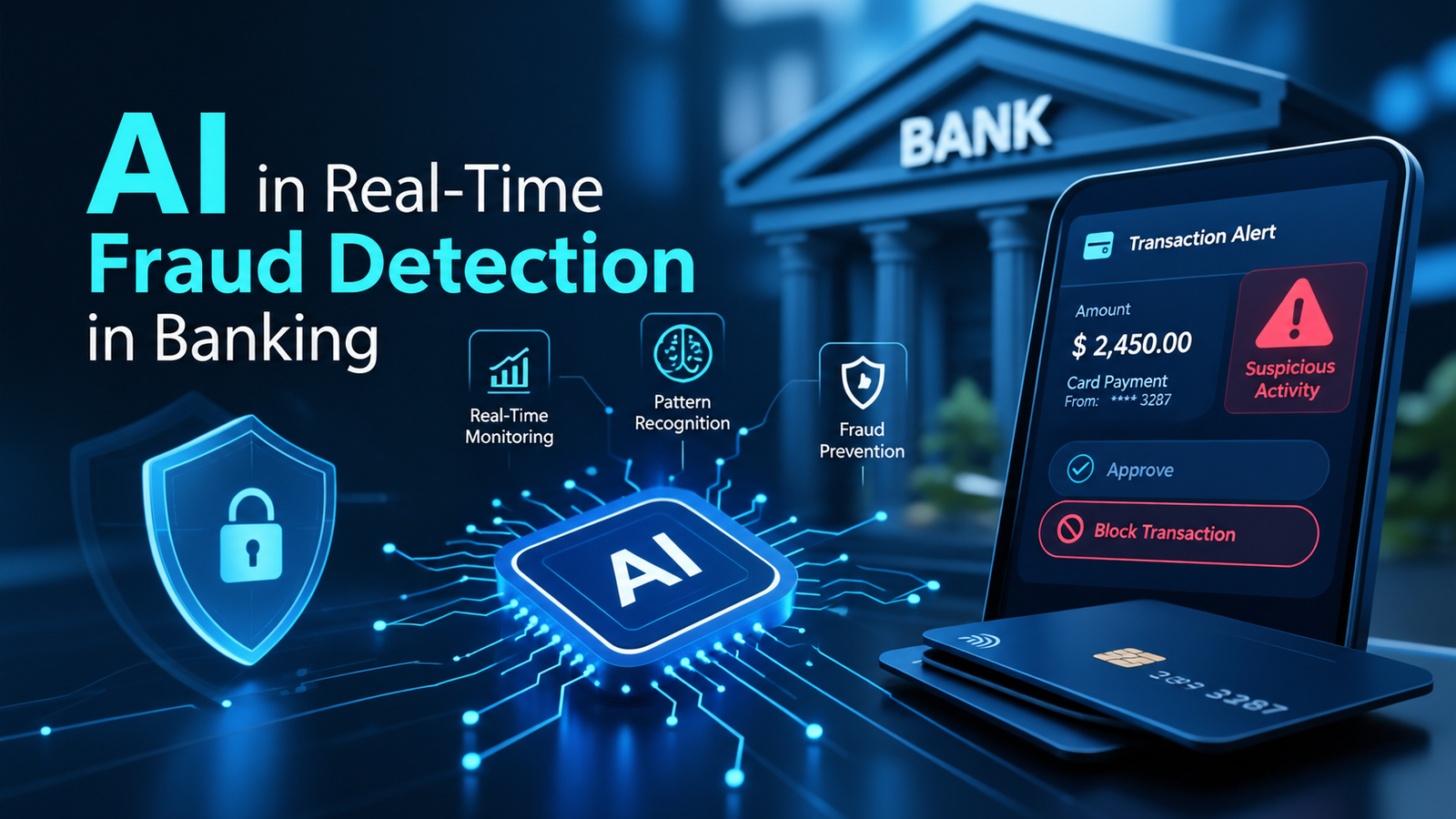
Primary topic: AI in Real-Time Fraud Detection in Banking
Research focus: Real-time transaction monitoring, machine learning fraud detection, behavioral analytics, anomaly detection, graph AI, deep learning, payment fraud, account takeover, synthetic identity fraud, scam detection, explainable AI, fraud prevention, model governance, cybersecurity, and the future of intelligent banking security.
What Is AI in Real-Time Fraud Detection?
Real-time fraud detection uses software to analyze financial activity as it happens and identify transactions or account behavior that may indicate fraud.
Traditional banking fraud systems often depend on predefined rules. A rule might flag an unusually large transaction, an unfamiliar location, a new device, or a transfer that exceeds a specific threshold.
Rules remain useful, but modern fraud is increasingly dynamic. Criminals can change transaction patterns, distribute activity across multiple accounts, use stolen credentials, create synthetic identities, or manipulate customers into authorizing payments themselves.
AI allows banks to analyze many signals simultaneously and estimate whether current activity is consistent with normal customer behavior.
The Federal Reserve notes that banks have already used machine-learning tools for fraud detection and prevention, while newer generative and agentic AI technologies are being explored for additional financial applications.
Source: Federal Reserve Board, Testimony on Innovation and Artificial Intelligence
Why Real-Time Fraud Detection Matters
The time available to stop a fraudulent transaction can be extremely short.
Once money moves through instant-payment networks, criminals may attempt to move it through additional accounts or institutions before the original bank can investigate.
This makes post-transaction investigation important, but it also makes prevention and real-time intervention critical.
A 2026 Federal Reserve Bank of Philadelphia research article argues that the value of AI in fraud prevention is not only prediction speed. The authors emphasize that AI can help detect uncertainty early enough to introduce friction, delay risky transactions, and create additional time for human judgment.
Source: Federal Reserve Bank of Philadelphia, AI-Enabled Fraud Is On the Rise
This changes the design objective.
The goal is not always:
“Make every payment instant.”
For suspicious activity, the objective may instead be:
“Detect uncertainty early enough to slow the transaction and verify it.”
Real-time fraud defense cycle
Analyze the transaction.
Estimate fraud risk.
Request additional evidence.
Hold, decline or challenge.
Feed confirmed outcomes back into monitoring.
AI Adoption in Financial Crime Detection
AI adoption is already significant across financial services.
The Bank of England and FCA joint survey found that 75% of responding UK financial firms were already using AI, with another 10% planning to use it over the following three years. The Bank of England also reported that fraud detection and financial crime were among the important operational use cases for AI adoption.
Source: Bank of England, Approach to Innovation in AI, DLT and Quantum Computing
The Bank of England’s financial stability report also identifies combating financial crime as one of the major near-term AI use cases being considered by financial firms.
This is important because fraud detection is one of the areas where AI can provide direct operational value without necessarily giving an AI system unrestricted authority over the bank.
Traditional Rules-Based Fraud Detection
Rules are still a core component of banking fraud systems.
Typical rules can detect:
- Transactions above a defined threshold.
- Multiple transactions within a short period.
- Unusual geographic activity.
- New devices or login locations.
- Rapid changes in account behavior.
- Transfers to previously unseen beneficiaries.
- Repeated failed authentication attempts.
The problem is that fixed rules can become predictable.
If criminals learn which conditions trigger a rule, they can modify their behavior to stay below the threshold.
Rules can also generate large numbers of false positives when legitimate customers behave differently from their historical patterns.
AI can therefore complement rules rather than simply replace them.
Machine Learning for Fraud Detection
Machine learning models learn relationships between transaction characteristics and historical outcomes.
Depending on the application, models can use:
- Transaction amount
- Transaction frequency
- Time of day
- Merchant information
- Device information
- IP and network information
- Geographic patterns
- Account age
- Beneficiary history
- Customer behavior
- Previous fraud indicators
Supervised learning is useful when historical transactions have reliable fraud labels.
Common approaches include:
- Logistic regression
- Decision trees
- Random forests
- Gradient boosting
- Neural networks
- Deep learning
However, banking fraud presents a difficult machine-learning problem because fraudulent transactions are usually much less common than legitimate transactions.
The Class Imbalance Problem
Fraud datasets are often highly imbalanced.
A recent 2026 deployment-derived dataset from a live cloud-based online banking fraud detection system contained 56,962 transaction inference logs, of which 98 were confirmed fraudulent transactions, representing a fraud rate of only 0.172%.
Source: Data in Brief, Deployment-derived online banking fraud detection inference-log dataset
This illustrates why accuracy alone is a poor metric.
A model could classify almost every transaction as legitimate and still appear highly accurate because legitimate transactions dominate the dataset.
Fraud systems therefore need metrics such as:
- Precision
- Recall
- F1 score
- False-positive rate
- False-negative rate
- Precision-recall AUC
- Detection latency
- Fraud loss prevented
- Customer friction
Anomaly Detection in Banking
Anomaly detection is particularly useful when banks do not have enough confirmed fraud labels.
Instead of asking:
“Does this transaction look like previous confirmed fraud?”
the system can ask:
“Does this transaction look significantly different from the expected behavior?”
Possible anomalies include:
- A sudden increase in transaction value.
- A new device combined with unusual payment behavior.
- Rapid transfers to multiple new beneficiaries.
- Unexpected international activity.
- Unusual account-access patterns.
- Transaction sequences that differ from the customer’s normal behavior.
A 2026 study examining Pakistan’s banking sector describes anomaly detection as one of the AI approaches being used by banks and notes that unsupervised and hybrid approaches can be useful where labeled fraud data is limited.
Source: Nature, AI-driven financial fraud detection in Pakistan’s banking sector
Behavioral Analytics
Behavioral analytics attempts to understand how a customer normally interacts with banking services.
The system can build a behavioral profile based on patterns such as:
- Normal login times
- Usual devices
- Typical transaction amounts
- Common beneficiaries
- Usual locations
- Payment frequency
- Typical account activity
A transaction may therefore be suspicious even if it does not violate a traditional rule.
For example, a small transfer may appear harmless by amount but become suspicious when combined with a new device, unusual login behavior, a new beneficiary, and a sudden change in transaction frequency.
Real-Time Transaction Risk Scoring
A real-time fraud engine can assign a dynamic risk score to each transaction.
The score does not need to be a simple yes-or-no fraud label.
A more useful architecture can create several response levels.
| Risk level | Possible response | Customer experience |
|---|---|---|
| Low | Allow | Normal transaction |
| Moderate | Additional verification | Small amount of friction |
| High | Temporary hold or manual review | Transaction delayed |
| Critical | Block and investigate | Strong intervention |
This risk-based approach allows banks to concentrate friction on transactions where uncertainty is high.
Graph AI for Banking Fraud
Fraud is often not an isolated transaction problem.
Criminal networks can involve:
- Multiple accounts
- Multiple devices
- Shared phone numbers
- Shared addresses
- Common beneficiaries
- Repeated IP addresses
- Common merchants
- Mule accounts
Graph analytics represents these relationships as a network.
The Federal Reserve describes graph analytics as a layer that can map relationships between people, accounts, and behaviors to identify patterns that may not be visible when transactions are examined individually.
Source: Federal Reserve Financial Services, Transforming Fraud Detection With Generative AI
Real-Time Network Fraud Detection
The BIS Innovation Hub’s Project Hertha specifically explored how transaction analytics and modern AI techniques could identify complex financial crime patterns in real-time retail payment systems.
The project was conducted with the Bank of England and focused on identifying coordinated criminal activity while using a minimum set of data points.
Source: BIS Innovation Hub, Project Hertha
This network-level perspective is important because criminals can distribute activity across institutions.
A single transaction may look ordinary.
The relationship between hundreds of transactions can reveal a very different pattern.
Deep Learning for Financial Fraud
Deep learning can analyze complex patterns across large datasets.
A 2025 systematic review examined 108 peer-reviewed publications from 2019 to 2024 on deep learning for financial fraud detection.
The review covered architectures including convolutional neural networks, LSTM networks, transformers, and ensemble approaches. It also identified data imbalance, explainability, automation, and privacy compliance as major challenges.
Source: Deep learning in financial fraud detection: Innovations, challenges, and applications
Deep learning can therefore provide strong pattern-recognition capabilities, but the model architecture should match the actual fraud problem.
Sequence Models and Transaction Behavior
Fraud can depend on transaction sequences rather than individual events.
For example:
Login → new beneficiary → small test transfer → multiple transfers → rapid account depletion
may be more informative than any individual event.
Sequence models such as LSTM networks and transformers can analyze temporal relationships between events.
A 2026 deployment-derived online banking dataset described a hybrid CNN-LSTM model processing incoming transactions through a real-time system.
This type of architecture is useful when timing and transaction order are important parts of the fraud signal.
AI for Account Takeover Detection
Account takeover occurs when criminals gain access to a legitimate customer’s account.
AI can detect changes across:
- Device identity
- Login location
- Typing or interaction behavior
- Session characteristics
- Transaction patterns
- Beneficiary changes
- Password-reset activity
The important point is that account takeover may begin before the fraudulent transaction.
A mature system therefore monitors the entire account journey.
Account takeover detection
Login behavior → Device intelligence → Session behavior → Account changes → Payment behavior → Transaction risk
AI for Synthetic Identity Fraud
Synthetic identity fraud combines real and fabricated information to create identities that can appear legitimate.
Generative AI makes document creation, voice imitation, image generation, and social engineering more accessible.
Recent financial-sector analysis has highlighted AI’s dual role: it can improve fraud detection while simultaneously giving criminals new tools for impersonation and fraud creation.
This means banks cannot rely only on traditional identity verification.
They increasingly need to connect:
- Identity verification
- Device intelligence
- Behavioral analysis
- Transaction monitoring
- Network relationships
- Document analysis
AI for Authorized Push Payment Scams
Not all fraudulent payments are technically unauthorized.
In some scams, criminals manipulate customers into authorizing a transfer themselves.
Examples include:
- Investment scams
- Romance scams
- Impersonation scams
- Fake technical-support scams
- Business email compromise
- Family-emergency scams
This makes traditional transaction-security models insufficient.
The bank needs to understand the context surrounding the transaction.
A new beneficiary, unusual payment, customer interaction patterns, and previous account behavior can collectively provide useful signals.
AI for Business Email Compromise
Business email compromise can involve fraudulent payment instructions that appear to come from a trusted person.
AI can help analyze:
- Payment behavior
- Beneficiary history
- Transaction timing
- Account relationships
- Communication patterns where legally and appropriately available
- Changes in normal business payment behavior
The objective is not to determine whether an email “sounds suspicious” alone.
The strongest systems combine communication context with financial behavior and transaction-network signals.
AI for Real-Time Payment Fraud
Instant payment systems create a difficult trade-off.
Customers expect transactions to be completed quickly, but fraud teams have less time to investigate suspicious activity.
This is why real-time risk scoring is becoming increasingly important.
The Federal Reserve’s research on AI-enabled fraud specifically emphasizes creating additional time for intervention rather than treating speed as the only objective.
Real-time payment decision
Transaction arrives
↓
Identity + device + behavior + transaction + network signals
↓
AI risk scoring
↓
Low risk → Allow
Moderate risk → Verify
High risk → Hold / review
Critical risk → Block / investigate
AI and Digital Risk Signals
Modern fraud systems can use many digital signals.
The Federal Reserve Financial Services describes a multilayered approach that can combine risk signals and verification methods, including biometrics, to improve customer security.
Potential signals include:
- Device fingerprint
- IP reputation
- Geographic consistency
- Behavioral biometrics
- Transaction velocity
- Beneficiary history
- Account age
- Authentication events
- Session characteristics
- Network relationships
AI and Behavioral Biometrics
Behavioral biometrics can examine how users interact with digital banking systems.
Signals can include:
- Typing rhythm
- Touch patterns
- Mouse movement
- Navigation behavior
- Device interaction
The objective is to determine whether the current session resembles the customer’s normal behavior.
This can be useful because stolen credentials alone may look legitimate.
The behavioral pattern surrounding the credentials may not.
Generative AI in Fraud Detection
Generative AI adds another layer to traditional fraud systems.
The Federal Reserve Financial Services describes modern fraud defense as a hybrid of rules-based tools, predictive models, graph analytics, and generative AI rather than a single replacement technology.
Generative AI can support fraud teams through:
- Alert summarization
- Investigation assistance
- Case documentation
- Pattern explanation
- Natural-language search
- Fraud analyst copilots
- Investigation report generation
For example, an analyst could ask:
“Why was this transaction flagged?”
The system could summarize:
- New device
- Unusual location
- New beneficiary
- Transaction amount above normal behavior
- Related account activity
- Previous suspicious events
The generative layer should retrieve evidence from controlled systems instead of inventing explanations.
AI Fraud Investigation Copilot
Fraud analysts often receive large numbers of alerts.
An AI copilot can organize evidence before a human investigator reviews the case.
Fraud analyst workflow
Alert generated
↓
AI gathers transaction history
↓
AI maps account and device relationships
↓
AI summarizes unusual behavior
↓
Analyst reviews evidence
↓
Analyst confirms, dismisses or escalates
This approach keeps the human investigator involved while reducing repetitive research.
False Positives in Fraud Detection
A fraud system that blocks too many legitimate customers creates its own problems.
False positives can lead to:
- Declined legitimate payments
- Customer frustration
- Call-center volume
- Manual investigation costs
- Lost transactions
- Reduced customer trust
This is why fraud detection should not optimize only for maximum fraud recall.
The bank needs to balance:
Fraud prevented + customer protection + operational cost + customer friction.
Fraud Detection and Customer Friction
Different levels of risk should produce different interventions.
A low-risk transaction may require no additional action.
A moderately unusual transaction might require confirmation through the banking application.
A highly suspicious transaction could require a temporary hold and human review.
This makes risk-based friction an important component of real-time fraud prevention.
The Federal Reserve Bank of Philadelphia research specifically proposes introducing friction earlier when uncertainty is high rather than relying on perfect prediction.
AI Fraud Detection Architecture
Transactions + account activity + devices + authentication + customer behavior + network data↓Real-Time Data Pipeline
Streaming ingestion + feature generation + event processing↓Detection Layer
Rules + anomaly detection + supervised ML + deep learning + graph analytics↓
Risk Engine
Transaction risk score + account risk + network risk
↓
Decision Layer
Allow + verify + hold + block + investigate
↓
Human Investigation
Fraud analyst + compliance + customer verification
↓
Learning Layer
Confirmed fraud + false positives + investigator feedback + model monitoring
Real-Time AI Data Pipeline
The technical architecture must be capable of processing transactions with very low latency.
A typical pipeline can include:
- Event streaming
- Real-time feature extraction
- In-memory risk scoring
- Model inference
- Rules evaluation
- Graph queries
- Decision orchestration
- Audit logging
The system should also have a fallback path.
If the AI service becomes unavailable, the bank still needs a controlled fraud-defense mechanism.
AI Fraud Detection and Model Explainability
Fraud teams need to understand why a system generated an alert.
An opaque risk score is difficult to investigate.
An explainable fraud system can show:
- Unusual transaction amount
- New device
- New beneficiary
- Unusual location
- High transaction velocity
- Related suspicious accounts
- Behavioral deviation
The BIS Project Noor is specifically exploring explainable AI tools that can help supervisors evaluate the transparency, fairness, and robustness of AI models used by financial institutions, including models that flag potential fraud in real time.
Source: BIS Innovation Hub, Project Noor
Fraud Model Monitoring
Fraud models cannot simply be trained once and left unchanged.
Fraudsters adapt.
Customer behavior changes.
Payment channels change.
New devices and authentication technologies appear.
Economic conditions can also affect transaction patterns.
Monitoring should therefore track:
- Fraud detection rate
- False-positive rate
- False-negative rate
- Model latency
- Data drift
- Feature drift
- Fraud-pattern changes
- Customer friction
- Analyst workload
AI and Fraud Model Drift
Model drift can occur when the relationship between data and fraud outcomes changes.
For example, a feature that was highly predictive last year may become less useful when criminals change their tactics.
This creates a continuous cycle:
Monitor transactions.
Identify performance changes.
Understand new patterns.
Retrain or modify controls.
AI Fraud Detection and Cybersecurity
Fraud and cybersecurity are increasingly connected.
A compromised account may begin as a cybersecurity event and become a financial fraud event.
Likewise, suspicious transaction behavior can provide evidence of an account compromise.
The BIS reported in September 2026 that frontier AI is increasing both offensive cyber capabilities and defensive opportunities, while highlighting compressed response windows and third-party dependency risks for financial institutions.
Source: BIS Financial Stability Institute, When Machines Attack
This means fraud platforms increasingly need to integrate with security operations rather than operating as isolated transaction systems.
AI Fraud Detection in Pakistan’s Banking Sector
AI fraud detection is particularly relevant to Pakistan as banking services become increasingly digital.
A 2026 study examining Pakistani banks investigated how AI-based fraud detection and prevention is being implemented and compared organizational practices with strategic objectives.
The study identifies anomaly detection, fraud detection, behavioral biometrics, and hybrid approaches among the technologies being explored across banking markets. It also emphasizes organizational readiness and regulatory frameworks as important factors in successful implementation.
Source: Nature, AI-driven financial fraud detection in Pakistan’s banking sector
For Pakistani banks, practical AI opportunities include:
- Mobile banking fraud detection
- Instant-payment monitoring
- Account takeover detection
- ATM fraud analytics
- Card transaction monitoring
- Behavioral biometrics
- Digital onboarding risk scoring
- Agent and merchant monitoring
AI Fraud Detection for Mobile Banking
Mobile banking creates a large amount of behavioral information.
A real-time mobile fraud system can analyze:
- Device changes
- Login patterns
- Transaction behavior
- Beneficiary creation
- Location changes
- Authentication behavior
- Session activity
The strongest design is not to treat each signal independently.
Instead, the system should combine multiple signals into a contextual risk assessment.
AI Fraud Detection for Cards
Card fraud detection has long used automated transaction monitoring.
AI can extend these systems by modeling:
- Merchant behavior
- Transaction sequences
- Customer spending patterns
- Geographic behavior
- Device relationships
- Transaction timing
A transaction can then be evaluated relative to both the customer’s history and broader patterns across the payment ecosystem.
AI Fraud Detection for ATMs
ATM fraud can involve:
- Card compromise
- Cash withdrawal anomalies
- Unusual locations
- Repeated failed authentication
- Device or ATM manipulation
AI can combine transaction behavior with ATM-level information to identify unusual activity.
For example, multiple unusual withdrawals across a group of locations can be investigated as a pattern rather than as isolated transactions.
AI and Mule Account Detection
Mule accounts receive and move funds on behalf of fraud networks.
They can be difficult to identify because individual transactions may appear legitimate.
Graph analytics can help identify:
- Rapid movement of funds
- Many incoming senders
- Many outgoing beneficiaries
- Shared account relationships
- Repeated links to known risky entities
The network perspective is important because the suspicious signal may exist across multiple accounts.
AI Fraud Detection Risk Matrix
| Risk | Why it matters | Recommended control |
|---|---|---|
| False positives | Legitimate customers may be blocked | Risk-based thresholds |
| False negatives | Fraud may pass through | Layered detection |
| Model drift | Attack patterns change | Continuous monitoring |
| Data poisoning | Training data can become unreliable | Data validation and access controls |
| Explainability | Analysts may not understand alerts | Evidence-based explanations |
| Privacy | Sensitive customer information | Data minimization and security |
| Latency | Slow decisions reduce prevention value | Low-latency architecture |
Human-in-the-Loop Fraud Prevention
AI should not automatically become the final authority for every fraud decision.
Human investigators remain important when:
- The model has high uncertainty.
- The customer disputes the transaction.
- Multiple accounts are involved.
- The case involves potential organized fraud.
- The transaction is unusually high value.
- The automated system produces conflicting signals.
A useful architecture lets AI prioritize and explain cases while humans make decisions where additional context is needed.
AI Fraud Detection Maturity Model
Static rules
Threshold-based monitoring
ML scoring
Predictive transaction risk
Behavioral AI
Customer and device patterns
Graph intelligence
Network-level fraud detection
Adaptive defense
AI + real-time intervention + continuous learning
AI Fraud Detection Implementation Roadmap
Map current fraud controls, data, rules, alerts and losses.
Connect transactions, devices, accounts and behavioral signals.
Run models alongside existing rules.
Introduce verification and controlled transaction friction.
Add graph analytics, advanced models and continuous monitoring.
High-Value AI Use Cases in Banking Fraud
| Use case | AI capability | Primary value |
|---|---|---|
| Transaction scoring | ML prediction | Real-time risk assessment |
| Account takeover | Behavioral analytics | Detect compromised accounts |
| Mule accounts | Graph analytics | Find fraud networks |
| Fraud investigation | Generative AI | Reduce analyst workload |
| Identity fraud | Document and biometric AI | Detect synthetic identities |
| Scam detection | Behavior + transaction context | Protect authorized payments |
Startup Opportunities in AI Fraud Detection
The growth of real-time payments and AI-enabled fraud creates opportunities for specialized financial technology products.
Potential startup categories include:
- Real-time transaction risk engines
- Graph-based fraud detection platforms
- AI account-takeover detection
- Synthetic identity detection
- Behavioral biometric platforms
- Fraud investigation copilots
- AI model monitoring platforms
- Payment scam detection
- Mule-account intelligence
- Fraud data-sharing platforms
The strongest products will need to integrate with existing banking infrastructure rather than operate as isolated prediction tools.
Legacy Banking Modernization
Banks do not necessarily need to replace existing fraud systems.
A layered modernization strategy can preserve existing rules while adding AI capabilities.
Rules + transaction monitoring + case management↓AI Layer
ML scoring + anomaly detection + behavioral analytics↓Advanced Intelligence
Graph analytics + device intelligence + generative AI↓
Decision Orchestration
Allow + verify + hold + block + investigate
This approach reduces migration risk and allows banks to measure each new capability before expanding it.
What Banks Should Measure
A real-time fraud program should measure more than the number of blocked transactions.
Useful KPIs include:
- Fraud losses prevented
- Fraud losses that escaped detection
- False-positive rate
- Detection latency
- Investigation time
- Customer friction
- Alert volume
- Analyst productivity
- Model stability
- Confirmed fraud conversion rate
These measures help banks understand whether AI is improving both security and operational performance.
The Future of AI in Real-Time Banking Fraud Detection
The future of banking fraud detection is likely to be increasingly layered.
Real-time intelligence will become more important. Instant payments reduce the time available for traditional investigation, making immediate risk assessment increasingly important.
Graph analytics will become more useful. Fraud networks often involve relationships that cannot be understood from a single transaction.
Behavioral analytics will expand. Banks can evaluate whether the person interacting with an account behaves consistently with previous activity.
Generative AI will support fraud analysts. Natural-language investigation and evidence summarization can reduce repetitive work.
Fraud and cybersecurity will become more integrated. Account compromise, identity attacks and fraudulent payments are increasingly connected.
AI will also strengthen the attacker’s capabilities. Recent financial-sector analysis shows that generative AI can make impersonation, social engineering, deepfakes and other fraud techniques easier to scale.
Intervention will matter as much as prediction. Research from the Federal Reserve Bank of Philadelphia emphasizes that creating time for verification can be more useful than trying to achieve perfect automated prediction.
Key Takeaways
- Real-time fraud detection analyzes banking activity while transactions are being processed.
- Rules remain useful but are increasingly combined with machine learning and behavioral analytics.
- Machine learning can identify complex patterns across large transaction datasets.
- Fraud datasets are often highly imbalanced, making accuracy alone an inadequate metric.
- Anomaly detection is valuable when reliable fraud labels are limited.
- Behavioral analytics can identify activity that differs from a customer’s normal pattern.
- Graph analytics can expose relationships between accounts, devices and transactions.
- Deep learning can analyze complex temporal and behavioral patterns.
- Generative AI can assist fraud investigators with summaries, evidence retrieval and case analysis.
- AI can help detect account takeover and synthetic identity fraud.
- Real-time payment systems require fast risk scoring and intervention capabilities.
- Fraud prevention should combine prediction with verification and controlled friction.
- False positives can create significant customer and operational costs.
- Model drift requires continuous monitoring because fraud tactics change.
- Human investigators remain important for complex and uncertain cases.
- AI fraud systems should integrate with existing banking fraud infrastructure rather than necessarily replacing it.
- Fraud detection, cybersecurity, identity intelligence and payment monitoring are increasingly interconnected.
Frequently Asked Questions
What is real-time fraud detection in banking?
Real-time fraud detection analyzes transactions and related account signals while a payment or banking event is occurring. The system can estimate risk and trigger actions such as allowing, verifying, delaying, blocking, or escalating a transaction.
How does AI detect banking fraud?
AI can analyze transaction patterns, customer behavior, devices, authentication events, network relationships, geographic signals, and historical fraud data to estimate whether activity is unusual or potentially fraudulent.
Can AI replace traditional fraud rules?
AI does not need to replace rules. A layered architecture can combine rules, machine learning, anomaly detection, graph analytics, behavioral signals, and identity verification.
Why is real-time fraud detection important?
Fast payment systems can move money quickly, reducing the time available for investigation. Real-time detection can identify suspicious activity early enough to trigger verification or other intervention.
What is graph AI in fraud detection?
Graph AI analyzes relationships between entities such as customers, accounts, devices, beneficiaries, merchants, and transactions. This can reveal coordinated fraud patterns that may not be visible when transactions are analyzed individually.
What is the biggest challenge in AI fraud detection?
There is no single challenge. Important issues include false positives, false negatives, changing fraud tactics, data quality, model drift, explainability, privacy, latency, and the need to integrate AI with human investigation.
Can generative AI detect fraud?
Generative AI can support fraud detection and investigation, but it is generally more useful as one layer in a broader fraud-defense architecture. Predictive models, rules, graph analytics and behavioral systems remain important components.
How can banks reduce false positives?
Banks can use risk-based thresholds, behavioral context, multiple signals, customer verification, model monitoring, and human review rather than relying on a single rule or risk score.
Original Research Sources
- BIS Innovation Hub: Project Hertha, Identifying Financial Crime Patterns in Real-Time Retail Payment Systems
- Federal Reserve Board: Testimony on Innovation and Artificial Intelligence
- Federal Reserve Bank of Philadelphia: AI-Enabled Fraud Is On the Rise
- Federal Reserve Financial Services: Transforming Fraud Detection With Generative AI
- Federal Reserve Financial Services: Digital Defenders and Digital Risk Signals
- Bank of England: Approach to Innovation in AI, DLT and Quantum Computing
- Bank of England: Financial Stability in Focus, Artificial Intelligence in the Financial System
- BIS Innovation Hub: Project Noor, Explainable AI for Financial Supervisors
- Nature: AI-Driven Financial Fraud Detection in Pakistan’s Banking Sector
- Data in Brief: Deployment-Derived Online Banking Fraud Detection Dataset
- Deep Learning in Financial Fraud Detection: Innovations, Challenges, and Applications
- Discover Computing: Dynamic Quantification Anti-Fraud Machine Learning Model for Real-Time Transaction Fraud Detection
- BIS Financial Stability Institute: When Machines Attack, Frontier AI Cyber Threats and Policy Responses
- Federal Reserve Bank of Dallas: Securing Digital Financial Assets From AI-Driven Fraud
Final Perspective
AI is changing real-time banking fraud detection from a transaction-by-transaction rules problem into a broader behavioral and network intelligence problem.
The strongest systems do not depend on one model. They combine established rules with machine learning, anomaly detection, behavioral analytics, graph intelligence, identity signals, and controlled human intervention.
Research from the BIS shows that AI can help identify complex financial crime patterns across real-time payment systems. Federal Reserve research highlights the importance of using AI to detect uncertainty early enough to create time for intervention, while Bank of England research shows that financial firms are already prioritizing fraud and financial crime among important AI use cases.
At the same time, AI is also changing the threat itself. Criminals can use generative AI for impersonation, deepfakes, synthetic identities, social engineering, and automated attacks. Financial institutions therefore need defensive systems that can adapt as quickly as the threat environment changes.
For banks, the practical path is not simply to install an AI fraud model. The real transformation involves building a complete fraud-intelligence layer that connects data, real-time scoring, customer verification, graph relationships, analyst workflows, intervention controls, and continuous monitoring.
For fintech startups, opportunities exist in real-time risk engines, graph-based fraud intelligence, account-takeover detection, synthetic identity protection, behavioral biometrics, investigation copilots, and adaptive payment-security platforms.
The future of banking fraud prevention is therefore increasingly based on:
Real-time data + AI prediction + behavioral intelligence + network analysis + verification + controlled intervention + human oversight + continuous learning.
Leave a Reply