Primary topic: AI in Retail Pharma Chains & Independent Stores
Research focus: Artificial intelligence in community pharmacy, retail pharmacy operations, prescription verification, medication safety, dispensing, inventory forecasting, medication adherence, patient engagement, clinical decision support, pharmacy automation, generative AI, computer vision, predictive analytics, and future pharmacy transformation.
AI in Retail Pharmacy: From Dispensing Automation to Intelligent Care
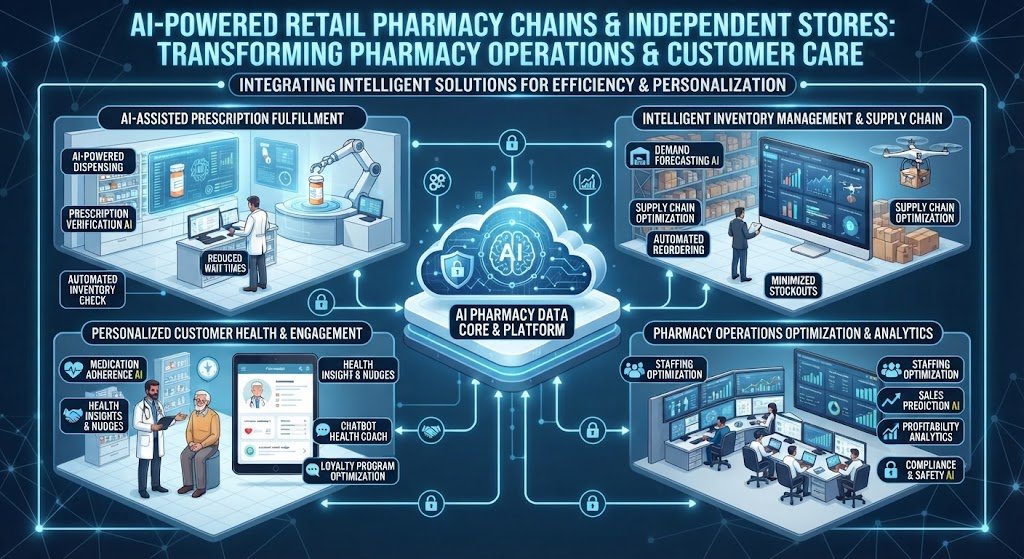
Retail pharmacies are changing from traditional medicine-dispensing locations into increasingly connected healthcare environments.
A modern pharmacy may process thousands of prescriptions, manage medication inventories, communicate with patients, handle refill requests, coordinate with prescribers, process insurance information, and provide clinical services from the same location.
This creates a large number of repetitive workflows where artificial intelligence can provide practical support.
AI can analyze large amounts of structured and unstructured information much faster than a person can manually review every record.
Machine learning can identify patterns in prescription histories and patient behavior.
Computer vision can help recognize medications and support dispensing verification.
Generative AI can help pharmacists summarize information, prepare patient communication, and organize documentation.
Predictive analytics can forecast demand and identify potential medication shortages.
The important point is that retail pharmacy AI does not need to begin with an ambitious autonomous system.
The strongest opportunities are often narrow and measurable.
A system that identifies prescriptions needing pharmacist attention can be more useful than a general chatbot.
A system that predicts a potential stockout before it happens can create more operational value than a generic AI dashboard.
A system that identifies patients with declining medication adherence can help pharmacists focus outreach on people who may benefit most.
This workflow-centered approach is supported by pharmacy research.
A 2025 scoping review of AI applications in pharmacy practice identified prescription intervention as the most frequent application, followed by screening services and patient-facing mobile applications. The review concluded that current pharmacy AI research is still more focused on workflow and productivity than direct patient health outcomes, while highlighting future potential in data analytics and medication-use improvement.
Source: PubMed: Applications of artificial intelligence in current pharmacy practice.
Prescription
AI checks, classifies, and prioritizes medication orders.
Inventory
AI forecasts demand and potential shortages.
Patient
AI identifies adherence and communication opportunities.
Pharmacist
AI provides information and decision support.
Why Retail Pharmacies Are Strong Candidates for AI
Retail pharmacies have several characteristics that make them suitable for focused AI adoption.
They generate repeated transactions throughout the day.
They work with structured prescription information.
They maintain medication histories.
They frequently interact with patients who need recurring medicines.
They also have operational data related to inventory, refills, appointments, claims, and prescription volumes.
This combination gives AI systems multiple sources of information for pattern recognition.
For example, a pharmacy could analyze historical dispensing patterns to estimate which medicines will experience increased demand next month.
Another system could identify prescriptions containing unusual instructions or information that deserves pharmacist review.
A patient-engagement system could identify people who repeatedly delay refills.
A computer-vision system could compare a physical medication against expected product information during dispensing.
The result is a shift from reactive pharmacy operations toward more proactive workflows.
Instead of waiting for a problem to appear, the pharmacy can use predictive systems to identify where attention may be needed.
Prescription → Manual processing → Dispensing → Patient interactionAI-supported workflow:
Prescription → Automated analysis → Risk prioritization → Pharmacist review → Dispensing → Patient support → Follow-up → Outcome tracking
Research Evidence: AI Applications in Pharmacy Practice
AI for Prescription Intervention and Clinical Decision Support
One of the clearest research areas is the use of AI to identify prescriptions that may require pharmacist intervention.
A 2025 systematic review of clinical pharmacy AI research reviewed 30 peer-reviewed articles.
The research found that AI applications were primarily used for adverse drug event detection, clinical decision support, prescription accuracy verification, and pharmacometrics.
Other applications included medication therapy management and prediction of therapeutic response.
The finding is important for retail pharmacies because pharmacists cannot manually investigate every prescription with the same depth.
An AI system can act as a prioritization layer.
It can scan available information and identify cases that deserve additional attention.
This does not mean that AI should independently approve every prescription.
Instead, the technology can reduce the amount of time pharmacists spend searching for potentially relevant information.
Source: PubMed: Artificial intelligence in clinical pharmacy.
AI-Assisted Medication Reviews Can Save Time
Clinical decision-support technology has also been evaluated specifically in community pharmacy medication reviews.
A randomized controlled crossover study involved 71 pharmacists who performed medication reviews with and without a clinical decision-support system.
The researchers found that pharmacists required between 25.7% and 30.7% more time to complete medication reviews without the system.
The number of relevant drug-related problems detected was also higher when the clinical decision-support system was used.
The study reported detection of relevant drug-related problems in 70% of reviews with the system compared with 50% without it.
This provides a useful example of how intelligent software can support pharmacist productivity.
The important value is not simply speed.
The system can help organize clinical information so pharmacists can spend more time interpreting the situation and communicating with the patient.
Source: PubMed: Clinical decision support in community pharmacy medication reviews.
AI and Medication Dispensing Verification
Medication dispensing is another important opportunity.
Traditional pharmacies already use technologies such as barcode scanning and verification procedures.
AI can add another layer by analyzing medication appearance, packaging, prescription information, and expected product identifiers.
Research into human-centered AI for dispensing verification found that pharmacists wanted simple interfaces that presented essential information without overwhelming the user.
Participants favored visual comparisons between pill images and packaging.
They also preferred clear decisions such as accept, reject, or unsure.
This research is valuable because it demonstrates that the success of pharmacy AI depends not only on model accuracy but also on interface design.
A technically strong AI system can become difficult to use if pharmacists have to interpret complicated dashboards during busy dispensing periods.
A better design presents the right information at the right moment.
Source: PubMed: Designing Human-Centered AI to Prevent Medication Dispensing Errors.
Large Language Models for Medication Direction Errors
Generative AI and large language models are also being tested in pharmacy workflows.
A 2024 study introduced MEDIC, a medication-direction copilot designed to reduce errors in prescription directions.
The system was developed using expert-annotated medication directions and incorporated pharmacy logic and safety guardrails.
The researchers tested the system on 1,200 expert-reviewed prescriptions.
The study also evaluated the technology inside an online pharmacy production environment.
During the experimental deployment, the system reduced near-miss events by 33%.
This is an important example because it shows how an LLM can be combined with domain knowledge and safety controls rather than being used as a general-purpose chatbot.
The lesson for retail pharmacies is that generative AI should not simply be asked to “check prescriptions.”
A safer architecture combines the language model with structured medication data, predefined rules, pharmacy logic, and pharmacist verification.
Source: PubMed: Large language models for preventing medication direction errors.
AI for Medication Adherence
Medication adherence is another major opportunity for retail pharmacies.
Pharmacies often have access to refill histories and medication-dispensing records that can reveal patterns of delayed refills.
Machine learning can analyze these patterns together with other available information to identify patients who may be at higher risk of non-adherence.
A scoping review identified 43 studies involving machine learning and medication adherence.
The research found multiple approaches for predicting adherence, including models based on pharmacy claims data and self-reported information.
Several studies used logistic regression, neural networks, random forests, or support-vector machines.
Monitoring systems also used sensors in medication containers, smartphones, and smartwatches.
Some conversational reminder systems showed improvements in adherence compared with traditional reminders.
However, the evidence is not strong enough to assume that every AI reminder system will improve adherence.
A 2025 focused review identified only seven eligible studies evaluating AI-based tools for patient medication support and concluded that the evidence base remained limited, with moderate-to-high risk of bias across the available research.
This means retail pharmacies should treat AI adherence prediction as a prioritization and engagement tool rather than a guaranteed clinical intervention.
Source: PubMed: Machine Learning and Medication Adherence.
Source: PubMed: AI-based tools for medication adherence.
Pharmacist-Led AI-Supported Adherence Programs
A particularly relevant study evaluated an AI-supported medication-adherence program involving 10,477 patients.
The program combined AI-supported analytics with pharmacist case review and direct patient outreach.
Researchers identified 2,762 actionable medication-adherence gaps.
After implementation, adherence improved across three measured chronic-disease medication categories.
Hypertension medication adherence improved by 5.9%.
Cholesterol medication adherence improved by 7.9%.
Diabetes medication adherence improved by 6.4%.
The percentage of patients with diabetes who reached their A1c goal also increased from 75.5% to 81.7%.
The study additionally reported lower healthcare expenditures among adherent patients compared with non-adherent patients across the evaluated disease categories.
This is a strong example of the model that may become increasingly important in retail pharmacy.
AI identifies the opportunity.
The pharmacist reviews the patient.
The pharmacist communicates with the patient.
The system measures the result.
Source: PubMed: AI-supported medication adherence program.
AI for Retail Pharmacy Inventory Management
Inventory is one of the most practical areas for AI in large pharmacy chains and independent stores.
Pharmacies must balance availability with the risk of overstocking.
A medicine that is unavailable when needed can create an immediate patient problem.
Excess inventory can tie up capital and create expiration-related losses.
Machine learning can analyze historical sales, prescription trends, therapeutic categories, seasonality, previous shortages, and other variables to forecast demand.
A research study used sales data from 22 Canadian pharmacies to build machine-learning models for predicting drug shortages.
The models predicted shortage classes one month in advance with 69% accuracy.
The researchers also predicted 59% of the shortages considered most impactful based on demand and availability of interchangeable medicines.
This demonstrates how pharmacy data can potentially be used for proactive inventory management.
The system could help pharmacy teams decide which products require closer monitoring.
Source: PubMed: Predicting drug shortages using pharmacy data and machine learning.
AI Inventory Intelligence
Previous dispensing patterns
Changing demand
Supply risk
Expected future demand
Ordering and inventory decisions
AI for Independent Pharmacies
Independent pharmacies can benefit from AI even when they do not have the massive technology budgets of national pharmacy chains.
The most important strategy is to avoid building unnecessary infrastructure.
Cloud-based pharmacy software can provide AI capabilities through existing workflows.
An independent pharmacy could begin with automated prescription prioritization.
It could then introduce inventory forecasting.
Later, it could add patient adherence analytics or AI-assisted communication.
The goal should be measurable improvement rather than adopting AI simply because it is available.
Independent stores can also use AI to identify operational patterns that may be difficult to see manually.
For example, the pharmacy could analyze which products experience repeated stockouts.
It could identify recurring refill delays.
It could analyze patient communication volume.
It could identify peak prescription-processing periods.
It could also help staff prepare summaries before pharmacist consultations.
This can make AI particularly useful for smaller teams where the same people manage multiple responsibilities.
AI for Large Retail Pharmacy Chains
Large pharmacy chains have a different opportunity.
They can potentially train or deploy systems across thousands of locations and use aggregated operational information to identify patterns.
AI can support centralized inventory forecasting.
It can help prioritize pharmacy workload.
It can detect unusual prescription patterns.
It can support enterprise-wide medication adherence programs.
It can identify locations experiencing unusual demand.
It can also help pharmacy organizations compare operational performance across stores.
A large chain could use predictive analytics to forecast staffing requirements based on prescription volume, seasonality, vaccination activity, appointment demand, and other operational signals.
The result could be a more adaptive pharmacy workforce.
Instead of staffing every location based only on historical schedules, organizations could use predicted workload to make more informed decisions.
AI for Patient Communication and Engagement
Retail pharmacies interact with patients frequently.
This makes patient communication an important AI use case.
Generative AI can help prepare appointment reminders, refill notifications, medication education, and administrative messages.
AI can also support conversational systems that answer basic questions and direct more complex issues to pharmacy staff.
However, patient-facing AI requires careful design.
A pharmacy chatbot should know when it cannot safely answer a question.
It should recognize situations requiring pharmacist intervention.
It should avoid presenting uncertain information as a definitive clinical recommendation.
A 2026 randomized controlled study involving 280 participants examined how an AI chatbot affected perceptions of pharmacist roles.
The researchers found that both video education and AI chatbot interaction improved patient knowledge, while deeper engagement with the chatbot was associated with better understanding of pharmacist capabilities.
The study supports the idea that AI can supplement patient education when it encourages meaningful interaction rather than simply providing passive information.
Source: PubMed: AI-powered chatbots and perceptions of pharmacist roles.
AI for Pharmacist Knowledge Support
Pharmacists frequently need to retrieve medication information.
Questions may involve drug interactions, dosing, contraindications, adverse effects, administration, patient-specific factors, or medication combinations.
Large language models can potentially assist with information retrieval and organization.
A study evaluating ChatGPT-4 on community pharmacy tasks found that the model could handle several drug-information and prescription-related scenarios, including identifying some labeling errors and supporting medication-management discussions.
However, the researchers specifically emphasized the need for rigorous validation across diverse queries, drug classes, and populations, along with strong privacy protections.
This distinction is critical.
A general AI model can produce a useful answer while still producing an unsafe answer in another situation.
Retail pharmacy systems should therefore connect AI to trusted medication databases and controlled knowledge sources where appropriate.
The AI should help pharmacists find and organize information rather than becoming an uncontrolled source of clinical authority.
Source: PubMed: Performance of ChatGPT for decision support in community pharmacy.
AI for Drug-Drug Interaction Detection
Drug-drug interactions represent another important area for machine learning.
Traditional drug-interaction systems often generate large numbers of alerts.
Too many low-value alerts can create alert fatigue.
AI may help prioritize interactions based on patient context and clinical relevance.
Recent research has explored machine learning, deep learning, graph-based models, knowledge graphs, and large language models for drug-interaction prediction.
A systematic review covering 147 studies published from 2018 to 2024 mapped AI approaches across drug-drug, drug-disease, and drug-nutrient interaction prediction.
The research highlighted promising advances but also identified continuing problems involving data imbalance, noisy data, limited explainability, and underrepresentation of certain interactions.
This suggests that future retail pharmacy systems may move from simple alert generation toward intelligent risk prioritization.
Instead of presenting every theoretical interaction equally, the system could help pharmacists identify which alerts deserve immediate attention.
Source: PubMed: AI applications in drug interaction prediction.
AI Workflow Automation in Retail Pharmacy
AI can support many administrative processes that consume pharmacy staff time.
Potential applications include:
- Prescription intake and data extraction.
- Refill request classification.
- Patient reminder generation.
- Prior authorization information preparation.
- Referral documentation support.
- Medication synchronization workflows.
- Inventory ordering assistance.
- Expired medication identification.
- Appointment scheduling support.
- Patient message categorization.
- Documentation drafting.
- Quality-control checks.
- Workflow prioritization.
- Store-level operational analytics.
- Escalation of unusual cases to pharmacy staff.
The strongest implementations are selective.
AI should handle repetitive tasks where the risk is understood and where human review remains practical.
This approach can reduce administrative pressure without unnecessarily automating high-risk clinical decisions.
Computer Vision in Retail Pharmacy
Computer vision is especially useful when the pharmacy workflow involves physical objects.
A camera-based system can potentially inspect medication packages, pill appearance, labels, barcodes, and dispensing containers.
Computer vision can also support shelf monitoring.
For example, a pharmacy could use cameras or imaging devices to identify misplaced products or detect empty shelf locations.
The technology could eventually support automated stock checks.
However, visual recognition in pharmacy has to account for packaging variations, lighting, damaged labels, similar-looking medicines, and product changes.
This makes confidence thresholds and pharmacist verification important.
A human-centered dispensing study showed that pharmacists preferred visual comparison tools and clear confidence information rather than complicated interfaces.
Source: PubMed: Human-centered AI for medication dispensing verification.
AI and Pharmacy Operations: A Practical Value Chain
Prescriptions, patients, inventory, claims
Machine learning and AI models
Identify what needs attention
Pharmacist evaluation
Dispense, contact, refer, reorder
Safety, efficiency, outcomes
This value chain illustrates the difference between useful pharmacy AI and simple automation.
The model should connect information to an operational or clinical action.
AI Capability Map for Retail Pharma
| AI Capability | Retail Pharmacy Use | Primary Value | Human Role |
|---|---|---|---|
| Machine Learning | Demand and adherence prediction | Proactive decisions | Review and action |
| Computer Vision | Medication verification | Safety and quality control | Verification |
| Generative AI | Documentation and communication | Time savings | Review and approval |
| Clinical Decision Support | Medication review and alerts | Clinical support | Clinical judgment |
| Predictive Analytics | Inventory and workload forecasting | Planning | Operational decisions |
| AI Workflow Automation | Refills, reminders, routing | Operational efficiency | Escalation |
AI Adoption: Chain vs Independent Pharmacy
| Area | Large Chain | Independent Store |
|---|---|---|
| Data | Large, multi-location datasets | Smaller local dataset |
| Inventory AI | Centralized forecasting | Store-level demand prediction |
| Patient Engagement | Enterprise campaigns | Personalized local outreach |
| Technology | Custom enterprise platforms | Cloud and SaaS solutions |
| Best Starting Point | High-volume workflow optimization | One measurable operational problem |
What AI Could Look Like Inside a Future Pharmacy
The future retail pharmacy is likely to be a combination of physical pharmacy services and intelligent digital infrastructure.
A prescription may enter the system electronically.
AI can analyze the order and identify unusual information.
The system can prioritize the prescription according to predefined rules.
A pharmacist reviews the relevant information.
Computer vision can provide an additional verification layer during dispensing.
Inventory software can simultaneously check stock and predict future demand.
After dispensing, the system can identify whether the patient may require additional education or follow-up.
For chronic medications, predictive analytics can identify potential refill delays.
A pharmacist can then contact the patient.
The interaction can be recorded within the appropriate pharmacy system.
The next refill cycle can be monitored automatically.
This creates a continuous medication-management loop.
Future AI-Enabled Pharmacy
Prescription Intake
↓
AI Screening
↓
Risk & Priority Detection
↓
Pharmacist Review
↓
AI-Assisted Verification
↓
Dispensing
↓
Patient Education
↓
Adherence Monitoring
↓
Follow-Up
↓
Outcome & Operational Analytics
AI Agents and the Next Phase of Pharmacy Automation
The next stage of AI adoption may move from individual AI functions toward AI agents capable of coordinating multiple steps.
An AI agent could receive a refill request.
It could check whether the medication is eligible for refill according to predefined rules.
It could review available information.
It could identify missing information.
It could prepare a message for the patient or pharmacy staff.
It could create a task for pharmacist review when an exception is identified.
The important distinction is that the agent should operate within clearly defined boundaries.
It should not be allowed to make unrestricted clinical decisions simply because it can access pharmacy data.
Agentic AI will therefore require stronger workflow controls than simple text-generation tools.
Challenges of AI Adoption in Retail Pharmacy
Data Quality
AI depends on the quality of its input.
Incorrect medication records, incomplete patient information, inconsistent product data, or missing clinical context can produce poor outputs.
Retail pharmacy AI therefore needs data-quality monitoring as part of the system.
False Positives and False Negatives
An AI system may flag a prescription that is actually appropriate.
It may also fail to identify a genuine problem.
Both errors matter.
The acceptable balance depends on the clinical task.
Automation Bias
One major risk is excessive trust in an AI recommendation.
A pharmacist may accept a system’s output because it appears confident.
This is why AI interfaces should communicate uncertainty appropriately and make professional review easy.
Privacy and Security
Retail pharmacies process sensitive health information.
AI systems must therefore be designed around appropriate privacy, access controls, security, auditability, and data governance.
Healthcare organizations should understand exactly what data an AI system receives, where that data is processed, how long it is retained, and who can access it.
Explainability
Pharmacists need to understand why an AI system generated an alert or recommendation.
A black-box output may be difficult to trust during a clinical workflow.
Human-centered research in pharmacy has specifically emphasized interpretability and understandable visual feedback.
Workflow Disruption
An AI system that adds extra clicks can reduce productivity instead of improving it.
The technology should fit naturally into the existing pharmacy workflow.
Evidence Quality
The research base is growing, but not every AI application has been validated in real-world retail pharmacy environments.
A strong laboratory result does not automatically demonstrate clinical effectiveness.
The 2026 pharmacy literature continues to emphasize the need for prospective studies, external validation, standardized outcomes, and cost-effectiveness analysis before widespread implementation.
Source: PubMed: Artificial intelligence in clinical pharmacy systematic review.
How Pharmacy Organizations Should Evaluate AI
Retail pharmacy leaders should evaluate an AI system as a healthcare technology rather than simply as software.
The first question should be the problem being solved.
The second question should be whether the available data is suitable.
The third question should be how the system will affect pharmacists and patients.
The fourth question should be what happens when the system is wrong.
The fifth question should be how performance will be measured after deployment.
| Evaluation Area | Questions to Ask | Example KPI |
|---|---|---|
| Clinical Safety | What happens when the AI is wrong? | Error and near-miss rate |
| Accuracy | How often is the output correct? | Sensitivity, specificity, precision |
| Workflow | Does it reduce or add work? | Task completion time |
| Adoption | Do pharmacists actually use it? | Usage and acceptance rate |
| Patient Value | Does the patient experience improve? | Adherence, satisfaction, follow-up |
| Financial | Does the investment create measurable value? | ROI and cost per encounter |
A Practical AI Adoption Roadmap for Retail Pharmacies
Start With One Workflow
A pharmacy should not attempt to automate everything simultaneously.
Choose one workflow where the problem is clear.
Prescription verification, inventory forecasting, refill prioritization, medication adherence, or documentation are possible starting points.
Establish a Baseline
Before deploying AI, measure the current process.
Record processing time, error rates, pharmacist workload, patient response, or inventory performance depending on the use case.
Without a baseline, it becomes difficult to determine whether AI created real improvement.
Validate the AI
Test the system against representative pharmacy cases.
Include normal cases, difficult cases, incomplete information, unusual medication combinations, and other situations relevant to the workflow.
Introduce Human Review
During early deployment, maintain pharmacist oversight.
This creates an opportunity to identify unexpected failure patterns before expanding the system.
Monitor After Deployment
AI performance can change over time.
New medications, new packaging, changing prescribing patterns, different patient populations, and software updates can affect performance.
Continuous monitoring is therefore important.
Scale Only After Evidence
Once the first workflow demonstrates measurable value, the organization can expand into additional pharmacy functions.
Industry Direction: From Pharmacy Automation to Intelligent Pharmacy
Traditional pharmacy automation focused heavily on mechanical efficiency.
Robots, barcode systems, automated dispensing equipment, and electronic prescription systems reduced manual work.
AI introduces a different layer.
It can analyze information and make predictions.
This means the pharmacy of the future may combine mechanical automation with intelligent decision support.
The dispensing process could use automation for physical handling.
Computer vision could support verification.
Machine learning could prioritize risk.
Generative AI could assist communication.
Predictive analytics could manage demand.
A pharmacist could remain responsible for complex decisions and patient relationships.
This division of work could allow pharmacy professionals to spend less time on repetitive information processing and more time on activities requiring clinical reasoning and human communication.
The American Society of Health-System Pharmacists has similarly emphasized that pharmacy professionals should participate in the selection, design, validation, implementation, and ongoing evaluation of AI systems affecting medication-use processes.
ASHP also recommends that AI be evaluated for accuracy, transparency, interpretability, and ongoing performance.
Source: ASHP Statement on Artificial Intelligence in Pharmacy.
Future Predictions for Retail Pharmacy AI
AI Will Become Embedded in Pharmacy Software
Pharmacists are unlikely to want separate AI applications for every task.
AI capabilities will increasingly appear inside pharmacy-management systems, dispensing platforms, patient portals, and clinical decision-support tools.
Predictive Pharmacy Will Become More Important
The pharmacy will increasingly predict what is likely to happen instead of only responding to what has already happened.
Demand forecasting, adherence risk, workload prediction, and patient follow-up are examples.
Medication Verification Will Become More Multimodal
Future systems may combine prescription text, barcode information, package images, pill images, patient data, and pharmacy records.
This can create a richer verification process.
AI Will Help Pharmacists Manage Larger Information Volumes
As pharmacy services expand, pharmacists may receive more clinical information than can realistically be reviewed manually.
AI can act as an information-filtering layer.
Independent Pharmacies Will Gain Access to Enterprise-Level Intelligence
Cloud-based AI services can potentially provide smaller pharmacies with capabilities that previously required large internal technology teams.
This could reduce the technology gap between independent stores and larger organizations.
Evidence Will Matter More Than AI Branding
Pharmacy organizations will increasingly ask whether an AI product actually improves safety, productivity, patient outcomes, or cost.
The strongest vendors will need to demonstrate evidence rather than relying only on claims about advanced models.
Original Research Opportunity Matrix
| Pharmacy Area | AI Application | Technology | Potential KPI |
|---|---|---|---|
| Prescription Processing | Risk classification | Machine Learning | Review time |
| Dispensing | Medication verification | Computer Vision | Near-miss rate |
| Medication Review | Clinical decision support | AI + Knowledge Graphs | Drug-related problems detected |
| Inventory | Demand forecasting | Predictive Analytics | Stockout rate |
| Adherence | Risk prediction | Machine Learning | Refill adherence |
| Patient Communication | AI-assisted education | Generative AI | Engagement rate |
| Operations | Workload forecasting | Predictive AI | Wait time |
| Documentation | Drafting and summarization | Generative AI | Documentation time |
What This Means for Pharmacy Technology Companies
Pharmacy technology companies have an opportunity to build AI around specific pharmacy workflows.
The strongest products will not necessarily be the systems with the largest models.
They will be the systems that understand pharmacy operations.
A successful product may combine a machine-learning model with medication databases, pharmacy-management software, computer vision, workflow automation, and a pharmacist-facing interface.
The product should make the pharmacist’s job easier without hiding important information.
It should also provide clear escalation paths when the AI is uncertain.
For healthcare technology companies, this creates opportunities across AI Development, Custom AI Model Development, Computer Vision Development, Generative AI, Data Analytics & AI Insights, AI Workflow Automation, and AI Integration and Deployment.
The most valuable products will connect these capabilities into a complete workflow.
Frequently Asked Questions
How is AI used in retail pharmacies?
AI can support prescription verification, medication reviews, drug-interaction detection, inventory forecasting, medication-adherence programs, patient communication, documentation, workflow automation, and pharmacy analytics.
Can AI verify prescriptions?
AI can assist with prescription verification by identifying unusual information, medication-direction problems, or other predefined risk signals. Appropriate pharmacist review remains important for clinical decisions.
Can AI reduce medication dispensing errors?
Research suggests that AI-based verification can provide an additional safety layer during medication dispensing. Human-centered research has also emphasized the importance of pharmacist involvement, understandable interfaces, and clear confidence information.
Can AI improve medication adherence?
AI can identify patients who may be at risk of non-adherence and help pharmacists prioritize outreach. Research has shown promising results, but the overall evidence base remains limited and varies by intervention.
How can AI help pharmacy inventory management?
Machine learning can analyze historical sales and pharmacy data to forecast demand and identify potential shortage risks. This can help pharmacy teams make more informed ordering and inventory decisions.
Can independent pharmacies use AI?
Yes. Independent pharmacies can start with focused cloud-based AI solutions for areas such as inventory forecasting, prescription prioritization, documentation, patient communication, and adherence analytics.
Can AI replace pharmacists?
AI is better viewed as an assistive technology for pharmacy practice. Pharmacists provide clinical judgment, patient communication, contextual reasoning, accountability, and professional oversight that cannot simply be replaced by an automated prediction.
How can generative AI help retail pharmacies?
Generative AI can assist with documentation, patient education, message drafting, information summarization, workflow classification, and other language-heavy tasks when used with appropriate safeguards and professional review.
What is computer vision in pharmacy?
Computer vision allows software to analyze visual information. In retail pharmacy, potential applications include medication identification, pill and package comparison, dispensing verification, shelf monitoring, and inventory-related visual inspection.
What is the biggest AI opportunity in retail pharmacy?
The strongest opportunity is usually a high-volume workflow where AI can reduce repetitive work, identify risk, or predict a future event while allowing pharmacy professionals to remain involved in the decision.
What are the biggest risks of AI in retail pharmacy?
Important risks include incorrect recommendations, false alerts, missed problems, automation bias, privacy concerns, cybersecurity risks, poor data quality, model drift, inadequate validation, and workflow designs that make it difficult for pharmacists to review AI outputs.
Credible Data Sources and Original Research
- Artificial Intelligence in Pharmacy Practice: A literature review covering AI applications including medication management, adverse-event detection, clinical decision support, dispensing automation, adherence, and drug-interaction detection. Source: Original research on PubMed.
- Current Pharmacy AI Applications: A scoping review identified 560 records and included seven studies focusing on prescription intervention, screening, patient-facing applications, and medication-use improvement. Source: Original research on PubMed.
- AI in Clinical Pharmacy: A systematic review of 30 articles examined adverse drug events, prescription verification, clinical decision support, pharmacometrics, medication management, and therapeutic-response prediction. Source: Original research on PubMed.
- Community Pharmacy Medication Reviews: A randomized controlled crossover study involving 71 pharmacists found faster medication reviews and greater detection of relevant drug-related problems when a clinical decision-support system was used. Source: Original research on PubMed.
- AI Dispensing Verification: A human-centered design study explored pharmacist requirements for AI-supported medication dispensing verification and emphasized simple, interpretable visual interfaces. Source: Original research on PubMed.
- LLM Medication Safety: Research on the MEDIC medication-direction copilot evaluated how domain knowledge and safety guardrails can reduce medication-direction errors and reported a 33% reduction in near-miss events during experimental production deployment. Source: Original research on PubMed.
- Medication Adherence: A scoping review examined 43 studies involving machine learning for medication-adherence prediction and monitoring. Source: Original research on PubMed.
- AI-Supported Adherence Program: A multicenter evaluation involving 10,477 patients examined an AI-supported, pharmacist-led medication-adherence program and reported improvements across hypertension, cholesterol, and diabetes adherence measures. Source: Original research on PubMed.
- AI for Medication Adherence: A focused review evaluated AI-based tools intended to improve medication adherence and concluded that promising evidence exists but the available research remains limited. Source: Original research on PubMed.
- AI for Drug Interactions: A systematic review covering 147 studies mapped machine learning, deep learning, graph-based models, knowledge graphs, and LLM approaches to drug-interaction prediction. Source: Original research on PubMed.
- AI in Community Pharmacy Decision Support: A study evaluated ChatGPT-4 on community-pharmacy scenarios involving drug information, labeling errors, prescription interpretation, uncertainty, and medication-management questions. Source: Original research on PubMed.
- AI Patient Engagement: A 2026 randomized controlled study involving 280 participants examined the effect of an AI chatbot on perceptions of pharmacist roles and medication-related communication. Source: Original research on PubMed.
- Pharmacy Inventory Forecasting: A machine-learning study used data from 22 Canadian pharmacies and predicted shortage categories one month ahead with 69% accuracy. Source: Original research on PubMed.
- ASHP AI Guidance: The American Society of Health-System Pharmacists provides guidance emphasizing pharmacy professionals’ role in AI selection, validation, implementation, safety, transparency, interpretability, and ongoing evaluation. Source: ASHP Statement on Artificial Intelligence in Pharmacy.
- WHO AI Governance: The World Health Organization emphasizes ethics, human rights, accountability, safety, transparency, equity, and responsible governance when AI is used in health. Source: WHO Guidance on Ethics and Governance of AI for Health.
- WHO Large Multimodal Models: WHO guidance discusses the opportunities and risks associated with large multimodal AI models in healthcare and emphasizes responsible governance. Source: WHO Guidance on Large Multimodal Models.
Final Takeaway
Artificial intelligence is creating a new layer of intelligence across retail pharmacy operations.
The technology can help pharmacies process information faster, identify prescriptions that deserve attention, support medication verification, forecast inventory demand, identify adherence risks, assist pharmacists with information retrieval, improve patient communication, and automate repetitive administrative workflows.
The research also shows why pharmacy AI should not be treated as simple automation.
AI can introduce new risks when its predictions are wrong, when data is incomplete, or when users place excessive trust in automated recommendations.
The most practical model is therefore a human-AI workflow.
AI can analyze.
AI can prioritize.
AI can predict.
AI can summarize.
AI can automate selected low-risk tasks.
Pharmacists can review.
Pharmacists can interpret.
Pharmacists can communicate.
Pharmacists can make appropriate clinical decisions.
The future of retail pharmacy is likely to combine these strengths rather than replace one with the other.
For large pharmacy chains, the biggest opportunity may be enterprise-scale predictive intelligence across prescriptions, inventory, staffing, patient engagement, and clinical services.
For independent pharmacies, the opportunity may be more focused, using accessible AI tools to solve one high-value workflow at a time.
The long-term competitive advantage will not come simply from having an AI feature.
It will come from having reliable data, validated models, strong pharmacy workflows, useful interfaces, measurable outcomes, and responsible human oversight.
Leave a Reply