Primary topic: Artificial Intelligence in Medicine Delivery Apps
Research focus: AI-powered prescription processing, medication safety, pharmacy automation, personalized medicine reminders, demand forecasting, inventory intelligence, delivery optimization, route planning, fraud detection, patient engagement, conversational AI, telepharmacy, predictive analytics, computer vision, data security, and the future of digital medicine delivery.
AI in Medicine Delivery Apps: How Artificial Intelligence Is Changing Online Pharmacy
Medicine delivery apps have evolved far beyond the basic concept of allowing a customer to search for a medicine and request home delivery. Modern platforms can connect patients, pharmacies, prescribers, pharmacists, inventory systems, payment services, logistics providers, and healthcare records through a single digital experience.
Artificial intelligence can add another layer to this ecosystem by converting large amounts of operational and healthcare-related data into predictions, recommendations, classifications, alerts, and automated workflows. This makes AI particularly relevant to medicine delivery because the platform must manage both digital commerce and safety-sensitive healthcare processes.
Unlike ordinary e-commerce, medicine delivery involves prescription verification, medicine availability, dosage instructions, substitution rules, patient identity, pharmacist review, storage conditions, delivery timing, and potentially sensitive health information. An intelligent platform therefore needs to optimize convenience without weakening the controls that protect patients.
The most valuable AI systems are likely to operate quietly in the background. A patient may simply see a faster search result, a clearer prescription status, a useful reminder, or a more accurate delivery estimate. Behind that experience, machine learning models can be analyzing inventory, demand, order patterns, prescription information, delivery routes, and operational bottlenecks.
This creates a major opportunity for AI Development, Machine Learning, Generative AI, Computer Vision Development, Data Analytics & AI Insights, AI Workflow Automation, and AI Integration and Deployment.
Why Medicine Delivery Apps Are Strong Candidates for AI
Medicine delivery platforms generate many types of structured and unstructured information. Every search, prescription upload, order, refill, delivery, cancellation, support interaction, and inventory movement can create data that may help improve future decisions.
The important point is that not every piece of data should automatically be used for AI. Healthcare organizations must establish clear purposes for data collection and appropriate controls before using patient information for analytics or model development.
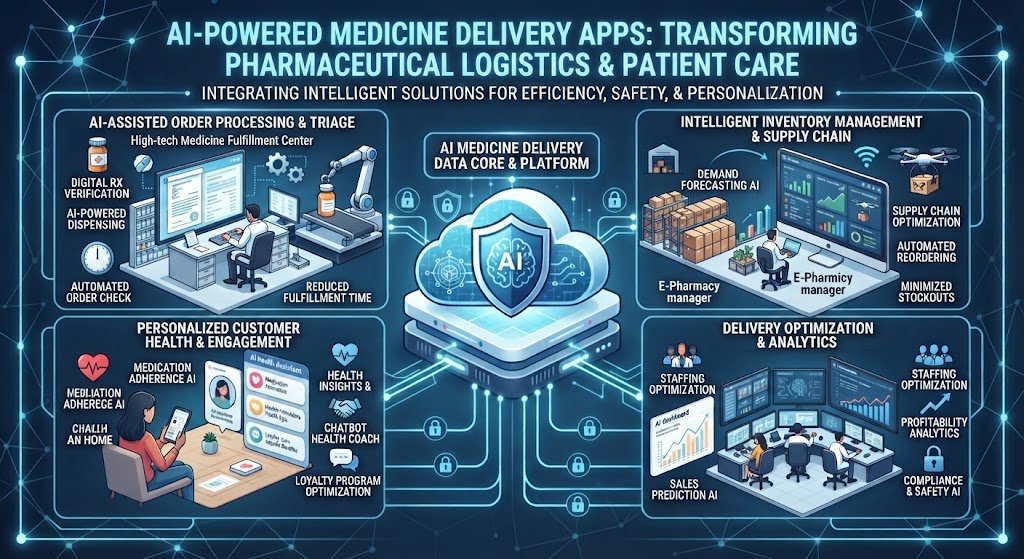
Within a properly governed environment, AI can help medicine delivery platforms in several major areas:
- Prescription processing: Extracting relevant information from prescriptions and identifying potential inconsistencies for pharmacist review.
- Medication safety: Detecting possible errors in directions, duplicate medications, or other predefined risk conditions.
- Inventory forecasting: Predicting future demand by medicine, location, season, and historical ordering patterns.
- Delivery optimization: Improving dispatch decisions, delivery sequencing, estimated arrival times, and operational planning.
- Patient adherence: Predicting when patients may need reminders or refill support.
- Conversational assistance: Helping users understand order status, prescription requirements, and approved medication information.
- Fraud and abuse detection: Identifying unusual purchasing or account behavior for investigation.
- Operational analytics: Identifying bottlenecks across pharmacy processing, packing, dispatch, and customer support.
The combination of these capabilities can turn a medicine delivery app into a connected intelligent pharmacy platform rather than a simple marketplace.
Research Evidence: AI Can Improve Online Pharmacy Medication Safety
One of the most directly relevant studies for medicine delivery apps examined the use of large language models to prevent medication-direction errors in an online pharmacy environment.
The researchers developed a system called MEDIC, designed to process medication directions using pharmacy-specific logic and safety guardrails. The system was trained using 1,000 expert-annotated and augmented medication directions.
The researchers then evaluated the approach using 1,200 expert-reviewed prescriptions. They compared MEDIC with other LLM-based approaches and subsequently tested MEDIC inside the production system of an online pharmacy.
The prospective production evaluation is particularly important because it moved beyond laboratory testing. During the experimental deployment, MEDIC reduced near-miss events by 33%, with a confidence interval of 26% to 40%.
A near-miss is an error that is identified and corrected before it reaches the patient. Reducing these events can potentially improve pharmacy workflow safety while also reducing the amount of repetitive verification work handled manually.
The study demonstrates an important principle for AI in medicine delivery apps. General-purpose generative AI should not simply be allowed to rewrite prescription directions independently. A safer architecture combines domain knowledge, structured extraction, pharmacy logic, validation rules, and professional oversight.
For medicine delivery companies, this type of AI can be positioned as a verification copilot rather than an autonomous prescribing system.
Source: Large language models for preventing medication direction errors in online pharmacies – PubMed.
Research finding
MEDIC was evaluated on 1,200 expert-reviewed prescriptions and later tested in an online pharmacy production environment. The production experiment reported a 33% reduction in near-miss medication-direction events.
What This Research Means for Medicine Delivery Apps
The research has a direct implication for platforms that process thousands or millions of prescription orders. Prescription instructions often contain information about dose, frequency, route, duration, and other details that must be represented accurately.
An AI system can extract these components into structured fields before the order moves to the next stage. It can then compare the structured information with the generated customer-facing directions and identify mismatches.
A practical workflow could look like this:
Uploaded or received
Medicine + directions
Checks and flags
Professional review
Pack and dispatch
This approach allows AI to perform repetitive information processing while preserving the pharmacist’s role in the final safety-sensitive decision.
AI-Powered Prescription Processing
Prescription processing is one of the most valuable areas for AI in medicine delivery applications because it sits directly between the patient order and pharmacy fulfillment.
Traditional digital pharmacies may require staff to manually review uploaded prescriptions, identify medicine names, interpret instructions, confirm patient information, and enter relevant details into pharmacy systems.
AI can assist with these steps using optical character recognition, natural language processing, document understanding, and structured data extraction.
A prescription-processing system can potentially identify:
- Patient information.
- Prescriber information.
- Medicine name.
- Strength.
- Dosage form.
- Quantity.
- Frequency.
- Duration.
- Route of administration.
- Refill information.
- Potentially missing or inconsistent information.
The important distinction is that extraction is not the same as clinical approval. The AI can organize information and identify predefined concerns, while an authorized pharmacist or other qualified professional can make the final determination when professional judgment is required.
AI for Medication Direction and Instruction Quality
Medicine delivery apps have another important responsibility after the prescription has been processed. They must communicate medication directions clearly to the patient.
Poorly formatted or incorrectly transformed directions can create safety problems. This is why the MEDIC research is particularly relevant to online pharmacies.
AI can help convert structured prescription information into standardized directions, but the system should operate within strict rules.
A robust architecture can include:
- Structured medication fields.
- Validated terminology.
- Pharmacy-specific rules.
- Safety guardrails.
- Automated consistency checks.
- Exception detection.
- Pharmacist review for flagged cases.
- Audit trails for important changes.
Generative AI becomes much safer when it is constrained by structured information rather than being allowed to invent clinical instructions.
AI-Powered Medication Search and Recommendations
Search is one of the most visible parts of a medicine delivery app. Patients may search using brand names, generic names, misspellings, symptoms, dosage forms, or informal language.
AI can improve search by understanding the intent behind the query.
For example, a user might enter a brand name while the pharmacy database stores the generic name. Another user might search for a particular strength but accidentally type an incomplete product name.
Natural language processing can help connect these variations to the appropriate catalog records.
AI search can also improve product discovery by understanding:
- Generic and brand relationships.
- Strength and dosage form.
- Pack size.
- Availability.
- Location.
- Prescription requirements.
- Previously ordered medicines.
- Approved substitution rules.
However, recommendation systems for medicines require much stronger controls than ordinary shopping recommendations. The system should not encourage a patient to select a medicine simply because it is popular or commercially valuable.
The objective should be accurate product discovery and safe workflow support, not uncontrolled medical recommendation.
AI for Medication Adherence and Refill Prediction
A medicine delivery app can potentially become a useful adherence-support platform because it already knows when medicines are ordered and when refills may become due.
AI can identify patterns in refill behavior and predict which patients may benefit from reminders or pharmacist outreach.
A 2025 focused review examined AI-based tools designed to support medication adherence and reduce medication-use errors. The review identified seven eligible studies and reported that randomized trials showed adherence improvements ranging from 6.7% to 32.7% compared with different control or current-practice conditions.
However, the researchers also emphasized that the overall evidence base was limited and that risk of bias was moderate to high in the available literature.
This is an important balance. AI shows potential, but medicine delivery companies should not claim that automated reminders automatically improve clinical outcomes for every patient.
A 2026 systematic review of AI-based chatbots found a significant pooled effect on medication adherence, but also reported very high heterogeneity across studies. The strongest results were associated with chatbots combining reminders, education or health coaching, and real-time question-answer capabilities.
This suggests that future medicine delivery apps may move from simple reminder notifications toward personalized medication-support systems.
Source: AI-based tools for patient support to enhance medication adherence – PubMed.
Source: AI-based chatbots to enhance medication adherence – PubMed.
AI for Predicting Medication Non-Adherence
Prediction is another important application.
A 2025 scoping review examined machine-learning approaches for predicting medication non-adherence and included 52 studies. The researchers found substantial variation in modeling approaches and outcome definitions, but several models showed useful predictive performance.
The review reported median AUC values of 0.837 for models using diagnostic data and 0.828 for models using subject-reported data, with an overall median AUC of 0.82 among the analyzed primary models.
Common predictors included previous adherence behavior, medication history, comorbidities, beliefs about medicines, and socioeconomic factors.
For medicine delivery apps, this creates a potential predictive workflow.
Instead of waiting until a patient misses several refills, an AI system could identify a pattern suggesting that the patient may need additional support.
The platform could then trigger an approved intervention such as:
- A refill reminder.
- A personalized notification.
- A pharmacist review task.
- A question about barriers to obtaining the medicine.
- A delivery scheduling prompt.
- A request to confirm the prescription status.
Source: Machine learning approaches to predicting medication nonadherence – PubMed.
AI for Inventory and Medicine Availability
A delivery app cannot provide a good patient experience if the medicine shown online is unavailable after the order is placed.
Inventory forecasting can therefore become one of the most practical AI applications.
Machine-learning models can analyze historical orders, seasonality, location, product movement, prescription trends, holidays, lead times, and stock levels to estimate future demand.
A platform could use these predictions to determine which products require additional inventory.
For example, demand for some medicines may change because of seasonal illnesses. Other medicines may have highly stable refill patterns associated with chronic conditions.
AI can separate these patterns instead of treating every product as if it behaves in the same way.
| Data Signal | AI Analysis | Possible Action |
|---|---|---|
| Historical orders | Demand patterns | Adjust inventory levels |
| Seasonal trends | Future demand estimation | Pre-position stock |
| Local demand | Location-level forecasting | Optimize pharmacy allocation |
| Supplier lead time | Stockout risk | Trigger replenishment |
| Expiry data | Waste risk | Prioritize appropriate stock movement |
Research on AI combined with vendor-managed inventory in pharmaceutical supply chains has also explored how AI can support drug-management practices and improve supply-chain information management.
Source: AI + vendor-managed inventory for drug supply-chain management – PubMed.
AI for Delivery Route Optimization
Once an order is approved and packed, the next challenge is getting the medicine to the correct patient.
Delivery optimization is a classic machine-learning and operations-research problem because multiple factors can affect the best route.
These can include:
- Delivery location.
- Traffic conditions.
- Number of active orders.
- Driver availability.
- Pharmacy location.
- Delivery priority.
- Expected preparation time.
- Weather conditions.
- Vehicle capacity.
- Time windows.
- Temperature-sensitive requirements where applicable.
AI can estimate travel times and continuously recalculate delivery priorities.
The system does not necessarily need to make a medical decision. It can optimize logistics while preserving pharmacy and clinical controls.
This can reduce unnecessary travel, improve estimated arrival times, and help dispatch teams respond to changing demand.
For medicine delivery, however, speed should not automatically be the only optimization target. The system should also consider whether the delivery is correctly matched to the patient and whether applicable handling requirements have been satisfied.
AI for Order Batching and Dispatch
Medicine delivery apps frequently process multiple orders at the same time.
AI can determine which orders should be grouped for operational efficiency.
A dispatch model could consider pharmacy preparation status, geographic proximity, delivery windows, courier availability, and order priority.
The result could be a dynamic dispatch queue.
This is especially useful during peak periods when manual coordination becomes difficult.
A 2025 quality-improvement study at Changi General Hospital examined digitalization and automation of medication delivery processes. The project focused on reducing manual and repetitive work across order taking, data entry, order generation, accounting, patient-information matching, bagging, and dispatch.
The research is not specifically an AI trial, but it provides an important operational lesson for AI-enabled delivery platforms: digitalization and workflow automation can remove repetitive manual work before more advanced AI is introduced.
AI for Medication Verification and Product Recognition
Computer vision can potentially support medication verification in pharmacy environments.
Cameras can be used to identify packaging, labels, barcodes, and product characteristics.
An AI-enabled system may compare the physical product with the expected medication record and flag discrepancies.
This type of technology is particularly relevant to high-volume fulfillment operations.
Potential computer-vision functions include:
- Package identification.
- Barcode recognition.
- Label verification.
- Product-location verification.
- Packaging anomaly detection.
- Quantity verification.
- Image-based quality checks.
Research published in 2025 on intelligent pharmacy delivery vehicles also explored drug recognition using computer vision and route planning algorithms. The researchers reported improvements in planning time, path quality, and CPU usage within their experimental system.
Such research should be interpreted as engineering evidence rather than proof of clinical readiness, but it illustrates how computer vision and intelligent routing can eventually become part of automated pharmacy infrastructure.
Source: Intelligent pharmacy delivery vehicle path planning and drug recognition research – PubMed.
AI-Powered Customer Support and Pharmacy Chatbots
Customer support is another area where generative AI can provide significant value.
Medicine delivery customers often ask repetitive questions about order status, prescription uploads, delivery windows, medicine availability, account problems, and general product information.
A conversational AI system can handle simple operational questions and route complex cases to human staff.
The system can potentially answer questions such as:
- Where is my order?
- Has my prescription been received?
- Does this order require pharmacist review?
- When is my refill due?
- Can I update my delivery address?
- Which payment methods are supported?
- Why is my order delayed?
- What information is required before prescription processing?
However, the system must distinguish administrative questions from clinical questions.
A user asking whether a particular medicine is appropriate for a serious condition is not equivalent to asking where their delivery is.
Clinical questions should be handled according to the platform’s approved clinical workflow and escalated to qualified professionals when necessary.
Research evaluating ChatGPT in telepharmacy has explored its ability to respond to pharmacist-style scenarios and assessed responses for accuracy, precision, and clarity.
Source: Utilizing ChatGPT in Telepharmacy – PubMed.
AI for Personalized Patient Experience
Personalization is common in e-commerce, but healthcare personalization requires a different approach.
A medicine delivery app can personalize operational experiences without making unsupported clinical recommendations.
Examples include remembering preferred delivery locations, predicting likely refill timing, showing frequently reordered products, simplifying prescription workflows, and providing reminders based on established patient preferences.
A responsible personalization system should focus on making healthcare access easier rather than maximizing purchases.
This distinction is particularly important because medicine is not an ordinary consumer product.
The platform should avoid recommendation logic that encourages unnecessary medicine consumption or creates pressure to purchase products based on commercial objectives.
AI for Fraud, Abuse, and Suspicious Ordering Patterns
Digital pharmacies also face fraud and abuse risks.
Machine learning can identify unusual patterns across accounts, orders, payment behavior, device characteristics, delivery addresses, and transaction frequency.
The purpose should be to identify orders that require additional verification rather than automatically accusing users of wrongdoing.
Potential signals include:
- Unusual ordering frequency.
- Repeated account creation patterns.
- Unusual combinations of delivery locations.
- Abnormal payment behavior.
- Repeated failed verification attempts.
- Suspicious account-access patterns.
- Unusual purchasing patterns that differ significantly from historical behavior.
High-risk actions should normally trigger review or additional verification rather than fully automated rejection.
AI for Delivery-Time Prediction
Customers increasingly expect accurate estimated arrival times.
A medicine delivery platform can use machine learning to predict delivery time based on historical and real-time operational data.
The prediction can incorporate order preparation time, pharmacy workload, courier availability, traffic, distance, and other relevant variables.
Preparation and fulfillment status
Distance and geographic conditions
Current and predicted travel conditions
Availability and active workload
Estimated delivery window
The benefit is not only customer satisfaction. Better ETA predictions can also improve dispatch planning and reduce support requests caused by uncertain delivery times.
AI for Patient Refill and Reminder Automation
Traditional pharmacy reminder systems often operate using fixed schedules.
AI can make the process more adaptive.
Instead of sending identical reminders to every customer, the platform could analyze refill history and determine the most appropriate time and communication channel.
A system could identify whether a patient usually orders early, waits until the last minute, or frequently misses expected refill windows.
It could then create different reminder strategies.
For example, an early reminder may be appropriate for a patient who routinely orders several days before running out, while another patient may respond better to a reminder closer to the expected refill date.
This approach can reduce unnecessary notifications and make patient communication more relevant.
Research Shows Both Promise and Uncertainty in AI Adherence Tools
The evidence around digital medication adherence is important because medicine delivery apps may be tempted to claim that AI automatically improves adherence.
Research does not support such a broad claim.
A 2026 systematic review and meta-analysis of digital health interventions included 13 studies involving 1,320 participants and found that the overall effect on medication adherence was not statistically significant. The authors concluded that the impact remains unclear and that more rigorous evidence is needed.
At the same time, a separate 2026 meta-analysis specifically examining AI-based chatbots found a significant pooled improvement, but with very high heterogeneity between studies.
These findings are not contradictory. They show that outcomes depend heavily on the type of intervention, population, duration, measurement method, and implementation design.
Source: Digital health interventions and medication adherence systematic review – PubMed.
Source: AI chatbot medication-adherence systematic review and meta-analysis – PubMed.
AI in Medicine Delivery Apps: Complete Opportunity Map
| AI Area | Application | Main Value | Human Oversight |
|---|---|---|---|
| Generative AI | Prescription direction assistance | Accuracy and workflow support | Pharmacist review |
| Machine Learning | Refill prediction | Adherence support | Clinical escalation where needed |
| Computer Vision | Prescription and package recognition | Verification efficiency | Exception review |
| Predictive Analytics | Demand forecasting | Inventory planning | Operations review |
| Optimization AI | Route and dispatch planning | Faster and more efficient delivery | Operations control |
| NLP | Search and support | Better user experience | Human escalation |
| Fraud AI | Suspicious-order detection | Risk reduction | Investigation team |
AI Integration With Pharmacy and Healthcare Systems
The success of an AI medicine delivery app depends heavily on integration.
A standalone AI model may produce useful predictions, but the prediction has limited value if it cannot reach the right workflow.
A mature medicine delivery ecosystem may need connections with:
- Pharmacy management systems.
- Electronic health record systems where applicable.
- Prescription processing systems.
- Inventory databases.
- Payment platforms.
- Courier and logistics systems.
- Patient identity systems.
- Customer-support platforms.
- Notification services.
- Analytics and reporting systems.
AI Integration and Deployment should therefore be designed as part of the product architecture from the beginning.
The system should also maintain appropriate audit records so organizations can determine what happened when an AI-supported process produced an alert, recommendation, or workflow action.
Privacy and Security Challenges
Medicine delivery apps can process highly sensitive information.
Depending on the platform and jurisdiction, information may include medication history, prescriptions, health conditions, patient identity, delivery location, payment information, and communication records.
In the United States, HIPAA obligations depend on the role and relationship of the entities involved. HHS explains that health information handled by consumer apps may not always be protected by HIPAA when the app is not a covered entity or business associate, while different obligations can apply to regulated entities and their vendors.
HHS also warns that tracking technologies on authenticated healthcare websites and apps can have access to protected health information and therefore require appropriate compliance controls when used by HIPAA-regulated entities.
The FTC has separately emphasized that mobile health apps handling health information may be subject to multiple federal requirements, including the Health Breach Notification Rule depending on the circumstances.
Source: HHS Resources for Mobile Health Apps Developers.
Source: HHS guidance on online tracking technologies and HIPAA.
Source: FTC Mobile Health App Interactive Tool.
Security Architecture for AI Medicine Delivery Apps
Security should be designed into the platform rather than added after AI functionality has already been deployed.
Important controls can include:
- Encryption in transit and at rest.
- Strong authentication.
- Role-based access control.
- Multi-factor authentication.
- Audit logging.
- Secure API architecture.
- Data minimization.
- Controlled AI model access.
- Vendor and third-party risk assessment.
- Monitoring for abnormal access.
- Secure storage of prescription documents.
- Defined data-retention policies.
AI systems should also be separated from unnecessary commercial data flows. A healthcare AI system should not automatically receive every available customer attribute simply because the platform technically has access to it.
AI Governance Is Essential for Digital Pharmacies
WHO guidance emphasizes that AI in healthcare should protect human autonomy, promote well-being and safety, ensure transparency and explainability, establish accountability, support inclusiveness and equity, and remain responsive and sustainable.
These principles are highly relevant to medicine delivery applications.
A platform should define which AI functions are allowed to operate automatically and which require professional review.
For example, automatically predicting delivery time is relatively low risk compared with independently changing a prescription instruction.
The risk-based approach should therefore determine the level of human involvement.
A practical governance framework can classify AI functions into three groups:
Low-Risk Automation
Delivery ETA prediction, inventory forecasting, basic order-status responses, and operational analytics can generally be designed for automated workflow support.
Moderate-Risk Support
Prescription data extraction, adherence-risk prediction, and medication-information workflows should include validation and defined escalation rules.
High-Risk Clinical Functions
Clinical recommendations, prescription interpretation, and safety-sensitive decisions require stronger validation and qualified professional oversight.
Source: WHO Ethics and Governance of Artificial Intelligence for Health.
Safe Online Pharmacy Operations Still Matter
AI cannot compensate for an unsafe pharmacy supply chain.
The FDA warns consumers about online pharmacies that sell unapproved, counterfeit, expired, or otherwise unsafe medicines. The agency recommends checking whether an online pharmacy requires prescriptions where required, has appropriate licensing, provides a physical address and contact information, and has access to a licensed pharmacist.
This is particularly important for AI-powered platforms because automation can increase the scale of an unsafe process if the underlying pharmacy controls are weak.
AI should strengthen legitimate pharmacy operations rather than create a shortcut around prescription and licensing requirements.
Source: FDA: How to Buy Medicines Safely From an Online Pharmacy.
Source: FDA BeSafeRx: Considering an Online Pharmacy.
Generative AI and the Future of Medicine Delivery Apps
Generative AI is likely to become one of the most visible technologies inside medicine delivery applications.
The first wave will probably focus on customer support and pharmacy operations.
Later systems may connect language models with structured medication databases, prescription workflows, patient records where permitted, and pharmacy rules.
A future user may interact with an AI assistant that understands the status of a prescription order, explains why a pharmacist needs additional information, identifies when a refill may be due, and routes complex questions to the appropriate healthcare professional.
The important architectural principle will be controlled access.
The AI should retrieve information from trusted sources rather than relying only on model memory.
A suitable architecture could look like this:
↓
AI INTENT DETECTION
↓
TRUSTED PHARMACY / ORDER DATA
↓
AI RESPONSE OR WORKFLOW ACTION
↓
SAFETY RULES
↓
HUMAN ESCALATION WHEN REQUIRED
↓
PATIENT COMMUNICATION
This approach can reduce hallucination risk because the model operates within a controlled information environment.
Prediction 1: Medicine Delivery Apps Will Become Predictive
The next generation of medicine delivery platforms will likely become more predictive.
Instead of waiting for customers to initiate every transaction, platforms may predict operational and patient-support needs.
Potential predictions include:
- Which medicines will experience higher demand.
- Which locations may experience stock shortages.
- Which orders may require additional verification.
- Which deliveries are at risk of delay.
- Which customers may need refill reminders.
- Which support requests are likely to require pharmacist involvement.
- Which operational processes are creating fulfillment bottlenecks.
This moves the platform from reactive order processing toward proactive pharmacy operations.
Prediction 2: AI Will Connect Ordering, Pharmacy, and Delivery
Today, many digital pharmacy processes can exist as separate stages.
A customer submits an order.
The pharmacy processes the prescription.
A fulfillment team prepares the medicine.
A courier receives the package.
The customer receives tracking information.
Future AI systems can connect these stages.
The system can monitor the entire order lifecycle and identify delays or exceptions before the customer experiences them.
For example, if prescription verification is taking longer than expected, AI can update the workflow and provide an appropriate customer notification.
If a medicine is temporarily unavailable, the platform can identify alternative operational options according to approved pharmacy rules.
If a courier is delayed, the system can update the estimated arrival time.
This creates a more intelligent end-to-end delivery experience.
Prediction 3: Multimodal AI Will Handle More Pharmacy Data
Medicine delivery platforms contain more than text.
They can contain prescription images, medicine packaging images, structured product data, order histories, voice messages, and customer conversations.
Multimodal AI can eventually combine these information types.
For example, a prescription image could be converted into structured information, validated against a medication database, connected to the patient’s order, and passed into a pharmacist review workflow.
Computer vision can support physical package verification while language models handle communication.
Machine learning can provide demand and adherence predictions.
Together, these capabilities create a complete AI ecosystem.
Prediction 4: AI Agents Will Automate Multi-Step Pharmacy Workflows
AI agents are likely to move beyond single responses.
A future pharmacy agent could receive an operational request and coordinate several approved actions.
For example:
↓
System checks refill eligibility and prescription status
↓
AI checks available pharmacy inventory
↓
System estimates fulfillment and delivery time
↓
AI prepares the order workflow
↓
Required pharmacist review is requested
↓
Order is released for fulfillment
↓
Delivery system assigns courier
↓
Patient receives controlled status updates
This type of workflow could significantly reduce repetitive coordination work.
The agent should not be given unrestricted authority. Its available actions should be explicitly defined, monitored, logged, and restricted according to the risk of each operation.
Business Value of AI for Medicine Delivery Companies
The commercial value of AI is likely to come from several areas rather than one single metric.
Operational efficiency can improve when repetitive prescription, customer-support, inventory, and dispatch tasks require less manual coordination.
Customer experience can improve through better search, more accurate delivery estimates, clearer communication, and personalized refill support.
Pharmacy safety can potentially improve through structured verification and exception detection.
Inventory performance can improve when demand forecasting reduces stockouts and unnecessary excess inventory.
The strongest business cases should therefore connect AI investment to measurable outcomes.
| Business Area | AI Opportunity | Useful KPI |
|---|---|---|
| Pharmacy Operations | Prescription workflow automation | Processing time |
| Medication Safety | Direction and order verification | Near-miss rate |
| Inventory | Demand forecasting | Stockout and waste rate |
| Delivery | Route and ETA prediction | On-time delivery |
| Patient Support | Conversational AI | Resolution rate |
| Adherence | Refill prediction and reminders | Refill completion |
| Risk | Fraud and anomaly detection | Confirmed risk events |
Recommended AI Architecture for Medicine Delivery Apps
A mature platform can separate AI capabilities into multiple layers.
Orders, prescriptions, inventory, delivery, and permitted patient data.
ML models, NLP, computer vision, prediction, and optimization.
Rules, validation, access controls, and human review.
Prescription, fulfillment, support, inventory, and delivery actions.
Mobile app, website, notifications, chatbot, and pharmacist interface.
This architecture allows organizations to introduce AI gradually rather than attempting to build one enormous system.
AI Adoption Roadmap for Medicine Delivery Apps
A practical implementation should begin with low-risk, measurable workflows.
| Phase | Focus | Example |
|---|---|---|
| Discover | Identify repetitive problems | Support volume or processing delays |
| Prepare | Clean and govern data | Prescription and order datasets |
| Validate | Test AI performance | Accuracy and false-positive analysis |
| Pilot | Controlled deployment | One pharmacy or workflow |
| Integrate | Connect with core systems | Pharmacy and delivery systems |
| Scale | Expand successful workflows | Multiple regions and pharmacies |
| Monitor | Continuous evaluation | Drift, safety, accuracy, ROI |
Key Metrics for Measuring AI Success
AI adoption should be measured using real business and healthcare outcomes.
Important metrics include:
- Prescription-processing time.
- Near-miss medication-direction events.
- Pharmacist review workload.
- Order cancellation rate.
- Inventory stockout rate.
- Inventory waste.
- Order fulfillment time.
- On-time delivery rate.
- Delivery ETA accuracy.
- Customer-support resolution time.
- Customer satisfaction.
- Refill completion rate.
- Adherence-support engagement.
- AI escalation rate.
- False-positive and false-negative rates.
- AI system uptime.
- Security incidents.
- Cost per order.
- Return on AI investment.
The right metric depends on the AI use case. A delivery prediction model should not be judged using the same metric as a prescription verification model.
What Healthcare and Pharmacy Companies Should Do Next
Medicine delivery companies should avoid adopting AI simply because competitors are announcing AI features.
The first step should be identifying a workflow where the problem is clear, the data exists, and the outcome can be measured.
Prescription processing is one strong candidate because research has already demonstrated an online-pharmacy use case for reducing near-miss medication-direction events.
Inventory forecasting is another practical opportunity because stock availability directly affects customer experience and operational cost.
Customer support can provide a lower-risk starting point when the system is restricted to administrative questions and trusted information.
Delivery prediction and dispatch optimization can provide additional operational value without directly making clinical decisions.
After these areas are stable, companies can move toward more complex predictive and clinical-support applications.
The Strategic Role of AI in the Future of Medicine Delivery
The long-term opportunity extends far beyond simply adding a chatbot to a pharmacy app. True transformation lies in connecting the entire medication journey—from prescription intake and fulfillment to delivery, refill support, and clinical follow-up.
A modern, intelligent pharmacy platform leverages a specialized stack of AI capabilities to bridge digital experiences with operational infrastructure:
-
Computer Vision: Parses complex prescription documents and verifies physical products with high accuracy.
-
Natural Language Processing (NLP): Interprets unstructured patient requests and structures vital pharmacy data.
-
Machine Learning: Forecasts inventory demand dynamically and flags potential patient adherence risks early.
-
Generative AI: Streamlines clinical communication and documentation workflows.
-
Optimization Algorithms: Streamlines routing and delivery planning for maximum efficiency.
-
Workflow Automation: Orchestrates these disparate capabilities into a unified, seamless process.
The ultimate result is an ecosystem where AI strengthens both the customer-facing experience and the backend infrastructure. However, the platforms that win long-term will be those that draw a clear line between automation and clinical autonomy.
While automation removes repetitive friction, predictive models spot hidden patterns, and AI organizes information at scale, safety-sensitive decisions will always require appropriate validation, governance, and human professional responsibility.
Frequently Asked Questions
How is AI used in medicine delivery apps?
AI can support prescription processing, medication-direction verification, inventory forecasting, delivery optimization, customer support, refill prediction, adherence support, fraud detection, product recognition, and pharmacy workflow automation.
Can AI verify prescriptions in medicine delivery apps?
AI can assist with prescription-data extraction and identify predefined inconsistencies or potential errors. Safety-sensitive prescription verification should operate within validated workflows and appropriate professional oversight.
Can AI prevent medication errors in online pharmacies?
Research has demonstrated potential. A 2024 study of an LLM-based medication-direction system called MEDIC reported a 33% reduction in near-miss events during an experimental production deployment in an online pharmacy.
Can AI improve medication adherence?
Research suggests that some AI-enabled reminders, chatbots, and personalized support systems can improve adherence, but results vary by intervention and population. Recent reviews also highlight limitations in the evidence and the need for stronger long-term studies.
How can AI help medicine inventory management?
Machine learning can analyze historical orders, seasonal patterns, geographic demand, supplier lead times, and stock levels to forecast future demand and identify potential stockout or excess-inventory risks.
Can AI optimize medicine delivery routes?
Yes. AI and optimization algorithms can use location, traffic, order volume, preparation status, courier availability, and delivery windows to support dispatch and route planning.
Can AI replace pharmacists in medicine delivery apps?
AI can automate or assist with selected repetitive tasks, but it should not be treated as a universal replacement for pharmacists. Safety-sensitive medication decisions require appropriate professional judgment, validation, and governance.
Can generative AI answer medication questions?
Generative AI can assist with information and communication, but unrestricted answers can be inaccurate. Medicine delivery platforms should use trusted sources, controlled workflows, safety rules, and escalation to qualified professionals for clinical questions.
Why is AI integration important for medicine delivery apps?
Integration connects AI predictions and outputs to the actual pharmacy workflow. Without integration, an AI model may produce useful information that staff still have to manually transfer between disconnected systems.
What data can AI use in medicine delivery platforms?
Depending on the use case and legal permissions, AI may use order information, prescription data, inventory records, delivery information, customer-support interactions, and other authorized datasets. Health-related data requires appropriate privacy, security, governance, and regulatory controls.
What is the biggest AI opportunity in medicine delivery?
There is no single universal opportunity. Prescription safety, inventory forecasting, delivery optimization, refill prediction, customer support, and workflow automation are among the strongest areas because each can be connected to measurable operational or safety outcomes.
What should a pharmacy do before deploying AI?
The organization should define the problem, identify the required data, evaluate privacy and security requirements, validate the model, determine human-review requirements, integrate the system into the workflow, conduct a controlled pilot, and continuously monitor performance after deployment.
Credible Research Sources and References
| Research / Organization | Key Contribution | Source |
|---|---|---|
| Nature Medicine | LLM system for preventing medication-direction errors in online pharmacies | PubMed |
| Frontiers in Digital Health | AI-based patient-support tools and medication adherence | PubMed |
| 2026 AI Chatbot Meta-Analysis | AI chatbots and medication adherence outcomes | PubMed |
| International Journal of Medical Informatics | Machine learning approaches for medication non-adherence prediction | PubMed |
| BMJ Open Quality | Digitalization and automation of medication delivery processes | PubMed |
| Frontiers in Pharmacology | AI + vendor-managed inventory for pharmaceutical supply chains | PubMed |
| PubMed / Pharmacy Research | AI-powered pharmacy clinical-service applications | Systematic Review |
| ASHP | AI applications and resources for pharmacy practice | ASHP AI Resources |
| WHO | AI benefits, risks, pharmaceutical development and delivery | WHO Research |
| WHO AI Governance | Ethics, accountability, safety, transparency, and human oversight | WHO Guidance |
| FDA BeSafeRx | Safety requirements and warnings related to online pharmacies | FDA Source |
| HHS | Privacy and security considerations for health apps | HHS Source |
| FTC | Privacy and regulatory considerations for mobile health apps | FTC Source |
Final Outlook
AI in medicine delivery apps is moving toward a model in which ordering, pharmacy processing, inventory, delivery, patient communication, and medication-support workflows become increasingly connected.
The strongest evidence today is concentrated around focused applications rather than fully autonomous digital pharmacies. The 2024 online-pharmacy MEDIC study provides a concrete example of how domain-specific AI with safety guardrails can reduce medication-direction near misses. Research on medication adherence also shows potential for AI-supported reminders and conversational interventions, although the evidence remains heterogeneous and requires continued validation.
The next stage will likely combine machine learning, computer vision, natural language processing, generative AI, predictive analytics, and workflow automation into a single pharmacy technology ecosystem.
For medicine delivery companies, the goal should not be to add AI everywhere. The better strategy is to identify workflows where AI can produce measurable improvements while maintaining patient safety, pharmacist oversight, privacy, and regulatory compliance.
A medicine delivery app that can accurately process prescriptions, predict inventory demand, coordinate fulfillment, optimize delivery, support medication adherence, and communicate clearly with patients can become much more than an online store.
It can become an intelligent digital pharmacy platform designed around safer medication access and more efficient healthcare delivery.

Leave a Reply