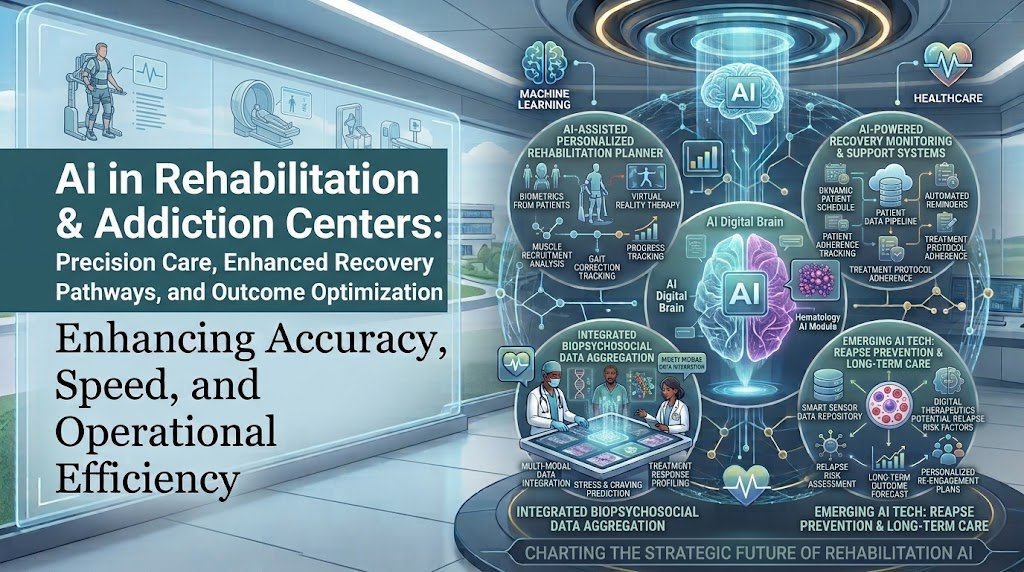
Primary topic: AI in Rehabilitation & Addiction Centers
Research focus: Artificial intelligence, machine learning, robotics, computer vision, digital therapeutics, predictive analytics, remote monitoring, addiction treatment, relapse prediction, personalized rehabilitation, clinical workflow automation, patient engagement, and responsible AI deployment.
Why AI Matters for Rehabilitation & Addiction Centers
Rehabilitation and addiction treatment are unusually suitable for AI because both depend on repeated observations over time. A single clinical assessment may provide only a snapshot, while recovery is influenced by behavior, adherence, physical performance, psychological state, social conditions, medication use, sleep, environment, and changing patient goals.
A rehabilitation center may already generate data from therapy sessions, wearable sensors, exercise repetitions, gait measurements, pain scores, range-of-motion assessments, functional tests, and electronic health records. Addiction centers can generate information from treatment attendance, medication adherence, counseling notes, screening instruments, toxicology results, telehealth sessions, patient-reported outcomes, social determinants, previous treatment history, and recovery-support interactions.
AI can connect these signals and turn them into actionable information.
AI converts clinical observations, movement data, questionnaires, images, audio, and patient-reported information into structured assessments.
Models can estimate risk of poor adherence, treatment dropout, functional decline, or relapse.
AI can help clinicians adjust exercise intensity, reminders, education, monitoring, and follow-up.
Continuous data can reveal changes between appointments rather than waiting for the next scheduled visit.
Research evidence: A large living systematic mapping review identified 240 studies applying AI for rehabilitation. Neurological rehabilitation accounted for 57.9% of studies and orthopedic rehabilitation for 22.7%. AI was used across intervention, prognosis, assessment, diagnosis, and monitoring, but only 5.8% of studies used external validation and only 10.2% reported explainability. This shows both the scale of the opportunity and the major evidence gap that healthcare startups must solve.
Source: PubMed: Artificial intelligence in rehabilitation: a living systematic mapping review
AI in Physical Rehabilitation
AI-supported rehabilitation is broader than robotic therapy. It includes computer vision, wearable sensors, smartphone applications, digital exercise platforms, robotic systems, speech analysis, predictive models, virtual reality, and remote rehabilitation.
The most valuable systems continuously compare what the patient is doing with what the treatment plan expects.
AI Movement and Exercise Assessment
Computer vision can estimate body position and movement from cameras or mobile devices. A rehabilitation platform can potentially analyze whether a patient is performing an exercise correctly, identify asymmetry, detect reduced range of motion, and provide immediate feedback.
This can be particularly useful when patients perform prescribed exercises at home. Instead of simply recording whether an exercise was completed, an AI system can analyze movement quality.
Potential capabilities include:
- Joint-angle estimation.
- Posture assessment.
- Movement symmetry analysis.
- Repetition counting.
- Exercise technique detection.
- Compensation-pattern identification.
- Range-of-motion tracking.
- Progress comparison across sessions.
The important distinction is between activity tracking and clinical interpretation. Counting repetitions is relatively straightforward. Determining whether a movement is clinically appropriate requires validated models, context, and professional oversight.
AI for Gait and Walking Rehabilitation
Gait rehabilitation is one of the strongest AI opportunities because walking produces measurable signals. Cameras, inertial measurement units, pressure sensors, force plates, smartphones, and robotic systems can generate information about cadence, stride length, balance, symmetry, and walking speed.
AI can help therapists identify changes that are difficult to quantify consistently during every session.
Patient walks → Sensors / Camera → Movement data → AI analysis → Functional metrics → Therapist review → Personalized intervention → Repeat measurement
Research evidence: A 2025 systematic review and meta-analysis included 23 randomized controlled trials involving 907 people after stroke. Combining robot-assisted gait training with conventional rehabilitation significantly improved gait function, gait speed, balance, and activities of daily living. The study also found differences based on robotic system characteristics and patient stage.
Source: PubMed: Effectiveness of Robot-Assisted Gait Training in Stroke Rehabilitation
Another 2026 overview covering 13 systematic reviews and 101 RCTs found that robotic gait training combined with physiotherapy improved walking speed, particularly with end-effector devices. However, evidence certainty varied substantially, with only one included review judged to have high certainty.
Source: PubMed: Gait Training Using Robotic Devices in Subjects With Stroke
AI for Upper-Limb Rehabilitation
Upper-limb rehabilitation can use AI to evaluate reaching, grasping, arm trajectory, coordination, repetition quality, and functional movement.
Robotic devices can provide repeated movements while sensors measure performance. AI can then adjust resistance, assistance, repetition targets, or difficulty according to patient performance.
A useful architecture is:
Research evidence: A 2025 systematic review and meta-analysis of upper-limb robotic rehabilitation after stroke evaluated randomized studies and examined how device features and program parameters influence outcomes. This supports the concept of robotic systems as an adjunct to conventional therapy rather than a universal replacement for therapist-led care.
Source: PubMed: Upper limb robotic rehabilitation following stroke
AI for Musculoskeletal Rehabilitation
Musculoskeletal rehabilitation creates another large opportunity because treatment frequently involves measurable pain, range of motion, strength, functional ability, and exercise adherence.
AI-assisted systems can combine patient-reported pain with movement and exercise information to understand whether a patient is improving, plateauing, or struggling with the prescribed program.
Potential applications include:
- Back and neck rehabilitation.
- Knee rehabilitation.
- Shoulder rehabilitation.
- Post-operative recovery.
- Sports injury rehabilitation.
- Arthritis management.
- Chronic pain rehabilitation.
- Home exercise monitoring.
Research evidence: A 2025 network meta-analysis evaluated 33 randomized controlled trials covering 13 AI-assisted rehabilitation strategies for musculoskeletal disorders. The strategies included AI feedback systems, exergaming, telerehabilitation, and robotic approaches, with outcomes covering pain, functional performance, and range of motion.
Source: PubMed: Effectiveness of AI-assisted rehabilitation for musculoskeletal disorders
AI in Neurorehabilitation
Neurorehabilitation is particularly suited to AI because neurological recovery can involve complex patterns across movement, cognition, speech, balance, swallowing, and behavior.
AI can combine several signals instead of treating each measurement independently.
- Movement: camera, IMU, robotics and motion sensors.
- Speech: voice recordings and speech-performance features.
- Cognition: digital cognitive assessments.
- Physiology: heart rate, sleep and activity patterns.
- Patient report: pain, fatigue, mood and perceived function.
- Clinical data: diagnosis, medication, therapy history and outcomes.
A multimodal system can produce a longitudinal recovery profile instead of a single score.
Research evidence: A 2026 systematic review of digital and intelligent rehabilitation technologies in stroke and neurological disorders identified improvements reported across motor function, balance, gait, swallowing, cognition, and psychosocial outcomes. The review also emphasized methodological heterogeneity, limited long-term follow-up, and inconsistent AI transparency.
Source: PubMed: Digital and Intelligent Rehabilitation Technologies in Stroke and Neurological Disorders
AI for Remote Rehabilitation
Remote rehabilitation can extend the center beyond its physical building.
A patient can perform exercises at home while an application collects movement, adherence, pain, and functional data. The clinical team can then focus attention on patients whose data indicate a meaningful change.
This creates a new model:
A 2023 systematic review identified 28 clinical AI rehabilitation projects spanning apps, robotic devices, gaming systems, and wearables. The authors found only five RCTs and reported inconsistent clinical effects, while highlighting improved access, remote monitoring, reduced manpower requirements, and potentially lower cost as important implementation advantages.
Source: PubMed: Artificial intelligence in physical rehabilitation
AI for Rehabilitation Adherence
One of the biggest operational problems in rehabilitation is not always the quality of therapy. It is whether patients continue the program.
AI can detect patterns such as:
- Repeated missed sessions.
- Declining home-exercise activity.
- Reduced exercise intensity.
- Increasing pain reports.
- Repeated unsuccessful exercises.
- Long gaps between sessions.
- Reduced engagement with the application.
The system can then trigger an appropriate workflow.
For example, a low-risk patient might receive an automated reminder, while a patient showing repeated deterioration could be routed to a therapist.
The goal should be early intervention, not automated punishment or discharge.
AI in Addiction Treatment and Recovery Centers
Addiction treatment presents a different but highly important AI opportunity.
Substance use disorders are chronic, heterogeneous, and influenced by clinical, psychological, behavioral, environmental, and social factors. Treatment outcomes can vary significantly between individuals.
This means a treatment center may benefit from systems that understand risk dynamically instead of relying only on an initial assessment.
Research evidence: A 2025 systematic review of machine learning for SUD treatment outcomes identified 28 studies from an initial pool of 362 articles. Studies covered opioids, cocaine, alcohol and other substance-use conditions, with models predicting outcomes such as treatment adherence, relapse, and severity. However, the review found important problems involving methodological consistency, transparency, and external validation.
Source: PubMed: Machine Learning Algorithms on Substance-Use Disorders Treatment Outcomes
AI for Relapse Risk Prediction
Relapse prediction is one of the most attractive AI use cases in addiction treatment, but it must be handled carefully.
A model should not tell a clinician that a patient will relapse. It should identify a pattern associated with elevated risk and provide additional information for clinical assessment.
Possible prediction signals include:
- Previous treatment history.
- Medication adherence.
- Recent treatment discontinuation.
- Craving levels.
- Stress and sleep changes.
- Psychiatric comorbidity.
- Previous overdose.
- Housing instability.
- Employment instability.
- Social environment.
- Previous relapse patterns.
- Changes in engagement with treatment.
Research evidence: A 2026 systematic review specifically examining psychosocial factors in AI models found 15 eligible studies. Across different datasets, housing instability, psychiatric comorbidity, employment status, craving, stress, legal involvement, previous overdose, treatment history, medication adherence, and neighborhood disadvantage were among influential predictors of treatment dropout, discontinuation, overdose risk, relapse, or poor engagement.
Source: PubMed: Integrating Psychosocial Factors into AI Models for Predicting Addiction Treatment Outcomes
This is important because an addiction AI system built only from medical records may miss some of the strongest contextual signals.
AI for Opioid Use Disorder
Opioid use disorder is an important area for predictive analytics because healthcare systems generate large amounts of relevant longitudinal information.
AI models can potentially help identify people at elevated risk for opioid-use disorder, treatment discontinuation, overdose, or poor follow-up.
A systematic review of machine learning models predicting opioid use disorder from healthcare data analyzed 16 studies. Most reported ROC AUC values above 0.80, but the authors also highlighted limited reporting, weak transparency, and limited availability of source code.
Source: PubMed: Machine learning for predicting opioid use disorder from healthcare data
This demonstrates an important principle for healthcare startups: a high model score does not automatically mean a clinically deployable product.
A production system needs external validation, calibration, monitoring, interpretability, workflow integration, privacy controls, and evidence that clinicians can actually use the output.
AI for Treatment Dropout Prediction
Treatment dropout is another high-value opportunity.
An addiction center can create an AI-supported risk model that evaluates whether a patient may disengage from treatment.
- Patient completes intake.
- EHR and treatment history are analyzed.
- Attendance and engagement data are continuously updated.
- AI calculates a risk score.
- Important contributing factors are shown to the care team.
- Clinician reviews the risk.
- Patient receives an appropriate intervention.
- Outcome is recorded for future model evaluation.
Possible interventions may include counselor outreach, transportation support, appointment changes, telehealth options, medication review, peer support, or additional psychosocial support.
The key is that the AI prediction should trigger help, not exclusion.
AI and Digital Therapeutics for Addiction Recovery
Digital therapeutics can provide structured behavioral support between clinical sessions.
They may include evidence-based educational content, craving-management exercises, reminders, personalized feedback, peer or clinician communication, and recovery tracking.
A 2026 review of digital therapies for SUD found that several applications showed efficacy in reducing substance use or supporting abstinence, particularly when they included evidence-based therapy content, personalized feedback, craving-management tools, and connection to peer or clinician support. The review also identified user engagement as a major challenge.
Source: PubMed: Digital Therapies for Substance Use Disorders
This creates an important product opportunity.
An addiction app should not simply send daily notifications. It should become part of a larger care pathway.
AI Chatbots and Recovery Support
Generative AI can support low-risk administrative and educational interactions, but addiction-related conversations require stronger safeguards than ordinary customer-service chatbots.
Appropriate applications may include:
- Appointment preparation.
- General treatment education.
- Medication information routing.
- Recovery-resource navigation.
- Daily check-in collection.
- Craving or stress check-ins.
- Escalation to human support.
- Administrative questions.
High-risk autonomous functions should not be delegated to a general-purpose chatbot.
The system should recognize crisis-related language, overdose concerns, self-harm signals, severe withdrawal concerns, and other emergency indicators and follow a predefined escalation pathway.
Remote Addiction Treatment and Telehealth
AI becomes more useful when combined with telehealth because it can help clinicians manage patients between scheduled appointments.
SAMHSA’s 2025 National Survey on Drug Use and Health estimated that 7.6 million people aged 12 or older received substance-use treatment during the previous year. The same survey estimated that 3.6 million people received substance-use treatment through telehealth, while among people with an SUD, 5.7% received treatment through telehealth.
Source: SAMHSA: 2025 National Survey on Drug Use and Health
HHS also maintains a dedicated best-practice guide for telehealth treatment of substance use disorder, covering treatment strategy, billing, medications for opioid use disorder, individual therapy, and group therapy.
Source: HHS Telehealth for Substance Use Disorder
Evidence for Remote and Digital Addiction Care
A 2025 systematic review and meta-analysis identified 34 RCTs involving 6,461 participants and 42 remote interventions for alcohol and drug treatment and recovery support.
When remote interventions supplemented in-person care, relapse odds were 39% lower than with in-person care alone in the analyzed studies. However, more than 70% of outcomes were judged to have high risk of bias, so the findings should not be treated as proof that every digital intervention will work equally well.
Source: PubMed: Remote and/or digital interventions for alcohol and drug treatment
This suggests a practical strategy for addiction centers: use digital and AI systems to strengthen human treatment rather than assuming technology can replace it.
AI for Personalized Rehabilitation Plans
Traditional rehabilitation plans often use standardized protocols adjusted by clinicians.
AI can support a more dynamic approach.
Diagnosis, functional status, pain, mobility, goals and risk factors.
Movement, adherence, exercise performance, fatigue and patient feedback.
Trend detection, progression assessment and risk identification.
Therapist reviews the recommendation and adjusts treatment.
This creates a closed-loop rehabilitation system where therapy is continuously informed by new evidence.
AI for Clinical Documentation
Rehabilitation and addiction professionals spend substantial time documenting sessions.
Generative AI can assist with:
- Session-note drafting.
- Progress summaries.
- Treatment-plan summaries.
- Patient education materials.
- Discharge summaries.
- Referral documentation.
- Appointment and follow-up summaries.
The safest architecture is AI drafts, clinician verifies, EHR stores.
The model should not silently introduce clinical facts that were not present in the original documentation.
AI for Therapist and Counselor Workload
AI can help prioritize the workload of rehabilitation and addiction teams.
Instead of treating every patient as having the same monitoring requirement, a center could create a risk-based worklist.
A therapist might receive a list of patients with declining mobility.
An addiction counselor might receive a list of patients with repeated missed sessions and increasing risk indicators.
The AI should organize attention rather than make the final clinical decision.
AI for Patient Engagement
Engagement is central to both rehabilitation and addiction recovery.
A useful AI engagement system can personalize the communication channel rather than sending the same message to every patient.
For example:
- A patient who repeatedly forgets appointments may receive reminders.
- A patient struggling with exercise technique may receive a video explanation.
- A patient reporting increased pain may receive a therapist-review prompt.
- A patient with declining addiction-treatment engagement may receive human outreach.
- A patient doing well may receive reinforcement rather than unnecessary alerts.
This reduces alert fatigue and makes digital engagement more relevant.
AI Architecture for Rehabilitation & Addiction Centers
A production-grade platform should be designed as a healthcare data system rather than a standalone AI chatbot.
Data sources
EHR / EMR • Therapy systems • Wearables • Cameras • Mobile apps • Patient questionnaires • Medication records • Attendance • Telehealth • Laboratory data
↓
Integration layer
FHIR APIs • HL7 interfaces • Secure APIs • Identity management • Consent management
↓
Data platform
Clinical data warehouse • Time-series data • Patient-reported outcomes • Feature store • Audit logs
↓
AI layer
Computer vision • Predictive ML • NLP • Generative AI • Risk models • Recommendation systems
↓
Clinical intelligence
Progress score • Adherence risk • Relapse risk • Therapist alerts • Patient recommendations • Documentation assistance
↓
Human oversight
Therapist • Physician • Psychologist • Counselor • Pharmacist • Care coordinator
AI Capability Map
| Capability | Rehabilitation | Addiction Care | Human Review |
|---|---|---|---|
| Computer Vision | Movement and exercise analysis | Potential behavioral/environmental signals | Required for clinical interpretation |
| Predictive ML | Progress and adherence risk | Relapse, dropout and engagement risk | Required |
| Generative AI | Documentation and education | Low-risk support and navigation | Required for clinical content |
| Wearables | Mobility and activity | Activity and recovery signals | Required |
High-Value AI Use Cases
- Remote rehabilitation monitoring
- Exercise-quality analysis
- Therapy progress tracking
- Documentation assistance
- Treatment dropout detection
- Gait analysis
- Relapse-risk support
- Adherence prediction
- Patient engagement
- Care-team prioritization
- Multimodal recovery models
- Digital phenotyping
- Adaptive robotics
- AI coaching
- Predictive care pathways
High-Risk AI Use Cases
AI should receive additional governance when it influences:
- Diagnosis of substance-use or psychiatric conditions.
- Medication decisions.
- Withdrawal management.
- Overdose-risk decisions.
- Emergency triage.
- Discharge decisions.
- Restriction of treatment access.
- Clinical decisions based on inferred emotional state.
- Autonomous treatment-plan changes.
The higher the potential harm, the stronger the human oversight and validation requirements should be.
AI Maturity Model for Rehabilitation & Addiction Centers
| Stage | Capability | Typical Examples |
|---|---|---|
| 1 | Digitization | EHR, digital scheduling, digital notes |
| 2 | Automation | Reminders, intake workflows, documentation assistance |
| 3 | Predictive AI | Adherence, dropout and progress prediction |
| 4 | Adaptive Care | Personalized therapy and dynamic monitoring |
| 5 | Intelligent Care Network | Multimodal AI, remote monitoring, robotics and continuous clinical intelligence |
AI Governance and Safety
The biggest mistake would be to treat healthcare AI as an ordinary software feature.
Rehabilitation and addiction data can be highly sensitive. Addiction-related information can also carry stigma, employment consequences, legal concerns, insurance implications, and social risks.
WHO emphasizes that AI for health must place ethics and human rights at the center of design, deployment, and use. Its guidance highlights risks involving bias, privacy, accountability, inappropriate use, and inequitable access.
Source: WHO: Ethics and governance of artificial intelligence for health
WHO’s 2026 responsible-AI knowledge community also identified fragmented and biased datasets, governance gaps, unclear accountability, and AI-literacy deficits as important barriers, while emphasizing strong governance, patient and clinician co-design, transparency, and equitable access.
Source: WHO Europe: Report of the Knowledge Community on responsible AI in health
Core Governance Controls
- Clear intended use.
- Documented model limitations.
- Clinical validation.
- External validation where appropriate.
- Bias and subgroup testing.
- Human oversight.
- Audit logs.
- Data minimization.
- Access controls.
- Model-performance monitoring.
- Drift detection.
- Incident-response procedures.
- Patient transparency.
AI Validation Is More Important Than AI Accuracy Claims
A model can achieve impressive performance in a research dataset and still fail after deployment.
This is particularly important in rehabilitation because patient populations vary by age, diagnosis, mobility level, device, environment, and treatment protocol.
It is equally important in addiction care because social and behavioral patterns can differ between communities.
The rehabilitation mapping review found external validation in only 5.8% of studies and explainability in only 10.2%. These numbers demonstrate why healthcare AI companies should treat validation as a core product capability rather than a final-stage marketing exercise.
Source: PubMed rehabilitation AI mapping review
Regulatory Considerations
If an AI system influences diagnosis, treatment, monitoring, or other regulated medical-device functions, the regulatory pathway needs to be considered from the beginning.
The FDA describes AI/ML medical-device development as requiring careful management throughout the product life cycle. In January 2025, the FDA published draft guidance addressing lifecycle management and marketing submission recommendations for AI-enabled device software functions.
Source: FDA: Artificial Intelligence in Software as a Medical Device
The FDA also maintains an AI-enabled medical-device list that identifies devices authorized for marketing in the United States and provides transparency into the existing regulatory landscape.
Source: FDA: AI-Enabled Medical Devices
For startups, this means the product architecture should separate low-risk wellness or administrative features from clinical functions that may require additional evidence and regulatory review.
Legacy Modernization for Rehabilitation & Addiction Centers
Many centers do not need to replace their existing EHR or practice-management system.
A better strategy is to create an AI layer around existing systems.
This approach reduces migration risk and allows organizations to modernize gradually.
Priority integrations may include:
- EHR and EMR systems.
- Scheduling platforms.
- Billing systems.
- Patient portals.
- Wearable devices.
- Therapy equipment.
- Telehealth platforms.
- Laboratory systems.
- Medication-management systems.
Startup Opportunities
Healthcare startups can build specialized products instead of trying to create one universal AI platform.
| Startup Opportunity | Primary Customer | AI Technology | Potential Value |
|---|---|---|---|
| AI Exercise Coach | Rehabilitation centers | Computer vision | Remote therapy monitoring |
| Gait Intelligence Platform | Neurorehabilitation centers | Computer vision + ML | Objective mobility tracking |
| Recovery Risk Engine | Addiction centers | Predictive ML | Early intervention |
| AI Recovery Assistant | SUD programs | Generative AI + workflow rules | Engagement and navigation |
| Therapist Copilot | Rehabilitation providers | NLP + GenAI | Documentation efficiency |
| AI Care Dashboard | Multi-site providers | Analytics + ML | Population management |
Recommended Implementation Roadmap
Phase 1: Digitize and Integrate
Start with clean data rather than advanced AI.
- Connect EHR and scheduling data.
- Standardize patient identifiers.
- Define outcome measures.
- Establish consent and access controls.
- Create baseline operational dashboards.
Phase 2: Automate Low-Risk Work
Introduce AI where failure has limited clinical consequences.
- Documentation assistance.
- Appointment reminders.
- Patient education.
- Administrative summarization.
- Non-clinical workflow routing.
Phase 3: Add Predictive Intelligence
Once enough quality data exists, introduce carefully validated predictive models.
- Rehabilitation dropout risk.
- Therapy adherence.
- Functional deterioration.
- Addiction treatment disengagement.
- Relapse-risk support.
Phase 4: Continuous and Adaptive Care
The organization can then integrate wearables, computer vision, telehealth, digital therapeutics, robotics, and multimodal AI.
At this stage, the objective is not simply to automate individual tasks. The goal is to create an intelligent recovery ecosystem that continuously learns from patient outcomes while remaining under clinical governance.
Key KPIs for AI Deployment
AI projects should be evaluated using clinical, operational, patient, and safety metrics.
- Functional improvement
- Recovery progression
- Relapse-related outcomes
- Adverse events
- Clinician time saved
- Documentation time
- Appointment adherence
- Workload distribution
- Engagement
- Satisfaction
- Access
- Retention
- False positives
- False negatives
- Bias
- Model drift
2027–2030 Outlook
The next stage of healthcare AI in rehabilitation and addiction care is likely to move from isolated tools toward connected care systems.
Rehabilitation will increasingly combine computer vision, wearable sensors, robotics, remote monitoring, and adaptive software. Addiction treatment will increasingly combine predictive analytics, telehealth, digital therapeutics, patient-reported data, and longitudinal risk monitoring.
The strongest systems will likely share several characteristics:
- Multimodal patient data rather than one isolated data source.
- Continuous monitoring rather than occasional assessment.
- Personalized interventions rather than one-size-fits-all pathways.
- Human-in-the-loop decision-making.
- Explainable risk signals.
- Strong interoperability.
- Outcome-based evaluation.
- Built-in privacy and governance.
The rehabilitation evidence base is growing rapidly, but current research still has major limitations around external validation, explainability, comparators, and long-term clinical outcomes. Addiction AI research has similar challenges, particularly around methodological consistency, transparency, and generalizability.
Therefore, the competitive advantage will not simply belong to the company with the largest AI model.
It will belong to the organization that can connect high-quality healthcare data, clinically meaningful workflows, validated AI, human expertise, and measurable patient outcomes.
Final Perspective
AI can fundamentally change how rehabilitation and addiction centers understand recovery.
For rehabilitation, the technology can transform therapy from periodic observation into continuous measurement. Computer vision, wearables, robotics, and predictive analytics can help therapists see movement quality, adherence, progression, and deterioration with greater consistency.
For addiction treatment, AI can help identify patterns associated with disengagement, relapse risk, craving, overdose risk, and treatment response. Digital therapeutics and telehealth can extend support beyond the treatment facility, while predictive systems can help clinicians decide where additional human attention may be most valuable.
The most responsible strategy is not to create an autonomous AI therapist.
It is to create an intelligent clinical support layer that makes therapists, physicians, counselors, psychologists, and care teams more informed and more responsive.
For healthcare startups, the largest opportunities are therefore concentrated around AI-assisted rehabilitation, computer-vision therapy monitoring, gait intelligence, personalized recovery platforms, treatment adherence prediction, addiction-risk analytics, digital therapeutics, clinical documentation copilots, remote monitoring, and multimodal care intelligence.
The central product principle should remain simple: AI should help healthcare professionals understand patients better, intervene earlier, personalize care, and measure whether the intervention actually works.
Original Research Sources
- Artificial intelligence in rehabilitation: a living systematic mapping review
- Artificial intelligence in physical rehabilitation: A systematic review
- AI in Physical, Occupational and Neuro-Rehabilitation: Clinical Effectiveness and Prognostic Performance
- Effectiveness of Robot-Assisted Gait Training in Stroke Rehabilitation
- Gait Training Using Robotic Devices in Subjects With Stroke
- Upper limb robotic rehabilitation following stroke
- Effectiveness of AI-assisted rehabilitation for musculoskeletal disorders
- Digital and Intelligent Rehabilitation Technologies in Stroke and Neurological Disorders
- Machine Learning Algorithms on Substance-Use Disorders Treatment Outcomes
- Psychosocial Factors in AI Models for Addiction Treatment Outcomes
- Machine Learning for Predicting Opioid Use Disorder from Healthcare Data
- Digital Therapies for Substance Use Disorders
- Remote and/or Digital Interventions for Alcohol and Drug Treatment and Recovery Support
- SAMHSA 2025 National Survey on Drug Use and Health
- HHS Telehealth for Substance Use Disorder
- SAMHSA Telehealth for Serious Mental Illness and Substance Use Disorders
- WHO Ethics and Governance of Artificial Intelligence for Health
- WHO Europe Report of the Knowledge Community on Responsible AI in Health
- FDA Artificial Intelligence in Software as a Medical Device
- FDA Artificial Intelligence-Enabled Medical Devices

Leave a Reply