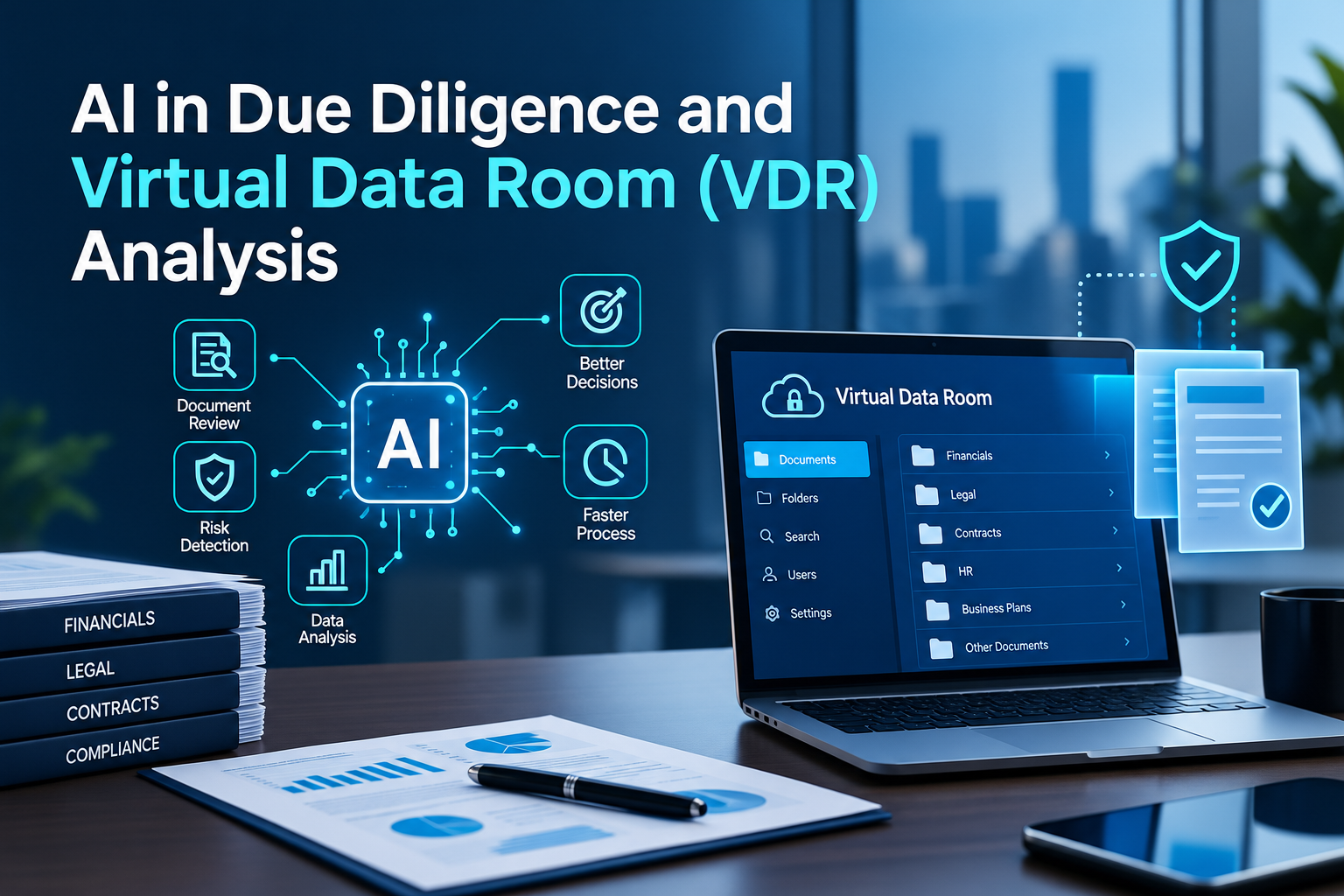
Primary topic: AI in Due Diligence and Virtual Data Room (VDR) Analysis
Research focus: AI-powered document review, VDR intelligence, financial and legal due diligence, risk detection, data extraction, anomaly detection, deal intelligence, governance, and the future of M&A technology.
Why AI Matters in Due Diligence
Due diligence has traditionally depended on teams of analysts, accountants, lawyers, consultants, and investment professionals reviewing large amounts of information under strict deadlines. The problem is not simply the amount of data. The deeper challenge is that important evidence is spread across different document types, systems, spreadsheets, emails, contracts, presentations, reports, and databases.
An acquisition team may need to answer questions such as whether revenue is sustainable, whether major customers can leave, whether contracts contain change-of-control clauses, whether liabilities have been properly disclosed, whether intellectual property is owned by the target, and whether reported financial performance is consistent with the underlying records. These questions require information to be connected across documents rather than simply summarized one file at a time.
AI changes this workflow by adding a reasoning and retrieval layer on top of the VDR. Instead of asking analysts to manually locate every relevant document, an AI system can search the data room using natural-language questions, retrieve supporting evidence, compare related documents, flag inconsistencies, and produce a structured list of issues for human review.
McKinsey notes that modern GenAI tools can access virtual data rooms, search and organize thousands of diligence files, analyze financial information, answer common diligence questions, and enrich findings with public and proprietary information. McKinsey also expects diligence to become increasingly continuous and connected across the deal lifecycle rather than remaining a one-time review immediately before signing.
Source: McKinsey: Gen AI in M&A
What an AI-Powered VDR Actually Does
A traditional VDR primarily provides secure document storage, permission management, audit trails, document sharing, and controlled access. An AI-enabled VDR adds an intelligence layer that can understand and organize the contents of those documents.
Documents → OCR & Parsing → Classification → Information Extraction → Cross-Document Linking → Risk Detection → AI Questions → Human Validation → Due Diligence Report → Deal Decision
The most useful capabilities include:
- Document classification: Automatically identify contracts, financial statements, employment agreements, tax documents, leases, IP records, insurance documents, and other categories.
- Information extraction: Extract dates, values, obligations, counterparties, renewal terms, liabilities, ownership information, customer concentrations, and other structured facts.
- Contract analysis: Search for termination rights, change-of-control provisions, exclusivity clauses, indemnities, unusual liabilities, and other transaction-sensitive terms.
- Financial analysis: Connect financial statements, management reports, customer revenue, accounts receivable, budgets, and supporting documents.
- Gap detection: Identify requested diligence items that have not been uploaded or appear incomplete.
- Contradiction detection: Compare information across multiple documents and highlight conflicting figures, dates, ownership claims, or contractual terms.
- Natural-language search: Allow deal teams to ask questions such as “Which customers account for more than 10% of revenue?” or “Show contracts with change-of-control restrictions.”
- Evidence-linked summaries: Produce findings that point back to the underlying source document rather than presenting unsupported AI conclusions.
Research Evidence: What Studies Tell Us
Study 1: Deloitte’s 2025 GenAI in M&A Study
Deloitte surveyed 1,000 senior corporate and private-equity leaders in the first half of 2025. The study found that 86% of responding organizations had integrated GenAI into their M&A workflows, while 65% had integrated it within the previous year.
The research also showed that adoption was concentrated in activities close to the core deal process. Forty percent of adopters were using GenAI for M&A strategy and market assessment, while 35% were using it for target identification and screening and another 35% for due diligence.
The important point is that AI adoption is not limited to experimentation. Deal teams are already incorporating GenAI into workflows where large quantities of information must be processed quickly. At the same time, Deloitte reported that data security and data quality remain major concerns. Sixty-seven percent of respondents identified data security as a leading concern and 65% identified data quality and availability.
For VDR technology, this suggests that document intelligence cannot be separated from information governance. A powerful model is not enough if documents are incomplete, incorrectly classified, poorly structured, or exposed to inappropriate systems.
Source: Deloitte 2025 GenAI in M&A Study
Study 2: DealRoom and M&A Science State of AI in M&A 2026
The 2026 State of AI in M&A report surveyed 237 responses from 233 M&A practitioners between November 2025 and July 2026. The report found that 82% of deal teams were either already using or piloting AI.
Due diligence represented 25% of current AI use, making it one of the two most common application areas alongside sourcing and target research. The expected future impact is even stronger: respondents identified due diligence as the area where AI would have the greatest impact over the following 12 to 24 months, at 26%.
The survey also provides an important warning. Data privacy and security were cited by 26% of respondents as an adoption barrier, integration by 20%, and lack of trust in AI outputs by 19%. Cost was only 6%.
This changes how AI VDR projects should be designed. The main challenge is not simply buying an AI tool. Deal teams need secure integration, evidence-backed outputs, access controls, auditability, and a workflow that allows professionals to verify AI findings.
Source: DealRoom and M&A Science: State of AI in M&A 2026
Study 3: A 2025 Study of GenAI in M&A Due Diligence
A 2025 master’s research study from Aalto University examined how GenAI is being used in M&A due diligence through nine semi-structured interviews with professionals involved in M&A advisory and consulting.
The study found that GenAI was primarily being used for supporting documentation activities such as report structuring, proposal drafting, and summarization. It was not yet widely used for core financial analysis or risk evaluation because of concerns about hallucinations, privacy, and transparency.
This finding is especially relevant for VDR analysis. It suggests that organizations should separate low-risk assistance from high-risk decision-making. AI can be highly useful for finding and organizing evidence, but the final interpretation of material financial, legal, tax, or commercial risks should remain subject to professional validation.
The study also found that adoption varied between organizations and could depend heavily on individual initiative rather than systematic integration. That means successful AI implementation requires operating-model changes, not just access to an AI chatbot.
Source: Aalto University: The Disruption of Due Diligence
Study 4: Automated Due Diligence and Machine Learning Document Extraction
Research published in the Journal of Property Investment & Finance examined automated due diligence using 8,339 digital documents from 14 properties and 21 technical due diligence reports.
Researchers identified 410 document classes and assessed how suitable the documents were for machine-readable processing. The study found that document availability and content varied significantly between owners and document categories. A substantial portion of documents were poorly suited for automated extraction.
This is one of the most important findings for AI VDR development because it demonstrates that the quality of the document environment directly affects automation. A system cannot reliably analyze information that is missing, unreadable, poorly categorized, duplicated, or inconsistent.
The research also identified an important opportunity: documents can be prioritized according to relevance and machine readability, allowing AI systems to focus attention on high-value material and automatically identify gaps in the diligence package.
Source: Fundamentals for Automating Due Diligence Processes in Property Transactions
Study 5: ContractEval and AI-Based Legal Risk Identification
ContractEval is a 2025 benchmark that evaluated four proprietary and 15 open-source large language models for clause-level legal risk identification using the Contract Understanding Atticus Dataset.
The researchers found that proprietary models generally outperformed open-source models in correctness and output effectiveness. Larger open-source models tended to perform better, although the gains became smaller as model size increased. The study also found that reasoning modes could improve output effectiveness while sometimes reducing correctness.
For M&A VDR analysis, this provides a practical lesson. Contract review should not be treated as a simple “ask an LLM to summarize this agreement” problem. A production system should identify the relevant clause, preserve its surrounding context, classify the risk, provide the original evidence, and allow a legal professional to confirm the interpretation.
A VDR system could therefore assign different confidence levels to findings and require human validation for high-impact clauses such as change-of-control provisions, termination rights, exclusivity, indemnification, intellectual property ownership, and material liability.
Source: ContractEval: Benchmarking LLMs for Clause-Level Legal Risk Identification
Study 6: Large-Scale Evidence on LLMs in Legal Document Analysis
A 2025 rapid evidence review examined 140 studies evaluating LLMs in legal settings. Legal analysis represented 44% of the identified use cases, with legal document analysis accounting for 47% of the legal-analysis studies.
The review found that legal document analysis commonly involved classification, information extraction, summarization, and information retrieval. It also highlighted significant concerns around hallucinations, bias, opaque reasoning, and the gap between benchmark performance and real-world professional environments.
This matters because M&A diligence is a high-stakes legal and financial environment. AI systems should therefore be evaluated using deal-specific tasks rather than generic language benchmarks. A model that produces fluent summaries is not necessarily reliable at identifying a hidden liability or correctly interpreting a contractual restriction.
Source: AI & Society: A Rapid Evidence Review of LLMs in Legal Use Cases
AI Due Diligence Evidence Dashboard
| Evidence | Key finding | Implication for VDR AI |
|---|---|---|
| Deloitte 2025 | 86% integrated GenAI into M&A workflows | Adoption is moving beyond experimentation |
| DealRoom 2026 | 82% using or piloting AI | Due diligence is a major AI use case |
| Aalto 2025 | Use remains stronger for documentation than core risk decisions | Human review remains important |
| Property diligence study | 8,339 documents analyzed; document quality varied | Data readiness is foundational |
| ContractEval | Model performance varies by system and task | Use benchmarked, task-specific models |
| Legal AI review | Hallucination and evaluation gaps remain | Evidence citations and validation are essential |
Where AI Creates the Most Value Inside a VDR
Document Classification and Data Room Organization
One of the first AI jobs should be organizing the data room. Instead of depending entirely on the folder structure created by the target company, AI can inspect document content and assign standardized categories.
This is valuable because transaction teams often receive documents in inconsistent formats and naming conventions. AI can identify whether a file is a customer agreement, supplier contract, employee document, financial statement, insurance policy, lease, tax document, litigation record, or intellectual property document.
A stronger system can also detect duplicates, outdated versions, missing attachments, and documents that appear to belong in another category.
Financial Due Diligence
Financial diligence can combine structured financial data with supporting documents. AI can compare reported revenue with customer-level information, analyze accounts receivable, identify unusual expense movements, examine working-capital trends, and locate supporting evidence for management claims.
AI can also help analysts ask questions across multiple years of financial information rather than manually searching individual spreadsheets.
However, financial analysis should use deterministic calculations wherever possible. The AI model should explain the result, while calculations should be performed by controlled financial logic or validated analytical software.
Legal Contract Review
Contract review is one of the clearest VDR applications because large acquisitions can involve thousands of agreements.
AI can identify:
- Change-of-control clauses.
- Termination rights.
- Renewal and expiration dates.
- Minimum purchase obligations.
- Exclusivity restrictions.
- Non-compete and non-solicitation provisions.
- Indemnification obligations.
- Unusual liability limits.
- Assignment restrictions.
- Customer and supplier concentration risks.
The important distinction is between finding a clause and deciding what that clause means for the transaction. AI is well suited to the first task. The second may require legal interpretation and professional judgment.
Commercial Due Diligence
Commercial diligence can combine VDR information with external market data. An AI system can connect customer contracts, revenue data, product information, sales pipelines, employee information, and public market information.
For example, the system could identify a customer contributing a large percentage of revenue and then automatically retrieve the relevant contract, renewal date, pricing terms, termination rights, and historical revenue.
This creates a much more useful picture than a simple summary of the customer agreement.
Tax and Regulatory Review
AI can identify tax documents, regulatory filings, licenses, permits, compliance records, and other evidence. It can also compare requested diligence checklists with the documents actually provided.
The system should flag potential issues for specialist review rather than automatically determining that a company is compliant or non-compliant.
Visual: AI Risk Detection Pipeline
PDFs, Excel, contracts, reports
OCR, classification, extraction
Entities, clauses, financial data
Gaps, anomalies, contradictions
Human review and evidence
AI-Powered VDR Architecture
↓
Document Ingestion + OCR
↓
Document Classification + Metadata
↓
Search Index + Vector Retrieval + Knowledge Graph
↓
Financial Models + Rules Engine + LLM Layer
↓
Risk Detection + Contradiction Detection + Question Answering
↓
Evidence-Cited Findings
↓
Human Review Workspace
↓
Diligence Report + Deal Decision
A production architecture should keep sensitive documents inside an approved environment and enforce role-based access. AI outputs should be connected to source documents so that reviewers can trace each material finding back to evidence.
This approach is also consistent with current thinking around data lineage and decision traceability. Thomson Reuters has argued that modern M&A processes need more granular data lineage, integration outcomes, and decision traceability than traditional virtual data rooms typically provide.
Source: Thomson Reuters Institute: M&A Data Rooms
From VDR to an Intelligent Deal Knowledge Base
The next stage of VDR development is not simply adding a chatbot. The more valuable architecture is a deal knowledge base that connects documents, entities, financial information, contracts, people, customers, suppliers, products, risks, and transaction questions.
For example, the system could connect:
This creates cross-document intelligence. A single document may not contain an obvious risk, but the relationship between several documents may reveal one.
AI for Missing Information and Contradictions
One of the most valuable capabilities of an intelligent VDR is identifying what is not present.
Traditional review often focuses on the files that have been provided. AI can compare the available information against a diligence checklist and expected relationships.
Examples include:
- A major customer appears in revenue data but its contract is missing.
- An employee appears on the payroll but the employment agreement is absent.
- A lease is referenced in a financial report but the underlying lease document is unavailable.
- A contract references an attachment that has not been uploaded.
- A financial figure differs between management reporting and another supporting document.
- A renewal date in a contract does not match the date entered into a transaction spreadsheet.
These capabilities can turn AI from a summarization tool into a quality-control layer for the transaction.
AI Risk Scoring for Due Diligence
A useful AI VDR can assign risk categories to findings, but the score should be treated as a prioritization mechanism rather than a final investment conclusion.
| Risk level | Typical finding | Recommended action |
|---|---|---|
| Critical | Major undisclosed liability or transaction restriction | Immediate specialist review |
| High | Material contract, customer, legal, or financial concern | Validate and quantify impact |
| Medium | Missing evidence or unusual contractual term | Request clarification |
| Low | Minor documentation inconsistency | Track and resolve during workflow |
Human-in-the-Loop Is Still Essential
The evidence does not support treating current GenAI systems as autonomous deal decision-makers. Research into legal AI continues to identify hallucination, evaluation, transparency, and context problems. The Aalto study also found that professionals were more comfortable using GenAI for documentation than for core financial analysis and risk evaluation.
A robust operating model should therefore divide work between AI and humans.
- AI: Search, classification, extraction, comparison, summarization, anomaly detection, and evidence organization.
- Analysts: Validate financial findings, investigate anomalies, and quantify commercial impact.
- Lawyers: Interpret material legal risks and contractual consequences.
- Tax specialists: Validate tax exposures and regulatory issues.
- Deal leaders: Decide how findings affect valuation, negotiation, structure, and transaction strategy.
An expert quotation from the 2026 Virtual Due Diligence research by Balan and colleagues captures this direction: “AI augments, not replaces, human judgment in M&A.”
Source: Virtual Due Diligence: How Generative AI is changing Deal Readiness
Key Risks of AI in VDR Analysis
AI may produce an incorrect interpretation or unsupported conclusion.
Sensitive transaction information requires strict access and processing controls.
Missing documents can produce incomplete conclusions.
A clause can change meaning depending on definitions and related provisions.
Training data and system design can affect outputs.
Deal teams need to know why a finding was generated and which evidence supports it.
What a Production-Ready AI VDR Should Include
| Capability | Purpose | Priority |
|---|---|---|
| Secure document ingestion | Bring PDFs, spreadsheets and other files into controlled processing | Essential |
| OCR and document parsing | Convert unstructured files into machine-readable information | Essential |
| Semantic search | Find evidence using natural-language questions | Essential |
| Evidence citations | Trace AI findings to original documents | Essential |
| Contract intelligence | Identify important legal terms and restrictions | High |
| Financial analytics | Connect financial data and supporting evidence | High |
| Gap detection | Identify missing or incomplete diligence information | High |
| Audit trail | Record users, actions, AI outputs and evidence | Essential |
AI VDR Maturity Model
Secure document storage
AI search and summarization
Extraction and risk detection
Cross-document intelligence
Continuous deal intelligence
At Level 1, the VDR is mainly a secure repository. At Level 2, users can search and summarize documents using AI. Level 3 introduces structured extraction and risk detection. Level 4 connects information across documents and systems. Level 5 creates a continuous intelligence layer that can support target screening, diligence, valuation, negotiation, and post-close integration.
AI and Legacy M&A Systems
Many organizations already use VDRs, CRM systems, ERP platforms, financial models, contract management software, business intelligence tools, and document management systems. Replacing everything is usually unnecessary.
A better modernization strategy is to create an AI intelligence layer that connects approved systems through APIs and controlled data pipelines.
↓
Integration & Data Governance Layer
↓
AI Search + Retrieval + Analytics + Risk Engine
↓
M&A Intelligence Workspace
This allows organizations to modernize gradually while keeping existing transaction infrastructure.
Startup Opportunities in AI Due Diligence
The market creates opportunities for startups building focused AI products rather than generic chatbots.
Potential products include:
- AI-powered VDR copilots for private-equity teams.
- Automated contract risk scanners.
- AI customer concentration analysis.
- Financial quality-of-earnings assistants.
- Automated diligence checklist and gap detection systems.
- AI-powered regulatory and compliance diligence.
- Cross-document contradiction detection.
- Evidence-linked diligence report generation.
- AI-powered post-merger integration planning.
- Industry-specific diligence models for healthcare, SaaS, manufacturing, fintech, energy, and real estate.
The strongest products will likely combine retrieval, deterministic analytics, domain-specific rules, and LLMs rather than depending on an LLM alone.
Expert Recommendation
The most practical approach is to begin with evidence retrieval and organization, not autonomous deal decisions. Build the system so every AI-generated finding has a source document, page or section reference, confidence information, and an obvious path for human verification.
For organizations modernizing an existing VDR, the implementation should follow a staged approach:
| Phase | Focus | Expected output |
|---|---|---|
| 1 | Document readiness | Clean, classified and searchable data |
| 2 | AI search | Natural-language diligence questions |
| 3 | Extraction and detection | Structured findings and risk flags |
| 4 | Cross-document intelligence | Relationships and contradictions |
| 5 | Continuous intelligence | Deal-wide AI decision support |
The key design principle should be simple: AI should reduce the amount of information that humans need to manually process, not reduce the level of professional accountability.
Future Predictions: 2027–2030
2027: AI Becomes a Standard Diligence Assistant
By 2027, AI-assisted search, document classification, summarization, contract extraction, and diligence checklists are likely to become standard capabilities across many enterprise M&A workflows. The differentiation will increasingly shift from whether a VDR has AI to how securely and accurately that AI works.
2028: Cross-Document Reasoning Becomes More Important
AI systems will increasingly move from analyzing individual documents to connecting evidence across the entire transaction. Customer contracts, revenue, employee records, litigation, intellectual property, and operational data will increasingly be analyzed as connected information.
2029: Continuous Due Diligence
The concept of “diligence” is likely to move beyond a single transaction window. Companies preparing for future acquisitions may continuously monitor financial, legal, operational, customer, and market information so that a future transaction can begin with a much more prepared information environment.
2030: AI Deal Intelligence Platforms
The VDR may evolve into a broader deal intelligence platform connecting sourcing, target screening, diligence, valuation, negotiation, integration planning, and post-close performance tracking.
The important shift will be from document storage to transaction intelligence.
McKinsey has already described a future in which GenAI connects diligence insights with target screening and post-close integration and learns from previous transactions to inform future deals.
Source: McKinsey: Gen AI in M&A
Key KPIs for an AI Due Diligence Platform
| KPI | What it measures |
|---|---|
| Document processing time | How quickly new VDR content becomes searchable |
| Extraction accuracy | Correctness of extracted facts and clauses |
| Evidence coverage | Percentage of material findings linked to source evidence |
| False-positive rate | How often AI incorrectly flags a risk |
| Missing-document detection | Ability to identify incomplete diligence packages |
| Human review time | Time professionals spend validating AI findings |
| User adoption | Actual usage by deal professionals |
Frequently Asked Questions
What is AI-powered due diligence?
AI-powered due diligence uses machine learning, natural-language processing, retrieval systems, and generative AI to analyze large collections of transaction documents. It can classify documents, extract information, search for evidence, identify risks, detect inconsistencies, and help professionals prepare diligence reports.
How does AI improve a Virtual Data Room?
A traditional VDR mainly stores and protects documents. An AI-enabled VDR can understand those documents and allow users to search, compare, summarize, extract, and connect information across the entire data room.
Can AI replace M&A lawyers and financial analysts?
Current evidence supports AI as an augmentation tool rather than a replacement for professional judgment. AI can automate repetitive information-processing tasks, while lawyers, accountants, analysts, and deal leaders remain responsible for interpreting material findings and making transaction decisions.
Is it safe to upload confidential M&A documents to AI?
Confidential transaction data requires strict controls. Organizations should evaluate data residency, encryption, access controls, retention policies, vendor agreements, audit logging, model-training policies, and integration architecture before allowing sensitive documents to be processed.
What is the biggest limitation of AI VDR analysis?
Data quality is one of the biggest limitations. Missing, poorly scanned, duplicated, outdated, or contradictory documents can reduce the quality of AI outputs. Hallucination and incorrect interpretation are additional concerns, particularly for legal and financial decisions.
What should companies build first?
The strongest starting point is usually secure document ingestion, classification, semantic search, evidence extraction, and source-linked question answering. More advanced risk scoring and autonomous workflows should be introduced only after the underlying data and validation processes are reliable.
Final Perspective
AI is changing the role of the Virtual Data Room from a secure document repository into an intelligent transaction environment. The biggest opportunity is not simply faster summarization. It is the ability to connect thousands of documents and datasets into a searchable evidence layer that helps deal teams identify risks, gaps, contradictions, opportunities, and relationships that may be difficult to discover through manual review alone.
Research from Deloitte, DealRoom, Aalto University, legal-AI studies, and automated due diligence research points toward the same broad direction: adoption is increasing, due diligence is becoming one of the most important AI use cases, and organizations are looking for measurable improvements in speed and insight. At the same time, security, data quality, hallucination, transparency, integration, and human accountability remain central requirements.
The strongest AI due diligence systems will therefore not try to eliminate human review. They will make human review more focused. Instead of spending most of their time opening files, searching for clauses, copying figures, and preparing repetitive summaries, professionals can spend more time evaluating material risks, challenging assumptions, negotiating transaction terms, and deciding whether the evidence supports the deal thesis.
The future VDR is therefore likely to become more than a room for documents. It will become a continuously updated intelligence layer for the entire M&A lifecycle.
Research Sources
- Deloitte 2025 GenAI in M&A Study
- DealRoom and M&A Science: State of AI in M&A 2026
- Aalto University: The Disruption of Due Diligence
- Fundamentals for Automating Due Diligence Processes in Property Transactions
- ContractEval: Benchmarking LLMs for Clause-Level Legal Risk Identification
- AI & Society: Rapid Evidence Review of LLMs in Legal Use Cases
- Virtual Due Diligence: How Generative AI is Changing Deal Readiness
- McKinsey: Gen AI in M&A
- Thomson Reuters Institute: M&A Data Rooms
Leave a Reply