
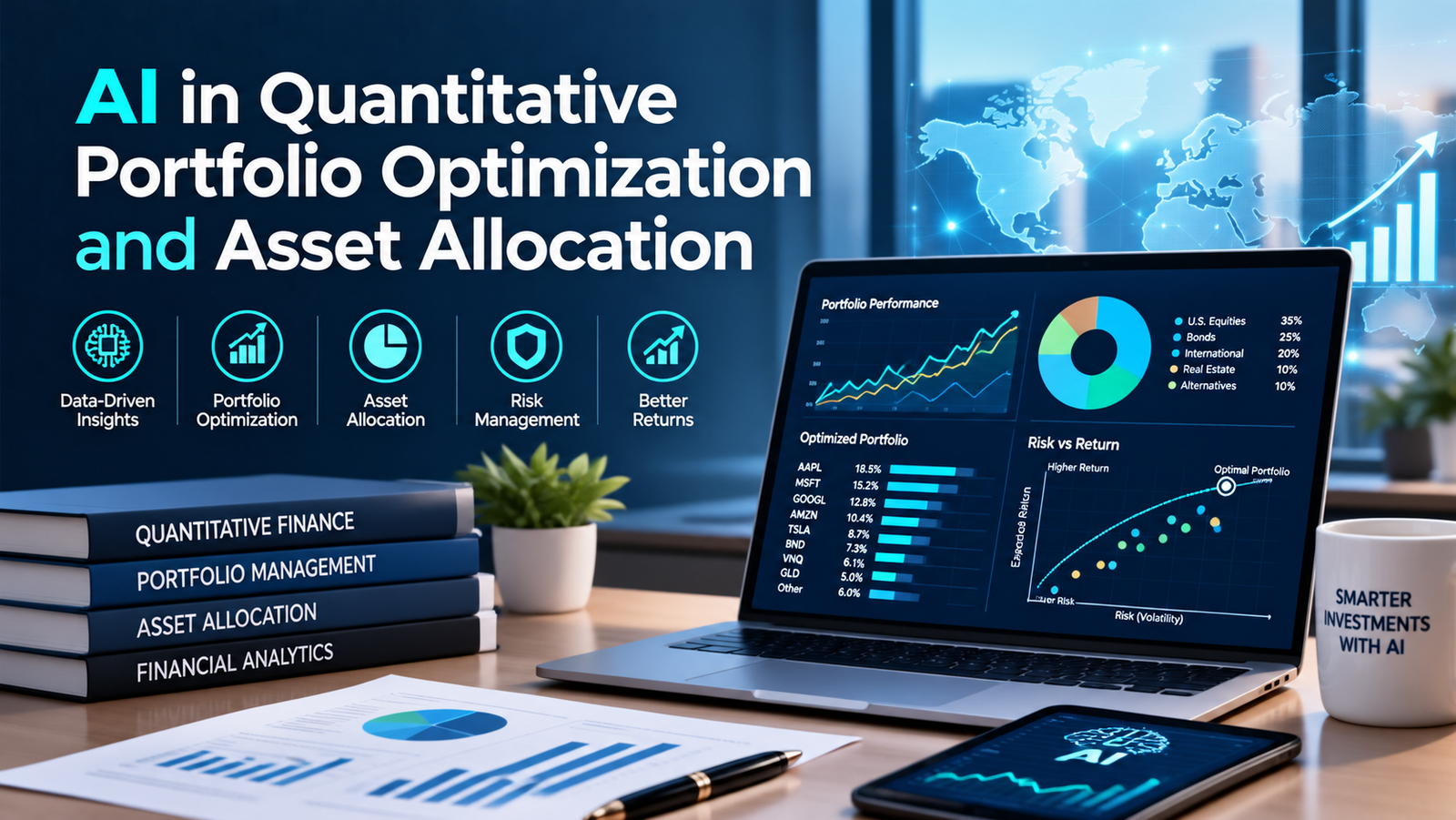
Primary topic: AI in Quantitative Portfolio Optimization and Asset Allocation
Research focus: Machine learning, deep learning, reinforcement learning, portfolio optimization, asset allocation, risk-return optimization, Black-Litterman models, dynamic rebalancing, market regimes, transaction costs, behavioral finance, multi-asset portfolios, AI portfolio managers, governance, and the future of intelligent investment systems.
What Is AI in Quantitative Portfolio Optimization?
Quantitative portfolio optimization is the process of deciding how much capital should be allocated to different assets while balancing objectives such as expected return, volatility, drawdown, liquidity, diversification, and investment constraints. Traditional portfolio theory provides mathematical frameworks for this problem, but many of its inputs are difficult to estimate accurately because financial markets are noisy, dynamic, and influenced by changing economic conditions.
AI adds another layer to the process. Instead of relying only on historical averages and predefined relationships, machine-learning systems can process large amounts of market, macroeconomic, fundamental, sentiment, and alternative data. The resulting predictions can then be passed into an optimization engine that determines portfolio weights.
This distinction is important. AI does not have to replace quantitative finance. In many practical systems, AI works best as an intelligence layer that improves the inputs to a conventional optimization framework.
Traditional Portfolio Optimization vs AI-Enhanced Optimization
| Area | Traditional approach | AI-enhanced approach |
|---|---|---|
| Return estimation | Historical estimates and factor models | ML, deep learning and alternative-data signals |
| Risk estimation | Variance, covariance and factor risk | Dynamic risk models and regime-aware prediction |
| Allocation | Optimization based on predefined objectives | Optimization informed by learned signals and policies |
| Rebalancing | Fixed schedule or threshold rules | Adaptive rebalancing based on market conditions |
| Data | Prices, returns and fundamentals | Prices, fundamentals, macro, news, sentiment and alternative data |
| Adaptation | Mostly rule-based | Potentially dynamic and regime-aware |
Why Portfolio Optimization Is Difficult
The mathematical optimization problem can look simple, but its inputs are uncertain. An optimizer may produce precise portfolio weights even when the expected returns, correlations, and risk estimates entering the calculation are inaccurate.
This is one of the central problems AI is trying to address. Instead of assuming that historical relationships will remain stable, AI systems can continuously update their understanding of the market.
- Expected returns are uncertain: small forecasting errors can produce large allocation changes.
- Correlations change: assets that normally diversify one another can become highly correlated during market stress.
- Market regimes change: relationships observed during low-volatility markets may not hold during crises.
- Transaction costs matter: frequent rebalancing can reduce net returns.
- Portfolio constraints matter: real investors face liquidity, leverage, concentration, turnover, regulatory, and mandate restrictions.
- Historical data is limited: many market events occur too rarely to provide large training samples.
Research Study: Systematic Review of Reinforcement Learning for Automated Equity Portfolio Management
A major systematic review published in 2026 examined reinforcement learning for automated equity portfolio management, covering the evolution from single-agent systems toward multi-agent approaches.
The review is important because reinforcement learning has become one of the most researched AI approaches for portfolio management. Instead of predicting a single future price, an RL agent learns a sequence of allocation decisions based on a reward function. That reward can incorporate return, risk, transaction costs, drawdown, or other portfolio objectives.
The review also highlights an important direction for future systems: moving beyond isolated single-agent portfolio models toward multi-agent architectures that can represent different strategies, market participants, or specialized decision functions.
This suggests that future portfolio-management systems may not rely on one AI model. They may instead combine several agents, with one handling allocation, another monitoring risk, another detecting market regimes, and another controlling transaction costs.
Research source: Systematic review of reinforcement learning for automated equity portfolio management from single agent to multi agent systems — Springer Nature, 2026
Research Study: AI-Enhanced Black-Litterman Portfolio Optimization
A 2026 study in Research in International Business and Finance examined an AI-powered Black-Litterman framework that generates investor views using deep-learning forecasts from technical and sentiment data.
The researchers used three information sets: technical data, sentiment data from MarketPsych Analytics, and a combined technical-plus-sentiment dataset. These AI-generated views were then incorporated into the Black-Litterman framework instead of relying entirely on manually specified investor opinions.
The study tested daily-rebalanced portfolios across different market regimes while accounting for transaction costs and different levels of risk aversion. Its results reported that the combined technical-and-sentiment framework produced stronger performance than the individual information sets and traditional benchmarks in the study’s experimental setting.
The significance of this work is architectural. Black-Litterman does not have to be discarded when AI is introduced. AI can generate more data-driven views, while the optimization framework continues to provide portfolio structure and risk control.
Research source: Bridging behavioral insights and quantitative finance: AI-powered Black-Litterman framework with technical and sentiment signals — ScienceDirect, 2026
Research Study: Deep Reinforcement Learning With High-Frequency Data
A 2023 study published in Information Processing & Management investigated online portfolio management using deep reinforcement learning and high-frequency data.
The researchers proposed an architecture called LSRE-CAAN that combines a long-sequence representation extractor with a cross-asset attention network. The objective was to deal with long sequences and relationships between multiple assets without directly suffering from the computational limitations of conventional Transformer architectures.
The study evaluated the framework using four cryptocurrency datasets. The authors reported that the proposed method outperformed traditional and state-of-the-art online portfolio strategies in their experiments. The paper also reported a six-fold return on the best dataset and lower volatility and maximum-drawdown measures than many comparison strategies.
These results should not be interpreted as evidence that AI will reliably produce six-fold investment returns in real markets. Cryptocurrency data is highly volatile, the study is experimental, and historical backtesting does not guarantee future results. The more useful finding is that attention-based deep learning can combine long historical sequences and cross-asset information for portfolio decisions.
Research source: Online portfolio management via deep reinforcement learning with high-frequency data — Information Processing & Management
Research Study: Behavioral Biases in AI Portfolio Optimization
A 2026 Scientific Reports study explored a different problem: investor behavior. The researchers developed a behaviorally informed deep reinforcement-learning framework that incorporates loss aversion and overconfidence into an actor-critic architecture.
This is interesting because traditional quantitative optimization often assumes that the decision-maker follows a mathematical objective without psychological biases. Real investors, however, can react differently to gains and losses and may change their position sizing when they become overconfident.
The study introduced regime-dependent bias thresholds that affect position sizing while allowing the reinforcement-learning policy to determine trading direction.
The broader implication is that future portfolio AI may incorporate behavioral information rather than assuming that investors are perfectly rational. This could be especially useful for wealth-management systems where the goal is not only mathematical optimization but also keeping portfolios aligned with actual investor behavior and risk tolerance.
Research source: Behaviorally informed deep reinforcement learning for portfolio optimization with loss aversion and overconfidence — Scientific Reports, 2026
Research Study: Dynamic Portfolio Optimization Using Deep Reinforcement Learning
A 2026 open-access study examined a multi-asset deep reinforcement-learning framework for dynamic portfolio optimization. The researchers compared the DRL framework with traditional mean-variance and Black-Litterman approaches across market data including U.S. and Hong Kong markets.
The central argument of the study is that static optimization can struggle when financial conditions change rapidly. A dynamic RL system can repeatedly observe the market state, select portfolio actions, receive feedback, and adjust future decisions.
This creates a decision loop rather than a one-time optimization exercise.
Dynamic AI Portfolio Loop
↓
Observe market state
↓
Estimate return and risk conditions
↓
Select portfolio action
↓
Apply allocation constraints
↓
Execute rebalance
↓
Measure outcome
↓
Update policy
↓
Observe next market state
The research supports the broader move toward adaptive portfolio systems, although performance remains dependent on data quality, model design, transaction costs, and the market environment used for evaluation.
Research source: Dynamic Optimization Strategy of Financial Portfolios Using Deep Reinforcement Learning-Based Neural Networks — 2026
Research Study: Deep Transformer Q-Learning for Portfolio Optimization
A 2026 study in Applied Soft Computing examined a deep Transformer Q-learning framework for cryptocurrency portfolio optimization. The research compared Transformer, LSTM, and artificial neural-network approaches using the same dataset and included a crisis period in the evaluation.
The authors reported that the Transformer-based approach produced stronger Sharpe-ratio results than the compared LSTM, ANN, and market approaches in their experiments.
The reason Transformers are attractive for portfolio optimization is their ability to represent long-range dependencies. Financial decisions often depend on information distributed across many previous observations rather than one isolated price movement.
However, Transformer models can also be computationally expensive and highly sensitive to training design. A larger model is not automatically a better portfolio model.
Research source: Deep transformer Q-learning based reinforcement learning for portfolio optimization of cryptocurrencies — Applied Soft Computing, 2026
Research Study: Memory-Augmented Reinforcement Learning and Transaction Costs
A September 2026 study examined portfolio optimization using a memory-augmented Soft Actor-Critic architecture with recurrent networks and an explicit path-dependent transaction-cost model.
The research is particularly relevant because transaction costs are often one of the biggest differences between academic backtests and real portfolio management. A model may appear attractive when it can trade freely, but frequent portfolio changes can consume a large portion of the expected return.
The study evaluated a recurrent SAC model against memoryless SAC, recurrent PPO, Transformer, and classical investment strategies using multi-asset data covering 2014–2024. The authors reported more stable convergence for their LSTM-SAC architecture across the tested market regimes.
The important lesson is that portfolio AI should optimize net outcomes, not simply predicted returns. Turnover, trading costs, liquidity, and the path taken by the portfolio all matter.
Research source: Memory-augmented deep reinforcement learning framework for portfolio optimization with path-dependent transaction costs — 2026
Research Evidence Dashboard
Major expansion of RL portfolio-management research
Emerging direction beyond single-agent portfolio systems
AI can generate data-driven portfolio views
Used for long-range financial sequence representation
Increasingly included directly in AI portfolio research
How AI Changes the Portfolio Optimization Pipeline
A conventional optimizer requires estimates of expected returns, covariance, risk preferences, and investment constraints. AI can operate before and around this optimization step.
Prices, fundamentals, macro, news, sentiment
Returns, volatility, regimes
Weights, risk and constraints
Rebalancing and transaction costs
Risk, drift and performance
AI for Expected Return Forecasting
Expected return is one of the most difficult inputs in portfolio optimization. Small errors can cause a mathematical optimizer to allocate too much capital to an asset whose expected return was overestimated.
Machine learning can combine multiple predictive variables instead of relying on a small number of manually selected factors. Depending on the strategy, these may include price momentum, volatility, earnings information, macroeconomic indicators, news sentiment, analyst revisions, market breadth, and alternative data.
The goal should not simply be to maximize forecasting accuracy. A prediction that improves statistical accuracy but produces unstable portfolio weights may not improve the final investment outcome.
AI for Risk Forecasting
Portfolio risk is not constant. Volatility and correlations can change quickly, especially during market stress.
AI can help estimate dynamic volatility, identify unusual correlation structures, classify market regimes, and forecast changes in risk. These predictions can then influence portfolio weights.
- Reduce exposure when predicted volatility rises.
- Increase diversification when correlations become concentrated.
- Limit positions in assets with deteriorating liquidity.
- Adjust risk budgets when market regimes change.
- Increase monitoring when model uncertainty becomes unusually high.
AI and Black-Litterman Portfolio Construction
The Black-Litterman framework is particularly interesting for AI because it already provides a mechanism for incorporating investor views into a structured portfolio allocation process.
AI can generate those views from data. For example, a model might estimate that an asset has a higher expected return than its equilibrium expectation. Instead of allowing the AI system to directly determine the entire portfolio, the predicted view can enter a Black-Litterman framework where confidence, risk, and diversification are still considered.
AI-Enhanced Black-Litterman Workflow
Market + Fundamental + Sentiment Data
↓
AI Forecast
↓
Expected Return View
↓
Confidence Estimate
↓
Black-Litterman Portfolio
↓
Risk & Constraint Checks
↓
Final Allocation
This hybrid approach can provide more transparency than allowing a black-box model to directly output portfolio weights.
AI for Dynamic Asset Allocation
Asset allocation is broader than stock selection. The portfolio may contain equities, fixed income, commodities, currencies, real estate, cash, and alternative investments.
AI can help identify changing relationships between these asset classes and adjust allocations accordingly. A regime-aware system might behave differently during expansion, inflation, recession, liquidity stress, or unusually high volatility.
| Market condition | Potential AI response | Important control |
|---|---|---|
| Low volatility | Normal allocation and monitoring | Avoid excessive risk expansion |
| Rising volatility | Reduce risk budgets or increase diversification | Prevent forced selling |
| Liquidity stress | Reduce turnover and illiquid positions | Liquidity constraints |
| Strong trend | Evaluate momentum and factor exposure | Avoid concentration |
| Regime uncertainty | Reduce model confidence | Use conservative allocation limits |
AI for Portfolio Rebalancing
Rebalancing determines when a portfolio should move back toward target weights. A fixed monthly or quarterly schedule is simple, but it may cause unnecessary trading or fail to respond quickly to significant changes.
AI can estimate whether the expected benefit of rebalancing is large enough to justify the transaction cost. This creates a more economically meaningful decision: rebalance only when the expected improvement exceeds the estimated cost and risk.
- Expected portfolio improvement.
- Transaction costs.
- Market liquidity.
- Tax implications where applicable.
- Portfolio drift.
- Risk concentration.
- Forecast confidence.
AI and Transaction Costs
Transaction costs are one of the most important considerations in quantitative portfolio management. A model that continuously changes portfolio weights can generate attractive gross returns but disappointing net returns.
This is why recent research increasingly incorporates transaction costs directly into the learning environment. The September 2026 memory-augmented DRL study is a clear example of this trend.
For practical systems, transaction costs should include more than a simple fixed commission assumption.
- Brokerage costs.
- Bid-ask spreads.
- Market impact.
- Slippage.
- Liquidity constraints.
- Taxes or duties where applicable.
- Execution timing.
AI and Portfolio Diversification
AI can identify relationships among assets that traditional correlation matrices may not fully capture. However, this creates a paradox. A model may identify assets that historically appear diversified while those assets become highly correlated during a crisis.
Portfolio AI should therefore evaluate diversification dynamically rather than treating historical correlation as permanent.
Alternative Data and AI Portfolio Management
AI makes it easier to process information that traditional quantitative systems may struggle to incorporate at scale.
- News and financial media.
- Investor sentiment.
- Company filings.
- Earnings-call transcripts.
- Analyst revisions.
- Macroeconomic releases.
- Social-media signals.
- Satellite and geospatial data where legally and economically appropriate.
- Supply-chain indicators.
The challenge is that alternative data can introduce noise, data-snooping risk, licensing restrictions, and unstable relationships. More data does not automatically mean more predictive information.
Generative AI in Portfolio Management
Generative AI has a different role from numerical portfolio models. Large language models are particularly useful for processing unstructured information and supporting investment workflows.
- Summarizing earnings calls.
- Extracting information from filings.
- Comparing company guidance.
- Organizing research notes.
- Generating investment research drafts.
- Explaining portfolio changes.
- Creating client-facing portfolio reports.
- Supporting investment analysts.
Generative AI should not automatically be trusted to produce portfolio weights without independent quantitative validation. Its strongest role is likely to be as a research and communication layer around more controlled quantitative systems.
Current Industry Direction
The financial industry is already moving toward AI-supported investment workflows. In September 2026, Anthropic announced a financial-advisor-focused version of Claude designed to connect with investment analytics and wealth-management software. The product is positioned around research, portfolio-review preparation, meeting preparation, documentation, and related advisor workflows rather than unrestricted autonomous trading.
This direction supports an important distinction: AI adoption in investment management is broader than automated trading. AI can improve research, portfolio analysis, client communication, risk monitoring, and operational workflows even when final investment decisions remain under human control.
Current industry reporting: Reuters — Anthropic targets financial advisers with new Claude tool, September 2026
Portfolio AI Architecture
Data Layer
- Market data
- Fundamentals
- Macro data
- Sentiment
AI Intelligence
- Return forecasts
- Risk forecasts
- Regime detection
- Sentiment analysis
Optimization
- Portfolio weights
- Risk budgets
- Constraints
- Diversification
Execution
- Rebalancing
- Transaction costs
- Liquidity
- Slippage
Governance
- Risk monitoring
- Model validation
- Drift detection
- Audit trail
AI Portfolio Optimization: Human-in-the-Loop Model
For institutional investment management, a human-in-the-loop architecture can provide a practical balance between automation and governance.
Market & Portfolio Data
↓
AI Forecasting Layer
↓
Portfolio Optimization Engine
↓
Risk & Compliance Checks
↓
Human Investment Committee / Portfolio Manager
↓
Approved Allocation
↓
Execution & Monitoring
This structure is particularly useful when investment mandates impose constraints that cannot be safely delegated to an unconstrained machine-learning policy.
Major Risks of AI Portfolio Optimization
| Risk | Why it matters | Recommended control |
|---|---|---|
| Overfitting | Model learns historical noise | Strict out-of-sample validation |
| Regime change | Historical relationships stop working | Regime monitoring |
| Concentration | AI may favor correlated assets | Hard concentration limits |
| Turnover | Frequent decisions increase costs | Cost-aware optimization |
| Black-box decisions | Difficult to explain portfolio changes | Explainability and model documentation |
| Data leakage | Future information can contaminate training | Time-aware data pipelines |
| Model correlation | Different strategies may react similarly | Strategy diversification |
Why Portfolio AI Needs Explainability
Portfolio managers need to understand why an AI system changed an allocation. A model that says “reduce equities by 8%” without explaining the relevant drivers creates governance problems.
Explainability does not necessarily mean revealing every mathematical operation inside a neural network. A practical system can provide a decision summary such as:
- Expected return forecast changed.
- Volatility forecast increased.
- Cross-asset correlation increased.
- Market regime probability changed.
- Portfolio concentration exceeded the target range.
- Transaction cost exceeded the expected benefit of rebalancing.
This makes the AI decision easier for portfolio managers and risk teams to challenge.
AI Portfolio Optimization Maturity Model
Traditional quantitative optimization
ML-based return and risk forecasts
Dynamic AI-assisted allocation
Deep RL and adaptive rebalancing
Multi-agent autonomous portfolio system
High-Value AI Use Cases in Portfolio Management
| Use case | AI opportunity | Main challenge |
|---|---|---|
| Return forecasting | Identify nonlinear signals | Overfitting |
| Risk forecasting | Detect changing volatility and regimes | Rare events |
| Asset allocation | Dynamic allocation decisions | Model instability |
| Rebalancing | Cost-aware timing | Transaction costs |
| Sentiment analysis | Convert unstructured information into signals | Noise and bias |
| Portfolio monitoring | Detect abnormal risk conditions | False alarms |
Expert Recommendation
The strongest approach for financial institutions is not to replace established portfolio theory with an unconstrained AI model. AI should be used where it adds measurable value and should operate inside a controlled portfolio framework.
- Keep portfolio constraints explicit: diversification, liquidity, concentration, leverage, and risk limits should not disappear simply because AI is being used.
- Use AI primarily for uncertain inputs: return forecasts, volatility, sentiment, regime classification, and nonlinear relationships are natural areas for machine learning.
- Use optimization for final allocation: an optimization engine can convert AI predictions into portfolios while enforcing investment constraints.
- Model transaction costs directly: portfolio decisions should be evaluated using expected net outcomes rather than gross returns.
- Use multiple models: ensemble and multi-agent systems can reduce dependence on one model or one market assumption.
- Validate across regimes: bull, bear, sideways, high-volatility, low-volatility, and crisis periods should be tested separately.
- Maintain human governance: portfolio managers and risk teams should be able to understand, challenge, override, and disable AI decisions.
- Monitor model drift: a model should be treated as a continuously monitored production system, not a finished research project.
Recommended AI Portfolio Architecture
Data Intelligence
- Market data
- Fundamentals
- Macro data
- Sentiment
Prediction Layer
- Return forecasts
- Risk forecasts
- Regime detection
- Confidence estimates
Optimization Layer
- Mean-variance
- Black-Litterman
- CVaR
- Risk budgets
Execution Layer
- Rebalancing
- Liquidity
- Transaction costs
- Slippage
Governance Layer
- Risk limits
- Model validation
- Drift monitoring
- Audit trail
Implementation Roadmap
Foundation
- Define portfolio objectives.
- Document investment constraints.
- Build reliable historical datasets.
- Establish benchmark portfolios.
AI Research
- Test supervised ML forecasting.
- Evaluate regime detection.
- Test sentiment and alternative data.
- Compare AI predictions against simple quantitative baselines.
Optimization
- Integrate forecasts into portfolio optimization.
- Add transaction costs.
- Add liquidity constraints.
- Add concentration and risk limits.
Simulation
- Perform walk-forward testing.
- Run stress scenarios.
- Test different market regimes.
- Measure portfolio turnover and drawdown.
Controlled Deployment
- Begin with paper portfolios.
- Use limited exposure.
- Monitor live model performance.
- Maintain human approval for significant allocation changes.
Continuous Governance
- Monitor data drift.
- Monitor model drift.
- Revalidate after major market changes.
- Maintain independent risk controls.
Future Predictions for 2027–2030
AI Will Move From Prediction Toward Portfolio Decision-Making
Many current systems use AI mainly to forecast returns, volatility, or sentiment. The next stage is likely to involve models that learn portfolio decisions directly while still operating within explicit risk constraints.
Hybrid AI and Classical Optimization Will Become More Common
The evidence from AI-enhanced Black-Litterman research suggests a practical direction: AI can generate views while established optimization frameworks control how those views affect the final portfolio.
This hybrid architecture can provide a better balance between adaptability and governance than an unconstrained end-to-end model.
Multi-Agent Portfolio Systems Will Grow
Instead of asking one model to perform every task, future systems may contain specialized agents for return forecasting, risk analysis, asset allocation, rebalancing, tax-aware decisions, liquidity management, and compliance.
AI Will Become More Regime-Aware
Future portfolio systems are likely to place more emphasis on identifying when their historical assumptions may no longer apply. The ability to recognize uncertainty may become as important as the ability to identify opportunities.
Transaction-Cost-Aware AI Will Become Standard
Research is increasingly incorporating realistic transaction costs directly into portfolio learning. This trend should continue because gross backtest performance can be misleading when turnover is high.
Explainability Will Become a Portfolio Requirement
Institutional investors will increasingly need systems that can explain why an allocation changed, what data influenced the decision, how confident the model was, and what risk controls were applied.
Generative AI Will Become the Portfolio Research Interface
Generative AI is likely to become the conversational layer through which portfolio managers interact with investment data. A manager could ask why portfolio risk increased, which holdings contributed most to a change, or what assumptions are driving the current allocation.
The numerical optimization itself can remain inside controlled quantitative systems while the generative model handles research and communication.
Key KPIs for AI Portfolio Optimization
| Category | Important metrics |
|---|---|
| Return | Total return, excess return, alpha |
| Risk | Volatility, maximum drawdown, VaR, CVaR |
| Risk-adjusted performance | Sharpe ratio, Sortino ratio |
| Execution | Turnover, slippage, transaction costs |
| AI quality | Forecast accuracy, calibration, stability |
| Portfolio stability | Weight changes, concentration, diversification |
| Governance | Override frequency, model drift, incidents |
Frequently Asked Questions
What is AI in quantitative portfolio optimization?
It is the use of machine learning, deep learning, reinforcement learning, and related AI techniques to improve portfolio forecasting, asset allocation, risk management, rebalancing, or investment decision-making.
Can AI replace traditional portfolio optimization?
It can be used as an alternative in some research settings, but a hybrid approach is often more practical. AI can generate forecasts and portfolio signals while classical optimization enforces risk, diversification, liquidity, and investment constraints.
What is the role of reinforcement learning?
Reinforcement learning is useful for sequential allocation problems because the model repeatedly observes market conditions, selects portfolio actions, and receives feedback based on the resulting portfolio outcome.
Can AI guarantee higher portfolio returns?
No. Research results are usually based on particular datasets, periods, assumptions, and backtesting environments. Financial markets change, and historical performance does not guarantee future results.
Why are transaction costs important?
AI systems can make frequent allocation changes. Even when each decision appears profitable before costs, commissions, spreads, slippage, market impact, taxes, and other trading expenses can reduce or eliminate the benefit.
What data can AI use for portfolio management?
Depending on the strategy, AI can use market prices, trading volumes, fundamentals, macroeconomic indicators, company filings, earnings-call transcripts, news, sentiment, alternative data, and portfolio-level risk information.
What is the most practical AI portfolio architecture?
A controlled hybrid architecture is generally the most practical: AI forecasting and regime detection feed a portfolio optimizer, while explicit risk, liquidity, concentration, transaction-cost, and governance constraints control the final allocation.
Final Perspective
AI is creating a new generation of quantitative portfolio-management systems that can process more information, recognize nonlinear relationships, adapt to changing market conditions, and learn sequential allocation policies. The research landscape in 2026 shows particularly strong activity around deep reinforcement learning, Transformers, AI-enhanced Black-Litterman models, behavioral finance, dynamic rebalancing, and multi-agent portfolio management.
The most important development is not simply that AI can predict markets. Prediction is only one part of portfolio management. A successful investment system must translate uncertain predictions into controlled allocations while considering risk, diversification, liquidity, transaction costs, investor objectives, and changing market regimes.
The recent research also points toward a hybrid future. Classical portfolio optimization provides useful mathematical structure, while AI can improve the information entering that structure. Black-Litterman can incorporate AI-generated views. Reinforcement learning can optimize sequential decisions. Transformers can process long sequences. Behavioral models can represent investor-specific preferences. Generative AI can make complex portfolio information easier for investment professionals to understand.
At the same time, AI creates new risks. Overfitting, unstable relationships, model drift, excessive turnover, concentration, correlated strategies, data leakage, and black-box decisions can all damage portfolio performance. A sophisticated model can still produce a poorly diversified or economically unrealistic portfolio.
The strongest long-term architecture is therefore unlikely to be a completely unconstrained autonomous model. A more robust design combines AI intelligence, classical financial theory, explicit portfolio constraints, transaction-cost awareness, continuous validation, and human governance.
By 2030, portfolio-management systems are likely to become increasingly adaptive and multi-agent. Instead of one model producing a portfolio once a month, investment platforms may continuously evaluate market conditions, risk, sentiment, liquidity, and investor objectives and then determine whether a portfolio change is justified. The important competitive advantage will not simply be having the biggest AI model. It will be having better data, stronger validation, more realistic cost models, disciplined risk controls, and a reliable process for turning AI predictions into investable decisions.
Original Research & Sources
- Systematic review of reinforcement learning for automated equity portfolio management from single agent to multi agent systems — Discover Computing, 2026
- Bridging behavioral insights and quantitative finance: AI-powered Black-Litterman framework with technical and sentiment signals — Research in International Business and Finance, 2026
- Online portfolio management via deep reinforcement learning with high-frequency data — Information Processing & Management
- Behaviorally informed deep reinforcement learning for portfolio optimization with loss aversion and overconfidence — Scientific Reports, 2026
- Dynamic Optimization Strategy of Financial Portfolios Using Deep Reinforcement Learning-Based Neural Networks — 2026
- Deep transformer Q-learning based reinforcement learning for portfolio optimization of cryptocurrencies — Applied Soft Computing, 2026
- Memory-augmented deep reinforcement learning framework for portfolio optimization with path-dependent transaction costs — 2026
- DeepTrader: A Deep Reinforcement Learning Approach for Risk-Return Balanced Portfolio Management with Market Conditions Embedding — AAAI
- Reinforcement learning for deep portfolio optimization — Electronic Research Archive
- Dancing with markets: A dynamic rebalancing mechanism using deep reinforcement learning for online portfolio selection — Information Fusion, 2026
- Smart Tangency Portfolio: Deep Reinforcement Learning for Dynamic Rebalancing and Risk–Return Trade-Off
- Reuters — Anthropic targets financial advisers with new Claude tool, September 2026
Leave a Reply