
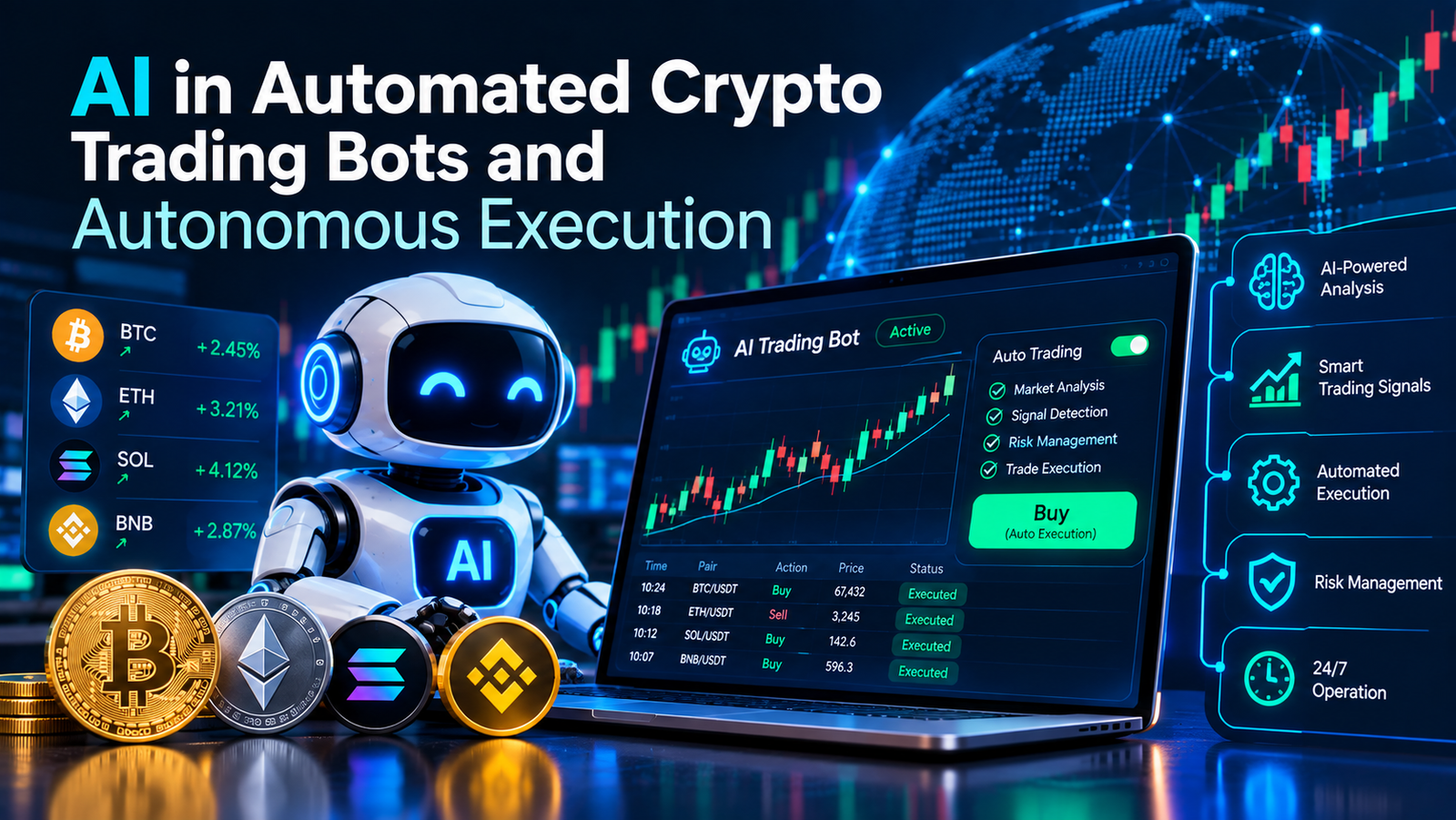
Primary topic: AI in Automated Crypto Trading Bots and Autonomous Execution
Research focus: AI-powered crypto trading bots, autonomous execution, reinforcement learning, LLM agents, market signals, portfolio decisions, order execution, risk controls, DeFi agents, transaction costs, model monitoring, human oversight, and the future of autonomous digital-asset trading.
What Are AI-Powered Automated Crypto Trading Bots?
Automated crypto trading bots are software systems that monitor markets and execute trading strategies without requiring a trader to manually place every order.
Traditional bots generally follow predefined rules.
For example:
- Buy when a moving average crosses above another moving average.
- Sell when a predefined stop-loss level is reached.
- Trade when price breaks a resistance level.
- Rebalance a portfolio at fixed intervals.
AI-powered bots can go further by learning patterns from historical and live data.
Instead of relying on one fixed rule, an AI system can estimate market conditions, rank opportunities, select strategies, adjust position sizes, and determine when trading should be reduced or stopped.
The architecture can therefore evolve from:
Rule → Signal → Order
to:
Data → Prediction → Market Regime → Strategy → Risk → Execution → Monitoring → Adaptation
This distinction matters because autonomous execution introduces another layer of risk. An AI model that makes a poor prediction is one problem. An AI system that can immediately convert that poor prediction into hundreds of real orders is a much larger operational problem.
Why Autonomous Crypto Trading Is Different
Cryptocurrency markets create an unusually attractive environment for automated systems because they operate continuously and generate large volumes of structured and unstructured information.
No traditional closing bell
Different exchanges and liquidity pools
Rapid changes in market conditions
Blockchain activity can be analyzed
News can quickly affect prices
These characteristics create opportunities for AI but also make autonomous execution difficult.
A model can encounter liquidity conditions that were not present in its training data. An exchange API can fail. An order can be partially filled. A market can move sharply between signal generation and execution. A blockchain transaction can remain pending. A smart contract can behave differently from what an agent expected.
Therefore, an autonomous crypto trading platform must be designed as a complete financial system, not simply as a machine-learning model connected to an exchange API.
How an Autonomous AI Crypto Trading System Works
↓
Data Validation & Normalization
↓
AI Market Analysis
↓
Signal & Opportunity Detection
↓
Strategy Selection
↓
Portfolio & Position Decision
↓
Risk Engine
↓
Execution Engine
↓
Exchange / DeFi Transaction
↓
Reconciliation & Monitoring
↓
Feedback & Controlled Adaptation
The most important point is that AI should not necessarily sit directly between the market and the exchange.
A safer architecture puts deterministic controls between the AI decision and the final transaction.
For example, an AI agent may recommend a $100,000 position, but the risk engine could reduce the permitted order to $20,000 because the portfolio already has significant exposure to the same market.
Research Study 1: 2026 Systematic Review of Machine Learning in Cryptocurrency Trading
A 2026 systematic review in Discover Artificial Intelligence examined machine-learning applications in cryptocurrency trading and their implications for fintech.
The research compared supervised machine learning with reinforcement learning and portfolio-based approaches.
The review specifically considered predictive performance, trading performance, risk management, and the broader implications for financial technology. It shows that research is moving away from treating AI only as a price-prediction tool and toward using AI for actual trading decisions and portfolio management.
This distinction is important for automated bots.
A prediction model might forecast that Bitcoin will rise, but an autonomous trading system still has to decide:
- Whether the expected move is large enough to trade
- How much capital should be allocated
- Which venue should receive the order
- How much slippage is acceptable
- Whether current volatility justifies trading
- When the position should be closed
The study therefore supports a broader architecture in which AI prediction is only one component of the trading system.
Research Study 2: Deep Reinforcement Learning for Automated Trading
A 2026 systematic review examined deep reinforcement learning for stock, portfolio, and cryptocurrency trading across research published from 2020 to 2025.
The review identifies a shift toward more adaptive models, including graph neural networks, Transformers, multimodal data fusion, and reinforcement-learning environments.
It also highlights methodological problems that are highly relevant to automated bots:
- Backtesting bias
- Incorrect data splitting
- Transaction-cost assumptions
- Overfitting
- Weak evaluation environments
This is especially important for autonomous execution because an AI agent can appear highly successful inside a simulated environment that does not accurately reproduce live market conditions.
A bot may assume that every order executes at the observed market price. In reality, the order may experience spread, slippage, partial fills, liquidity constraints, or execution delays.
The research therefore supports testing the entire decision and execution pipeline rather than evaluating only the AI model.
Research Study 3: Autonomous AI Traders in Experimental Markets
A 2026 study in the Journal of Economic Behavior & Organization examined an autonomous AI trader interacting with human participants in experimental asset markets.
The AI trader used machine-learning neural networks and operated autonomously rather than following a conventional hand-programmed trading algorithm.
The researchers found that the presence of the AI trader did not significantly change the level of market mispricing compared with markets containing human traders alone. However, human traders’ wealth declined significantly when the AI trader was present, while the AI trader consistently performed as the top performer in the experiment.
This study is particularly relevant because it moves beyond backtesting.
The AI was actually interacting with other market participants.
However, the experiment should not be interpreted as proof that autonomous AI bots will outperform live cryptocurrency markets. Experimental markets are not equivalent to global crypto markets, and one autonomous-agent design cannot represent the full range of real-world trading environments.
The broader lesson is that autonomous agents can behave strategically when they interact continuously with a market.
That makes execution governance increasingly important.
Research Study 4: LLM-Enhanced Reinforcement Learning
A 2026 survey examined 34 core studies on the integration of large language models with reinforcement learning in financial markets.
The authors categorize LLM use into three broad approaches:
The LLM converts text or contextual information into features used by another trading model.
The LLM supports parts of the reinforcement-learning workflow.
The LLM has a more direct role in decision-making or trading policy.
For crypto bots, LLMs can potentially process information that traditional numerical models struggle to interpret.
Examples include:
- Exchange announcements
- Regulatory developments
- Protocol upgrades
- Governance proposals
- Security incidents
- News reports
- Social-media narratives
- Project announcements
However, the survey also highlights concerns around reliability, interpretability, evaluation, and reproducibility.
This creates an important architectural principle.
An LLM can help an autonomous trading system understand information, but the final order should pass through deterministic validation.
For example:
LLM: “This announcement appears highly negative for the token.”
Risk engine: “Maximum exposure reduction allowed: 15%.”
Execution engine: “Sell only within approved liquidity and price limits.”
This separation reduces the possibility that a language-model error immediately becomes an uncontrolled financial transaction.
Research Study 5: Autonomous AI Agents in Decentralized Finance
A 2026 study in Technological Forecasting and Social Change analyzed the emergence of autonomous AI agents in decentralized finance.
The study mapped 306 AI agents across DeFi application areas and examined their roles in trading, governance, community activity, and other applications.
The research highlights the potential for AI agents to reduce transaction costs and reshape market structures, while also identifying risks involving opacity, misalignment, and centralization.
This is especially important for autonomous crypto execution because DeFi agents can potentially perform multi-step operations.
For example, an agent could:
↓
Identify an opportunity
↓
Evaluate expected yield / price impact
↓
Choose a protocol
↓
Execute a transaction
↓
Monitor the position
↓
Rebalance or exit
This is very different from a simple exchange bot.
The agent is not merely placing orders. It is interacting with a programmable financial environment.
That creates additional risks around smart contracts, wallet permissions, transaction simulation, gas costs, protocol failures, and unintended actions.
Research Study 6: Evidence Limits in AI Trading
A September 2026 state-of-the-art review examined AI across equity and crypto markets, including prediction, portfolio construction, execution, and agent-based systems.
Its central framework is an important one:
Information → Signal → Position → Executable Order → Risk-Adjusted Net Return.
The review finds that AI research shows meaningful progress in upstream activities such as prediction, text processing, portfolio design, and workflow integration, but evidence for durable net performance remains thinner.
It identifies several reasons why apparently successful AI trading strategies can fail in practice:
- Look-ahead contamination
- Repeated model selection
- Survivorship bias
- Weak benchmarks
- Transaction costs
- Venue-specific execution mechanics
- Capacity constraints
- Signal decay
For autonomous crypto bots, this is arguably the most important research lesson.
The objective should not be:
“Build the smartest trading model.”
It should be:
“Build a system that can demonstrate reliable net performance after realistic execution and risk assumptions.”
Research Evidence Dashboard
Mapped in a 2026 study of autonomous AI agents in DeFi.
Reviewed in research on LLM-enhanced reinforcement learning.
Period covered by a major DRL trading review.
Prediction alone does not establish profitable autonomous trading.
Strategic authority should remain separated from unrestricted model action.
Models must be tested across changing market conditions.
What Makes an AI Crypto Bot Truly Autonomous?
Not every automated trading bot should be described as an autonomous AI system.
There are several levels of automation.
| Level | System behavior | Autonomy |
|---|---|---|
| 1. Rule bot | Executes predefined rules | Low |
| 2. AI signal bot | AI generates signals; rules execute them | Low to medium |
| 3. Adaptive bot | AI changes strategy based on market conditions | Medium |
| 4. Autonomous trader | AI selects strategies, positions and execution actions | High |
| 5. Agentic DeFi system | AI plans and executes multi-step financial operations | Very high |
The higher the autonomy, the stronger the governance requirements should become.
AI Market Analysis Before Execution
A sophisticated bot can evaluate multiple data layers before creating an order.
| Data layer | Examples | Potential use |
|---|---|---|
| Market | Price, volume, volatility | Trend and momentum |
| Order book | Bid/ask depth, imbalance | Short-term execution conditions |
| Derivatives | Funding, open interest, liquidations | Leverage and positioning |
| On-chain | Wallets, transfers, flows | Blockchain behavior |
| Text | News, announcements, social data | Event and sentiment analysis |
The value of this architecture is not simply having more data.
More data can increase noise and overfitting.
The goal is to identify information that adds incremental value to the decision.
AI Strategy Selection
An autonomous bot does not necessarily need to use one strategy continuously.
AI can act as a strategy-selection layer.
For example:
Momentum / trend following
Mean reversion
Reduced exposure
Defensive mode
This can be more robust than assuming that one algorithm should trade every market environment.
Autonomous Position Sizing
The AI should not only determine whether an opportunity exists.
It should also estimate whether the opportunity is large enough to justify the associated risk.
Potential position-sizing inputs include:
- Expected return
- Prediction confidence
- Expected volatility
- Liquidity
- Portfolio concentration
- Correlation with existing positions
- Current drawdown
- Execution costs
A risk engine can then apply hard limits.
This is a critical difference between an autonomous decision system and unrestricted automation.
Autonomous Order Execution
Execution is where a prediction becomes a financial transaction.
The execution engine should evaluate:
- Current bid and ask
- Available liquidity
- Expected slippage
- Order size
- Market impact
- Exchange status
- API latency
- Partial-fill conditions
A sophisticated system may divide a large order into smaller transactions instead of sending the entire order at once.
The execution layer can also determine whether to use:
- Market orders
- Limit orders
- Post-only orders
- Time-based execution
- Liquidity-aware execution
- Multi-venue routing
This is why the execution engine should be deterministic even if the strategy engine is AI-driven.
AI and DeFi Autonomous Execution
DeFi expands the capabilities of autonomous crypto agents.
Instead of trading only on a centralized exchange, an agent could potentially interact with:
- Decentralized exchanges
- Lending protocols
- Liquidity pools
- Yield protocols
- Bridges
- On-chain derivatives
- Governance systems
This creates new opportunities but also introduces new failure modes.
An AI agent interacting with a smart contract needs to understand more than market price.
It may need to evaluate:
- Contract permissions
- Gas costs
- Liquidity depth
- Slippage
- Protocol risk
- Oracle dependencies
- Transaction confirmation
- Smart-contract upgrade mechanisms
An autonomous DeFi agent therefore needs transaction simulation and permission boundaries before it receives authority to move assets.
Critical Risk: AI Hallucination and Incorrect Decisions
LLMs can generate convincing but incorrect information.
This creates a special risk when a language model is connected to trading tools.
For example, an AI agent might incorrectly interpret:
- A regulatory announcement
- A token migration
- A protocol upgrade
- A market statistic
- A social-media post
If the error remains inside a research conversation, the damage may be limited.
If the same model has permission to execute trades, the error can become financial.
The architecture should therefore separate:
Reasoning → Authorization → Execution.
The model can recommend an action, but authorization should be independently validated.
Critical Risk: API and State Failures
Autonomous trading systems operate continuously.
The system may lose connection to an exchange while believing that an order was not executed.
This can produce a dangerous situation:
Internal state: No position.
Exchange state: Position already exists.
If the agent then places another order, exposure can unexpectedly double.
A production trading system therefore needs continuous reconciliation.
→
Order Submitted
→
Exchange Confirmation
→
Fill Verification
→
Portfolio Reconciliation
→
Updated State
If reconciliation fails, the system should be able to freeze new trading activity.
Critical Risk: Model Drift
Crypto markets are nonstationary.
The relationships learned by an AI model can change.
A model trained during a strong bull market may learn patterns that become ineffective during a prolonged bear market or liquidity crisis.
Model monitoring should therefore measure:
- Prediction accuracy
- Signal decay
- Profitability by market regime
- Drawdown
- Trade frequency
- Slippage
- Execution quality
- Feature distribution changes
A model should not automatically retrain and deploy itself without controls.
Automatic adaptation can itself become a source of risk.
Expert Recommendation
The strongest architecture for automated crypto trading is a controlled autonomy model.
The AI should have enough freedom to analyze markets and adapt strategies, but not unlimited authority over capital.
The development priorities should be:
- Separate intelligence from execution: Keep AI reasoning and deterministic order execution in separate layers.
- Use hard risk limits: Maximum position, leverage, drawdown, order size, and daily-loss limits should not be controlled solely by the AI.
- Build state reconciliation: The internal portfolio state must continuously match the actual exchange or blockchain state.
- Test realistic execution: Include spread, fees, slippage, latency, partial fills, and liquidity constraints.
- Use multiple market regimes: Test bull, bear, sideways, high-volatility, and liquidity-stress periods.
- Use staged autonomy: Start with research support, then signals, then paper trading, then limited capital, and only later consider greater autonomy.
- Keep emergency controls outside the model: A model should not be able to disable the system’s own risk limits.
- Monitor every autonomous action: Store decisions, inputs, model versions, orders, fills, and exceptions for auditability.
- Limit wallet permissions: DeFi agents should receive only the permissions required for their specific task.
Expert Quotation
This recommendation from recent work on reliable agentic trading infrastructure reflects an important engineering principle. AI can perform research, reasoning, strategy selection, and decision support, while deterministic systems should enforce execution rules, risk checks, state management, reconciliation, and auditability.
Recommended Autonomous Trading Architecture
1. Data layer
Market feeds + blockchain + derivatives + news + social information
2. AI intelligence layer
Prediction + sentiment + regime detection + opportunity scoring
3. Strategy layer
Momentum + mean reversion + arbitrage + market making + portfolio strategies
4. Portfolio layer
Position sizing + exposure + correlation + diversification
5. Risk layer
Limits + drawdown controls + leverage controls + liquidity checks
6. Execution layer
Order generation + routing + slippage controls + exchange interaction
7. Reconciliation layer
Order status + balances + positions + blockchain confirmations
8. Monitoring layer
Performance + model drift + data drift + system health + alerts
9. Governance layer
Human approvals + audit logs + model versioning + emergency shutdown
Autonomy Risk Matrix
| Risk | Example | Primary control |
|---|---|---|
| Model error | Incorrect market prediction | Confidence thresholds and position limits |
| Hallucination | Incorrect interpretation of news | Source verification and structured validation |
| API failure | Order status unavailable | Reconciliation and trading freeze |
| Liquidity shock | Large slippage | Liquidity-aware execution |
| Model drift | Strategy stops working | Continuous performance monitoring |
| DeFi risk | Smart-contract or protocol failure | Contract allowlists and transaction simulation |
| Runaway trading | Agent repeatedly creates orders | Rate limits and independent kill switch |
Development Roadmap for an AI Crypto Trading Bot
| Phase | Main work | Autonomy |
|---|---|---|
| 1. Research | Historical data and strategy research | None |
| 2. Backtesting | Time-aware testing with realistic costs | None |
| 3. AI signals | Prediction and opportunity ranking | Low |
| 4. Paper trading | Live signals without material capital | Medium |
| 5. Limited live deployment | Small capital with strict limits | Controlled |
| 6. Adaptive system | Regime-aware strategy selection | High but bounded |
| 7. Agentic execution | Multi-step autonomous workflows | High with independent controls |
KPIs for Autonomous Crypto Trading Systems
| KPI | What it measures |
|---|---|
| Net return | Performance after fees and execution costs |
| Sharpe ratio | Risk-adjusted performance |
| Maximum drawdown | Largest observed portfolio decline |
| Slippage | Difference between expected and actual execution price |
| Fill rate | Execution success |
| Prediction decay | Whether model accuracy is deteriorating |
| Reconciliation errors | Difference between internal and actual account state |
| Risk-limit violations | Whether the system exceeded approved boundaries |
Future Predictions: 2027–2030
2027: Controlled AI Trading Bots Will Become More Common
The next stage of crypto automation is likely to focus on controlled autonomy rather than unrestricted autonomous trading.
AI systems will increasingly handle:
- Market scanning
- Signal generation
- Strategy selection
- Sentiment analysis
- Portfolio recommendations
Execution will remain surrounded by independent controls.
This approach allows companies to gain automation benefits without giving a single model unlimited authority.
2028: Multi-Agent Crypto Trading Architectures Will Expand
Instead of one AI model doing everything, trading platforms may use multiple specialized agents.
For example:
+
Market Agent
+
On-Chain Agent
+
Risk Agent
+
Execution Agent
↓
Portfolio Decision Layer
The advantage is specialization.
The risk is coordination.
A multi-agent system needs a clear authority hierarchy so that agents cannot independently override risk controls.
2029: AI Agents Will Move Deeper Into DeFi
AI agents are likely to become more involved in decentralized finance, including liquidity management, portfolio rebalancing, arbitrage, yield optimization, and automated treasury operations.
This will increase demand for:
- Transaction simulation
- Permission management
- Smart-contract risk analysis
- On-chain monitoring
- Wallet security
- Agent accountability
Research on autonomous AI agents in DeFi already points toward a market structure in which software agents can perform increasingly complex financial operations.
2030: Autonomous Execution Will Become an Infrastructure Problem
As models become more capable, the competitive advantage may move away from the AI model itself.
The important infrastructure will increasingly include:
- Reliable market data
- Low-latency execution
- Accurate portfolio state
- Risk management
- Reconciliation
- Audit trails
- Model governance
- Security
The Bank of England has already noted that trading firms are increasingly experimenting with more autonomous AI systems, while emphasizing challenges around anticipating AI outputs, validating models, and bounding autonomous behavior as market conditions change. The Bank is also working with the BIS Innovation Hub on Project Logos to study LLM-based agents acting as portfolio managers in simulated financial markets.
Potential Startup Opportunities
The growth of autonomous crypto trading creates opportunities beyond another generic trading bot.
- AI Trading Infrastructure: Build APIs that connect AI strategy engines with reliable execution and risk controls.
- Autonomous Strategy Platforms: Let users build, test, and deploy adaptive strategies.
- AI Risk Engines: Monitor exposure, leverage, drawdown, liquidity, and model behavior.
- On-Chain Intelligence: Convert blockchain activity into structured trading signals.
- AI Execution Optimization: Optimize order timing, venue selection, and execution quality.
- Agentic DeFi Platforms: Provide controlled AI agents for portfolio and liquidity management.
- AI Backtesting: Offer realistic simulation with transaction costs and market-impact modeling.
- Model Monitoring: Detect data drift, strategy decay, and abnormal agent behavior.
- AI Treasury Management: Automate digital-asset treasury decisions within predefined corporate policies.
Frequently Asked Questions
What is an autonomous crypto trading bot?
An autonomous crypto trading bot is software that can analyze market information, make trading decisions, and execute transactions with limited or no manual intervention. More advanced systems can adapt strategies based on market conditions.
How is an AI trading bot different from a normal trading bot?
A conventional bot usually follows predefined rules. An AI bot can use machine learning or reinforcement learning to identify patterns, estimate probabilities, select strategies, and adapt decisions.
Can an AI agent trade crypto without human intervention?
Technically, software can be designed to execute trades automatically. However, production systems should use independent risk controls, position limits, monitoring, reconciliation, and emergency shutdown mechanisms rather than giving unrestricted authority to the AI.
Can ChatGPT or another LLM directly control a crypto trading account?
An LLM can be connected to trading tools, but a safer architecture treats the LLM as a research or decision-support component. Trade authorization and execution should be handled by deterministic systems with independent risk checks.
What is the biggest risk of autonomous crypto trading?
The combination of model error and execution authority is one of the biggest risks. A wrong prediction can become much more damaging when an autonomous system can immediately deploy capital.
Can AI bots work across different crypto market conditions?
They can be designed to detect market regimes and adapt strategies, but research does not establish that any particular AI system will remain profitable across all future market conditions.
What data should an autonomous crypto bot use?
Depending on the strategy, useful inputs can include market prices, volume, order-book information, derivatives data, blockchain activity, news, social sentiment, and macroeconomic variables. Data should be evaluated based on incremental predictive value rather than simply increasing the number of inputs.
Should an autonomous bot use reinforcement learning?
Reinforcement learning can be useful when the objective involves sequential decisions such as position management and strategy selection. It should be tested carefully with realistic transaction costs, market constraints, and out-of-sample validation.
Final Perspective
AI in automated crypto trading is evolving from simple bots into increasingly sophisticated decision systems. The first generation of crypto bots largely followed fixed technical rules. The next generation added machine-learning signals. Deep learning then introduced more complex pattern recognition.
Reinforcement learning introduced adaptive sequential decision-making.
Now, agentic AI is beginning to combine research, reasoning, tool use, memory, strategy selection, and execution into a single workflow.
The important question is no longer simply:
“Can AI trade cryptocurrency?”
The more important question is:
“How can AI trade within a system that remains measurable, controllable, auditable, and resilient when the market behaves differently from the training environment?”
Current research provides useful evidence that AI can support cryptocurrency trading, autonomous decision-making, portfolio management, and DeFi operations. At the same time, recent reviews repeatedly identify weaknesses around transaction costs, reproducibility, regime changes, data contamination, interpretability, and real-world execution.
The strongest commercial architecture is therefore likely to be a controlled autonomous trading platform.
Its AI layer can:
- Understand market conditions.
- Process multiple information sources.
- Identify opportunities.
- Choose among strategies.
- Estimate confidence.
- Adapt to market regimes.
Its deterministic infrastructure should:
- Enforce position limits.
- Validate orders.
- Control leverage.
- Manage execution.
- Reconcile balances and positions.
- Detect abnormal behavior.
- Freeze trading when critical conditions occur.
And its governance layer should:
- Define the strategy mandate.
- Approve model versions.
- Maintain audit logs.
- Monitor model performance.
- Control permissions.
- Provide emergency intervention.
That architecture creates a practical balance between autonomy and control.
The future of automated crypto trading is unlikely to be defined simply by the model with the highest backtested return. It will increasingly be defined by systems that can translate information into decisions, decisions into executable orders, and autonomous actions into measurable risk-adjusted outcomes while maintaining strong operational controls.
Research Sources
- Discover Artificial Intelligence: Machine learning integration in cryptocurrency trading and its fintech implications
- Cureus Journal of Computer Science: Deep Reinforcement Learning for Stock, Portfolio, and Crypto Trading: Insights and Trends (2020–2025)
- Journal of Economic Behavior & Organization: The impact of an autonomous AI trader on outcomes in experimental asset markets
- Discover Artificial Intelligence: A survey on LLM-enhanced reinforcement learning in financial markets
- Technological Forecasting and Social Change: Autonomous AI agents in decentralized finance
- Artificial Intelligence in Equity and Crypto Markets: Progress, Profitability Evidence, and the Limits of Automated Investing
- Beyond LLMs: What it takes to build reliable infrastructure for agentic trading
- Bank of England: Financial Stability Report, July 2026
- Trading Cryptocurrency Perpetual Futures with Machine Learning: A Systematic Review of Signals, Execution Costs, and Regime Adaptation
- Cryptocurrency trading: A systematic mapping study
Leave a Reply