
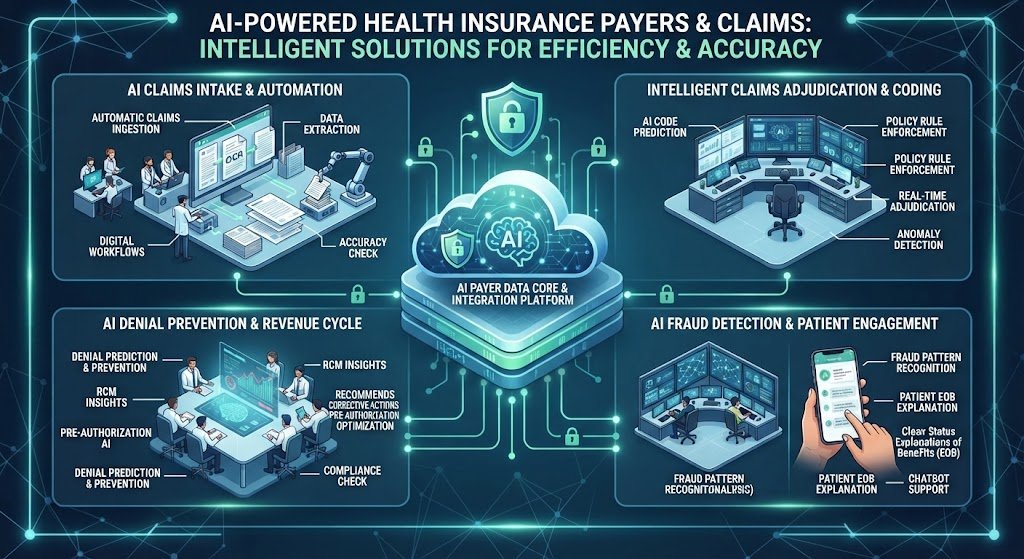
Primary topic: AI in Health Insurance Payers & Claims
Research focus: AI claims processing, claims adjudication, prior authorization, denial prevention, fraud detection, payer interoperability, clinical-document intelligence, generative AI, member experience, utilization management, predictive analytics, healthcare automation, governance, and future opportunities
Why AI Is Becoming Important for Health Insurance Payers
Health insurance is fundamentally a data and decision business.
Payers process information about members, providers, benefits, eligibility, diagnoses, procedures, medications, claims, clinical documentation, authorizations, payments, appeals, and utilization.
The scale is enormous.
U.S. national health expenditures reached $5.3 trillion in 2024. Private health insurance spending alone reached approximately $1.645 trillion, representing 31% of total national health expenditures. Medicare spending was about $1.118 trillion and Medicaid spending was approximately $931.7 billion.
Source: CMS — National Health Expenditure Fact Sheet
This financial scale creates a massive opportunity for better administrative technology.
The challenge is that payer workflows are highly complex.
A single healthcare claim can involve:
- Member eligibility.
- Benefit rules.
- Provider contracts.
- Procedure codes.
- Diagnosis codes.
- Prior authorization requirements.
- Clinical documentation.
- Network status.
- Coverage exclusions.
- Payment rules.
- Fraud and abuse controls.
- Appeal rights.
Traditional rules engines remain important.
But AI can help analyze the information around those rules.
That creates a major shift.
Traditional Payer Decision
Claims Data → Rules Engine → Decision
AI-Enhanced Payer Decision
Claims + Clinical Data + History + Documentation
↓
Rules + Machine Learning + AI
↓
Risk / Evidence / Recommendation
↓
Human Review When Required
↓
Explainable Decision
The goal is not to remove rules.
It is to make the overall decision process more intelligent.
The Administrative Problem Is Already Worth Billions
Before discussing AI, it is important to understand the size of the administrative opportunity.
The 2024 CAQH Index tracked approximately $90 billion in annual healthcare administrative spending across the medical and dental transactions it measures.
The report identified another approximately $20 billion in potential annual savings through greater automation.
CAQH also estimated that healthcare automation avoided approximately $222 billion in administrative costs.
Source: CAQH — 2024 CAQH Index
The more recent 2025 CAQH Index reported that U.S. healthcare avoided an estimated $258 billion in administrative costs during 2024 through electronic transactions and improved data exchange. The report was based on data from more than 600 provider organizations and health plans representing 63% of insured lives.
Source: CAQH — 2025 CAQH Index
This is important for AI startups.
The market does not need automation from scratch.
It already has electronic automation.
The next opportunity is to make those electronic workflows more intelligent.
Claims Denials Show Why AI Needs to Be Used Carefully
Claims denial is one of the most visible problems in health insurance.
KFF analyzed CMS transparency data for HealthCare.gov qualified health plans in 2024.
Insurers reported approximately 496 million claims.
About 451 million were in-network claims.
Approximately 85 million in-network claims were ultimately denied, producing an average in-network denial rate of 19%.
Out-of-network claims had a higher denial rate of approximately 37%.
2024 HealthCare.gov Claims Snapshot
Total reported claims: ~496 million
In-network claims: ~451 million
In-network claims denied: ~85 million
Average in-network denial rate: 19%
Average out-of-network denial rate: 37%
The data also shows why “AI claims automation” should not simply mean “AI denial automation.”
Among reported in-network denial reasons, approximately 36% were categorized as “Other,” while 25% were administrative.
About 9% involved lack of prior authorization or referral.
Only 5% were categorized as lack of medical necessity.
This matters because a large portion of denials are not necessarily sophisticated clinical decisions.
They may involve missing information, administrative problems, coverage rules, documentation, or other issues.
AI could potentially help prevent some of those errors before a claim reaches final adjudication.
Source: KFF — Claims Denials and Appeals in ACA Marketplace Plans in 2024
AI Can Move Claims Processing From Reactive to Predictive
Traditional claims processing often happens after healthcare services have already been delivered.
AI can potentially move some intelligence earlier in the workflow.
Instead of waiting for a claim to fail, a payer could identify potential problems before final submission or adjudication.
For example:
- Missing documentation.
- Invalid coding combinations.
- Potential eligibility conflicts.
- Prior authorization mismatches.
- Provider-network issues.
- Duplicate claims.
- Unusual utilization patterns.
- Potential fraud indicators.
This creates a preventive model.
Predictive Claims Intelligence
Claim / Pre-Claim Data
↓
AI Risk Analysis
↓
Potential Issue Identified
↓
Evidence / Explanation
↓
Provider or Payer Action
↓
Clean Claim / Appropriate Review
The value is not simply fewer denied claims.
The bigger value is fewer unnecessary administrative cycles.
AI in Health Insurance Is Already Moving Beyond Theory
A 2025 systematic literature review examined the use of AI in health insurance.
Researchers initially identified 520 potentially eligible articles and ultimately included 12 studies in the systematic analysis.
The review found AI applications across fraud detection, underwriting, claims processes, virtual agents, customer engagement, telematics, and other insurance functions.
However, it also identified important barriers including insufficient technical skills, weak data strategies, privacy concerns, and resistance to AI.
Source: Exploratory Digital Health Technologies — Role of Artificial Intelligence in Healthcare Insurance
A separate 2025 scoping review of AI applications in health insurance found that AI is being explored across multiple insurance functions, while highlighting challenges involving data, transparency, ethics, privacy, implementation, and governance.
The research therefore points to an important conclusion.
AI adoption in insurance is real, but the industry is still working out how to use it responsibly at scale.
AI for Claims Adjudication
Claims adjudication is one of the most obvious AI applications.
A payer needs to determine whether a submitted claim meets the applicable requirements for payment.
AI can assist by analyzing:
- Claims history.
- Member eligibility.
- Procedure combinations.
- Diagnosis relationships.
- Provider patterns.
- Historical payment behavior.
- Clinical documentation.
- Authorization records.
- Contract and benefit information.
A mature system should not replace the payer’s underlying benefit and coverage rules.
Instead, AI can act as an intelligence layer around those rules.
For example:
Rules engine: Is the service covered?
AI model: Is the submitted claim consistent with historical and clinical patterns?
Generative AI: Can the supporting documentation be summarized?
Human reviewer: Is an exception or clinical judgment required?
This creates a hybrid architecture.
AI-Assisted Claims Adjudication
Claims Data
↓
Eligibility & Benefit Rules
↓
AI Risk / Pattern Analysis
↓
Clinical Documentation Analysis
↓
Decision Support
↓
Auto-Adjudicate Low-Risk Claims
Route Complex Claims to Human Review
This is safer than allowing an AI model to independently make every coverage decision.
Prior Authorization Is One of the Biggest AI Opportunities
Prior authorization is a major administrative burden for providers, payers, and patients.
The AMA’s 2024 survey of 1,000 practicing physicians found:
- 94% said prior authorization delays access to necessary care.
- 93% said it negatively affects clinical outcomes.
- 78% reported that patients abandon treatment because of authorization problems.
- 24% reported that prior authorization had led to a serious adverse event.
- Physicians completed an average of 43 prior authorizations per physician per week.
- Physicians and staff spent about 12 hours per week on prior authorization.
- 95% said prior authorization increases physician burnout.
Source: AMA — Prior Authorization Survey
This creates a clear technology opportunity.
AI can potentially help identify whether an authorization request already contains sufficient information.
It can extract clinical evidence from records.
It can identify missing documents.
It can compare a request against payer policy.
It can route straightforward cases for faster processing.
It can send complex cases to appropriately qualified human reviewers.
AI Should Make Prior Authorization More Transparent, Not Just Faster
There is a major difference between:
“AI approves this request.”
and:
“The request meets these specific coverage criteria because these documented facts were found in the clinical record.”
The second approach is much more useful.
A strong prior-authorization AI platform should show:
- Relevant policy criteria.
- Clinical evidence found.
- Missing information.
- Model confidence.
- Rules triggered.
- Reason for escalation.
- Human reviewer decision.
This creates an evidence trail.
It also makes appeals easier.
CMS Is Building the Digital Infrastructure for AI-Enabled Payers
AI works better when healthcare data can move between systems.
CMS’s Interoperability and Prior Authorization Final Rule requires impacted payers to implement several APIs and interoperability capabilities.
The rule includes Patient Access, Provider Access, Payer-to-Payer, and Prior Authorization APIs.
The rule also includes requirements around prior-authorization metrics and data exchange.
Source: CMS — Interoperability and Prior Authorization Final Rule
This creates an important technical foundation.
Payer Interoperability Layer
Patient Access API
Provider Access API
Payer-to-Payer API
Prior Authorization API
↓
Shared Data Layer
↓
AI Analytics + Claims Intelligence + Workflow Automation
The future payer AI environment is therefore likely to be API-driven rather than dependent on fax, phone calls, and isolated databases.
Claims Attachments Are Another Major AI Opportunity
Claims frequently need supporting clinical information.
Historically, this could involve faxing or mailing medical records.
That creates a major bottleneck.
In March 2026, CMS finalized the first HIPAA-adopted national standards for healthcare claims attachments.
The rule supports electronic exchange of supporting documentation such as:
- Medical records.
- X-rays and imaging.
- Clinical notes.
- Telemedicine documentation.
- Laboratory results.
It also establishes standards for electronic signatures.
CMS estimates the rule could save the healthcare industry approximately $781 million annually.
Source: CMS — Claims Attachments and Electronic Signatures Final Rule
This creates an enormous opportunity for AI.
Once clinical attachments become electronically accessible, AI can help extract useful information from them.
AI Clinical Attachment Workflow
Medical Record / Imaging / Clinical Note
↓
Document Ingestion
↓
OCR / NLP / Computer Vision
↓
Clinical Fact Extraction
↓
Claim Context Matching
↓
Coverage / Authorization Review
↓
Human Review if Required
The claims attachment rule therefore does more than reduce paperwork.
It creates a better data environment for AI.
AI Fraud Detection in Health Insurance Claims
Fraud detection is another major AI application.
Traditional fraud systems often depend heavily on predefined rules.
For example:
- Unusual billing frequency.
- Unexpected provider behavior.
- Duplicate claims.
- Impossible combinations.
- Unusual procedure patterns.
Machine learning can analyze more complex relationships.
A 2025 systematic review of machine learning for healthcare claims fraud detection found that researchers have used supervised, unsupervised, and hybrid approaches.
The review also identified the scarcity of confirmed fraud cases as a major challenge.
It recommended advanced machine-learning methods and explainable AI for fraud detection.
Source: PubMed — Fraud Detection in Healthcare Claims Using Machine Learning: A Systematic Review
This is important because fraud datasets are often highly imbalanced.
Most claims are not fraudulent.
That means an AI model can appear highly accurate while still performing poorly at identifying actual fraud.
A better evaluation framework should focus on:
- Precision.
- Recall.
- False-positive rate.
- Financial recovery.
- Investigator workload.
- Time to detection.
- Provider impact.
AI Fraud Detection Should Prioritize Investigation, Not Automatic Accusation
This distinction is extremely important.
A fraud model should identify unusual patterns.
It should not automatically declare a provider fraudulent.
The safer workflow is:
↓
Anomaly Detection
↓
Risk Score
↓
Evidence Collection
↓
Investigator Review
↓
Final Determination
The AI output should therefore be:
“This claim pattern deserves investigation.”
rather than:
“This provider committed fraud.”
This protects providers from false accusations and makes the AI system more defensible.
Generative AI Can Become a Payer Operations Copilot
Generative AI has a different role from predictive machine learning.
Machine learning can estimate risk.
Generative AI can help people understand information.
A payer operations copilot could help employees:
- Summarize claims histories.
- Explain benefit rules.
- Summarize clinical attachments.
- Prepare appeal documentation.
- Search internal policies.
- Draft provider communications.
- Explain authorization requirements.
- Identify missing information.
The key requirement is retrieval from trusted sources.
Payer Generative AI Architecture
Claims Database
+
Benefits Policies
+
Clinical Documentation
+
Provider Information
+
Authorization Rules
↓
Secure Retrieval Layer
↓
LLM
↓
Evidence + Citation + Explanation
↓
Payer Employee Review
A generic public chatbot should not be allowed to answer sensitive claims questions using unrestricted patient data.
A secure enterprise architecture is essential.
AI Can Improve Member Experience
Health insurance members often struggle to understand:
- What their plan covers.
- Why a claim was denied.
- How much they owe.
- Whether prior authorization is required.
- How to appeal.
- Which provider is in-network.
Generative AI can translate complex insurance language into simpler explanations.
For example:
Traditional:
“Service denied due to benefit exclusion under the applicable plan provisions.”
AI-assisted explanation:
“Your plan does not currently cover this service. The denial is based on a plan benefit exclusion, not because your doctor failed to provide documentation.”
The AI should always preserve the legally relevant meaning.
It should not invent coverage.
Appeals Are an Important AI Opportunity
KFF found that fewer than 1% of the approximately 85 million in-network claims denied in 2024 were appealed.
Of the appeals reported, insurers upheld approximately 66% of the denials.
This raises an important question.
Are patients and providers always satisfied with the original decision?
Not necessarily.
Appeals can be difficult because the person appealing needs to understand:
- Why the claim was denied.
- Which policy applies.
- What evidence is missing.
- Which documents should be submitted.
- What deadline applies.
AI could help organize this information.
A member-facing system could potentially:
- Explain the denial.
- Identify the appeal deadline.
- List the relevant documentation.
- Organize submitted evidence.
- Draft an appeal summary.
- Track appeal status.
The final appeal decision should remain governed by applicable rules and human processes.
AI Can Reduce Administrative Work for Payers
Payer organizations have thousands of employees performing repetitive tasks.
AI can automate or assist with:
- Document classification.
- Data extraction.
- Claim routing.
- Provider correspondence.
- Call summarization.
- Appeal preparation.
- Policy search.
- Case summarization.
- Quality assurance.
- Fraud investigation support.
The 2024 CAQH Index specifically identified major savings opportunities from moving administrative workflows toward full electronic automation.
The next step is intelligent automation.
That means:
Automation + Prediction + Reasoning + Human Oversight.
AI and Real-Time Claims Intelligence
A mature payer environment can move toward real-time intelligence.
Instead of waiting for end-of-month reports, payer teams could monitor:
- Denial rates.
- Authorization turnaround.
- Provider anomalies.
- Member complaints.
- Appeal trends.
- Utilization changes.
- Potential fraud patterns.
AI can identify unusual changes.
For example, if a provider’s denial rate suddenly increases from 8% to 24%, the system could flag the change.
The AI could then investigate possible causes:
- Coding changes.
- Benefit changes.
- Provider contract changes.
- Documentation problems.
- System configuration errors.
- Changes in patient mix.
This is much more valuable than simply reporting that the denial rate increased.
AI Can Help Payers Predict Claims Cost
Claims data contains information about healthcare utilization.
Predictive models can potentially help payers estimate:
- Expected healthcare spending.
- High-cost utilization.
- Potential care-management needs.
- Population risk.
- Utilization trends.
- Potential readmissions.
However, predictive models need careful validation.
A model trained on historical utilization may learn historical inequalities.
That means a payer must distinguish:
What predicts cost?
from:
What should determine access to care?
Those are not always the same thing.
AI Risks in Health Insurance Are Different From Ordinary Enterprise AI
Health insurance AI can affect whether people receive coverage, how quickly they receive services, how much they pay, and whether claims are reimbursed.
That creates high stakes.
A 2026 KFF analysis of AI in prior authorization and claims review highlighted concerns around incorrect predictions, incomplete data, transparency, individual assessment, discrimination, privacy, and regulatory oversight.
KFF also reported that a National Association of Insurance Commissioners survey found 84% of responding insurers across health insurance product lines were using AI or machine learning for a broad range of tasks, including utilization management, disease management, and prior authorization.
Source: KFF — Regulation of AI in Prior Authorization and Claims Review
This is a significant finding.
AI adoption is already happening.
The governance question is therefore becoming urgent.
AI Bias Can Become a Payer Risk
Suppose an AI model learns that a particular group historically generated lower healthcare spending.
The model might then predict lower future spending.
That does not mean the group has lower clinical need.
Similarly, a model trained on historical claims could learn patterns that reflect previous access inequalities.
This is why payer AI needs subgroup evaluation.
The model should be tested across:
- Age groups.
- Geographic populations.
- Clinical populations.
- Relevant demographic groups.
- Different provider types.
- Different insurance products.
The objective is not necessarily identical model output for every population.
The objective is to detect whether the model creates inappropriate or unjustified differences.
Explainability Should Be Built Into the Product
A payer AI system should be able to answer:
Why did the system flag this claim?
What information influenced the recommendation?
Which policy or rule applies?
What information was missing?
How confident is the model?
When was the model last validated?
This requires an explanation layer.
Explainable AI Decision Record
Decision
↓
Relevant Claim Data
↓
Relevant Clinical Evidence
↓
Rules / Policy Applied
↓
AI Factors
↓
Confidence / Uncertainty
↓
Human Review
↓
Final Outcome
This type of architecture can support compliance, audits, appeals, and internal quality improvement.
Human-in-the-Loop Should Be a Core Payer Architecture
Not every claim needs human review.
Not every claim should be automatically decided by AI.
A risk-tiered system is more practical.
| Risk Level | AI Role | Human Role |
|---|---|---|
| Low | Automate | Audit samples |
| Medium | Recommend | Approve / modify |
| High | Summarize evidence | Make decision |
| Sensitive | Assist only | Required review |
This allows payers to gain efficiency without treating every decision as equally suitable for automation.
AI in Medicare Prior Authorization Is Already Being Tested
The federal government is also testing technology-assisted utilization management.
CMS launched the WISeR Model on January 1, 2026.
The model introduces new prior authorization requirements for selected services in traditional Medicare across six states and tests technologies including artificial intelligence to review the appropriateness of selected services.
KFF notes that the model is being tested over six years.
Source: KFF — Examining Medicare’s WISeR Model
This is important because it provides a real-world environment for evaluating technology-assisted utilization management.
The key question will not simply be whether AI can process cases faster.
It will be whether AI can improve accuracy and administrative efficiency without creating inappropriate barriers to care.
Future Payer Architecture
The payer of the future can be viewed as a layered intelligence platform.
Modern AI Payer Architecture
Data Sources
Claims • Eligibility • Provider Data • Clinical Records • Authorizations • Pharmacy • Member Data
↓
Interoperability Layer
FHIR APIs • X12 Transactions • Claims Attachments • Clearinghouses
↓
Data Platform
Data Lake • Warehouse • Knowledge Graph • Metadata • Data Quality
↓
AI Layer
Machine Learning • NLP • Computer Vision • Generative AI • Anomaly Detection
↓
Decision Layer
Rules • Risk Scores • Recommendations • Evidence • Confidence
↓
Workflow Layer
Claims • Prior Auth • Appeals • Fraud • Member Service • Care Management
↓
Governance Layer
Security • Auditability • Bias Testing • Model Monitoring • Human Oversight
This architecture allows different AI technologies to work together.
AI Maturity Ladder for Health Insurance Payers
A payer should not attempt to become fully autonomous overnight.
A practical maturity path is:
| Stage | Capability | Example |
|---|---|---|
| Digitization | Electronic workflows | Electronic claims |
| Automation | Rules-based processing | Automatic eligibility checks |
| Prediction | Machine learning | Fraud risk scoring |
| Intelligence | AI-assisted decisions | Prior authorization recommendations |
| Generative | LLM-powered workflows | Claims and policy copilot |
| Closed Loop | Continuous learning and monitoring | Real-time claims intelligence |
High-Value AI Use Cases for Payers
| Use Case | AI Technology | Potential Value |
|---|---|---|
| Claims intelligence | ML + rules | High |
| Denial prevention | Predictive analytics | Very high |
| Prior authorization | NLP + ML + rules | Very high |
| Fraud detection | Anomaly detection | Very high |
| Clinical attachments | NLP + computer vision | High |
| Member support | Generative AI | High |
| Appeals support | LLM + RAG | High |
| Provider analytics | Predictive ML | High |
High-Risk AI Use Cases
Not every payer AI application should be automated.
Higher-risk applications include:
- Automatic clinical denial decisions.
- Automated medical-necessity determinations without adequate human review.
- Member risk scoring that influences access to care.
- Fraud accusations based solely on algorithmic output.
- Automated appeal rejection.
- Opaque utilization-management decisions.
- AI decisions based on incomplete clinical records.
The problem is not that AI cannot contribute.
The problem is that errors can affect real people.
AI Governance Should Be Designed Into the Payer Platform
A mature payer AI governance framework should include:
- Model inventory: Know where AI is being used.
- Purpose definition: Clearly define each model’s intended use.
- Validation: Test performance before deployment.
- Bias testing: Evaluate relevant population groups.
- Monitoring: Track performance after deployment.
- Human oversight: Define when human review is required.
- Auditability: Maintain decision records.
- Vendor governance: Evaluate third-party AI systems.
- Data governance: Control sensitive information.
- Incident response: Define what happens when AI fails.
KFF’s 2026 review notes that state insurance regulators are increasingly addressing AI use in insurance, including expectations around governance, validation, testing, ongoing audits, and mitigation of adverse outcomes.
This means AI governance is not simply an IT concern.
It is becoming part of insurance operations.
What Healthcare AI Companies Can Build for Payers
The market creates opportunities for specialized technology companies.
AI Claims Platform: A system that predicts claim-processing issues and routes complex claims.
Prior Authorization AI: A platform that extracts evidence, checks requirements, identifies missing information, and routes cases.
Claims Attachment Intelligence: AI that reads clinical documents and connects them to claims.
Fraud Intelligence: A risk-scoring and investigation platform.
Appeals Copilot: A system that organizes denial reasons, policy requirements, and supporting documentation.
Payer Knowledge Copilot: A secure enterprise AI assistant for insurance employees.
Member Insurance Copilot: A consumer-facing system that explains benefits, claims, and appeals.
Provider Claims Assistant: AI that helps providers identify potential claim problems before submission.
AI Governance Platform: A monitoring system for payer AI models.
Interoperability Intelligence Platform: A layer connecting claims, FHIR APIs, clinical attachments, and payer workflows.
Opportunity for Existing Payers With Legacy Systems
Large insurers do not necessarily need to replace their core claims platforms.
That would be expensive and risky.
A better approach is often to build an intelligence layer around existing systems.
Legacy Payer Modernization
Legacy Claims System
+
Eligibility Platform
+
Authorization System
+
Provider Systems
↓
API / Integration Layer
↓
Modern Data Platform
↓
AI / ML / Generative AI
↓
Modern Payer Experience
This strategy reduces disruption.
It also allows organizations to modernize one workflow at a time.
AI + FHIR + Claims Attachments Could Create a New Payer Data Layer
Three developments are particularly important:
FHIR-based interoperability.
Electronic prior authorization.
Electronic claims attachments.
Together, they can create a much richer data environment.
The payer can potentially receive structured claims information alongside supporting clinical documentation.
AI can then analyze both.
This is much more powerful than analyzing claims codes alone.
Future Intelligent Claim
Claim Codes
+
Eligibility Data
+
Provider Data
+
Clinical Notes
+
Laboratory Results
+
Imaging
+
Prior Authorization
↓
AI Claims Intelligence
↓
Decision Support + Explanation
This is one of the most important technology shifts for the payer industry.
2027–2030 Outlook for AI in Health Insurance Payers
The next several years are likely to move payer AI from isolated pilots toward integrated workflows.
Claims will become increasingly machine-readable.
More structured data and electronic attachments will create better inputs for AI.
Prior authorization will become more API-driven.
CMS interoperability requirements are pushing payers toward standardized electronic processes.
AI will move upstream.
Instead of detecting claim problems after submission, systems will increasingly predict problems before they happen.
Denial prevention will become more important.
The business value is not simply processing denials faster.
It is preventing avoidable denials.
Generative AI will become a workforce layer.
Payer employees will use AI to search policies, summarize cases, understand claims, and prepare communications.
Fraud detection will become more network-aware.
AI will increasingly analyze relationships among providers, patients, services, locations, and claims rather than evaluating each claim in isolation.
Clinical documentation will become more important.
As electronic claims attachments become standardized, AI will have richer information for claims review.
Governance will become a competitive capability.
Payers will need to prove that AI systems are reliable, monitored, explainable, and appropriately controlled.
Best Starting Strategy for a Payer AI Program
A payer should not begin by trying to automate the entire claims department.
A practical sequence is:
↓
Step 2 — Identify data gaps
↓
Step 3 — Build interoperability
↓
Step 4 — Start with low-risk AI assistance
↓
Step 5 — Measure accuracy and financial impact
↓
Step 6 — Add human-in-the-loop decision support
↓
Step 7 — Expand to higher-value workflows
↓
Step 8 — Continuously monitor models
This approach makes AI measurable.
It also reduces the risk of deploying an unvalidated system into a high-stakes workflow.
What Success Should Look Like
Payer AI should not be evaluated only by how many tasks it automates.
A strong measurement framework should include:
| Metric | Why It Matters |
|---|---|
| Processing time | Measures operational efficiency |
| Denial rate | Measures claims outcomes |
| Avoidable denial rate | Measures preventable errors |
| Appeal overturn rate | Identifies decision quality issues |
| False-positive rate | Measures unnecessary reviews |
| Fraud detection precision | Measures investigation quality |
| Provider satisfaction | Measures workflow impact |
| Member experience | Measures consumer impact |
| Equity metrics | Detects harmful disparities |
The most important metric may ultimately be whether AI improves both operational efficiency and the quality of insurance decisions.
Final Takeaway
AI has the potential to transform health insurance payers and claims because insurance is fundamentally a high-volume decision and information environment.
The opportunity is much larger than automated claims processing.
AI can help prevent avoidable denials.
It can improve prior authorization.
It can identify fraud patterns.
It can summarize clinical attachments.
It can help employees understand complex cases.
It can make appeals easier.
It can improve member communication.
It can predict operational problems before they become expensive.
And it can connect previously fragmented information into a more intelligent payer workflow.
The evidence already shows that this transformation is underway.
Health insurance organizations are adopting AI across claims, utilization management, prior authorization, disease management, and other functions. At the same time, CMS is expanding interoperability requirements and establishing national standards for electronic claims attachments.
But the most important lesson is that payer AI should not be designed around automation alone.
The future is not “AI decides everything.”
The better model is:
AI analyzes → AI explains → AI recommends → humans review when needed → the system learns from outcomes.
This approach can make insurance operations faster without making them less accountable.
For healthcare AI startups, the strongest opportunities may therefore exist in claims intelligence, denial prevention, prior authorization, clinical-document intelligence, fraud investigation, appeals support, payer copilots, interoperability, and AI governance.
For established payers, the opportunity is to modernize legacy systems without replacing everything at once.
The payer that combines strong data infrastructure, interoperable systems, AI, human expertise, transparent decision-making, and continuous governance will be better positioned for the next generation of healthcare administration.
Original Research Sources
- CMS — National Health Expenditure Fact Sheet
- CAQH — 2024 CAQH Index
- KFF — Claims Denials and Appeals in ACA Marketplace Plans in 2024
- KFF — Regulation of AI in Prior Authorization and Claims Review
- AMA — Prior Authorization Survey
- CMS — Interoperability and Prior Authorization Final Rule
- CMS — Health Care Claims Attachments and Electronic Signatures Final Rule
- PubMed — Fraud Detection in Healthcare Claims Using Machine Learning: A Systematic Review
- Exploratory Digital Health Technologies — Role of Artificial Intelligence in Healthcare Insurance
- Springer — Artificial Intelligence Applications in Health Insurances: A Scoping Review
- KFF — Examining Medicare’s WISeR Model
- CAQH — 2025 CAQH Index
Leave a Reply