
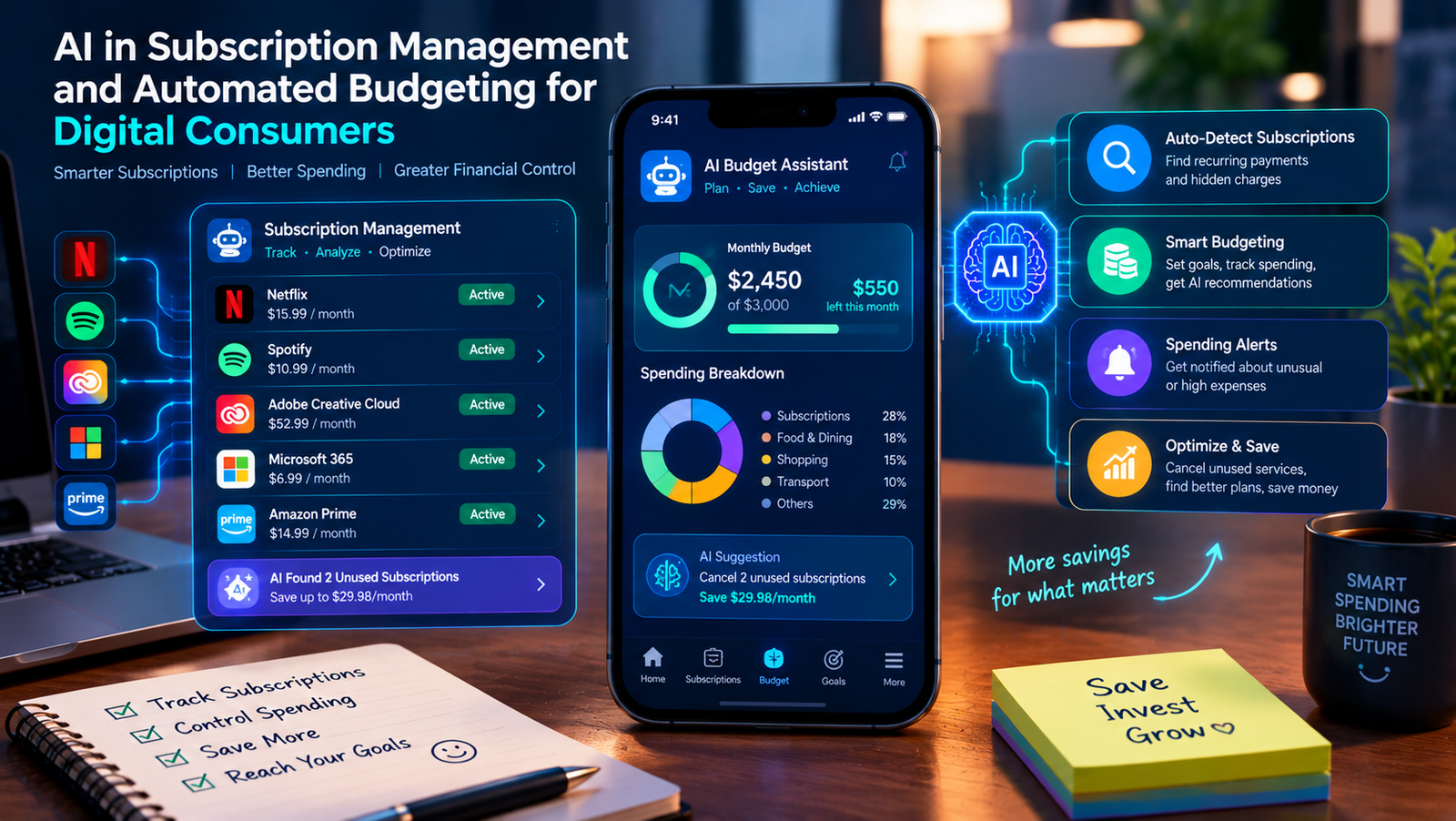
Primary topic: Artificial Intelligence in Personal Finance Management
Research focus: Subscription detection, recurring payment intelligence, expense categorization, cash-flow forecasting, personalized budgets, bill prediction, overspending alerts, financial behavior analytics, and AI-powered consumer finance apps
Why Digital Consumers Need More Than a Traditional Budgeting App
Digital consumers increasingly manage their finances through a combination of bank accounts, payment cards, digital wallets, buy-now-pay-later services, app stores, streaming platforms, cloud software, online marketplaces, and recurring utility payments. Each service may provide its own billing history, renewal notices, and spending dashboard. The result is a fragmented view of household finances, even when every individual transaction is recorded correctly.
Subscriptions are particularly difficult to manage because their costs are spread across time. A consumer may remember paying for a streaming service but forget about a second plan, an annual software renewal, an app-store purchase, or a free trial that converted into a paid membership. A single charge may look small, while the combined cost of several services can meaningfully affect the monthly budget.
Traditional budgeting tools also tend to focus on what has already happened. They categorize completed transactions and compare spending against a monthly limit. That information is useful, but it may arrive too late to prevent a shortfall before rent, insurance, utilities, or a subscription renewal is due.
AI can make these tools more forward-looking. By combining transaction history, payment timing, income patterns, recurring commitments, and user-defined goals, a system can estimate upcoming expenses and warn a consumer before available cash becomes tight.
The Difference Between Subscription Tracking and Automated Budgeting
Subscription management and budgeting should be designed as connected capabilities, not treated as identical features. Subscription tracking focuses on identifying recurring commitments and helping users manage them. Budgeting considers the wider relationship between income, essential spending, flexible spending, debt payments, savings, and future obligations.
| Capability | Subscription management | Automated budgeting |
|---|---|---|
| Primary question | Which recurring services am I paying for? | How much can I safely spend? |
| Main data | Merchant, amount, frequency, renewal date | Income, spending, bills, balances, goals |
| AI output | Recurring-payment detection and renewal alerts | Forecasts, category limits, cash-flow warnings |
| Consumer action | Review, keep, change, or cancel a service | Adjust spending, move money, or revise a goal |
| Success measure | Accurate detection and informed subscription decisions | Fewer avoidable shortfalls and better budget control |
The opportunity is to combine both capabilities into one financial planning experience. A consumer should be able to see not only the next subscription renewal, but also how that renewal affects the money available for groceries, transport, debt payments, and savings.
How AI Subscription Management Works
AI-powered subscription management begins with transaction data from connected bank accounts, payment cards, or other permitted financial sources. The system standardizes transaction descriptions, identifies likely merchants, compares payment timing and amounts, and estimates whether a charge is recurring.
The process is more complex than searching for the same merchant name. A subscription provider may use different billing descriptors, change its payment processor, vary the charge because of tax or currency conversion, or bill annually instead of monthly. Conversely, a consumer may visit the same merchant every week without having a subscription.
A useful model therefore combines several signals:
- Merchant identity and normalized transaction description
- Time between charges and consistency of billing dates
- Repeated or similar transaction amounts
- Merchant category and known billing behavior
- Historical payment patterns and account context
- Refunds, failed payments, reversals, and plan changes
The model should produce a confidence score and explain why it believes a payment is recurring. When confidence is low, the app should ask the user to confirm rather than automatically label the payment as a subscription.
Visual: AI Subscription Detection Pipeline
Payment records
Merchant matching
Timing and amount
User review
Reminder or insight
Research Study: A Deep Learning Framework for Transaction Classification and Budget Prediction
A study published in Discover Artificial Intelligence in August 2026 proposed a deep-learning framework for automated transaction classification and personal budget prediction. The system combined a pretrained language model with a Transformer attention mechanism, a bidirectional LSTM, and a temporal convolutional network. Its design aimed to understand both the meaning of transaction descriptions and the timing patterns in a person’s financial activity.
The researchers evaluated the framework on 52,847 transaction records collected from Chinese payment channels, including Alipay, WeChat Pay, and bank cards. The dataset covered 15 spending categories. The model achieved 96.3% accuracy and a 95.8% F1 score for transaction classification. For budget prediction, it reported a mean absolute percentage error of 6.2%, outperforming the ARIMA and LSTM comparison models used in the study.
The significance is not simply that a model can classify expenses. The study combines classification and forecasting, allowing transaction interpretation to contribute to future budget estimates. This is directly relevant to consumer finance apps that need to understand a purchase before deciding how it affects a spending plan.
There are important limits. The dataset was self-collected and drawn from a particular payment environment, so the reported results should not be treated as proof that the same performance will transfer to every bank, country, or consumer group. Merchant descriptions, payment habits, currencies, and income cycles vary across markets.
For product teams, the practical lesson is to evaluate transaction classification and budget prediction together, but validate both on chronological data from the intended user population.
Research Study: Identifying Recurring Payments in Financial Transaction Data
A 2026 research project presented at the Society for Causal Inference examined how to distinguish true recurring payments from habitual spending. This distinction is central to subscription management. A person buying coffee from the same café every morning creates a repeated merchant pattern, but those purchases are not a subscription. A monthly software payment may occur less frequently, yet it is a genuine recurring commitment.
The researchers tested periodicity-detection techniques, including Fourier transforms and convolution-based methods. A simple baseline using the variance in time gaps achieved 94.14% recall but only 28.39% precision on real transaction data from Weber State University. In practical terms, it found many recurring payments but also incorrectly flagged many ordinary repeated purchases.
To improve the results, the team engineered 25 features describing timing and transaction structure, then trained machine-learning models including XGBoost and multilayer perceptrons. The study found that combining real data with synthetic examples of irregular habitual spending improved precision while maintaining strong recall. An XGBoost model trained on the combined data provided the most effective balance in the reported experiments.
This is a highly specific lesson for subscription products: detecting repetition is not the same as detecting a contractual or recurring financial obligation. Models must learn the difference between repeated behavior and repeated billing.
A production system should also allow users to correct a label. Those corrections can improve personalization and help the app avoid repeatedly misclassifying ordinary purchases.
Source: Identifying Recurring Payments in Financial Transaction Data, Society for Causal Inference, 2026
Research Study: AI and Behavioral Finance for Preventing Overdraft Fees
A field experiment published in Management Science in 2025 tested an AI-based advising system designed to help consumers avoid overdrafts and nonsufficient-funds fees. The system used customers’ financial information to predict the likelihood of an overdraft and send reminders when they were needed.
The research examined users of a large personal financial management platform operating in the United States and Canada. It found that timely reminders were effective, and that the wording and framing of the messages influenced their impact. Simpler messages were more effective, while the way the information was presented also mattered.
This finding has direct implications for automated budgeting. A technically accurate warning can still fail if it arrives too late, contains too much information, or does not tell the user what to do. A useful alert should connect the forecast to a clear financial decision.
For example, instead of saying, “Your spending is above average,” the app could explain that three scheduled payments are expected before the next paycheck and that the projected balance may fall below the user’s chosen buffer. It could then offer options such as reviewing flexible spending or moving money from another account, where supported and authorized.
The research also supports human-centered AI. The algorithm identifies a possible risk, but the message must be understandable and actionable. The study does not mean that reminders will prevent every overdraft or that results will be identical across all financial institutions.
Research Study: How Consumers Use Generative AI for Personal Financial Management
A 2026 study in the Journal of Behavioral and Experimental Finance examined how 2,170 South Korean adults aged 25–59 used large language models for everyday financial tasks. The survey covered ten areas, including budgeting, savings, investments, taxes, debt, insurance, financial literacy, fraud detection, and financial support.
The study found that 67.8% of respondents had used an LLM for at least one personal-finance task, while 47.6% reported using it for budget management. Savings planning and investment were also common uses. Respondents often treated the technology as a tutor or search tool, although some used it for more personalized financial guidance.
For budgeting apps, this points to a role for conversational interfaces. Consumers may want to ask questions such as “Why is my remaining budget lower this month?”, “What bills are due before payday?” or “How would reducing two subscriptions affect my savings goal?”
A language model can explain a forecast in plain language, summarize spending changes, and help users explore scenarios. However, the underlying calculations should come from verified transaction data and tested financial logic. A generative model should not invent balances, payment dates, or savings estimates.
The study surveyed adults in South Korea, so it does not establish adoption rates for every country. It nevertheless provides evidence that consumers are already using generative AI for financial tasks, including budgeting.
Research Study: Smart Subscription Tracking Through SubBuddy
The 2025 Procedia Computer Science paper “SubBuddy: Designing a Smart Subscription Tracker for Efficient Spending Management” described a subscription-tracking application developed through design-science research and user-centered design.
The application combined subscription tracking, spending analysis, reminders, and visual summaries. Its usability evaluation produced a System Usability Scale score of 76.08, categorized by the authors as “Good.” User feedback also identified practical areas for improvement, including integration with popular payment platforms and more personalization.
This study addresses an often-overlooked part of AI product development: a model can identify subscriptions correctly, but the feature still has limited value if users cannot understand or act on the results. Subscription management requires a clear view of the service, expected charge, billing frequency, next renewal, and available action.
The study is a design and usability contribution rather than proof of long-term financial savings. Its value lies in showing how automated detection must be paired with usable presentation and convenient workflows.
For product teams, the lesson is to measure whether users can identify their recurring commitments, understand the expected costs, and complete the next step without confusion.
Research Study: AI and Automated Expense Categorization for Personalized Finance
A 2025 paper on an AI- and machine-learning-based expense categorization and budgeting system proposed combining predictive analytics, natural language processing, and hybrid machine-learning techniques. The system was designed to classify expenses, identify anomalies, and support personalized budgeting recommendations.
The research reflects a common architecture in personal finance technology: transaction descriptions are processed to identify spending categories, and the resulting history is used to generate insights. This can help consumers move beyond manual spreadsheets and fixed category rules.
The most relevant challenge is the difference between a technically correct category and a useful budget decision. A transaction at a large retailer might represent groceries, household equipment, clothing, or a business expense. Merchant-level classification alone may not be enough to understand the user’s intention.
An effective product should therefore support user corrections, maintain confidence scores, and avoid forcing uncertain transactions into overly specific categories. It should also separate the model’s prediction from the user’s confirmed financial record.
The paper describes a proposed system, so its claims should be interpreted as a design and implementation contribution rather than definitive evidence of improved household financial outcomes.
Source: AI-ML Based Expense Categorization and Budgeting System for Personalized Financial Management, 2025
AI Features That Make Subscription Management More Useful
Recurring Payment Detection
The system should identify likely monthly, quarterly, and annual payments, including charges whose amounts vary slightly. It should distinguish confirmed subscriptions from probable recurring bills and ordinary repeated purchases. Users should be able to confirm, correct, or dismiss a detection.
Subscription Cost Forecasting
A subscription dashboard should show the expected monthly equivalent of annual plans as well as the actual date when money is likely to leave the account. These are different views: the monthly equivalent helps with budgeting, while the renewal date helps with cash-flow planning.
Price Increase Detection
AI can compare a new charge with a merchant’s previous charges and identify possible price increases. The app should distinguish a genuine increase from currency conversion, tax, a plan change, or a one-time fee. It should present the evidence rather than immediately label the charge as an unwanted increase.
Free-Trial and Renewal Reminders
Where the app has reliable evidence of a trial or renewal date, it can provide a reminder before the charge. It should not claim to know a cancellation deadline unless that information is available from a reliable source or confirmed by the user.
Duplicate Subscription Detection
Some consumers pay for similar services through multiple accounts or platforms. AI may identify overlapping merchants or service categories, but it cannot always know whether the overlap is unnecessary. A family may intentionally maintain several accounts, and a professional may need both personal and business plans.
The correct approach is to flag possible overlap and let the consumer decide.
Automated Budgeting: From Historical Spending to Future Cash Flow
An automated budget should estimate what is likely to happen next, not merely summarize the previous month. It can combine expected income, recurring bills, subscription renewals, debt payments, and typical variable spending to estimate the user’s available balance over time.
Visual: Forward-Looking Budget Model
Paychecks and deposits
Rent, utilities, debt
Subscriptions and memberships
Food, transport, shopping
A good system should distinguish between money already spent, money committed to upcoming bills, and money that remains flexible. Without that distinction, a consumer may see a positive account balance and assume the full amount is available for discretionary spending.
Why Static Monthly Budgets Often Fail
Many budgeting tools divide spending into monthly categories and compare transactions with fixed limits. This is easy to understand, but it can be misleading for consumers whose income or expenses vary.
A monthly budget may not reflect the timing of a paycheck, an annual insurance premium, a quarterly utility bill, or a cluster of subscription renewals. Two consumers with the same monthly income and spending can face very different short-term cash-flow risks if their payment dates differ.
AI can improve this by forecasting expenses at a daily or weekly level. It can estimate when a balance may become tight and identify the commitments contributing to that forecast.
However, the system should communicate uncertainty. A forecast based on stable salary deposits may be more reliable than one based on irregular freelance income. The interface should make that difference visible rather than presenting every estimate as a certainty.
Personalized Budget Recommendations
Personalization should mean more than assigning a different spending limit to every user. It should account for the person’s income schedule, essential commitments, savings goals, preferences, and tolerance for financial uncertainty.
For example, a consumer who receives income twice a month may benefit from a budget organized around pay periods. A freelancer may need a conservative baseline that reserves money for essential expenses before treating the remainder as available. A student may need alerts about term-time costs and irregular education expenses.
AI can suggest a budget based on observed patterns, but the consumer should be able to change the recommendation. The app should explain why it suggested a limit and show how the choice affects future cash flow.
Useful recommendations include:
- Adjusting a category limit after an unusual month
- Setting aside money for a known annual payment
- Reviewing subscriptions before a tight pay period
- Increasing a cash buffer when income is less predictable
- Separating essential spending from flexible spending
- Changing a savings target when circumstances change
The purpose is not to shame users for spending. It is to help them understand the trade-offs and make choices that fit their circumstances.
Designing an AI-Powered Consumer Finance Dashboard
A useful dashboard should make the most important information visible without overwhelming the consumer with charts and alerts.
Illustrative dashboard layout
Safe to spend
Illustrative value after planned bills
Upcoming renewals
Expected within 14 days
Budget status
Based on current forecast
The figures above are illustrative and are not research findings or a real user’s financial data.
Generative AI as a Financial Explanation Layer
Generative AI can make personal finance insights easier to understand. Instead of showing only a chart, the app can explain why the forecast changed, which transactions contributed to the change, and what options the user has.
For example, a consumer could ask, “Why is my available budget lower than last month?” The system could explain that an annual subscription renewed, grocery spending increased, and the next paycheck arrives later in the current cycle.
The language model should retrieve facts from a controlled financial data layer. It should not independently calculate balances from conversational memory or invent transactions. Numeric outputs should be generated by tested calculations, with the language model responsible for explanation and interaction.
A safe design should also avoid making unsupported claims such as guaranteeing savings or promising that a user will avoid overdraft fees. Financial forecasts are estimates, and real outcomes can change when income, bills, or spending patterns change.
Technical Architecture for AI Subscription and Budgeting Apps
Recommended architecture
Open banking APIs, card feeds, user-confirmed bills
Merchant resolution, currency, dates, reversals
Classification, recurrence, anomaly detection
Income, bills, balance, budget scenarios
Dashboard, explanations, reminders
Consent, security, audit, model monitoring
The architecture should separate deterministic financial calculations from probabilistic AI predictions. For example, adding confirmed upcoming bills to a balance is a calculation. Predicting whether an unfamiliar merchant charge is a subscription is a model inference. Keeping those functions separate makes the system easier to test, explain, and audit.
Privacy, Security, and Consumer Trust
Personal finance data can reveal sensitive information about a person’s habits, health-related purchases, relationships, location, employment, and financial difficulties. Subscription and budgeting tools should therefore collect only the information required to deliver the service.
Important safeguards include:
- Clear consent for connected financial accounts
- Data minimization and limited retention
- Encryption in transit and at rest
- Strong authentication and access controls
- Separation of identifying data from model features where practical
- Clear options to disconnect accounts and delete eligible data
- Monitoring for unauthorized access and data misuse
- Transparent explanations of how transaction data is used
The app should not sell or share detailed spending profiles for unrelated purposes without a clear, lawful basis and appropriate user consent. Privacy should be treated as a product requirement, not a final compliance checklist.
Key Risks and How to Reduce Them
| Risk | Why it matters | Recommended control |
|---|---|---|
| False subscription detection | Ordinary repeat purchases may be mislabeled | Confidence thresholds and user confirmation |
| Incorrect budget forecast | Unexpected expenses or income changes can invalidate estimates | Show uncertainty and update forecasts frequently |
| Alert fatigue | Too many notifications reduce attention | Prioritize timely, actionable alerts |
| Biased recommendations | Some users may have irregular income or limited financial flexibility | Test across user groups and support flexible budgets |
| Privacy exposure | Transaction histories reveal sensitive behavior | Data minimization, encryption, access controls |
| Overconfident AI explanations | Users may mistake estimates for confirmed facts | Ground explanations in verified data |
Expert Recommendation
The recommended product strategy is to build a reliable financial data foundation first, then add AI capabilities in stages. Subscription detection and transaction categorization are useful starting points because their outputs can be checked against transaction histories and corrected by users.
The next stage should connect confirmed recurring payments to a cash-flow forecast. This creates a clear consumer benefit: users can see what is due, when it is expected, and how it affects their available money. Personalized recommendations and conversational AI should be added after the underlying data and calculations are dependable.
A practical implementation sequence is:
- Normalize transaction descriptions and merchant identities
- Detect recurring payments and expose confidence levels
- Let users confirm or correct subscription records
- Build a forecast using confirmed bills and observed spending
- Introduce useful alerts based on predicted cash-flow pressure
- Add natural-language explanations grounded in verified data
- Measure user outcomes and model errors before expanding automation
The product should optimize for consumer understanding and financial control, not for the number of notifications, recommendations, or AI interactions it generates.
Expert Quote
Research-based principle: The 2025 Management Science field experiment found that as-needed reminders can help users avoid overdrafts, and that simpler message framing can improve their effectiveness. The implication for AI budgeting is clear: a useful prediction must be delivered in a form that helps a person act on it
Implementation Roadmap
Phase One: Data and Merchant Intelligence
Start with secure transaction ingestion, merchant normalization, transaction deduplication, and reliable categorization. Test the system against manually reviewed records and make it easy for users to correct errors.
Phase Two: Recurring Payment Detection
Introduce recurring-payment models that use amount, timing, merchant identity, and transaction context. Separate confirmed subscriptions from likely recurring bills and ordinary repeated purchases. Track precision and recall rather than relying on a single accuracy figure.
Phase Three: Cash-Flow Forecasting
Combine confirmed recurring payments with income deposits, known bills, and historical variable spending. Provide daily or weekly projections and explain which assumptions drive the forecast.
Phase Four: Personalized Alerts
Use predicted cash-flow pressure to determine when a notification is useful. Allow consumers to control alert frequency, preferred buffer levels, and the types of events they want to hear about.
Phase Five: Conversational Financial Insights
Add a conversational interface that answers questions using verified transaction data and tested calculations. Keep the model from initiating transfers, cancelling services, or changing budgets without explicit user approval.
KPIs for AI Subscription Management and Budgeting
| Metric | What it measures |
|---|---|
| Subscription precision | How often detected subscriptions are genuine recurring commitments |
| Subscription recall | How many known recurring payments the system identifies |
| Merchant resolution rate | How often transactions are linked to the correct merchant |
| Forecast error | Difference between predicted and actual balances or spending |
| Useful alert rate | Share of alerts users consider timely and actionable |
| User correction rate | How often users need to correct classifications or forecasts |
| Financial outcome measures | Changes in avoidable fees, missed bills, or progress toward user-defined goals |
These metrics should be evaluated across different income patterns, account types, transaction volumes, and user groups. A model that works well for salaried consumers with stable monthly bills may perform differently for freelancers, students, or households with irregular income.
Future Predictions: 2027–2030
2027: Subscription Detection Becomes More Contextual
Consumer finance apps will increasingly combine merchant identity, payment timing, transaction descriptions, and user corrections to distinguish subscriptions from ordinary recurring purchases. Renewal calendars will become more closely connected to cash-flow forecasts.
2028: Budgeting Moves from Monthly Limits to Cash-Flow Planning
Budgeting tools will increasingly show how spending decisions affect the next paycheck, upcoming bills, and a user’s chosen cash buffer. This will be particularly useful for consumers with variable income or irregular payment schedules.
2029: Conversational Budgeting Becomes More Practical
Generative AI interfaces will make it easier to ask questions about spending and explore budget scenarios. Reliable systems will ground their answers in transaction records and deterministic calculations rather than allowing a language model to invent financial facts.
2030: Consumer Finance Apps Become Proactive Financial Assistants
More advanced platforms may combine subscription management, bill forecasting, savings planning, and personalized financial guidance in one interface. Some may support user-authorized actions such as changing savings allocations or opening a cancellation workflow, but consequential actions should remain transparent, reversible where possible, and subject to explicit approval.
These are technology forecasts, not guaranteed outcomes. Adoption will depend on data access, consumer trust, regulation, product quality, and whether the tools deliver measurable benefits.
Startup Opportunities
AI subscription management and automated budgeting offer several product opportunities for fintech companies and consumer software startups.
- AI Subscription Intelligence: Detect recurring payments, renewal dates, price changes, and possible duplicate services
- Cash-Flow Forecasting API: Provide balance projections and upcoming-bill intelligence to banks and finance apps
- Personalized Budgeting Assistant: Explain spending patterns and suggest user-controlled budget adjustments
- Subscription Renewal Calendar: Combine expected charges with reminders and consumer-approved cancellation links
- Financial Wellness Copilot: Answer questions using verified transaction data and explainable forecasts
- Variable-Income Budgeting: Help freelancers and gig workers plan essential expenses around uncertain income
- Family Subscription Dashboard: Help households understand recurring commitments across permitted accounts
- Embedded Budgeting SDK: Let banks, neobanks, and consumer platforms add forecasting and recurring-payment intelligence
A differentiated product should focus on a specific consumer problem rather than offering another generic expense tracker. For example, a tool designed for variable-income households could combine income uncertainty, bill timing, subscription renewals, and a minimum cash buffer into one understandable forecast.
Frequently Asked Questions
How does AI detect subscriptions from bank transactions?
AI analyzes merchant descriptions, transaction amounts, payment intervals, and historical patterns to identify likely recurring charges. More reliable systems also account for variable billing amounts and allow users to confirm or correct detections.
Can AI automatically cancel subscriptions?
AI can help identify a subscription and guide a user to a cancellation process. Actual cancellation depends on the merchant’s policies, available integrations, and user authorization. The app should not claim that a subscription has been cancelled unless the cancellation is confirmed.
How is AI budgeting different from a traditional budget tracker?
A traditional tracker mainly categorizes past spending and compares it with preset limits. AI budgeting can use transaction patterns and upcoming commitments to forecast future spending and balances, then provide personalized alerts and explanations.
Can AI predict whether I will run out of money before payday?
It can estimate the risk by combining current balances, expected income, known bills, and likely spending. The result is a forecast, not a guarantee, because unexpected expenses and changes in income can affect the outcome.
Is it safe to connect a bank account to an AI budgeting app?
Safety depends on the provider’s security practices, permissions, data handling, and applicable regulations. Consumers should understand what data is accessed, how it is used, how it is protected, and how access can be revoked.
What data does an AI budgeting app need?
A basic system may need transaction dates, amounts, merchant descriptions, account balances, and user-confirmed income or bills. It should collect only what is necessary for the features the consumer chooses to use.
Can AI budgeting work for people with irregular income?
Yes, but forecasts should account for uncertainty. A useful system can prioritize essential bills, use conservative income assumptions, and show a range of possible balances rather than treating variable income as guaranteed.
What is the biggest challenge in AI subscription management?
The key challenge is distinguishing genuine recurring payments from ordinary repeated purchases and correctly identifying billing changes. Reliable merchant data, contextual models, and user confirmation are essential.
Final Perspective
AI can make subscription management and budgeting more useful by connecting financial history with future commitments. The opportunity is not limited to identifying a streaming subscription or categorizing a grocery purchase. It is to help consumers understand how recurring payments, bill timing, variable spending, and income patterns interact.
The research points toward several practical conclusions. Deep-learning systems can combine transaction classification with budget prediction. Recurring-payment research shows why simple repetition detection creates false positives and why richer transaction features matter. A field experiment on AI-based overdraft prevention demonstrates the importance of timely, understandable messages. Research on generative AI adoption shows that consumers are already using conversational tools for budgeting and other financial tasks, while subscription-tracker research highlights the importance of usability and payment-platform integration.
The strongest product strategy is to combine these lessons into one coherent experience:
For consumers, the result should be fewer surprises and a clearer understanding of what their money needs to cover. For banks and fintech companies, it creates an opportunity to deliver practical financial guidance within the apps people already use.
The long-term advantage will not come from adding the most AI features. It will come from making financial information accurate, understandable, timely, private, and useful enough that consumers can make better decisions with confidence.
Research Sources
- A Deep Learning Framework for Automated Transaction Classification and Budget Prediction in Personal Financial Management, 2026
- Identifying Recurring Payments in Financial Transaction Data, Society for Causal Inference, 2026
- Using AI and Behavioral Finance to Cope with Limited Attention and Reduce Overdraft Fees, Management Science, 2025
- How Individuals Use Generative AI for Personal Financial Management, Journal of Behavioral and Experimental Finance, 2026
- SubBuddy: Designing a Smart Subscription Tracker for Efficient Spending Management, Procedia Computer Science, 2025
- AI-ML Based Expense Categorization and Budgeting System for Personalized Financial Management, 2025
- Consumer Financial Protection Bureau, Financial Well-Being Resources

Leave a Reply