
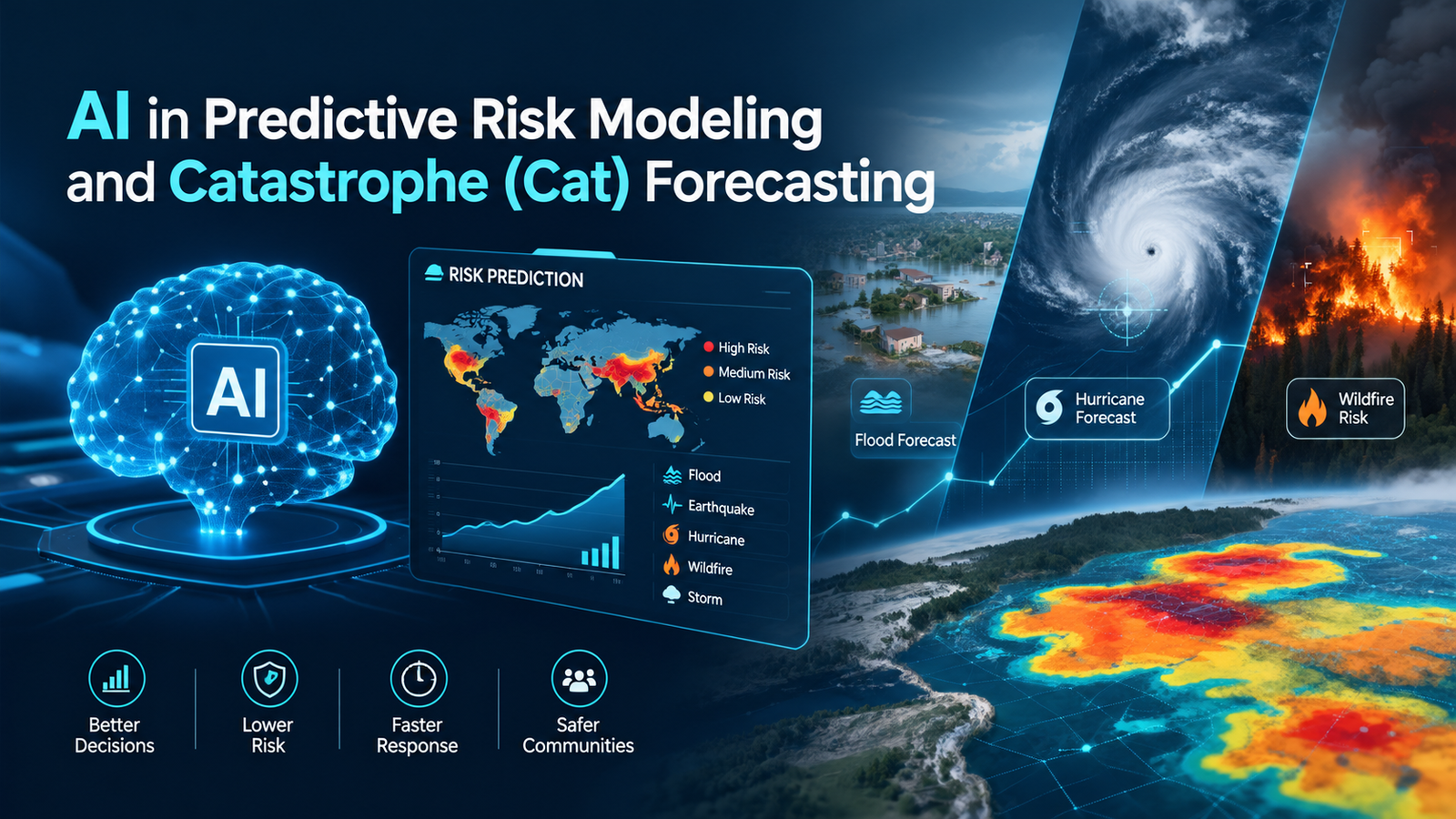
Primary topic: AI in Predictive Risk Modeling and Catastrophe Forecasting
Research focus: AI catastrophe modeling, natural disaster prediction, property and casualty insurance, climate risk, extreme-weather forecasting, insured-loss estimation, geospatial intelligence, underwriting, reinsurance, portfolio accumulation, catastrophe bonds, claims forecasting, and explainable AI
Understanding AI in Catastrophe Risk Modeling
Catastrophe risk modeling estimates the potential financial consequences of events such as hurricanes, floods, wildfires, earthquakes, severe storms, and other natural hazards. Insurers, reinsurers, brokers, lenders, infrastructure operators, and public agencies use these estimates to understand exposure, plan capital, evaluate protection strategies, and prepare for extreme events.
Traditional catastrophe models generally connect three core components: the probability and intensity of a hazard, the assets exposed to that hazard, and the damage those assets may experience. Financial modules then translate estimated damage into insured losses after considering policy limits, deductibles, exclusions, and reinsurance arrangements.
AI can improve individual parts of this process. It can identify patterns in historical losses, estimate damage from satellite or aerial imagery, detect changes in flood or wildfire exposure, and update risk estimates as new information becomes available. It can also help identify relationships between weather conditions, property characteristics, and claim severity that are difficult to represent through simple linear models.
Hurricane, flood, fire, earthquake
Properties, infrastructure, assets
Expected damage at each intensity
Claims, deductibles, limits, reinsurance
Where AI contributes: Each stage can use machine learning, but the outputs must remain consistent with physical evidence, insurance contract terms, and the uncertainty of rare events.
Why Catastrophe Forecasting Needs AI
Catastrophe risk is difficult to estimate because extreme events are relatively rare, their effects vary by location, and the financial consequences depend on more than the hazard itself. Two storms with similar wind speeds can produce very different insured losses because of differences in storm surge, building quality, construction codes, insurance penetration, and the concentration of valuable properties.
Historical data is essential, but it can become less representative when exposure changes or climate conditions shift. A model trained on past events may struggle when it encounters a new combination of hazard intensity, urban development, building characteristics, or policy coverage.
AI can help process large and varied datasets, but it does not eliminate these limitations. The model still needs suitable training data, meaningful validation, and a clear understanding of the physical and financial processes it is attempting to estimate.
Property-level information can reveal risk differences hidden by regional averages.
New weather observations and imagery can update estimates while an event develops.
Models can connect hazard intensity with damage, claims, and portfolio exposure.
AI can help test how alternative hazard and exposure assumptions affect losses.
Research Study: Data-Driven AI for Climate Multi-Hazard and Multi-Risk Assessment
A major 2026 review published in Natural Hazards and Earth System Sciences examined how machine learning and other data-driven methods are being used to assess multiple climate hazards and their combined risks. The authors selected and analyzed 153 key papers, covering data processing, hazard identification, risk assessment, and future risk scenarios.
The review is especially relevant to catastrophe modeling because it looks beyond forecasting one hazard in isolation. Real-world losses can arise from connected or consecutive events. Heavy rainfall can trigger flooding and landslides, while drought and heat can contribute to wildfire conditions. A model that forecasts each hazard separately may fail to capture the way one event changes the probability or consequences of another.
The review found that different model families tend to serve different purposes. Convolutional neural networks are widely used for Earth-observation processing, while sequence-based models such as LSTMs are used for temporal forecasting. Random Forest and other ensemble methods appear frequently in risk and impact assessment, where structured data and interpretability are important. Statistical approaches, including copulas, also remain useful for representing dependencies between hazards.
The authors identify several priorities for future research: modeling interactions between hazards, incorporating changing exposure and vulnerability, improving open disaster datasets, and addressing the uncertainty involved when models extrapolate beyond the conditions represented in their training data.
What this means for insurers: Catastrophe models should not treat every hazard as an independent event. AI can help identify interacting risk factors, but the system must be designed to represent the physical relationship between hazards rather than merely finding statistical correlations.
Source: Harnessing data-driven methods for climate multi-hazard and multi-risk assessment, 2026
Research Study: AI-Based Early Warning for Complex Climate Risk
A 2025 article in Nature Communications explored how integrated AI could strengthen early-warning systems for complex climate risks. The work discusses combining meteorological and geospatial foundation models to improve hazard and impact prediction, while emphasizing that forecasting is only one part of an effective warning system.
The authors highlight a critical distinction between predicting an event and helping people act on that prediction. A forecast becomes useful when it reaches the right decision-maker, communicates uncertainty clearly, and supports an appropriate response. For an insurer, that response could involve preparing claims teams, notifying policyholders, arranging emergency contractors, or estimating the potential concentration of losses.
The article also emphasizes causal AI as a way to reduce the risk of relying on spurious relationships. This matters because a model may discover that a particular variable is associated with historical losses without that variable being a reliable cause or a stable predictor in a new environment.
What this means for insurers: An AI catastrophe platform should connect forecasts to operational decisions. It should also distinguish between a signal that is statistically associated with losses and evidence that supports a defensible risk explanation.
Source: Early warning of complex climate risk with integrated artificial intelligence, 2025
Research Study: Machine Learning for Insurance Risk Assessment and Claims Estimation
A 2026 study published in Frontiers in Artificial Intelligence proposed a machine-learning pipeline for natural-disaster classification, loss estimation, and insurance claims forecasting. The research used 68,485 disaster records covering 1953 to 2025, with ten disaster categories and 49 engineered features. The pipeline combined classification models such as Random Forest, XGBoost, and LightGBM with regression models for estimating severity and claims.
The study illustrates how a practical insurance workflow can connect several predictive tasks. First, the system classifies the disaster or estimates its category. It then models severity and produces a financial estimate that could support risk scoring, pricing analysis, portfolio planning, or early-warning decisions.
However, the study also demonstrates why validation design matters. Its results differed substantially between random data splits and temporal holdouts. The authors noted that synthetic financial targets and changes across time affected the results. A high score on a randomly divided dataset therefore should not be interpreted as proof that the model will accurately forecast future insured losses.
What this means for insurers: AI can help connect disaster data to financial decisions, but models should be tested on later events that were not available during training. Actual claims data and transparent assumptions are especially important when the output is used for pricing or capital planning.
Research Study: Trustworthy AI for Natural Disaster Prediction
A 2024 systematic review published in Computers and Electrical Engineering examined trustworthy AI applications in natural disaster management. The researchers retrieved 981 papers and included 108 studies in their quantitative synthesis. The review covered disaster prediction, risk assessment, early-warning systems, explainable AI, data fusion, and decision support.
The review is useful because catastrophe forecasting is not only a model-accuracy problem. A system may generate a forecast quickly, but decision-makers need to understand the uncertainty, data quality, and consequences of acting on it. A false alarm can create unnecessary operational costs, while a missed event can leave an insurer unprepared for a large volume of claims.
The authors discuss explainability, data integration, bias, and the consequences of AI-based decisions. These concerns become especially important when risk scores influence insurance availability, premium decisions, or the allocation of recovery resources.
What this means for insurers: Model governance should be designed alongside model development. Teams should document data sources, test performance across relevant locations, provide explanations for important outputs, and define how people should respond when a model is uncertain.
Source: A systematic review of trustworthy artificial intelligence applications in natural disasters, 2024
Research Study: Machine Learning for Hurricane Damage Risk in Florida
A 2025 study in Earth Systems and Environment examined machine-learning approaches to hurricane damage risk assessment in Florida. The research focuses on the relationship between hurricane hazards and potential damage, making it relevant to property insurers that need to understand how exposure and vulnerability vary across locations.
Hurricane losses are shaped by several interacting factors. Wind speed is important, but so are storm surge, rainfall, distance from the coast, construction type, roof condition, building age, and local terrain. A model that uses only a storm’s maximum wind speed can miss important differences in the damage experienced by individual properties.
Machine learning can help combine these variables into more granular estimates. Geospatial models can identify areas with similar risk characteristics, while property-level features can help distinguish between buildings exposed to similar hazards but likely to experience different damage.
The practical limitation is that performance in one region does not automatically transfer to another. Florida-specific relationships may not describe the building stock, storm patterns, or insurance conditions found in a different state or country.
What this means for insurers: Hurricane models should be calibrated to local building characteristics and claims experience. Geographic validation is essential before using a model to price policies or estimate portfolio-wide losses.
Research Study: Probabilistic Machine Learning for Extreme-Event Forecasting
A 2025 research article in Expert Systems with Applications developed a probabilistic machine-learning framework for forecasting daily extreme events. The work addresses the importance of estimating extreme weather risks in regions exposed to tropical storms, hurricanes, and flooding.
The probabilistic approach is important because catastrophe decisions should not depend on a single forecast value. An insurer may need to understand a range of possible outcomes, including the chance of a relatively limited event and the possibility of a much more damaging one.
For example, a forecast that estimates a 20% chance of a high-impact event communicates something different from a model that simply labels the event “high risk.” Probabilities can support decisions about staffing, reinsurance, liquidity, and policyholder communication, provided that they are well calibrated and their uncertainty is understood.
What this means for insurers: Probabilistic forecasts can help decision-makers compare scenarios, but their usefulness depends on calibration. A model that repeatedly assigns a 20% probability to events should be evaluated to see whether those events occur at approximately that frequency over an appropriate sample.
Source: A probabilistic machine learning framework for daily extreme events forecasting, 2025
Research Evidence Dashboard
| Research | Main focus | Practical relevance |
|---|---|---|
| 2026 multi-risk review | 153 key papers on data-driven multi-hazard risk | Compound hazards and future scenarios |
| 2025 AI early-warning article | Integrated meteorological and geospatial AI | Forecast-to-action workflows |
| 2026 insurance pipeline | 68,485 disaster records and claims estimation | Risk scoring and financial modeling |
| 2024 trustworthy AI review | 108 studies on AI for disaster management | Explainability and governance |
| 2025 Florida hurricane study | Machine learning and hurricane damage | Localized property risk |
| 2025 probabilistic forecasting | Daily extreme-event probabilities | Scenario-based decisions |
Research interpretation: These studies support AI as a useful layer for forecasting, risk assessment, and operational planning. They do not establish that one model can reliably predict every catastrophe or replace physical catastrophe models. Evidence varies by hazard, geography, dataset, validation method, and intended use.
How AI Improves the Catastrophe Modeling Workflow
AI can contribute across the catastrophe modeling lifecycle, from collecting exposure data to estimating losses after an event. The most effective implementation is not necessarily a single end-to-end neural network. In many insurance settings, a collection of specialized models is easier to validate, explain, and maintain.
Weather, satellite imagery, property records, claims, policy terms
Geocoding, building attributes, asset values, geographic features
Event probabilities, hazard intensity, expected damage
Gross losses, insured losses, claims frequency and severity
Underwriting, reinsurance, capital, response planning
AI for Hazard Forecasting
Hazard forecasting estimates the likelihood, location, timing, or intensity of a physical event. Depending on the hazard, the model may use weather observations, radar, satellite data, terrain, soil moisture, river levels, seismic measurements, or historical event records.
Different hazards require different modeling approaches. Time-series models can help capture evolving weather conditions, computer vision can process satellite and radar imagery, and ensemble methods can combine multiple signals. Models should be selected according to the forecast horizon and the physical process being modeled rather than simply choosing the newest AI architecture.
- Hurricanes: Estimate track, intensity, rainfall, wind exposure, and potential storm-surge conditions
- Floods: Combine rainfall, river levels, terrain, drainage, soil saturation, and flood maps
- Wildfires: Analyze temperature, vegetation dryness, wind, fuel conditions, and ignition-related information
- Earthquakes: Support exposure and impact analysis, while avoiding claims that AI can reliably predict the exact time and location of an earthquake
- Severe storms: Combine atmospheric observations and historical event patterns to estimate local impacts
For insurers, the goal is not only to forecast whether an event will happen. The system must estimate which insured assets may be affected and how the expected impact could evolve.
AI for Property-Level Exposure and Vulnerability
Exposure data describes what is located in a hazard area. Vulnerability describes how susceptible those assets are to damage. These are different concepts, and a strong catastrophe model needs both.
Satellite imagery, aerial photographs, property databases, building permits, roof attributes, construction materials, elevation models, and claims histories can help improve exposure and vulnerability estimates. Computer vision can extract visible property characteristics from imagery, while machine learning can estimate damage relationships from historical claims and engineering data.
However, image-based inference has limits. A satellite image may not reveal internal structural condition, hidden water damage, roof fastening, maintenance quality, or policy coverage. AI-generated property attributes should therefore include confidence levels and should be verified when the decision has a material financial impact.
| Data source | AI application | Limitation |
|---|---|---|
| Satellite and aerial imagery | Building footprint, roof, vegetation, visible damage | Image resolution, cloud cover, hidden conditions |
| Property records | Construction, age, occupancy, replacement value | Missing or outdated records |
| Claims history | Damage and loss-severity modeling | Reporting bias and changing coverage |
| Weather and terrain | Hazard intensity and local exposure | Resolution and forecast uncertainty |
| Policy data | Translate damage into insured loss | Complex wording, exclusions, limits |
AI for Catastrophe Loss Estimation
Loss estimation converts physical damage into financial consequences. This is where insurance-specific data becomes essential. A model may estimate that a property has a 30% damage ratio, but the insurer’s payment depends on the insured value, deductible, limit, exclusions, and other contract conditions.
AI can help estimate claim frequency, repair costs, damage severity, and the likely number of claims following an event. It can also help prioritize claims for inspection by combining event footprints with property characteristics and early claim reports.
For portfolio management, the system should distinguish between several financial measures:
- Ground-up loss: The estimated physical or economic loss before insurance terms
- Insured loss: The portion covered by insurance contracts
- Gross loss: The insurer’s covered loss before reinsurance recoveries, subject to the company’s accounting definitions
- Net loss: The amount retained after applicable reinsurance recoveries and other risk-transfer arrangements
- Claims development: How reported and estimated claims change as more information becomes available
These values should not be treated as interchangeable. A catastrophe model that forecasts economic damage accurately may still estimate an insurer’s net loss poorly if it lacks accurate policy and reinsurance information.
AI in Reinsurance and Portfolio Accumulation
Insurers can face substantial accumulation risk when many policies are exposed to the same event. A hurricane may affect thousands of properties, while a flood can damage homes, commercial buildings, roads, utilities, and industrial facilities within the same region.
AI can help identify concentrations of exposure and test how different event scenarios may affect the portfolio. Graph analytics can connect insured locations to shared hazard zones, supply-chain dependencies, infrastructure, and geographic clusters. Machine learning can then support scenario analysis and help identify where exposure data is incomplete.
Reinsurance teams can use these outputs to evaluate potential losses under different assumptions. However, AI estimates should be compared with established catastrophe models and stress scenarios, particularly when they influence reinsurance purchases, capital adequacy, or risk appetite.
Individual exposure
Shared hazard
Accumulated losses
Risk transfer
AI can help connect these levels, but the final financial result must reflect contract structure, event definitions, attachment points, limits, and reinstatements where applicable.
AI for Claims Triage After a Catastrophe
Once a catastrophe occurs, insurers must process a sudden increase in claims. AI can support triage by combining the event footprint, property information, customer submissions, photographs, adjuster notes, and historical claims patterns.
Computer vision may help classify visible damage in submitted images, while language models can summarize claim documents and extract relevant information. Predictive models can estimate which claims may require specialist inspection, additional evidence, or escalation.
These tools should assist rather than automatically deny claims. Image quality can be poor, damage may be hidden, and a model may confuse pre-existing damage with damage caused by the insured event. Human review is especially important when a decision affects coverage, payment, or a policyholder’s ability to recover.
AI for Catastrophe Insurance Pricing
AI can support pricing by estimating expected loss, identifying relevant risk factors, and helping actuaries test how changes in exposure or hazard assumptions affect premiums. Yet pricing is not simply a prediction problem. It also involves regulatory requirements, actuarial standards, affordability, fairness, and the insurer’s chosen risk appetite.
Research on catastrophe insurance has highlighted fairness concerns in risk-based pricing. A 2024 research spotlight in Information Systems Research discussed the distinctive fairness challenges of machine-learning-based catastrophe insurance ratemaking, including the possibility that complex risk models can reproduce or intensify unequal outcomes across communities.
Insurers should therefore examine whether model features act as proxies for protected or sensitive characteristics, whether data quality varies by neighborhood, and whether pricing outcomes create disproportionate burdens. Model performance should be evaluated alongside the distribution of its effects.
Source: Fairness of Ratemaking for Catastrophe Insurance: Lessons from Machine Learning, 2024
AI and Climate Risk: Historical Data Is Not the Whole Future
Climate risk creates a difficult modeling problem because future hazard conditions may differ from the historical period used to train a model. Changes in temperature, precipitation, sea levels, land use, urban development, and building exposure can affect both the frequency and financial impact of extreme events.
Machine learning can identify patterns in historical data, but a model cannot reliably infer every future climate condition from past observations alone. Insurers should combine AI with climate projections, physical hazard models, and scenario analysis. Where possible, the system should evaluate multiple plausible futures rather than present one forecast as certain.
For long-term planning, the distinction between weather forecasting and climate-risk assessment is important. Weather forecasts estimate conditions over relatively short periods. Climate scenarios examine how the distribution of conditions and risks may change over longer horizons. The two can inform each other, but they answer different questions.
Key Model Risks and Controls
| Risk | Why it matters | Control |
|---|---|---|
| Rare-event data | Extreme events provide limited training examples | Use physical models, stress tests, and uncertainty ranges |
| Data leakage | Future information can inflate test performance | Use event-level and temporal validation |
| Climate non-stationarity | Historical patterns may not persist | Test climate scenarios and monitor drift |
| Geographic bias | Models may perform unevenly across regions | Validate by region, hazard, and property type |
| Uncertain exposure data | Incorrect property attributes distort loss estimates | Track provenance and confidence; verify important records |
| Black-box decisions | Risk decisions may be difficult to explain | Use explainability, documentation, and human review |
Expert Recommendation
Insurers should build AI catastrophe modeling as a decision-support layer around a sound physical, actuarial, and financial foundation. The aim should not be to replace established catastrophe models with a single machine-learning score. Instead, AI should improve data quality, provide more granular estimates, identify emerging patterns, and help decision-makers understand uncertainty.
A practical implementation should follow these principles:
- Start with a defined decision: Decide whether the model will support underwriting, accumulation management, event response, claims triage, reinsurance, or long-term climate scenarios
- Separate hazard from insured loss: Maintain clear links between physical forecasts, property vulnerability, policy terms, and financial outputs
- Use multiple data sources: Combine weather, geospatial, property, claims, and policy data while tracking provenance and quality
- Validate on unseen events: Use temporal and event-level testing instead of relying only on random train-test splits
- Retain established catastrophe models: Compare AI outputs with physical and actuarial benchmarks, especially for tail-risk decisions
- Show uncertainty: Provide ranges, scenarios, and confidence measures rather than presenting one estimate as certain
- Monitor geographic performance: Test results across regions, building types, and hazard categories
- Keep consequential decisions accountable: Use qualified human review for pricing, coverage, claims, and capital decisions
Expert Perspective
The practical lesson is that predictive performance alone is not enough. A catastrophe model should provide evidence that its outputs remain meaningful under changing conditions, and it should make the limits of its forecasts clear to the people using them.
AI Catastrophe Modeling Maturity Model
| Stage | Capability | Operational focus |
|---|---|---|
| Foundational | Historical claims and hazard analytics | Data quality and consistent reporting |
| Predictive | ML models for frequency, severity, and damage | Temporal validation and calibration |
| Geospatial | Property-level imagery and exposure intelligence | Coverage, accuracy, and confidence tracking |
| Integrated | Hazard, vulnerability, policy, and claims models | Consistent financial loss estimates |
| Adaptive | Scenario updates and continuous monitoring | Governance, drift detection, and auditability |
Implementation Roadmap
Build the Data Foundation
Start by connecting the datasets required for the selected use case. For a property insurer, this may include policy and claims records, geocoded insured locations, building attributes, weather observations, hazard maps, and reinsurance terms. Standardize locations, dates, event identifiers, currencies, and coverage fields before training models.
Establish a Baseline
Measure the performance of existing actuarial methods, catastrophe models, or operational rules. The baseline should include metrics relevant to the actual decision, such as loss-estimation error, event detection, claims triage time, or portfolio accumulation accuracy.
Train and Validate Specialized Models
Build models for distinct tasks such as hazard classification, damage estimation, claims severity, or property attribute extraction. Evaluate them using later events and, where possible, separate geographic regions. Document where performance falls short.
Integrate Outputs into Business Workflows
Make model outputs available to underwriters, catastrophe analysts, actuaries, claims teams, and risk managers through tools they already use. Show the estimate, key drivers, data freshness, confidence, and relevant limitations together.
Monitor and Improve
Track performance after deployment, especially following major events. Compare predicted losses with observed claims as the claims develop. Investigate material differences and update the model only through a documented validation and approval process.
KPIs for AI Catastrophe Forecasting
| KPI | What it measures | Why it matters |
|---|---|---|
| Loss-estimation error | Difference between predicted and observed losses | Tests financial usefulness |
| Probability calibration | Agreement between predicted probabilities and observed frequencies | Supports decisions under uncertainty |
| Event-level recall | Share of relevant events identified | Measures missed-event risk |
| Claims triage time | Time required to route and assess claims | Measures operational improvement |
| Exposure data completeness | Share of records with required attributes | Reveals blind spots in risk estimates |
| Regional performance gap | Differences in model quality across locations | Highlights geographic bias |
| Forecast update latency | Time between new data and updated output | Measures operational responsiveness |
Future Predictions: 2027–2030
2027: More Frequent Integration of AI with Catastrophe Models
AI is likely to be used increasingly for targeted tasks such as exposure enrichment, damage estimation, claims triage, and rapid event-loss updates. Rather than replacing established catastrophe models outright, these tools can provide additional data and specialized predictions that improve existing workflows.
2028: Greater Use of Property-Level Risk Intelligence
Improvements in satellite imagery, geospatial data, and computer vision may support more detailed estimates of building characteristics and visible damage. The main challenge will be verifying inferred attributes and ensuring that coverage and image quality are sufficient for the regions being modeled.
2029: More Explicit Modeling of Compound Hazards
Catastrophe platforms are likely to place greater emphasis on interactions between hazards and infrastructure dependencies. Insurers may increasingly test scenarios in which multiple hazards occur together or one event causes a second event, rather than relying only on isolated hazard estimates.
2030: Scenario-Based Climate and Portfolio Decision Systems
AI-enabled platforms may increasingly combine climate scenarios, exposure projections, portfolio data, and financial models to support longer-term planning. These systems will be most useful when they communicate a range of plausible outcomes and explain how assumptions influence the result.
AI-assisted hazard, exposure, and claims analytics
Faster property-level updates and event-loss estimation
Integrated multi-hazard and climate-scenario planning
Important: These are directional expectations, not guaranteed timelines or claims that every insurer will adopt the same capabilities.
Startup Opportunities
AI catastrophe modeling creates opportunities for specialized products that solve specific data, modeling, or workflow problems. Startups do not necessarily need to build a complete catastrophe model to deliver value. A focused product that improves one difficult part of the process may be easier to validate and integrate.
- Property Exposure Intelligence: Use geospatial AI to enrich building records and identify missing or outdated attributes
- Rapid Event-Loss Estimation: Combine event footprints, property exposure, and claims data to estimate potential losses during an unfolding catastrophe
- AI Claims Triage: Prioritize claims using event severity, location, submitted evidence, and expected complexity
- Flood Risk Analytics: Combine terrain, rainfall, drainage, and property information for localized flood exposure assessment
- Wildfire Exposure Intelligence: Analyze vegetation, weather, terrain, and property proximity to estimate changing exposure
- Catastrophe Model Validation: Help insurers test model calibration, geographic transferability, and performance after new events
- Climate Scenario Analytics: Translate climate projections into portfolio-level risk scenarios and decision-support reports
- Reinsurance Portfolio Analytics: Identify accumulation concentrations and compare potential losses under different event scenarios
Frequently Asked Questions
What is AI in catastrophe risk modeling?
AI in catastrophe risk modeling uses machine learning, deep learning, geospatial analytics, and related methods to estimate natural-hazard risk, property vulnerability, potential damage, insured losses, and portfolio exposure.
Can AI predict natural disasters accurately?
AI can support forecasting for particular hazards and time horizons, but accuracy varies by event type, location, data quality, and model design. It cannot reliably predict the exact timing and location of every catastrophe, and earthquake prediction remains especially limited.
How does AI help property insurers?
AI can improve exposure data, estimate property damage, support underwriting analysis, identify portfolio concentrations, forecast claims, and help prioritize claims after a major event.
What is the difference between hazard forecasting and catastrophe loss forecasting?
Hazard forecasting estimates the probability or intensity of a physical event. Catastrophe loss forecasting estimates the financial impact after considering exposed assets, vulnerability, insurance coverage, and other financial factors.
Why is historical data a limitation?
Extreme events are relatively rare, and future conditions may differ from the historical period. Models can also learn patterns that do not generalize to new regions, changing exposure, or different climate conditions.
Can AI replace traditional catastrophe models?
AI can improve specific modeling tasks, but a complete catastrophe assessment often requires physical hazard science, engineering vulnerability functions, actuarial methods, policy terms, and financial modeling. AI is generally most useful when integrated with these components and validated against established approaches.
How should insurers measure AI catastrophe model performance?
Insurers should evaluate loss-estimation error, probability calibration, event-level detection, geographic performance, data completeness, forecast latency, and performance on events that were not used during training.
Final Perspective
AI is creating new ways to understand catastrophe risk, but its value depends on how well the technology connects physical events to real financial exposure. The most important advances are not limited to predicting whether a hurricane, flood, or wildfire will occur. They include identifying which properties may be affected, estimating how vulnerable those properties are, translating damage into insured losses, and helping insurers prepare for the financial and operational consequences.
The research reviewed here shows several distinct directions. Multi-hazard research is exploring how connected events can be modeled together. AI early-warning research is connecting meteorological and geospatial intelligence with decisions. Insurance-focused machine learning is linking disaster records to severity and claims estimates. Studies of trustworthy AI and hurricane damage highlight the importance of explainability, local validation, and the limits of transferring models between regions.
These findings point toward a practical architecture that combines specialized AI models with physical hazard models, property data, actuarial methods, and human expertise. It should make uncertainty visible rather than hide it behind a single risk score. It should also be tested on future events, because a model that performs well on a random sample of historical records may not perform equally well when the next major catastrophe occurs.
Research Sources
- Harnessing data-driven methods for climate multi-hazard and multi-risk assessment, Natural Hazards and Earth System Sciences, 2026
- Early warning of complex climate risk with integrated artificial intelligence, Nature Communications, 2025
- Machine learning-based insurance risk assessment pipeline for natural disaster prediction and claims estimation, Frontiers in Artificial Intelligence, 2026
- A systematic review of trustworthy artificial intelligence applications in natural disasters, Computers and Electrical Engineering, 2024
- AI Meets the Eye of the Storm: Machine Learning-Driven Insights for Hurricane Damage Risk Assessment in Florida, Earth Systems and Environment, 2025
- A probabilistic machine learning framework for daily extreme events forecasting, Expert Systems with Applications, 2025
- Fairness of Ratemaking for Catastrophe Insurance: Lessons from Machine Learning, Information Systems Research, 2024
- Insuring the Future: Beneficial AI Use Cases in the Insurance Industry, NAMIC, 2024

Leave a Reply