
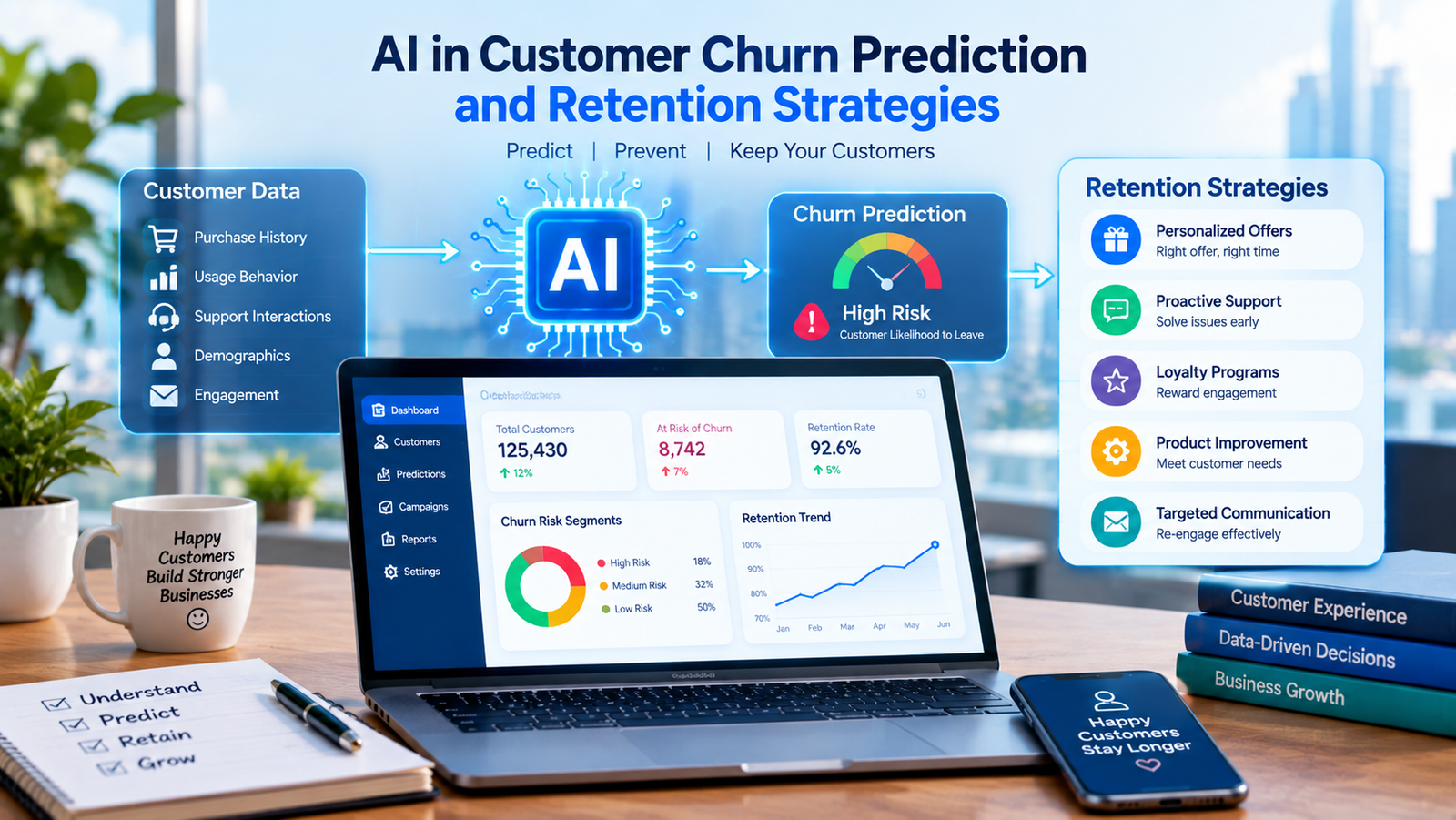
Primary topic: AI in Customer Churn Prediction and Retention Strategies
Research focus: Predictive churn analytics, customer behavior modeling, early-warning signals, explainable AI, retention decisioning, customer lifetime value, causal inference, personalized engagement, and measurable retention outcomes
What Is AI in Customer Churn Prediction?
Customer churn occurs when a customer stops using a product, closes an account, cancels a subscription, or becomes inactive beyond a defined period. The exact meaning depends on the business model. A subscription company may define churn as a cancellation, while a bank may focus on account closure, salary deposits moving elsewhere, or a sustained decline in product usage.
AI-powered churn prediction uses customer data to estimate the likelihood that a customer will leave within a defined period. Machine learning models identify patterns in transactions, product usage, service interactions, payment behavior, and customer history. Businesses can use these predictions to investigate problems and decide whether a retention action is appropriate.
The distinction between prediction and retention is important. A model that identifies likely churners can still fail commercially if the business cannot identify the reason, contact the customer appropriately, or offer a useful solution. A complete system therefore connects prediction, explanation, intervention, and outcome measurement.
How AI-powered retention works
Transactions, usage, service history
Churn probability and timing
Drivers and warning signals
Relevant support or offer
Incremental retention and value
Why Traditional Churn Models Often Fall Short
Traditional churn analysis often relies on historical reports, fixed thresholds, and broad customer segments. These methods can identify patterns such as customers with low activity or repeated service complaints, but they may miss combinations of small behavioral changes that appear before a customer leaves.
For example, a digital bank customer might continue logging in while gradually moving deposits to another institution, reducing card spending, and contacting support about fees. A simple activity threshold could classify the customer as engaged. A model combining transaction trends, product usage, and service interactions may identify a different pattern.
Traditional approaches also tend to treat customers with similar churn probabilities as if they need the same intervention. In practice, one customer may need help resolving a failed payment, another may be dissatisfied with pricing, and another may have no remaining need for the product.
AI can help detect these differences, but the quality of its recommendations depends on the information available and how carefully the system is designed.
Research Study: A Systematic Review of Machine Learning and Deep Learning for Churn Prediction
A 2025 systematic review by Imani and colleagues examined machine learning and deep learning research published between 2020 and 2024. The researchers identified 240 studies for bibliometric analysis and conducted a detailed qualitative synthesis of 61 studies. The review covered churn prediction across industries, including banking, telecommunications, retail, insurance, and subscription services.
The review found that ensemble methods such as XGBoost and LightGBM remained prominent in churn prediction. Deep learning methods, including recurrent neural networks and convolutional neural networks, were increasingly used to capture more complex customer behavior. The review also identified recurring challenges involving class imbalance, model interpretability, concept drift, and the limited use of business-oriented evaluation metrics.
This matters because churn is often a minority outcome. If only a small share of customers leave during a measurement period, a model can achieve high overall accuracy by predicting that nearly everyone will stay. That result may look impressive while providing little practical value to a retention team.
The review also points to a gap between predictive performance and business outcomes. A model should be evaluated not only on whether it identifies churners, but also on whether its predictions help a company allocate retention resources more effectively.
Practical implications
- Use precision, recall, and precision-recall analysis alongside accuracy
- Compare models against a simple baseline before adopting a complex architecture
- Track model performance as customer behavior and products change
- Measure retention value and intervention outcomes, not only prediction quality
Research Study: Ensemble-Based Customer Churn Prediction in Banking
A 2025 study published in Discover Sustainability investigated an ensemble-based approach to predicting customer churn in banking. The researchers used demographic, financial, and behavioral information, including account balance, credit score, tenure, and activity levels. The work explored a voting-classifier approach that combines predictions from multiple machine learning models.
The central idea is that different models can recognize different patterns. One model may perform well with financial variables, while another may capture interactions between customer characteristics and account behavior. An ensemble combines their outputs to produce a final prediction.
For banks, this approach is relevant because customer relationships are multi-product and long-running. Churn may not be visible through a single event. A customer could stop using a debit card while keeping a deposit account, or move regular income deposits to a competitor before formally closing the account.
An ensemble can help combine signals, but it still requires careful testing. If the models share the same weaknesses or rely on outdated data, combining them does not automatically improve the result. The business should test performance on a later time period and examine whether the model works consistently across customer groups.
Practical implications
- Combine financial and behavioral features when they are lawfully available
- Test whether the ensemble improves results over its individual models
- Evaluate performance on future-period data rather than relying only on random splits
- Use explanations to help retention teams understand the strongest risk factors
Research Study: Improving Churn Prediction in Retail Banking
A 2024 study in Financial Innovation examined a framework for improving churn prediction in retail banking. The research focuses on a practical problem: customer attrition data can contain many variables, while churn itself may be difficult to identify consistently.
Retail banking is a particularly useful setting for this research because customers can maintain accounts for years without using every product equally. A customer may remain technically active while gradually shifting their financial activity to another institution. That means churn prediction requires more than detecting formal account closure.
The study’s contribution is its focus on improving the modeling process for a banking-specific churn problem. It reinforces the importance of selecting suitable variables, preparing the data, and evaluating models in a way that reflects the institution’s customer base.
For implementation, banks should define separate churn outcomes where appropriate. Account closure, primary-bank switching, product cancellation, and reduced engagement are related but not identical. Combining them into one label can make the model harder to interpret and can lead to retention actions that do not match the actual risk.
Practical implications
- Define churn according to the business relationship being protected
- Distinguish formal account closure from declining engagement
- Validate models on customer cohorts that resemble the intended deployment population
- Connect each churn definition to a specific retention workflow
Source: A Framework to Improve Churn Prediction Performance in Retail Banking, Financial Innovation, 2024
Research Study: Account Balance as a Signal in Banking Churn
A 2025 study published in AI examined the relationship between account balance and customer attrition. It compared decision trees, random forests, and gradient-boosting methods, using synthetic oversampling to address class imbalance.
The study reported that account balance was an important predictor in its dataset and that boosting methods achieved the strongest predictive performance among the tested approaches. This finding is useful because it illustrates how financial behavior can contain information that customer satisfaction measures alone may not capture.
However, account balance should not be treated as a universal churn rule. A high balance may indicate a valuable customer, but it may also reflect a temporary deposit. A low balance may indicate disengagement, or it may be normal for a customer who uses the account mainly for payments. The meaning depends on the customer’s history, product mix, and financial circumstances.
The correct use of balance is therefore contextual. A model can compare a customer’s current behavior with their own historical pattern, while considering other signals such as incoming payments, card usage, savings activity, and service interactions.
Practical implications
- Use changes in account behavior rather than relying only on absolute balance
- Consider the customer’s product mix and historical patterns
- Check whether the feature behaves differently across customer segments
- Avoid turning a statistical association into an automatic customer decision
Research Study: A Hybrid Deep Learning Framework for E-Commerce Churn
A 2026 study in Scientific Reports proposed a hybrid framework for customer churn prediction in e-commerce. It combines RFM features, embedding-based customer representations, clustering, and deep sequential learning.
RFM stands for recency, frequency, and monetary value. These measures describe how recently a customer purchased, how often they buy, and how much they spend. The framework adds representation learning and clustering to capture customer similarities, then uses sequential modeling to learn from behavior over time.
This is relevant because e-commerce churn rarely has a single universal definition. A customer who buys household supplies every month may be at risk after a short period of inactivity, while a customer who purchases a high-value appliance once every few years may be behaving normally.
A time-aware model can help distinguish these patterns by learning from purchase sequences and customer segments. The study’s approach also addresses the difficulty of working with limited labeled churn data, a common issue when businesses have not tracked customer inactivity consistently.
Practical implications
- Define inactivity windows according to normal purchase frequency
- Use RFM features as a baseline for more advanced behavior models
- Segment customers by purchase patterns before interpreting churn risk
- Evaluate whether deep learning adds value over simpler models
Research Study: Dynamic Customer Behavior Prediction Using Causal Reinforcement Learning
A 2025 paper in Engineering Applications of Artificial Intelligence explored customer behavior prediction in subscription services using causal inference and reinforcement learning. The framework models customers as changing states rather than assigning them to fixed segments indefinitely.
This is an important shift for retention strategy. A customer may move from onboarding to regular use, then into declining engagement, and finally to cancellation. The transition between these states can be influenced by product experience, pricing, customer support, and changing needs.
The study combines causal variables with a modified Markov decision process and reinforcement learning. Its goal is to represent customer behavior dynamically and improve forward-looking predictions. The reported experiments use a Wikipedia traffic dataset and a multinational-organization dataset, so the results should not be interpreted as direct proof of improved retention in every subscription business.
The broader lesson is that customer behavior changes over time. A useful retention system should update its view as new events occur and should distinguish between predicting a future state and estimating the effect of a particular intervention.
Practical implications
- Represent customer journeys as changing states rather than fixed segments
- Update predictions when meaningful customer events occur
- Use causal analysis to investigate whether an intervention changes outcomes
- Test any reinforcement-learning policy in controlled conditions before live deployment
What the Research Means for Business
The studies point to several connected lessons. Ensemble models remain useful for structured customer data, while deep learning can help when behavior is sequential or more complex. Banking research highlights the importance of financial activity, while e-commerce research shows why customer purchase cycles and segmentation matter. Dynamic models add another dimension by treating customer relationships as processes that evolve over time.
The evidence does not establish one universally superior model for every industry. Results depend on the dataset, churn definition, evaluation design, and business environment. A model that performs well on a public banking dataset may not transfer directly to a neobank, subscription platform, or online retailer.
| Research direction | What it contributes | Business application |
|---|---|---|
| Ensemble learning | Combines signals across models | Structured banking and CRM data |
| Deep learning | Learns complex and sequential patterns | Digital usage and purchase histories |
| RFM and clustering | Separates different customer rhythms | E-commerce and repeat-purchase businesses |
| Causal methods | Studies what may change an outcome | Retention offer testing |
| Explainable AI | Makes predictions easier to investigate | Customer support and risk review |
Customer Churn Prediction vs. Retention Optimization
Churn prediction estimates who may leave. Retention optimization decides what the business should do about that risk. These tasks are related, but they require different models and different evidence.
A high-risk customer is not automatically a good candidate for a discount. The customer may be leaving because of a product defect that needs fixing, or the customer may have already decided to leave for reasons the company cannot address. Another customer may have a moderate churn probability but respond strongly to a relevant intervention.
A useful system estimates at least three things:
- Churn risk: How likely is the customer to leave within the defined period?
- Customer value: What future contribution margin may the relationship generate?
- Action effectiveness: How likely is a specific intervention to change the outcome?
Retention decision framework
Investigate the cause and urgency
Estimate the value worth protecting
Select a relevant intervention
Decision: Prioritize interventions when the expected incremental benefit exceeds the cost and the action is appropriate for the customer
Which Data Should an AI Churn Model Use?
The strongest feature set depends on the business model. A neobank, for example, may have transaction activity, card usage, direct deposits, savings behavior, app sessions, support tickets, and product adoption data. A subscription company may rely more heavily on login frequency, feature usage, failed payments, renewal history, and customer support.
| Data category | Example signals | Potential insight |
|---|---|---|
| Product usage | Sessions, feature adoption, inactivity | Declining engagement |
| Financial behavior | Balances, deposits, spend, payment failures | Changing relationship with the service |
| Customer service | Complaints, repeat contacts, resolution time | Unresolved friction |
| Commercial history | Tenure, plan, renewal, product count | Relationship maturity and exposure |
| Customer feedback | Survey responses, support text, reviews | Potential dissatisfaction themes |
Data collection must follow applicable privacy, consumer-protection, and financial-services requirements. Sensitive attributes should not be used simply because they improve predictive performance. Teams should document why each feature is needed, check for proxy discrimination, and restrict access to personal information.
From Churn Scores to Personalized Retention
Once the model identifies a customer at risk, the next step is to select an appropriate response. The action should address the likely cause rather than simply attempt to persuade the customer to stay.
For a neobank, an appropriate action might be resolving a card-payment problem, clarifying a fee, helping the customer activate a useful feature, or improving support. For a subscription platform, it could involve onboarding assistance, plan adjustment, fixing a product issue, or offering a pause option.
| Observed signal | Possible explanation | Potential response |
|---|---|---|
| Repeated payment failures | Payment friction | Troubleshooting and payment support |
| Declining feature use | Low perceived value or changing needs | Relevant onboarding or feature guidance |
| Repeated complaints | Unresolved service issue | Escalation and service recovery |
| Reduced transaction activity | Possible account switching or seasonal change | Contextual review before contacting |
| Upcoming cancellation or renewal | Price, value, or changing requirements | Plan review or relevant alternative |
These are hypotheses, not guaranteed explanations. A model should not infer a customer’s motive with certainty from behavior alone. When the cause is unclear, a respectful question or service review may be more appropriate than a personalized offer.
Measuring Whether Retention Actually Works
A retention campaign can appear successful even when it changes nothing. If a business contacts customers with high churn scores and many remain, the company may conclude that the campaign worked. But some of those customers would have stayed without contact.
This is why controlled experiments are important. Where practical and ethical, eligible customers can be assigned to a treatment group and a comparable control group. The difference in outcomes estimates the incremental effect of the intervention.
A basic measurement framework should include:
- Retention rate: The share of eligible customers who remain active after the measurement period
- Incremental retention: The difference between treatment and control outcomes
- Cost per retained customer: Campaign and incentive costs divided by incremental customers retained
- Incremental contribution margin: Additional contribution attributable to the intervention
- Customer experience: Complaints, opt-outs, satisfaction, and contact burden
The financial decision should be based on incremental contribution, not simply the number of customers who received an offer or remained active.
Customer Lifetime Value and Retention Economics
Customer lifetime value, or CLV, estimates the economic value of a customer relationship over time. A practical model may consider expected revenue, contribution margin, retention probability, servicing costs, and the time value of money.
A churn model and a CLV model answer different questions. Churn prediction estimates the risk of departure, while CLV estimates the value of the relationship. Combining them can help prioritize retention spending, but the result should also consider whether a proposed action is likely to work.
Illustrative retention economicsA customer has an estimated future contribution value of $600. A retention intervention costs $30, and the estimated probability that the intervention changes the customer’s outcome is 10 percentage points.
$600 × 10% − $30 = $30
This simplified example produces $30 in expected net value before considering delivery costs, uncertainty, future servicing costs, and any effects on customer experience. It is an illustration, not a benchmark or forecast.
This approach discourages indiscriminate discounting. A retention incentive may be unnecessary for a customer who would stay anyway, while a high-value customer with a solvable service problem may benefit more from service recovery than from a price reduction.
Visual Framework: A Modern AI Retention Architecture
Customer profiles, events, transactions, service records, consent and preferences
Usage trends, recency, frequency, value, complaints, lifecycle stage
Churn probability, time-to-churn, CLV, explanations, uplift estimates
Eligibility, action selection, channel, timing, budget limits
Experiment results, retention outcomes, model monitoring, feedback
Design principle: Keep predictions, business rules, customer contact policies, and outcome measurement as distinct components. This makes the system easier to audit and improve.
Model Selection: Which AI Approach Should a Business Use?
The right model depends on data volume, feature types, prediction frequency, and the cost of mistakes. For many businesses with structured customer records, gradient-boosted trees provide a strong starting point. They can handle nonlinear relationships and interactions without requiring the scale of data often needed for large deep-learning systems.
Deep learning may be useful when the business has rich sequential data, such as long event histories, product usage sequences, or large volumes of customer interactions. However, more complex models can be harder to explain and maintain. They should be adopted when they deliver a measurable improvement over simpler alternatives.
| Approach | Best fit | Key consideration |
|---|---|---|
| Logistic regression | Baseline and interpretable scoring | May miss complex relationships |
| Random forest | Nonlinear structured data | Calibration and explanation need attention |
| Gradient boosting | Tabular customer datasets | Requires tuning and drift monitoring |
| Sequential deep learning | Detailed behavioral histories | Data and operational complexity |
| Causal or uplift models | Estimating intervention impact | Needs suitable experimental or causal data |
Expert Recommendation
Build a retention decision system, not just a churn dashboard. Begin with a clearly defined churn event, a reliable historical dataset, and a baseline model. Then connect the predictions to a small number of retention actions that address real customer problems.
The recommended approach is to:
- Define separate churn labels for cancellation, account closure, and declining engagement where needed
- Start with a strong, explainable baseline and compare more complex models against it
- Use time-based validation to reduce the risk of data leakage
- Calibrate probabilities so that predicted risk can support operational decisions
- Separate churn risk from customer value and intervention effectiveness
- Run controlled experiments to estimate incremental retention
- Monitor fairness, privacy, model drift, and customer contact frequency
- Give service teams clear explanations and practical next actions
- Review whether the system improves contribution margin and customer experience
For neobanks and digital financial institutions, avoid using churn scores to pressure customers into keeping products they do not need. Retention should focus on fixing service problems, improving product relevance, and making the relationship more useful. A model should not be allowed to make consequential decisions about access to financial services solely because a customer is predicted to leave.
Expert Perspective
A useful conclusion from the 2025 systematic review is that churn modeling still faces gaps in explainability, real-world deployment, and business-aligned evaluation. The review specifically identifies “profit-oriented metrics” as an area where research and practice need greater attention.
Source: Imani et al., Customer Churn Prediction: A Systematic Review, 2025
This is a useful principle for business leaders: a model’s predictive score is an intermediate output. The final test is whether the system helps the business make better decisions without creating unnecessary cost, unfair treatment, or unwanted customer contact.
Implementation Roadmap
Data and Definition
Agree on the churn definition, prediction window, eligible customer population, and outcome data. Audit missing values, inconsistent customer IDs, duplicated records, and changes in product definitions. Confirm that the data can be used for the intended purpose.
Baseline and Validation
Build a baseline model and compare it with candidate machine learning methods. Use time-based validation where possible, and report precision, recall, calibration, and performance across meaningful customer groups. Do not rely on accuracy alone.
Retention Workflow
Connect the model to a limited set of approved actions. Define which teams own each action, when customers can be contacted, what channels are permitted, and when no intervention should be made.
Experimentation
Run controlled tests to measure incremental retention. Track the cost of incentives and service interventions, and compare customer outcomes with a suitable control group.
Monitoring and Improvement
Monitor prediction quality, customer response, drift, and operational costs. Revisit the churn definition when products or customer behavior change. Retrain models only through a documented process with validation and approval.
KPIs for AI-Powered Retention
| Metric | What it measures | Why it matters |
|---|---|---|
| Precision at campaign capacity | How many contacted customers are genuinely at risk | Helps allocate limited outreach resources |
| Recall | Share of churners identified | Shows how much churn risk is missed |
| Probability calibration | Alignment between predicted and observed risk | Supports reliable decision thresholds |
| Incremental retention | Additional customers retained because of the intervention | Separates impact from correlation |
| Net contribution | Incremental value after intervention costs | Measures commercial value |
| Customer experience | Complaints, opt-outs, satisfaction | Detects harmful or excessive outreach |
Future Predictions: 2027–2030
2027: Retention Models Become More Action-Oriented
Businesses are likely to put greater emphasis on linking churn prediction to operational decisions. Instead of producing a static list of at-risk customers, systems will increasingly combine risk, customer value, likely causes, and available interventions. The commercial question will shift toward which action is appropriate for each customer and whether it produces incremental value.
2028: More Dynamic Customer Journeys
As event-based data infrastructure improves, churn models will increasingly update when meaningful events occur, such as a failed payment, a sharp change in product use, a service complaint, or an upcoming renewal. This should make retention workflows more timely, although companies will need controls to prevent excessive notifications and overreaction to short-term changes.
2029: Causal Measurement Gains Importance
Businesses will likely invest more in uplift modeling and experimentation. These methods can help distinguish customers who are likely to stay without intervention from those whose behavior may change because of a specific action. Adoption will depend on experiment quality, sufficient data, and the ability to measure outcomes consistently.
2030: Retention Systems Become Part of Customer Experience Operations
AI retention may become more closely integrated with customer support, product analytics, billing, and customer success systems. The most mature platforms will coordinate prediction, explanation, intervention, and measurement while maintaining clear human oversight. The likely direction is not fully autonomous customer persuasion, but more context-aware service that resolves problems before they become reasons to leave.
These are forward-looking assessments, not guaranteed outcomes. Progress will depend on data quality, privacy requirements, organizational capability, and evidence that interventions create lasting customer value.
Frequently Asked Questions
What is AI customer churn prediction?
AI customer churn prediction uses machine learning to estimate which customers are likely to stop using a product or service within a defined period. It analyzes patterns in customer behavior, transactions, product usage, and service history to identify potential risk before departure occurs.
Which AI model is best for churn prediction?
There is no single best model for every business. Gradient-boosted trees are a useful starting point for many structured datasets, while deep learning can help with complex sequential behavior. Models should be compared using time-based validation and business-relevant metrics.
How does AI improve customer retention?
AI can identify customers at risk earlier, help explain possible causes, and support more relevant interventions. Retention improves only when the actions address customer needs and produce better outcomes than doing nothing.
What data is needed for churn prediction?
Common inputs include customer tenure, product usage, transaction patterns, payment history, service interactions, complaints, renewal events, and changes in engagement. The right features depend on the business model and must be collected and used lawfully.
What is the difference between churn prediction and churn prevention?
Churn prediction estimates the likelihood of a customer leaving. Churn prevention involves taking action to reduce that risk, such as resolving a service issue, improving onboarding, or offering a suitable product or plan.
How can a business measure whether a retention campaign works?
Use a controlled experiment where feasible. Compare outcomes for customers who receive the intervention with a suitable control group, then calculate incremental retention and contribution after campaign costs.
Can AI predict customer lifetime value?
AI can estimate customer lifetime value by modeling future revenue, margin, retention, and servicing costs. These estimates are uncertain and should be validated against realized customer outcomes.
Can churn prediction create privacy or fairness risks?
Yes. Models may use sensitive data or proxy variables, and customer scores can lead to unfair treatment or unwanted targeting. Businesses should minimize data collection, assess model behavior across groups, explain decisions, and maintain appropriate governance.
Final Perspective
AI customer churn prediction is most useful when it is treated as part of a wider customer-retention system. The research reviewed here shows that ensemble methods, deep learning, customer segmentation, financial behavior analysis, and dynamic modeling can all contribute to identifying customers at risk. It also shows why model performance must be evaluated in context rather than assumed to transfer across industries.
For businesses, the opportunity is to replace broad, reactive retention campaigns with earlier and more relevant support. That requires a clear churn definition, reliable data, suitable models, explainable predictions, and interventions that address actual customer problems.
The most important distinction is between identifying customers who may leave and identifying actions that can genuinely change their outcomes. A high churn score does not prove that a customer will leave, and a successful prediction does not prove that a retention campaign worked. Controlled measurement is essential.
A mature AI retention strategy brings together:
The goal should not be to contact every customer who appears at risk. It should be to understand where the relationship is weakening, determine whether the business can help, and offer the right support at the right time. When implemented responsibly, AI can make retention more measurable, more relevant, and more closely aligned with long-term customer value.
Research Sources
- Imani et al., Customer Churn Prediction: A Systematic Review of Recent Advances, Trends, and Challenges in Machine Learning and Deep Learning, 2025
- Ensemble-Based Customer Churn Prediction in Banking: A Voting Classifier Approach for Improved Client Retention, 2025
- A Framework to Improve Churn Prediction Performance in Retail Banking, Financial Innovation, 2024
- Bridging Predictive Insights and Retention Strategies: The Role of Account Balance in Banking Churn Prediction, 2025
- A Novel Hybrid Deep Learning Framework for Customer Churn Prediction Using RFM and Embedding Clustering, Scientific Reports, 2026
- Dynamic Customer Behavior Prediction in Subscription Services Using Causal Reinforcement Learning, 2025
- Artificial Intelligence in Customer Relationship Management: Literature Review and Future Research Directions

Leave a Reply