
Primary topic: Artificial intelligence in regulatory reporting, compliance automation, financial data governance and digital financial infrastructure
Research focus: Regulatory data extraction, reporting validation, reconciliation, regulatory change management, XBRL and structured disclosures, AI-assisted report preparation, audit trails, supervisory technology and human-controlled reporting workflows
What Is AI in Automated Regulatory Reporting?
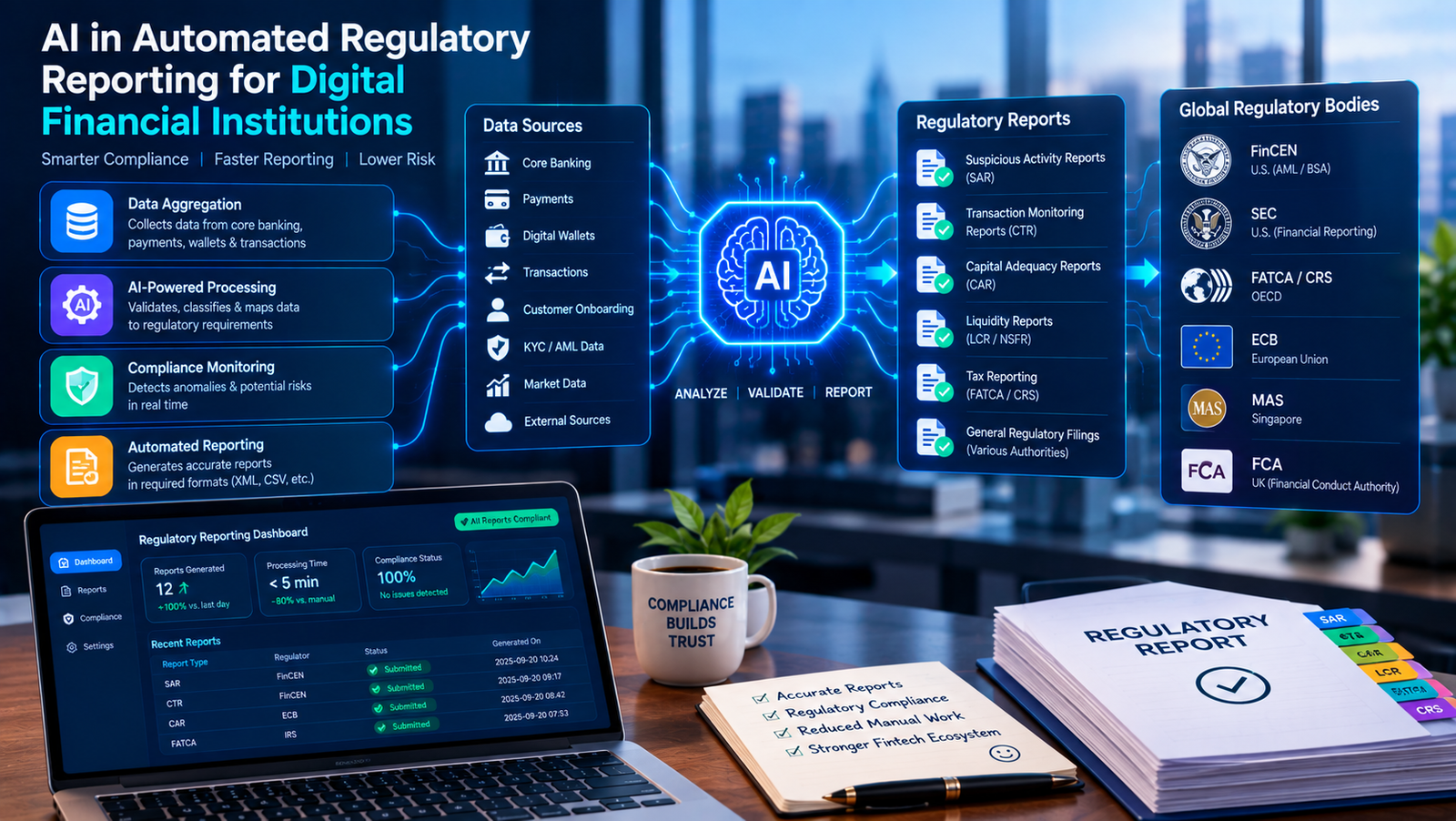
Automated regulatory reporting is the use of software to collect, transform, validate and submit information required by financial regulators. Depending on the institution and jurisdiction, this can include prudential returns, capital and liquidity information, payment statistics, transaction reports, consumer-protection disclosures, financial crime reporting and other regulatory returns.
AI can support this process by working with information that is difficult to handle through fixed rules alone. Examples include interpreting new regulatory instructions, extracting information from unstructured documents, identifying unusual changes in reported figures and helping compliance teams investigate data-quality problems.
The distinction between AI and conventional automation matters. A rules engine can calculate a capital ratio using an approved formula. AI may help identify the relevant data, explain why a figure changed, or interpret a new reporting instruction. The calculation itself should generally remain governed by a controlled, reproducible process.
For digital financial institutions, a mature reporting system therefore combines several capabilities:
- Automated collection of data from banking, payments, lending, treasury and finance systems
- Data mapping that connects internal fields to regulatory definitions
- Controlled calculations using approved formulas and business rules
- AI-assisted extraction and interpretation of regulatory documents
- Validation, reconciliation and exception management
- Version control for reporting templates and regulatory requirements
- Human review, approval and evidence retention
Why Digital Financial Institutions Need a Different Reporting Approach
Digital banks and fintech companies often operate through API-based services, cloud infrastructure, outsourced providers and rapidly changing product systems. A single customer relationship may generate information across a core banking platform, card processor, payment gateway, lending engine, general ledger, fraud platform and customer-support system.
That creates a data-lineage problem. A reporting team may know the final number but struggle to establish exactly which source records, transformations and definitions produced it.
The problem becomes more difficult when an institution operates across jurisdictions. Similar concepts may have different definitions, reporting frequencies, thresholds or submission formats. A field that is valid for one regulator may not be suitable for another.
AI can help manage this complexity, but it cannot resolve inconsistent definitions or missing source data by itself. Institutions need a governed data model that establishes what each field means, where it originates and how it should be transformed before a model is allowed to assist with reporting.
Research Study: Cambridge Judge Business School’s 2026 Global AI in Financial Services Report
The Cambridge Centre for Alternative Finance at Cambridge Judge Business School published its 2026 Global AI in Financial Services Report, examining AI adoption, impact and risks across financial services. Its results provide useful context for regulatory reporting because they distinguish broad AI experimentation from deployment in specific institutional functions.
The report identifies regulatory reporting automation as an area where adoption is still developing. In its use-case table, 5% of respondents reported full deployment, 17% reported a pilot or development stage, and 13% expected deployment within three years. The table lists 110 respondents for this use case, excluding those who marked it as not applicable.
These figures should not be read as a universal adoption rate for every bank or fintech. They describe the survey population and its reporting categories. Nevertheless, they suggest that regulatory reporting automation remains less mature than some other AI applications in financial services.
The research is useful for technology leaders because it highlights a practical gap: institutions may already use AI in customer service, software development or internal productivity while still relying on controlled, largely conventional systems for regulatory submissions.
For product teams, this points to a realistic development path. Begin with bounded tasks such as document extraction, data-quality investigation and report commentary, then expand only after accuracy, traceability and operational controls have been demonstrated.
Source: Cambridge Judge Business School, 2026 Global AI in Financial Services Report
Research Study: Regnology’s 2026 AI Readiness Research
Regulatory technology provider Regnology’s 2026 AI readiness research, titled The Agentic Gap: From Control to Intelligence in Regulatory Reporting, surveyed 276 practitioners across 22 countries. The findings focus directly on the distance between experimenting with AI and trusting it inside the reporting process.
According to the published summary, 71% of surveyed organizations were exploring or piloting AI, while only 16% described AI as embedded in operations.
The distinction is important. A reporting team can successfully demonstrate that an AI model extracts values from a sample document without proving that the same model can operate safely across every reporting period, entity, jurisdiction and exception type.
Production deployment requires more than a promising demonstration. The system must handle incomplete data, changed templates, unusual transactions, late adjustments and failed upstream feeds. It must also produce evidence that allows reviewers to reproduce the result.
For digital financial institutions, the key lesson is to measure deployment maturity through operational controls rather than the number of AI pilots. Useful evidence includes the proportion of reports with automated lineage, the rate of exceptions resolved without manual rework, the frequency of model errors and the time required to investigate a disputed figure.
Source: Regnology, The Agentic Gap: From Control to Intelligence in Regulatory Reporting, 2026
Research Study: Nasdaq and Risk.net’s APAC Regulatory Reporting Survey
Nasdaq and Risk.net surveyed 50 banks across Asia-Pacific about AI in regulatory reporting. The published findings show that 8% of surveyed banks were using AI in regulatory reporting, 10% had use cases in development, and 42% were interested in using AI for this purpose.
The survey is geographically focused, so its results should not be generalized to every global financial institution. Its value lies in its specificity: it examines regulatory reporting rather than AI adoption across banking as a whole.
The accompanying analysis identifies data extraction, calculations and reconciliation as areas where banks are prioritizing automation. Qualitative commentary is harder to govern, while explainability, validation and regulatory acceptance are significant barriers to wider deployment.
This reflects the different risk profiles of reporting tasks. Extracting a value from a known field can be tested against a source document. Generating a narrative explanation requires the system to interpret why the value changed and whether the explanation is supported by evidence.
A practical implementation should therefore separate numerical production from narrative assistance. Calculations should use approved rules and validated data, while AI-generated commentary should cite the underlying metrics and remain subject to review.
Source: Nasdaq and Risk.net, AI in APAC Regulatory Reporting: The Growing Case for Agentic Automation
Research Study: Wolters Kluwer’s 2026 Banking Compliance AI Trend Report
Wolters Kluwer’s Q1 2026 Banking Compliance AI Trend Report draws on a survey of 148 financial institutions. It examines AI adoption, data readiness and regulatory challenges across the banking sector.
The published findings state that 31.8% of respondents had deployed AI or machine learning in production and 29.1% were actively piloting it. However, only 12.2% described their AI strategy as well-defined and adequately resourced.
The report also identifies data quality as the leading challenge, cited by 48% of respondents. Legacy-system integration was cited by 40.5%, while regulatory concerns were cited by 37.8%.
These findings matter directly to regulatory reporting. An AI model cannot reliably prepare a regulatory return if source systems contain inconsistent customer classifications, duplicated transactions, incomplete records or conflicting definitions. Even a technically strong model can produce unreliable results when its inputs are not controlled.
The implication is that institutions should fund data engineering, metadata management, lineage and validation alongside AI development. Reporting teams also need clear ownership of regulatory definitions and a process for resolving disagreements between finance, risk, compliance and technology teams.
Source: Wolters Kluwer, Q1 2026 Banking Compliance AI Trend Report
Research Study: Automated Change Analysis in FinTech Regulations
A 2026 study published in Information and Software Technology examined automated regulatory change analysis in a FinTech setting. The researchers used a mixed-methods approach involving practitioners and investigated whether large language models could help detect and classify regulatory changes.
The study focuses on a recurring operational problem: software and compliance teams must identify which regulatory changes affect their systems, processes and reporting obligations. This work is often handled manually, even though a single regulatory update may affect several internal controls or data fields.
AI-assisted change analysis can help compare versions of regulatory documents, identify modified passages, classify the type of change and direct reviewers toward potentially affected requirements. This can reduce the amount of material that specialists must inspect manually.
However, identifying a textual change is not the same as determining its legal effect. A model may overlook a dependency, misunderstand an exception or classify a change incorrectly. The final interpretation should therefore be confirmed by qualified regulatory specialists.
For automated reporting, this capability can connect regulatory intelligence to the reporting inventory. When a requirement changes, the institution can identify affected templates, data fields, calculations, validation rules, owners and testing procedures.
Research Study: 2026 AI Research on Machine-Readable Financial Reporting
A 2026 article in the Journal of Risk and Financial Management examines machine-readable accountability, eXtensible Business Reporting Language (XBRL), artificial intelligence and the role of structured information in financial reporting.
The research discusses how Inline XBRL combines a human-readable financial report with embedded structured data, while AI can support automated extraction and screening.
This is relevant to regulatory reporting because machine-readable formats create a more consistent foundation for validation and downstream analysis. When reported facts have defined concepts, contexts, units and periods, systems can perform checks that are difficult to apply reliably to unstructured documents alone.
AI can assist with mapping source information to reporting concepts, detecting potential inconsistencies and screening disclosures. But structured tagging does not automatically guarantee that a figure is correct. The underlying accounting treatment, reporting definition and source data still need to be valid.
For digital financial institutions, the lesson is to treat structured reporting standards and AI as complementary. Standardized data makes automation more dependable, while AI can help manage the interpretation and review tasks that remain difficult to express as fixed rules.
Where AI Adds Value Across the Reporting Lifecycle
AI should be applied to specific reporting tasks, not treated as a single system that autonomously produces every regulatory return. The following map separates areas where AI can assist from controls that should remain deterministic or subject to formal approval.
| Reporting activity | AI contribution | Required control |
|---|---|---|
| Regulatory document intake | Classify documents and extract requirements | Reviewer confirms applicability |
| Data mapping | Suggest mappings between internal and regulatory fields | Approved mapping catalogue |
| Data validation | Detect unusual values and likely root causes | Deterministic validation rules |
| Reconciliation | Group mismatches and suggest explanations | Reproducible calculations and sign-off |
| Narrative commentary | Draft explanations from approved metrics | Evidence-linked human review |
| Submission preparation | Check completeness and identify exceptions | Authorized approval and submission controls |
AI-Powered Regulatory Data Extraction
Regulatory reporting often depends on information held in documents, spreadsheets, contracts, policy manuals and operational records. Intelligent document processing can classify these materials, extract relevant fields and attach the extracted values to their source locations.
For example, a reporting workflow may need to identify a contractual maturity date, a counterparty category or a specific financial amount. AI can suggest the value and its context, while validation logic checks the expected format and reporting rules.
The most important design principle is source traceability. Each extracted value should retain the document identifier, page or field location, extraction timestamp, model version and review status. If the value is later challenged, the reporting team should be able to return to the original evidence.
Regulatory Data Mapping and Semantic Consistency
A common reporting failure occurs when different systems use similar labels for different concepts, or different labels for the same concept. A payment platform might record a merchant category, while a regulatory template asks for a different classification defined by a specific rulebook.
AI can suggest possible mappings by comparing field names, descriptions, data types and surrounding documentation. It can also flag fields that appear to have changed meaning between system versions.
However, mapping decisions should be stored in a controlled catalogue rather than recreated by a language model each reporting cycle. The catalogue should include the source field, target reporting concept, transformation, effective date, approving owner and relevant regulatory reference.
This creates a reusable foundation for multiple reports and reduces the risk that two teams interpret the same data differently.
Automated Reconciliation and Anomaly Detection
Reconciliation compares figures across systems or reporting views. A digital institution might need to reconcile payment totals against the general ledger, loan balances against the servicing platform, or regulatory aggregates against finance-approved figures.
AI can help identify unusual differences and group exceptions that share a likely cause. For instance, a sudden mismatch may be associated with a delayed data feed, a changed product code, a duplicated batch or an unexpected reversal pattern.
The model should not silently alter a regulatory value to make two systems agree. Instead, it should explain the discrepancy, point to the underlying records and route the issue to an accountable owner.
The model explains and prioritizes exceptions; approved rules and accountable staff determine how the reporting record is corrected.
Regulatory Change Intelligence
Regulatory change management is a natural use case for language models because requirements are often published as long documents with cross-references, definitions, exceptions and implementation dates.
An AI-assisted system can compare a new document with the previous version, summarize changed passages, classify affected topics and identify reporting templates that may need review. It can also create a structured change record for compliance and technology teams.
A useful change record should include:
- The source regulator and publication date
- The affected rule, paragraph or reporting instruction
- The effective date and implementation deadline
- The potentially affected products, entities and jurisdictions
- The reporting fields, validations and workflows that may change
- The assigned business owner and approval status
- The test evidence required before production release
AI should help discover and organize changes, but qualified specialists must determine the institution’s legal obligations. This distinction is essential when a document contains ambiguous language or when a change interacts with existing rules.
Generative AI for Regulatory Commentary
Regulatory submissions may require explanations of material changes, unusual movements or significant exceptions. Generative AI can prepare an initial narrative from approved data, helping teams reduce repetitive writing.
The model should receive only controlled facts, such as the current-period value, prior-period value, approved reason codes and relevant supporting evidence. It should not invent explanations for changes that the data does not establish.
A safe commentary workflow uses evidence-linked generation:
↓
Evidence and variance analysis
↓
AI-generated commentary
↓
Fact and policy checks
↓
Human approval
For example, the system may state that a reported balance increased by a certain amount if the calculation confirms it. It should not claim the increase was caused by customer growth, pricing changes or a new product unless supporting evidence establishes that cause.
Architecture for AI-Enabled Regulatory Reporting
A production-grade system should separate source data, regulatory logic, AI services and submission controls. This reduces the chance that a probabilistic model can silently change a controlled calculation or bypass approval.
Core banking, payments, lending, finance ledger, treasury, customer systems and external reference data
Governed data layer
Data quality, lineage, ownership, metadata, access controls and reconciled datasets
Reporting engine
Approved calculations, regulatory mappings, validation rules and versioned templates
AI assistance layer
Document extraction, change analysis, anomaly explanations and evidence-based commentary
Control and approval layer
Exception queues, reviewer sign-off, audit logs and submission authorization
Regulatory output
Validated reports, structured files, submission records and retained evidence
Key Risks and Controls
| Risk | Potential consequence | Control |
|---|---|---|
| Incorrect extraction | Wrong value enters a return | Source-linked validation and sampling |
| Hallucinated commentary | Unsupported explanation is submitted | Evidence-constrained generation and approval |
| Incorrect rule mapping | Misclassified reporting data | Approved mappings and effective-date control |
| Model drift | Quality declines as data or rules change | Monitoring and periodic revalidation |
| Data leakage | Sensitive financial information is exposed | Least-privilege access and approved environments |
| Uncontrolled automation | Submission occurs without proper review | Segregation of duties and release gates |
Expert Recommendation
Financial institutions should begin with AI tasks that are measurable, reversible and easy to verify. Data extraction, document classification, change detection, exception grouping and evidence-based commentary are often more suitable starting points than allowing an AI agent to produce and submit a complete regulatory return without intervention.
The implementation strategy should follow these principles:
- Keep calculations deterministic: Use approved formulas and controlled reporting logic for material financial figures
- Make every value traceable: Preserve links from reported fields to source records and transformations
- Use AI where interpretation is needed: Apply models to document understanding, anomaly investigation and change analysis
- Require evidence for explanations: Commentary should be grounded in approved metrics and supporting records
- Version regulatory requirements: Track effective dates, mappings, templates and validation rules
- Test against difficult cases: Include missing data, restatements, late adjustments and unusual transactions
- Keep human accountability: Assign owners for interpretation, exception resolution and final submission
- Measure operational outcomes: Track rework, error rates, review time and on-time submission performance
The key principle is that AI should make the reporting process easier to operate and inspect, not harder to explain.
Expert Quotation
Wolters Kluwer, Q1 2026 Banking Compliance AI Trend Report
This finding captures the central challenge in automated regulatory reporting. The model is only one component of the system. Data quality, reporting definitions, control ownership, integration and evidence management determine whether AI can be used reliably in a regulated workflow.
Implementation Roadmap
The first pilot should use a reporting process with a clear owner, stable definitions, accessible source data and a meaningful manual workload. The institution should record the existing baseline before deployment so that it can measure whether AI actually improves the process.
KPIs for Measuring Success
| KPI | What it measures |
|---|---|
| First-pass validation rate | Share of reports passing defined checks without correction |
| Reconciliation exception rate | Frequency of unresolved differences between source systems |
| Manual review time | Effort required to validate and approve a report |
| Traceability coverage | Share of reported values linked to source evidence |
| On-time submission rate | Share of submissions completed by the applicable deadline |
| AI correction rate | Frequency of material AI suggestions rejected or corrected |
| Change implementation time | Time from confirmed regulatory change to tested implementation |
A reduction in preparation time is useful, but it should not be the only success measure. A system that produces reports faster while increasing correction rates or weakening traceability is not delivering a sound regulatory outcome.
Future Predictions: 2027–2030
Regulatory Change Intelligence Will Become More Connected
AI tools are likely to become more closely linked to regulatory inventories, reporting templates and change-management workflows. Instead of producing only a summary of a new rule, systems will increasingly help identify affected fields, controls, owners and test cases. Human specialists will still need to confirm the legal interpretation and implementation requirements.
Reporting Agents Will Handle More Bounded Tasks
Agentic systems may coordinate document extraction, reconciliation, validation and exception preparation across multiple tools. In regulated environments, adoption is likely to depend on permissions, logging, deterministic checks and clear limits on what an agent can change or submit.
Data Lineage Will Become a Competitive Capability
As reporting becomes more automated, institutions will need to explain not only the final figure but also its origin, transformations and approvals. Strong lineage will support audits, issue resolution, restatements and faster responses to supervisory questions.
Structured Data Will Support More Automated Validation
Machine-readable reporting formats and standardized data definitions can make automated checks more consistent. AI will add value where documents, exceptions and changing instructions require interpretation, while structured rules will continue to govern the meaning and calculation of reported values.
Human Review Will Shift Toward Exceptions
As routine extraction and reconciliation improve, reporting specialists may spend less time checking every ordinary record and more time investigating exceptions, approving changes and evaluating model performance. This shift depends on reliable controls; it should not be assumed that every report can safely become fully autonomous.
Startup Opportunities
The market offers opportunities for focused products that solve specific reporting problems rather than attempting to replace an institution’s entire regulatory technology stack.
- Regulatory change intelligence: Compare new and previous rules, classify changes and map potential reporting impacts
- AI data-lineage assistant: Explain where a reported value originated and which transformations were applied
- Regulatory data mapping: Suggest mappings between internal data fields and regulatory concepts
- Reconciliation copilot: Group mismatches and help analysts investigate their likely causes
- Evidence-linked reporting commentary: Generate explanations from approved metrics and source records
- Reporting quality assurance: Detect unusual movements, missing fields and inconsistent classifications
- Multi-jurisdiction reporting tools: Manage different templates, deadlines and definitions through a governed rules catalogue
For a startup, a narrow product with measurable accuracy and clear integration boundaries may be easier to validate than a fully autonomous reporting platform. The strongest differentiation is likely to come from domain-specific data models, transparent evidence trails, reliable integrations and tested regulatory workflows.
Frequently Asked Questions
What is AI in automated regulatory reporting?
AI in automated regulatory reporting uses machine learning, natural language processing and related technologies to assist with regulatory data extraction, mapping, validation, anomaly detection, regulatory change analysis and report preparation. The final reporting process still needs controlled calculations, evidence and appropriate approval.
Can AI prepare regulatory reports automatically?
AI can automate or assist with parts of report preparation, including extracting information, identifying exceptions and drafting commentary. Fully automated submission requires additional controls, validated data, approved reporting logic and authorization appropriate to the institution and jurisdiction.
How does AI improve regulatory reporting accuracy?
AI can help identify unusual values, missing information, inconsistent classifications and potential reconciliation problems. Accuracy improves only when these capabilities are supported by reliable source data, deterministic validation and effective human review.
What is the role of generative AI in regulatory reporting?
Generative AI can summarize regulatory documents, suggest data mappings, explain variances and draft commentary from approved evidence. It should not invent causes, legal interpretations or financial figures that cannot be supported by source records.
What are the main risks of AI in regulatory reporting?
Key risks include incorrect extraction, unsupported explanations, poor data quality, model drift, privacy breaches, incorrect regulatory interpretation and insufficient auditability. Institutions should use evidence-linked outputs, independent validation, access controls and formal approval workflows.
Which regulatory reporting tasks should be automated first?
Good starting points include document classification, source-data quality checks, reconciliation exception grouping, regulatory change comparison and drafting commentary from approved metrics. These tasks can be tested against known evidence before being expanded to higher-risk activities.
Will AI replace regulatory reporting teams?
AI is more likely to change how reporting teams allocate their time than remove the need for specialists. Data interpretation, regulatory judgment, exception resolution, governance and accountability remain important even when routine tasks are automated.
Final Perspective
AI can make regulatory reporting more timely, consistent and easier to investigate, but the value comes from improving the complete reporting process rather than generating documents more quickly.
The research points to a clear implementation challenge. Cambridge’s 2026 financial-services research shows that regulatory reporting automation remains an emerging AI use case. Regnology’s survey highlights the gap between AI experimentation and embedded operations, while the Nasdaq and Risk.net survey identifies data extraction, calculations and reconciliation as practical areas of interest. Wolters Kluwer’s findings reinforce the importance of data quality and legacy integration, and research into automated regulatory change analysis shows how AI may help teams connect changing rules to the systems that implement them.
These findings support a disciplined approach. Institutions should establish reliable data foundations, preserve the distinction between probabilistic AI and deterministic reporting logic, and make every material output traceable to its source. AI can then help analysts identify problems earlier, investigate exceptions more efficiently and prepare clearer evidence for review.
The long-term direction is not simply automated report writing. It is a reporting environment where regulatory changes, governed data, validated calculations, exception analysis and approval workflows are connected.
For digital financial institutions, the central objective should be straightforward: make regulatory reporting more efficient without weakening accuracy, accountability or auditability.
Research Sources
- Cambridge Judge Business School, 2026 Global AI in Financial Services Report
- Regnology, The Agentic Gap: From Control to Intelligence in Regulatory Reporting, 2026
- Nasdaq and Risk.net, AI in APAC Regulatory Reporting
- Wolters Kluwer, Q1 2026 Banking Compliance AI Trend Report
- Information and Software Technology, Investigating Automated Change Analysis in FinTech Regulations, 2026
- Journal of Risk and Financial Management, Machine-Readable Accountability: XBRL, Artificial Intelligence, and the Institutional Rewriting of Accounting Judgement, 2026

Leave a Reply