
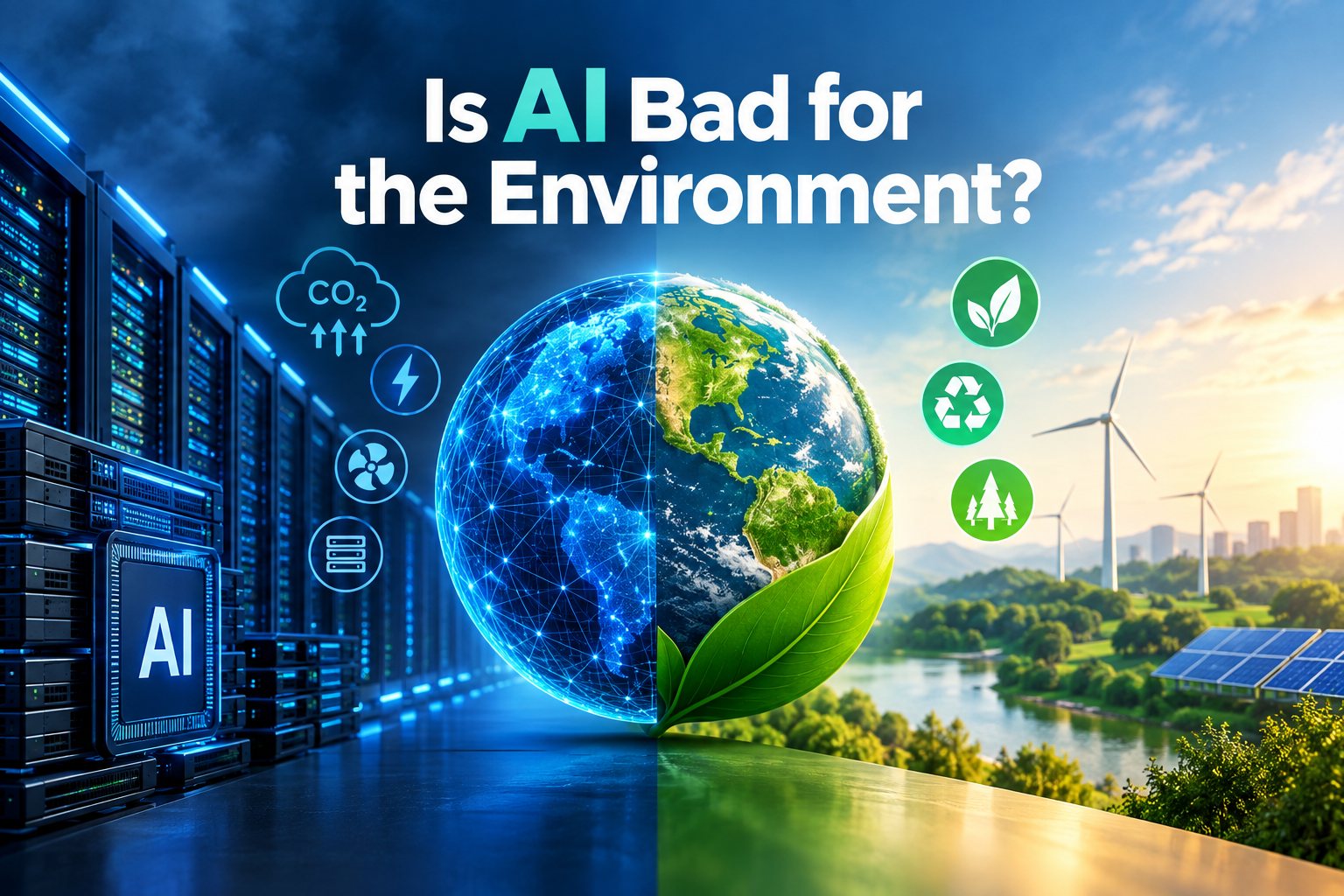
Artificial intelligence can help scientists study climate change, improve energy systems, and reduce waste. But the technology also needs electricity, water, computer chips, and large data centers. As AI use grows across the United States, the environmental question is no longer just how much energy one prompt consumes. It is how much infrastructure AI requires, where that infrastructure is built, and whether its benefits can outweigh its environmental costs.
The short answer
AI can harm the environment, particularly when its growth increases fossil-fuel electricity use, water demand, hardware production, and electronic waste. However, AI is not automatically harmful in every application. It can also support energy efficiency, climate research, and environmental monitoring. Its overall impact depends on how much computing is used, how data centers are powered and cooled, how hardware is manufactured, and whether AI delivers measurable environmental benefits.
For people in the United States, this question has become increasingly practical. Data centers are being planned and built to support cloud computing, generative AI, and other digital services. These facilities can bring investment and infrastructure, but they can also increase local electricity demand, require new power lines, consume water, and compete with other land uses.
There is no single number that captures the environmental cost of all AI. Training a large model, answering a short text question, generating a high-resolution video, and running an AI agent continuously are different workloads. Their energy and water requirements can vary substantially.
This article examines the evidence, with a focus on the United States. It explains the environmental costs of AI, what research says about energy and water use, how AI may help the environment, and what technology companies, policymakers, and consumers can do to reduce the damage.
Why AI Has an Environmental Footprint
AI software runs on physical infrastructure. The systems behind a chatbot or image generator use processors, memory, storage, networking equipment, and data centers. These machines need electricity to operate and cooling systems to remove heat. They also require buildings, construction materials, water infrastructure, and hardware manufactured through global supply chains.
That means AI’s environmental impact comes from several connected sources. Looking only at the electricity used by a model during one task leaves out much of the picture.
Electricity
Servers, networking, storage, and cooling equipment draw power. The climate impact depends partly on how that electricity is generated.
Water
Some data centers use water for cooling. Electricity generation can also consume water, creating an indirect water footprint.
Hardware and materials
AI chips, servers, batteries, buildings, and network equipment require raw materials, manufacturing, and transport.
Electronic waste
Replacing servers and accelerators creates equipment that must be reused, refurbished, or responsibly recycled.
These impacts are connected. A data center powered by a carbon-intensive grid can create more emissions than an otherwise similar facility using lower-carbon electricity. A facility in a water-stressed region may raise different concerns from one in a water-abundant area. A more efficient chip can reduce electricity use per task, but the benefit may be partly offset if the company runs many more tasks.
How Much Electricity Does AI Use?
Electricity is one of the clearest environmental concerns because AI depends on energy-intensive computing infrastructure. Large AI models may require substantial computing resources during training. After a model is released, it continues to consume energy whenever people use it or when businesses run it inside their products.
Training and everyday use are different parts of the energy picture. Training involves developing a model using large datasets and repeated computation. Inference is the process of using a trained model to generate an answer, image, prediction, or other output. A model may be trained occasionally but serve millions or billions of requests over time.
For popular services, the total energy used during everyday operation can become significant because usage is repeated at scale. The amount depends on model size, hardware, output length, system efficiency, and how much of the available computing capacity is actually used.
What the US data center outlook tells us
The US Department of Energy and Lawrence Berkeley National Laboratory published research examining electricity use by data centers in the United States. Their report estimated that data centers consumed about 4.4% of total US electricity in 2023. It projected that the share could rise to approximately 6.7% to 12% by 2028 under the scenarios studied.
These figures cover data centers overall, not AI alone. Data centers support many services, including cloud computing, business software, video, storage, and conventional internet infrastructure. AI is an important driver of new demand, but it would be inaccurate to describe the entire projected increase as AI electricity consumption.
The range also matters. It reflects uncertainty about how quickly data centers will grow, how efficiently they will operate, and how much computing demand will materialize. It is a projection, not a measurement of what has already happened.
A data center’s electricity use is not automatically equal to AI’s electricity use. Good environmental reporting should separate AI workloads from other computing wherever reliable data is available.
What Research Says About AI’s Carbon Emissions
Electricity use and carbon emissions are related, but they are not the same thing. The climate impact of a data center depends partly on the electricity sources serving it. Power generated from coal or natural gas generally produces more operational greenhouse gas emissions than wind, solar, or nuclear power.
A 2025 study published in Nature Sustainability examined the potential energy, water, and climate impacts of AI servers deployed in the United States between 2024 and 2030. Its scenario analysis estimated that annual AI-server-related carbon emissions could reach tens of millions of metric tons of carbon dioxide equivalent, with results depending on the scale and location of deployment, efficiency improvements, and the pace of grid decarbonization.
The study’s abstract gives a range of 24 to 44 million metric tons of additional annual CO₂-equivalent emissions under the deployment scenarios it assessed. This is a modeled estimate, not a direct measurement of all AI emissions in the United States. It also depends on assumptions about future infrastructure and electricity supply.
The research highlights an important point: where AI servers are installed can change their environmental footprint. A region with lower-carbon electricity may reduce emissions per unit of computing, while a region relying more heavily on fossil fuels may produce a larger footprint for similar workloads.
Why renewable energy claims need context
Technology companies often announce renewable energy purchases or clean-energy projects. These efforts can help support a lower-carbon electricity system, but they do not automatically mean every data center runs on renewable electricity every hour.
There is a difference between matching annual electricity consumption with renewable energy certificates or purchases and ensuring that a facility’s electricity demand is met by low-carbon power at the time it operates. The location of generation, timing, grid conditions, and the way emissions are accounted for all matter.
For a more complete picture, companies should report actual electricity demand, the energy sources serving their facilities, the methodology used to calculate emissions, and how their clean-energy purchases relate to the locations where they consume power.
Does AI Use a Lot of Water?
Water is another important part of the discussion, especially for data centers located in areas that already face water stress. Some facilities use water-based cooling systems to remove heat from servers. The amount consumed depends on the cooling design, weather, facility efficiency, and operating conditions.
There is also an indirect water footprint. Power plants can use water to generate electricity, so a data center may be associated with water consumption even when its own cooling system uses little water. This makes it important to distinguish direct water use at a facility from water associated with the electricity it consumes.
A study published in Nature Sustainability modeled the US AI-server water footprint under different deployment scenarios. It estimated annual water footprints ranging from approximately 731 million to 1.125 billion cubic meters across the scenarios it examined. These are modeled estimates with substantial uncertainty, not a universal figure for every AI service or a guaranteed future outcome.
The study also found that location matters. Climate, local water conditions, cooling systems, and the water intensity of electricity generation can change the overall footprint. A location that performs well on carbon emissions may not always minimize water use, so companies need to consider both.
Why a single “water per prompt” number can mislead
You may see claims that a particular AI question consumes a specific amount of water. Such figures can be useful when their assumptions are clear, but they should not be treated as universal measurements.
Water use can vary with the model, workload, data center, cooling system, local climate, and electricity source. Some estimates include only direct cooling water, while others include water used to generate electricity. Some divide facility-level water use across computing workloads using assumptions that may not be publicly verifiable.
For this reason, a claim such as “every AI prompt uses exactly this many milliliters of water” is usually too broad unless it specifies the service, measurement method, location, and accounting boundary.
The Hidden Environmental Cost of AI Chips and Hardware
AI’s environmental footprint begins before a data center switches on. Advanced processors, memory, servers, cooling equipment, and networking hardware must be designed, manufactured, transported, and eventually replaced.
Semiconductor manufacturing is complex. It requires specialized facilities, energy, ultrapure water, and a range of materials and chemicals. The environmental impact of a particular chip depends on its design, manufacturing process, supply chain, and useful life.
AI hardware can also become outdated quickly as companies seek greater performance. Replacing equipment too often can increase the demand for new manufacturing and create more electronic waste. Extending the useful life of hardware, improving utilization, and refurbishing equipment can reduce some of these pressures.
However, keeping older equipment in service is not always automatically better. A newer, more efficient server may use less electricity per unit of work. The relevant question is whether the operational savings justify the environmental cost of manufacturing and replacing the equipment. That requires lifecycle analysis rather than looking at electricity efficiency alone.
Companies should therefore measure more than the power used by active servers. A credible environmental assessment should consider hardware production, equipment lifetime, utilization, replacement cycles, and end-of-life treatment where data is available.
AI Data Centers Can Affect Local Communities
The environmental impact of AI is not limited to global carbon emissions. Large data center projects can also affect the communities where they are built.
Potential local concerns include increased electricity demand, new transmission infrastructure, water consumption, land use, construction activity, backup generators, and noise from cooling equipment. The significance of each issue depends on the project and its location.
In the United States, data center development has become a public discussion because large facilities can require substantial power capacity. Even when a company plans to purchase clean energy, local grid infrastructure may need upgrades to serve the project. Those upgrades can raise questions about who pays, how quickly new capacity becomes available, and whether local residents face higher costs or other impacts.
These concerns should be assessed project by project. A data center built in a region with available power, low water stress, and strong infrastructure may have a different local impact from one built where electricity supply or water resources are already constrained.
Local planning decisions should consider transparent energy and water estimates, grid impacts, construction effects, community input, and the facility’s expected contribution to the local economy.
Is AI Becoming More Efficient?
Yes, there is evidence that AI systems can become more efficient. Better chips, optimized software, improved model architectures, higher server utilization, and more efficient cooling can reduce the resources needed for a given task.
A 2025 research paper by Google researchers, published as a preprint, measured the environmental impact of serving Gemini Apps text prompts in Google’s production infrastructure. The paper reported a median energy use of 0.24 watt-hours per text prompt and a median water use of 0.26 milliliters under the methodology described by the authors. It also reported substantial reductions in the measured footprint over the preceding year.
These figures are useful because they come from a production measurement rather than a generic estimate. But they should be interpreted carefully: they describe a particular service and measurement system. They are not a benchmark for every AI model, every prompt, image generation, video generation, or all of Google’s AI activity.
Efficiency improvements matter, but they do not guarantee that total environmental impact will fall. If each task becomes cheaper and faster, people and companies may use AI more often. This is sometimes described as a rebound effect: efficiency reduces the cost of using a resource, which can increase total demand.
For example, a more efficient model may reduce the energy needed for one response. But if a company then adds AI to thousands of workflows, generates large volumes of synthetic content, or runs agents continuously, its total electricity use may still rise.
A system can become more efficient per task while using more energy overall. Environmental progress depends on both efficiency gains and the total scale of computing demand.
Can AI Help the Environment?
AI can also support environmental goals. The technology is being explored in areas such as energy forecasting, building management, climate research, agriculture, industrial efficiency, and ecosystem monitoring.
For example, AI-based forecasting can help grid operators estimate electricity demand and renewable energy production. Better forecasts may help operators balance supply and demand. In buildings, AI can help manage heating, ventilation, and cooling systems. In manufacturing, it can help identify equipment problems and reduce wasted materials.
AI can also help researchers analyze large environmental datasets, identify patterns in satellite imagery, monitor deforestation, and improve some forms of weather and climate modeling. These applications may produce meaningful benefits when they improve decisions or enable work that would otherwise be difficult or costly.
| Application | Potential environmental benefit | What must be measured |
|---|---|---|
| Power grid forecasting | Better matching of supply and demand | Changes in reliability, curtailment, and emissions |
| Building optimization | Potentially lower heating and cooling demand | Actual energy use before and after deployment |
| Precision agriculture | More targeted use of water, fertilizer, and other inputs | Water use, input use, yield, and local conditions |
| Environmental monitoring | Faster analysis of satellite and sensor data | Detection accuracy and resulting conservation action |
| Industrial maintenance | Less downtime, waste, and avoidable equipment failure | Material savings and lifecycle emissions |
But a potential benefit is not the same as a proven net benefit. An AI system used to optimize a building may save electricity, but its own computing footprint must also be considered. A system that improves industrial output may increase total production, which can change the overall environmental result.
The right question is not simply whether AI can help the environment. It is whether a specific AI application produces a measurable environmental improvement after accounting for the energy, water, hardware, and other resources it requires.
How US Technology Companies Can Reduce AI’s Environmental Impact
Companies building and operating AI systems have several ways to reduce their environmental footprint. The most effective approach depends on the facility, workload, and local energy and water conditions.
Use lower-carbon electricity
Data center operators can reduce operational emissions by using lower-carbon electricity and supporting the development of clean power. The timing and location of electricity supply matter, so companies should explain how their energy procurement relates to the facilities and workloads being served.
Improve hardware utilization
Servers that sit idle or run inefficiently still contribute to the infrastructure footprint. Better scheduling, workload consolidation, and resource allocation can help companies get more useful computing from the equipment they already operate.
Choose cooling systems based on local conditions
Cooling choices should account for both energy and water. A system that reduces electricity use may have different water requirements. Operators should evaluate the local climate, water availability, facility design, and the full environmental trade-offs.
Use smaller models when they are sufficient
Not every business task requires the largest available model. A smaller model, a conventional software tool, or a simpler automated workflow may deliver the required result with fewer computing resources. Companies should select models based on task requirements, quality, safety, and total cost rather than assuming that the largest model is always necessary.
Extend hardware life and reduce e-waste
Companies can evaluate whether equipment can be reused, refurbished, or redeployed before replacing it. Responsible recycling and better tracking of hardware lifecycles can reduce waste and improve visibility into the environmental cost of AI infrastructure.
Publish meaningful environmental data
Companies should report energy consumption, emissions, water use, and the boundaries used for their calculations. Where possible, they should distinguish AI workloads from other data center activity. Clear reporting makes it easier for customers, researchers, investors, and communities to understand progress.
What Consumers Can Do
Individual users are not responsible for the entire environmental footprint of the AI industry. Decisions about data centers, electricity supply, hardware manufacturing, and infrastructure investment are largely made by companies and institutions. Still, consumers can make practical choices.
- Use AI when it adds value. Avoid unnecessary, repeated, or extremely large tasks when a simpler approach will work.
- Choose the right tool for the task. A basic search, calculator, or standard software feature may be enough for a simple question.
- Avoid wasteful regeneration. Be clear about what you need before requesting multiple versions of an image, video, or long output.
- Support transparency. Pay attention to whether AI providers publish credible information about energy, water, and emissions.
- Consider the wider impact. When choosing digital services, look at privacy, reliability, accessibility, and environmental reporting rather than one sustainability claim alone.
There is no need to assume that every AI interaction causes major environmental harm. The impact of a single task may be small, while the combined effect of millions of tasks and the infrastructure behind them can be substantial. Both facts can be true.
What Needs to Change in AI Environmental Reporting?
One of the biggest barriers to understanding AI’s footprint is limited transparency. Researchers often cannot separate AI workloads from other data center activity because companies do not consistently publish detailed, comparable figures.
A 2025 paper in Patterns examined the carbon and water footprints of data centers and the implications for AI. It argued that estimating AI’s environmental impact is difficult because public reporting often does not distinguish AI workloads from non-AI workloads, and key operational information may not be disclosed.
The paper estimated a wide range for AI’s global carbon and water footprints in 2025. Those estimates should be understood as model-based assessments using available disclosures and assumptions, rather than direct measurements of every AI system. The authors emphasized the need for better environmental reporting to improve the accuracy of future assessments.
More useful reporting would distinguish training from inference, identify the scope of facilities included, explain direct and indirect water use, disclose electricity sources, and describe how hardware manufacturing is treated. It should also explain the uncertainty around estimates instead of presenting a single number as a universal fact.
For US policymakers and local authorities, consistent reporting could help communities assess proposed data center projects and understand their likely effects on power systems, water resources, and emissions. For companies, it could make environmental performance easier to compare and improve.
Will AI’s Environmental Impact Get Worse by 2030?
There is no certain answer. AI demand may continue to grow, while hardware, software, cooling, and electricity systems become more efficient. The balance between those trends will shape the result.
Three broad scenarios help explain what could happen.
High-demand scenario
AI use expands rapidly, data centers grow, and efficiency improvements fail to keep pace with demand. Total energy and resource use rises.
Mixed-progress scenario
More efficient systems reduce the impact per task, but growing adoption still increases total infrastructure demand.
Lower-impact scenario
Efficiency, cleaner electricity, water-aware siting, longer hardware lifetimes, and useful applications limit environmental costs.
These are illustrative scenarios, not predictions of which outcome will occur. The future will depend on the scale of AI adoption, the energy mix, the speed of grid and infrastructure development, and whether companies measure and manage their environmental impact.
The most important issue is whether total resource demand grows faster than efficiency improves. A lower energy cost per AI task is valuable, but it does not guarantee lower total emissions or water use if the number and complexity of tasks increase much faster.
Frequently Asked Questions
Is AI bad for the environment?
AI can harm the environment through electricity consumption, carbon emissions, water use, hardware manufacturing, and electronic waste. It can also support environmental improvements in areas such as energy management and climate research. Its overall impact depends on how it is built, powered, used, and measured.
Does ChatGPT use a lot of electricity?
ChatGPT uses computing infrastructure that consumes electricity, but the energy required for an individual request depends on factors such as the model, hardware, output length, and infrastructure efficiency. Estimates for one service or model should not be treated as universal figures for all AI systems.
Does AI consume water?
AI can be associated with direct water use for data center cooling and indirect water use from electricity generation. The amount varies by facility, cooling technology, climate, power source, and accounting method.
Are AI data centers increasing US electricity demand?
Data center electricity demand in the United States is projected to rise, with AI among the important drivers. However, overall data center estimates also include non-AI workloads, so the total should not be described as AI-only electricity use.
Can AI help fight climate change?
AI can help with tasks such as renewable energy forecasting, building efficiency, environmental monitoring, and scientific research. Whether a specific application provides a net environmental benefit depends on the resources it consumes and the real-world improvements it produces.
Will more efficient AI solve the environmental problem?
Efficiency can reduce the resources required for each task, but total impact may still rise if AI use expands quickly. Reducing environmental harm requires efficiency improvements alongside clean energy, responsible infrastructure planning, water management, and transparent reporting.
Conclusion: AI’s Environmental Impact Depends on the Choices We Make
So, is AI bad for the environment? The evidence shows that AI has a real and growing environmental footprint, particularly through the electricity, water, and physical infrastructure required to operate it. In the United States, projected data center growth raises important questions about power supply, emissions, water resources, and the effects of new facilities on local communities.
But a simple yes-or-no answer misses the full picture. AI can also help improve energy systems, support environmental research, and reduce waste in some industries. Those benefits need to be measured rather than assumed, just as environmental costs should be based on transparent data rather than viral estimates.
The priority for the AI industry should be to reduce the footprint of each useful task, power infrastructure with lower-carbon electricity, use water responsibly, extend hardware lifetimes, and publish better environmental data. US policymakers and communities also need reliable information to evaluate large data center projects and their local effects.
AI is not environmentally harmless, but its impact is not fixed. The decisions made by technology companies, energy providers, policymakers, and users will help determine whether AI’s benefits justify the resources it consumes.
Sources and Further Reading
- Lawrence Berkeley National Laboratory, 2024 United States Data Center Energy Usage Report. US data center electricity use and projections.
- Nature Sustainability, Environmental Impact and Net-Zero Pathways for Sustainable Artificial Intelligence Servers in the USA. US AI server energy, water, and emissions scenarios.
- Elsworth et al., Measuring the Environmental Impact of Delivering AI at Google Scale, 2025. Production measurements for Gemini Apps text prompts.
- Alex de Vries-Gao, The Carbon and Water Footprints of Data Centers and What This Could Mean for Artificial Intelligence, Patterns, 2026.
- International Energy Agency, Energy and AI. Analysis of AI, data centers, electricity demand, and energy systems.
- Resources, Conservation and Recycling, The Water Use of Data Center Workloads: A Review and Assessment of Key Determinants, 2025.
Disclaimer
This article is for informational and educational purposes only. Environmental estimates vary by methodology, system boundaries, location, electricity mix, and assumptions about future AI adoption. Projections are not guaranteed outcomes, and data center estimates should not be treated as AI-only figures unless the source explicitly measures AI workloads. Readers should consult the original research for full methods, assumptions, and limitations.

Leave a Reply