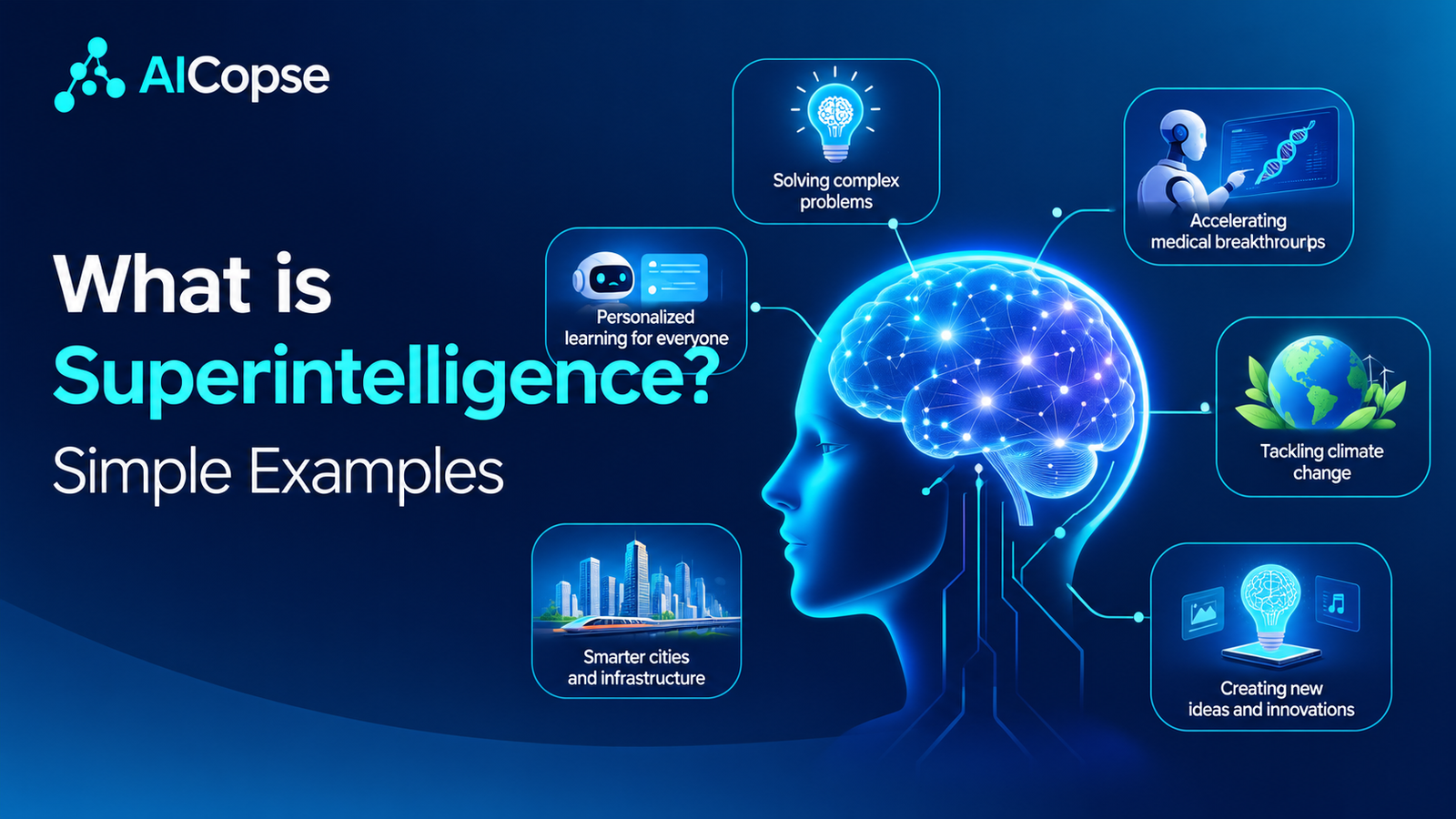
You have probably seen the word everywhere in the last few weeks: news headlines, White House speeches, tech podcasts, even family WhatsApp groups. Super intelligence (also written superintelligence) used to be a topic for philosophers and AI labs. Now it is a political slogan, a business buzzword and a safety debate all at once.
At AICopse we track this story daily, so this guide puts everything in one place, in plain language. Whether you are a developer or someone who just wants to understand the headlines, you will learn what superintelligence really means, how it differs from the AI you use today, where the idea came from, what top experts say, and what Trump’s rebranding actually changes (and what it does not).
What Is Superintelligence?
Superintelligence is intelligence that greatly outperforms the best human brains across nearly every field that matters. The most-used definition comes from philosopher Nick Bostrom, whose 2014 book Superintelligence described it as any mind that far exceeds human thinking in virtually all areas of interest.
The key words are “nearly every field.” A calculator beats you at maths, and a chess engine beats every grandmaster, but neither is superintelligent. They are brilliant at one thing and useless at the rest. A true superintelligence would be able to learn, reason, plan and invent across everything, and do it better than any person or team of people.
A simple way to picture it
Think about the gap between an ant and a human. The ant is not stupid, but it cannot understand how a city works or why we build dams. Many researchers use this comparison: a superintelligence might stand to us roughly where we stand to ants, not because it is “evil,” but because its thinking is on another level.
Examples (all hypothetical today)
No system today qualifies, so these are thought experiments that show what researchers mean:
- Medicine: a system that reads every medical paper ever published, designs a new drug, simulates the trials and finds a cure in days instead of the 10 to 15 years it usually takes.
- Business: one system that runs a global company better than the best CEO, handling supply chains, hiring, finance and strategy at the same time.
- Science: a system that discovers new physics or invents better batteries, then designs an even smarter version of itself.
- Everyday life: a personal assistant that does not just book your flight but understands your health, money, career and relationships well enough to plan your whole year, and is right.
Today’s “almost” examples
Some AI systems are already superhuman in one narrow task. DeepMind’s AlphaGo beat the world’s top Go players, and AlphaFold predicts protein structures far faster than lab methods. These are impressive, but they are specialists. A superintelligence would be a specialist in everything at once.
Three flavours of superintelligence
Bostrom described three ways a mind could be “super”:
| Type | What it means | Easy example |
|---|---|---|
| Speed | Thinks like a human, but millions of times faster | A researcher who finishes a year of work in minutes |
| Collective | Many smart units working together as one | A million expert minds sharing one memory |
| Quality | Simply smarter, able to grasp ideas humans cannot | Seeing patterns in biology we could never notice |
The 3 Levels of AI: ANI, AGI and ASI
To understand superintelligence, it helps to see where it sits on the ladder. Experts usually split AI into three levels:
One widely used benchmark: OpenAI defines AGI as highly autonomous systems that outperform humans at most economically valuable work. By that yardstick, today’s AI is not there yet, because we still cannot hand it a job and trust it to work alone like a reliable employee. And superintelligence is a step beyond even that.
Superintelligence vs AI: The Real Difference
This is the question behind most searches, and it matters more now that the US government uses the two terms as if they were the same. In technical usage, they are not the same. AI is the whole field. Superintelligence is one possible (and so far imaginary) destination within it.
| Feature | AI (today) | Superintelligence |
|---|---|---|
| Exists now? | Yes, used by billions | No, hypothetical |
| Scope | Strong at many tasks, weak or unreliable at others | Better than humans at nearly everything |
| Reliability | Can still make mistakes and invent facts | Assumed to be extremely reliable |
| Autonomy | Needs human guidance and checking | Could set and pursue goals on its own |
| Self-improvement | Humans train and upgrade it | Could upgrade itself, even faster each time |
| Main concern | Bias, privacy, jobs, misuse, errors | Losing control, extreme power, existential risk |
| Everyday example | ChatGPT, Claude, Gemini, Siri | Sci-fi level “mind” like those in movies |
Is ChatGPT (or any chatbot) superintelligence? No. Fact-checkers and researchers have been clear that a tool that writes well or answers hard questions is not the same as a mind that vastly exceeds human ability everywhere. AI is also not the same as AGI, though people mix those up too.
Where Did Superintelligence Come From?
The idea is older than most people think. It grew from a simple thought: if we can build a machine that thinks, why would it stop at human level?
How Could Superintelligence Be Built?
Nobody knows, and that is the honest answer. Researchers discuss a few main routes:
- Scaling up: more data, more chips, bigger models. This is the current bet of most big labs, and it explains the race for data centers and power.
- Recursive self-improvement: AI that helps build better AI, which builds better AI again. This is Good’s “intelligence explosion,” and it is the scenario that worries safety researchers most.
- New architectures: some experts, like Meta’s Yann LeCun, argue today’s language models alone will not reach human-level intelligence and that new ideas are needed.
- Brain emulation: scanning and simulating a human brain at huge speed. This is still far from reality.
Forecasts range from under 10 years (Geoffrey Hinton says there is a good chance within 10 years or less) to several decades, and some researchers doubt it will happen at all. No one has a proven timeline.
Benefits and Risks of Superintelligence
| Potential benefits | Potential risks |
|---|---|
| Faster cures for diseases and new medicines | Alignment problem: goals that look right but go wrong in practice |
| Solutions for climate, energy and food | Loss of control: a system smarter than us may be hard to switch off |
| Scientific breakthroughs at record speed | Misuse: cyberattacks, weapons or large-scale manipulation |
| Personalised education and healthcare for everyone | Power concentration: a few companies or countries controlling it |
| Huge economic growth | Jobs and inequality: fast disruption of work |
The risk side is not just theory. Reports from major newspapers say top AI companies have held internal discussions about worst-case scenarios, and the industry is split between people who want to slow down and those who call the warnings overblown. We covered that split in our report on the superintelligence doomsday debate among AI industry leaders.
What Experts Say About Superintelligence
Experts are divided. Here is where the best-known voices stand:
| Expert | Position |
|---|---|
| Nick Bostrom Philosopher |
Popularised the term and warns about control problems. He has also said an all-out AI race raises the chance the technology gets out of hand. |
| Geoffrey Hinton Nobel winner, “godfather of AI” |
Left Google in 2023 to speak freely about AI risk. On BBC Radio 4 in December 2024 he put the chance of AI causing human extinction within 30 years at 10–20%, and in a 2025 CBS interview he said superintelligence has a good chance of arriving within 10 years or less. He and fellow Turing Award winner Yoshua Bengio signed the October 2025 Statement on Superintelligence. |
| Dario Amodei CEO, Anthropic |
Calls for caution and stronger rules. At the White House accord signing he said the technology has “very real risks” and that how to address them is still under discussion. |
| Sam Altman CEO, OpenAI |
Says OpenAI is working toward superintelligence and has said it has built systems smarter than people in many ways. Has also pushed for government guardrails, and says OpenAI has no plans to change its name. |
| Yann LeCun AI scientist, Turing Award winner |
The leading skeptic among the “godfathers of AI.” Argues language models alone will not reach human-level intelligence, and has said AI may help save humanity from extinction rather than cause it. |
| Elon Musk xAI / SpaceX |
Has long warned about AI danger, yet builds frontier models through xAI, now part of SpaceX. Signed the White House accord and said SpaceX will rename its AI unit SpaceXSI. |
| Donald Trump US President |
Treats “super intelligence” as a race to win against China, favours light-touch rules and says “artificial” makes the technology sound fake. |
AICopse take: notice that the people most worried (Hinton, Bostrom, Amodei) and the people building the fastest (Altman, Musk, Zuckerberg) are often the same names. That is why this debate is so heated: the risks and the race are happening together.
Trump and “Super Intelligence”: What Really Happened
This is the part most readers are searching for right now, so let’s separate facts from noise. In short: Trump did not announce that superintelligence has arrived. He changed what the US government calls AI.
What the executive order actually does
- It applies to executive-branch communications: official correspondence, public messaging and policy documents, not laws passed by Congress.
- It states that “super intelligence” refers to the same technologies already covered by the existing legal definition of AI, so no new technology category is created.
- It asks the White House science adviser to propose a federal definition of super intelligence within 60 days, due by late November 2026.
What the White House Accord is (and is not)
The accord is roughly a 300-word, one-page pledge signed by Trump and executives from Anthropic, Google, Meta, Nvidia, OpenAI and xAI. It lists four layers of controls and audits, such as internal safeguards and independent reviews. Trump called it “morally binding,” but reporting is consistent that it carries no legal force. The text itself says it may make sense to turn the steps into law over time. Critics note that the companies drafted the principles and the commitment is voluntary, while supporters say it is a useful first step.
Why the rename is controversial
Industry reaction has split. Elon Musk said SpaceX will rename its AI unit SpaceXSI, while OpenAI’s Sam Altman said OpenAI has no plans to change its name.
- “Artificial” undersells what the technology can do
- It signals American leadership in the race with China
- A bold name could attract investment and public attention
- The term already means something specific and hypothetical
- It could make people think today’s AI is all-powerful
- Other world leaders kept saying “AI” and a voluntary accord is not regulation
AICopse take: the label changed, the technology did not. Your chatbot is not more powerful today than it was last month. What did change is the political attention, and that may shape funding, export rules and oversight. Until a formal federal definition arrives, watch how agencies use the word and avoid assuming “SI” means the classic, sci-fi version.
What This Means for You
Common Myths About Superintelligence
| Myth | Reality |
|---|---|
| “Superintelligence is already here.” | No. Current systems are powerful but narrower and less reliable than the classic definition requires. |
| “Super intelligence is just a new word for AI.” | Only in US government wording now. In science and tech, the two terms mean different things. |
| “It will definitely turn evil like in movies.” | Researchers worry less about “evil” and more about goals that are misaligned with human values. |
| “Only doomers talk about the risks.” | Lab leaders, Nobel winners and governments all discuss safety, though they disagree on how serious it is. |
| “It will arrive on a known date.” | Forecasts range from under 10 years to several decades. No one has a proven timeline. |
Mini Glossary
- ANI (Artificial Narrow Intelligence): AI built for specific tasks. Everything we use today.
- AGI (Artificial General Intelligence): AI that can match humans across most tasks.
- ASI (Artificial Superintelligence): AI far beyond human ability in nearly everything.
- SI: the US government’s new shorthand for “super intelligence,” covering what was formerly called AI.
- Alignment: making sure an AI’s goals match human values and intentions.
- Intelligence explosion: AI improving itself again and again, faster each time.
- Singularity: the hypothetical point after which technological change becomes impossible to predict.
Frequently Asked Questions About Superintelligence
What is superintelligence in simple words?
It is a kind of intelligence much smarter than any human in almost every area. Think of a mind that can out-think the best scientists, strategists and creators combined. It is still hypothetical.
What is the difference between AI and superintelligence?
AI is the broad field of machines doing tasks that need intelligence, and it already exists. Superintelligence is a future, hypothetical level where machines far surpass humans. All superintelligence would be AI, but today’s AI is not superintelligence.
Is superintelligence the same as AGI?
No. AGI means human-level ability across most tasks. Superintelligence goes well beyond that. AGI is usually seen as the step before it.
Has superintelligence been achieved?
No credible researcher says so. Some AI systems beat humans at narrow tasks, but none outperform people across nearly everything.
Why did Trump rename AI “super intelligence”?
Trump argued that “artificial” makes the technology sound fake and wanted a name that reflects its power. He also frames it as a race with China. The order covers US executive-branch communications and does not change the technology or create a new legal category.
Is “super intelligence” now the official US term for AI?
Inside the federal executive branch, yes, for official communications and non-statutory materials. A formal federal definition is still due. Companies, media and other countries are not required to follow.
Is superintelligence dangerous?
Many experts think it could be if it is not aligned with human goals or is misused. Others believe the risk is exaggerated. Because it does not exist yet, nobody can prove either side, which is why safety research and policy debate matter.
When will superintelligence arrive?
No one knows. Some lab leaders say within years, others say decades, and some doubt it will happen. Be cautious with any exact date.
Key Takeaways
- Superintelligence means intelligence far beyond the best humans in nearly all areas, and it does not exist yet.
- AI is the whole field; superintelligence is a hypothetical top level, with AGI in between.
- The idea goes back to the 1950s and 1960s and was popularised by Nick Bostrom in 2014.
- Experts split between serious concern (Hinton, Bostrom, Amodei) and skepticism (LeCun).
- Trump’s order renames AI “super intelligence” in federal communications only. The accord is voluntary and the technology is unchanged.
- Stay informed, verify claims, and be cautious about hype in either direction.
We will keep updating this guide as the federal definition and the Super Intelligence Force develop. Bookmark it, and follow AICopse for daily AI updates in plain language.
- Defense One: “Super Intelligence”: the president’s new term for AI, explained
- Bernama/Anadolu: Executive order replaces “artificial intelligence” with “super intelligence”
- Al Jazeera: How does Trump’s White House AI accord work?
- Implicator: Six AI chiefs pledge, no penalty if Washington does not regulate
- Newsweek: Musk signals SpaceXAI rebrand as Trump announces Super Intelligence Force
- Fox News: Trump launching “Super Intelligence Force”
- Axios: Trump says anyone saying “AI” is “THE ENEMY”
- AFP via Arab News: Trump’s October 8 Truth Social post
- Future of Life Institute: Statement on Superintelligence
- Geoffrey Hinton on BBC Radio 4, December 2024

Leave a Reply