
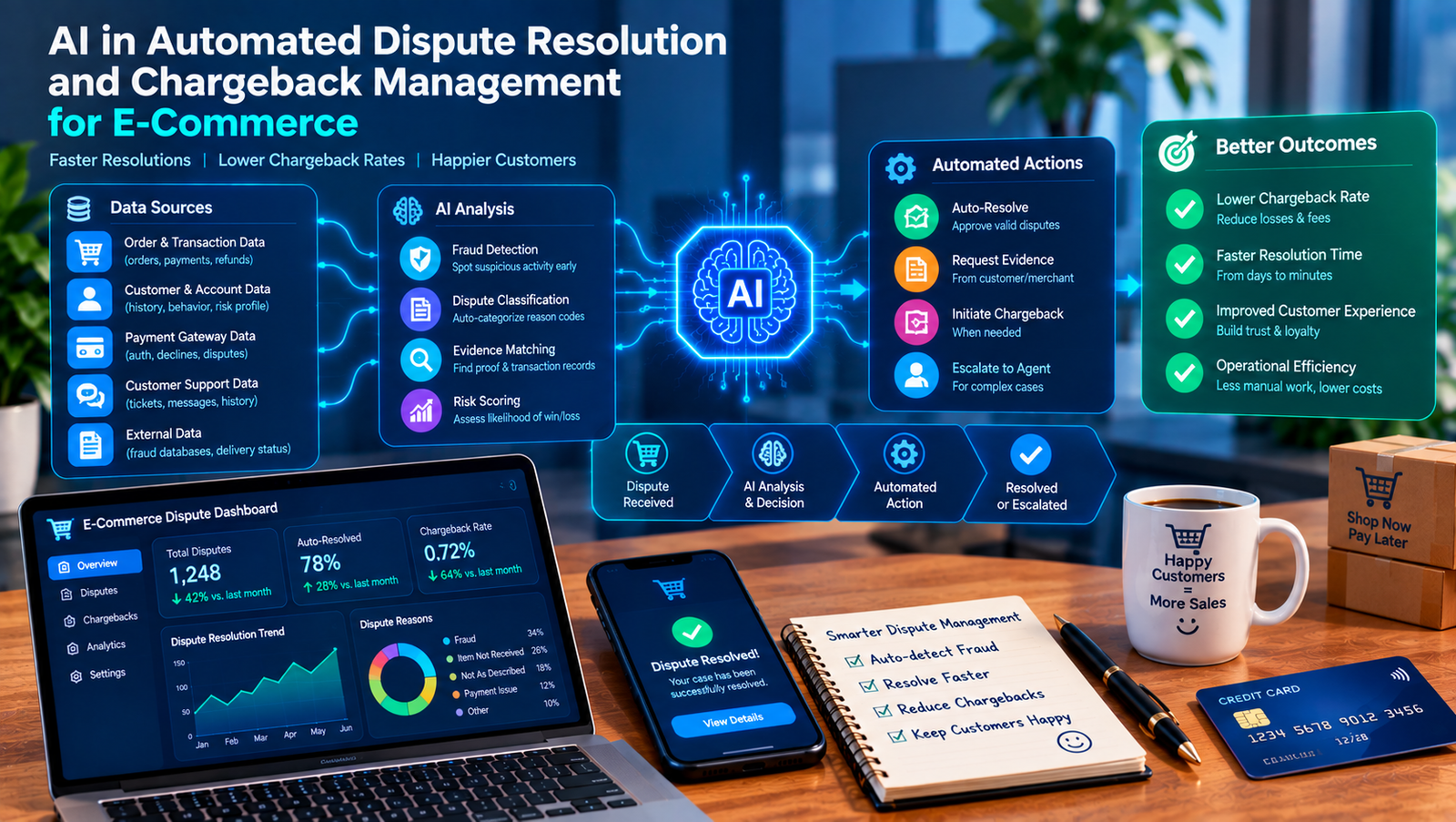
Primary topic: AI in Automated Dispute Resolution and Chargeback Management for E-Commerce
Research focus: Chargeback prediction, friendly fraud, dispute prevention, evidence intelligence, representment automation, refund fraud, AI-assisted case decisions, payment-network tools, and e-commerce dispute operations
Understanding AI in E-Commerce Dispute Resolution
An e-commerce chargeback occurs when a cardholder disputes a payment through their card issuer and the transaction enters the payment network’s formal dispute process. The reason may involve an unauthorized transaction, a product that never arrived, a refund that was not received, a duplicate charge, a subscription the customer does not recognize, or a disagreement about the goods or services supplied.
Chargebacks are different from ordinary refund requests. A refund is usually handled directly between the customer and merchant, while a chargeback follows a process involving the issuer, acquirer, payment network, and merchant. That process creates deadlines, evidence requirements, fees, and operational work.
AI can support several connected tasks:
- Predicting transactions that are more likely to result in a dispute
- Distinguishing potential payment fraud from service-related dissatisfaction
- Detecting recurring causes such as delivery failures or unclear billing descriptors
- Identifying customers who may need help before they contact their bank
- Collecting relevant order, payment, delivery, and communication records
- Preparing evidence packages for representment
- Summarizing case files for human reviewers
- Forecasting the likely value of pursuing a dispute
- Finding patterns across products, customer cohorts, payment methods, and fulfillment partners
A useful system treats the chargeback as the final stage of a longer customer and payment journey. It does not wait until the dispute arrives to begin looking for the cause.
Why Chargeback Management Needs AI
Chargebacks create direct and indirect costs. Merchants may lose the transaction amount, the goods or service already delivered, dispute fees, staff time, and sometimes additional payment-processing costs. Issuers and acquirers also incur costs when they investigate and process disputes.
Mastercard’s 2026 research with Datos Insights projected approximately 286 million chargebacks globally in 2026, rising to 359 million in 2029. The same research estimated that the global financial impact could rise from $36.9 billion in 2026 to $46.1 billion in 2029. These are projections, not final observed totals, but they illustrate the scale of the operational challenge.
Source: Mastercard, What’s the True Cost of a Chargeback for Businesses?
Projected chargebacks in 2026
Projected chargebacks in 2029
Projected 2029 impact
The numbers do not mean every dispute is fraudulent. Customers can have legitimate reasons to challenge a transaction, and merchants can make genuine mistakes. An AI system that treats every dispute as an attack may damage customer trust and create compliance problems.
The business goal should be to reduce avoidable disputes and improve the quality, speed, and fairness of decisions.
The Full AI-Powered Chargeback Workflow
The strongest architecture connects prevention, dispute handling, and learning. Each stage uses different data and models, so a single generic fraud score is rarely sufficient.
Checkout, payment, customer, product, and device signals
Fraud likelihood, dispute reason, and preventability
Clarification, support, delivery intervention, or refund
Reason code, deadline, amount, and case requirements
Evidence retrieval, document analysis, and representment recommendation
Track result, cost, customer impact, and model performance
Research Study: E-Commerce Dispute Resolution Prediction
A 2021 research paper by David Tsurel and colleagues, titled E-Commerce Dispute Resolution Prediction, examined how machine learning could help online marketplaces resolve disputes at scale. The researchers used a large dataset of disputes from eBay and studied behavioral and linguistic patterns associated with dispute outcomes.
The research is directly relevant to automated dispute resolution because it focuses on predicting how a case may be resolved, rather than only predicting whether a payment is fraudulent. The team trained classifiers to estimate dispute outcomes and explored which features were associated with those outcomes. The paper notes that straightforward cases may be automated, while more complicated cases still require human judgment.
Source: Tsurel et al., E-Commerce Dispute Resolution Prediction, 2021
Why this matters for e-commerce: A marketplace dispute often contains more than payment data. It may include buyer and seller messages, order details, shipping events, product descriptions, and platform policy. AI can help organize these signals into a consistent case assessment.
A practical system could recommend whether a case appears to involve non-delivery, a product-condition disagreement, a refund delay, or a policy misunderstanding. It could also identify missing evidence before the case reaches a human reviewer.
However, a model trained on one marketplace’s dispute policies may not transfer directly to another platform. Merchant terms, evidence standards, customer populations, and dispute processes differ. The model should therefore be validated against the specific business and dispute categories where it will be used.
Research Study: Fraud Detection at eBay
A 2025 paper, Fraud Detection at eBay, reviewed fraud detection in a real-world e-commerce environment and examined systems that use multiple information sources, including transaction records and user behavior. The work discusses challenges such as heterogeneous data, changing transaction networks, scalability, and explainability.
The review highlights graph-based approaches, including systems designed to detect suspicious relationships and provide human-readable explanations. It also discusses the need for real-time inference as new transactions arrive.
Source: Rao et al., Fraud Detection at eBay, Emerging Markets Review, 2025
This research is relevant to chargeback operations because disputes can be connected. A cluster of orders may share a device, delivery destination, account behavior, payment instrument, or merchant relationship. Looking at each transaction independently can hide these relationships.
Graph-based analysis can help identify coordinated activity, including repeated abuse involving linked accounts. It can also help merchants detect operational patterns, such as a particular product category or fulfillment route producing an unusually high number of disputes.
The important distinction is that graph connections are investigative signals, not automatic proof. Families may share devices, offices may share networks, and legitimate customers may use common delivery locations. AI should explain why a relationship matters and allow investigators to assess its context.
Research Study: Systematic Review of E-Commerce Fraud Detection
A 2022 systematic literature review in Electronic Commerce Research and Applications analyzed 64 articles on fraud detection and prevention in e-commerce. It found that credit-card fraud and online payment fraud received substantial attention, while comparatively few papers focused specifically on fraud prevention strategies.
The review also identified machine-learning techniques used in the field and discussed the need for more work on real-time prevention and automated bot detection. Its broader contribution is a structured view of the methods, datasets, fraud types, and open challenges in e-commerce fraud research.
Source: Fraud Detection and Prevention in E-Commerce: A Systematic Literature Review, 2022
For chargeback management, the key lesson is that prevention and detection are separate problems. A model that identifies a suspicious payment after checkout may help an investigation, but it may not prevent the dispute. A prevention system must act early enough to change the customer or transaction outcome.
This supports a layered approach:
- Use transaction risk models to detect potentially unauthorized purchases
- Use behavioral signals to identify unusual account activity
- Use order and delivery data to identify service-related dispute risk
- Use customer-service history to find unresolved complaints
- Use dispute outcomes to improve future prevention policies
The review also points to a practical limitation: fraud datasets are often drawn from a specific business or payment environment. A model’s reported performance should not be assumed to apply unchanged to every e-commerce store.
Research Study: Effective Fraud Detection Using Machine Learning and Big Data Analytics
A 2024 study titled Effective Fraud Detection in E-Commerce: Leveraging Machine Learning and Big Data Analytics examined how machine learning and large-scale data processing can support online fraud detection. The paper discusses anomaly detection, predictive modeling, and the analysis of large volumes of transaction data.
The study’s relevance to chargebacks lies in the data pipeline. An AI model is only as useful as the information it receives. If payment records, customer support tickets, shipping updates, refund events, and dispute outcomes sit in disconnected systems, the model may miss the reason a dispute occurred.
For example, a transaction may appear normal at checkout, but later signals could show that the package was returned to the warehouse, delivery failed, or a refund was promised but never processed. These operational events can be more useful for predicting a service dispute than the original payment-risk score.
An e-commerce business should therefore prioritize reliable data integration before investing in complex models.
Research Study: Chargeback Fraud Detection on Anonymized Merchant Data
A 2026 industry case study published in the proceedings of the Australasian Information Security Conference examined chargeback fraud detection using anonymized merchant data. The researchers compared machine-learning models and class-imbalance techniques on a dataset where fraudulent cases were relatively rare.
The study reported a best-model ROC-AUC of 87%, with 86% precision at 47% recall. It also found that fraud was concentrated among a small share of merchants in the dataset: seven of 32 merchants accounted for 80% of the identified fraud cases. The authors reported that merchant-level features contributed substantially to prediction.
Source: Chargeback Fraud Detection on Anonymised Merchant Data: An Industry Case Study, ACM, 2026
This is a useful example of why chargeback models need domain-specific features. A general transaction model may focus on customer, device, and payment details. A chargeback model may also need merchant category, fulfillment characteristics, historical dispute rates, and the timing of disputes.
The reported results are specific to the study’s data and evaluation. They should not be treated as a guarantee that a similar model will achieve the same precision or recall for another merchant.
The operational takeaway is to measure performance in terms of the cases a business can actually act on. High precision can reduce wasted investigation time, while recall indicates how much of the relevant fraud population the model identifies. The appropriate balance depends on the cost of missed fraud, the cost of false alerts, and the available review capacity.
Research Study: Generative AI-Enabled Refund Fraud in E-Commerce
A 2026 study, Generative AI-Enabled Refund Fraud in Chinese E-Commerce, examined how generative AI may change the evidence used in online refund disputes. The researchers conducted semi-structured interviews with 17 merchants and 13 platform workers.
The paper describes how attackers may use generative AI to create realistic-looking evidence of product defects. It identifies threat opportunities across transactions, disputes, logistics, and communications. The authors also discuss defensive responses such as automated screening, requests for additional evidence, and stronger verification procedures.
Source: Zhang et al., Generative AI-Enabled Refund Fraud in Chinese E-Commerce, 2026
This research raises an important issue for automated chargeback management: evidence can no longer be assumed to be trustworthy simply because it is digital.
An uploaded image may be edited or synthetically generated. A written customer statement may be AI-generated. A delivery image may be genuine but fail to prove that the correct item reached the correct person.
AI can help screen evidence for inconsistencies, but automated authenticity judgments also have limitations. A genuine image may look unusual, and a sophisticated synthetic image may evade detection. Evidence screening should therefore combine file provenance, timestamps, logistics records, order details, and other independent signals.
For merchants, the lesson is to build evidence systems that preserve the chain of custody and link each item to the relevant order and event.
Research Study: Governed Agentic Automation for Chargebacks
A 2026 working paper, Governed Agentic Automation for Chargebacks: A Prompt-First Architecture for Policy-Driven Enterprise Workflows, examines how generative AI and agentic workflows can support chargeback handling. It describes a governed orchestration approach that includes prompt management, policy enforcement, evaluation, and observability.
The authors report internal deployment measurements including a 35% reduction in generation latency, a 20% improvement in internal quality scores, and automatic resolution of 85% of policy issues before human review. These figures are reported by the authors for their internal system; they should not be interpreted as independently validated industry-wide outcomes.
Source: Sundar and Morabia, Governed Agentic Automation for Chargebacks, 2026
The most relevant idea is governance. An AI agent should not freely invent policy interpretations or submit arbitrary claims. It should operate within controlled workflows, use approved evidence, follow current dispute rules, and record what it did.
A production system should distinguish between tasks that can be automated safely, tasks that require approval, and decisions that must remain with an authorized person.
What the Research Means for E-Commerce Businesses
Across these studies, several themes emerge. First, chargeback handling benefits from combining transaction data with operational and behavioral context. Second, graph-based and machine-learning methods can help identify patterns that individual transaction checks may miss. Third, dispute decisions are not purely technical: evidence quality, platform policy, customer fairness, and human review matter.
The research also shows that prevention remains underdeveloped compared with detection in parts of the e-commerce literature. Businesses should not spend their entire AI budget on fighting chargebacks after they occur. A system that fixes confusing billing descriptors, delayed refunds, poor delivery communication, or recurring product issues may prevent disputes more efficiently than a system that only improves representment.
AI Use Cases Across the Chargeback Lifecycle
| Stage | AI application | Business outcome | Important safeguard |
|---|---|---|---|
| Before payment | Transaction and account risk scoring | Reduce unauthorized transactions | Avoid excessive checkout friction |
| After purchase | Dispute-likelihood prediction | Identify preventable problems | Separate fraud from service issues |
| Customer support | Intent classification and case routing | Resolve complaints earlier | Escalate complex or sensitive cases |
| Dispute intake | Reason-code classification | Route cases to the correct workflow | Validate network-specific requirements |
| Evidence preparation | Document extraction and evidence matching | Reduce manual case preparation | Preserve source records and provenance |
| Representment | Case-strength assessment and response drafting | Focus effort on viable cases | Require evidence-backed claims |
| After resolution | Outcome analysis and root-cause detection | Improve products and operations | Monitor model drift and policy changes |
Preventing Disputes Before They Become Chargebacks
Prevention is often more valuable than winning a dispute after the customer has contacted their bank. A merchant should identify which disputes can be prevented through better communication, operational fixes, or early resolution.
AI can combine order status, shipment tracking, customer messages, refund history, subscription events, and payment information to estimate the likelihood of a dispute. The model can then trigger an appropriate intervention.
Examples include:
- Sending clearer shipping updates when delivery is delayed
- Showing recognizable billing descriptors and order details
- Reminding customers about subscription renewals before billing
- Escalating a complaint when a promised refund has not been completed
- Offering customer support when an order appears lost
- Identifying repeated problems associated with a product or fulfillment partner
The intervention must match the reason for the risk. A customer whose package is delayed needs delivery support, not a fraud warning. A cardholder who does not recognize a merchant descriptor needs transaction clarity, not an unnecessary account restriction.
AI for Evidence Collection and Representment
Representment is the process through which a merchant responds to a chargeback with evidence supporting its position. Evidence requirements vary by dispute type and payment-network rules.
AI can reduce the manual effort required to prepare a case by collecting relevant information from connected systems. It can identify the order, payment authorization, delivery confirmation, customer communications, refund history, product terms, and other records relevant to the dispute.
A useful evidence workflow looks like this:
Retrieve records from payment, order, support, and logistics systems
Check completeness, dates, and source integrity
Map evidence to the dispute reason and required fields
Generate a case summary and route for approval
Generative AI can draft a clear response, but it should not create missing facts. Every factual statement should be traceable to an underlying record. If delivery evidence is missing, the system should say so rather than imply that delivery was confirmed.
AI-Powered Dispute Decisions: What Should Be Automated?
Not every case needs the same level of automation. Low-risk administrative tasks can often be automated, while decisions that could materially affect customers or create legal and financial consequences need stronger controls.
| Automation level | Suitable tasks | Control |
|---|---|---|
| Fully automated | Data extraction, deadline reminders, duplicate detection, routine case routing | Validation rules and audit logs |
| AI-assisted | Risk scoring, evidence matching, case summaries, response drafting | Human review for material decisions |
| Human-led | Ambiguous evidence, high-value cases, suspected abuse, customer-impacting exceptions | Authorized decision-maker |
Current Industry Direction: Visa’s AI Dispute Tools
On April 1, 2026, Visa announced new and enhanced dispute-resolution services for merchants, issuers, and acquirers. The announcement included AI-supported dispute intelligence, document analysis, and automated revenue-recovery capabilities.
Visa said it processed 106 million disputes globally in 2025, a 35% increase compared with 2019. Its announced tools include services intended to streamline pre-dispute handling, help merchants automate representment, predict case outcomes, and help issuers analyze merchant documents. Availability varies by product, with some tools announced for pilots or later rollout rather than being universally available at announcement time.
Source: Visa, Visa Unveils New Services to Modernize Dispute Resolution Process, April 1, 2026
Expert Recommendation
E-commerce companies should build chargeback AI around a clear operating principle: prevent what can be prevented, automate what can be verified, and escalate what requires judgment.
A practical strategy should include the following priorities:
- Establish a single case record that connects payments, orders, delivery, refunds, customer support, and dispute outcomes
- Separate unauthorized-payment fraud from service disputes, subscription confusion, and potential first-party misuse
- Use prediction models to identify preventable disputes before they become formal chargebacks
- Automate evidence retrieval and document structuring before automating final decisions
- Use generative AI to draft responses only from verified records and approved policy
- Require human approval for ambiguous, high-value, or customer-sensitive cases
- Measure prevention and customer outcomes, not just chargeback win rates
- Review model performance by product, payment method, customer cohort, and dispute reason
- Maintain versioned policies, evidence provenance, and complete audit trails
A merchant should not optimize solely for winning more representment cases. A high win rate can coexist with poor customer experience if the business ignores the underlying reasons customers are disputing payments. The long-term objective is fewer avoidable disputes, fair treatment, lower operating costs, and reliable evidence when a case must be contested.
Expert Perspective
Mastercard’s chargeback research emphasizes the value of identifying and resolving disputes before they become formal chargebacks. Its 2026 update describes early resolution as a way to reduce the direct and indirect costs associated with disputes. Source: Mastercard, What’s the True Cost of a Chargeback for Businesses?
The practical lesson is that chargeback prevention should not be treated as a narrow fraud-team metric. It should be shared across payments, customer support, fulfillment, product, subscriptions, and finance. AI can reveal which operational failures repeatedly lead to disputes, but the business must be willing to fix those failures.
Implementation Roadmap
Phase: Establish a Reliable Data Foundation
Connect the systems that contain the evidence needed to understand a dispute. At minimum, this usually includes payment processor records, order management, customer support, refund systems, delivery tracking, subscription billing, and historical chargeback outcomes.
Create consistent identifiers so that each dispute can be connected to the correct transaction, order, customer interaction, and evidence record. Record timestamps and source systems to preserve the history of each case.
Phase: Build Dispute Taxonomy and Baselines
Group disputes by reason and operational cause. Separate unauthorized transactions from non-delivery, product dissatisfaction, duplicate billing, subscription confusion, and refund problems.
Measure the current dispute rate, preventable-dispute rate, time spent per case, evidence completeness, representment rate, and outcomes by category. Without these baselines, it is difficult to prove that AI has improved the process.
Phase: Deploy Predictive Models
Begin with models that address clear business problems, such as identifying orders at risk of non-delivery disputes or detecting unusual clusters of chargeback activity. Use historical data, but test models on later time periods to reduce the risk of data leakage.
The first deployment should support human decisions rather than automatically block customers or reject claims. Monitor false positives and check whether the model performs differently across customer groups, payment methods, and product categories.
Phase: Automate Evidence Preparation
Automate retrieval, classification, and structuring of evidence. Introduce generative AI for case summaries and response drafts only after the underlying records are reliable.
Require the system to cite or link each factual claim to its source record. If a required document is missing, the workflow should flag the gap instead of generating an unsupported statement.
Phase: Introduce Controlled Decision Automation
Once the workflow has been validated, automate low-risk tasks such as routine routing, duplicate checks, deadline monitoring, and evidence completeness checks. Expand to more consequential actions only when performance, governance, and exception handling are demonstrably reliable.
Phase: Learn From Every Outcome
Feed final dispute outcomes and confirmed operational causes into the analytics process. Review losses to determine whether they resulted from weak evidence, missed deadlines, incorrect classification, customer-service failure, or a legitimate customer claim.
This feedback loop allows the business to improve both its dispute strategy and the customer experience that precedes a dispute.
KPIs for AI Chargeback Management
| KPI | What it measures | Why it matters |
|---|---|---|
| Dispute rate | Disputes relative to the relevant transaction base | Tracks the overall problem |
| Preventable dispute rate | Disputes linked to issues that could have been addressed earlier | Measures prevention effectiveness |
| Evidence completeness | Cases with required evidence available before submission | Shows data and workflow quality |
| Representment outcome rate | Results of cases the merchant chooses to contest | Measures case effectiveness, with selection bias considered |
| Cost per case | Staff, vendor, and processing cost | Measures operational efficiency |
| Time to resolution | Elapsed time from intake to outcome | Tracks speed and customer impact |
| Customer complaint recurrence | Repeat complaints after an intervention | Checks whether the root cause was fixed |
Risks and Governance Requirements
AI can make chargeback operations faster, but it can also scale mistakes. A model may misclassify a legitimate customer as abusive, recommend contesting a weak case, or produce a persuasive response that contains unsupported claims.
The main risks include:
- False positives: Legitimate customers may be flagged as suspicious or subjected to unnecessary friction
- False negatives: Fraudulent patterns may remain undetected
- Biased decisions: Historical outcomes may reflect uneven processes rather than objective truth
- Hallucinated evidence: Generative AI may introduce facts that do not appear in source records
- Outdated rules: Payment-network requirements and dispute procedures can change
- Privacy exposure: Case files may contain personal, payment, address, and communication data
- Automation bias: Staff may accept a model recommendation without checking the evidence
- Adversarial evidence: Fraudsters may use synthetic images, altered documents, or fabricated narratives
Governance should include access controls, data minimization, retention policies, model monitoring, evidence provenance, policy versioning, and a clear process for human escalation. The system should preserve a record of which model and policy version influenced a recommendation and which evidence was used.
Future Predictions: 2027–2030
2027: Evidence Preparation Becomes More Automated
More merchants are likely to automate document collection, case summaries, reason-code routing, and deadline management. These tasks are structured and measurable, making them more practical starting points than fully autonomous dispute adjudication.
2028: Prevention and Resolution Data Become More Connected
Dispute systems will increasingly connect customer support, delivery, subscriptions, refunds, and payment data. This should help businesses distinguish between unauthorized payments and disputes caused by service failures or customer confusion.
2029: AI Agents Handle More Policy-Bounded Workflows
Governed AI agents may coordinate evidence retrieval, policy checks, draft generation, and case routing. The key development will not simply be more autonomy, but better controls over what the agent can access, decide, and submit.
2030: Dispute Intelligence Becomes a Continuous Operating Capability
Leading platforms may use dispute outcomes to improve checkout, billing descriptions, fulfillment, customer communication, and fraud prevention. Chargeback management will increasingly operate as a feedback loop across the business rather than as an isolated team.
These are reasoned projections based on current research and industry announcements, not guaranteed outcomes. Adoption will depend on data quality, payment-network requirements, model reliability, cost, and customer-protection expectations.
Startup Opportunities
There is room for specialized products that solve narrow, measurable problems rather than attempting to replace an entire payments operation.
- AI Evidence Assembly Platform: Connects order, delivery, payment, and support records into structured evidence packages
- Dispute Prevention Engine: Predicts preventable disputes and recommends customer-service interventions
- Chargeback Case Copilot: Summarizes case files, maps evidence to requirements, and drafts responses grounded in source records
- Friendly-Fraud Intelligence: Identifies suspicious patterns across linked transactions while preserving human review
- Subscription Dispute Monitor: Detects billing confusion, renewal complaints, and failed cancellation workflows
- Dispute Root-Cause Analytics: Connects chargeback trends to products, delivery partners, payment methods, and support issues
- AI Evidence Authenticity Screening: Flags inconsistencies in submitted images and documents for additional verification
- Multi-Processor Dispute Operations: Provides a unified workflow across payment providers and marketplaces
The most defensible products will combine integrations, reliable evidence handling, clear policy controls, and measurable operational improvements. A generic chatbot that merely writes a dispute letter is easier to replicate and may introduce unacceptable factual risk.
Frequently Asked Questions
How does AI help with chargeback management?
AI can predict dispute risk, classify cases, retrieve evidence, summarize documents, draft responses, prioritize investigations, and identify the operational causes of recurring chargebacks. It is most useful when connected to reliable payment, order, delivery, refund, and customer-service data.
Can AI prevent chargebacks before they happen?
AI can identify signals associated with preventable disputes and trigger interventions such as clearer billing information, delivery support, or faster refund handling. It cannot prevent every dispute, and the intervention should match the underlying problem.
Can generative AI write chargeback representment letters?
Yes. Generative AI can prepare a structured draft using verified records and approved templates. The system should not invent facts, claim that evidence exists when it does not, or ignore the relevant payment-network requirements.
What is the difference between chargeback prediction and fraud detection?
Fraud detection typically assesses whether a transaction or account may be unauthorized or deceptive. Chargeback prediction estimates whether a transaction may later be disputed, which can also happen because of delivery problems, billing confusion, service dissatisfaction, or refund delays.
Should every chargeback be contested?
No. A merchant should consider the evidence, applicable rules, case value, operational cost, and likelihood of success. Contesting weak cases can waste resources and may worsen the customer relationship.
What data is needed for AI dispute resolution?
Useful data includes payment records, order details, product information, delivery tracking, customer communications, refund events, subscription terms, dispute reason codes, evidence submitted, and final outcomes. Data should be collected and retained under appropriate privacy and security controls.
What is the biggest risk of AI-powered chargeback automation?
A major risk is allowing an automated system to produce unsupported claims or make consequential decisions without adequate evidence and oversight. Explainability, source-linked evidence, policy controls, and human escalation are essential.
Final Perspective
AI can transform chargeback management when it is used across the complete dispute lifecycle. The largest opportunity is not simply to generate faster responses after a dispute arrives. It is to understand why disputes happen, prevent the avoidable ones, and make the remaining cases easier to investigate and resolve.
The research points toward a combination of predictive modeling, graph-based fraud detection, structured evidence processing, and governed generative AI. E-commerce dispute prediction research shows how behavioral and linguistic signals can support case assessment. Research on eBay’s fraud systems highlights the value of connected transaction and behavior data. The 2026 chargeback fraud case study demonstrates the importance of domain-specific features, while new work on generative-AI-enabled refund fraud shows why digital evidence needs stronger verification.
Payment-network developments reinforce the same direction. Visa’s 2026 announcement described AI-supported dispute intelligence, document analysis, and automated revenue-recovery tools. Mastercard’s research highlights the scale of chargeback costs and the value of earlier resolution.
For e-commerce businesses, the practical path is to begin with reliable data, clear dispute categories, evidence automation, and measurable prevention workflows. More autonomous decision-making should come only after the system demonstrates consistent performance and appropriate controls.
The future of chargeback management is not about contesting every customer claim. It is about making better decisions, resolving genuine problems earlier, reducing avoidable losses, and ensuring that every disputed transaction can be understood through reliable evidence.
Research Sources
- Tsurel et al., E-Commerce Dispute Resolution Prediction, 2021
- Rao et al., Fraud Detection at eBay, Emerging Markets Review, 2025
- Fraud Detection and Prevention in E-Commerce: A Systematic Literature Review, 2022
- Effective Fraud Detection in E-Commerce: Leveraging Machine Learning and Big Data Analytics, 2024
- Chargeback Fraud Detection on Anonymised Merchant Data: An Industry Case Study, ACM, 2026
- Zhang et al., Generative AI-Enabled Refund Fraud in Chinese E-Commerce, 2026
- Sundar and Morabia, Governed Agentic Automation for Chargebacks, 2026 working paper
- Visa, New Services to Modernize Dispute Resolution Process, April 2026
- Mastercard, What’s the True Cost of a Chargeback for Businesses?
- Mastercard, 2025 State of Chargebacks Report

Leave a Reply