
AICOPSE Research Report | Financial AI and Market Technology
AI in Order Flow Analysis and Market Microstructure
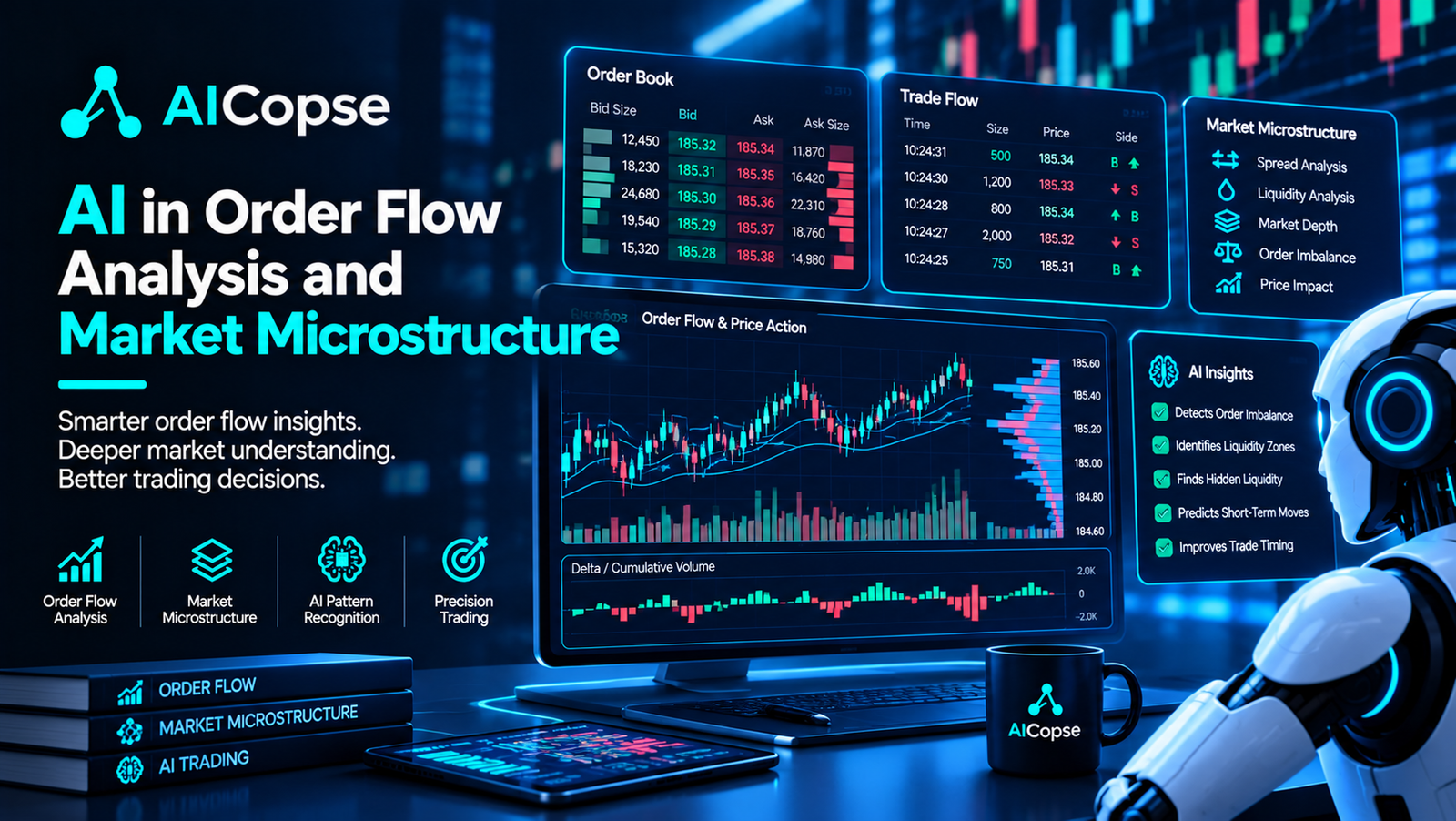
How machine learning interprets buying and selling pressure, reads limit order books, improves execution decisions, and helps trading teams understand the real mechanics behind short-term price movements.
Limit Order Books
Execution Quality
AI Risk Controls
Executive summary
AI in order flow analysis is the use of machine learning and related technologies to study how orders enter, change, cancel, and execute in financial markets. Instead of looking only at the latest stock price or trading volume, these systems examine the interaction between buyers and sellers, the depth of available liquidity, changes in the bid and ask, and the way market participants respond to new information.
The strongest use cases are not limited to predicting whether a stock will rise or fall. AI can help estimate short-term price pressure, identify unusual liquidity conditions, improve order timing, forecast execution costs, and recognize when a strategy is no longer working. However, research also shows that strong prediction scores do not automatically translate into profitable trades. A credible system must account for fees, spread, slippage, market impact, data quality, and the possibility that market behavior will change.
Key takeaways
Order events
New orders, executions, and cancellations can reveal pressure that closing prices hide.
Depth matters
The same imbalance can have different effects in deep and thin markets.
Net results
A signal must survive realistic execution costs before it can be considered useful.
Live monitoring
Models need drift checks, risk limits, audit trails, and clear shutdown rules.
What are order flow analysis and market microstructure?
Order flow analysis examines the stream of buying and selling activity in a market. It looks beyond the final transaction price to study which side is demanding immediate execution, how much liquidity is available, where orders are waiting, and how the order book changes as participants react to new information. Traders may use this information to estimate short-term price pressure or decide how to execute an existing trade.
Market microstructure is the broader study of how trading rules, market participants, order types, liquidity, and execution mechanisms determine the process of price formation. It helps explain why two orders of the same size can receive different execution prices, why a market can move sharply when displayed liquidity is limited, and why a strategy that looks attractive on a price chart may perform poorly once real execution costs are included.
These concepts are closely connected, but they are not interchangeable. Order flow is one source of information about market activity. Market microstructure provides the framework for understanding how that activity affects prices, liquidity, and trading outcomes.
| Concept | What it measures | Why AI teams care |
|---|---|---|
| Order flow | Buy-initiated and sell-initiated activity, new orders, and cancellations | Helps estimate near-term supply and demand pressure |
| Limit order book | Displayed bids, asks, prices, and quantities at multiple levels | Provides a snapshot of available displayed liquidity |
| Market microstructure | Rules, market design, execution, liquidity, and price formation | Explains how a model’s signal may translate into an actual trade |
| Execution quality | Fill price, spread, slippage, speed, and likelihood of completion | Shows whether a trading decision was implemented efficiently |
For example, a stock can show strong buying pressure while its best ask price remains unchanged because sellers keep adding liquidity. Another stock can move quickly after a smaller wave of buying if its available sell-side depth is thin. An AI model that studies only price and volume may miss part of this difference. A model that also observes order-book changes can build a more detailed view, although that additional information does not guarantee a correct forecast.
How AI reads the limit order book
A limit order book records resting buy and sell orders at different prices. The best bid is the highest displayed price at which someone is willing to buy. The best ask is the lowest displayed price at which someone is willing to sell. The difference between them is the quoted spread. Further levels show additional displayed liquidity away from the best prices.
AI systems can convert this information into features such as bid-ask imbalance, changes in depth, order arrival rates, cancellation activity, spread changes, and short-term price response. A model may process one snapshot or a sequence of snapshots. Sequence-based models can examine how the book changes over time rather than treating every observation as independent.
Illustrative order book snapshot
Bid side | Buyers
Illustrative displayed bid depth: 4,000 shares
Ask side | Sellers
Illustrative displayed ask depth: 1,800 shares
This example shows more displayed buying interest than selling interest across the selected levels. It is a snapshot, not proof that the next price move must be upward. Orders can be cancelled, new liquidity can arrive, and hidden or off-exchange activity may not appear in this view.
A useful starting feature is order-book imbalance. One simple version compares the displayed quantities on the bid and ask sides:
Imbalance = (Bid depth − Ask depth) ÷ (Bid depth + Ask depth)
The result ranges from −1 to +1 when both depth values are non-negative and their sum is greater than zero. Positive values indicate greater displayed bid depth in the selected book levels; negative values indicate greater displayed ask depth. The calculation is only as meaningful as the chosen levels, timestamp, data quality, and market context.
More advanced systems study order flow imbalance, which can incorporate changes in the best bid and ask caused by limit-order submissions, market orders, and cancellations. This is different from simply counting trades. It attempts to capture how supply and demand at the top of the book change between observations.
Six important research studies and what they mean
The research below combines foundational market-microstructure work with newer deep-learning benchmarks. This mix matters because new AI architectures are built on older findings about liquidity and price formation. The most useful question is not which paper reports the highest model score. It is whether its data, evaluation method, and trading assumptions resemble the environment in which a team intends to operate.
Research study
The Price Impact of Order Book Events
Researchers: Rama Cont, Arseniy Kukanov, and Sasha Stoikov. Published in the Journal of Financial Econometrics in 2014.
The researchers examined order-book events using NYSE Trades and Quotes data for 50 U.S. stocks. They studied limit orders, market orders, and cancellations to understand their relationship with short-term price changes. Their analysis found that order flow imbalance was closely related to price movement over short intervals. The relationship was approximately linear in their setting, with the impact of a given imbalance increasing as market depth decreased.
The important contribution is the connection between buying and selling pressure and available liquidity. An order-flow signal should not be interpreted without knowing how much depth is available to absorb that pressure. A given imbalance may have a different effect in a highly liquid large-cap stock than in a thinner market.
Practical lesson: Include liquidity and depth in the feature set. Compare imbalance signals across market-depth conditions instead of assuming that the same threshold has the same meaning in every instrument.
Limitation: The paper provides a market-microstructure relationship, not a guarantee of profitable AI trading. Market design, participants, data quality, and trading costs still affect how the finding can be used.
Research study
DeepLOB: Deep Convolutional Neural Networks for Limit Order Books
Researchers: Zihao Zhang, Stefan Zohren, and Stephen Roberts. Published in IEEE Transactions on Signal Processing in 2019.
DeepLOB combined convolutional neural network layers with long short-term memory components. The convolutional layers were designed to capture structure across the order book, while the sequence component learned from changes over time. The researchers tested the approach on a benchmark dataset and also examined one year of market quotes from the London Stock Exchange.
The paper helped establish an influential direction in financial machine learning: treating the order book as structured data with both spatial and temporal relationships. Rather than manually defining every interaction, a neural network can learn patterns from prices, quantities, and successive observations.
The authors reported encouraging out-of-sample results across several instruments and investigated whether the model could transfer to instruments that were not part of its training set. That transfer question remains important for firms that cannot train a separate large model for every security.
Practical lesson: CNN and recurrent architectures are useful baselines for order-book research. However, a startup should compare them with simpler models and test across different securities, market periods, and prediction horizons before selecting a production design.
Limitation: A model’s results on its original data do not establish that it will remain effective in a different market or after the order book changes. Later benchmark research has shown that generalization can be substantially weaker than results on familiar datasets suggest.
Research study
The Short-Term Predictability of Returns in Order Book Markets
Researchers: Lorenzo Lucchese, Mikko S. Pakkanen, and Almut E. D. Veraart. Published in the International Journal of Forecasting, 2024.
This study conducted a large-scale investigation of high-frequency return predictability using deep learning. The researchers introduced a volume-based representation of the order book and examined how the representation affected short-term forecasting. The work moves beyond the assumption that there is only one best way to arrange the book data for a neural network.
Representation matters because the same market state can look different depending on whether data is organized by price levels, volume, event time, or another structure. A model can appear weak because its inputs hide useful relationships, or appear strong because its representation is particularly suited to a specific dataset.
Practical lesson: Test different data representations as part of model evaluation. Compare predictions at multiple horizons and assess whether improvements survive changes in market conditions.
Limitation: Predictability depends on the market and evaluation design. The existence of a statistically detectable short-term pattern does not establish that the pattern can be traded after fees, spreads, slippage, and latency.
Research study
LOB-Based Deep Learning Models for Stock Price Trend Prediction: A Benchmark Study
Publication: Artificial Intelligence Review, 2024. The study introduced the LOBCAST framework.
This benchmark examined 15 deep-learning models for stock-price trend prediction using limit order book data. Its experiments covered the well-known FI-2010 benchmark and additional LOB-2021 and LOB-2022 datasets. The purpose was not only to compare model scores but also to test whether reported performance could be reproduced and whether models generalized to different data.
The researchers found substantial performance degradation when models were exposed to new data. They also identified sensitivity to training choices, data labeling, random initialization, and experimental conditions. Attention-based models often performed well in their experiments, but model rankings and reported scores did not transfer uniformly across datasets.
The paper also included a trading simulation. Its simplified assumptions included a fixed trade size, next-open execution, and no transaction fees. In that simulation, profitability varied by stock and was related to the direction of the underlying stock’s returns. This is a valuable warning: a model can classify short-term price trends well without independently producing a robust trading edge.
Practical lesson: Reproduce results on a separate period and separate securities. Test economic performance with realistic fees, bid-ask spreads, fill probabilities, and market impact. Treat benchmark scores as research evidence, not a forecast of future returns.
Research study
HLOB: Information Persistence and Structure in Limit Order Books
Publication: Expert Systems with Applications, March 2025. Authors: Antonio Briola, Silvia Bartoltucci, and Tomaso Aste.
The HLOB study introduced a deep-learning model designed to capture relationships across different levels of the limit order book. It used a graph-based information-filtering approach to identify connections between book levels and evaluated its method against nine deep-learning alternatives across three real-world datasets, each covering 15 Nasdaq-listed stocks.
The researchers found that the spatial structure of the order book differed across stocks and was related to characteristics such as tick size. Their findings also showed that the predictability of the book weakened as the forecasting horizon increased and that performance depended on the microstructural characteristics of the instrument.
This is relevant for product teams considering one universal model for every security. A shared model may be useful, but the market structure of an instrument can influence what the model learns. A liquid, tightly quoted stock and a less liquid stock may require different calibration or execution rules.
Practical lesson: Evaluate models by instrument type, tick size, liquidity, and prediction horizon. A model that works well for the next few book events should not automatically be used for a longer holding period.
Limitation: The study reports results from its own datasets and evaluation setup. Its findings do not prove that the model will outperform every alternative in live U.S. trading.
Research study
Deep Limit Order Book Forecasting: A Microstructural Guide
Publication: 2025. The study introduced the LOBFrame open-source code base.
This research examined deep-learning methods for forecasting high-frequency mid-price changes across a heterogeneous set of Nasdaq stocks. Its contribution is especially relevant to production teams because it questions whether traditional prediction metrics adequately measure the usefulness of an order-book model.
The authors emphasize that high forecasting power does not necessarily correspond to actionable trading signals. They propose evaluating whether the predicted outcome supports a complete transaction rather than focusing only on whether a label was classified correctly. A prediction may arrive too late, may be too small to cover execution costs, or may be impossible to capture at the assumed price.
Practical lesson: Track completed trades, fill rates, realized spread, slippage, and net returns alongside classification metrics. A model should be assessed on the decision it supports and the economic outcome it can realistically help achieve.
Limitation: A framework can improve how a model is evaluated, but it cannot remove market uncertainty or guarantee profitable execution. The result still depends on the data and assumptions used in testing.
What the six studies collectively tell us
Price pressure
Order flow can contain useful information about short-term price changes.
Representation
How the order book is structured for a model can affect the information it learns.
Generalization
Performance may weaken across securities, periods, and market conditions.
Tradeability
Economic evaluation must include realistic execution and transaction costs.
Which AI models are useful for order flow analysis?
There is no single architecture that fits every order-flow problem. Model selection should follow the task, available data, response-time requirements, and cost of a wrong decision. A small trading team may get more reliable results from a transparent gradient-boosting model than from a large neural network. A high-frequency research team with detailed event-level data may have stronger reasons to test convolutional or attention-based models.
| Model approach | Best fit | Main advantage | Main caution |
|---|---|---|---|
| Logistic regression | Baseline directional probability | Simple to inspect and compare | May miss complex nonlinear relationships |
| Random forest or gradient boosting | Structured features and imbalance signals | Often effective on engineered tabular data | Can still overfit and require recalibration |
| CNN | Spatial relationships across book levels | Learns local structure from book snapshots | Depends on representation and training data |
| LSTM or GRU | Sequential order-book changes | Models temporal patterns | More complex to train and monitor |
| Transformers and attention models | Longer event sequences and feature interactions | Can learn complex dependencies | Computational cost and generalization risk |
| Reinforcement learning | Order execution and sequential decisions | Can optimize a sequence of actions | Reward design and simulated-market realism are difficult |
Developers should start with a clear baseline. For example, a model could estimate whether the mid-price will move up, down, or remain within a small range over the next defined number of book events. The team can compare a simple logistic regression with a tree-based model and then test a DeepLOB-style architecture. Complexity should be added only when the improvement remains visible on unseen data and matters to the intended trading decision.
Reinforcement learning deserves separate treatment. It can be useful when the problem is not merely predicting a price but choosing how to execute an order over time. A model may decide whether to submit an order now, wait for liquidity, or divide a large order into smaller pieces. The reward function should include execution price, completion risk, time, and market impact. A reward based only on a simulated profit can encourage behavior that does not survive live trading.
Current market updates that matter to AI trading teams
Market microstructure research is not just an academic subject. Data availability, execution reporting, exchange design, and market technology affect what developers can measure and how firms can evaluate their systems. The following developments are especially relevant to teams working with U.S. equities and related products.
U.S. market data
SEC market-structure datasets extend through June 2026
The SEC’s exchange-level market-structure datasets cover metrics including trade-to-order volume, cancel-to-trade ratio, odd-lot activity, and hidden volume. The published series extends from January 2012 through June 2026. These datasets can help researchers examine how market activity and displayed-versus-hidden liquidity vary across exchanges and time.
Execution reporting
Rule 605 reporting changes affect execution-quality analysis
In September 2025, the SEC extended the compliance date for amendments to Rule 605 from December 14, 2025, to August 1, 2026. The amendments expand the scope of entities covered by execution-quality reporting and change reporting requirements. For AI teams, the broader lesson is that execution evaluation needs consistent definitions, timestamps, and reporting methods.
Data quality lesson
NYSE announced corrections to historical Rule 605 reports
In an August 31, 2026 notice, NYSE Group said its legacy Rule 605 reports from January 2022 through July 2026 had incorrectly included certain short-sale orders that should have been excluded, and that affected reports would be corrected. This is a practical reminder that official data is not automatically error-free. Research pipelines should record data versions and review publisher corrections before relying on historical execution metrics.
Research infrastructure
Faster historical market-data analysis is becoming a competitive priority
A Financial News London report published on October 14, 2026 described an LSEG and NVIDIA data-analysis deal aimed at accelerating historical market research, order-book reconstruction, and AI-assisted analysis. This is a secondary report rather than an official technical specification, so its claims should be read in that context. The broader direction is relevant: data processing, replay, and research iteration are becoming important parts of quantitative infrastructure, not just background engineering tasks.
The SEC also provides market-structure analytics and visualizations that let researchers inspect activity down to very fine time intervals. These resources can support independent analysis of market activity, but users should understand the coverage, definitions, and limitations of each dataset before combining it with proprietary order-book feeds.
Explore SEC market-structure analytics
Competitor and content landscape: what existing resources cover
The current information landscape includes exchange and regulator education, quantitative research platforms, academic papers, and specialist market-data providers. Each serves a different purpose. Exchange and regulator resources help readers understand market rules and activity. Quantitative platforms show how orders and backtests are implemented. Academic research examines whether a model captures repeatable information in the order book.
| Resource type | Examples reviewed | What readers get | What this report adds |
|---|---|---|---|
| Trading development platforms | QuantConnect documentation | Order types, fill models, order management, and backtesting mechanics | Connects execution mechanics with AI signal validation and microstructure research |
| Academic benchmarks | LOBCAST, HLOB, LOBFrame, DeepLOB | Model design, benchmark performance, generalization analysis, and limitations | Translates findings into a practical build and evaluation workflow |
| Regulatory data | SEC market-structure analytics and Rule 605 | Official market activity and execution-quality reporting | Explains how data provenance, reporting definitions, and corrections affect model evaluation |
| Market education | Exchange and platform explainers | Order books, spreads, order types, and trading basics | Combines the concepts with model design, deployment, governance, and business planning |
QuantConnect’s order documentation explains how limit orders, market orders, and fill models behave in its research environment. This is useful for understanding execution assumptions, but a fill model is still a simulation of market behavior rather than a guarantee of live fills.
Read QuantConnect’s limit-order documentation and review its equity fill model.
The opportunity for a useful industry guide is to connect the full chain: what data is available, how AI interprets it, how the prediction changes an order decision, how that decision is evaluated after costs, and what controls are needed before deployment. This integrated view is more actionable than treating model accuracy, execution, and risk management as separate topics.
Where AI can create practical value
Short-term price pressure estimation
A model can estimate the probability of a near-term upward, downward, or limited move using order-book imbalance, recent trades, depth changes, and volatility. The prediction should be tied to a clearly defined horizon, such as the next several book events or a short time interval. A model should not mix horizons during training and evaluation without accounting for the difference.
Execution optimization
Execution optimization is often a more practical first use case than building an entirely autonomous trading strategy. A firm may already know which shares it needs to buy or sell. AI can help estimate the cost of immediate execution, the risk of waiting, and whether the order should be split into smaller pieces. The objective is to improve the quality of the completed trade, not simply to predict the next price movement.
Liquidity and adverse-selection monitoring
A trading system can monitor sudden reductions in displayed depth, widening spreads, fast cancellation activity, and unexpected price responses. These features can help identify conditions in which a passive limit order is more likely to be filled just before the price moves against it. This is a risk-management application, not proof that every cancellation or imbalance indicates manipulation.
Market making and inventory management
Market makers need to balance spread capture against inventory risk and adverse selection. AI may help estimate short-term pressure and adjust quotes or inventory limits when market conditions change. However, the system must respect exchange rules, market-access controls, and the firm’s risk limits. A model should never be allowed to expand exposure simply because its own confidence score rises.
Trade surveillance and anomaly detection
AI can help surface unusual order submission, cancellation, or execution patterns for review. Such tools may support surveillance teams, but a model-generated anomaly is not a legal conclusion. Human review, reliable audit records, and the applicable regulatory definitions remain essential.
A practical AI order-flow system architecture
For developers and quantitative teams, a reliable architecture should separate data capture, feature generation, model inference, trade decisions, execution, and independent risk controls. The model should not be responsible for every layer. In particular, the risk gateway should be able to reject an order even when the prediction model recommends it.
From market data to controlled execution
Trades, quotes, book updates, timestamps
Sequence checks, missing events, venue alignment
Imbalance, depth, spread, cancellation and volatility features
Trade, wait, split, route, or reduce urgency
Position limits, order limits, kill switch, permissions
Acknowledgements, fills, cancellations, rejects
Net execution quality, drift, incidents, audit logs
This is a reference architecture. Actual requirements depend on the venue, broker, market-data rights, strategy, latency target, and regulatory obligations.
Timestamp quality is especially important. A backtest can accidentally use a book update that was not yet available when the simulated order was submitted. This creates look-ahead bias and can make a strategy look better than it would have performed. Teams should preserve event timestamps, receive timestamps, sequence information where available, and the exact data version used in each experiment.
Order-book reconstruction is another major challenge. Missing messages, duplicate updates, incorrect event ordering, and inconsistent handling of trading halts can distort calculated depth or imbalance. A production pipeline needs data-quality checks before the model is allowed to interpret the feed.
How to evaluate an AI order-flow model properly
Model evaluation should answer two different questions. First, does the model learn a repeatable relationship from market data? Second, does acting on that relationship produce a useful outcome after realistic costs and constraints? A team that answers only the first question has not established that its system is ready for live trading.
| Evaluation layer | Metrics or checks | Question answered |
|---|---|---|
| Prediction | Precision, recall, F1, log loss, calibration | Are predicted outcomes useful and well calibrated? |
| Generalization | Walk-forward tests, unseen securities, regime splits | Does the result persist outside the training sample? |
| Execution | Fill rate, time to fill, spread, slippage, partial fills | Can the strategy execute the intended orders? |
| Economics | Net return, turnover, market impact, drawdown, cost sensitivity | Does the result remain useful after costs and risk? |
| Operations | Latency, data gaps, rejected orders, drift alerts, uptime | Can the system operate reliably and safely? |
Walk-forward validation is particularly important. Train the model on an earlier period, validate its settings on the next period, and evaluate it on a later untouched period. Then move the time window forward and repeat the test. This is more realistic than randomly mixing market observations because adjacent order-book events are highly related and random splits can allow information from nearly identical conditions to leak across training and testing.
Teams should also test across securities and market conditions. A model may perform well during normal trading but deteriorate during opening auctions, earnings announcements, market-wide volatility spikes, or periods of reduced depth. A result that depends on a single security or a short, unusually favorable period should be treated cautiously.
Finally, use realistic execution assumptions. A limit order is not guaranteed to fill merely because the market touches its price. Queue position, competing orders, cancellations, and the path of the market matter. A market order may execute quickly but incur spread and market impact. A useful simulator should make these trade-offs explicit rather than assigning idealized fills to every signal.
Risks, privacy, security, and governance
Order-flow systems can be exposed to technical, operational, and market risks. A model can fail because the data feed is incomplete, because the market changes, because a training label is poorly designed, or because an execution simulator makes unrealistic assumptions. A live system can also face cyber risks if credentials, model artifacts, or order-submission permissions are not properly protected.
| Risk | Potential impact | Recommended control |
|---|---|---|
| Data errors | False signals and distorted historical tests | Sequence validation, reconciliation, versioning, and source checks |
| Model drift | Falling prediction quality and unexpected trading behavior | Drift monitoring, thresholds, retraining reviews, and fallback rules |
| Execution mismatch | Backtest profits fail to appear in live trading | Realistic fill models, paper trading, and live cost tracking |
| Excessive order activity | Unexpected exposure, high costs, or compliance concerns | Rate limits, pre-trade checks, supervision, and emergency stop controls |
| Cybersecurity | Unauthorized orders, data theft, or model tampering | Least-privilege access, secret management, signed releases, and audit logs |
| Data licensing and privacy | Unauthorized use or sharing of licensed or sensitive information | Data-rights review, retention limits, access controls, and contractual checks |
For U.S. securities firms, AI governance should be considered alongside existing obligations for market access, supervision, execution quality, and algorithmic trading controls. The relevant obligations depend on the firm’s role, products, venues, and activities. A technology provider should not assume that using a third-party broker or model transfers every compliance responsibility to that provider.
The SEC’s market-structure resources can help firms understand reporting and execution-quality data. Firms should also review the rules and guidance that apply to their particular business model rather than relying on a general AI checklist. Where required, legal and compliance teams should participate in design, testing, release approval, incident response, and change management.
Privacy is relevant even when order-book data does not contain a person’s name. Market data can be commercially sensitive, subject to license restrictions, or reveal trading patterns that a firm does not want exposed. Teams should define who can access raw feeds, derived features, model outputs, and execution logs. Data should not be sent to public AI services unless the data rights, security controls, and applicable contracts allow that use.
Recommendations for developers, startups, and established businesses
For developers and quantitative researchers
- Begin with a well-defined prediction target and a simple baseline.
- Preserve event timestamps and point-in-time data integrity.
- Compare tree-based models with deep-learning alternatives.
- Use walk-forward tests and separate securities for generalization checks.
- Report execution and net-cost metrics beside model scores.
- Keep inference, order routing, and risk authorization as separate components.
For startups and fintech builders
- Choose a narrow first product, such as execution analytics or liquidity monitoring.
- Validate that target customers can lawfully access the required data.
- Build a replay and evaluation environment before live order connectivity.
- Measure latency and reliability as well as model performance.
- Offer transparent reporting rather than promising guaranteed trading profits.
- Plan for data licensing, support, security, and compliance costs early.
For trading firms and financial businesses
- Identify whether the business problem is alpha generation, execution, or risk control.
- Set risk limits that the prediction model cannot override.
- Track slippage and fill quality by security, venue, order size, and time of day.
- Review model changes before deploying them to production.
- Maintain incident logs, audit trails, and tested shutdown procedures.
- Review regulatory and contractual duties with qualified specialists.
For teams exploring the wider relationship between AI and financial systems, AICOPSE’s related research can provide useful context. Read AI in Algorithmic Trading and Automated Strategy Execution for the broader trading lifecycle, and AI in Predictive Financial Modeling and Market Forecasting for forecasting applications. These topics complement order-flow analysis but address different parts of the financial AI stack.
A realistic implementation roadmap
A startup or research team does not need to begin with a fully autonomous high-frequency trading platform. A staged approach can help establish whether the data contains useful information before the team invests in complex infrastructure or production connectivity.
Discovery
Define the problem
Choose one market, one instrument group, one prediction horizon, and one measurable business objective.
Research
Build the data pipeline
Validate timestamps, reconstruct the book, document features, and establish baseline models.
Validation
Test economic value
Run walk-forward tests and model realistic fees, spreads, partial fills, and market impact.
Deployment
Control and monitor
Start with replay or paper trading, then use approved limits, alerts, and a tested shutdown process.
The decision to move from research into live trading should depend on evidence, not a deadline. If the model only performs under unrealistic fill assumptions, the correct next step is to improve the experiment or reconsider the use case. If the model provides a reliable improvement to execution analytics but does not support directional trading, the business may still have a useful product.
Future outlook: what may change by 2027 to 2030?
The following points are reasoned outlooks based on current research directions and market infrastructure developments. They are not guaranteed predictions of market performance or regulatory outcomes.
More focus on tradeable predictions
Model research is likely to place greater weight on fill probabilities, execution costs, and completed transactions instead of relying mainly on directional accuracy.
More specialized market models
Researchers may increasingly combine shared model representations with instrument-specific calibration because liquidity, tick size, and book structure differ across securities.
Execution becomes an AI product category
Firms may find practical value in execution analytics, cost forecasting, order scheduling, and liquidity-risk monitoring even when they do not automate investment selection.
Data provenance gains importance
As more firms use market data and AI-assisted analysis, versioned datasets, reproducible experiments, licensing checks, and clear audit trails should become more important operational requirements.
Hybrid models remain attractive
Combining microstructure rules, statistical baselines, deep learning, and explicit risk controls may offer a more practical route than relying on a single large model for every decision.
Governance becomes part of system design
Production systems are likely to place more emphasis on monitoring, permissions, incident handling, human review, and independent controls over order submission.
The main uncertainty is whether new architectures will produce stable advantages after accounting for the costs of obtaining and processing market data, competition from other market participants, and changing trading conditions. Improvements in hardware and modeling may expand what teams can test, but they do not remove the economic limits of trading. Any forecast about future AI capabilities should therefore be separated from evidence of current, independently validated performance.
Frequently asked questions
What is AI in order flow analysis?
It is the use of machine learning and related methods to analyze orders, executions, cancellations, bid-ask depth, and other market activity. The goal may be to estimate short-term price pressure, identify liquidity changes, or improve how trades are executed.
Can AI predict stock prices using order flow?
AI can identify statistical patterns associated with short-term price changes in some datasets. The strength of those patterns varies by instrument, prediction horizon, market conditions, and evaluation method. Prediction accuracy alone does not prove that a strategy can earn positive returns after costs.
What is order flow imbalance?
Order flow imbalance measures differences between buying and selling pressure. Depending on the method, it can use displayed bid and ask quantities or changes caused by order submissions, executions, and cancellations. Its relationship with price movement depends partly on available market depth.
Which AI model is best for limit order book analysis?
There is no universally best model. Logistic regression and tree-based methods provide useful baselines, while CNNs, recurrent networks, and attention models can capture more complex book structures or sequences. The best choice is the model that generalizes to unseen data and supports the intended decision at a reasonable cost.
What is the difference between order flow analysis and technical analysis?
Traditional technical analysis often uses price, volume, and derived indicators. Order flow analysis focuses more directly on buying and selling activity, order-book depth, and changes in liquidity. The two approaches can be combined, but they answer different questions and may require different data resolutions.
Do startups need expensive high-frequency data to use AI in trading?
Not for every use case. A startup building execution analytics or longer-horizon liquidity research may be able to begin with a narrower dataset. A system that depends on detailed event-level order-book information may need specialized data access, suitable licensing, and more demanding infrastructure. The required data should follow the business problem.
Why can a model with high accuracy still lose money?
The prediction may be too small to cover the spread and fees, may arrive too late, or may be based on an unrealistic assumption about fills. A model can also perform well in one market period and fail in another. Trading evaluation must include execution, costs, risk, and out-of-sample performance.
How should a team start building an AI order-flow product?
Choose one clearly defined use case, validate the data, establish a simple benchmark, and test it on unseen market periods. Measure economic value with realistic execution assumptions before connecting the model to live orders. Keep risk limits independent from the model and document the system’s limitations.
Conclusion
AI in order flow analysis and market microstructure offers a way to study the details behind short-term price movements and execution outcomes. By examining order-book structure, order flow imbalance, liquidity changes, and the sequence of market events, models can support more informed decisions about price pressure, execution timing, and trading risk.
The research also sets clear limits. A pattern in historical order-book data may disappear when market conditions change. A strong benchmark score may not transfer to new securities. A correct prediction may be too small to trade profitably, and a realistic execution model may produce results that are very different from a simplified backtest.
For developers, the priority is data integrity, careful validation, and measurable performance after costs. For startups, the most practical starting point may be execution analytics or liquidity monitoring rather than a promise of fully autonomous profitable trading. For established financial businesses, independent risk controls, governance, and continuous monitoring should be built into the system from the beginning.
The most credible AI trading systems will not be defined only by how accurately they predict the next move. They will be defined by how consistently they turn reliable data into controlled, explainable, and economically useful decisions.
Sources and further reading
The following sources support the research findings, market updates, platform comparisons, and technical explanations used in this report. Study-specific findings should be interpreted in the context of each paper’s data and methods.
- Cont, Kukanov, and Stoikov, The Price Impact of Order Book Events, Journal of Financial Econometrics, 2014.
- Zhang, Zohren, and Roberts, DeepLOB: Deep Convolutional Neural Networks for Limit Order Books, IEEE Transactions on Signal Processing, 2019.
- Lucchese, Pakkanen, and Veraart, The Short-Term Predictability of Returns in Order Book Markets: A Deep Learning Perspective, International Journal of Forecasting, 2024.
- LOBCAST benchmark, LOB-Based Deep Learning Models for Stock Price Trend Prediction, Artificial Intelligence Review, 2024.
- Briola, Bartolucci, and Aste, HLOB: Information Persistence and Structure in Limit Order Books, Expert Systems with Applications, 2025.
- LOBFrame research, Deep Limit Order Book Forecasting: A Microstructural Guide, 2025.
- U.S. Securities and Exchange Commission, Summary Metrics by Exchange, data through June 2026.
- U.S. Securities and Exchange Commission, Disclosure of Order Execution Information, Rule 605 compliance update, September 2025.
- NYSE, Rule 605 Reports, including the August 2026 correction notice.
- U.S. Securities and Exchange Commission, Market Structure Analytics.
- QuantConnect, Limit Orders and Equity Fill Model.
- Financial News London, LSEG and NVIDIA data-analysis deal, October 14, 2026.
- Related AICOPSE research: AI in Algorithmic Trading and Automated Strategy Execution and AI in Predictive Financial Modeling and Market Forecasting.
Disclaimer
This report is for educational and informational purposes only. It is not investment, legal, tax, or financial advice and does not recommend buying or selling any security. Research results are specific to their datasets, assumptions, and evaluation methods. Historical model performance does not guarantee future results. Live trading involves the risk of loss, including losses caused by slippage, liquidity changes, technical failures, and unexpected market conditions. Firms should obtain appropriate legal, compliance, data-licensing, and risk-management advice before deploying AI systems in financial markets.

Leave a Reply