
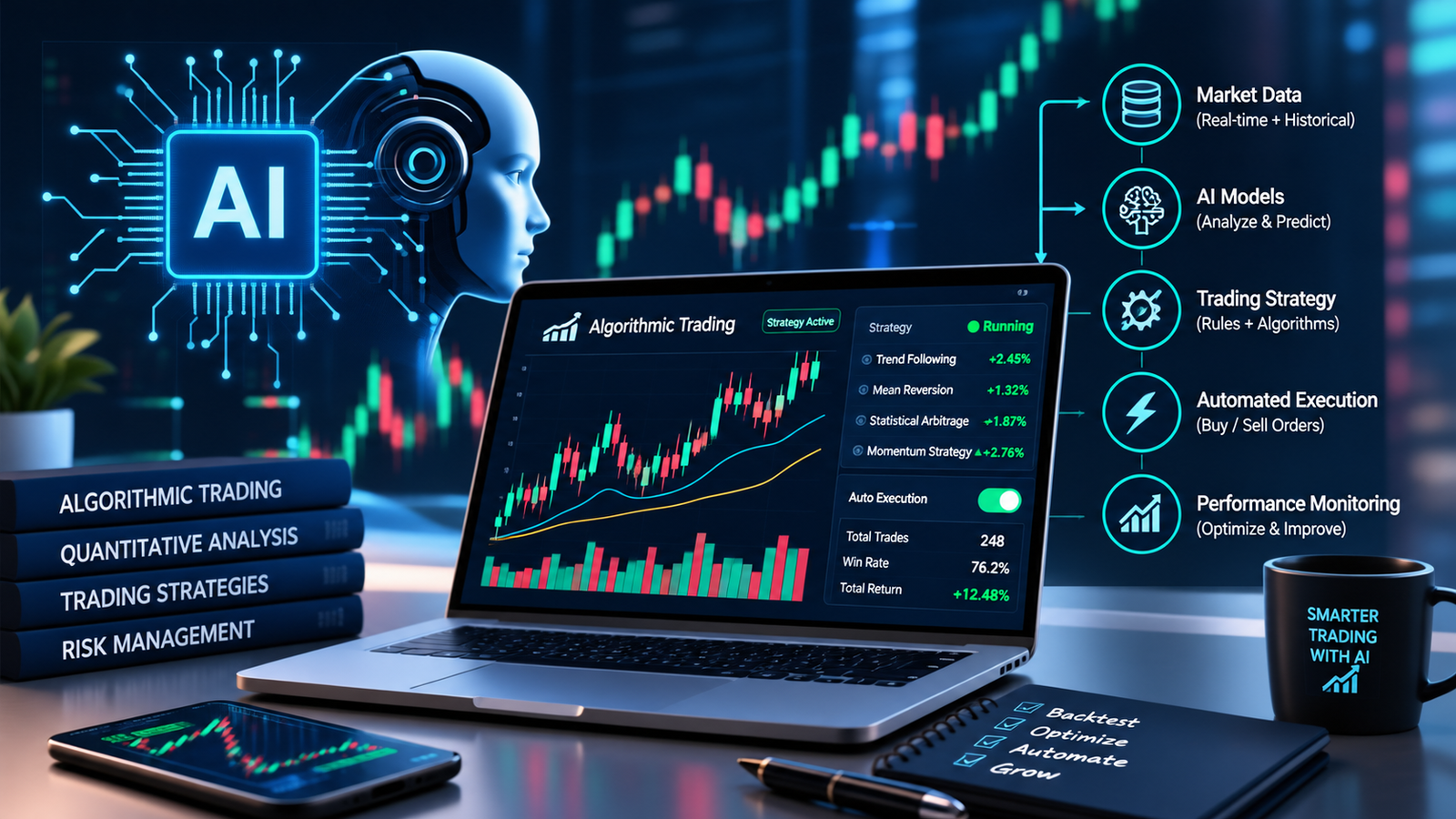
Primary topic: AI in Algorithmic Trading and Automated Strategy Execution
Research focus: Artificial intelligence, machine learning, deep learning, reinforcement learning, automated trading, algorithmic execution, smart order routing, market prediction, portfolio decisions, transaction costs, market impact, risk controls, U.S. securities markets, governance, and the future of autonomous trading systems.
What Is AI in Algorithmic Trading?
AI in algorithmic trading refers to the use of machine learning, deep learning, reinforcement learning, natural language processing, and related AI technologies to support or automate trading decisions and order execution.
Traditional algorithmic trading generally depends on predefined rules.
For example, a strategy may instruct a system to buy when a moving average crosses another moving average, execute an order gradually when volume reaches a specific level, or sell when a predetermined risk threshold is reached.
AI can make this process more adaptive.
Instead of relying entirely on manually written rules, an AI system can learn relationships from historical and real-time data and use those relationships to estimate market conditions, generate trading signals, select execution tactics, or optimize portfolio decisions.
Potential inputs include:
- Real-time and historical prices.
- Trading volume and liquidity.
- Bid and ask information.
- Order-book data.
- Volatility.
- Company fundamentals.
- Earnings and financial statements.
- Economic indicators.
- Options-market information.
- Financial news.
- SEC filings.
- Earnings-call transcripts.
- Market sentiment.
- Alternative data.
The resulting system can perform several different functions.
- Identify trading opportunities.
- Rank securities.
- Predict short-term returns or volatility.
- Detect market regimes.
- Determine position sizes.
- Select execution strategies.
- Optimize order timing.
- Estimate transaction costs.
- Monitor portfolio risk.
- Detect abnormal market or model behavior.
The important distinction is that AI trading is broader than AI price prediction.
A modern system can use AI to decide not only what to trade, but also how much to trade, when to trade, how to execute the order, and when not to trade.
How AI Changes the Algorithmic Trading Workflow
↓
Data Cleaning & Point-in-Time Validation
↓
AI Feature Engineering
↓
Signal Generation
↓
Market Regime Detection
↓
Portfolio / Position Decision
↓
Execution Optimization
↓
Risk Gateway
↓
Order Routing & Execution
↓
Post-Trade Analysis
↓
Model & Strategy Monitoring
The biggest change is that AI can connect multiple stages of the trading process.
A traditional system might use one algorithm to determine an order and another system to execute it.
An AI-native architecture can connect prediction, portfolio construction, execution and risk management so that each component understands the economic consequences of the others.
For example, a signal may indicate that a stock has attractive expected returns. The execution layer can then determine whether the expected opportunity is large enough to justify the spread, slippage, market impact and opportunity cost associated with executing the trade.
This is increasingly important as trading becomes more automated and competitive.
Research Study 1: AI Trading Research Has Expanded Across Many Techniques
A systematic literature review examined 143 research articles covering AI techniques used in financial trading between 2015 and 2023.
The researchers identified 40 different AI techniques used either independently or in hybrid models.
The review found that technical analysis was more commonly used than fundamental analysis and that deep learning was the most frequently used AI approach among the reviewed studies.
One particularly important finding was that only 16% of the selected studies fully automated the trading process.
This indicates that academic AI trading research has historically concentrated more heavily on prediction and signal generation than on complete end-to-end automated execution.
The distinction matters because a profitable prediction does not automatically create a profitable trading system.
A production system must also solve:
- Position sizing.
- Order timing.
- Execution.
- Transaction costs.
- Liquidity constraints.
- Risk controls.
- Monitoring.
The research therefore supports a broader view of AI trading: the next stage is not simply developing better predictors but integrating AI throughout the trading lifecycle.
Research Study 2: Deep Learning Is Expanding Algorithmic Trading Capabilities
A 2025 systematic review examined the use of deep learning in algorithmic trading.
The research covered architectures including:
- Recurrent neural networks.
- Long short-term memory networks.
- Convolutional neural networks.
- Hybrid deep-learning architectures.
These models are being investigated for stock-price prediction, volatility forecasting, market-trend prediction and other trading-related tasks.
Deep learning is attractive because financial relationships can be nonlinear and highly dependent on combinations of variables.
For example, the relationship between price momentum and future returns may behave differently during periods of low volatility than during market stress.
A sufficiently flexible model can potentially learn such conditional relationships.
However, the review identifies three major problems:
- Data noise: Financial markets contain large amounts of randomness and short-lived relationships.
- Overfitting: Complex models can learn historical patterns that do not survive outside the training dataset.
- Interpretability: Some deep-learning systems make it difficult to understand why a particular trading decision was produced.
These limitations mean that deep learning should not be treated as a guaranteed replacement for quantitative research.
The model must be evaluated through robust out-of-sample testing and realistic trading assumptions.
Research Study 3: Reinforcement Learning Is Particularly Relevant to Automated Execution
A 2025 review in Expert Systems with Applications examined reinforcement learning for intelligent investment decision-making.
The review focused on four important financial applications:
- Portfolio selection.
- Trade execution.
- Options hedging.
- Market making.
This is especially relevant to automated strategy execution because reinforcement learning is designed around sequential decision-making.
A supervised model might predict whether a stock will increase.
An RL system can instead learn a sequence of actions.
For example:
Increase exposure
Wait for better conditions
Reduce exposure
Reduce market impact
The RL system receives feedback through a reward function.
That reward might consider return, risk, transaction costs, drawdown, execution quality, or a combination of these objectives.
The research emphasizes the importance of the state representation, action space, reward function and neural architecture.
This means that choosing an RL algorithm is only one part of the strategy-development process.
The economic objective must be designed correctly.
A poorly designed reward function can encourage undesirable behavior even when the underlying AI model is technically sophisticated.
Research Study 4: AI Trading Strategies Must Account for Transaction Costs
A 2026 paper published in The Review of Financial Studies introduced the concept of the implementable efficient frontier.
The researchers argue that investment strategies should be evaluated according to their return after trading costs at each level of risk.
This is highly relevant to automated trading.
An AI model may identify a small expected advantage.
But if capturing that advantage requires frequent trading, the strategy may generate substantial:
- Commissions.
- Bid-ask spreads.
- Slippage.
- Market impact.
- Execution costs.
The research finds that machine-learning portfolio strategies that ignore trading costs can rely too heavily on small and temporary characteristics, resulting in poor net returns.
The authors develop a framework that incorporates trading costs directly into portfolio optimization and reports improved out-of-sample net-of-cost performance relative to alternative approaches.
This provides a major lesson for automated strategy development:
AI should optimize the economic outcome, not simply the prediction.
A strategy that predicts returns accurately but trades too frequently may be less useful than a slightly less accurate model that produces stable signals with low turnover.
Source: The Review of Financial Studies, Machine Learning and the Implementable Efficient Frontier
Research Study 5: Reinforcement Learning Research Is Moving Toward More Advanced Systems
A 2025 survey published in ACM Computing Surveys reviewed 167 publications examining reinforcement learning in quantitative finance.
The review covers the evolution of RL methods in financial applications and discusses approaches including:
- Transfer learning.
- Meta-learning.
- Multi-agent systems.
- Dynamic decision-making.
This evolution is important because financial markets are not simple environments.
Many participants interact simultaneously.
A trading strategy affects market conditions through its own orders, while other market participants respond to information and to one another.
This makes financial markets fundamentally different from static prediction problems.
The research suggests that future RL systems will increasingly need to deal with:
- Changing market regimes.
- Multiple interacting agents.
- Limited and noisy information.
- Changing transaction costs.
- Portfolio constraints.
- Execution uncertainty.
For automated strategy execution, this points toward systems that can adapt rather than relying on one fixed policy indefinitely.
Research Study 6: AI Strategy Development Is Moving Toward Asset-Pricing and Large-Scale Feature Research
A 2025 systematic literature review on AI and asset pricing analyzed 859 articles covering the intersection of finance and computer science.
The research highlights the growing use of machine learning and deep learning for asset pricing and the analysis of large numbers of potential financial factors.
This direction is important for algorithmic trading because modern AI systems can evaluate thousands of potential variables rather than relying on a small set of manually selected indicators.
Potential signals can include:
- Price momentum.
- Volatility.
- Liquidity.
- Valuation.
- Earnings revisions.
- Quality measures.
- Investor sentiment.
- Market structure.
- Industry relationships.
However, a larger feature set also increases the risk of discovering relationships that are statistically impressive but economically weak.
The larger the search space, the stronger the validation process needs to become.
Source: ScienceDirect, Unraveling asset pricing with AI: A systematic literature review
Research Evidence Dashboard
Systematic review of AI techniques used in financial trading.
RL research reviewed across quantitative finance.
AI and asset-pricing research mapped in a 2025 review.
Recent research shows they can materially change ML strategy results.
Changing market conditions remain a core challenge for AI systems.
Research increasingly treats execution as an optimization problem rather than a final technical step.
AI for Trading Signal Generation
AI systems can generate several types of trading signals.
Directional signals estimate the probability that an asset will move upward or downward.
Cross-sectional signals rank securities against one another.
Event signals detect opportunities around earnings, announcements, regulatory events or other market-moving information.
Volatility signals estimate the expected magnitude of future price movement.
Regime signals estimate whether the market environment resembles a trend, range, high-volatility, low-volatility, crisis, or recovery period.
These signals can be combined.
Price + Volume + Liquidity + Volatility + Fundamentals + News
↓
AI Feature Layer
↓
Signal Ensemble
↓
Expected Return + Confidence + Risk
↓
Trading Decision
An important design principle is to separate prediction confidence from trading confidence.
A model may be highly confident that a stock has a positive expected return.
That does not automatically mean the system should trade.
The expected return must be large enough to compensate for risk, transaction costs and execution uncertainty.
AI and Automated Order Execution
Automated execution is one of the most practical applications of AI.
The objective is not necessarily to decide whether a stock is attractive.
Instead, the system may already have an order and need to determine how that order should be executed.
AI can help answer questions such as:
- Should the order be executed immediately?
- Should the order be divided into smaller orders?
- How much liquidity is currently available?
- Is the spread unusually wide?
- Is market volatility increasing?
- Should execution be delayed?
- Which venue or routing option offers better expected execution?
- How much market impact could the order create?
FINRA identifies AI applications in securities trading that include smart order routing, price optimization, best execution and allocation of block trades.
This makes AI execution technology relevant even when the underlying investment strategy is not itself AI-generated.
AI-Based Smart Order Routing
Smart order routing traditionally uses predefined rules to determine where and how orders should be routed.
AI can potentially make the process more adaptive.
The model could consider:
- Current liquidity.
- Historical execution quality.
- Spread conditions.
- Market volatility.
- Order size.
- Time sensitivity.
- Expected market impact.
The system could then estimate the expected execution outcome across available alternatives.
The key objective should be execution quality, not simply execution speed.
A faster order is not necessarily a better order if it produces materially worse price impact.
AI for Market Regime Detection
Financial markets constantly change.
A strategy that works during a strong upward trend may behave differently during a sideways market or a volatility shock.
AI can classify market regimes using variables such as:
- Volatility.
- Market breadth.
- Interest rates.
- Credit spreads.
- Momentum.
- Liquidity.
- Cross-asset relationships.
- Options-market signals.
The strategy can then adapt its behavior.
For example:
Allow momentum exposure
Reduce trend-following exposure
Reduce position size
Increase execution caution
This does not guarantee better results.
It simply provides a framework through which strategy behavior can respond to changing conditions.
AI and Alternative Data
AI can process information that is difficult to incorporate into traditional quantitative models.
Potential sources include:
- Financial news.
- SEC filings.
- Earnings transcripts.
- Analyst revisions.
- Search behavior.
- Consumer activity.
- Supply-chain information.
- Satellite or geospatial information.
Natural language processing can transform documents into structured signals.
For example, an AI system could extract:
- Management sentiment.
- Changes in guidance.
- New business risks.
- Demand commentary.
- Capital expenditure changes.
- Competitive pressure.
- Unexpected events.
The major challenge is timing.
The system must know exactly when the information became publicly available.
Using information that was published after the trade occurred creates look-ahead bias.
AI and Financial LLMs
Large language models create another layer of opportunity.
An LLM can help transform unstructured financial information into structured research signals.
For example:
Earnings Call → Sentiment & Event Analysis → Signal
News → Entity + Event + Materiality Analysis → Trading Feature
LLMs can also assist quantitative researchers with:
- Research-code generation.
- Strategy documentation.
- Financial-document analysis.
- Feature discovery.
- Model monitoring.
- Trade explanations.
However, an LLM should not automatically be trusted to generate trading decisions without validation.
Hallucination, inconsistent reasoning and changes in model behavior can introduce additional risks.
Backtesting AI Trading Systems
Backtesting is one of the most important parts of automated strategy development.
But a backtest can be misleading when it contains unrealistic assumptions.
A robust system should account for:
- Point-in-time data.
- Corporate actions.
- Delisted securities where relevant.
- Transaction costs.
- Bid-ask spreads.
- Slippage.
- Market impact.
- Liquidity limits.
- Order execution timing.
- Position constraints.
The system should also separate:
Training data → Validation data → Untouched test data.
The test period should not be repeatedly used to improve the strategy.
Otherwise, the test set effectively becomes part of the training process.
Walk-Forward Strategy Validation
↓
Train
↓
Validate
↓
Forward Test
↓
Move Time Window
↓
Retrain
↓
Forward Test Again
↓
Aggregate Results
Walk-forward validation is particularly useful because markets are not stationary.
It tests whether the strategy continues to function when it is moved through different market periods.
A strong strategy should be examined across:
- Bull markets.
- Bear markets.
- High-volatility periods.
- Low-volatility periods.
- Rapid interest-rate changes.
- Liquidity stress.
- Major market shocks.
Transaction Costs and Market Impact
Transaction costs can be particularly important for high-frequency and short-horizon strategies.
A strategy with thousands of trades can accumulate significant costs even when each individual trade appears inexpensive.
The total economic result should therefore be evaluated as:
− Transaction Costs
− Bid/Ask Spread
− Slippage
− Market Impact
= Net Implementable Return
The 2026 Review of Financial Studies research is particularly relevant here because it argues that the implementable efficient frontier should focus on out-of-sample returns after trading costs rather than cost-agnostic historical performance.
Source: Oxford Academic, Machine Learning and the Implementable Efficient Frontier
AI Algorithmic Trading Architecture
Real-time market data + historical data + fundamentals + news + alternative data
2. Data Quality Engine
Timestamp validation + missing-data detection + anomaly detection + corporate-action handling
3. Feature Engineering
Technical + fundamental + sentiment + volatility + liquidity + market-microstructure features
4. AI Model Layer
ML + deep learning + Transformers + reinforcement learning + ensemble models
5. Decision Engine
Signal ranking + expected return + confidence + regime + portfolio constraints
6. Execution Engine
Order slicing + timing + routing + execution optimization
7. Risk Gateway
Position limits + exposure limits + drawdown controls + volatility controls + kill switch
8. Broker / Market Connectivity
Order submission + acknowledgements + fills + cancellations
9. Monitoring Layer
Model drift + data drift + execution quality + P&L + abnormal behavior
10. Governance Layer
Model versioning + approvals + audit trails + human oversight
Risk Matrix for AI Algorithmic Trading
| Risk | Potential problem | Recommended control |
|---|---|---|
| Overfitting | Excellent historical performance but poor live performance | Walk-forward validation and untouched test data |
| Look-ahead bias | Artificially inflated backtest results | Point-in-time datasets |
| Model drift | Signal quality deteriorates | Continuous monitoring and retraining policy |
| Data drift | Input distribution changes | Data-quality and distribution monitoring |
| Execution risk | Actual fill differs from modeled execution | Execution simulation and live monitoring |
| Liquidity risk | Large orders move the market | Liquidity-aware position and order limits |
| Unexpected market event | Model behavior becomes unreliable | Stress testing, circuit breakers and human escalation |
| Correlated AI behavior | Multiple systems react similarly | Scenario analysis and strategy diversification |
| Cybersecurity | Unauthorized model or order activity | Access controls, monitoring and independent execution limits |
AI Trading in U.S. Securities Markets
For a U.S.-focused audience, algorithmic trading must be designed around the existing regulatory and supervisory environment.
FINRA states that algorithmic trading, including high-frequency trading, has become widespread in U.S. securities markets. FINRA guidance emphasizes risk assessment, software and code development, testing, implementation controls, monitoring and supervisory programs for firms using algorithmic strategies.
FINRA also identifies AI applications in trading such as:
- Smart order routing.
- Price optimization.
- Best execution.
- Block-trade allocation.
At the same time, FINRA warns that autonomous AI systems can behave unexpectedly when they encounter circumstances that were not represented in training data, including unusual volatility, natural disasters, pandemics or geopolitical events. It also identifies the possibility that AI trading systems could learn from one another and contribute to herd behavior or unpredictable outcomes.
This makes governance a core engineering requirement.
A production AI trading system should have an independent risk layer capable of stopping or limiting orders even if the AI model generates an aggressive recommendation.
AI Trading and Human Oversight
Full automation does not mean removing humans from the system.
A stronger architecture separates:
AI decision-making
from
risk authorization.
For example, the AI may recommend a trade, while a deterministic risk engine checks:
- Maximum position size.
- Maximum portfolio exposure.
- Daily loss limits.
- Liquidity requirements.
- Maximum order size.
- Allowed securities.
- Trading-hour restrictions.
- System health.
Only after the trade passes these controls should it reach the execution engine.
This architecture creates a second line of defense.
Expert Recommendation
The strongest way to build an AI algorithmic trading system is to avoid starting with the question:
“Which AI model will make the most money?”
Instead, begin with:
“What economic decision are we trying to optimize?”
The development process should follow this sequence:
Determine whether the system is designed for alpha generation, execution optimization, market making, portfolio rebalancing, hedging, or another objective.
2. Define the tradable universe.
Set liquidity, market-capitalization, security-type and exposure constraints.
3. Build point-in-time data.
Make sure every feature was actually available when the historical decision would have been made.
4. Build a simple benchmark.
A complex AI model should outperform a meaningful baseline after realistic costs.
5. Introduce AI selectively.
Use ML, deep learning or RL where the data and decision problem justify the complexity.
6. Optimize the economic objective.
Include transaction costs, turnover, market impact and risk directly in strategy evaluation.
7. Test across regimes.
Do not rely on a single bull-market or low-volatility period.
8. Paper trade before production.
Observe real-time behavior before allocating meaningful capital.
9. Separate AI from risk authorization.
Use an independent risk engine with deterministic limits.
10. Continuously monitor the system.
Track model drift, data drift, execution quality, costs, drawdowns and abnormal behavior.
Expert Quotation
Source: FINRA, AI Applications in the Securities Industry
This observation is particularly important for automated execution.
A human trader may recognize that a market has entered an unusual environment and stop using a familiar strategy.
An autonomous model may continue following its learned policy unless the system has explicit mechanisms for detecting abnormal conditions.
AI Algorithmic Trading Maturity Model
Rule-based execution
ML-assisted signals
AI portfolio decisions
AI execution optimization
Adaptive end-to-end AI trading
Organizations do not necessarily need to reach Level 5.
For many firms, a well-governed AI signal or execution-optimization system can provide meaningful value without giving an autonomous model unrestricted control over trading.
Implementation Roadmap
| Phase | Primary activities | Output |
|---|---|---|
| 1. Strategy definition | Define objective, universe, horizon and constraints | Strategy specification |
| 2. Data engineering | Build point-in-time market and alternative-data infrastructure | Validated dataset |
| 3. Baseline model | Develop transparent quantitative benchmark | Benchmark strategy |
| 4. AI development | Train and compare candidate AI models | Candidate models |
| 5. Backtesting | Run historical and walk-forward tests | Out-of-sample results |
| 6. Cost modeling | Model spread, slippage, impact and turnover | Net performance |
| 7. Paper trading | Test live signals and execution without material capital deployment | Operational evidence |
| 8. Risk integration | Implement independent controls and kill switches | Controlled architecture |
| 9. Production | Deploy with controlled capital and monitoring | Live trading system |
| 10. Continuous validation | Monitor drift, execution, risk and performance | Ongoing strategy governance |
Key KPIs for AI Algorithmic Trading
| KPI | Why it matters |
|---|---|
| Net return | Measures economic performance after trading costs |
| Sharpe ratio | Measures risk-adjusted performance |
| Maximum drawdown | Shows downside exposure |
| Turnover | Shows how heavily the strategy trades |
| Slippage | Measures execution difference from modeled prices |
| Market impact | Measures price movement caused by execution |
| Fill rate | Measures execution completion |
| Model drift | Detects deterioration in model behavior |
| Data drift | Detects changes in input distributions |
Future Predictions: 2027–2030
2027: AI Execution Will Become More Adaptive
AI execution systems are likely to increasingly adapt order timing and execution tactics to changing liquidity, volatility and market conditions.
Rather than using one fixed execution rule, systems will increasingly evaluate the expected cost of alternative execution paths.
The focus will shift from simply executing orders quickly toward optimizing execution quality under changing market conditions.
2028: Trading Systems Will Combine More Data Types
Future algorithmic systems will increasingly combine numerical and unstructured information.
Market prices may be analyzed alongside:
- News.
- SEC filings.
- Earnings transcripts.
- Options activity.
- Economic indicators.
- Alternative data.
Multimodal AI could become an important research architecture for combining these information streams.
2029: Reinforcement Learning Will Expand Beyond Portfolio Selection
RL is likely to become increasingly relevant to execution and sequential decision-making.
Instead of simply predicting a return, an RL system can optimize a sequence of actions while considering the consequences of previous actions.
This makes it particularly relevant to:
- Order execution.
- Market making.
- Portfolio rebalancing.
- Dynamic hedging.
- Liquidity management.
2030: AI Trading Systems Will Become More Modular
Rather than using one giant model for everything, sophisticated trading platforms are likely to use specialized AI components.
For example:
Finds signals
Analyzes market conditions
Allocates capital
Optimizes orders
Can reject trades
This architecture could make AI systems easier to monitor because each component has a clearly defined responsibility.
Potential Startup Opportunities
The growth of AI-driven algorithmic trading creates opportunities beyond consumer-facing trading bots.
Potential products include:
- AI Quant Research Platforms: Platforms that allow quantitative teams to discover, test and compare strategies.
- AI Backtesting Infrastructure: Cloud systems focused on point-in-time data, realistic execution and transaction-cost modeling.
- AI Execution APIs: APIs that optimize order timing, slicing, routing and execution tactics.
- AI Signal Platforms: APIs delivering sentiment, momentum, volatility, regime and event signals.
- AI Portfolio Engines: Systems that convert predictive signals into constrained portfolio decisions.
- AI Trading Risk Gateways: Independent services that validate AI-generated orders before execution.
- Model Monitoring Platforms: Tools for model drift, data drift, performance deterioration and abnormal behavior.
- Financial LLM Infrastructure: Systems that turn filings, earnings calls and news into structured quantitative features.
- Algorithmic Trading Governance: Model inventories, audit trails, approval workflows and deployment controls.
Frequently Asked Questions
What is AI in algorithmic trading?
AI in algorithmic trading uses machine learning, deep learning, reinforcement learning, NLP and related technologies to generate trading signals, optimize portfolio decisions, improve execution or automate parts of the trading process.
How is AI different from traditional algorithmic trading?
Traditional algorithmic trading often depends on predefined rules. AI-based systems can learn relationships from historical and real-time data and adapt their decisions based on changing information, although they still require predefined constraints and controls.
Can AI automatically execute stock trades?
Yes. AI can be integrated with automated execution systems, broker infrastructure and order-routing systems. However, autonomous execution requires strong testing, monitoring, risk controls and appropriate regulatory oversight.
What AI models are used in algorithmic trading?
Common approaches include gradient boosting, random forests, neural networks, LSTMs, CNNs, Transformers, reinforcement learning and ensemble models. NLP and LLM systems are increasingly being explored for financial text and alternative-data processing.
Is reinforcement learning useful for automated trading?
RL is particularly relevant to sequential decision problems such as portfolio management, trade execution, options hedging and market making. Recent research reviews these applications extensively.
Why are transaction costs important?
Transaction costs can significantly reduce strategy performance, especially when a system trades frequently. Recent research shows that strategies should be evaluated on net-of-cost performance rather than relying only on gross backtest results.
What is the biggest risk of AI algorithmic trading?
A major risk is that an AI model may perform well under historical conditions but behave poorly when market conditions change. Other important risks include overfitting, data leakage, execution errors, liquidity shocks, model drift and unexpected autonomous behavior.
Will AI replace algorithmic traders?
AI is more likely to change the role of quantitative and trading professionals than eliminate them. Human expertise remains important for strategy design, validation, risk management, governance, regulatory compliance and deciding how much autonomy a trading system should have.
Final Perspective
AI is changing algorithmic trading from a collection of predefined trading rules into a broader technology discipline built around prediction, optimization, decision-making, and automated execution.
Research across more than a hundred studies shows that the field has expanded from conventional machine-learning approaches into deep learning, reinforcement learning, hybrid models, multi-agent systems, and increasingly sophisticated financial AI architectures.
The most important development, however, is not simply the increasing complexity of AI models. It is the shift toward economic optimization.
A trading system does not create value merely because it predicts a price correctly.
It creates value only when its decisions can be implemented at an acceptable cost and risk level. That requires the complete system to consider:
- Signal quality
- Market regime
- Portfolio exposure
- Liquidity
- Transaction costs
- Slippage
- Market impact
- Execution quality
- Model stability
- Operational risk
The 2026 Review of Financial Studies research on the implementable efficient frontier reinforces this principle by emphasizing out-of-sample performance after trading costs. At the same time, FINRA’s U.S. securities-market guidance shows why autonomous trading systems require strong controls.
AI systems can encounter conditions that were not represented in their training data, and algorithmic strategies can create risks that extend beyond the individual model. The future is therefore unlikely to be defined by one universal AI trading model.
Instead, the next generation will likely consist of modular systems in which different AI models handle research, prediction, regime detection, portfolio optimization, and execution, while an independent risk layer controls what the system is allowed to do.
→
AI Research
→
Signals
→
Decision
→
Cost Optimization
→
Risk Controls
→
Execution
→
Monitoring
Research Sources
- Journal of King Saud University Computer and Information Sciences: Artificial intelligence techniques in financial trading: A systematic literature review
- ScienceDirect: Deep learning for algorithmic trading: A systematic review of predictive models and optimization strategies
- ScienceDirect: A Survey on recent advances in reinforcement learning for intelligent investment decision-making optimization
- The Review of Financial Studies: Machine Learning and the Implementable Efficient Frontier
- ACM Computing Surveys: The Evolution of Reinforcement Learning in Quantitative Finance: A Survey
- ScienceDirect: Unraveling asset pricing with AI: A systematic literature review
- FINRA: Algorithmic Trading
- FINRA: AI Applications in the Securities Industry
- FINRA: Regulatory Notice 24-09, Generative Artificial Intelligence and Large Language Models
- Federal Reserve: Governor Lisa Cook on Generative AI and Financial Markets
Leave a Reply