
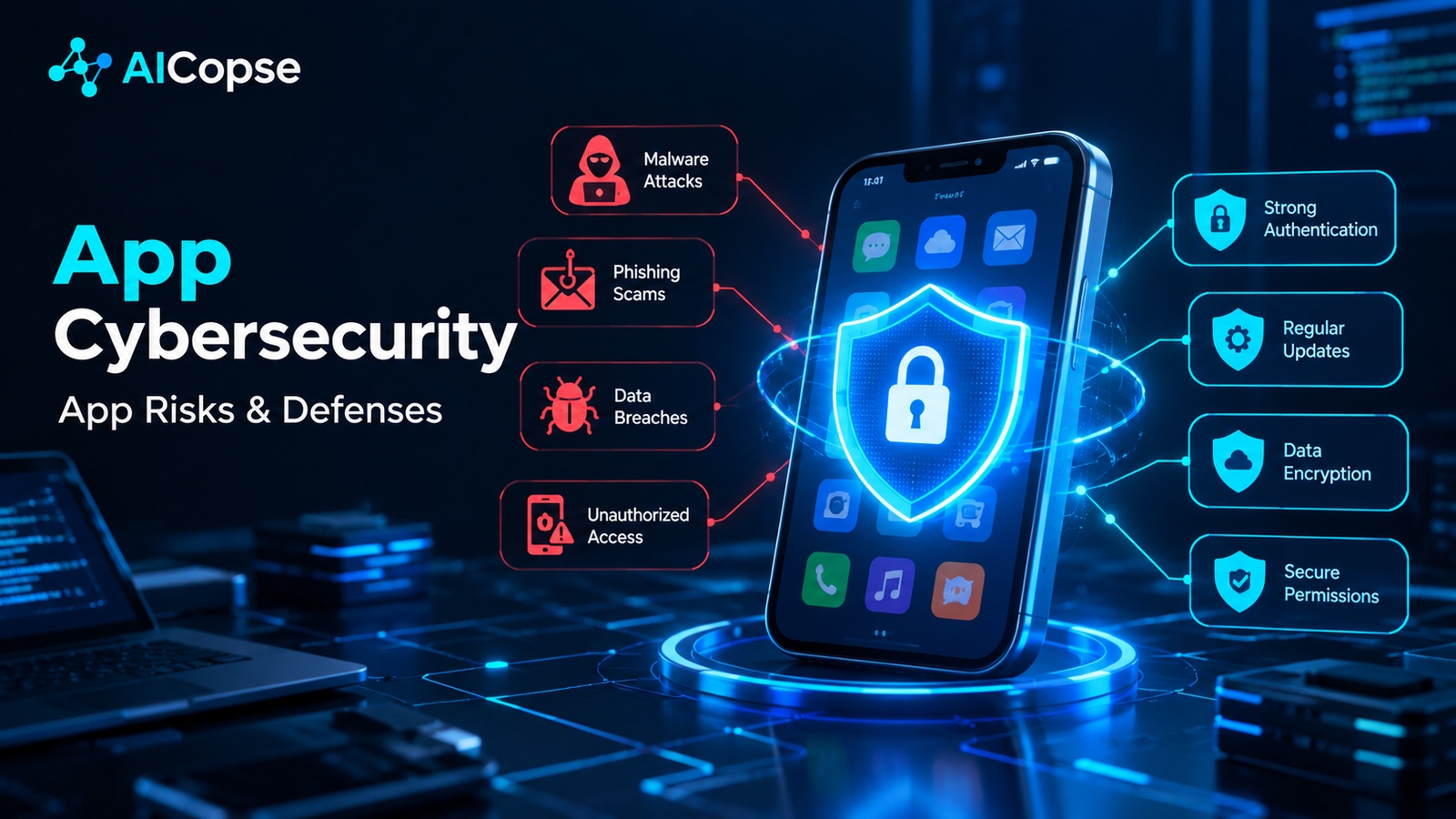
AICOPSE Research Report · 2026
Cybersecurity Application Risks, Vulnerabilities, and Security Practices in 2026
A research-based guide to application security threats, exploited vulnerabilities, API risks, AI-powered attacks, real-world incidents, and practical security controls for developers, startups, and businesses.
2026 threat statistics
AI and API security
Developer security checklist
Executive finding: Application security in 2026 requires more than finding software bugs. Organizations must reduce exploitable exposure, secure identities and APIs, control software supply chains, protect sensitive data, and prepare for attackers who can use AI to accelerate reconnaissance and exploitation.
Executive Summary
Applications are the front door to modern businesses. Websites, mobile applications, APIs, cloud services, payment systems, customer portals, and internal tools all process information that attackers may want to steal, change, or hold for ransom. As companies add AI features and connect more services, the number of potential entry points grows.
Verizon’s 2026 Data Breach Investigations Report analyzed more than 31,000 security incidents, including more than 22,000 confirmed data breaches across 145 countries. Software vulnerability exploitation accounted for 31% of breaches in the report, becoming the leading initial access vector in its dataset. The report also found ransomware involved in 48% of breaches. These findings make patching, application testing, identity protection, and incident readiness central business priorities.
The risks are not limited to traditional web applications. APIs can expose customer records or business operations when authorization rules are weak. Software supply chains can introduce malicious or vulnerable dependencies. Cloud misconfigurations can expose databases and storage. AI applications can introduce prompt injection, unsafe tool access, data leakage, and untrusted output handling.
AI also changes the speed of the threat environment. CrowdStrike’s 2026 Global Threat Report reported an 89% year-over-year increase in activity by AI-enabled adversaries during 2025. The same report recorded a fastest observed eCrime breakout time of 27 seconds. These are CrowdStrike’s telemetry-based findings, not a measurement of every attack worldwide, but they underline why security teams should reduce delays between detection and containment.
Sources: Verizon 2026 DBIR and CrowdStrike 2026 Global Threat Report. The figures describe different datasets and should not be combined into one incident rate.
Table of Contents
- Application cybersecurity in 2026
- Six major cybersecurity studies
- The most critical application vulnerabilities
- APIs, cloud, dependencies, and AI attack surfaces
- Major events and incidents
- Risks by industry and business size
- Security practices and developer checklist
- Security roadmap for startups and businesses
- Future predictions and expert recommendations
- Frequently asked questions
- Research sources and limitations
Application Cybersecurity in 2026: What Has Changed?
Application cybersecurity covers the practices used to protect software from unauthorized access, data theft, manipulation, disruption, and abuse. It includes the code developers write, the libraries they use, the servers that run the application, the APIs that connect services, and the identities allowed to access each component.
The application attack surface is also changing. A modern product may depend on a frontend framework, backend services, cloud storage, identity providers, payment processors, third-party APIs, analytics tools, and AI models. A weakness in one component can create a route into another. Security therefore needs to cover the complete application lifecycle, from design and coding to deployment, monitoring, and retirement.
Application code
Injection, unsafe input handling, access-control errors, and insecure design.
Identity and sessions
Weak authentication, stolen tokens, excessive privileges, and session abuse.
APIs and integrations
Broken object authorization, exposed data, weak rate limits, and unsafe trust between services.
Cloud and infrastructure
Misconfigured storage, exposed management interfaces, weak secrets handling, and unpatched systems.
Software supply chain
Compromised dependencies, build pipelines, package registries, and third-party vendors.
AI features and agents
Prompt injection, data exposure, unsafe tool execution, and excessive autonomy.
One important distinction is the difference between a vulnerability and a breach. A vulnerability is a weakness that could be exploited. An attack attempt is an effort to exploit a weakness or bypass a control. A confirmed breach means unauthorized access or another qualifying security compromise has occurred. A vulnerability count alone cannot show how many organizations have been breached, just as a high volume of blocked attacks does not necessarily mean an organization suffered a compromise.
Organizations should also distinguish a security finding from a business risk. A low-severity flaw in an isolated test system may not deserve the same immediate attention as a remotely exploitable flaw in an internet-facing payment service. Effective security prioritizes vulnerabilities using exposure, exploit evidence, privileges required, potential impact, affected data, and available mitigations.
Six Major Cybersecurity Studies and What They Reveal
Study 1: Verizon 2026 Data Breach Investigations Report
Source: Verizon 2026 DBIR
Research scope: More than 31,000 real-world security incidents and more than 22,000 confirmed data breaches across 145 countries. The report’s principal incident dataset covers November 1, 2024, through October 31, 2025, with additional observations and context about emerging activity in 2026.
The 2026 DBIR is especially useful because it analyzes actual incidents contributed by organizations such as law enforcement, forensic firms, cyber insurers, security groups, and Verizon’s threat research teams. It does not depend only on executives describing their security concerns. Its findings show how attacks succeeded in observed cases.
The percentage figures have different denominators and describe overlapping breach characteristics. They should not be added together.
One of the report’s most important findings is that vulnerability exploitation has become a leading initial access route in its dataset. This shifts attention toward internet-facing systems, exposed edge devices, unpatched software, and the speed of remediation. It also reinforces the need to identify which applications are reachable from the internet and which assets contain valuable information.
Verizon also reported that ransomware was involved in 48% of breaches in the 2026 report. Ransomware risk extends beyond encrypting files. Modern extortion operations can include data theft, threats to publish information, disruption of business operations, and pressure on customers or partners. A recovery plan therefore needs to cover both restoring systems and responding to possible data exposure.
The report further noted that generative AI was being used to support multiple attack techniques. The practical implication is not that every attack is now autonomous. Rather, existing methods such as reconnaissance, social engineering, and malware development can be accelerated through AI-assisted workflows.
What businesses should learn: Maintain an accurate asset inventory, prioritize externally exposed vulnerabilities, reduce patching delays, protect remote access, and test incident response plans. Security leaders should measure the time from identifying an exploitable weakness to verifying that it has been fixed.
Study 2: IBM and Ponemon Institute Cost of a Data Breach Report 2026
Source: IBM Cost of a Data Breach Report 2026
IBM’s 2026 report examines the financial consequences of data breaches and the growing relationship between AI and cybersecurity. IBM reported a global average breach cost of US$4.99 million, a 12% increase over the previous year. It also reported a 56% increase in AI-driven attacks, highlighting the growing role of AI-enabled malware and deepfake impersonation in the incidents included in its research.
The financial cost of a breach can include detection and investigation, legal and regulatory work, customer notifications, recovery, operational downtime, and lost business. A company that calculates risk only from direct technical repair expenses will miss much of the impact.
IBM also reported that extensive use of AI and automation in security was associated with US$1.93 million in savings compared with organizations using none. This is a reported comparison, not a guaranteed saving for any individual company. The results depend on the level of adoption, the organizations studied, and how the costs were calculated.
The report’s emphasis on AI model inversion attacks is also relevant to organizations that build or customize AI systems. A model can reveal information about its training data under certain conditions, so security testing should consider not only the application around the model but also the information that model outputs might disclose.
What businesses should learn: Estimate breach costs before an incident occurs. Include downtime, recovery, legal support, customer communication, and potential revenue loss. Security automation can help with repetitive detection and response tasks, but automated actions need safeguards and clear escalation rules.
Study 3: OWASP Top 10 for Web Application Security 2025
Source: OWASP Top 10:2025
OWASP’s Top 10 is a widely used awareness document that helps development teams understand major categories of web application risk. It is not a complete list of every vulnerability, nor is it a direct estimate of the probability that a particular business will be breached. Its value lies in giving developers and security teams a shared language for discussing recurring weaknesses.
| Rank | OWASP Top 10:2025 category | Main security concern |
|---|---|---|
| A01 | Broken Access Control | Users access data or actions they should not be allowed to use. |
| A02 | Security Misconfiguration | Unsafe defaults, exposed services, or incorrect security settings. |
| A03 | Software Supply Chain Failures | Compromised or vulnerable components, build systems, and distribution channels. |
| A04 | Cryptographic Failures | Sensitive data is not adequately protected. |
| A05 | Injection | Untrusted input changes how a command or query is interpreted. |
| A06 | Insecure Design | Security requirements and threat scenarios were not adequately addressed. |
| A07 | Authentication Failures | Identity verification and session controls can be bypassed or abused. |
| A08 | Software or Data Integrity Failures | The system trusts software or data without adequate integrity checks. |
| A09 | Security Logging and Alerting Failures | Attacks are not detected or investigated quickly enough. |
| A10 | Mishandling of Exceptional Conditions | Unexpected errors create unsafe behavior or expose information. |
OWASP reported that broken access control remained at number one in the 2025 list. Its contributed data indicated that an average of 3.73% of tested applications had one or more weaknesses mapped to the category’s 40 Common Weakness Enumerations. Security misconfiguration moved from fifth place in the 2021 list to second in 2025, with an average of 3.00% of tested applications showing one or more mapped weaknesses in that category.
These percentages refer to applications in OWASP’s contributed testing dataset. They do not mean that exactly 3.73% of all applications worldwide are vulnerable. The dataset and testing methods influence the result, and application security testing does not cover every possible failure mode.
One notable change is the expanded focus on software supply chain failures. Modern applications rely on external packages, container images, build systems, plugins, and deployment pipelines. A business may write secure application code and still inherit risk from a compromised dependency or build process.
What businesses should learn: Use the OWASP categories as a baseline for secure design and testing. Make authorization tests, configuration checks, dependency scanning, cryptographic review, and security logging part of normal development instead of treating them as a final release checklist.
Study 4: CrowdStrike 2026 Global Threat Report
Source: CrowdStrike 2026 Global Threat Report
CrowdStrike’s report draws on its threat intelligence and observed adversary activity during 2025. It reported an 89% increase in AI-enabled adversary activity, a fastest recorded eCrime breakout time of 27 seconds, and that 82% of detections in 2025 were malware-free. It also reported a 42% increase in zero-day vulnerabilities exploited before public disclosure within the activity it tracked.
Malware-free activity is important because attackers do not always need to install a traditional malicious file. They may abuse legitimate administrative tools, stolen credentials, remote management services, scripts, or existing cloud capabilities. Defenses that focus only on known malware files can miss behavior that looks like ordinary system administration.
CrowdStrike also reported that attackers were exploiting legitimate AI tools and development platforms. In more than 90 organizations observed by the company, attackers manipulated AI tools to generate malicious commands or assist data theft. This is a warning that AI applications themselves can become part of the attack surface when they are connected to sensitive information or privileged tools.
The report’s measurements come from CrowdStrike’s own telemetry and threat intelligence. They should not be interpreted as a complete count of all global cyberattacks. The value lies in the direction of the observed threat patterns and the practical implications for defenders.
What businesses should learn: Detect suspicious behavior across identities, endpoints, cloud services, and applications. Limit administrative privileges, monitor unusual data access, and prepare for attackers who may use legitimate tools instead of obvious malware.
Study 5: Microsoft Digital Defense Report 2025
Source: Microsoft Digital Defense Report 2025
Microsoft’s annual report examines threats across identities, cloud services, endpoints, email, and connected business environments. Its 2025 report described the continuing use of AI-assisted phishing, multi-stage attack chains, and the exploitation of known security gaps in web assets and remote services.
Microsoft reported that 97% of identity attacks in its observed data were password-spray attacks. In this technique, attackers try a limited set of commonly used passwords across many accounts rather than repeatedly attacking one account with a large number of guesses. This can help them evade poorly configured detection and account lockout controls.
of identity attacks in Microsoft’s reported data were password-spray attacks.
This is a finding from Microsoft’s observed identity attack data, not a claim that 97% of all cyberattacks worldwide use password spraying.
The report also described a major disruption operation against Lumma Stealer in mid-2025. Microsoft’s Digital Crimes Unit worked with the U.S. Department of Justice, Europol, and Japan’s Cybercrime Control Center to seize or block more than 2,300 malicious domains. Lumma Stealer was a malware-as-a-service platform used to collect sensitive information from browsers and applications, including cryptocurrency wallet information.
This case demonstrates why application security cannot stop at the web server. Browser sessions, stored credentials, developer machines, API tokens, and cloud identity credentials can all provide access to business systems. A compromised employee device may become a route into applications that have no direct software vulnerability.
What businesses should learn: Enforce phishing-resistant multifactor authentication where possible, use secure session management, monitor risky sign-ins, protect browser and developer environments, and limit the lifetime and scope of access tokens. Security teams should also review whether stolen credentials can be used to reach sensitive production systems.
Study 6: CISA Known Exploited Vulnerabilities and NIST Secure Software Guidance
Sources: CISA Known Exploited Vulnerabilities Catalog and NIST Secure Software Development Framework.
The CISA Known Exploited Vulnerabilities catalog is not a survey. It is a curated list of vulnerabilities for which there is evidence of exploitation in the wild. It helps defenders identify flaws that deserve urgent attention because attackers are already using them. CISA adds vulnerabilities as evidence becomes available, so the catalog changes over time.
For example, in July 2026, CISA added CVE-2025-68686, involving exposure of sensitive information in Fortinet FortiOS, and CVE-2026-16812, involving command injection in Arista VeloCloud Orchestrator On-Prem. These additions illustrate why organizations need to monitor newly listed vulnerabilities and check whether affected products are present in their own environments.
However, the catalog should not be treated as a complete inventory of all dangerous flaws. A vulnerability absent from the catalog can still be severe. Organizations should combine CISA’s confirmed-exploitation evidence with asset exposure, vendor advisories, vulnerability severity, business impact, and their own threat intelligence.
NIST’s Secure Software Development Framework complements this approach by describing practices that can reduce vulnerabilities during software development. It encourages organizations to prepare people and processes, protect software components, produce well-secured releases, and respond to vulnerabilities that are discovered after deployment.
What businesses should learn: Monitor CISA KEV and vendor advisories, identify affected assets, prioritize fixes based on exposure and impact, and verify that remediation actually worked. For development teams, use a secure development process that makes security a continuous activity rather than a one-time test.
The Most Critical Application Vulnerabilities in 2026
Application vulnerabilities are not equally dangerous. A weakness may allow information disclosure, unauthorized actions, remote code execution, account takeover, or service disruption. The impact depends on what the application can access, how it is exposed, and what an attacker can do after exploiting it.
1. Broken Access Control
Broken access control occurs when an application fails to enforce the permissions required for a user, role, or service to access a resource or perform an action. For example, a customer may be able to change an identifier in a URL and view another customer’s invoice if the backend checks only whether the user is logged in.
This risk is especially common in applications with many users, roles, organizations, and API endpoints. Authentication confirms who a user is. Authorization determines what that user is allowed to do. A valid login does not grant permission to access every record or administrative function.
- Enforce authorization on the server for every sensitive operation.
- Check both the user’s role and the specific object being accessed.
- Test horizontal access, such as one customer accessing another customer’s data.
- Test vertical access, such as a normal user attempting an administrator-only action.
- Avoid relying on hidden buttons or frontend checks as security controls.
2. Security Misconfiguration
Security misconfiguration includes exposed administrative interfaces, overly permissive cloud storage, unnecessary services, weak security headers, default credentials, verbose error messages, and insecure deployment settings. These weaknesses can appear even when the application code is otherwise well written.
Configuration problems are particularly challenging because modern applications can have separate settings for development, testing, staging, production, containers, cloud accounts, and third-party platforms. A secure development environment does not guarantee that production is configured correctly.
- Use secure configuration templates and infrastructure as code.
- Remove default accounts, unnecessary services, and unused public endpoints.
- Keep development and production credentials separate.
- Scan cloud resources and deployment configurations regularly.
- Check security settings after major releases and infrastructure changes.
3. Injection and Unsafe Input Handling
Injection occurs when untrusted input changes how a system interprets a command or query. Examples include SQL injection, command injection, and cross-site scripting. The underlying problem is that an application treats user-controlled content as instructions or executable structure rather than as data.
Developers should use parameterized database queries, safe APIs, context-aware output encoding, and strict validation. Input validation is useful, but it is not a replacement for parameterized queries or correct output handling. Security checks should reflect the actual context in which data is used.
4. Authentication and Session Failures
Authentication failures can result from weak passwords, missing multifactor authentication, insecure password recovery, poorly protected session tokens, and inadequate session expiration. Attackers may also use stolen credentials from other services, making password reuse a serious risk.
Applications should use established identity standards where practical, enforce strong authentication for privileged accounts, protect tokens from browser-based theft, and revoke sessions when risk changes. Privileged access should be limited and monitored, particularly for production systems, cloud consoles, and administrative APIs.
5. Cryptographic Failures and Data Exposure
Cryptographic failures occur when sensitive information is not protected properly. Examples include storing passwords in plaintext, using weak cryptographic settings, exposing secrets in source code, failing to encrypt sensitive data in transit, or keeping encryption keys alongside the data they protect.
Encryption alone does not solve every privacy problem. An application can encrypt a database and still expose customer information through an overly permissive API. Businesses should combine encryption with access control, key management, data minimization, retention limits, and monitoring.
6. Software Supply Chain Failures
Most modern applications depend on third-party packages, frameworks, container images, plugins, and build tools. A vulnerable or compromised component can introduce risk even if the business’s own source code contains no obvious defect.
Security teams should maintain a software bill of materials where appropriate, scan dependencies, pin and verify packages, review critical updates, protect build credentials, and restrict which workflows can publish releases. Package updates should be tested, but security fixes for actively exploited vulnerabilities may require an accelerated release process.
7. Unsafe Error Handling and Logging Gaps
Errors are inevitable, but unsafe error handling can reveal internal paths, database details, credentials, or sensitive records. Missing logs create a different problem: the organization may be unable to reconstruct what happened after an incident.
Applications should return useful but non-sensitive error messages to users, record relevant security events, protect logs from tampering, and alert on suspicious patterns. Logs should not indiscriminately collect passwords, authentication tokens, payment details, or other sensitive information.
APIs, Cloud, Software Dependencies, and AI: The Expanding Attack Surface
API Security
APIs connect mobile applications, web frontends, payment systems, business software, and AI tools. Their security depends on more than a valid API key. Each request must be authorized for the specific user, object, operation, and data being accessed.
Common API risks include broken object-level authorization, weak authentication, excessive data exposure, unrestricted resource consumption, and poor inventory management. An endpoint may work as designed while still returning more data than a user should receive. Attackers can also abuse legitimate endpoints through automated requests, expensive queries, or sensitive business flows.
- Inventory public, private, partner, and deprecated APIs.
- Verify object-level and function-level authorization on the server.
- Use rate limits and quotas that reflect the cost and sensitivity of each endpoint.
- Validate request and response schemas.
- Protect credentials and rotate exposed keys promptly.
- Monitor unusual access patterns and unexpected data volumes.
Cloud Application Security
Cloud platforms can provide strong security capabilities, but the customer remains responsible for configuring and using them correctly. Common risks include public storage, exposed management interfaces, excessive service permissions, weak secrets management, insecure network rules, and incomplete monitoring.
Businesses should use identity and access management policies that grant only necessary permissions. Separate production from development environments, store secrets in managed secret systems, enable audit logging, and use automated configuration checks. A cloud account should not rely on a single administrator account with broad permissions and no recovery plan.
AI Application Security
AI applications introduce risks that differ from conventional input validation. A language model may interpret instructions embedded in a document, retrieved webpage, email, or other untrusted content. If the model can call tools or access sensitive data, manipulated instructions can influence what it retrieves or attempts to do.
Prompt injection is not solved reliably by adding one instruction telling a model to ignore malicious content. Security must be enforced by the application architecture. The model should not be the final authority on access permissions, payment approvals, database access, or high-impact actions.
Untrusted content attempts to influence model instructions or tool behavior.
The model reveals information that the current user should not receive.
An AI agent calls tools or changes records without sufficient controls.
Generated content is executed, rendered, or used in a decision without validation.
Practical controls include limiting tool permissions, checking authorization outside the model, validating structured outputs, separating trusted instructions from untrusted data, and requiring human approval for high-impact actions. Teams should also test whether retrieved documents or external content can cause unauthorized data access or tool use.
For broader context on AI security, privacy, and governance developments, readers can explore AICOPSE’s AI news, research, technology, and industry insights. Related articles should be linked directly when their published pages have been verified.
Major Cybersecurity Events and Incidents
Real-world incidents help explain how application weaknesses become business problems. The examples below are documented developments and security operations, not a claim that every event resulted from the same vulnerability type.
February 2026
CrowdStrike reported faster AI-enabled adversary activity
CrowdStrike’s 2026 Global Threat Report described an 89% increase in AI-enabled adversary activity and a fastest observed eCrime breakout time of 27 seconds. The findings suggest that defenders may have less time to recognize and contain intrusions. Organizations should therefore prioritize strong identity controls, centralized telemetry, rapid containment procedures, and automation with safeguards.
May 2026
Verizon identified vulnerability exploitation as a leading breach entry point
The 2026 DBIR reported that 31% of breaches in its dataset involved vulnerability exploitation as an initial access vector. The report analyzed more than 31,000 incidents and more than 22,000 confirmed breaches. This makes asset inventory and verified patching essential, particularly for internet-facing applications and edge systems.
Mid-2025 disruption, continuing relevance in 2026
Lumma Stealer infrastructure was disrupted
Microsoft reported that its Digital Crimes Unit worked with law enforcement partners to seize or block more than 2,300 malicious domains associated with Lumma Stealer. The operation illustrates the importance of disrupting the infrastructure used to collect credentials and sensitive information. Businesses should also protect endpoints and sessions because stolen browser data can be used to access legitimate applications.
July 2026
CISA added actively exploited vulnerabilities to its catalog
CISA added CVE-2025-68686, related to sensitive information exposure in Fortinet FortiOS, and CVE-2026-16812, related to command injection in Arista VeloCloud Orchestrator On-Prem. The additions are reminders that vulnerability management must include affected-product identification, vendor guidance, remediation, and verification rather than stopping at a scanner finding.
October 2026
Reuters reported AI-agent-assisted intrusions against more than 100 websites
A Reuters investigation published on October 19, 2026, described a researcher observing a campaign in which AI agents were used to probe and compromise websites. The reporting said the activity targeted more than 1,200 sites and identified successful intrusions against more than 100. Companies named in the report described limited damage in some cases or said they were investigating. These details are based on the investigation and statements reported at publication time, and should not be treated as a final forensic account for every named organization.
The common lesson across these events is that application security must connect vulnerability management, identity protection, monitoring, incident response, and supply-chain security. No single scanner, firewall, or AI security product can replace that coordinated approach.
Application Security Risks by Industry
The same technical vulnerability can have different consequences depending on the business. A weakness in a public blog may expose user accounts or editorial access. A similar weakness in a healthcare application may expose patient information. In a financial application, it could affect transactions, account balances, or fraud controls.
| Industry | High-value assets | Major application risks | Priority controls |
|---|---|---|---|
| Banking and fintech | Account data, payment instructions, identity records. | Broken authorization, account takeover, API abuse, transaction manipulation. | Strong authentication, transaction controls, audit logs, API testing. |
| Healthcare | Patient records, clinical systems, scheduling, billing. | Sensitive data exposure, ransomware, unsafe integrations, service disruption. | Access segmentation, encryption, tested recovery, monitoring. |
| E-commerce | Customer accounts, orders, payment integrations, inventory. | Account takeover, injection, fraud, exposed APIs, checkout manipulation. | Secure checkout, rate limits, fraud detection, patching. |
| SaaS and technology | Tenant data, source code, cloud credentials, customer integrations. | Cross-tenant access, supply-chain compromise, secret exposure, privilege escalation. | Tenant isolation, secure builds, secrets management, automated tests. |
| Manufacturing and industrial | Production systems, engineering files, operational technology. | Remote access abuse, legacy vulnerabilities, disruption, unsafe IT-to-OT connections. | Network segmentation, asset visibility, controlled remote access, recovery plans. |
| Professional services | Client documents, contracts, credentials, internal knowledge. | Phishing, data leakage, access-control errors, insecure AI use. | Identity protection, data classification, endpoint security, approved AI tools. |
How Business Size Changes Application Security
Small businesses and large enterprises face many of the same vulnerability classes, but their ability to manage them differs. A small startup may have limited security staff and rely heavily on managed cloud services. A large enterprise may have specialist teams but struggle with legacy systems, fragmented ownership, and a large number of applications.
Focus on secure identity, managed updates, backups, cloud configuration, dependency checks, and a clear incident contact plan.
Introduce formal security ownership, automated testing, vulnerability prioritization, access reviews, and vendor assessments.
Coordinate application inventories, legacy modernization, third-party risk, security operations, and enterprise incident exercises.
Smaller companies should not assume that attackers will ignore them. Criminals often automate scanning and target exposed systems without first knowing the organization’s size. Large organizations should not assume that purchasing more security tools guarantees better protection. Unclear ownership, weak integration, and slow remediation can undermine even a substantial security budget.
Essential Application Security Practices for 2026
Secure the Development Lifecycle
Application security is most effective when it begins before code is written. Developers and product teams should identify sensitive assets, likely attackers, trust boundaries, and possible misuse scenarios during design. Security requirements should be translated into tests and acceptance criteria rather than left as broad statements.
- Create a threat model for important features and data flows.
- Use peer review and automated checks for security-sensitive code.
- Run static analysis, dependency scanning, and secret detection in development workflows.
- Test authorization, input handling, error handling, and session behavior.
- Require a documented exception and remediation plan for accepted risks.
Build a Risk-Based Vulnerability Management Process
Security teams often discover more vulnerabilities than they can fix immediately. A useful process therefore needs a way to prioritize remediation. Severity scores are helpful, but they do not capture the full business context.
Consider these factors when prioritizing a vulnerability:
- Exploit evidence: Is the vulnerability listed in CISA KEV or otherwise known to be actively exploited?
- Exposure: Is the affected system internet-facing, accessible to partners, or isolated inside a restricted network?
- Access required: Can an unauthenticated attacker exploit it, or does exploitation require privileged access?
- Business impact: Could it expose regulated data, affect payments, disrupt operations, or compromise other systems?
- Available mitigation: Is a patch available, or can the risk be reduced through configuration or temporary isolation?
Fix confirmed exploited vulnerabilities on exposed, high-impact systems first. Then prioritize other severe weaknesses according to exploitability, asset criticality, data sensitivity, and available mitigations. Verify the fix rather than closing a ticket only because a patch was installed.
Protect Identity and Privileged Access
Identity security is a foundation of application security because applications increasingly rely on cloud identity providers, service accounts, access tokens, and third-party integrations. A stolen credential may let an attacker bypass a vulnerable application entirely by logging in as a legitimate user.
- Require multifactor authentication for privileged and sensitive accounts.
- Use phishing-resistant authentication where practical.
- Apply least privilege to employees, services, automation, and AI agents.
- Review access when roles change and remove unused accounts.
- Store secrets securely and rotate them when exposure is suspected.
- Monitor unusual logins, token use, and changes to privileged settings.
Test Applications Before and After Release
Pre-release testing helps identify weaknesses before customers are affected. Post-release monitoring is equally important because production environments change, new vulnerabilities emerge, and attackers may discover paths that were not covered in the test environment.
| Security method | What it helps find | When to use it |
|---|---|---|
| Static application security testing | Potential code weaknesses without executing the application. | During development and code review. |
| Dynamic application security testing | Runtime weaknesses in a running application. | In controlled test environments and scheduled assessments. |
| Software composition analysis | Known vulnerabilities and risk in third-party components. | At dependency changes and continuously in CI/CD. |
| Secret scanning | Potential credentials or tokens exposed in code and repositories. | At commits, pull requests, and repository reviews. |
| Penetration testing | Combinations of weaknesses and practical exploitation paths. | Before major launches and according to risk or compliance needs. |
| Runtime monitoring | Suspicious behavior, unusual access, and attacks in production. | Continuously, with incident escalation procedures. |
No single testing method detects every problem. Static analysis can identify risky code patterns but may produce false positives. Dynamic testing observes a running application but may miss routes it does not reach. Penetration testing can reveal complex attack paths but is a time-limited assessment. Combining methods creates better coverage.
Incident Response and Recovery: Prepare Before an Attack
Even well-managed applications can be affected by vulnerabilities, credential theft, or third-party compromise. The goal is to prevent as many incidents as possible while ensuring that a security failure does not become an uncontrolled business crisis.
Detect
Identify suspicious activity and confirm its scope.
Contain
Limit access and stop further damage.
Investigate
Preserve evidence and determine what was affected.
Recover
Restore trusted systems and verify their integrity.
Improve
Fix root causes and update controls and procedures.
Businesses should maintain offline or otherwise protected backups, test restoration regularly, and define who can make emergency decisions. A backup is not proven useful until it has been restored successfully. The incident plan should also cover communication with customers, legal counsel, insurers, regulators where applicable, and affected service providers.
For serious incidents, preserve logs and forensic evidence before making changes that could destroy useful information. The response team should know how to revoke compromised credentials, isolate affected systems, disable risky integrations, and restore operations safely.
A 90-Day Application Security Roadmap
The following roadmap is a practical starting point for a business that needs to strengthen application security without attempting to solve every issue at once. The exact schedule should reflect the size of the environment, the severity of current exposure, and applicable obligations.
1–30
- Inventory internet-facing applications, APIs, cloud assets, and software owners.
- Review privileged accounts, multifactor authentication, and exposed credentials.
- Identify CISA KEV vulnerabilities affecting the environment.
- Check backup integrity and confirm incident-response contacts.
31–60
- Add dependency, secret, and static analysis scanning to the delivery process.
- Test authorization and input validation for critical APIs.
- Improve cloud configuration checks and logging.
- Assign owners and remediation deadlines based on risk.
61–90
- Run a focused penetration test or equivalent risk-based assessment.
- Exercise incident response and restore a backup in a controlled test.
- Review vendor access, AI integrations, and data-sharing permissions.
- Report measurable security outcomes to leadership and set the next improvement targets.
Security Metrics That Matter to Business Leaders
Counting vulnerabilities or security alerts is not enough to measure how well an organization is protected. Leaders need to know whether important risks are being reduced and whether the organization can detect, contain, and recover from incidents.
| Metric | What it measures | Why it matters |
|---|---|---|
| Time to remediate exploited vulnerabilities | Time from identification to verified remediation. | Shows whether the organization can reduce known exposure quickly. |
| Asset inventory coverage | Share of important applications and APIs with known owners. | Unknown assets are difficult to secure and monitor. |
| Critical authorization test coverage | Coverage of role, object, and function-level access tests. | Helps identify unauthorized access paths. |
| Mean time to detect | How long it takes to identify an incident. | Earlier detection can limit the scope of damage. |
| Mean time to contain | How long it takes to limit an active incident. | Measures the ability to interrupt attacker activity. |
| Recovery test success | Whether critical systems can be restored and validated. | Demonstrates readiness for destructive incidents. |
| Repeat findings | Security weaknesses that return after remediation. | Shows whether root causes are being fixed. |
Each metric needs a clear definition, an owner, a reporting period, and a target that reflects the organization’s risk. A low average remediation time can hide a small number of critical issues that remain open for months, so leaders should also review the oldest and highest-risk unresolved findings.
Future Predictions for Application Cybersecurity
The following predictions are informed interpretations of the cited reports and observed security developments. They are not guaranteed outcomes or official forecasts.
Exploitation windows will keep shrinking
AI-assisted discovery and automation may shorten the time between identifying a weakness and exploiting it. Organizations will need faster asset identification, patch prioritization, and verification.
Identity will remain a primary control
As attackers use legitimate tools and stolen credentials, identity protection, session security, and least-privilege access will remain essential.
AI systems will need security testing of their own
Organizations will increasingly test prompt injection, tool permissions, sensitive-data exposure, and unsafe model outputs as part of application security.
Supply-chain security will move closer to release controls
Dependency integrity, build permissions, signed artifacts, and provenance checks will become more important in protecting software delivery.
Security automation will need stronger safeguards
Automated containment can improve speed, but teams will need permissions, approvals, rollback options, and monitoring to avoid causing outages.
Evidence-based risk prioritization will grow
Security teams will increasingly combine exploit intelligence, asset exposure, business impact, and remediation status instead of relying on severity scores alone.
Expert Recommendations for Developers, Startups, and Businesses
Frequently Asked Questions
What is application cybersecurity?
Application cybersecurity is the practice of protecting software, APIs, data, identities, dependencies, and connected services from unauthorized access, manipulation, exposure, and disruption. It includes secure design, code review, testing, patching, monitoring, and incident response.
What are the most important application security risks in 2026?
Major risks include broken access control, security misconfiguration, software supply-chain failures, injection, authentication weaknesses, exposed secrets, vulnerable dependencies, API authorization problems, and unsafe AI integrations. The most urgent risks for an individual business depend on its assets, exposure, and threat environment.
Why is vulnerability exploitation a major concern in 2026?
Verizon’s 2026 DBIR found that vulnerability exploitation accounted for 31% of breaches in its dataset. AI-assisted workflows may also help attackers accelerate parts of the process. Businesses should identify exposed systems, monitor exploited-vulnerability advisories, and verify remediation quickly.
What is the OWASP Top 10?
The OWASP Top 10 is an awareness resource that identifies major categories of web application security risk. The 2025 edition includes broken access control, security misconfiguration, software supply-chain failures, cryptographic failures, injection, insecure design, authentication failures, software or data integrity failures, security logging and alerting failures, and mishandling of exceptional conditions.
How can a startup improve application security on a limited budget?
Start with multifactor authentication, secure cloud configuration, automated dependency and secret scanning, tested backups, least-privilege access, and a basic incident-response plan. Use managed services where they reduce maintenance burden, and prioritize fixes according to exposure and business impact.
How often should applications be security tested?
Security checks should run throughout development and deployment. Automated scanning can run on code and dependency changes, while deeper testing should be scheduled according to application risk and significant releases. Testing should also follow major architecture changes, serious vulnerabilities, and relevant incidents.
Are AI applications vulnerable to cyberattacks?
Yes. AI applications can be affected by ordinary software vulnerabilities as well as risks such as prompt injection, sensitive-data exposure, unsafe tool use, and untrusted output handling. Controls should be enforced by the application and its permission system, not left entirely to the model.
What is the CISA Known Exploited Vulnerabilities catalog?
CISA’s KEV catalog lists vulnerabilities for which there is evidence of exploitation in the wild. It helps organizations prioritize urgent remediation, but it is not a complete list of all dangerous vulnerabilities. Businesses should also consider asset exposure, vendor advisories, severity, and business impact.
Which cybersecurity metrics should executives monitor?
Useful measures include asset inventory coverage, time to remediate exploited vulnerabilities, critical authorization test coverage, mean time to detect, mean time to contain, recovery test success, and repeat security findings. Metrics should be tied to business risk and verified outcomes.
Research Sources and Methodology Notes
This report synthesizes public research and official security guidance available as of October 21, 2026. Each source has a different scope and method. Some analyze observed incidents, some examine vendor telemetry, and others provide risk taxonomies or secure-development guidance. Their statistics should not be treated as directly interchangeable.
- Verizon. 2026 Data Breach Investigations Report. Analysis of more than 31,000 incidents and more than 22,000 confirmed breaches across 145 countries.
- IBM and Ponemon Institute. Cost of a Data Breach Report 2026. Research into breach costs, AI-driven attacks, and the role of security AI and automation.
- OWASP Foundation. OWASP Top 10:2025. Web application security risk categories and contributed testing data.
- CrowdStrike. 2026 Global Threat Report. Threat intelligence findings covering adversary activity observed during 2025.
- Microsoft. Digital Defense Report 2025. Threat intelligence, identity attacks, malware, and disruption operations.
- CISA. Known Exploited Vulnerabilities Catalog. Official catalog of vulnerabilities with evidence of exploitation in the wild.
- NIST. Secure Software Development Framework. Practices for integrating security into the software development lifecycle.
- Reuters. How One Hacker Used AI Agents to Break Into Scores of Sites. Reporting published October 19, 2026, about AI-agent-assisted intrusions and the investigation behind them.
- CISA notice. July 27, 2026 KEV Catalog Update. Addition of two vulnerabilities based on evidence of active exploitation.
How to Interpret These Findings
- A vendor’s telemetry represents its observed environment, not necessarily every organization or attack worldwide.
- A breach percentage refers to the denominator defined by the original report. It should not be applied to all applications or all businesses without qualification.
- The OWASP Top 10 is a risk-awareness taxonomy, not a guarantee that every listed category will be present in every application.
- The CISA KEV catalog provides evidence of exploitation, but the absence of a vulnerability from the catalog does not prove that it is safe.
- Incident reporting can change as investigations progress. Organizations should follow official advisories and updates before making decisions about a specific event.
Conclusion: Build Security Into Every Application Layer
The cybersecurity evidence from 2026 shows that application risk is not limited to a single vulnerability or technology. Software flaws, identity compromise, insecure configurations, third-party dependencies, APIs, and AI integrations can combine to create serious business exposure.
The most useful response is a coordinated security program. Know which applications and services exist, protect identities, test authorization, fix actively exploited vulnerabilities, secure the software supply chain, and monitor production behavior. Prepare to contain incidents and restore operations before a crisis occurs.
For developers, startups, and established businesses, effective cybersecurity is a continuous process of reducing exposure and verifying that controls work. AI can help defenders analyze threats and automate routine work, but it must operate within clear permissions and reliable oversight. Strong fundamentals remain essential even as attack techniques change.
Research note: Statistics reflect the specific reports and observation periods cited. The report is for general educational purposes and is not a substitute for a security assessment, incident-response plan, legal advice, or advice tailored to a particular organization’s systems.

Leave a Reply