
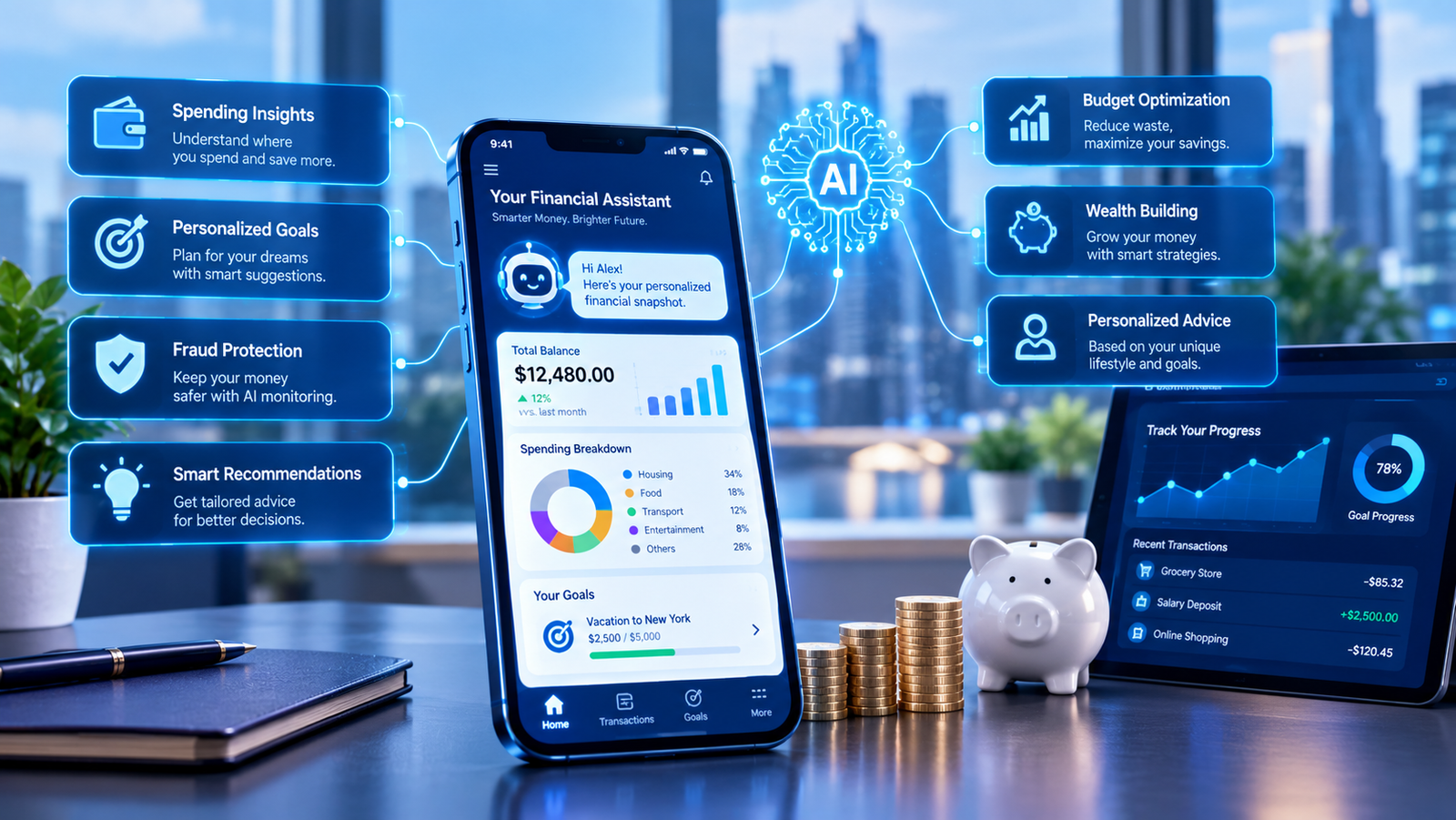
Primary topic: AI in Personalized Financial Management: How Intelligent Systems Are Changing Everyday Money Decisions
Research focus: AI-powered budgeting, expense forecasting, savings optimization, debt management, financial wellness, personalized recommendations, behavioral finance, generative AI financial assistants, cash-flow prediction, financial goal planning and consumer protection
What Is AI in Personalized Financial Management?
AI in personalized financial management uses machine learning, predictive analytics, behavioral models and generative AI to help individuals manage their money according to their income, expenses, obligations, financial goals and changing circumstances.
Traditional personal finance applications usually focus on recording transactions, displaying account balances and categorizing spending. These functions are useful, but they often leave the user to interpret the information and decide what to do next. An AI-powered system can go further by estimating future cash flow, identifying spending patterns, explaining financial trade-offs and suggesting actions that fit the user’s current situation.
For example, a conventional budgeting application may show that a person spent more than usual on food and transport. A personalized AI system could identify that several large bills are due before the next payday, estimate the amount of money likely to remain available, and suggest a practical spending limit for the next two weeks. The recommendation should change if the user reports a new expense, a reduction in income or a different savings priority.
The main objective is to connect financial data with useful decisions.
Understand
Organize transactions, income, bills, debts and financial goals
Anticipate
Forecast cash flow, upcoming expenses and potential shortfalls
Recommend
Suggest actions that reflect the user’s priorities and constraints
Learn
Improve recommendations using feedback and changing circumstances
Why Personalized Financial Management Needs AI
People do not manage money under identical conditions. Two customers earning the same amount may have very different financial needs because of their housing costs, dependants, debt payments, job stability, health expenses and savings goals. A fixed budgeting rule cannot fully account for these differences.
AI can help identify patterns across a person’s financial activity and adapt recommendations to their circumstances. However, personalization should not mean making assumptions about someone’s priorities from their spending alone. A high grocery bill, for example, might reflect a larger household rather than poor financial discipline. A missed savings target may result from an unexpected expense rather than a lack of commitment.
The most useful systems combine transaction evidence with user-confirmed goals and constraints.
| Traditional personal finance | AI-personalized finance |
|---|---|
| Shows historical spending | Explains patterns and estimates future spending |
| Uses fixed budget categories | Adapts categories and targets to personal needs |
| Sends the same reminder to many users | Times reminders around individual cash-flow conditions |
| Requires users to interpret the data | Provides explanations and possible next steps |
| Often treats each financial task separately | Can connect budgeting, debt, savings and goals |
Research Study: How Individuals Use Generative AI for Personal Financial Management
A 2026 study published in the Journal of Behavioral and Experimental Finance examined how people use large language models for everyday financial tasks. Tae-Young Pak surveyed 2,170 South Korean adults aged 25–59 and examined ten areas of personal finance, including budgeting, savings, investment, debt, insurance, taxes, housing, fraud detection, financial literacy and psychological support.
The study found that 67.8% of respondents had used an LLM for at least one financial task, while 58.7% had used one across two or more financial domains. Around 15% reported using these tools across all ten areas. Budget management was among the most common uses, reported by 47.6% of respondents, while savings planning was reported by 48.2%.
The research is particularly relevant because it examines actual reported consumer behavior rather than merely proposing a theoretical AI budgeting system. It suggests that consumers are already using conversational AI to understand financial concepts, search for information, compare products and obtain personalized guidance.
However, the results should not be interpreted as evidence that AI advice improves financial outcomes for every user. The survey covered South Korean adults aged 25–59, and reported usage does not establish whether recommendations were accurate, followed or financially beneficial. The study also found differences in adoption across demographic groups, which raises questions about whether AI financial tools are equally accessible and useful to everyone.
For product teams, the key insight is that a conversational interface can become a natural entry point for financial management. The system still needs reliable financial data, transparent calculations and safeguards against unsuitable recommendations.
Research Study: MIT Sloan Research on the Quality of AI Financial Advice
Research reported by MIT Sloan in May 2026 examined how AI-generated financial advice compares with recommendations derived from standard economic models. The findings suggest that AI advice can help people move toward more economically consistent patterns of saving, spending and investing.
The research also identified limitations that matter for personalized financial management. AI systems can struggle to adjust spending appropriately after an income shock, may fail to actively rebalance portfolios and can recommend insufficiently gradual retirement drawdowns. The quality of the advice also depends on the quality of the information and instructions supplied by the user.
These findings highlight a central design challenge. A financial assistant may produce sensible advice for a stable financial situation but respond poorly when the user’s circumstances change. Someone who loses a job, faces an unexpected medical bill or takes on a new dependant may need a different plan immediately.
A practical system should therefore detect significant changes in financial conditions and reassess its recommendations. It should also ask targeted questions when essential information is missing rather than filling the gaps with assumptions.
The research is useful for product design, but its findings should not be generalized to every AI model or financial task without examining the underlying study and evaluation method.
Source: MIT Sloan, “Half of Americans now ask AI for financial advice, but how good is it?”, May 2026
Research Study: AI and Behavioral Finance in Preventing Overdraft Fees
A randomized field experiment published online in Management Science in May 2025 examined whether reminders could help people avoid overdrawing their bank accounts. The researchers studied users of a large personal financial management platform operating in the United States and Canada.
The experiment found that sending reminders when they were needed could reduce overdraft behavior. The effect was also influenced by how the message was written. Simpler messages were more effective, and the framing of those messages mattered.
This is a valuable finding for AI-powered financial coaching because it connects personalization with a measurable consumer outcome. A system does not necessarily need to deliver a long explanation or sophisticated financial plan. A short, well-timed notification about an upcoming bill or low projected balance may be more useful.
AI can improve this approach by predicting when a user may face a cash shortfall and selecting an appropriate moment to communicate. For example, it could notify a customer that a scheduled payment may leave insufficient funds before the next salary arrives. The application should show the transactions and assumptions behind that estimate so the user can verify it.
The experiment supports targeted, behaviorally informed reminders. It does not mean that every AI-generated message will reduce overdrafts, or that reminders alone can solve financial hardship.
Research Study: Systematic Review of AI and Consumer Financial Behavior
A systematic literature review published in the Journal of Consumer Behaviour in 2025 examined 89 peer-reviewed articles on AI and consumer financial behavior. The researchers used bibliometric analysis and a domain-based review to map how AI is being applied to financial decisions.
The review documents the expansion of research in this area and provides a broader context for understanding AI-powered personal finance. Consumer financial behavior includes more than the calculation of budgets. It also involves how people process information, respond to risk, select financial products and make decisions under uncertainty.
For personalized finance products, this means a recommendation engine should consider how people actually make decisions. A technically correct recommendation may not be useful if it is difficult to understand, arrives at the wrong time or requires an unrealistic change in behavior.
Behavioral insights can help product teams design clearer explanations, manageable goals and reminders that respect the user’s attention. However, behavioral personalization must not become manipulation. A system should not exploit a user’s anxiety, financial vulnerability or spending habits to encourage borrowing or sell financial products.
The review is broad rather than limited to one budgeting intervention. Its value is in showing that consumer behavior, AI design and financial decision-making need to be considered together.
Research Study: AI-Driven Financial Insights for Personal Budget Planning
A 2025 IEEE conference paper examined AI-driven financial insights for budget planning and future expense prediction. The work discusses how machine learning can use historical financial data to estimate upcoming expenditures and support personalized budgeting recommendations.
The core application is straightforward: instead of treating last month’s spending as a complete picture of the future, an AI system can use recurring patterns and historical data to estimate what may happen next. This can help users plan for regular bills, identify spending categories that are changing and prepare for periods when expenses are likely to be higher.
For example, a system may learn that a household’s utility expenses rise during certain months or that several annual subscriptions renew within the same period. It can incorporate these expected costs into a forward-looking budget instead of treating them as unexpected events every time they occur.
The practical value depends on forecast quality. Irregular income, cash transactions, newly opened accounts and changes in household circumstances can make predictions less reliable. A responsible product should communicate uncertainty and allow users to correct incorrect transaction classifications.
The paper provides a relevant technical direction, but its abstract does not establish a universally applicable improvement in financial well-being. Product teams should validate their own forecasts against real user outcomes.
Research Study: AI and Machine Learning for Expense Categorization and Budgeting
A 2025 paper on an AI and machine-learning-based expense categorization and budgeting system proposed a personal finance framework that combines predictive analytics, natural language processing and hybrid machine learning.
The system’s intended functions include examining financial transactions, classifying expenditures, identifying anomalies and supporting personalized budgeting strategies. These are foundational capabilities because recommendations become unreliable when the underlying transaction data is incomplete or incorrectly categorized.
Consider a card transaction that appears under an unfamiliar merchant name. A categorization model may infer that it belongs to groceries, transport, entertainment or a recurring subscription. If that classification is wrong, the application may misstate how much the user has spent in a category and recommend an inappropriate adjustment.
A robust implementation should combine automated classification with confidence scores, user corrections and rules for recurring merchants. Corrections should improve future categorization without silently changing historical records in ways that make financial reports difficult to audit.
This research is best treated as a proposed system design rather than conclusive evidence of large-scale consumer outcomes. Its practical contribution is the connection between transaction classification, anomaly detection and personalized budgeting.
Research Evidence: What the Studies Mean for Product Development
| Research | Main contribution | Product implication |
|---|---|---|
| Generative AI use, 2026 | Documents reported use across financial tasks | Build conversational access to verified financial data |
| MIT Sloan, 2026 | Highlights strengths and limitations of AI advice | Reassess recommendations after financial shocks |
| Overdraft field experiment, 2025 | Tests reminders and message framing | Use timely, clear and actionable notifications |
| Consumer behavior review, 2025 | Maps AI research across financial decisions | Design for real behavior, not just model accuracy |
| Budget forecasting, 2025 | Explores predictive expense planning | Forecast upcoming bills and communicate uncertainty |
| Expense categorization, 2025 | Connects classification with budgeting | Make transaction corrections easy and auditable |
Personalized Cash-Flow Forecasting
Cash-flow forecasting is one of the most practical applications of AI in personal finance. Many users do not need a complex investment strategy as much as they need to know whether their money will cover upcoming expenses.
A forecasting model can combine account balances, salary deposits, recurring bills, scheduled repayments, card transactions and known savings commitments. It can then estimate the user’s available balance over the coming days or weeks.
A useful forecast should distinguish between confirmed obligations and uncertain spending. A rent payment scheduled for a known date is different from an estimate of how much a user might spend on dining. Treating both as equally certain can make the forecast misleading.
Example only. This is a conceptual visualization, not actual customer data or a validated prediction.
Illustrative planning buffer
The actual forecast should also account for variable spending, uncertainty in income timing, pending transactions and any minimum balance the user wants to maintain.
A more advanced system can show several scenarios. The user might compare the expected balance if they maintain their current spending, reduce discretionary spending or make an additional debt payment. This turns a forecast into a decision-support tool.
AI-Powered Budget Recommendations
A budget recommendation should be specific enough to act on and flexible enough to reflect the user’s priorities. Telling someone to “spend less” is not a useful recommendation. A better system identifies a category where a change may be practical, explains why it matters and allows the user to accept or reject the suggestion.
Useful recommendations include:
- Set aside money for bills before allocating discretionary spending
- Adjust a savings target after an unexpected expense
- Identify subscriptions that have not been used recently
- Set a weekly spending limit based on the next payday
- Build an emergency fund gradually instead of using an unrealistic target
- Review recurring payments that have increased
- Compare the impact of making an extra debt payment with preserving cash reserves
AI should not assume that the highest possible savings rate is always the right answer. A user may reasonably prioritize paying down expensive debt, maintaining emergency savings, supporting family members or preparing for a planned purchase. The system should make trade-offs visible rather than imposing a single definition of financial success.
Personalized Debt Management
Debt management requires more than sorting balances from smallest to largest. An AI system can help users understand interest costs, payment schedules, minimum payments and the consequences of different repayment strategies.
For users with several debts, the system can compare approaches such as prioritizing the highest interest rate or paying off a smaller balance first. It should show the estimated cost and timeline of each option, using the actual terms of the user’s accounts whenever possible.
The system also needs to protect essential liquidity. Recommending an extra debt payment that leaves a user unable to cover rent or food can make their overall position worse, even if the payment reduces interest.
Personalized debt tools should therefore consider:
- Interest rates and fees
- Minimum payment requirements
- Due dates and late-payment consequences
- Income stability
- Essential living expenses
- Emergency savings
- Potential changes in borrowing costs
When a user’s situation is complex, the application should explain the limits of its calculation and direct the user toward qualified financial support where appropriate.
Generative AI as a Personal Finance Assistant
Generative AI can make financial information easier to understand by allowing users to ask questions in everyday language. Instead of navigating several menus, a user could ask why their spending increased, how much they can safely save this month or what a particular bank fee means.
The language model should not be responsible for inventing balances, calculating figures from memory or making unsupported claims about financial products. It should retrieve verified account data and use trusted calculation services for amounts, dates, interest and projections.
AI assistant: Your current forecast shows approximately $240 remaining after the bills recorded in your account. Your recent variable spending is not fully predictable, so saving another $100 may leave a smaller buffer than usual. You could transfer $50 now and review the remaining amount after your next major bill. Would you like to compare both options?
Why this works: The response explains the evidence, recognizes uncertainty and offers a choice instead of presenting a prediction as a guarantee.
The assistant should also clearly distinguish general financial education from regulated investment advice or other activities that may require authorization, depending on the jurisdiction and product design.
Behavioral Personalization Without Manipulation
Financial behavior is influenced by attention, habits, emotions and how choices are presented. AI can help people act on their own goals by delivering timely reminders, simplifying complex decisions and breaking large goals into manageable steps.
However, personalization creates a risk when the system is optimized primarily for engagement, product sales or lending revenue. A model that learns when a user is most likely to accept an offer could be used to promote an unsuitable credit product at a vulnerable moment.
Responsible behavioral personalization should follow clear principles:
- Help users pursue goals they have chosen
- Explain why a reminder or recommendation was generated
- Allow users to change notification frequency
- Avoid shame-based language and pressure tactics
- Do not use financial distress to target unsuitable products
- Measure financial outcomes rather than engagement alone
A financial assistant should support user agency. It should make choices clearer, not make decisions on the user’s behalf without permission.
Privacy, Security and Consumer Protection
Personal financial management systems may process highly sensitive information, including salary deposits, purchases, debts, account balances, financial goals and details that can reveal a person’s daily routines. Combining this information with generative AI creates additional questions about data access, retention, model training and third-party processing.
The system should collect only the information needed for its stated purpose. Users should be able to understand what data is used, revoke optional permissions and correct inaccurate information. Financial institutions should also assess the security and privacy practices of any external AI provider.
The OECD’s 2026 policy paper on AI and personal finance identifies opportunities in accessibility, personalization and decision-making, while highlighting risks involving bias, hallucinations, commercial influence, data privacy and exclusion. These risks are particularly important when an AI tool is used to influence real financial decisions.
Source: OECD, “Artificial intelligence and personal finance,” July 2026
AI Architecture for Personalized Financial Management
A reliable platform should separate financial data processing, predictive models, recommendation logic and conversational AI. This makes it easier to test calculations, control permissions and identify the source of an incorrect recommendation.
Bank accounts, cards, bills, income, goals and user preferences
Normalization, categorization, recurring payment detection and reconciliation
Cash flow and expense forecasts
Budgets, obligations and constraints
Goals, preferences and feedback
Ranked actions with evidence, trade-offs and uncertainty
Plain-language explanations, user questions and feedback
Consent, access control, audit logs, model evaluation and escalation
Expert Recommendation
The recommended strategy is to build an AI financial coach around verified data and measurable user outcomes, not around a chatbot alone. The most valuable early features are likely to be those that help users understand their cash position, prepare for upcoming bills and make realistic savings or debt decisions.
A practical product should follow these principles:
- Start with trusted data: Make account linking, transaction categorization and recurring-payment detection reliable before adding complex advice
- Use deterministic calculations: Calculate balances, interest, payment dates and budget totals through tested financial logic rather than asking a language model to estimate them
- Forecast with uncertainty: Show ranges or confidence indicators when income and expenses are variable
- Personalize around user goals: Let users define priorities, minimum cash buffers and preferred levels of automation
- Make recommendations explainable: Show the transactions, assumptions and trade-offs behind important suggestions
- Keep users in control: Require clear consent before moving money, changing a payment or taking another consequential action
- Evaluate financial outcomes: Measure whether users avoid fees, meet savings goals and improve cash-flow stability
- Protect vulnerable users: Test recommendations for users with irregular income, low balances and limited financial literacy
Expert Quote
“AI is transforming how consumers access and use financial information, education and advice for personal financial decision making.”
— OECD, Artificial intelligence and personal finance, July 2026
The OECD’s analysis is a useful framing for product builders: AI can broaden access to financial information and make it more personal, but that potential must be balanced against privacy, bias, hallucinations and commercial conflicts. The quote describes the changing role of AI in personal finance; it should not be read as proof that every AI financial assistant produces better outcomes.
Implementation Roadmap
Reliable financial data
Connect accounts, normalize transactions, categorize expenses and let users correct mistakes
Cash-flow intelligence
Forecast bills, recurring payments, income timing and potential shortfalls
Goals and recommendations
Adapt savings, budgeting and debt suggestions to user-selected priorities
Continuous improvement
Evaluate outcomes, test for bias, monitor errors and refine recommendations
Key Performance Indicators
| Metric | What it measures | Why it matters |
|---|---|---|
| Expense categorization accuracy | Correct classification of transactions | Prevents misleading budgets |
| Cash-flow forecast error | Difference between predicted and actual balances | Measures forecasting reliability |
| Avoided overdraft or late fees | Fees avoided by users over time | Connects the product to tangible outcomes |
| Savings-goal progress | Progress against user-defined targets | Measures whether plans are achievable |
| Recommendation acceptance | Actions users choose to follow | Helps assess relevance, but not success alone |
| User-reported financial confidence | Changes in users’ understanding and confidence | Captures outcomes beyond app engagement |
| Disparate error rates | Differences in model errors across user groups | Supports fairness and consumer protection |
Future Predictions: 2027–2030
2027: Financial Assistants Become More Context-Aware
Personal finance applications are likely to move toward assistants that can answer questions using a user’s verified financial data. Instead of providing generic budgeting guidance, these tools will explain upcoming bills, spending changes and savings options in the context of the user’s actual accounts.
The main differentiator will be data reliability. A fluent assistant that cannot accurately interpret pending transactions or recurring payments will not be dependable enough for important financial decisions.
2028: Cash-Flow Forecasting Becomes More Actionable
More products are likely to combine transaction histories, recurring payments and user-defined goals to provide forward-looking cash-flow guidance. Users may be able to compare scenarios, such as saving more this month, making an additional debt payment or preserving a larger emergency buffer.
Forecasts will still need to communicate uncertainty, especially for people with irregular income or unpredictable expenses.
2029: Personalization Becomes More Behavioral and Goal-Based
Financial assistants may increasingly adapt the timing, format and complexity of their guidance to user preferences. Some users may prefer weekly summaries, while others may want alerts only when a meaningful risk appears.
The challenge will be to personalize support without exploiting behavioral vulnerabilities or encouraging users to make decisions that benefit the provider more than the customer.
2030: Personal Finance Moves Toward Coordinated Financial Planning
A mature personal finance platform may connect budgeting, savings, debt, subscriptions, bill payments and longer-term goals in one coordinated experience. With user permission, it could identify conflicts between goals and show the likely consequences of different choices.
More advanced automation may be possible, but consequential actions should remain subject to clear authorization, spending limits, reversibility where possible and appropriate oversight.
These are informed projections, not guaranteed outcomes. Adoption will depend on consumer trust, data access, product economics, technical reliability and regulation.
Startup Opportunities
AI-powered personal finance creates opportunities for fintech companies, neobanks, financial wellness platforms and consumer finance applications.
- AI Cash-Flow Coach: Forecast balances and warn users about upcoming shortfalls
- Personalized Budgeting Assistant: Create flexible budgets based on actual income and expenses
- AI Debt Planner: Compare repayment strategies and explain interest trade-offs
- Subscription and Bill Intelligence: Identify recurring charges, price increases and renewal dates
- Financial Goal Optimizer: Help users balance emergency savings, debt and planned purchases
- Financial Literacy Copilot: Explain financial terms and product conditions in plain language
- Financial Wellness API: Provide forecasting and personalized insights to banks and fintech apps
- AI Financial Inclusion Tools: Build accessible guidance for users with irregular income or limited financial experience
A particularly promising product direction is a financial wellness API that allows banks and consumer applications to add verified cash-flow forecasts, personalized recommendations and explainable financial insights without building every model from scratch.
Frequently Asked Questions
What is AI in personalized financial management?
AI in personalized financial management uses financial data, machine learning and AI assistants to help people understand spending, forecast cash flow, manage debt, plan savings and make decisions that reflect their individual circumstances.
How does AI personalize a budget?
AI can analyze income, expenses, recurring bills, financial goals and spending patterns to suggest budget limits and savings targets. A reliable system should also let users correct inaccurate data and adjust recommendations when their circumstances change.
Can AI predict future expenses?
AI can estimate future expenses using historical transactions, recurring payments and other relevant information. The forecast may be less reliable when income is irregular, data is incomplete or a person’s circumstances change unexpectedly.
Can AI help users avoid overdraft fees?
AI can identify potential cash shortfalls and provide timely reminders. A 2025 randomized field experiment found that reminders and message framing can influence overdraft behavior, although outcomes depend on the intervention and user context.
Is AI financial advice always accurate?
No. AI can misunderstand financial information, rely on incomplete inputs or provide unsuitable recommendations. Important calculations should use verified data and tested financial logic, while consequential decisions should include appropriate safeguards.
How can banks use AI for financial wellness?
Banks can use AI to provide cash-flow forecasting, spending insights, savings recommendations, debt-management support, bill reminders and conversational explanations based on customers’ financial data and stated goals.
What are the main risks of AI in personal finance?
The main risks include inaccurate recommendations, privacy breaches, biased outcomes, misleading forecasts, excessive automation, hidden commercial incentives and advice that does not reflect the user’s real circumstances.
What should companies build first?
Companies should start with reliable transaction categorization, recurring-payment detection and cash-flow forecasting. These capabilities provide the data foundation needed for useful personalized recommendations.
Final Perspective
AI in personalized financial management is not simply about automating budgets. Its larger opportunity is to help people connect everyday financial activity with decisions that support their goals.
Recent research provides several useful signals. A 2026 survey of South Korean adults found that generative AI is already being used across budgeting, savings and other financial tasks. MIT Sloan’s 2026 research highlights both the potential of AI advice and its limitations when circumstances change. A randomized field experiment published in 2025 shows that well-timed reminders and message design can influence overdraft behavior. Research reviews and technical papers also point to opportunities in behavioral personalization, expense categorization and predictive budgeting.
Together, these findings suggest that useful financial AI must combine more than a language model. It needs reliable transaction data, tested calculations, forecasting, behavioral understanding, clear explanations and strong privacy controls.
The strongest products will help users answer practical questions:
- How much money can I safely spend before payday?
- Which bills are likely to arrive next?
- Can I increase my savings without creating a cash shortfall?
- Which debt should I prioritize, and what trade-offs will that create?
- What changed in my spending, and what can I do about it?
A good AI financial assistant should explain the evidence behind its recommendations, acknowledge uncertainty and allow users to choose what happens next. It should support a person’s financial goals rather than push a provider’s commercial interests.
The long-term opportunity is a shift from reactive expense tracking toward proactive, personalized financial support. For banks, neobanks and fintech platforms, the objective should be to build systems that make financial decisions easier to understand, improve day-to-day money management and help users make progress without surrendering control of their finances.
Research Sources
- Pak, “How individuals use generative AI for personal financial management,” Journal of Behavioral and Experimental Finance, 2026
- MIT Sloan, “Half of Americans now ask AI for financial advice, but how good is it?”, 2026
- Mintz and Sade, “Using AI and Behavioral Finance to Cope with Limited Attention and Reduce Overdraft Fees,” Management Science, 2025
- Meng et al., “Artificial Intelligence and Consumer Financial Behavior: A Systematic Literature Review and Agenda for Future Research,” Journal of Consumer Behaviour, 2025
- IEEE, “AI-Driven Financial Insights for Personal Budget Planning: A Smart Approach to Future Expense Prediction,” 2025
- Jadhav and Patil, “AI-ML based Expense Categorization and Budgeting System for Personalized Financial Management,” 2025
- OECD, “Artificial intelligence and personal finance,” July 2026
- Cambridge Centre for Alternative Finance, 2026 Global AI in Financial Services Report

Leave a Reply