
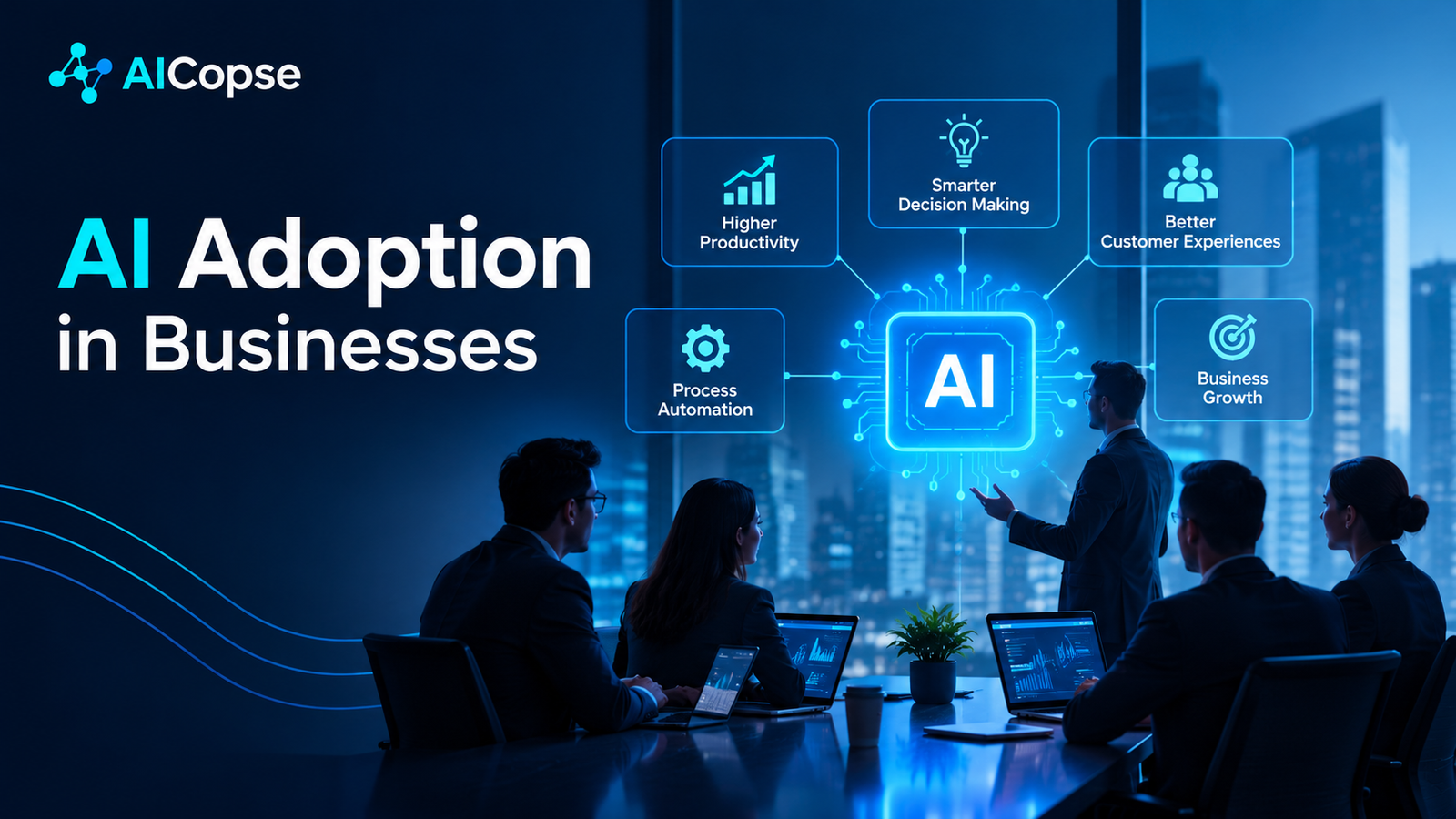
AICOPSE Research Report · 2026
AI Adoption in Businesses: Statistics by Sector, Business Size, and Use Case in 2026
A research-led analysis of how companies are using artificial intelligence, which industries are moving fastest, why adoption figures differ, and what businesses must do to turn AI experiments into measurable results.
Sector comparison
SMBs and enterprises
AI agents and ROI
Executive finding: In 2026, AI adoption is no longer simply about whether a company has access to a chatbot. The bigger questions are how many business functions use AI, whether AI is connected to real company systems, whether employees trust the outputs, and whether the company can demonstrate better financial or operational results.
Executive Summary
Artificial intelligence adoption is expanding across business functions, but the scale of adoption depends heavily on what a study measures. Some surveys count any employee using an AI assistant. Others measure whether a company uses AI in its operations, whether AI has reached several departments, or whether enterprise-wide deployment is producing measurable value. These different definitions explain why reported adoption rates can vary substantially.
McKinsey’s 2026 global survey found that nearly nine in ten respondents said their organizations regularly used AI in at least one business function. However, only 44% reported that AI was scaling across their enterprise. The survey also found that 37% reported a positive contribution from AI to organizational earnings before interest and taxes, or EBIT. Broad use, enterprise-wide scaling, and financial impact therefore remain different stages of maturity.
U.S. Census Bureau data provides another perspective. Its Business Trends and Outlook Survey found that reported AI use by U.S. businesses remained between 17% and 20% during the period from December 14, 2025, to May 3, 2026. The rate was higher among larger firms and in sectors such as information and finance. This survey asks a different question and represents a broader business population, so it should not be compared directly with a survey of organizational leaders.
Small and midsize businesses are also adopting AI. QuickBooks’ 2026 AI Impact Report, based on more than 34,000 business-owner survey responses across four countries and anonymized data from more than 5.3 million businesses, reported that more than three in four U.S. small and midsize businesses used AI regularly. This broad measure includes free tools and built-in AI features, not just formally approved enterprise deployments.
Important: These numbers come from different research designs and populations. They describe different measures of adoption and impact, not four directly comparable estimates of the same thing.
Table of Contents
- How to interpret AI adoption statistics
- Six major studies and what they reveal
- AI adoption by business size
- AI adoption by sector
- Most important business use cases
- Major developments and incidents in 2026
- Barriers, risks, and implementation costs
- Implementation roadmap for businesses and developers
- Expert recommendations and future predictions
- Frequently asked questions
- Research sources and limitations
How to Interpret AI Adoption Statistics in 2026
Before comparing industries or company sizes, it is essential to understand what researchers mean by AI adoption. A business may use a free writing assistant without having an approved AI policy. Another company may integrate predictive models into its inventory, customer support, fraud detection, and software development systems. Both can be described as AI users, but their operational maturity is very different.
At least five measures should be separated when assessing AI adoption:
Access and experimentation
Employees try chatbots, AI writing tools, coding assistants, or built-in software features.
Regular usage
Teams use AI repeatedly for defined tasks, with varying levels of review and oversight.
Workflow integration
AI connects to company data, software, approval systems, and business processes.
Enterprise scaling
Several functions or business units use AI with shared governance, monitoring, and support.
Measured business impact
The company can show changes in cost, revenue, quality, risk, customer experience, or delivery time.
A useful adoption assessment should report these stages separately. If a survey says 80% of companies use AI, that figure does not automatically mean that 80% have deployed AI agents, trained proprietary models, automated core processes, or achieved a return on investment.
Six Major Research Studies: Detailed Findings
Study 1: McKinsey’s State of AI Global Survey 2026
Research link: The State of AI: Global Survey 2026
Sample: 1,719 respondents from 97 countries. The survey was conducted from May 4 to June 8, 2026. Thirty-six percent of respondents said they worked for organizations with annual revenue above US$1 billion. McKinsey weighted the results to account for differences in national response rates.
This is one of the most useful broad studies for understanding the gap between AI adoption and business transformation. Nearly nine in ten respondents reported regular AI use in at least one business function. Yet only 44% said AI was scaling across their enterprise, up from 38% a year earlier. The share using AI in three or more functions rose from 51% to 56%.
McKinsey 2026: selected adoption indicators
These are separate survey measures, not successive stages measured in the same group of businesses.
McKinsey also found a difference between large and smaller organizations. Among respondents from companies with at least US$1 billion in annual revenue, 54% reported enterprise-wide AI scaling, compared with roughly one-third of respondents from smaller organizations. The share scaling AI agents in at least one function rose from 27% to 40% among the larger organizations, while the smaller-company rate remained around 22%.
The business impact findings deserve special attention. Eight in ten respondents said AI improved their own productivity. However, only 37% reported a positive organizational EBIT contribution. That gap suggests that individual time savings do not always become financial gains. Time may be spent checking outputs, managing new processes, correcting mistakes, or performing work that does not directly affect revenue or cost.
McKinsey identified cost reductions in functions such as supply chain management, service operations, and manufacturing. Reported revenue gains were more commonly associated with marketing and sales, product and service development, and software engineering. These patterns help businesses select use cases, but they should not be interpreted as guaranteed results for every organization.
What businesses should learn: Start with a measurable operational problem rather than an AI tool. Track whether a use case reduces total processing time, improves quality, generates revenue, or lowers risk. Enterprise scaling requires changes to processes, management, training, data access, and accountability, not merely broader software access.
Study 2: U.S. Census Bureau Business Trends and Outlook Survey, 2026
Research link: Large Firms With at Least 20 Employees Biggest AI Users
Method: The Business Trends and Outlook Survey is a recurring, nationally representative survey of U.S. businesses. The published analysis reviewed data collected from December 14, 2025, through May 3, 2026.
The Census Bureau’s findings are especially useful because they provide a view of the wider U.S. business population rather than focusing only on senior leaders at companies already interested in AI. Reported AI use hovered between 17% and 20% over the measured period. The share of businesses expecting to use AI within the following six months was between 20% and 23%.
Current use
Reported U.S. business AI usage during the measured period.
Expected use
Businesses expecting AI use within the following six months.
Information sector
Reported AI use as of the period ending May 3, 2026.
Finance and insurance
Reported AI use in the same Census Bureau period.
Business size was an important factor. As of the period ending May 3, 2026, 37% of firms with at least 250 employees reported AI use, compared with 32% of firms with 100 to 249 employees. Fewer than 20% of firms with four or fewer employees reported use. The Census Bureau also found that AI use had increased among firms with at least 20 employees, while the change among firms with fewer than 20 employees was not statistically significant during the measured period.
These findings reveal a different side of adoption from enterprise surveys. A large organization may have many employees using AI and several production deployments, making it likely to report adoption. A small business may be experimenting with AI informally or may not use it during the particular two-week measurement window. The results depend on the question, timeframe, and business population.
What businesses should learn: Do not assume that competitors have adopted AI simply because the technology receives extensive media coverage. Assess the actual use of AI in your sector, customer expectations, staff capabilities, and available data. For smaller firms, a focused use case can create value without requiring enterprise-scale infrastructure.
Study 3: QuickBooks 2026 AI Impact Report
Research link: 2026 AI Impact Report
Research base: More than 34,000 small and midsize business owners across the United States, Canada, the United Kingdom, and Australia, combined with anonymized data from more than 5.3 million QuickBooks businesses. The report was published on May 13, 2026, and was developed with economists at the University of Chicago.
QuickBooks reported that more than three in four U.S. small and midsize businesses used AI regularly. The report includes a broad definition that covers free tools, built-in software features, and dedicated paid subscriptions. It is therefore useful for understanding everyday adoption among small businesses, but it does not mean that three in four businesses have deployed complex AI systems into core operations.
The distinction matters because a small retailer using AI to draft product descriptions has a different level of integration from a retailer using demand forecasts to control replenishment, pricing, and purchasing. Both may report regular AI use. Their technical needs, risk exposure, training requirements, and financial results can be very different.
What this research contributes
- A large cross-country view of AI adoption in small and midsize businesses.
- A broader picture than surveys limited to technology leaders or large corporations.
- A reminder that adoption includes both simple tools and dedicated paid services.
- A basis for asking whether regular usage improves revenue, productivity, customer service, or business resilience.
The study is valuable, but its sponsor and measurement approach should be considered when interpreting the results. QuickBooks serves small businesses and has access to a large business ecosystem. Its findings are not interchangeable with Census Bureau estimates, and regular usage alone does not establish causation between AI and improved financial performance.
What businesses should learn: Small companies can begin with accessible tools, but they should establish basic rules from the start. Staff should know which information can be shared with AI services, which outputs require review, and how to check the quality of AI-generated work. Regular usage becomes more valuable when it is connected to an agreed business goal.
Study 4: McKinsey’s Findings on AI Agents and Business Functions
Research link: McKinsey State of AI 2026
AI agents deserve separate analysis because they are not the same as a chatbot that answers a question. An agent may plan a task, use software tools, retrieve information, and carry out a sequence of actions under defined permissions. The more authority an agent receives, the more important reliability, access controls, monitoring, and human approval become.
McKinsey found that larger companies were moving faster in scaling AI agents. The share of respondents from companies with at least US$1 billion in annual revenue who reported scaling agents in one or more functions rose from 27% to 40%. For smaller organizations, the reported rate remained around 22%. The survey also found that technology companies were prominent in agent adoption, particularly for software engineering.
Reported use varied by industry. Consumer goods and retail respondents more often described agents supporting marketing and sales. Advanced manufacturing respondents reported applications in supply chain management, inventory, and manufacturing. These patterns make operational sense: agents can help with tasks where there are repeated steps, accessible data, and defined systems, but the right design differs by sector.
Technology
Coding assistance, software testing, documentation, internal knowledge search, and support triage.
Retail and consumer goods
Marketing workflows, product discovery, customer service, and inventory planning.
Manufacturing
Maintenance support, production documentation, quality analysis, and supply chain coordination.
Professional services
Research, document analysis, knowledge retrieval, and first-draft preparation with expert review.
The study also found that 32% of respondents said their organizations had decided against buying at least one software product or feature because coding agents enabled them to build the functionality in-house. This is an important signal for software vendors and developers, but it does not prove that in-house development is always cheaper. Maintenance, security, compliance, and long-term support must be included in the comparison.
What businesses should learn: Start agent deployment with bounded tasks. Give an agent only the data and tools it needs, log its actions, define when it must ask for approval, and test failure scenarios before allowing it to affect customers, money, production systems, or legal commitments.
Study 5: Federal Reserve Bank of San Francisco Research on Small Businesses
Research link: Early Findings on Small Business Use of AI
Publication date: March 23, 2026.
The Federal Reserve Bank of San Francisco examined small-business evidence, including data from the Federal Reserve’s 2024 Small Business Credit Survey. Its review noted that estimates of AI adoption had increased substantially after generative AI became widely commercially available in late 2022. Estimates from different surveys suggested that around 20% to 40% of businesses had adopted traditional or generative AI tools by 2024, depending on the measure used.
Nearly 40% of responding small businesses, including employers and sole proprietors, were already using AI or planning to use it in the near future. The result is useful because it shows that smaller firms are not simply waiting for large companies to establish the market. They are exploring AI even when they have fewer staff and smaller technology budgets.
However, an intention to adopt is not the same as actual deployment. A business may plan to use AI but lack the data, training, budget, or time to implement it. The Federal Reserve’s work also draws attention to the need to examine adoption in the context of small-business conditions rather than assuming that all firms can invest at the same pace.
What businesses should learn: Small businesses should compare AI use cases by expected benefit, setup effort, ongoing cost, and risk. A tool that saves a few minutes on a frequent task may provide more value than a complex custom system that requires months of work. Start with repeatable processes and expand only after the results are demonstrated.
Study 6: European Commission’s 2026 Eurobarometer on SMEs and Mid-Caps
Research link: Workplace-Related Drivers and Obstacles for AI Adoption by SMEs and Mid-Caps
Fieldwork: March to April 2026. Published in October 2026. The study covered European Union countries and examined AI and algorithmic management in workplace matters.
The European Commission reported that 63% of surveyed small and midsize enterprises and mid-cap companies either already used AI and algorithmic management systems or planned to do so in the coming years. The reported split was 42% already using these systems and 21% planning adoption.
European business findings
The study identified customer service and client relations as common applications, reported by 47% of interviewed enterprises. Worker performance and productivity monitoring accounted for 36%, while logistics, planning, and staff scheduling accounted for 30%. These categories involve different levels of sensitivity. Automating a customer inquiry is not the same as using an algorithm to monitor employees or influence staffing decisions.
The reported obstacles included high investment costs at 50%, legal uncertainty at 49%, and lack of expertise at 48%. The research also found that 61% of companies using AI for decisions said they relied on AI in decision-making, while 52% said AI made suggestions and humans decided. Because these are distinct survey questions and may have different respondent bases, they should not be treated as mutually exclusive shares.
What businesses should learn: Adoption policies should reflect the effect of the AI system on people. A low-risk writing assistant may need basic review rules. AI used for recruitment, performance assessment, scheduling, or consequential decisions needs stronger transparency, documentation, human oversight, and legal review.
AI Adoption by Business Size in 2026
Company size affects AI adoption because larger organizations generally have more data, dedicated technology teams, larger budgets, and more opportunities to distribute the cost of implementation. Smaller businesses can move quickly because they have fewer approval layers, but they may lack the engineering and governance capacity required for complex deployments.
| Business group | 2026 evidence | Common advantage | Typical challenge |
|---|---|---|---|
| Microbusinesses 1–4 employees in the Census size comparison |
Fewer than 20% reported AI use in the measured Census period. | Fast decisions and accessible low-cost tools. | Limited time, training, data quality, and technical support. |
| Small and midsize businesses | QuickBooks reported regular AI use among more than three in four U.S. SMBs using its broad definition. | Can focus on high-frequency customer and back-office tasks. | Integration costs, vendor dependence, and unclear ROI. |
| Mid-sized firms | Census reported 32% AI use among firms with 100–249 employees. | Enough process volume to justify targeted automation. | Legacy systems and limited specialist teams. |
| Large firms 250 or more employees in the Census comparison |
Census reported 37% AI use among firms with at least 250 employees. McKinsey found larger organizations more likely to scale enterprise AI. | Larger budgets, specialist teams, and more data. | Complex governance, fragmented systems, and organizational change. |
The figures in this table come from different studies and definitions. They are presented as contextual evidence, not as a single comparable ranking of company sizes.
What Microbusinesses Should Do
Very small businesses should avoid starting with expensive custom AI development unless their needs justify it. They can test established tools for drafting, customer support, scheduling, sales administration, and document search. The first objective is to identify a recurring task that consumes time and has a clear measure of success.
- Choose one task performed every day or every week.
- Measure current time, error rates, and direct costs.
- Test an existing tool before building a custom application.
- Keep human approval for customer commitments, payments, and sensitive decisions.
- Review subscriptions and usage costs monthly.
What Mid-Sized and Large Companies Should Do
Companies with more employees should assess how AI fits into their existing software, data architecture, and business controls. Buying multiple AI tools without an integration plan can create duplicate systems, inconsistent answers, and unmanaged data flows.
- Create an inventory of AI applications, models, vendors, and data connections.
- Assign an accountable owner to every production use case.
- Define approved data access and retention rules.
- Integrate testing, monitoring, security, and incident response into the delivery process.
- Scale only when a pilot has demonstrated repeatable results.
AI Adoption by Business Sector in 2026
Sector adoption varies because industries have different data assets, regulations, margins, and operational needs. Information-intensive businesses can often deploy software-based AI quickly. Industries with physical operations may need additional sensor data, equipment integration, validation, and safety controls.
| Sector | 2026 evidence or adoption signal | High-value use cases | Key risk |
|---|---|---|---|
| Information and technology | Census reported 39.7% AI use in the information sector as of May 3, 2026. | Software development, support, knowledge retrieval, testing, and content workflows. | Data leakage, software vulnerabilities, and unreliable outputs. |
| Finance and insurance | Census reported 33.9% AI use during the same period. | Fraud detection, risk analysis, customer service, claims support, and document review. | Privacy, model bias, explainability, and regulatory obligations. |
| Retail and consumer goods | McKinsey reports agent use in marketing and sales among consumer goods and retail respondents. | Product discovery, demand forecasting, service automation, and marketing analysis. | Incorrect product claims, customer frustration, and privacy issues. |
| Manufacturing | McKinsey identifies supply chain, inventory, and manufacturing as agent application areas. | Predictive maintenance, visual inspection, production planning, and inventory control. | Safety, poor sensor data, and costly errors in physical operations. |
| Healthcare and life sciences | AI adoption is shaped by sensitive data, clinical evidence, and workflow-specific validation. | Administrative documentation, literature search, imaging support, and research assistance. | Patient safety, confidentiality, bias, and unsupported clinical claims. |
| Professional services | Knowledge work is a major area of enterprise AI use in the 2026 research landscape. | Research, summarization, document comparison, proposal drafting, and internal search. | Confidentiality, factual errors, and professional accountability. |
| Logistics and transportation | AI applications align with planning, scheduling, and operations optimization. | Route planning, demand forecasts, exception handling, and warehouse operations. | Bad operational data, service disruption, and unsafe automation. |
| Education and training | Adoption can begin with accessible tools, but institutional deployment requires policy and evaluation. | Tutoring support, lesson preparation, feedback assistance, and administrative tasks. | Student privacy, inaccurate answers, and overreliance on generated work. |
The table combines measured adoption data where available with research-backed examples of sector use. It is not a universal sector ranking: comparable, consistently defined 2026 adoption percentages are not available for every industry in the sources reviewed.
Finance, Banking, and Insurance
Financial services have strong reasons to use AI because they handle large volumes of transactions, documents, customer interactions, and risk signals. Potential applications include identifying unusual payment patterns, extracting information from documents, prioritizing customer requests, supporting analysts, and assisting insurance claims teams.
However, high data sensitivity changes the deployment model. AI-generated risk assessments should be tested for accuracy and bias. Access to account information must follow the user’s permissions. Financial decisions with significant consequences need clear accountability and a way to challenge or review outcomes. Businesses should also distinguish between AI that helps an employee analyze information and AI that independently authorizes a transaction or changes a customer record.
Retail, E-commerce, and Consumer Businesses
Retailers can apply AI to product descriptions, search, customer service, campaign analysis, demand forecasting, inventory planning, and product recommendations. The value often depends on whether AI has access to accurate product information, inventory levels, delivery terms, and customer context.
A product chatbot connected to an outdated catalogue can create more problems than it solves. Businesses should ground customer-facing answers in current product and policy data, measure the rate of incorrect answers, and provide a straightforward route to a human agent. Automated refunds, cancellations, and order changes should have strict permission checks and audit logs.
Software and Technology Companies
Software teams are using AI for coding suggestions, test generation, documentation, debugging, code review support, and technical knowledge search. The potential benefit is faster delivery, but the correct measurement is not simply the number of lines of code produced. Teams should assess defects, review time, security findings, maintenance cost, and whether features reach production faster without reducing quality.
Developers should also examine software licensing, secret exposure, dependency security, and whether generated code follows internal architecture standards. AI coding tools should not receive broad access to production credentials or sensitive repositories without a clear security model.
Manufacturing and Industrial Operations
Manufacturers can use machine learning to detect equipment anomalies, forecast maintenance needs, inspect products through computer vision, and improve production scheduling. Generative AI can help workers search maintenance manuals, summarize incident records, and retrieve technical instructions.
Physical operations require stricter testing than low-risk office tasks. A false alert may waste time, while a missed fault can damage equipment or create safety risks. Systems that influence machinery should use validated thresholds, fallback modes, and clear escalation procedures. AI should not directly control a safety-critical process simply because it performs well in a limited demonstration.
The Most Important Business AI Use Cases in 2026
Businesses often begin with tasks that are frequent, repetitive, and easy to check. More advanced projects combine AI with internal data and software tools. The following comparison can help teams prioritize use cases according to business value and implementation complexity.
| Use case | Potential value | Useful metric | Control required |
|---|---|---|---|
| Customer support assistance | Faster responses and lower workload. | Resolution time, customer satisfaction, escalation rate. | Approved knowledge sources and human escalation. |
| Software development | Faster coding, testing, and documentation. | Lead time, defects, review effort, security findings. | Code review, repository permissions, secret scanning. |
| Sales and marketing | Research support, personalization, and campaign testing. | Conversion rate, qualified leads, revenue per campaign. | Claim verification, consent, brand and legal review. |
| Document processing | Less manual data entry and faster document review. | Processing time, extraction accuracy, rework rate. | Validation rules and exception handling. |
| Forecasting and planning | Better inventory, capacity, and demand decisions. | Forecast error, stockouts, waste, operating cost. | Data quality and comparison with a baseline model. |
| Internal knowledge search | Faster access to company documents and procedures. | Answer accuracy, retrieval time, employee satisfaction. | Permission-aware retrieval and source references. |
| Fraud and anomaly detection | Earlier identification of suspicious activity. | Detection rate, false positives, loss avoided. | Model monitoring, analyst review, audit trail. |
| AI agents for workflow execution | Coordinating multiple steps across approved tools. | Successful completion, exception rate, cost per task. | Least-privilege access, action limits, approvals, logs. |
How to Calculate AI Return on Investment
AI ROI should include the cost of the full operating process, not only the subscription or model price. Implementation, integration, data preparation, evaluation, staff training, monitoring, and error correction can all affect the result.
AI ROI formula
ROI (%) = [(Measured financial benefit − Total AI cost) ÷ Total AI cost] × 100
Use a defined measurement period and include ongoing operating costs, not just initial setup expenses.
Consider a hypothetical support workflow that saves 200 staff hours each month. If the fully loaded labor cost is US$35 per hour, the theoretical value of the time saved is US$7,000 per month. If the AI system costs US$2,000 per month to operate and requires another US$1,500 in monthly oversight and maintenance, the estimated monthly net benefit is US$3,500 before any additional costs or revenue effects.
This example is illustrative, not a reported industry average. The business must confirm that the 200 hours are genuinely saved, that quality remains acceptable, and that the freed capacity can be used productively. If staff spend the same time correcting AI errors, the real benefit will be lower.
Major Developments and Incidents Shaping Business AI Adoption in 2026
The major story in 2026 is not just wider access to AI. It is the transition from experimentation to integration, with growing attention to agentic workflows, data readiness, operating costs, and governance. The following developments illustrate why business adoption needs to be assessed as a technology and management challenge together.
May 2026
U.S. Census data highlighted the adoption gap by firm size
The Census Bureau reported AI use of 37% among firms with at least 250 employees, compared with less than 20% among businesses with four or fewer employees. The figures showed that business size remains a significant factor in measured adoption. The result does not establish why the gap exists, but it supports closer attention to cost, skills, and implementation capacity among small firms.
May–June 2026 research
McKinsey documented progress in scaling alongside a limited financial impact
The 2026 survey found more organizations scaling AI across the enterprise than in the previous year. Yet the share reporting a positive contribution to organizational EBIT remained at about 37%. This is a significant warning against treating broader adoption as proof of financial transformation. Companies still need to connect deployments to operating and financial measures.
August 2026
Large-scale enterprise usage research examined real AI activity
A research paper titled How Organizations Use AI: Evidence from ChatGPT linked enterprise account records with worker roles, tasks, and public-company data through March 2026. Its six-month adoption analysis included more than 1,500 organizations and over 17 million messages. The authors reported rapid growth from both new company adoption and more intensive usage among existing adopters. The evidence offers a different lens from surveys, although it reflects the observed enterprise platform rather than every AI provider or business.
October 2026
European Commission findings exposed barriers for smaller employers
The Commission’s October survey found that 63% of surveyed SMEs and mid-cap firms either used or planned to use AI and algorithmic management. At the same time, high investment costs, legal uncertainty, and limited expertise remained major barriers. The findings show why adoption plans must account for employee impact, organizational capability, and compliance as well as software availability.
October 2026 reporting
Data readiness and AI operating costs became central concerns
Recent reporting on enterprise data readiness described AI projects being delayed by fragmented, unstructured, or inaccessible information. Separate reporting on AI observability highlighted unpredictable usage costs and the need to monitor production systems. These reports are useful signals, but their figures should be attributed to the specific surveys behind them rather than treated as universal industry rates.
These are major developments in the evidence and deployment environment, rather than a list of independently verified breach incidents. They show how the adoption discussion has changed: the question is increasingly how companies can deploy AI safely and at scale, not simply whether AI is available.
Why Businesses Struggle to Scale AI
Many organizations can demonstrate a successful AI prototype but struggle to move it into daily operations. A prototype usually operates within a narrow set of conditions. A production system must handle incomplete information, unexpected inputs, access restrictions, outages, changing data, user feedback, and cost limits.
Poor data readiness
Duplicate records, missing fields, outdated documents, and disconnected systems undermine model performance.
Legacy integration
AI tools cannot deliver full workflow value when they cannot access approved systems or return reliable updates.
Skills and adoption
Employees need to know how to evaluate outputs, report failures, and use the tools appropriately.
Unclear ROI
A pilot may save time but fail to improve cost, quality, capacity, revenue, or customer outcomes.
Security and privacy
Sensitive data, excessive permissions, weak logging, and uncontrolled vendors create operational risks.
Ongoing operating cost
Model usage, retrieval, infrastructure, human review, and error correction can reduce expected savings.
MuleSoft’s 2026 Connectivity Benchmark provides additional context for integration challenges. Based on a survey of 1,050 IT leaders, it reported an average of 957 applications per organization, with only 27% connected. The report also said 82% cited data integration among their biggest AI challenges, while 86% believed agents without proper integration could add complexity instead of value.
These are survey findings from a vendor-sponsored report, not a universal census of all companies. Nevertheless, the pattern is important: an AI model cannot reliably automate a business process if the underlying systems are disconnected, the data is inconsistent, or the agent lacks a safe way to take action.
For more background on AI risk, governance, and the technical systems around AI deployment, readers can explore AICOPSE’s AI news, research, technology, and industry insights. Specific internal article links should be added only when the relevant published pages are confirmed, so readers are not sent to invented or unrelated URLs.
AI Security, Privacy, and Governance Risks
As AI systems gain access to company data and tools, their risk profile changes. A writing assistant that produces an inaccurate draft creates one kind of problem. An agent that can read customer records, send messages, alter inventory, issue refunds, or execute code can create a much larger operational impact.
Business leaders should assess at least the following risks before moving a system into production:
- Confidential data exposure: Employees may paste sensitive customer, financial, legal, or source-code information into an unapproved service.
- Incorrect outputs: Generated answers may contain false facts, outdated policies, or unsupported recommendations.
- Excessive permissions: An AI system may be able to access more data or execute more actions than its task requires.
- Prompt injection: Malicious or misleading instructions embedded in documents or webpages may influence a model or agent.
- Vendor dependence: Changes to pricing, model behavior, service availability, or data terms can affect operations.
- Unclear accountability: Teams may not know who owns an AI decision, investigates an error, or approves a system change.
- Hidden operating costs: Increased model calls, long prompts, repeated agent actions, and human correction can erode savings.
The NIST AI Risk Management Framework offers a voluntary framework for identifying, assessing, and managing AI risks. Organizations should combine such guidance with applicable privacy, consumer protection, employment, financial services, and sector-specific obligations.
Implementation Roadmap for Developers, Startups, and Businesses
A useful AI adoption strategy should progress from a defined problem to a measured deployment. The stages below provide a practical starting point. Timelines are illustrative and should be adjusted to the system’s complexity, risk, and regulatory requirements.
Define the business problem
Choose a process with measurable pain, such as long response times, high document-processing costs, repeated manual work, or avoidable errors. Record the baseline before introducing AI.
Assess data and risk
Identify the data needed, its quality, who may access it, and whether the task involves sensitive information or consequential decisions. Select the lowest-risk design that meets the need.
Build a limited pilot
Test the AI system with representative examples, including difficult cases. Compare its output with current human or software performance. Avoid giving an experimental system unrestricted production access.
Measure the full cost and quality
Include model usage, integration, training, monitoring, human review, rework, and security costs. Check whether the improvement is large enough to justify these expenses.
Deploy, monitor, and improve
Release gradually, monitor failures and costs, collect employee feedback, and establish a rollback plan. Expand only after the system remains reliable under real operating conditions.
Guidance for Developers
- Evaluate outputs, not just demonstrations. Create a test set containing normal cases, edge cases, ambiguous inputs, and adversarial examples.
- Use structured outputs when appropriate. Validate required fields and types instead of trusting free-form model responses.
- Keep credentials outside prompts and source code. Use secrets management and least-privilege service accounts.
- Instrument the application. Record latency, errors, model versions, usage, costs, and appropriate audit events while protecting sensitive content.
- Design a fallback path. A business process should have a safe way to continue when the model or an external provider is unavailable.
- Test changes before release. Model updates, prompt changes, retrieval changes, and tool changes can alter system behavior.
Guidance for Startups
Startups should not confuse a large number of AI features with a defensible business. Customers pay for a useful outcome, reliable service, and a product that fits their workflow. A startup can use a third-party model to validate demand before investing in custom training, provided it understands data terms, costs, latency, and vendor dependence.
- Identify one customer problem that occurs often and has a measurable cost.
- Interview users and observe the existing workflow before selecting a model.
- Compare the cost and reliability of existing AI services before building custom infrastructure.
- Create a repeatable evaluation set from permitted, anonymized, or synthetic examples.
- Explain product limitations clearly and provide a path for customers to report errors.
- Track retention, task completion, customer satisfaction, gross margin, and support burden alongside model performance.
Guidance for Business Leaders
Executives should treat AI adoption as a business change program rather than a software purchase. The leadership team should identify who owns the outcome, who approves risk, and how employees will use the system. A cross-functional group involving business operations, IT, security, legal, finance, and the relevant department can help prevent fragmented deployments.
- Maintain a register of approved AI tools and production use cases.
- Set rules for confidential data, intellectual property, retention, and external sharing.
- Train staff to check facts, recognize uncertainty, and escalate failures.
- Review performance and total cost at a fixed interval.
- Give employees a clear way to report inaccurate or harmful outcomes.
- Stop or redesign systems that fail to meet their quality, safety, or financial targets.
Future Predictions: Where Business AI Adoption Is Heading
The following predictions are evidence-based interpretations of the research above, not guaranteed outcomes or official forecasts. They draw on the observed differences between experimentation and scaling, the expansion of agent use, the adoption gap by company size, and the persistent challenges around data and ROI.
Integration will matter more than access
As AI tools become easier to obtain, differentiation will increasingly depend on connecting them to reliable company data and real workflows.
Agent adoption will be selective
Companies will be more willing to use agents for bounded tasks with clear permissions than for unrestricted end-to-end decision-making.
ROI scrutiny will increase
Leaders will ask for evidence of cost, quality, revenue, and productivity gains instead of counting licenses, prompts, or pilots.
Small firms will favor managed solutions
Many smaller businesses will prefer existing software with built-in AI over maintaining their own model infrastructure.
Governance will become operational
AI governance will increasingly include access controls, audit logs, evaluation, incident response, and employee training.
Human review will remain important
High-impact decisions will continue to require defined accountability, verification, and routes for human intervention.
What Could Change These Predictions?
Several factors could accelerate or slow adoption. Lower model costs and more reliable tools could make advanced use cases accessible to smaller firms. Better integration standards could reduce implementation effort. In the other direction, privacy incidents, regulatory changes, inaccurate outputs, or unexpected operating costs could delay deployments.
Sector differences will also persist. Software and information-intensive businesses can often test digital workflows faster than organizations that depend on physical equipment, clinical validation, financial controls, or safety-critical infrastructure. Even within one industry, a company with clean data and a capable engineering team may move much faster than a competitor with fragmented systems.
Expert Recommendations for a More Reliable AI Strategy
Based on the combined findings from McKinsey, the Census Bureau, QuickBooks, the Federal Reserve Bank of San Francisco, and the European Commission, businesses should use the following principles to guide adoption.
Frequently Asked Questions
How many businesses use AI in 2026?
There is no single global percentage that applies to every business. McKinsey’s 2026 survey found nearly nine in ten respondents reporting regular AI use in at least one business function. The U.S. Census Bureau measured AI use among businesses at 17% to 20% during its December 2025 to May 2026 observation period. The difference reflects different populations, survey designs, and definitions.
Which industries are leading business AI adoption?
In U.S. Census Bureau data for the period ending May 3, 2026, the information sector reported 39.7% AI use and finance and insurance reported 33.9%. These figures are above the overall business rate in that survey. Industry rankings may change when studies use different definitions or measure specific technologies rather than any AI use.
Are small businesses adopting AI?
Yes. QuickBooks’ 2026 report found that more than three in four U.S. small and midsize businesses used AI regularly under its broad definition. Census data, which uses a different measurement approach, found lower reported usage among the smallest firms. Together, the findings suggest that small-business adoption is real but varies according to the type of business and how use is measured.
Does AI adoption automatically improve business profits?
No. McKinsey’s 2026 survey found that 37% of respondents reported a positive AI contribution to organizational EBIT, even though AI use was much more widespread. Companies need to measure the full cost of AI, including integration, review, training, and error correction, and compare results against a baseline.
What is the difference between AI adoption and AI integration?
Adoption can mean that employees use an AI tool for individual tasks. Integration means AI is connected to business data, software, workflows, and controls. Integrated systems can deliver broader operational benefits, but they also require more careful testing, monitoring, and security.
Should a startup build its own AI model?
Not necessarily. Many startups should first test whether an existing model or AI-enabled product can solve the customer problem. Custom models may become appropriate when a startup has unique data, strict deployment requirements, specialized performance needs, or enough usage to justify the additional engineering and maintenance cost.
What is the safest way to introduce AI agents?
Begin with narrow tasks and limited permissions. Test representative and adversarial cases, log actions, define approval requirements, restrict access to sensitive data, and create a safe fallback. Expand autonomy only after the system performs reliably under real operating conditions.
What should businesses measure after deploying AI?
Measure task completion, processing time, quality, error rates, employee workload, customer satisfaction, total operating cost, revenue impact where relevant, and security incidents. Choose metrics before the pilot begins so that the results can be compared with the previous process.
Research Sources and Methodology Notes
This report synthesizes public research published or updated in 2026. Sources have different sample sizes, geographic coverage, definitions of AI adoption, and research objectives. Survey results are generally self-reported unless the source specifies another method. Vendor-sponsored reports can provide useful data, but their commercial context should be considered when interpreting the findings.
- McKinsey & Company. The State of AI: Global Survey 2026. Global survey of 1,719 respondents across 97 nations, conducted May 4 to June 8, 2026.
- U.S. Census Bureau. Large Firms With at Least 20 Employees Biggest AI Users. Analysis of Business Trends and Outlook Survey data collected from December 14, 2025, through May 3, 2026.
- Intuit QuickBooks. 2026 AI Impact Report. More than 34,000 small and midsize business-owner survey responses across four countries, combined with anonymized data from more than 5.3 million businesses.
- Federal Reserve Bank of San Francisco. Early Findings on Small Business Use of AI. Published March 23, 2026, including analysis of Federal Reserve small-business survey data.
- European Commission. Workplace-Related Drivers and Obstacles for the Adoption of AI and Algorithmic Management by SMEs and Mid-Caps. Fieldwork March to April 2026; published October 2026.
- Research paper. How Organizations Use AI: Evidence from ChatGPT. Analysis of enterprise account records, worker roles, tasks, and public-company data through March 2026. The study includes more than 1,500 organizations and over 17 million messages in its reported six-month adoption analysis.
- MuleSoft. 2026 Connectivity Benchmark Report. Survey of 1,050 IT leaders, useful for integration and connectivity context; findings should be interpreted with the report’s vendor context in mind.
- NIST. AI Risk Management Framework. Guidance for identifying, assessing, and managing AI risks.
How to Use the Statistics Responsibly
- Do not combine percentages from different surveys into a single global adoption rate.
- Check whether a study measures individuals, business leaders, organizations, or actual platform usage.
- Distinguish current use from future intentions, pilot projects, enterprise scaling, and measured financial impact.
- Treat reported associations as evidence of a pattern, not automatic proof that AI caused the result.
- Use the original study for detailed sector or country comparisons, because survey questions and sample definitions can change over time.
Conclusion: The Next Stage of Business AI Adoption
The evidence from 2026 points to a business environment where AI is spreading rapidly, but adoption remains uneven across company sizes, industries, and levels of operational maturity. Larger organizations are more likely to report enterprise-wide scaling, while small businesses are finding accessible ways to use AI in everyday work. Sector differences reflect data availability, workflow complexity, regulation, and the cost of implementation.
The most important distinction is between using AI and building a business process that benefits from it. A company can introduce many tools without improving profit, quality, or customer experience. Real value requires a clear problem, reliable data, suitable integration, employee training, measurable outcomes, and controls that match the risk.
For developers, startups, and established businesses, the strongest strategy is to begin with a well-defined use case, prove its value, and expand carefully. In 2026 and beyond, the organizations most likely to benefit from AI will be those that combine useful technology with sound operating processes, accountability, and continuous measurement.
Research note: Statistics reflect the cited studies and their stated observation periods. Figures may change as new data becomes available. The examples and ROI calculation in this report are illustrative and should not be interpreted as guaranteed business outcomes or financial advice.

Leave a Reply