
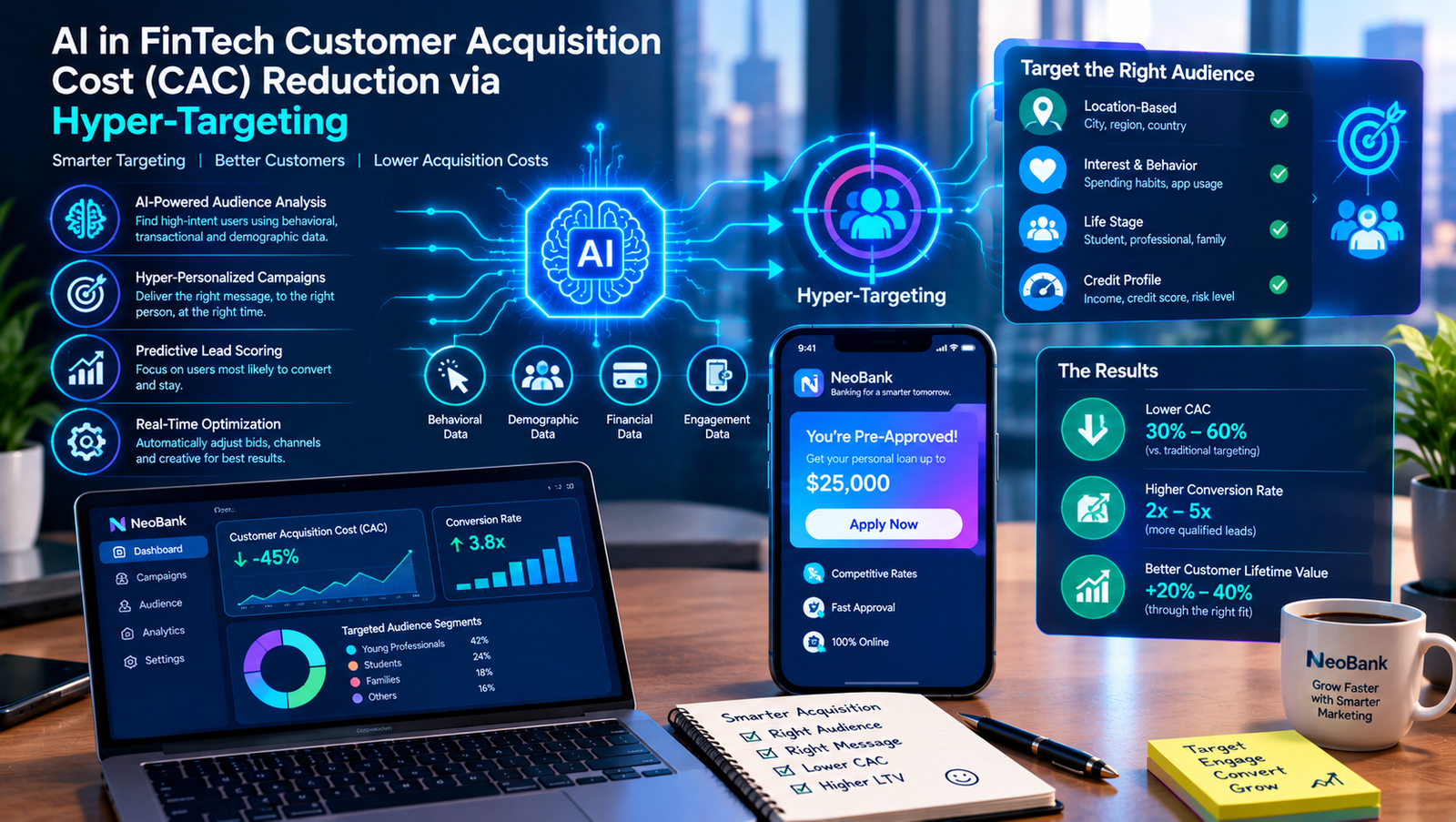
Primary topic: AI-powered customer acquisition and hyper-targeting in financial technology
Research focus: Predictive audience selection, customer propensity modeling, financial-services personalization, conversion optimization, first-party data, campaign economics, acquisition quality, privacy, fairness, and customer lifetime value
What Is AI-Powered Hyper-Targeting in FinTech?
Customer acquisition cost (CAC) measures how much a business spends to acquire a customer. A basic calculation divides sales and marketing expenses over a defined period by the number of new customers acquired during that period. For FinTech companies, however, the result depends heavily on what counts as an acquired customer. A person who installs a banking app is not necessarily equivalent to someone who completes identity verification, funds an account, makes a first payment, and continues using the service.
AI-powered hyper-targeting uses customer, campaign, behavioral, and contextual data to estimate which audiences are likely to take a meaningful action. It then helps marketers allocate spending, select messages, personalize onboarding, and determine when to engage a prospect. The goal is to increase the number of suitable customers acquired from a given budget without creating misleading advertising, discriminatory targeting, or unnecessary pressure to buy financial products.
For a digital bank, this might mean identifying prospects who are likely to complete account opening and use a debit card. For a payment app, it could mean finding merchants or consumers who are likely to complete their first transaction. For a lending platform, it may mean improving the relevance of product information while keeping marketing decisions separate from regulated credit eligibility and underwriting decisions.
Hyper-targeting should answer three questions:
- Which audience is most likely to become an active customer?
- Which channel and message are most likely to reach that audience efficiently?
- Will the acquired customer generate enough long-term value to justify the acquisition cost?
Why FinTech CAC Needs a Different Strategy
FinTech customer acquisition involves trust, identity checks, financial relevance, and product activation. A low-cost app install can become an expensive acquisition if the user abandons onboarding, fails verification, never funds an account, or leaves after receiving a promotional reward.
Research summarized by the University of Chicago’s Becker Friedman Institute in February 2026 found that FinTech firms spend approximately three times as much on sales and marketing as traditional financial firms. The researchers connect this difference with the demands of building customer trust, acquiring data, and operating digital platforms. This finding helps explain why acquisition efficiency is strategically important in a sector where customer relationships are built digitally.
Source: Becker Friedman Institute, FinTech and Customer Capital, February 2026
A FinTech acquisition funnel may include several steps before a customer produces meaningful revenue.
Visual: A conceptual funnel. Actual stages vary by product, market, and regulatory requirements.
If AI optimizes only the top of this funnel, it may produce more clicks without improving customer economics. A stronger system optimizes toward a clearly defined downstream outcome, such as a verified and activated account, while monitoring customer quality and retention.
Research Study: AI-Based Predictive Marketing in Digital Banking
A 2026 paper in the Journal of Information Systems Engineering and Management examined AI-based predictive marketing and its relationship with customer acquisition and financial performance in digital banking. The authors used machine-learning prediction of subscription behavior with the UCI Bank Marketing Dataset to examine customer lifetime value, marketing return on investment, and profitability.
The paper reports that AI-based methods, including neural networks, can help identify likely responders and allocate marketing resources more efficiently. It also identifies data privacy, regulatory compliance, and consumer trust as factors that influence the effectiveness of AI marketing.
This study is relevant because it connects predictive targeting with financial outcomes rather than treating campaign response as the only success metric. However, its use of a bank marketing dataset means its results should not automatically be interpreted as proof of a specific CAC reduction for every modern FinTech app. The value of the research is its modeling approach and the need to assess acquisition alongside downstream economics.
What FinTech teams can apply:
- Predict meaningful conversion events rather than clicks alone
- Compare customer acquisition cost with expected customer value
- Measure whether predictive targeting improves campaign profitability
- Include privacy, trust, and compliance in the model’s design
Research Study: AI-Powered Personalization in Financial Services
A 2026 paper in Procedia Computer Science proposed a framework for personalized financial services using AI, deep learning, and graph-based methods. The framework considered financial behaviors such as spending patterns, portfolio growth, and credit risk, and evaluated predictions, retention probability, and acceptance of recommendations.
The authors report that their framework performed better than traditional approaches on the metrics they evaluated. They also discuss explainable AI as a way to support fairer and more sustainable personalization.
For acquisition teams, the useful insight is that personalization can be based on a richer understanding of a customer’s needs rather than broad demographic segments alone. A prospect exploring budgeting tools may respond to a different product explanation than someone looking for international payments. The system should use only data that the company is authorized to process for that purpose, and it should avoid inferring sensitive traits or financial distress to pressure people into unsuitable products.
The paper uses synthetic data for its validation, so its reported performance should be treated as evidence of a proposed technical framework rather than a verified reduction in real-world acquisition costs.
Research Study: AI-Powered Adaptive Engagement in Banking
A study published in Scientific Reports in April 2026 introduced an adaptive engagement framework for banking that uses AI to personalize interactions. The research addresses a central challenge in financial marketing: a message can be relevant to a customer while still feeling intrusive if the timing, channel, or level of personalization is wrong.
This distinction matters for CAC because acquisition is not only about predicting who might convert. It is also about choosing an appropriate way to communicate. Repeated messages can increase marketing costs, cause customers to disengage, and damage trust. A well-designed engagement system should consider the likely usefulness of a message, the customer’s recent interactions, contact frequency, and whether the customer has already completed the desired action.
The study supports the direction of adaptive, context-aware engagement, but it should not be interpreted as a universal benchmark for CAC improvement. Financial institutions should test such systems against a control group and track both conversion and negative outcomes, including unsubscribes, complaints, and account abandonment.
Research Study: AI Marketing Adoption in Financial Services
A practitioner field study published in the journal Decision examined factors influencing the adoption of AI-powered marketing in financial services. The authors used a structured decision-analysis approach and practitioner validation to investigate the factors that encourage organizations to adopt AI marketing.
The study is useful because marketing performance depends on more than model accuracy. Data quality, organizational readiness, technology integration, employee skills, and trust in the system can determine whether a predictive model is actually used in campaigns.
For example, a model may identify promising prospects, but its recommendations will have limited value if campaign tools cannot activate the segments, analytics cannot attribute conversions, or compliance teams cannot review the targeting logic. AI acquisition projects therefore need coordination between marketing, data science, product, engineering, risk, and legal teams.
The research concerns adoption drivers rather than a controlled experiment measuring a specific reduction in CAC. Its contribution is an organizational perspective on why AI marketing succeeds or stalls in practice.
Research Study: Deep Learning and Random Forests in Retail Banking Campaigns
A study published in Expert Systems with Applications examined direct marketing campaigns in retail banking using deep learning and random forests. It explored a time-series representation of customer data and used transaction-related patterns to predict willingness to take a personal loan.
This work is particularly relevant to hyper-targeting because it treats customer behavior as something that develops over time. A customer’s recent product activity or response history may be more informative than a static profile captured months earlier.
The practical lesson is to build features that represent meaningful behavioral change, while avoiding the assumption that past behavior will always predict future needs. Models should be tested on later time periods and monitored for changes in customer behavior, market conditions, and product offers.
The study is older than the recent generative-AI wave, but its core lesson remains useful: transaction histories and time-aware features can help identify which customers are more likely to respond to a relevant offer. It does not establish a universal CAC reduction for current FinTech platforms.
Research Study: FinTech Customer Capital and Acquisition Spending
A February 2026 research brief from the Becker Friedman Institute summarizes research on FinTech customer capital. It reports that FinTech firms spend around three times as much on sales and marketing as traditional financial firms, with the difference linked to customer trust, data acquisition, and the digital nature of the business.
This research provides an important economic context for AI-driven targeting. FinTech companies often need to spend to establish trust, explain unfamiliar products, and encourage customers to move financial activity from established providers. AI cannot remove these costs entirely. Instead, it can help companies understand which acquisition investments are generating durable customer relationships.
The implication is that CAC should be evaluated alongside customer retention, contribution margin, product usage, and the cost of servicing the acquired cohort. A campaign that attracts many low-engagement customers may appear successful at first but perform poorly over time.
The research is about FinTech customer capital and marketing expenditure, not a direct test of an AI targeting model. It helps explain why acquisition quality and long-term value should sit at the center of a FinTech growth strategy.
What the Research Means for FinTech Growth Teams
The studies point toward a more disciplined model of customer acquisition. Predictive analytics can help identify likely responders, adaptive engagement can improve message relevance, and behavioral features can make targeting more timely. But the evidence does not support promising a fixed percentage reduction in CAC for every FinTech company.
A practical strategy should separate three questions:
- Prediction: Can the model identify prospects who are more likely to complete a valuable action?
- Incrementality: Does targeting those prospects cause additional conversions, or would they have converted anyway?
- Economics: Do the additional customers generate enough contribution margin and retention to justify the cost?
The distinction between prediction and incrementality is critical. A model may identify people who are already likely to open an account. If the company spends advertising budget to reach them, it may simply pay for conversions that would have happened organically. Incrementality testing helps determine whether the campaign creates additional value.
AI Hyper-Targeting Use Cases Across FinTech
| FinTech business | AI targeting application | Meaningful outcome |
|---|---|---|
| Neobanks | Predict likelihood of completing account opening and first funding | Activated accounts |
| Digital payments | Identify users likely to complete a first payment | First successful transaction |
| Personal finance apps | Match budgeting features to declared user needs | Activated paid or retained users |
| Remittance platforms | Identify relevant corridors and use cases from permitted contextual signals | First completed transfer |
| SMB finance SaaS | Predict business fit and onboarding completion | Activated business accounts |
| Digital lenders | Personalize educational content and product discovery, separate from credit decisions | Qualified engagement and completed applications |
How AI Reduces CAC Across the Acquisition Journey
Predictive Audience Selection
Predictive models can estimate the probability that a prospect will complete a defined action. Depending on the product and available permissions, features may include campaign interactions, referral source, product-page activity, onboarding progress, and broad engagement patterns.
The model should optimize for a meaningful outcome rather than the easiest event to measure. For example, predicting a funded account may be more useful than predicting an app install. The target event should also be available consistently enough to support reliable training and evaluation.
Channel and Budget Allocation
AI can help compare the expected value of different acquisition channels. Paid search, paid social, referrals, partnerships, organic search, and lifecycle messaging may produce different customer cohorts, even when their headline conversion rates look similar.
A budget allocation system should consider marginal performance. A channel that performs well at a small budget may become less efficient when spending increases. Marketers should therefore monitor incremental CAC as budgets change rather than assuming that past average CAC will remain constant.
Creative and Message Personalization
AI can help test different explanations of a product’s value. A customer interested in international transfers may need clear information about fees and delivery times, while a small business owner may care more about reconciliation and cash-flow visibility.
Personalization should make the product easier to understand. It should not exploit a person’s financial stress, imply guaranteed outcomes, or conceal material fees and limitations.
Onboarding Conversion
Acquisition does not end when someone clicks an advertisement. AI can identify common points where users abandon the application journey and help teams test clearer instructions, better error messages, and more relevant reminders.
For regulated products, the objective should be to remove unnecessary friction without weakening identity verification, fraud controls, disclosures, or eligibility requirements.
Referral and Lifecycle Optimization
Models can help identify customers who may be receptive to a referral invitation or a relevant additional service. However, referral rewards should be evaluated against fraud, reward abuse, and the quality of customers acquired through the program.
Lifecycle targeting can also reduce wasted spend by suppressing advertisements to users who have already completed the target action, while respecting consent and communication preferences.
Visual Framework: From Data to Lower Incremental CAC
Consented first-party data and campaign events
Conversion and customer-value estimates
Audience, channel, message, timing
Incremental conversion and cohort value
The loop matters because customer behavior and channel economics change. A model that performs well today may become less accurate after a product launch, pricing change, competitor promotion, or shift in advertising inventory.
Measuring CAC Correctly
A reliable CAC framework starts with a clearly defined customer and a consistent cost boundary.
Basic CAC formula:
For decision-making, companies should distinguish between blended CAC, paid-channel CAC, marginal CAC, and incremental CAC.
- Blended CAC: Total acquisition spending divided by all new customers, including organic and paid sources
- Paid CAC: Paid acquisition costs divided by customers attributed to paid channels
- Marginal CAC: The additional cost of acquiring the next group of customers
- Incremental CAC: Additional campaign cost divided by additional customers caused by the campaign
Incremental CAC is particularly useful for evaluating AI targeting. If the model finds people who would have converted without advertising, attributed CAC may look attractive while the campaign creates little additional value.
Visual: The Metrics That Connect Targeting to Profit
| Metric | What it tells you | Common mistake |
|---|---|---|
| Cost per click | Cost of attracting traffic | Treating cheap clicks as successful acquisition |
| Application completion | Funnel friction | Ignoring verification and activation outcomes |
| Activated-customer CAC | Cost of acquiring a customer who uses the product | Counting registrations as active customers |
| Incremental CAC | Cost of customers caused by the campaign | Relying only on attribution models |
| LTV:CAC | Relationship between customer value and acquisition cost | Using revenue instead of contribution value |
Customer Lifetime Value: Avoiding Cheap but Unprofitable Growth
A targeting model that maximizes conversion volume may attract customers who rarely use the product or cost more to serve than they generate in revenue. This is why customer lifetime value (LTV) should be considered alongside CAC.
For FinTech, LTV can depend on interchange income, subscription revenue, payment volume, lending revenue where appropriate, retention, servicing costs, fraud losses, funding costs, and other product-specific factors. The calculation should use contribution economics rather than assuming that all revenue is profit.
A simplified relationship is:
AI can estimate customer value, but those estimates should be calibrated against observed outcomes. Early predictions may be unreliable for new products or customer segments with limited history. Teams should compare predicted LTV with realized cohort contribution over time and update the model when the gap becomes material.
Privacy, Fairness, and Responsible Targeting
Financial data can reveal sensitive details about a person’s life. Targeting systems may also create unfair outcomes if they use proxies for protected characteristics or infer vulnerability from spending patterns.
The Consumer Financial Protection Bureau has warned that sophisticated data-driven marketing can create risks involving privacy, discrimination, and manipulative practices. Its discussion of AI in financial services also emphasizes that existing consumer-protection laws continue to apply when companies use automated systems.
Source: CFPB, AI Opportunities and Risks in Financial Services
A responsible hyper-targeting program should include:
- Clear purposes for collecting and using customer data
- Consent and preference management where required
- Data minimization and appropriate retention limits
- Controls against targeting based on sensitive traits or proxies
- Review of advertising for regulated financial products
- Monitoring for disparate outcomes and customer complaints
- Human review of high-impact or unusual campaign decisions
- Documentation of model inputs, tests, and campaign changes
Personalization should help customers discover relevant products. It should not use AI to exploit financial distress or hide important product conditions.
Expert Recommendation: Build an Incrementality-First Growth System
The recommended approach is to treat AI hyper-targeting as a measurable growth experiment, not a standalone marketing tool.
Start with these priorities:
- Define the right conversion: Choose a downstream event such as a verified, activated, or funded account
- Establish a reliable baseline: Calculate current CAC using consistent costs, time windows, and customer definitions
- Use first-party data responsibly: Prioritize consented product interactions and campaign events over unnecessary sensitive data
- Build a simple baseline model: Compare logistic regression or a tree-based model before introducing complex deep learning
- Run controlled tests: Use holdout groups or randomized experiments to estimate incremental lift
- Optimize for customer value: Track retention and contribution margin, not just conversion rate
- Keep marketing separate from credit decisions: Do not allow acquisition targeting to bypass underwriting, eligibility, or fair-lending controls
- Review model behavior: Monitor drift, segment-level performance, complaints, and unwanted targeting outcomes
McKinsey’s September 2026 analysis of AI-powered personalization in banking argues that banks can use more tailored engagement to create value, while emphasizing the need to connect personalization to customer experience and business outcomes. For FinTech teams, the practical lesson is to design personalization around customer needs and measurable value rather than increasing message volume.
Expert Quote
Paraphrased from McKinsey’s September 2026 analysis of AI-powered personalization in banking. This is a summary of the article’s argument, not a direct quotation.
Implementation Roadmap for FinTech Companies
KPIs for an AI Hyper-Targeting Program
| KPI | Purpose | Review frequency |
|---|---|---|
| Activated-customer CAC | Measures cost of acquiring customers who reach the activation milestone | Weekly or monthly |
| Incremental conversion lift | Estimates additional conversions caused by targeting | Per experiment |
| Application completion rate | Identifies onboarding friction | Weekly |
| First transaction rate | Measures activation beyond registration | Weekly or monthly |
| Contribution LTV:CAC | Connects acquisition cost with customer economics | Monthly or quarterly |
| Complaint and opt-out rate | Monitors negative customer experience | Weekly |
| Segment-level model performance | Checks reliability and potential unfair outcomes | Monthly or after model changes |
Future Predictions: 2027–2030
AI Will Optimize the Full Customer Journey
FinTech growth systems are likely to move beyond campaign-level conversion prediction. Models will increasingly connect acquisition source, onboarding friction, first product use, and early retention. This should make it easier to distinguish channels that generate active customers from channels that generate inexpensive but inactive registrations.
Incrementality Will Become More Important Than Attribution Alone
As privacy changes and fragmented customer journeys make attribution less certain, controlled experiments and modeled incrementality will become more important. Teams will need to test whether AI-driven targeting creates additional customers instead of simply claiming credit for conversions that would have happened anyway.
Personalization Will Become More Contextual
Customer-facing AI is likely to adapt not only the message but also the timing, channel, and level of detail. In financial services, this should be paired with stronger controls against excessive messaging, sensitive inference, and manipulative personalization.
Customer Value Will Shape Media Buying
Acquisition models will increasingly connect campaign data with downstream contribution and retention. This could help companies allocate budgets based on expected customer value, provided the estimates are calibrated and do not create unfair exclusion or unsuitable product promotion.
Governance Will Become Part of Marketing Technology
Financial institutions will face continued pressure to document how customer data is used, test for unfair outcomes, and maintain oversight of automated decisions. Privacy, explainability, and responsible targeting will become core requirements of the acquisition stack rather than separate compliance tasks.
These are directional projections based on current research and industry developments, not guaranteed outcomes or quantified forecasts.
Frequently Asked Questions
What is AI hyper-targeting in FinTech?
AI hyper-targeting uses machine learning and customer data to identify relevant audiences, predict likely actions, and personalize campaigns. In FinTech, it should focus on meaningful outcomes such as completed onboarding, activated accounts, or first transactions rather than clicks alone.
How can AI reduce customer acquisition cost?
AI can help reduce wasted campaign spending by improving audience selection, predicting conversion, optimizing channel allocation, and identifying onboarding friction. Actual savings depend on the product, data quality, campaign design, and whether the improvements produce incremental customers.
What data can FinTech companies use for AI targeting?
Depending on permissions and applicable law, companies may use campaign interactions, referral source, product-page engagement, onboarding events, and relevant first-party behavioral data. Sensitive financial data should not be collected or reused without a clear lawful purpose and appropriate safeguards.
Why should FinTech companies measure activated-customer CAC?
An app install or registration does not necessarily create business value. Measuring the cost of acquiring a customer who completes a meaningful action gives a more useful view of acquisition efficiency.
Can AI targeting create discrimination risks?
Yes. Models may use sensitive attributes or proxies that lead to unfair differences in who sees financial products or offers. Companies should test targeting outcomes, limit sensitive data use, document decisions, and maintain appropriate legal and compliance oversight.
Should FinTech companies optimize for CAC or customer lifetime value?
They should evaluate both. Lower CAC is not a sustainable improvement if the acquired customers generate little contribution or leave quickly. Cohort-level contribution LTV, retention, and incremental CAC provide a more complete view of growth quality.
Does AI guarantee lower acquisition costs?
No. AI can improve targeting and measurement, but results depend on data quality, campaign execution, competition, product-market fit, and customer trust. Controlled experiments are necessary to establish whether a particular system improves performance.
Final Perspective
AI-powered hyper-targeting gives FinTech companies a way to make customer acquisition more precise, measurable, and responsive. Its strongest use is not simply identifying people who are likely to click an advertisement. It is connecting audience selection with product relevance, completed onboarding, activation, retention, and customer contribution.
The research reviewed here supports several parts of that strategy. A 2026 digital-banking study connects predictive marketing with acquisition and financial-performance measures. A 2026 personalized-finance framework explores deep learning and graph-based methods. Research on adaptive banking engagement highlights the importance of timing and relevance, while earlier retail-banking work demonstrates the value of behavioral and time-aware prediction. A 2025 practitioner study also shows why organizational readiness matters when financial institutions adopt AI marketing. Meanwhile, research on FinTech customer capital explains why acquisition spending remains strategically important in digital financial services.
The evidence does not justify promising a universal CAC reduction. The practical opportunity is to identify where a company is wasting acquisition spend, use AI to improve those decisions, and prove the result through controlled measurement.
For FinTech companies, the most durable approach is to combine:
This turns hyper-targeting from a campaign tactic into a customer-acquisition capability. The goal is not to acquire the largest possible number of users at any cost. It is to acquire suitable customers efficiently, help them understand and use the product, and build relationships that generate sustainable value for both the business and the customer.
Research Sources
- Khan and Kernez, The Influence of AI-Based Predictive Marketing on Fintech Customer Acquisition and Financial Performance, 2026
- Procedia Computer Science, Personalized Financial Services through Artificial Intelligence: Transforming FinTech with Predictive Analytics and Deep Learning, 2026
- Scientific Reports, The Adaptive Engagement Framework: Enhancing Banking Customer Experience Through AI-Powered Invisible Marketing, 2026
- Chintalapati and Pandey, Factors Driving the Adoption of AI-Powered Marketing in Financial Services, 2025
- Ładyżyński, Żbikowski and Gawrysiak, Direct Marketing Campaigns in Retail Banking with the Use of Deep Learning and Random Forests, 2019
- Becker Friedman Institute, FinTech Firms Spend Much More on Sales and Marketing Than Traditional Financial Firms, 2026
- McKinsey, At Last, Customers First: AI-Powered Personalization Can Help Banks Create Value, 2026
- Consumer Financial Protection Bureau, AI Opportunities and Risks in Financial Services

Leave a Reply