Primary topic: AI in IoT Medical & Healthcare
Research focus: Artificial Intelligence, Internet of Medical Things (IoMT), smart medical devices, connected healthcare systems, wearable sensors, predictive analytics, real-time monitoring, edge AI, remote care, medical device interoperability, cybersecurity, privacy, and future healthcare infrastructure.
AI in IoT Medical & Healthcare
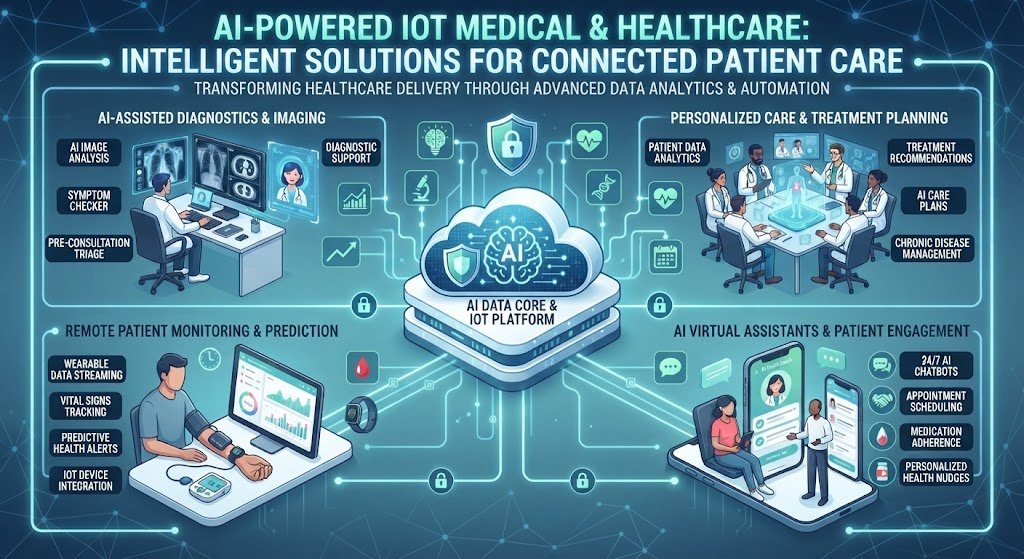
The Internet of Things has expanded healthcare beyond traditional clinical environments by connecting medical devices, sensors, software platforms, smartphones, hospital systems, and patient-generated health data. When Artificial Intelligence is added to this connected ecosystem, the result is commonly described as the Artificial Intelligence of Medical Things or AI-enabled Internet of Medical Things.
The basic idea is simple. Connected devices collect information, communication networks move that information, software platforms store and organize it, and AI models analyze the resulting data to identify patterns or support decisions.
The importance of this architecture comes from continuous data. A conventional medical appointment may provide one measurement at one point in time, while an IoMT device can potentially generate information throughout the day or during a patient’s normal activities.
This creates a different approach to healthcare monitoring. Instead of relying only on periodic measurements, healthcare providers can increasingly work with longitudinal data that shows how a patient’s condition changes over time.
A wearable ECG device, for example, can generate repeated cardiac measurements. A connected glucose system can provide frequent glucose readings. A smart inhaler can record medication-use events, while a motion sensor can capture activity or gait information.
AI can analyze these streams to detect abnormalities, identify trends, estimate risk, and determine which events deserve human attention.
However, AI does not automatically make IoT healthcare useful. A device that generates thousands of measurements can actually increase workload if every measurement creates an alert. The real objective is therefore to transform raw device data into reliable, prioritized, and actionable information.
How AI and IoMT Work Together
An AI-enabled IoMT ecosystem generally contains several connected layers. Each layer performs a different function, and weaknesses in any one layer can affect the complete system.
Collect physiological, behavioral, environmental, or equipment data from patients and healthcare environments.
Transfers information through Bluetooth, Wi-Fi, cellular networks, gateways, APIs, or other communication technologies.
Stores, organizes, normalizes, and prepares device-generated information for analytics and clinical workflows.
Uses machine learning, deep learning, anomaly detection, or other AI techniques to interpret the data.
Routes important insights to clinicians, care teams, patients, or operational systems according to defined rules.
A practical system therefore looks less like a single AI model and more like a connected healthcare pipeline.
↓
CONNECTED MEDICAL DEVICE
↓
DATA COLLECTION
↓
EDGE OR CLOUD PROCESSING
↓
AI ANALYSIS
↓
RISK / INSIGHT / ALERT
↓
CLINICIAN OR CARE-TEAM REVIEW
↓
ACTION + FOLLOW-UP
↓
OUTCOME DATA
The final stage is especially important because it creates a feedback loop. Outcomes can be used to evaluate whether the AI system is producing useful signals and whether the overall workflow is actually improving care.
Research Evidence Behind AI-Enabled IoMT
Research into IoMT has expanded considerably, covering connected sensors, smart healthcare platforms, medical device networks, remote monitoring, AI-based analytics, security, interoperability, and patient-centered applications.
A systematic review published in 2021 examined the potential of IoMT applications in smart healthcare. The researchers initially identified 987 articles and ultimately included 135 relevant studies after screening. The review covered areas such as monitoring, diagnosis, prevention, treatment, data management, and supporting technologies including AI and blockchain.
The research highlighted the potential of IoMT to support healthcare delivery while also identifying technical and implementation challenges. This is important because it shows that IoMT is not simply a consumer-wearable trend. It has developed into a broader research area involving healthcare systems, medical devices, communication technologies, and clinical applications.
Source: Potential of Internet of Medical Things applications in building a smart healthcare system.
A more recent 2024 review analyzed enabling technologies for IoMT, including sensors, medical devices, platforms, data visualization, and AI. The review initially identified hundreds of relevant records and examined how connected medical technologies are being applied across healthcare environments.
The study reinforces an important concept for healthcare organizations: IoMT requires more than connected hardware. Data management, communication, analytics, and intelligent interpretation are all necessary components of a useful system.
Source: A Topical Review on Enabling Technologies for the Internet of Medical Things.
Wearable Medical Devices and AI
Wearable devices are one of the most visible parts of IoMT. Smartwatches, ECG patches, activity trackers, continuous glucose monitors, connected blood-pressure devices, motion sensors, and other wearable technologies can generate health-related information outside traditional healthcare facilities.
The main limitation of wearable data is volume. A patient can generate thousands of observations without producing a clear clinical conclusion. AI can provide an interpretation layer that helps distinguish normal variation from patterns that may require additional attention.
A 2026 comprehensive review of machine-learning-driven wearable sensors examined applications involving ECG, blood glucose, respiratory patterns, health monitoring, early disease detection, and precision medicine. The review also highlighted emerging technologies including explainable AI, edge computing, and federated learning.
The researchers identified several barriers to clinical translation, including data standardization, interpretability, privacy, and regulatory requirements.
This research suggests that the future of wearable healthcare is not simply about adding more sensors. The more valuable direction is to make sensor data easier to interpret, more reliable, and more directly connected to clinical workflows.
AI-Powered ECG and Cardiac Monitoring
Cardiac monitoring is one of the strongest applications for AI-enabled connected devices because ECG and other physiological signals contain patterns that can be difficult to evaluate continuously through manual observation.
AI can process ECG signals and identify patterns associated with arrhythmias or other cardiac conditions. When combined with wearable hardware, this can create continuous or repeated monitoring outside hospitals.
A systematic review and meta-analysis evaluated AI models for cardiovascular-related disease detection from wearable and mobile devices. The review included 102 studies. Among the models examined, arrhythmia detection was the largest application category, with 62 studies.
For atrial fibrillation detection, 26 studies were included in the quantitative analysis. The pooled sensitivity was 94.80% and pooled specificity was 96.96%.
These figures demonstrate the research potential of AI-supported wearable cardiac monitoring, although they should not be interpreted as a universal performance level for every consumer or medical device.
A newer 2025 scoping review also examined AI-driven real-time cardiovascular monitoring using wearable devices. ECG-based wearables were the most frequently used devices in the reviewed literature, with AI ranging from traditional machine learning to lightweight deep-learning systems operating on wearable or cloud-based infrastructure.
The researchers identified real-world challenges such as patient compliance, connectivity limitations, hardware constraints, and the need to optimize AI models for continuous monitoring.
Source: AI-Driven Real-Time Monitoring of Cardiovascular Conditions With Wearable Devices.
Connected Glucose Monitoring and AI
Diabetes management creates another major opportunity for AI and IoMT because glucose data can be collected repeatedly through connected monitoring devices.
Instead of looking at isolated glucose measurements, AI can analyze trends and relationships between glucose levels, activity, meals, medication patterns, sleep, and other available information.
The potential value is personalized insight. One patient may experience glucose changes after certain activities, while another may show a different pattern. Machine learning can identify individual trends when sufficient quality data is available.
Connected glucose devices can also become part of a larger healthcare ecosystem where information moves between the patient, mobile application, care platform, and clinical team.
The FDA notes that some diabetes technologies allow glucose meters and insulin pumps to communicate with one another, illustrating how connected medical devices can create integrated care workflows.
Source: FDA: Medical Device Cybersecurity.
AI can add another layer by identifying unusual patterns, supporting risk stratification, and helping clinicians prioritize patients who may need review.
The important design principle is that an AI-generated prediction should connect to an approved clinical workflow rather than becoming an unexplained notification.
AI for Remote Patient Monitoring
Remote Patient Monitoring is closely connected with IoMT because patients can use connected devices to send health measurements to healthcare organizations from home.
Possible measurements include:
- Blood pressure.
- Heart rate.
- ECG signals.
- Blood glucose.
- Blood oxygen saturation.
- Body temperature.
- Weight.
- Respiratory measurements.
- Activity and mobility.
- Sleep-related information.
The challenge is turning these measurements into useful clinical information.
AI can support this process by identifying deviations from a patient’s baseline, detecting trends, estimating risk, and prioritizing alerts.
A useful RPM platform therefore does not need to send every abnormal measurement directly to a clinician. Instead, it can combine multiple signals and determine whether the overall pattern deserves attention according to clinically defined rules and validated models.
A 2025 systematic review examined factors influencing adoption of IoMT for remote patient monitoring and described IoMT as a network of interconnected medical devices and applications designed to facilitate real-time data sharing and personalized patient care.
Source: Factors influencing the adoption of Internet of Medical Things for remote patient monitoring.
AI and Smart Hospital IoT
IoMT is not limited to devices worn by patients. Hospitals themselves contain large networks of connected medical equipment and operational technologies.
Examples include connected monitors, infusion equipment, ventilators, imaging systems, beds, asset trackers, environmental sensors, medication systems, and location technologies.
AI can analyze information from these systems to improve visibility across hospital operations.
Potential applications include:
- Predictive maintenance for connected medical equipment.
- Detection of unusual equipment behavior.
- Asset location and utilization analysis.
- Patient-flow optimization.
- Bed-management analytics.
- Environmental monitoring.
- Energy-use optimization.
- Operational anomaly detection.
- Equipment failure prediction.
- Clinical workflow monitoring.
Predictive maintenance is particularly valuable because medical equipment failure can disrupt clinical operations. AI can analyze historical equipment behavior and sensor signals to identify patterns associated with potential problems.
This approach changes maintenance from a purely reactive process toward condition-based or predictive maintenance.
AI and Medical Device Interoperability
Interoperability is one of the most important issues in IoMT.
Healthcare organizations frequently use equipment from different manufacturers, different generations of technology, and different software platforms. If those systems cannot exchange and interpret information correctly, the value of connected healthcare becomes limited.
The FDA defines medical-device interoperability as the ability to safely, securely, and effectively exchange and use information among devices, products, technologies, or systems.
The FDA also emphasizes that interoperability can support improved patient care, reduced errors, innovation, and the creation of more diverse datasets.
Source: FDA Medical Device Interoperability.
Research into IoMT interoperability identified several recurring challenges, including device heterogeneity, system heterogeneity, data standardization, security, safety, architecture, workflow integration, and regulatory requirements.
The researchers reviewed 18 publications and identified technologies such as middleware, semantic frameworks, standards, and other architectural approaches as potential solutions.
Source: How Interoperability Challenges Are Addressed in Healthcare IoT Projects.
A 2025 scoping review of interoperable IoMT platforms for emergency and home-based care analyzed 158 selected articles. Among the technologies frequently reported in the included systems were cloud computing, REST APIs, Wi-Fi, gateways, and JSON, while MQTT and WebSocket were used for real-time communication in some applications.
Source: Technologies for Interoperable Internet of Medical Things Platforms.
The lesson for AI developers is straightforward: AI should be designed as part of an interoperable system instead of as an isolated application.
Edge AI in Healthcare IoT
Traditional cloud-based AI sends data to centralized infrastructure for processing. Edge AI moves some computation closer to the device or local gateway.
This can be valuable in healthcare because some IoMT applications require fast responses and may operate in environments where internet connectivity is unreliable.
Edge processing can reduce the amount of raw information transferred to the cloud. It can also reduce latency for certain use cases.
Examples include:
- Real-time ECG signal analysis.
- Fall detection.
- Movement analysis.
- Device anomaly detection.
- Local image-quality assessment.
- Continuous physiological monitoring.
- Safety alerts.
Edge AI also creates technical constraints. Medical devices may have limited computing power, battery capacity, storage, and connectivity.
AI models therefore need to be optimized for the hardware on which they operate.
A 2026 review of wearable sensor technologies identified edge-computing-enabled devices as an important direction for intelligent healthcare monitoring while also emphasizing reliability, standardization, privacy, and regulatory challenges.
Source: Machine-learning-driven wearable sensors in healthcare.
AI for Fall Detection and Mobility Monitoring
Connected sensors can monitor movement and help identify falls or changes in mobility.
Wearable devices may use accelerometers, gyroscopes, pressure sensors, or other motion technologies. AI models can analyze the resulting signals to classify activities and detect patterns associated with falls or elevated risk.
A 2025 review examined research on wearable sensors for fall detection between 2015 and 2024. The review analyzed 582 research articles and 65 reviews, showing substantial growth in research activity around wearable fall-detection technologies.
Source: A Decade of Progress in Wearable Sensors for Fall Detection.
Another review of wearable systems examined inertial and insole-based technologies for fall-risk assessment and gait-related monitoring.
Source: Wearable Sensor Systems for Fall Risk Assessment.
The practical opportunity is larger than simply detecting a fall. AI could potentially monitor changes in gait, balance, mobility, and activity patterns and identify gradual deterioration before an acute event occurs.
However, the system must account for false alarms, sensor placement, patient behavior, device adherence, and environmental differences.
AI for Chronic Disease Management
Chronic disease management is particularly suitable for IoMT because many chronic conditions require ongoing observation rather than one-time diagnosis.
Connected devices can continuously or periodically collect relevant measurements. AI can then analyze longitudinal patterns and help healthcare teams prioritize patients.
Potential applications include:
- Cardiovascular disease monitoring.
- Diabetes management.
- Respiratory disease monitoring.
- Hypertension monitoring.
- Mobility and neurological monitoring.
- Post-surgical monitoring.
- Frailty and elderly-care monitoring.
- Medication-adherence monitoring.
The strongest approach is patient-specific modeling.
Instead of comparing every patient against one universal threshold, AI can learn a patient’s normal pattern and identify meaningful deviations.
This does not eliminate clinical thresholds or professional judgment. Instead, it can provide an additional layer of continuous observation.
AI and IoMT Cybersecurity
Connectivity creates another major responsibility: cybersecurity.
Medical IoT devices can contain sensitive patient information and may connect to hospital networks, smartphones, cloud platforms, or other medical systems.
A compromised device can therefore create privacy, operational, and potentially patient-safety risks.
The FDA states that many modern medical devices contain software and connect to the internet, hospital networks, mobile phones, or other devices. The agency emphasizes the importance of cybersecurity because connected devices can introduce vulnerabilities into healthcare environments.
Source: FDA Medical Device Cybersecurity.
A 2024 comprehensive review specifically examined the use of AI for IoMT cybersecurity. The researchers found that machine learning and deep learning can improve the speed and effectiveness of certain cybersecurity measures, including anomaly detection and protection against network-level threats.
Source: Enhancing Internet of Medical Things security with artificial intelligence.
Earlier systematic research reviewed 153 publications on IoMT security and privacy and the role of machine-learning approaches.
The researchers noted that many studies improved conventional performance measures but did not sufficiently account for practical factors such as computational complexity and power consumption. This is particularly important for medical IoT because a model that performs well in a laboratory environment may not be suitable for a battery-powered or resource-constrained device.
Source: A systematic review of security and privacy issues in the Internet of Medical Things.
AI, Privacy, and Federated Learning
Healthcare organizations often face a difficult balance between AI development and patient-data protection.
Traditional machine-learning development may require large datasets to be transferred into a central environment. That can create privacy, governance, security, and data-sharing challenges.
Federated learning offers an alternative approach.
Instead of moving all training data to a central location, models can be trained across distributed datasets while the underlying patient data remains local.
Research into federated learning for smart healthcare has identified IoMT, wearables, and remote monitoring as important application areas.
Source: Federated Learning for Privacy Preservation in Smart Healthcare Systems.
Another review specifically examined federated learning and IoMT and described how distributed model training can reduce the need for centralized data sharing.
Source: Federated Learning and Internet of Medical Things: Opportunities and Challenges.
Federated learning is not a complete privacy solution by itself. Model updates can still create security risks, and healthcare data can be heterogeneous across organizations.
Research has identified additional techniques such as differential privacy, encryption, secure aggregation, blockchain, and edge intelligence as possible components of stronger privacy-preserving architectures.
A 2026 systematic review also identified communication costs, scalability, interoperability, explainability, and computational requirements as continuing challenges for secure healthcare data systems.
AI and Predictive Analytics in IoMT
Predictive analytics changes the role of IoMT from passive monitoring to proactive risk assessment.
Instead of asking only what a patient’s current measurement is, a predictive system attempts to answer whether the observed pattern suggests a higher probability of a future event.
Possible prediction tasks include:
- Risk of deterioration.
- Potential cardiac events.
- Fall risk.
- Mobility decline.
- Abnormal glucose trends.
- Medication adherence problems.
- Potential hospital readmission.
- Equipment failure.
- Changes in patient activity.
The quality of these predictions depends heavily on the quality and representativeness of the underlying data.
If the training data does not adequately represent the population where the system will be deployed, performance can decline.
This is why validation should occur in the real environment where possible.
Generative AI and Connected Healthcare Data
Generative AI introduces another layer to IoMT.
Most IoMT devices produce structured measurements rather than natural-language information. Generative AI can potentially convert complex device information into summaries that are easier for clinicians or patients to understand.
For example, a healthcare platform could summarize a patient’s recent monitoring history and identify important trends for clinician review.
Possible applications include:
- Patient monitoring summaries.
- Clinician-facing trend summaries.
- Device-generated report drafting.
- Patient education.
- Alert explanations.
- Care-team communication drafts.
- Operational summaries.
- Device-support assistance.
Large multimodal models may eventually combine text, images, physiological signals, and other data types.
WHO’s guidance on large multimodal models specifically discusses their expected use across healthcare and emphasizes the need for appropriate governance, ethical safeguards, and responsible implementation.
Source: WHO Ethics and Governance of Artificial Intelligence for Health: Large Multi-Modal Models.
The most practical role for generative AI is therefore not to independently interpret every medical measurement. It is to organize and communicate validated information within a controlled workflow.
AI Use-Case Map for Medical IoT
| IoMT Area | AI Application | Technology | Potential Value |
|---|---|---|---|
| Wearables | Signal analysis and anomaly detection | ML / Deep Learning | Continuous monitoring |
| ECG Devices | Arrhythmia detection | AI / Signal Processing | Earlier review |
| Glucose Devices | Trend and risk analysis | ML / Predictive Analytics | Personalized monitoring |
| Motion Sensors | Fall and mobility analysis | Computer Vision / ML | Safety and mobility insight |
| Hospital Equipment | Predictive maintenance | Machine Learning | Reduced downtime |
| Home Devices | Remote monitoring | AI + IoMT | Home-based care |
| IoMT Networks | Cybersecurity anomaly detection | AI / ML | Threat detection |
| Healthcare Platforms | Data summarization | Generative AI | Lower information burden |
Operational Benefits of AI-Enabled IoMT
The value of AI in medical IoT extends beyond diagnosis.
Healthcare organizations can also use connected data to improve operational decision-making.
AI can analyze utilization patterns across devices, departments, patient populations, and time periods. This can help organizations understand where capacity is being used and where bottlenecks are developing.
For example, hospital administrators could analyze connected equipment utilization to identify underused assets. Clinical engineering teams could use predictive models to prioritize equipment maintenance.
Care teams could use patient-monitoring dashboards to identify which patients require attention first.
The broader opportunity is to connect clinical intelligence with operational intelligence.
Prioritize meaningful signals instead of manually reviewing every available measurement.
Support continuous observation and identify changes that may require professional review.
Use device data to identify maintenance patterns and utilization opportunities.
Convert large volumes of connected-device data into dashboards, predictions, and trends.
Major Challenges in AI and Medical IoT
The expansion of AI-enabled IoMT creates significant opportunities, but healthcare organizations should not assume that connectivity automatically produces better care.
Data quality: Sensors can produce missing, noisy, delayed, or incorrectly labeled information. AI systems trained on poor-quality data can generate unreliable outputs.
Device heterogeneity: Different manufacturers can use different data formats, communication protocols, firmware versions, and measurement characteristics.
Interoperability: AI systems need reliable access to relevant information from devices, EHRs, clinical platforms, and other healthcare systems.
Connectivity: A remote device may operate in an environment where bandwidth is limited or the connection temporarily fails.
Battery and compute limitations: Wearable and portable devices cannot always run large AI models continuously.
False alerts: Excessive alerts can create alert fatigue and reduce the usefulness of a monitoring system.
Privacy: Medical IoT generates highly sensitive information that requires strong access controls, secure transmission, appropriate storage, and responsible data governance.
Cybersecurity: Connected devices can become attack surfaces and must be protected throughout their lifecycle.
Clinical validation: A high model score in a research dataset does not automatically prove clinical effectiveness.
Model drift: Patient populations, devices, workflows, and data distributions can change after deployment.
Explainability: Clinicians may need to understand why an AI system produced a particular risk score or alert.
Regulatory Considerations for AI Medical Devices
AI-enabled IoMT products can fall into different regulatory categories depending on their intended purpose, functionality, claims, and jurisdiction.
The regulatory question should therefore be addressed during product planning rather than after development.
The FDA maintains a public list of AI-enabled medical devices that have met applicable premarket requirements. The agency states that the list can help innovators understand the current landscape and regulatory expectations.
Source: FDA Artificial Intelligence-Enabled Medical Devices.
The FDA also maintains digital-health guidance covering areas such as clinical decision-support software, AI-enabled device software functions, cybersecurity, and other digital-health technologies.
Source: FDA Digital Health Guidance.
For connected medical devices, cybersecurity is increasingly treated as part of product development rather than a feature added at the end.
The FDA’s 2026 cybersecurity guidance provides recommendations concerning device design, labeling, premarket documentation, and cybersecurity risks for medical devices.
Source: FDA Cybersecurity in Medical Devices Guidance.
IoMT Cybersecurity Architecture
A secure AI-IoMT architecture should protect the system across multiple layers.
Device identity, secure configuration, protected interfaces, authentication, and software-update mechanisms.
Secure communication, segmentation, monitoring, and protection against unauthorized access.
Encryption, access control, secure storage, retention policies, and appropriate governance.
Monitoring for manipulation, abnormal inputs, model attacks, and unexpected model behavior.
Security maintenance from product development through deployment, updates, support, and end of life.
NIST’s IoT cybersecurity guidance identifies capabilities including device identification, configuration, data protection, logical access control, software updates, cybersecurity-state awareness, and device security.
Source: NISTIR 8259 IoT Cybersecurity Guidance.
Future of AI in IoT Medical & Healthcare
The next phase of medical IoT will likely involve deeper integration between sensors, AI, clinical platforms, and healthcare workflows.
Wearable sensors will continue to generate richer physiological and behavioral information, while AI will increasingly process this information locally or through connected infrastructure.
The result could be more personalized monitoring, where the system learns patterns associated with an individual patient instead of relying exclusively on population-level thresholds.
Multimodal AI may also become increasingly important. Future systems could combine device readings with clinical notes, imaging, laboratory results, medication information, patient-reported symptoms, and other relevant data.
This could provide healthcare teams with a more complete picture of a patient’s condition.
Edge AI is another important direction because it can reduce latency and limit the need to send all raw data to centralized infrastructure.
Federated learning may support collaboration between healthcare organizations while reducing the need to centralize sensitive training datasets.
AI agents could eventually coordinate multi-step workflows around connected devices. For example, an agent could receive a validated alert, retrieve relevant patient information, prepare a summary, create a task for a care team, and document the workflow event for professional review.
The most important future development, however, may be the shift from isolated devices to intelligent healthcare ecosystems.
What Healthcare Organizations Should Build First
Healthcare organizations should avoid beginning with the question, “Where can we add AI?”
A better question is, “Which connected healthcare workflow has enough reliable data and enough measurable friction to justify AI?”
Strong initial candidates usually have three characteristics: the data is available, the problem occurs frequently, and the outcome can be measured.
Examples include:
- Reducing unnecessary RPM alerts.
- Detecting important ECG patterns for professional review.
- Identifying changes in patient mobility.
- Predicting equipment maintenance needs.
- Improving connected-device utilization.
- Summarizing longitudinal patient monitoring data.
- Detecting cybersecurity anomalies.
- Improving referral and escalation workflows.
A controlled pilot is usually more informative than a large organization-wide deployment.
The organization can establish a baseline, introduce the AI workflow, measure outcomes, collect user feedback, evaluate false positives and false negatives, and then decide whether the system should be expanded.
AI Development Framework for IoMT
A strong AI-IoMT development process should connect the clinical problem with the device, data, model, integration, and measurable outcome.
↓
CONNECTED DEVICE
↓
DATA QUALITY
↓
AI MODEL
↓
VALIDATION
↓
SECURE INTEGRATION
↓
CLINICAL WORKFLOW
↓
OUTCOME MEASUREMENT
↓
CONTINUOUS IMPROVEMENT
This approach prevents organizations from treating AI accuracy as the only success metric.
A model can have excellent technical performance but still fail operationally if alerts arrive at the wrong time, data does not integrate with existing software, clinicians do not trust the output, or patients do not use the connected device consistently.
Key Metrics for AI-IoMT Projects
| Area | Important Metrics | Why It Matters |
|---|---|---|
| AI Performance | Sensitivity, specificity, precision, recall, AUC | Measures model performance for the intended task. |
| Device Quality | Data completeness, signal quality, uptime | Poor device data can undermine AI performance. |
| Clinical | Missed findings, escalation accuracy, outcomes | Shows whether the technology helps clinical care. |
| Workflow | Alert volume, response time, task completion | Determines whether AI actually reduces workload. |
| Patient | Adherence, engagement, satisfaction | Connected healthcare depends on patient participation. |
| Security | Incidents, vulnerabilities, patching, access events | Protects devices, systems, and patient information. |
Industry Recommendations
Build the workflow before building the model
Healthcare organizations should first map how data currently moves from the medical device to the person responsible for reviewing it.
This reveals where delays, duplicate work, missing information, and unnecessary alerts occur.
AI can then be designed around the actual problem instead of being added as an isolated feature.
Make data quality a first-class requirement
AI performance depends on input quality.
IoMT projects should monitor missing readings, device failures, sensor placement, calibration, connectivity interruptions, duplicate observations, and unusual values.
A reliable system should know when data is not good enough to support a prediction.
Design for human review
High-risk clinical decisions require appropriate professional oversight.
AI should make relevant information easier to review rather than creating a false impression that the system is infallible.
The interface should make it clear what the model detected, what information influenced the result when appropriate, and what action the healthcare professional is expected to take.
Plan interoperability early
Device integration should not be postponed until the final stage.
The system architecture should define how devices, gateways, APIs, data platforms, AI services, EHRs, and clinical applications exchange information.
The FDA specifically emphasizes safe, secure, and effective interoperability for connected medical devices.
Source: FDA Medical Device Interoperability.
Use security throughout the lifecycle
IoMT security should cover design, manufacturing, deployment, updates, monitoring, incident response, and end-of-life management.
Security should not depend only on the network surrounding the device.
NIST’s IoT guidance supports a lifecycle-oriented approach to device cybersecurity and manufacturer responsibilities.
Source: NIST Cybersecurity for IoT Program.
Measure clinical and business value together
AI adoption becomes easier to justify when organizations can demonstrate measurable improvement.
Useful measurements can include reduced alert burden, faster response, improved monitoring adherence, fewer unnecessary manual tasks, better equipment utilization, improved patient engagement, or other outcomes appropriate to the specific workflow.
AI-IoMT Opportunity Matrix
| Healthcare Area | Connected Data | AI Opportunity | Potential Outcome |
|---|---|---|---|
| Cardiology | ECG and heart-rate data | Arrhythmia and anomaly detection | Earlier clinical review |
| Diabetes | Glucose measurements | Trend and risk analysis | Personalized monitoring |
| Elderly Care | Motion and activity | Fall and mobility prediction | Safety monitoring |
| Respiratory Care | Respiratory measurements | Trend and anomaly detection | Proactive follow-up |
| Hospitals | Equipment telemetry | Predictive maintenance | Reduced downtime |
| Remote Care | Home monitoring data | Risk stratification | Prioritized care |
| Healthcare IT | Network and device events | Security anomaly detection | Improved cyber resilience |
What the Research Means for Healthcare Technology Companies
The research around AI and IoMT creates opportunities for technology companies that can solve specific healthcare problems rather than simply adding an AI chatbot to an existing product.
A company developing connected medical technology can build AI directly into its platform for signal analysis, anomaly detection, predictive monitoring, or workflow prioritization.
Another company may focus on the infrastructure layer that connects devices from different manufacturers and moves their data into healthcare systems.
There is also an opportunity in AI-powered cybersecurity because connected medical devices create a large and complex attack surface.
Healthcare software companies can build dashboards that convert device data into clinician-friendly summaries instead of forcing healthcare workers to manually interpret large volumes of measurements.
The most valuable products are likely to combine multiple capabilities.
For example, a remote-monitoring platform could collect data from connected devices, perform quality checks, apply machine-learning models, prioritize alerts, summarize trends using generative AI, and route tasks to the appropriate care team.
That creates a complete workflow rather than a standalone algorithm.
What the Research Means for Healthcare Providers
Healthcare providers should evaluate AI-enabled IoMT according to the complete patient journey.
The question is not simply whether a sensor can collect data.
The organization needs to understand what happens after the data is collected.
A strong implementation answers several practical questions:
- Who receives the AI-generated alert?
- How quickly should the alert be reviewed?
- What information should the clinician see?
- What happens when the device produces poor-quality data?
- What happens when the AI system is unavailable?
- How are false positives handled?
- How are false negatives identified?
- How are patients informed about monitoring?
- How is patient data protected?
- How is model performance monitored after deployment?
These questions are as important as the model architecture itself.
Final Research Assessment
AI in IoT Medical and Healthcare represents a shift from connected devices that simply collect information toward connected systems capable of interpreting information and supporting action.
The research base demonstrates meaningful opportunities across wearable monitoring, ECG analysis, cardiovascular care, glucose management, fall detection, chronic disease monitoring, smart hospitals, equipment management, cybersecurity, and remote healthcare.
The strongest evidence currently exists around specific tasks rather than a universal claim that AI can independently manage healthcare.
This distinction is important for responsible implementation.
AI works best when the clinical problem is clearly defined, the device data is reliable, the model is appropriately validated, and the resulting insight is connected to a human-reviewed workflow.
Interoperability is another central requirement. Healthcare environments contain many devices and software systems, and disconnected technologies can prevent organizations from realizing the full value of their data.
Cybersecurity and privacy must also be treated as core product requirements because connected medical devices can expose sensitive information and create new attack surfaces.
The future is likely to bring more edge AI, multimodal models, personalized monitoring, federated learning, intelligent medical-device networks, predictive analytics, and AI-assisted healthcare workflows.
However, the biggest opportunity is not simply making individual devices smarter.
It is creating a connected healthcare environment where devices, data platforms, AI models, clinicians, patients, and healthcare workflows operate together in a secure and measurable way.
Frequently Asked Questions
What is AI in IoT Medical and Healthcare?
AI in IoT Medical and Healthcare refers to the use of artificial intelligence with connected medical devices, sensors, healthcare platforms, and networks to analyze health-related data, detect patterns, predict risks, support decisions, and automate selected workflows.
What is IoMT?
IoMT stands for Internet of Medical Things. It describes connected medical devices, sensors, software, networks, and healthcare technologies that collect and exchange medical or health-related information.
How does AI improve IoMT?
AI adds an intelligence layer to connected healthcare systems. Instead of simply collecting measurements, an AI-enabled IoMT platform can analyze data, identify trends, detect anomalies, prioritize alerts, estimate risk, and generate useful summaries for healthcare professionals.
How is AI used with wearable medical devices?
AI can analyze physiological and movement data from wearable devices. Applications include ECG analysis, arrhythmia detection, activity monitoring, fall-risk assessment, glucose trend analysis, mobility monitoring, and personalized health-risk assessment.
Can AI analyze ECG data from connected devices?
Yes. Research has investigated machine-learning and deep-learning models for analyzing wearable ECG data, particularly for arrhythmia and atrial-fibrillation detection. The performance of a specific system depends on its device, dataset, population, intended use, and validation environment.
How can AI help remote patient monitoring?
AI can analyze continuous or periodic measurements from connected devices and prioritize information that may require clinical attention. It can also identify trends, compare measurements with individual baselines, reduce unnecessary alert volume, and support care-team workflows.
How can IoMT help hospitals?
Hospital IoMT can connect medical equipment, patient monitors, environmental sensors, asset-tracking systems, and other technologies. AI can analyze this information for predictive maintenance, operational analytics, anomaly detection, equipment utilization, and clinical workflow support.
What is edge AI in healthcare?
Edge AI processes some data closer to the medical device or local gateway rather than sending all information to a centralized cloud system. This can help reduce latency, lower data-transfer requirements, and support applications where rapid processing is important.
What is federated learning in healthcare IoT?
Federated learning allows AI models to be trained across distributed datasets without requiring all underlying patient data to be centralized. It can support privacy-preserving collaboration, although it still requires strong security, governance, and technical controls.
What are the biggest challenges of AI in IoMT?
The major challenges include data quality, device interoperability, connectivity, cybersecurity, privacy, model validation, explainability, false alerts, device limitations, regulatory requirements, and differences between research environments and real-world clinical settings.
Is AI in medical IoT regulated?
Some AI-enabled medical technologies may fall under medical-device regulations depending on their intended use and functionality. Regulatory requirements vary by jurisdiction, so healthcare technology companies should assess regulatory classification and compliance requirements during product development.
Can AI replace healthcare professionals in IoMT?
AI should generally be treated as a support technology for healthcare professionals. The appropriate level of human oversight depends on the clinical risk, intended use, validation evidence, and applicable regulations.
Why is interoperability important in IoMT?
Interoperability allows connected medical devices and healthcare systems to exchange and use information safely and effectively. Without interoperability, healthcare organizations may have valuable data trapped in disconnected devices and platforms.
How can AI improve medical device cybersecurity?
AI can analyze device and network behavior to identify unusual activity and potential threats. Machine learning and deep learning have been researched for anomaly detection and other IoMT security applications, although AI itself must also be secured.
What should healthcare organizations measure after deploying AI-IoMT?
Organizations should evaluate model performance, data quality, alert volume, clinical outcomes, response times, patient adherence, staff workload, system uptime, security incidents, and financial or operational impact.
Credible Research Sources and References
- IoMT Smart Healthcare Research: A systematic review examined IoMT applications and supporting technologies in smart healthcare systems. Source: PubMed.
- IoMT Technologies: A 2024 review examined sensors, devices, platforms, data visualization, and AI applications in medical IoT. Source: PubMed.
- Wearable AI: A 2026 review examined machine-learning-driven wearable sensors for ECG, glucose, respiratory monitoring, early detection, and precision healthcare. Source: PubMed.
- Cardiovascular Wearables: A systematic review and meta-analysis evaluated AI models for cardiovascular disease detection using wearable and mobile technologies. Source: PubMed.
- Real-Time Cardiac Monitoring: A 2025 scoping review examined AI-driven real-time cardiovascular monitoring with wearable devices. Source: PubMed.
- Fall Detection: A 2025 review analyzed research trends in wearable sensors and machine learning for fall detection. Source: PubMed.
- Fall Risk Assessment: A review examined wearable sensor systems, gait analysis, inertial sensors, smart insoles, and machine-learning approaches for fall-risk assessment. Source: PubMed.
- IoMT Cybersecurity: A 2024 comprehensive review examined AI and machine learning for improving security and privacy in the Internet of Medical Things. Source: PubMed.
- IoMT Security and Privacy: A systematic literature review analyzed 153 studies concerning IoMT security, privacy, and machine-learning approaches. Source: PubMed.
- Federated Learning: Research reviewed federated learning as a privacy-preserving approach for smart healthcare systems using IoMT devices. Source: PubMed.
- Federated Learning and IoMT: Research examined opportunities and challenges of federated learning for Internet of Medical Things environments. Source: PubMed.
- IoMT Interoperability: A scoping review identified device, system, data-standardization, security, safety, and workflow-integration challenges in healthcare IoT. Source: PubMed.
- Home and Prehospital IoMT: A 2025 scoping review examined technologies and standards for interoperable IoMT platforms in home-based and emergency care. Source: PubMed.
- FDA Medical Device Interoperability: FDA guidance explains the importance of safe, secure, and effective exchange of information between connected medical devices and systems. Source: FDA.
- FDA AI-Enabled Medical Devices: FDA maintains a list of AI-enabled medical devices authorized for marketing in the United States and provides information about regulatory expectations. Source: FDA.
- FDA Cybersecurity: FDA guidance addresses cybersecurity considerations for medical-device design, premarket submissions, and lifecycle management. Source: FDA.
- NIST IoT Cybersecurity: NIST provides cybersecurity guidance for IoT products covering device identification, configuration, data protection, access control, software updates, and device security. Source: NIST.
- WHO AI Governance: WHO guidance addresses ethics, governance, accountability, safety, human rights, and responsible implementation of AI in healthcare. Source: WHO.
- WHO Large Multimodal AI: WHO guidance examines governance and ethical considerations for large multimodal models in health. Source: WHO.

Leave a Reply