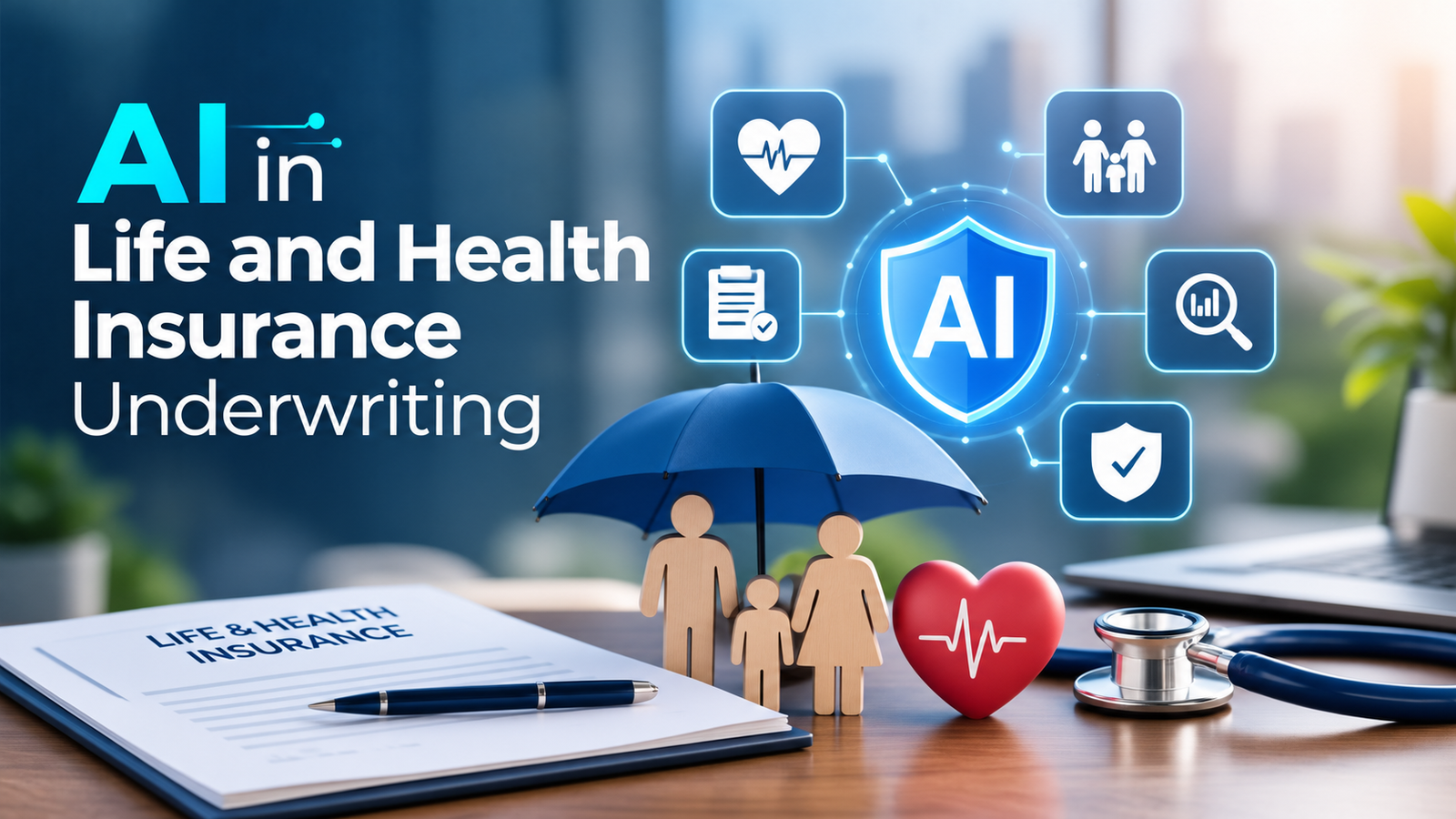
Primary topic: AI in Life and Health Insurance Underwriting
Research focus: Artificial intelligence, machine learning, predictive underwriting, accelerated underwriting, mortality prediction, health-risk assessment, medical data, external data, underwriting automation, explainable AI, fairness, governance, legacy modernization, and the future of life and health insurance
What Is AI in Life and Health Insurance Underwriting?
Life and health insurance underwriting is the process of assessing an applicant’s expected risk before coverage is issued. Depending on the product, insurers may evaluate age, medical history, diagnoses, medications, laboratory information, family history, occupation, lifestyle, previous insurance experience, claims information, and other permitted factors.
Traditional underwriting can require applicants to complete detailed questionnaires, provide medical records, undergo examinations, submit laboratory information, or wait while underwriters manually review evidence. AI introduces the ability to analyze these information sources at scale and identify patterns that may help an insurer determine whether a case can be processed automatically, requires additional evidence, or should be referred to an experienced underwriter.
The distinction between life and health insurance is important. Life underwriting is strongly concerned with mortality and longevity risk, while health insurance involves expected healthcare utilization, medical conditions, claims costs, risk adjustment, fraud, care patterns, and population-level expenditure. AI can support both, but the underlying objectives and regulatory environments are different.
The NAIC reports that life insurers are using AI to reduce policy issuance time, support approval or denial decisions, and assign underwriting risk classes. Health insurers report AI applications in risk adjustment, modeling, fraud detection, pricing and plan design, claims adjudication, data processing, and other activities.
Source: NAIC, Artificial Intelligence in Insurance
Why AI Matters in Life and Health Underwriting
Life and health underwriting are unusually data-intensive insurance functions. An insurer may have access to years of policy information, mortality experience, claims records, prescription data, medical evidence, demographic information, and other structured or unstructured records.
The opportunity for AI is therefore larger than simply making underwriting faster. Properly governed AI can help insurers connect information that was previously reviewed separately, identify cases that need human attention, and create more consistent decision-support processes.
AI can extract and organize information before an underwriter performs a detailed review.
Predictive systems can combine many approved information sources instead of relying on a small set of application fields.
AI can identify straightforward cases and route complex cases to specialists.
Models can apply the same analytical process across large volumes of applications.
Research Study: AI and Life Underwriting in Transition
One of the most relevant recent sources is the Society of Actuaries Research Institute’s July 2026 expert-panel report, AI and Life Underwriting in Transition. The panel brought together perspectives from underwriting, brokerage and distribution, technology and data, and reinsurance.
The report’s central message is important for insurers considering AI. The future of AI-enabled life underwriting depends on combining automation with judgment, speed with explainability, innovation with governance, and efficiency with trust. The report also emphasizes that AI value is already being realized, but that the value varies by carrier maturity, data readiness, workflow design, and how effectively underwriting teams use AI tools.
For organizations beginning their AI journey, the panel recommends starting with the underwriting problem and workflow rather than beginning with a particular technology. This is particularly useful advice because a technically impressive model can produce little business value if the surrounding underwriting process is poorly designed.
Original research: Society of Actuaries, AI and Life Underwriting in Transition, July 2026
Research Study: Machine Learning and Mortality Prediction
A 2025 systematic review and meta-analysis published in Scientific Reports examined machine learning models for predicting all-cause mortality. The research included 88 studies and found a pooled AUC of 0.831, with a 95% confidence interval of 0.797 to 0.865.
That result demonstrates the predictive potential of machine learning for a complex outcome directly relevant to life insurance. However, the researchers also found extreme heterogeneity between studies, with I² equal to 100%. Only 8% of the studies used external validation in another dataset, and fewer than 10% conducted equity-oriented subgroup analysis.
This is one of the most important findings for life insurers. A high pooled AUC does not mean that a mortality model can automatically be transferred from one population, country, product, or data environment to another. Local validation is essential because mortality relationships can vary by population, healthcare access, data quality, socioeconomic conditions, underwriting population, and time period.
Original research: Global Performance of Machine Learning Models to Predict All-Cause Mortality
Research findings at a glance
- 88 studies were included in the meta-analysis.
- Pooled AUC was 0.831.
- Between-study heterogeneity was extremely high.
- Only 8% of studies used external validation.
- Equity-oriented subgroup analysis was uncommon.
- Local validation remains essential before deployment.
Research Study: Accelerated Underwriting and Mortality Risk
Accelerated underwriting has become one of the most important practical applications of predictive analytics in life insurance. Instead of requiring every applicant to complete the full traditional underwriting process, an insurer may use application information, external data, predictive models, and automated rules to determine whether an applicant qualifies for a faster pathway.
The Society of Actuaries has studied accelerated underwriting for years. Its 2024 research on mortality slippage explains that accelerated underwriting programs have increasingly become a normal part of life insurance operations. At the same time, credible long-term mortality experience remains an important challenge because many programs only became widespread in 2017 and 2018.
Mortality slippage refers to additional mortality risk that may appear when accelerated underwriting does not collect the same evidence as traditional full underwriting. This makes ongoing monitoring particularly important. A program can appear successful because it issues policies faster, but the insurer must still determine whether the resulting risk pool performs as expected over time.
More medical evidence, longer processing, greater manual involvement.
More automated evidence gathering and predictive risk assessment.
Predictive models, NLP, external data, automation, and human review combined.
Research Study: Machine Learning for Health Insurance Risk Adjustment
A major study published in BMC Public Health evaluated machine learning for prospective health insurance risk adjustment using claims data from more than one million privately insured U.S. adults. The researchers compared traditional linear regression with gradient boosting and also examined the effect of adding ZIP-code-level social determinant indicators.
The machine learning model without social determinant indicators improved the coefficient of determination from 0.327 to 0.388, reduced mean absolute error from approximately $6,992 to $6,637, and increased the C-statistic from 0.703 to 0.717. The researchers estimated that the improvement reduced cost misestimation by about $3.5 million per 10,000 members.
The study also found that adding social determinant indicators reduced underestimation of costs in several vulnerable populations. This finding is useful but also raises an important governance issue. Additional data can improve prediction while simultaneously creating concerns about fairness, privacy, and the appropriate use of socioeconomic information.
| Model | R² | C-statistic | Mean absolute error |
|---|---|---|---|
| Linear regression | 0.327 | 0.703 | $6,992 |
| Gradient boosting | 0.388 | 0.717 | $6,637 |
Research Study: Predicting High-Risk Health Insurance Beneficiaries
A study published in 2024 investigated machine learning approaches for identifying high-risk beneficiaries in private health insurance. The researchers compared five algorithms, including random forest, extra trees, XGBoost, Naive Bayes, and k-nearest neighbors.
The k-nearest-neighbor model achieved a reported recall of 81.12%, precision of 83.77%, and AUC of 0.9045. An especially interesting finding was the timing of prediction: the system could identify individuals approximately 8.11 months before they entered a high-risk category in the study dataset.
For health insurers, the significance is broader than underwriting. Predictive systems can potentially help insurers understand expected future risk, identify members who require additional attention, and support financial planning. However, these applications must be carefully separated from clinical decision-making and governed according to the purpose for which the model was developed.
Original research: Identification of High-Risk Beneficiaries in Private Healthcare Insurance
Research Study: AI Applications in Health Insurance
A 2025 scoping review examined literature on AI applications in health insurance from 2000 through 2024. The review identified applications across risk management, financial management, fraud detection, monitoring, diagnostics, technical analysis, private insurance operations, and other areas.
The research demonstrates that AI in health insurance is not limited to premium calculation. It can become part of a broader risk-management architecture that connects underwriting or risk assessment with claims, fraud, utilization, and operational analytics.
Original research: Artificial Intelligence Applications in Health Insurances: A Scoping Review
Research Study: Machine Learning for Health Insurance Claim Costs
A 2026 retrospective predictive modeling study examined machine learning models for predicting health insurance claim costs among older adults in Indonesia. The research is useful because healthcare cost prediction is closely related to health insurance risk assessment.
The study demonstrates the growing ability of insurers and researchers to use machine learning for estimating future claim costs from healthcare and demographic information. At the same time, results from one country’s population should not be treated as universal underwriting performance. Health systems, treatment patterns, insurance structures, demographics, and medical costs vary substantially between markets.
Six Research Findings Compared
| Study | Evidence | Practical lesson |
|---|---|---|
| SOA AI Life Underwriting, 2026 | Expert panel across underwriting, distribution, technology, and reinsurance | Start with workflow and governance |
| Mortality ML meta-analysis, 2025 | 88 studies; pooled AUC 0.831 | Validate models locally |
| SOA accelerated underwriting research | Mortality slippage remains an important monitoring issue | Monitor accelerated programs over time |
| Health risk adjustment, 2020 | ML improved several prediction metrics | ML can improve cost-risk estimation |
| High-risk beneficiary study, 2024 | KNN AUC 0.9045 in tested dataset | Earlier risk identification is possible |
| Health insurance AI review, 2025 | AI applications span risk, fraud, finance, and operations | AI should be viewed as an enterprise capability |
Data Used by AI Underwriting Systems
The effectiveness of AI underwriting depends heavily on the quality and appropriateness of the data available to the insurer. More data is not automatically better data. The value of a variable depends on its predictive relationship with the insured risk, its reliability, its legal and regulatory status, and whether its use is appropriate for the insurance decision.
Applicant data
- Age
- Application responses
- Occupation
- Insurance history
Medical information
- Diagnoses
- Prescription history
- Laboratory results
- Medical records
Insurance data
- Claims history
- Policy history
- Persistency
- Previous underwriting
External signals
- Permitted public data
- Prescription databases
- Consumer data sources
- Other approved datasets
AI-Powered Life Insurance Underwriting Workflow
A modern life underwriting system can use AI at several stages. The important principle is that the system should distinguish between data extraction, prediction, recommendation, and the final underwriting decision.
↓
Identity + Data Validation
↓
Medical and External Data Retrieval
↓
NLP + Data Extraction
↓
Predictive Risk Models
↓
Risk Class Recommendation
↓
Confidence + Explainability Layer
↓
Automated Issue OR Underwriter Referral
↓
Policy Issuance
Accelerated Underwriting
Accelerated underwriting is one of the clearest examples of AI-supported life insurance transformation. The basic concept is simple: applicants who appear to meet defined low-risk criteria can potentially receive coverage without completing every traditional underwriting requirement.
The Society of Actuaries reported that accelerated underwriting programs were increasingly viewed as normal practice by 2024. However, the same research emphasizes that insurers must continue monitoring mortality because accelerated programs may have less mature experience than traditional underwriting.
NAIC regulatory guidance also recognizes the importance of external data, predictive models, and potential unfair discrimination in accelerated underwriting programs.
Source: NAIC, Accelerated Underwriting
AI for Medical Record Analysis
Medical records are difficult for traditional underwriting systems because they are often long, inconsistent, and written in different formats. Natural language processing can extract diagnoses, medications, procedures, dates, severity indicators, and other information from unstructured medical documents.
- Identify relevant diagnoses.
- Extract medication names and dates.
- Detect chronic conditions.
- Summarize hospitalization history.
- Identify missing medical evidence.
- Compare records against application answers.
- Prepare a concise case summary for the underwriter.
Generative AI can make this workflow more conversational by allowing underwriters to ask questions about a case. However, generative AI should not be allowed to invent medical facts or make unsupported conclusions. Every important output should be traceable to an underlying source document or structured data field.
AI for Mortality Risk Prediction
Mortality prediction is a natural application for machine learning because life insurers already maintain large historical datasets containing policyholder characteristics and mortality outcomes. AI can identify nonlinear relationships and interactions that may be difficult to represent through simple models.
For example, a model may detect interactions between age, medical conditions, medication patterns, historical underwriting information, and other permitted risk factors. The purpose is not simply to generate a more complicated score. The goal is to improve the insurer’s estimate of expected mortality while maintaining appropriate actuarial, regulatory, and governance controls.
Mortality prediction pipeline
Historical insured lives → Feature engineering → ML model → Mortality probability → Calibration → Risk class recommendation → Underwriter review → Experience monitoring
AI for Health Insurance Risk Assessment
Health insurance underwriting and risk assessment involve different questions from life insurance. Instead of focusing primarily on mortality, insurers may need to estimate expected healthcare costs, utilization, chronic disease burden, future claims, and population risk.
Machine learning can analyze longitudinal claims and healthcare information to estimate future risk. The research on high-risk beneficiaries and health insurance risk adjustment shows that models can identify patterns before individuals enter high-cost or high-risk categories in the observed data.
However, health insurance AI must be especially careful about the difference between predicting cost and deciding how a person should be treated. A model designed to estimate aggregate financial risk should not automatically be converted into a clinical decision system.
Generative AI as an Underwriting Copilot
Generative AI is likely to become one of the most visible AI tools used by underwriting teams. Unlike traditional predictive models, a large language model can interact directly with underwriting documents and natural-language questions.
- Summarize an application.
- Summarize medical evidence.
- Explain why a case was referred.
- Retrieve relevant underwriting guidelines.
- Compare current and previous applications.
- Generate questions for missing evidence.
- Draft underwriting notes.
- Organize evidence by condition.
- Search internal knowledge bases.
Swiss Re has described AI-enabled life and health predictive underwriting as a way to make underwriting more seamless within the customer journey. Its research emphasizes that traditional AI remains highly relevant even as generative AI attracts attention.
Source: Swiss Re, An Expanded Role for AI in Life & Health Predictive Underwriting
Expert quotation: Swiss Re describes AI-enabled predictive underwriting as a way to make underwriting “more seamlessly” integrated into the customer experience. The company’s broader AI approach emphasizes using technology to amplify expert judgment rather than simply removing human expertise.
AI and Underwriting Explainability
Explainability is especially important in life and health underwriting because decisions can affect access to insurance, premiums, coverage terms, and risk classification. If an AI system produces an unexpected result, the insurer should be able to determine which information contributed to that result and whether the model operated as intended.
Explainability does not necessarily mean revealing every mathematical detail of a neural network. For an underwriter, a useful explanation may be a clear list of the important factors, their direction of influence, the confidence of the prediction, the data sources used, and the reasons for referral.
Useful underwriting explanation
- Primary risk factors
- Relevant evidence
- Model confidence
- Data freshness
- Missing information
- Applicable underwriting rule
- Reason for referral
- Human override history
AI Bias and Fairness
Fairness is one of the most difficult challenges in life and health insurance AI. Historical insurance data may contain socioeconomic patterns, healthcare access differences, demographic differences, and other correlations that can influence model outputs.
A model can therefore be statistically accurate while still creating inappropriate outcomes for particular groups. This is why fairness testing must be performed at the population and subgroup level rather than relying only on overall model accuracy.
EIOPA has specifically highlighted concerns around AI in insurance, including the possibility that highly sophisticated risk segmentation could increase premiums or reduce access to insurance for higher-risk or vulnerable consumers. Its 2025 AI governance opinion identifies data governance, fairness, cybersecurity, explainability, record keeping, and human oversight as important considerations.
Source: EIOPA, Opinion on AI Governance and Risk Management
Regulation of AI in Life and Health Insurance
Life and health insurance underwriting requires particularly strong governance because AI can directly influence risk assessment and pricing decisions. In the European Union, EIOPA explains that AI systems used for risk assessment and pricing in life and health insurance are classified as high-risk under the EU AI Act.
This creates a stronger governance expectation around data quality, record keeping, human oversight, explainability, and risk management. EIOPA’s 2025 opinion also emphasizes a risk-based and proportionate approach rather than treating every AI application identically.
Source: EIOPA, Opinion on Artificial Intelligence Governance and Risk Management
In the United States, the NAIC Model Bulletin on the Use of Artificial Intelligence Systems by Insurers establishes expectations around governance and compliance. NAIC’s ongoing work also includes evaluation of third-party data and models used by insurers.
Source: NAIC, Artificial Intelligence in Insurance
AI Governance Framework
Validate sources, quality, permissions, lineage, and freshness.
Validate performance, calibration, explainability, and stability.
Test model outcomes across relevant populations and risk segments.
Define when an underwriter must review or override AI recommendations.
Keep records of model versions, data, decisions, overrides, and outcomes.
Model Drift and Mortality Slippage
AI underwriting cannot be considered complete when a model is deployed. Population health changes, medical technology changes, treatments improve, consumer behavior changes, application channels evolve, and underwriting strategies change.
For life insurance, mortality slippage is especially important in accelerated underwriting. For health insurance, the equivalent concern can involve changes in healthcare utilization, medical costs, claims behavior, provider patterns, or population composition.
| Problem | What changes? | Control |
|---|---|---|
| Data drift | Applicant or member population | Monitor distributions |
| Concept drift | Relationship between variables and risk | Retrain and validate |
| Mortality slippage | Actual mortality versus expected | Experience monitoring |
| Cost drift | Healthcare utilization and prices | Claims and cost monitoring |
Human-in-the-Loop Underwriting
For life and health insurance, human-in-the-loop AI is particularly important. The underwriter should remain able to question a recommendation, request additional evidence, override a model where appropriate, and document the reason for the decision.
↓
AI generates risk recommendation
↓
Confidence + explanation
↓
Simple case → automated pathway
Complex case → human underwriter
↓
Final decision + audit record
Life vs Health Insurance AI
| Area | Life insurance | Health insurance |
|---|---|---|
| Primary risk | Mortality and longevity | Healthcare utilization and cost |
| Major data | Medical evidence, mortality, applications | Claims, diagnoses, utilization, costs |
| AI use | Risk classification and accelerated underwriting | Risk adjustment and cost prediction |
| Key challenge | Mortality slippage and fairness | Cost prediction, fairness, and appropriate use |
AI Architecture for Life and Health Underwriting
A modern AI underwriting platform should separate data ingestion from model decisions. This creates a more manageable architecture for validation, auditing, security, and future model replacement.
↓
Medical / Claims / External Data Sources
↓
Data Integration + Quality Layer
↓
Feature Store / Risk Data Platform
↓
AI Models
Mortality • Cost • Risk Classification • NLP • Anomaly Detection
↓
Explainability + Fairness + Governance
↓
Underwriter / Actuary Workbench
↓
Decision + Policy Administration
↓
Experience Monitoring + Model Feedback
Legacy Modernization
Legacy systems are one of the biggest obstacles to insurance AI. Many insurers have policy administration systems that were designed long before modern machine learning, cloud data platforms, or generative AI existed.
Replacing a core insurance platform can take years and carries substantial operational risk. A more practical approach is often to introduce AI through an integration layer while keeping the existing policy administration platform as the system of record.
Digitize documents and centralize underwriting data.
Add NLP, automated extraction, and submission triage.
Introduce predictive risk scoring and accelerated underwriting.
Add generative AI copilots and continuous monitoring.
AI Risk Matrix
| Risk | Potential consequence | Recommended control |
|---|---|---|
| Biased historical data | Unfair model outcomes | Fairness testing and data review |
| Poor medical data | Incorrect risk assessment | Data quality and source validation |
| Model drift | Unexpected risk experience | Continuous performance monitoring |
| Opaque model | Poor explainability and governance | Explainability requirements |
| Overautomation | Complex cases handled incorrectly | Human referral thresholds |
| Third-party model risk | Limited visibility into model behavior | Vendor due diligence and audit rights |
Expert Recommendations for Insurers
The strongest recommendations from recent actuarial, regulatory, and industry research point toward a controlled and workflow-focused implementation strategy.
- Start with a specific underwriting problem. Choose a measurable bottleneck such as application triage, medical record extraction, or case summarization.
- Do not start with generative AI simply because it is popular. Traditional machine learning may be more appropriate for mortality, cost, or risk classification.
- Build a reliable data foundation. Model performance cannot compensate for poor data quality.
- Validate outside the training population. External validation is particularly important because mortality and healthcare relationships can change between populations.
- Monitor experience after deployment. Underwriting models should be compared continuously against actual mortality, claims, cost, and risk outcomes.
- Design human oversight from the beginning. Human review should be a deliberate part of the architecture rather than an emergency fallback.
- Document third-party data and models. Insurers should understand where external information comes from and how it affects decisions.
- Make fairness measurable. Do not rely on a general statement that an AI system is unbiased.
- Give underwriters useful explanations. A risk score without context is much less useful than a score supported by evidence and reasoning.
- Measure customer experience as well as cost savings. Faster underwriting can improve customer experience, but trust and transparency also matter.
High-Value AI Use Cases
| Use case | Potential value | Implementation difficulty |
|---|---|---|
| Application triage | High | Medium |
| Medical document extraction | Very high | High |
| Mortality prediction | Very high | Very high |
| Health cost prediction | Very high | Very high |
| Underwriter copilot | High | High |
| Risk-class recommendation | Very high | Very high |
Startup Opportunities in AI Life and Health Underwriting
The insurance AI market creates opportunities for startups that solve specific underwriting problems rather than attempting to replace the entire insurance platform.
- AI medical record summarization for underwriters
- Automated life insurance application triage
- Explainable mortality risk scoring
- Health insurance cost prediction APIs
- AI underwriting copilots
- Automated evidence requirement recommendations
- Prescription and medical-history intelligence
- Underwriting quality assurance platforms
- AI fairness monitoring for insurance models
- Model drift monitoring for mortality and health-risk models
- Third-party insurance data governance platforms
- AI audit and regulatory documentation tools
Future Predictions: 2027–2030
The following outlook is based on current research, actuarial work, regulatory developments, and insurer adoption patterns. These are forward-looking scenarios rather than guaranteed outcomes.
AI copilots become increasingly common for application review, medical evidence summarization, and underwriting research.
Accelerated underwriting becomes more data-driven as insurers improve experience monitoring and external-data integration.
Agentic workflows may coordinate document retrieval, evidence checks, model execution, and referral processes for selected products.
Continuous risk intelligence may become more important for selected insurance products, while complex decisions remain human-led.
Prediction: Underwriting Will Become More Continuous
Traditional underwriting is concentrated around the point of application. AI makes it technically possible to build a more continuous risk intelligence system that learns from policy experience, claims, new evidence, and changing population characteristics.
For life insurance, this does not necessarily mean continuously repricing an existing policy. It can instead mean continuously improving portfolio monitoring, mortality assumptions, underwriting rules, and future new-business decisions.
For health insurance, continuous intelligence may involve claims trends, utilization patterns, medical cost changes, and population risk changes. The exact use will depend heavily on product structure and applicable regulation.
Traditional approach
Application → Medical evidence → Underwriting → Policy issuance
AI-enabled approach
Application → Automated evidence analysis → Predictive risk → Human review → Policy issuance → Experience monitoring → Model improvement
Prediction: Generative AI Will Become the Interface, Not the Risk Model
Generative AI is likely to become the main interface through which underwriters interact with multiple insurance systems. However, the underlying mortality or health-risk prediction may continue to rely on specialized statistical and machine learning models.
This creates a layered architecture. The language model can retrieve information and explain results, while validated predictive models perform the numerical risk assessment. This separation can reduce the temptation to use a general-purpose language model for tasks that require highly controlled actuarial behavior.
Prediction: Governance Will Become a Competitive Capability
As AI becomes embedded deeper into underwriting, governance will move from a compliance activity to an operational capability. Insurers will need to know what models are running, what data they use, how they perform, how they change, and when they should be withdrawn or recalibrated.
Recent EIOPA and NAIC developments show that regulators are increasingly focused on governance, third-party models, data, fairness, explainability, human oversight, and risk management. This suggests that responsible AI infrastructure will become part of the core technology stack for large insurers.
What AI Should Not Do
AI should not become an unquestionable authority in life or health insurance underwriting. The more sensitive the decision, the stronger the requirement for validation, explainability, governance, and human accountability.
- Do not treat model predictions as medical diagnoses.
- Do not allow generative AI to invent missing medical evidence.
- Do not use external data simply because it improves statistical performance.
- Do not assume historical relationships will remain stable.
- Do not deploy mortality models without appropriate experience monitoring.
- Do not remove human review from unusual or high-impact cases without strong evidence.
- Do not evaluate fairness only at the overall portfolio level.
- Do not allow third-party models to operate without appropriate governance and validation.
Key KPIs for AI Underwriting
| KPI category | Example metrics |
|---|---|
| Speed | Application-to-decision time, manual processing time |
| Risk | Mortality experience, claims cost, risk-class accuracy |
| Model | AUC, calibration, precision, recall, drift |
| Operations | Referral rate, automation rate, manual touch rate |
| Governance | Fairness metrics, overrides, audit findings |
| Customer | Decision time, application completion, satisfaction |
Final Perspective
AI is becoming a major technology layer for life and health insurance underwriting. Research demonstrates that machine learning can improve prediction in mortality and health-risk applications, while industry experience shows that AI can support accelerated underwriting, application triage, data extraction, and underwriting decision support.
The evidence also shows why AI should not be deployed as a simple replacement for traditional underwriting. Mortality prediction research demonstrates substantial heterogeneity between studies. Accelerated underwriting research highlights the importance of monitoring mortality slippage. Health insurance research shows that machine learning can improve risk prediction while also raising questions about socioeconomic data and fairness.
The practical future is therefore likely to be AI-augmented underwriting. Underwriters will have faster access to organized evidence, predictive risk signals, automated summaries, and decision-support recommendations. Actuaries will increasingly work with machine learning alongside traditional actuarial techniques. Technology teams will manage data pipelines, model monitoring, explainability, and integration. Governance teams will ensure that the systems remain fair, secure, auditable, and compliant.
The insurers that benefit most from AI will not necessarily be those with the most complex models. The more important advantage will come from connecting reliable data, validated models, modern workflows, experienced professionals, and strong governance into one underwriting system.
Frequently Asked Questions
What is AI in life insurance underwriting?
AI in life insurance underwriting refers to the use of machine learning, predictive analytics, natural language processing, automation, and related technologies to analyze applicant information and support mortality risk classification and underwriting decisions.
How does AI improve life insurance underwriting?
AI can process large amounts of application, medical, prescription, claims, and other permitted data more quickly. It can support application triage, accelerated underwriting, risk classification, medical-record summarization, and underwriting decision support.
What is accelerated underwriting?
Accelerated underwriting is an approach in which selected life insurance applicants can receive coverage through a faster underwriting pathway without completing every traditional underwriting requirement. Predictive models and external data can be used to determine which applicants qualify for that pathway.
How is AI used in health insurance?
AI can support health insurance risk adjustment, cost prediction, fraud detection, claims analysis, utilization forecasting, population risk assessment, and other operational functions.
Can AI replace life insurance underwriters?
AI can automate parts of underwriting, particularly repetitive data analysis and standardized cases. Complex cases, exceptions, uncertain predictions, and governance-sensitive decisions still require appropriate human oversight.
What are the biggest risks of AI underwriting?
Major risks include biased data, inappropriate external variables, privacy concerns, model drift, poor explainability, cybersecurity issues, third-party model risk, mortality slippage, and excessive automation.
Why is explainability important in life and health insurance?
Insurance decisions can affect access to coverage, risk classification, and pricing. Explainability helps underwriters, insurers, regulators, and other stakeholders understand how an AI system reached a recommendation and whether the system is operating as intended.
What will AI underwriting look like by 2030?
A likely direction is AI-assisted underwriting with automated evidence analysis, predictive risk models, generative AI copilots, accelerated underwriting, continuous experience monitoring, and stronger governance. The exact level of automation will vary by product, jurisdiction, insurer, and risk complexity.
Original Research and Industry Sources
- Society of Actuaries: AI and Life Underwriting in Transition, 2026
- Scientific Reports: Global Performance of Machine Learning Models to Predict All-Cause Mortality, 2025
- Society of Actuaries: Accelerated Underwriting, Mortality Slippage Study and Monitoring Best Practices
- BMC Public Health: Machine Learning and Social Determinants in Health Insurance Risk Adjustment
- Identification of High-Risk Beneficiaries in Private Healthcare Insurance
- Artificial Intelligence Applications in Health Insurances: A Scoping Review
- Machine Learning Models to Predict Health Insurance Claim Costs Among Older Indonesians
- SOA: Predictive Analytics and Accelerated Underwriting Survey Report
- SOA: Company Practice Survey of Individual Life Insurance Accelerated Underwriting
- NAIC: Artificial Intelligence in Insurance
- NAIC: Accelerated Underwriting
- EIOPA: Opinion on AI Governance and Risk Management
- EIOPA: Opinion on Artificial Intelligence Governance and Risk Management
- Swiss Re: An Expanded Role for AI in Life & Health Predictive Underwriting
- Swiss Re: AI at Swiss Re
Leave a Reply