
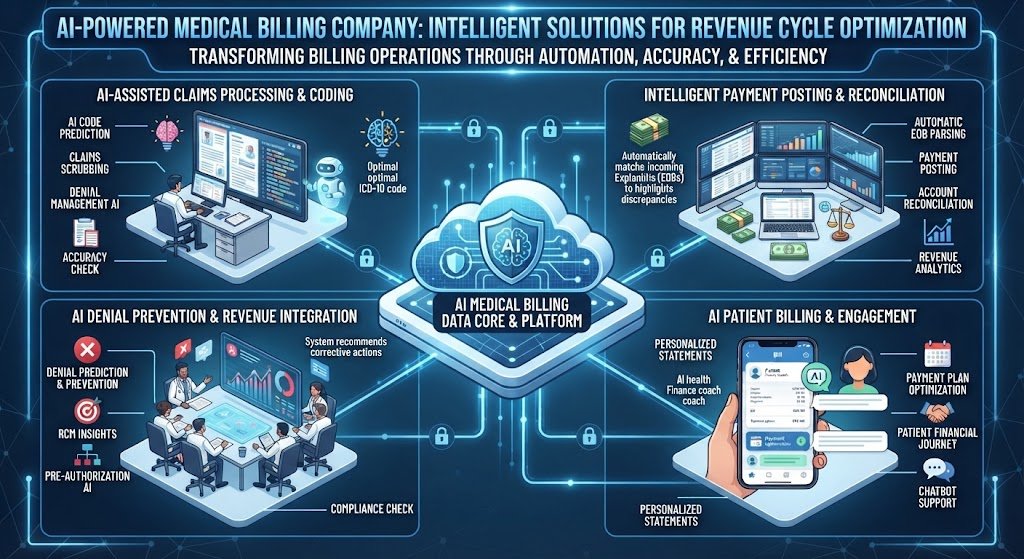
Primary topic: Artificial Intelligence in Medical Billing
Research focus: AI-powered medical coding, claims processing, denial prevention, eligibility verification, prior authorization, payment posting, fraud detection, RCM automation, legacy modernization, governance, and healthcare startup opportunities
Why AI in Medical Billing Matters Now
Medical billing is one of the most data-heavy administrative functions in healthcare. A single patient encounter can create clinical notes, diagnosis information, procedure documentation, insurance eligibility data, authorization requirements, claim forms, supporting documents, remittance information, payment records, denial codes, and appeal documentation.
Traditionally, much of this information has moved through disconnected systems and manual workflows.
Billing staff may need to review documentation, select codes, check payer requirements, submit claims, monitor claim status, investigate denials, communicate with insurance companies, post payments, and reconcile accounts.
AI can connect these steps into a more intelligent workflow.
Manual data entry → Rules-based automation → AI-assisted decisions → Predictive RCM → Intelligent revenue cycle
The goal is not simply to remove humans. The goal is to move humans toward exceptions, judgment, compliance, and complex cases.
The financial opportunity is already measurable. The 2024 CAQH Index tracked approximately $90 billion in healthcare administrative spending and identified another $20 billion annual savings opportunity from greater automation. The newer 2025 CAQH Index reported an estimated $258 billion in administrative costs avoided in 2024 through electronic transactions and improved data exchange, with approximately $21 billion in additional savings still available.
Source: CAQH 2024 Index Report
Source: 2025 CAQH Index announcement
The Medical Billing Revenue Cycle
AI becomes more useful when medical billing is viewed as an end-to-end revenue cycle instead of a single claims-submission task.
| Stage | Traditional problem | AI opportunity |
|---|---|---|
| Patient registration | Manual data entry | Intelligent data extraction and validation |
| Eligibility | Manual verification | Automated eligibility checks and exception detection |
| Clinical documentation | Manual review | NLP-based information extraction |
| Coding | Manual code assignment | AI-assisted ICD and procedure coding |
| Claim creation | Rule checking | Predictive claim validation |
| Denial management | Reactive investigation | Denial prediction and prevention |
| Accounts receivable | Manual prioritization | Predictive work queues |
| Payment posting | Manual reconciliation | Automated remittance interpretation |
Research Evidence: AI Is Moving Into Administrative Healthcare
The 2025 CAQH Index provides one of the clearest indicators that AI is moving beyond experimentation. According to CAQH, more than 50% of health plans and 25% of provider organizations were using AI tools in administrative workflows. The same report identified a remaining $21 billion savings opportunity through full automation of manual and partially manual transactions.
| Indicator | Reported finding |
|---|---|
| Administrative costs avoided in 2024 | $258 billion |
| Remaining savings opportunity | $21 billion |
| Health plans using AI in administrative workflows | More than 50% |
| Provider organizations using AI in administrative workflows | 25% |
| Organizations represented | 600+ provider organizations and health plans |
Source: CAQH 2025 Index findings
AI-Powered Medical Coding
Medical coding is one of the most important areas for AI because clinical documentation is usually written in natural language while reimbursement depends on standardized codes.
Coders may need to interpret diagnoses, procedures, conditions, complications, documentation details, and payer-specific requirements.
Modern NLP systems can analyze clinical notes and identify candidate ICD codes and other billing-related information.
A 2025 systematic review examined AI-based automated ICD coding and described AI as a promising approach for improving coding efficiency and accuracy while also identifying challenges that still require research and validation.
A newer systematic literature review published in 2026 analyzed 54 studies selected from 4,280 initial citations covering automated ICD coding research from 2019 through 2024. It found a clear evolution from traditional machine learning toward deep learning, transformer-based approaches, and hybrid architectures.
Source: AI-based Automated ICD Coding: A Systematic Review
Source: Recent Advances in AI for Automated ICD Coding
The safest production model is not “AI chooses every code without supervision.”
A better architecture is:
- AI extracts relevant clinical information.
- AI recommends one or more codes.
- The system explains why each code was recommended.
- Low-confidence cases are routed to professional coders.
- High-confidence repetitive cases can move through automated workflows according to organizational policy.
- Every decision remains auditable.
AI for Claims Creation and Pre-Submission Validation
Many billing problems can be identified before a claim reaches the payer.
AI can examine the combination of patient information, clinical documentation, codes, payer rules, previous claims, authorization data, and required attachments.
The system can then generate a pre-submission risk score.
| Signal | AI question |
|---|---|
| Eligibility | Is coverage active? |
| Coding | Does documentation support the proposed codes? |
| Authorization | Was required authorization obtained? |
| Payer policy | Does the claim match known payer requirements? |
| Attachments | Are required supporting documents available? |
| Historical pattern | Does this claim resemble previously denied claims? |
This changes denial management from a reactive process into a preventive process.
AI for Denial Prediction
Denials are one of the strongest AI use cases in medical billing.
Instead of waiting for a payer to reject a claim, an AI system can estimate the probability of denial before submission.
The model can learn from historical claims, payer behavior, diagnosis and procedure combinations, authorization records, documentation patterns, eligibility data, denial codes, appeal outcomes, and payment history.
A 2025 systematic review of predictive revenue-cycle analytics found growing research around machine learning and graph-based approaches for claims denial prediction, fraud detection, and multi-source data integration. The review concluded that AI can shift RCM from reactive management toward predictive optimization, while also highlighting concerns around data quality, privacy, bias, and workforce readiness.
Source: Predictive Revenue Cycle Analytics Using AI-Driven Claims Optimization
Why Denial Prevention Is More Valuable Than Denial Recovery
A traditional billing department often spends substantial effort after a claim has already failed.
That means staff must understand the denial, locate missing information, correct the claim, contact the payer, submit documentation, or prepare an appeal.
AI can move much of this work upstream.
- Identify claims with high denial probability.
- Predict the likely denial reason.
- Identify missing documentation.
- Check authorization status.
- Flag potential coding inconsistencies.
- Recommend corrective actions.
- Prioritize claims based on financial value and denial probability.
- Learn from previous appeal outcomes.
The best system therefore does not measure success only by the number of denials successfully appealed.
It measures how many preventable denials never happen.
AI and Prior Authorization
Prior authorization is closely connected to medical billing because missing or incorrect authorization can result in delayed services, administrative work, and payment problems.
The burden remains substantial. In the AMA’s 2024 survey, physicians reported an average of 43 prior authorization requests per physician per week. They and their staff spent approximately 12 hours each week completing these requests. Ninety-four percent said prior authorization delays access to necessary care, 93% reported a negative impact on clinical outcomes, and 78% reported that patients sometimes or often abandon treatment because of authorization problems.
Source: AMA Prior Authorization Survey
AI can reduce some of this administrative workload by automatically collecting relevant clinical documentation, identifying payer requirements, checking whether required information is present, generating structured authorization packets, tracking responses, and escalating exceptions.
Regulation is also pushing payer-provider workflows toward better digital interoperability. CMS requires impacted payers to implement a Prior Authorization API that can communicate covered services, documentation requirements, requests and responses, approvals, denials, and specific denial reasons, with implementation beginning primarily in 2027.
Source: CMS Interoperability and Prior Authorization Final Rule
AI and Claims Attachments
Claims frequently require supporting documentation.
Historically, supporting information could involve manual document collection, faxing, scanning, uploading, or payer-specific processes.
That creates another opportunity for AI.
CMS finalized the first-ever HIPAA-adopted standards for healthcare claims attachments in March 2026. The rule supports secure electronic exchange of claims-related clinical documentation including medical records, imaging, clinical notes, telemedicine documentation, and laboratory results.
Source: CMS Claims Attachments Final Rule
AI can operate on top of this digital infrastructure by determining which documents are relevant, extracting required information, identifying missing evidence, matching documents to claims, and routing exceptions.
AI for Accounts Receivable
Accounts receivable is another area where predictive AI can create significant value.
A billing organization may have thousands of outstanding claims. Treating every account equally is inefficient.
AI can classify accounts according to:
- Probability of payment.
- Expected payment value.
- Probability of denial.
- Age of the account.
- Payer behavior.
- Historical payment patterns.
- Likelihood that additional documentation will change the outcome.
- Probability that an appeal will succeed.
High-value + High-probability recovery → Priority 1
High-value + Medium recovery probability → Priority 2
Low-value + Low recovery probability → Automated/low-touch workflow
Complex/high-risk account → Human specialist
This approach allows billing teams to focus their limited time where the expected financial return is highest.
AI for Payment Posting and Remittance Processing
After a payer processes a claim, billing teams must understand the remittance information and update financial records.
This process can involve large volumes of structured and unstructured information.
AI can help interpret remittance advice, match payments to claims, identify underpayments, detect unexpected adjustments, and route unusual transactions to staff.
Generative AI can also provide a natural-language explanation of why a payment differs from the expected amount.
The objective is not simply faster posting.
The larger opportunity is finding revenue leakage that may remain hidden inside high-volume payment transactions.
AI for Underpayment Detection
Medical billing systems often focus heavily on denials, but a claim that is paid incorrectly can also represent lost revenue.
AI can compare expected reimbursement with actual payment patterns and identify unusual differences.
Potential signals include:
- Unexpected contractual adjustments.
- Incorrect payment amounts.
- Unusual payer behavior.
- Repeated underpayment patterns.
- Missing line-item payments.
- Unexpected bundling or adjustment patterns.
- Contract interpretation inconsistencies.
Over time, the system can create payer-specific financial intelligence.
AI for Fraud, Waste and Abuse Detection
Medical billing contains another major AI opportunity: detecting suspicious behavior.
Machine learning can examine large volumes of claims and identify patterns that are difficult to detect manually.
A 2025 systematic review of machine learning for healthcare claims fraud detection analyzed the research landscape and found that provider fraud was the most common focus, followed by patient-related fraud. The review also highlighted persistent challenges involving inconsistent data, limited standardized integration, privacy, and the scarcity of labeled fraud cases.
Source: Fraud Detection in Healthcare Claims Using Machine Learning: A Systematic Review
- Unusual billing frequency.
- Unexpected procedure combinations.
- Provider behavior that differs substantially from peers.
- Repeated high-cost claims.
- Unusual patient-provider relationships.
- Duplicate or near-duplicate claims.
- Impossible or inconsistent timelines.
- Rapid changes in billing patterns.
AI should flag suspicious cases rather than automatically accuse a provider or patient of fraud.
Final investigations require appropriate human review, evidence, due process, and organizational controls.
Generative AI for Medical Billing Teams
Traditional predictive AI is useful for scoring and classification.
Generative AI adds another layer: it can interact with billing staff using natural language.
A billing specialist could ask:
- “Why was this claim denied?”
- “What information is missing?”
- “Show me similar claims from this payer.”
- “Which claims over $10,000 have a high denial probability?”
- “Summarize this patient’s billing history.”
- “What documents are required for this appeal?”
- “Draft an appeal using the approved documentation.”
The AI assistant can retrieve information from the organization’s billing system, payer rules, claim history, documentation, and approved knowledge sources.
This creates a billing copilot rather than another dashboard.
AI-Powered Denial Appeal Assistance
Denial appeals often require staff to gather records, understand the denial reason, identify supporting documentation, and construct a response.
Generative AI can assist with the administrative portion.
The most important part is the final human review.
AI-generated appeal language should not be treated as automatically correct. The system should show the evidence used, identify uncertainty, preserve source references, and maintain an audit trail.
AI and Patient Financial Experience
Medical billing is not only an organizational finance problem.
Patients also experience confusing bills, insurance adjustments, unexpected balances, payment requests, and explanations of benefits.
Generative AI can help create patient-friendly explanations.
For example, instead of showing a complex billing adjustment, the system could explain:
- What service was billed.
- What the insurance plan paid.
- What amount was adjusted.
- What the patient may owe.
- Why the balance exists.
- Which questions should be directed to the provider or insurer.
This can reduce confusion while giving patients a clearer understanding of their financial responsibility.
AI and Eligibility Verification
Eligibility verification is one of the earliest points where billing problems can be prevented.
AI can combine eligibility responses with patient records, historical claims, payer information, and scheduling data to identify potential problems before services are delivered.
Appointment → Coverage Check → Benefits Interpretation → Potential Restriction Detection → Staff Alert → Patient Communication
This is especially valuable when payer rules are complex or when a patient has multiple coverage relationships.
AI and Medical Billing Data Quality
AI cannot compensate indefinitely for poor data.
If a billing platform contains duplicate patient records, inconsistent provider information, incomplete payer data, outdated insurance information, or poorly structured clinical documentation, AI predictions may become unreliable.
Therefore, data quality should be treated as a core AI project rather than a secondary technical task.
| Data problem | Potential AI impact | Recommended response |
|---|---|---|
| Duplicate records | Incorrect predictions | Master data management |
| Missing claims data | Incomplete models | Data validation |
| Inconsistent coding | Bad training signals | Coding quality controls |
| Payer rule changes | Model drift | Continuous monitoring |
AI Architecture for Medical Billing
A production-grade AI billing platform should not be a single chatbot connected directly to the billing database.
A stronger architecture separates data ingestion, business rules, AI models, workflow automation, human review, and audit controls.
↓
Data Integration Layer + FHIR / Transaction Interfaces
↓
Clinical NLP + Coding Models + Predictive Models + Document AI
↓
Rules Engine + AI Decision Layer + Confidence Scoring
↓
Workflow Automation + Human Review Queue
↓
Claims + Appeals + Payment Posting + A/R + Analytics
↓
Audit Logs + Governance + Monitoring + Security
FHIR and Interoperability Are Becoming More Important
AI billing systems need reliable access to data.
That makes interoperability a foundational technology rather than an optional feature.
CMS has been expanding API requirements for certain payers. The CMS interoperability framework includes Patient Access, Provider Access, Payer-to-Payer, and Prior Authorization APIs. The Provider Access API includes claims and encounter information and specified prior authorization information, while the Payer-to-Payer API supports continuity of data when patients change plans.
Source: CMS APIs and Interoperability Standards
For AI billing startups, this creates an important strategic lesson.
The winning product may not be another standalone billing dashboard.
It may be an intelligence layer that sits between existing EHR, practice management, clearinghouse, payer, and financial systems.
Legacy Medical Billing Modernization
Many healthcare organizations cannot replace their entire billing infrastructure.
They may depend on older practice-management software, custom databases, clearinghouse integrations, fax-based workflows, and manually maintained payer rules.
AI modernization should therefore be incremental.
↓
API / Integration Layer
↓
Data Normalization
↓
Rules Automation
↓
Predictive AI
↓
Generative AI Assistant
↓
Human-in-the-Loop Autonomous Workflows
This approach reduces implementation risk because organizations can modernize individual workflows without immediately replacing the core system.
AI Maturity Ladder for Medical Billing
| Level | Capability | Example |
|---|---|---|
| Level 1 | Manual | Human enters and reviews everything |
| Level 2 | Rule automation | Eligibility and workflow automation |
| Level 3 | AI assistance | Coding recommendations and denial prediction |
| Level 4 | Predictive RCM | A/R prioritization and revenue leakage detection |
| Level 5 | Intelligent automation | AI handles routine cases and routes exceptions |
| Level 6 | Continuous optimization | Models continuously learn from outcomes under governance |
High-Value AI Use Cases
| Use case | Potential value | AI type |
|---|---|---|
| Coding assistance | High | NLP / LLM |
| Denial prediction | Very high | Machine learning |
| Eligibility automation | High | Automation + AI |
| A/R prioritization | Very high | Predictive analytics |
| Payment variance detection | High | ML + rules |
| Appeal assistance | High | Generative AI |
| Fraud detection | Very high | ML / graph analytics |
| Patient billing assistant | Medium-high | Generative AI |
High-Risk AI Use Cases
Not every billing decision should be automated.
High-risk situations include decisions that could materially affect patient access, payment, coverage, or professional accountability.
- Automatically denying medically related claims without human review.
- Automatically accusing providers of fraud.
- Automatically changing clinically significant codes without oversight.
- Generating unsupported documentation.
- Making authorization decisions without appropriate controls.
- Using patient data with an unapproved AI provider.
- Allowing an LLM to access unrestricted billing and clinical databases.
The appropriate approach is risk-based automation.
Human-in-the-Loop Is Essential
AI should handle routine, predictable, high-volume work.
Humans should handle uncertainty, exceptions, disputes, compliance questions, complex coding, and decisions that require professional judgment.
High confidence + low risk → Automated workflow
Medium confidence → AI recommendation + human approval
Low confidence → Specialist review
High risk → Mandatory human decision
This model is more realistic than trying to make billing completely autonomous.
Privacy and HIPAA Requirements
Medical billing involves protected health information.
Billing companies, healthcare providers, clearinghouses, and technology vendors may become HIPAA-regulated entities or business associates depending on their activities.
HHS explicitly lists claims processing or administration, billing, data analysis, and practice management among activities that can make an organization a business associate when performed for a covered entity and involving protected health information.
Source: HHS Business Associate Guidance
Healthcare organizations must also implement appropriate administrative, physical, and technical safeguards for electronic protected health information.
Source: HHS HIPAA Security Rule
Can AI Medical Billing Use the Cloud?
Yes, but healthcare organizations must design the environment correctly.
HHS states that covered entities and business associates may use cloud services to store or process ePHI when the appropriate HIPAA-compliant business associate agreement is in place and applicable HIPAA requirements are satisfied.
Source: HHS Cloud Computing and ePHI
For an AI billing platform, security should therefore include:
- Encryption in transit and at rest.
- Role-based access control.
- Strong authentication.
- Audit logging.
- Data minimization.
- Tenant isolation.
- Business associate agreements where required.
- Secure model and API architecture.
- Prompt and output monitoring.
- Incident response procedures.
- Data retention controls.
- Regular risk assessments.
AI Model Governance
A medical billing AI system should be monitored after deployment.
A model that performs well today may become less accurate when payer policies change, coding standards change, documentation patterns change, or new services enter the healthcare system.
| Governance area | What to monitor |
|---|---|
| Accuracy | Correct recommendations and classifications |
| Drift | Performance changes over time |
| Bias | Different outcomes across populations or provider groups |
| Explainability | Ability to understand important decisions |
| Security | Unauthorized access and data leakage |
| Human override | Ability to correct AI decisions |
AI Medical Billing Startup Opportunities
The strongest startup opportunities are not necessarily another complete electronic health record.
Focused AI infrastructure can solve specific revenue-cycle problems much faster.
- AI Denial Prevention Platform: predicts claim denials before submission.
- AI Coding Copilot: extracts clinical information and recommends codes.
- AI Claims Auditor: identifies billing errors before submission.
- AI Prior Authorization Agent: prepares and tracks authorization workflows.
- AI A/R Prioritization: tells billing teams which accounts deserve attention first.
- AI Payment Variance Engine: detects underpayments and unexpected adjustments.
- AI Appeal Assistant: creates evidence-linked appeal drafts.
- AI Patient Billing Assistant: explains complex bills in simple language.
- AI Fraud Detection: identifies unusual provider and claim patterns.
- AI Revenue Leakage Platform: finds missed reimbursement opportunities.
- AI Payer Intelligence: learns payer-specific claim and denial patterns.
- AI Medical Billing Quality Platform: continuously audits coding and claims workflows.
Best AI Product Strategy for a Healthcare Startup
A startup should avoid trying to automate the entire revenue cycle on day one.
A better strategy is to select one high-volume, measurable problem.
↓
Connect to existing billing/EHR data
↓
Build rules and data-quality layer
↓
Add predictive AI
↓
Add human review
↓
Measure financial outcomes
↓
Add generative AI interface
↓
Expand into adjacent RCM workflows
Denial prevention is particularly attractive because the business value can be measured directly through denial rate, recovered revenue, clean claim rate, days in A/R, and staff productivity.
ROI Framework for AI Medical Billing
Healthcare organizations should not evaluate AI only by model accuracy.
The financial impact matters more.
| Metric | Why it matters |
|---|---|
| Clean claim rate | Shows pre-submission quality |
| Denial rate | Shows claim rejection performance |
| Days in A/R | Measures cash-flow efficiency |
| First-pass resolution | Shows how often work is resolved without rework |
| Coder productivity | Measures workload efficiency |
| Recovered revenue | Direct financial impact |
| Cost per claim | Measures operational efficiency |
| Appeal success rate | Measures denial recovery effectiveness |
AI Medical Billing Implementation Plan
Phase 1: Data and workflow audit
- Map the complete revenue cycle.
- Identify manual steps.
- Identify the highest-volume tasks.
- Measure denial patterns.
- Review available historical claims data.
- Identify integration constraints.
Phase 2: Select a focused AI use case
Start with a measurable problem such as denial prediction, coding assistance, eligibility verification, or A/R prioritization.
Phase 3: Build the data foundation
Normalize claims, payer, clinical, financial, and workflow data.
Phase 4: Add AI with human review
Deploy recommendations before allowing automation.
Phase 5: Measure outcomes
Compare performance before and after implementation.
Phase 6: Expand automation
Automate high-confidence, low-risk workflows while keeping complex decisions under human control.
What the Future of Medical Billing Looks Like
The future is unlikely to be a billing office where every task is performed by a completely autonomous AI agent.
A more realistic future is an intelligent revenue-cycle operating layer.
↓
Real-Time Eligibility + Authorization Intelligence
↓
AI-Assisted Documentation + Coding
↓
Predictive Claim Validation
↓
Automated Claim Submission
↓
AI Denial Prevention
↓
Intelligent Payment Posting
↓
Predictive A/R + Revenue Leakage Detection
↓
Human Exception Management
↓
Continuous Learning and Governance
2027–2030 Outlook
AI-assisted coding will become normal. The focus will move from whether AI can recommend codes to how accurately it can explain recommendations and integrate them into compliant workflows.
Denial prevention will become more predictive. Organizations will increasingly want to know why a claim may fail before sending it to the payer.
Prior authorization will become more API-driven. CMS interoperability requirements are creating infrastructure for more standardized payer-provider exchange.
Claims attachments will become more digital. CMS’s 2026 claims attachment rule creates a stronger foundation for electronic exchange of supporting documentation.
Generative AI will become the interface layer. Billing staff will increasingly ask questions in natural language instead of manually searching multiple systems.
AI governance will become a competitive requirement. Healthcare organizations will need to prove how models are validated, monitored, secured, and overridden.
Revenue-cycle platforms will become more proactive. The system will increasingly identify financial problems before they become denials, delayed payments, or lost revenue.
Final Research Takeaway
AI in medical billing is much larger than automated coding.
The strongest transformation is happening across the complete revenue cycle.
- AI can read and structure clinical documentation.
- AI can recommend billing codes.
- AI can identify missing information.
- AI can predict denial risk.
- AI can support prior authorization.
- AI can organize claims attachments.
- AI can prioritize accounts receivable.
- AI can detect payment anomalies.
- AI can identify suspicious claims.
- AI can assist with appeals.
- Generative AI can become a billing team’s knowledge interface.
The business case is becoming stronger as healthcare administration becomes increasingly digital. CAQH reported that more than half of health plans and one-quarter of provider organizations were already using AI tools in administrative workflows, while approximately $21 billion in additional savings remained available through further automation.
The biggest opportunity for healthcare organizations is therefore not simply replacing billing employees with AI.
It is redesigning the revenue cycle so that machines handle repetitive information processing, predictive systems identify problems early, and experienced professionals focus on exceptions, judgment, compliance, and complex financial decisions.
For healthcare startups, this creates a large product opportunity around AI-powered denial prevention, coding intelligence, claims auditing, prior authorization, payment intelligence, A/R optimization, fraud detection, and revenue leakage prevention.
For existing healthcare organizations, the most practical path is incremental modernization: connect existing systems, improve data quality, automate repetitive workflows, introduce predictive AI, keep humans in control of high-risk decisions, and measure financial outcomes continuously.
The future medical billing system will not simply process claims faster.
It will increasingly predict what is likely to go wrong, explain why it may happen, recommend the next action, and automatically complete low-risk work.
Original Research Sources
- CAQH 2024 Index Report
- CAQH 2025 Index Findings
- AI-based Automated ICD Coding: A Systematic Review
- Recent Advances in AI for Automated ICD Coding
- Fraud Detection in Healthcare Claims Using Machine Learning
- Predictive Revenue Cycle Analytics Using AI-Driven Claims Optimization
- AMA Prior Authorization Survey
- CMS Interoperability and Prior Authorization Final Rule
- CMS Claims Attachments Final Rule
- CMS APIs and Interoperability Standards
- HHS Business Associate Guidance
- HHS HIPAA Security Rule
- HHS Cloud Computing and ePHI
Leave a Reply