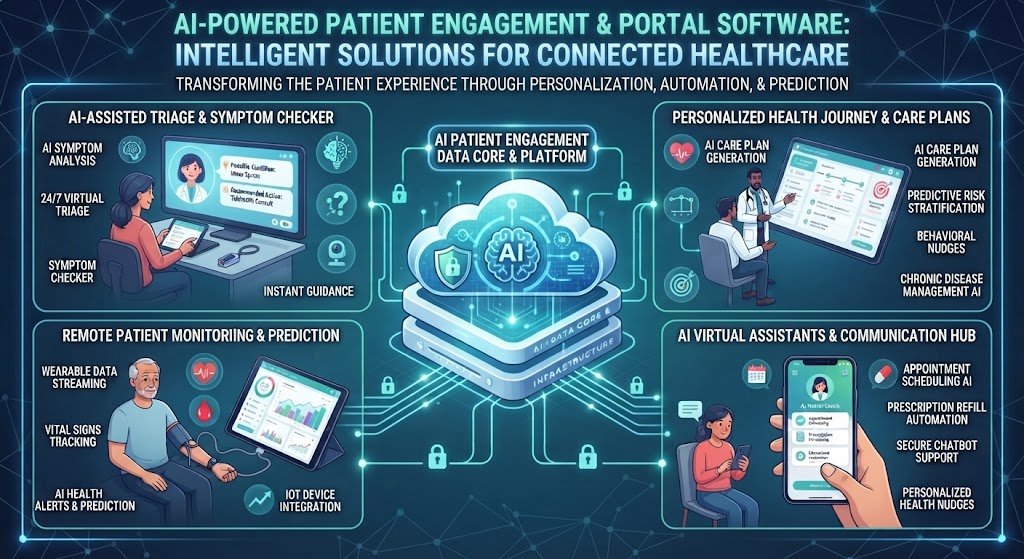
Primary topic: Artificial Intelligence in Patient Engagement & Portal Software
Research focus: AI-powered patient portals, generative AI, conversational AI, patient-provider messaging, clinical communication, personalized health information, patient education, digital navigation, predictive engagement, interoperability, workflow automation, accessibility, privacy, and the future of patient-centered digital healthcare.
AI in Patient Engagement & Portal Software
Patient portals have become an important part of modern healthcare delivery. They give patients access to medical records, laboratory results, clinical notes, appointments, medication information, secure messages, forms, and other digital services.
The role of the portal is now expanding.
Instead of simply allowing patients to view information, healthcare organizations are increasingly exploring ways to make digital interactions more intelligent, personalized, and useful.
Artificial intelligence can provide the intelligence layer behind this transformation.
A conventional patient portal mainly responds to user actions. A patient clicks a menu, opens a laboratory result, searches for an appointment, or sends a message.
An AI-enabled portal can understand what the patient is trying to accomplish and help guide the interaction.
For example, a patient may open a laboratory report containing unfamiliar medical terminology. Instead of forcing the patient to search the internet, the portal could provide a plain-language explanation based on approved information and the patient’s clinical context.
A patient could also ask why a follow-up appointment was recommended.
The AI system could explain the documented reason in simple language while directing the patient to contact the care team when clarification is needed.
This creates a fundamental change in portal design.
The portal becomes less like a digital filing cabinet and more like an intelligent patient-access layer connected to the healthcare system.
The opportunity is significant because portal adoption has already reached a high level in many healthcare environments.
According to the U.S. Office of the National Coordinator for Health Information Technology, 99% of U.S. hospitals enabled patients to electronically view health information in 2024, while 92% enabled secure messaging with providers. The same data show that 95% enabled patients to view clinical notes and 96% enabled downloading of health information.
This means the next challenge is not simply providing digital access.
The challenge is making that access more useful.
Our Key Findings
Our research across patient portals, AI-assisted communication, conversational agents, health information access, and digital patient engagement identifies several important findings.
AI is moving patient portals from access toward assistance
Traditional portals mainly provide access to information.
AI can help patients understand, organize, and act on that information.
The difference is important.
A portal may show a laboratory result.
An AI layer can explain the terminology, identify the relevant section of the report, summarize the result in plain language, and direct the patient toward an appropriate next step.
The system still needs appropriate safeguards, but the interaction becomes more useful.
Patient messaging is one of the strongest immediate AI opportunities
Secure messaging has become an important communication channel between patients and healthcare professionals.
However, increasing message volume creates additional work for physicians, nurses, and other clinical staff.
Research published in 2025 found that generative AI could produce patient portal message drafts with comparable ratings to real physician responses for several measures, while scoring higher on empathy and readability in that particular study. The researchers emphasized the need for additional workflow and patient-focused evaluation.
This makes message drafting one of the most practical applications for Generative AI in patient portals.
AI can help prioritize messages before they reach clinical staff
Not every patient portal message has the same urgency.
One patient may ask about an appointment.
Another may report a symptom that requires rapid attention.
AI can classify and prioritize messages so that potentially urgent communications receive faster human review.
A 2024 NYU Langone study developed a BERT-based system using 40,132 patient-sent messages to identify high-acuity patterns. On an expert-reviewed validation dataset of 7,260 messages, the model achieved a C-statistic of 97% and average precision of 72%.
This illustrates how AI can operate as a workflow-support system rather than as an autonomous clinical decision-maker.
Patient engagement depends on usability, not technology alone
Simply providing a portal does not guarantee that patients will use it.
The ONC specifically notes that portals need to be engaging and user-friendly and should be integrated into clinical encounters so care teams use them for communication, self-care, and decision support.
AI therefore needs to improve the user experience rather than make the portal more complicated.
Portal access is increasing, but digital disparities remain
The latest ONC data show strong growth in patient access to digital medical records.
In 2024, 65% of individuals nationally reported both being offered and accessing online medical records or a patient portal. App-based access increased from 38% in 2020 to 57% in 2024.
However, multiple studies have found persistent disparities related to socioeconomic status, education, age, and other factors.
AI should therefore be designed to reduce unnecessary complexity rather than increase the digital divide.
Patient education is a major AI opportunity
Medical information is often written for professionals rather than patients.
AI can transform complex terminology into clearer language.
A 2025 study involving 2,000 U.S. adults compared original radiology reports with AI-generated plain-language versions. Comprehension of key findings improved from 58.0% to 68.0%, while comprehension of recommended follow-up improved from 58.4% to 64.5%. Participants also reported higher confidence and lower anxiety with the simplified reports, although 60% still preferred the original report.
This demonstrates both the potential and the limitation of AI-generated explanations.
AI must be designed around human review
Generative AI can produce convincing language even when the underlying information is wrong or incomplete.
A 2025 simulation study found that 35% to 45% of erroneous AI-generated patient-message drafts were submitted without editing by participating clinicians. The study also found that 80% of participants agreed AI drafts reduced cognitive workload.
The lesson is clear.
AI can reduce workload while still introducing safety risks.
Healthcare organizations need systems that make review easy and visible.
Research Evidence: AI and Patient Portal Communication
Research Study: AI-Generated Draft Replies for Patient Messages
One of the most directly relevant studies examined whether generative AI could produce responses to patient portal messages that were comparable with physician-written responses.
The researchers used GPT-3.5-turbo to generate responses to real patient portal questions.
A group of 49 healthcare professionals evaluated the responses using measures including empathy, relevance, medical accuracy, and readability.
The AI-generated responses scored significantly higher than physician responses on empathy and readability in the study.
There was no statistically significant difference in relevance or medical accuracy.
This does not mean AI is automatically better than clinicians.
The study evaluated the quality of drafted responses under controlled conditions rather than proving that autonomous AI communication is safe for clinical deployment.
The more practical interpretation is that generative AI can potentially help clinicians prepare patient-facing communication while leaving the final responsibility with the healthcare professional.
This is particularly useful for repetitive questions.
Patients frequently ask about appointment preparation, medication instructions, test-result terminology, follow-up timing, referrals, and administrative processes.
AI can create a first draft that a clinician or trained staff member reviews before sending.
Source: Original research on AI-generated patient portal responses.
Research Study: AI Prioritization of Patient Portal Messages
Another important research direction focuses on message triage.
Healthcare teams can receive large numbers of portal messages every day.
If every message enters the same queue, urgent cases can become difficult to identify quickly.
Researchers at NYU Langone developed a BERT-based AI model designed to identify messages associated with high-acuity topics that might warrant immediate callback.
The system was trained using 40,132 patient-sent messages.
It was then evaluated using an expert-reviewed dataset containing 7,260 messages.
The model achieved a C-statistic of 97% and average precision of 72%.
The research is important because it demonstrates a different type of patient-engagement AI.
The system does not need to answer every patient.
It can instead help the clinical team decide which messages deserve faster attention.
This can potentially improve operational response times while maintaining professional oversight.
The safest architecture is therefore not:
Patient → AI → Clinical decision
A more appropriate workflow is:
Patient → AI prioritization → Clinical team review → Appropriate action
Source: Original research on AI-based patient portal message prioritization.
Research Study: AI Detection of Emergencies in Portal Messages
Researchers at Vanderbilt University Medical Center investigated whether large language models combined with knowledge-graph retrieval could identify patient messages indicating emergencies.
The study evaluated 1,020 messages sent to providers between January 2022 and March 2023.
Several approaches were compared, including prompt-only LLM processing and retrieval-augmented approaches using knowledge graphs.
The purpose was not to replace emergency services.
Instead, the goal was to identify messages where patients may need immediate emergency care rather than waiting for a portal response.
This is a particularly important use case because patient portals are asynchronous.
A patient may assume that sending a portal message is equivalent to contacting a healthcare professional immediately.
An AI safety layer could potentially identify predefined emergency signals and trigger an appropriate warning or escalation workflow.
However, this application requires especially careful validation.
A false negative could delay urgent care.
A false positive could create unnecessary alarm.
For that reason, emergency detection should be designed as a safety-support mechanism with clear escalation rules and human oversight.
Source: Original research on emergency detection in patient portal messages.
Research Study: AI for Creating Better Patient Messages
Another study evaluated whether LLMs could help patients formulate more complete clinical messages.
Researchers compared AI-generated follow-up questions with questions written by healthcare providers.
They tested multiple approaches, including GPT-4 and a locally fine-tuned model.
The researchers found that AI-generated follow-up questions could compare favorably with provider-generated questions across measures such as clarity, completeness, conciseness, and utility.
This creates an interesting patient-side application.
Instead of simply allowing a patient to type:
“I am not feeling good after my medicine.”
The portal could guide the patient toward useful information.
The system could ask about timing, symptoms, severity, medication name, dosage, and other approved information relevant to the workflow.
This can make the message more useful before it reaches a clinician.
The system should not diagnose the patient.
Its purpose is to improve information collection.
Source: Original research on LLM-assisted patient clinical messages.
Patient Portal Adoption and Engagement: What the Research Shows
AI cannot create patient engagement from nothing.
The underlying portal experience still matters.
A systematic review of 24 patient portal intervention studies found improvements in areas such as health knowledge, self-efficacy, decision-making, medication adherence, and preventive service use. However, effects on clinical outcomes such as blood pressure, glucose, cholesterol, and weight loss were mixed.
Another systematic review of 10 randomized controlled trials found that most studies showed no or only small clinically relevant effects on patient empowerment and health-related outcomes.
This difference in evidence is important.
Patient engagement should not be measured only by portal logins.
A patient logging into the portal once does not necessarily mean the system improved care.
A better measurement framework looks at what happens after engagement.
| Engagement Layer | Example AI Capability | Potential Outcome |
|---|---|---|
| Access | Intelligent navigation | Faster information discovery |
| Understanding | Plain-language explanations | Better comprehension |
| Communication | Message drafting and guidance | More efficient communication |
| Action | Task recommendations | Better follow-through |
| Monitoring | Predictive engagement | Earlier intervention |
The goal is therefore to move from measuring activity to measuring meaningful engagement.
AI-Powered Patient Education
One of the strongest applications for AI in patient portals is personalized education.
Healthcare information often becomes difficult for patients because of medical terminology, complex treatment plans, and large amounts of information delivered at once.
AI can organize information according to the patient’s situation.
A patient portal could present:
- A plain-language explanation of a diagnosis.
- A summary of recent laboratory results.
- An explanation of why a particular test was ordered.
- Preparation instructions for an upcoming appointment.
- Medication-related educational material.
- Questions the patient may want to discuss with the care team.
- Follow-up instructions in simpler language.
- Links to approved educational resources.
- Multilingual explanations where supported.
The important distinction is between explanation and clinical advice.
The AI should primarily help patients understand information that has already been provided or approved.
This can reduce confusion without turning the portal into an uncontrolled diagnostic system.
Research into patient education through portals has also identified a broad range of potential benefits, while emphasizing the need for better evidence regarding which portal education approaches consistently improve engagement.
AI for Medical Record Summarization
Patients can struggle to understand long medical records.
A record may contain years of laboratory results, diagnoses, medications, procedures, imaging reports, and clinical notes.
AI can organize this information into a patient-friendly timeline.
For example:
↓
AI Retrieval & Summarization
↓
Relevant Events + Dates + Context
↓
Patient-Friendly Explanation
↓
Patient Understanding & Next Action
A patient could ask:
“What changed between my last two appointments?”
The system could retrieve relevant information and present a concise comparison.
The same technology could help caregivers understand a patient’s recent care history.
The system must clearly distinguish documented facts from generated explanations.
It should not invent missing information.
AI for Clinical Notes and Test Results
Open clinical notes give patients greater visibility into their healthcare.
However, clinical notes are often written for communication between healthcare professionals.
They can contain abbreviations and technical language that patients do not understand.
AI can potentially act as a translation layer between professional documentation and patient comprehension.
A 2025 proof-of-concept study explored the use of LLMs to help patients understand clinical notes.
The broader opportunity includes:
- Summarizing long clinical notes.
- Explaining medical abbreviations.
- Identifying key documented findings.
- Highlighting documented follow-up instructions.
- Explaining terminology in plain language.
- Creating patient-friendly summaries.
- Organizing information chronologically.
- Helping patients prepare questions for their next appointment.
This can make information access more meaningful.
AI for Patient-Provider Messaging
Messaging is likely to become one of the most heavily AI-assisted components of patient portals.
A mature messaging system could contain several AI capabilities.
The first layer can classify the message.
The second can identify missing information.
The third can retrieve relevant approved information.
The fourth can generate a draft.
The fifth can route the message to the correct staff member.
The final clinical response can remain under human control.
| Message Stage | AI Function | Human Role |
|---|---|---|
| Receive | Classify topic | Define workflow rules |
| Understand | Extract relevant information | Verify context |
| Prioritize | Identify urgency signals | Review escalations |
| Draft | Generate response | Edit and approve |
| Send | Apply communication rules | Final authorization where required |
This architecture can improve efficiency without assuming that an AI model should independently practice medicine.
AI for Patient Navigation
Healthcare systems can be difficult to navigate.
Patients may not know which department they need, which appointment type to select, what information they need to provide, or where to find specific services.
AI can provide conversational navigation.
A patient might ask:
“I need to see someone about persistent knee pain. What appointment should I request?”
The portal could identify the relevant service category and present available options.
It could also explain administrative requirements.
This can reduce friction between the patient’s intention and the healthcare system’s workflow.
Patient navigation can include:
- Finding the correct department.
- Identifying appointment types.
- Explaining referral requirements.
- Finding available appointment slots.
- Providing location and preparation information.
- Helping patients understand forms.
- Guiding patients to approved services.
- Supporting multilingual navigation.
- Helping caregivers navigate care on behalf of authorized patients.
The AI should avoid making unsupported clinical diagnoses while navigating the system.
AI for Personalized Patient Engagement
Not every patient needs the same type of communication.
A patient managing a chronic condition may require regular reminders.
Another patient may need appointment preparation.
A recently discharged patient may require follow-up information.
AI can use approved patient information and engagement signals to personalize the portal experience.
Potential signals include:
- Missed appointments.
- Upcoming appointments.
- Unread clinical information.
- Incomplete forms.
- Medication refill requests.
- Pending follow-up tasks.
- Patient communication patterns.
- Care-plan milestones.
- Recent healthcare encounters.
- Patient-selected communication preferences.
The objective should be useful personalization rather than excessive notification.
Too many alerts can create alert fatigue.
A good AI engagement engine should therefore determine not only what message to send, but also whether a message is necessary.
AI for Appointment Management
Appointment workflows contain many repetitive tasks.
AI can help patients find suitable appointment types, understand preparation requirements, reschedule appointments, and receive reminders.
Predictive analytics can also help organizations understand appointment demand and cancellation patterns.
A portal could identify a patient who has repeatedly started but not completed an appointment request.
The system could provide targeted assistance rather than sending a generic reminder.
Healthcare organizations can also use AI to analyze:
- Appointment demand.
- Cancellation patterns.
- No-show patterns.
- Scheduling bottlenecks.
- Provider availability.
- Referral delays.
- Appointment completion.
- Patient access patterns.
These capabilities connect patient engagement with operational intelligence.
AI and Patient-Generated Health Data
Modern patient portals increasingly connect with data generated outside traditional clinical encounters.
Examples include wearable devices, home monitoring systems, fitness applications, glucose measurements, blood pressure readings, and other patient-generated data.
ONC reported that in 2024 approximately 9 in 10 hospitals enabled patient access to health information through an API, while about two-thirds enabled some form of patient-generated health data submission.
AI can help convert large quantities of patient-generated data into useful summaries.
For example, rather than showing a patient hundreds of measurements, the system could organize trends over time.
For clinicians, AI could highlight predefined patterns that deserve review.
The challenge is distinguishing meaningful clinical signals from normal variation and device noise.
AI and Interoperability
Patient engagement becomes more difficult when health information is fragmented across multiple systems.
ONC reported that 59% of individuals had multiple online medical records or patient portals in 2024.
However, only 7% reported using a portal-organizing application to combine medical information from different portals.
This creates an important opportunity for interoperability.
AI can potentially help organize information from multiple authorized sources into a coherent patient-facing experience.
FHIR-based APIs are particularly important in this environment.
In 2024, approximately 9 in 10 hospitals enabled patient access to health information through an API, and 7 in 10 hospitals reported using standards-based APIs for patient access.
This creates infrastructure for future AI-enabled patient applications.
↓
INTEROPERABILITY / FHIR APIs
↓
AI RETRIEVAL + ANALYSIS
↓
PERSONALIZED PATIENT EXPERIENCE
The quality of the AI experience depends heavily on the quality, completeness, timeliness, and authorization of the underlying data.
AI Use Cases Across Patient Portal Software
| Use Case | AI Technology | Patient Value | Healthcare Value |
|---|---|---|---|
| Message drafting | Generative AI | Faster responses | Lower communication burden |
| Message prioritization | NLP + ML | Faster attention when needed | Better queue management |
| Record summaries | Generative AI + Retrieval | Easier understanding | Less information friction |
| Report explanation | LLM + RAG | Improved comprehension | Better patient education |
| Navigation | Conversational AI | Easier service discovery | Reduced administrative friction |
| Engagement prediction | Machine Learning | More relevant reminders | Better follow-up |
| Patient education | Generative AI | Personalized explanations | More scalable education |
Research Data Visualization
Hospitals
Enabled patients to electronically view health information in 2024.
Hospitals
Enabled secure patient-provider messaging.
Individuals
Used an app to access online medical records in 2024.
C-statistic
Reported for an AI patient-message prioritization model.
These figures come from different datasets and studies. They describe different aspects of patient engagement and AI performance and should not be interpreted as directly comparable measures.
AI Chatbots and Conversational Patient Portals
Conversational AI can make portal navigation more natural.
Patients do not always know the exact name of the function they need.
A menu may say “Clinical Documents.”
A patient may simply ask:
“Where can I see my test results?”
Conversational AI can understand the intent and guide the patient.
More advanced systems can answer questions using approved healthcare information.
However, evidence regarding conversational agents is not uniformly positive.
A 2024 systematic review and meta-analysis of health chatbots found no significant effect on clinical-trial retention and noted that the number of high-quality studies remained limited. The authors called for further research rather than treating chatbot adoption as proof of improved engagement.
This is an important distinction for healthcare organizations.
A chatbot may be convenient.
Convenience does not automatically equal better health outcomes.
AI for Accessibility and Health Literacy
Patient portals need to serve people with different levels of health literacy, technology experience, language ability, and accessibility needs.
AI can potentially support:
- Plain-language explanations.
- Translation into supported languages.
- Voice-based navigation.
- Conversational search.
- Step-by-step form assistance.
- Summarization of long documents.
- Alternative explanations for complex medical terms.
- Personalized education based on approved patient information.
However, personalization must not become profiling that unfairly limits access to information.
A patient should not receive a lower-quality explanation simply because an algorithm predicts that the patient has lower digital literacy.
The system should provide flexible choices.
Digital Divide and Patient Portal Equity
Patient engagement technology can unintentionally increase disparities.
A 2025 study examining U.S. patient portal access found that portal availability and utilization increased over time, but disparities persisted or worsened among some groups, including people with lower household incomes, people without college degrees, and adults over age 65.
Earlier research also demonstrated that the digital divide extends beyond basic internet access.
In a study of 14,102 adults with diabetes, differences in portal use were associated with demographic and educational factors.
AI-enabled portals should therefore support multiple access methods.
A good system can provide:
- Simple mobile interfaces.
- Accessible web interfaces.
- Large, readable text.
- Voice interaction where appropriate.
- Multilingual support.
- Caregiver and proxy access.
- Clear instructions for first-time users.
- Human support when automated assistance is insufficient.
AI and Caregiver Engagement
Patient engagement does not always involve the patient alone.
Caregivers may help manage appointments, medications, records, and communication.
ONC reported that proxy or caregiver access to online medical records increased from 24% in 2020 to 51% in 2024.
This creates a major opportunity for portal software.
AI can help authorized caregivers understand information and manage administrative tasks.
For example, a caregiver could receive a concise summary of upcoming appointments and outstanding tasks for a patient they are authorized to support.
The system should respect authorization boundaries.
A caregiver should not automatically gain access to information simply because they are interacting with the system.
AI Workflow Automation for Patient Engagement
Patient engagement involves many repetitive workflows.
AI can help automate portions of these processes.
Potential workflows include:
- Appointment reminders.
- Incomplete-form reminders.
- Follow-up reminders.
- Referral-status notifications.
- Medication refill workflow support.
- Patient education delivery.
- Message classification.
- Message routing.
- Patient question clarification.
- Care-plan task reminders.
- Post-discharge communication.
- Patient satisfaction analysis.
The strongest implementations use automation rules together with AI.
Not every workflow requires a large language model.
A deterministic rule may be better for a simple reminder.
Machine learning may be useful for prediction.
Generative AI may be useful for language generation.
Computer vision may be appropriate for image-based patient data.
The architecture should therefore match the problem.
AI Integration With EHR and Portal Infrastructure
AI cannot operate effectively if it is isolated from the systems containing patient information.
A production environment may include:
Clinical records and notes
Patient-facing interaction
Data exchange
Reasoning and generation
Engagement insights
A practical architecture can connect these systems through secure APIs.
The AI layer can retrieve only the information required for the task.
This principle is important for privacy and security.
A patient asking about an appointment does not necessarily require the AI system to access the entire medical record.
AI Architecture for Patient Portal Software
A modern architecture can be organized around several layers.
↓
PATIENT PORTAL / MOBILE APP
↓
IDENTITY + AUTHORIZATION
↓
FHIR / EHR / APPROVED DATA SOURCES
↓
AI ORCHESTRATION
↓
LLM + RAG + ML + CLASSIFICATION
↓
SAFETY CHECKS + POLICY RULES
↓
HUMAN REVIEW WHEN REQUIRED
↓
PATIENT COMMUNICATION / WORKFLOW ACTION
This architecture separates the AI model from the patient-facing experience.
That separation makes it easier to introduce governance, logging, authorization, monitoring, and model changes.
Generative AI and Retrieval-Augmented Generation
A major risk of general-purpose language models is that they may generate information that is not supported by the patient’s actual record or by approved clinical sources.
Retrieval-Augmented Generation can reduce this problem by providing relevant source information to the model before generation.
For patient portal software, the retrieval layer could search:
- Authorized patient records.
- Approved clinical education materials.
- Healthcare organization policies.
- Appointment information.
- Care-plan information.
- Medication instructions.
- Verified service information.
The AI then generates a response based on the retrieved information.
This approach can be more controlled than asking a general-purpose model to answer from its own learned knowledge.
However, retrieval does not eliminate risk.
Incorrect source data can still produce incorrect output.
Patient Trust and AI Transparency
Trust is critical in patient-facing healthcare software.
Patients may want to know whether they are communicating with a person or an AI system.
They may also want to know how their information is being used.
A responsible patient portal should make AI involvement understandable.
Useful design practices include:
- Clearly identifying AI-assisted interactions.
- Providing a way to reach a human when needed.
- Explaining the purpose of AI features.
- Avoiding claims that the AI is a doctor.
- Showing important source information where appropriate.
- Providing clear escalation instructions.
- Allowing patients to report incorrect information.
Transparency should not create unnecessary technical complexity.
Patients need understandable explanations, not machine-learning terminology.
Security and Privacy Requirements
Patient portal software handles highly sensitive information.
Adding AI creates additional data-flow considerations.
Organizations need to understand where patient information travels, which systems process it, how long information is retained, and which users or services can access it.
Important controls include:
- Strong authentication.
- Role-based access control.
- Encryption.
- Audit logging.
- Data minimization.
- Secure API access.
- Vendor security assessment.
- Controlled model access.
- Monitoring of AI interactions.
- Incident response procedures.
Security should be designed into the architecture rather than added after deployment.
What AI Should Not Do Inside Patient Portals
There are situations where automation requires additional caution.
A patient-facing AI system should not independently make high-risk clinical decisions without appropriate validation and governance.
It should not create the impression that a generated answer is equivalent to professional medical evaluation.
It should not hide uncertainty.
It should not invent clinical history.
It should not provide fabricated references.
It should not make unsupported diagnoses.
It should not silently change important patient information.
It should not bypass established emergency pathways.
The safest patient engagement systems clearly define what the AI can do and what requires a healthcare professional.
Future Predictions for AI in Patient Engagement
AI will become embedded inside portal interfaces
Patients are unlikely to interact with separate AI products for every healthcare task.
AI will increasingly appear directly inside existing portals and healthcare applications.
The experience may resemble an intelligent assistant that can search records, explain information, organize tasks, and guide users.
Portals will become more personalized
Future systems will increasingly adapt the presentation of information to patient needs.
A patient may receive a different interface depending on current care activities, preferred language, accessibility requirements, or communication preferences.
Personalization should remain transparent and controllable.
AI will summarize rather than overwhelm
Healthcare data volume is growing.
Patients do not necessarily need more information.
They need better organization.
AI will increasingly convert large records into concise timelines, summaries, comparisons, and action lists.
Patient messages will become structured before reaching clinicians
AI can ask patients targeted follow-up questions before submitting a message.
This can reduce back-and-forth communication.
Instead of receiving an incomplete question, the care team may receive a structured summary containing the patient’s stated concern and relevant information.
AI will support proactive engagement
Future systems may identify patients who are likely to miss important care activities.
The portal could then provide targeted reminders or educational support.
This may be more effective than sending identical messages to every patient.
Multimodal patient portals will emerge
Future patient portals may work with text, voice, images, documents, wearable data, and other forms of patient-generated information.
WHO’s guidance on large multimodal models recognizes the growing potential of systems capable of accepting different types of input and generating diverse forms of output, while emphasizing the need for appropriate governance and safeguards.
AI agents will coordinate complete engagement workflows
The future portal may contain AI agents that can perform multiple connected administrative steps.
For example:
↓
AI UNDERSTANDS INTENT
↓
RETRIEVES APPROVED INFORMATION
↓
IDENTIFIES REQUIRED ACTION
↓
CREATES / ROUTES TASK
↓
HUMAN APPROVAL WHEN REQUIRED
↓
PATIENT RECEIVES UPDATE
This could turn the portal into an orchestration layer connecting patients, clinical teams, and healthcare systems.
Industry Recommendations for Healthcare Organizations
Start with one high-value workflow
Healthcare organizations should avoid trying to introduce AI everywhere at once.
A focused pilot provides a better opportunity to measure value.
Strong starting points include:
- Patient message drafting.
- Message prioritization.
- Patient record summarization.
- Plain-language report explanation.
- Appointment navigation.
- Patient education.
- Administrative question handling.
Measure the existing workflow first
Organizations should understand the baseline before deploying AI.
Useful measurements include:
- Average response time.
- Message volume.
- Staff time per message.
- Patient satisfaction.
- Portal completion rates.
- Appointment completion.
- Escalation frequency.
- Patient comprehension.
- Human editing requirements.
Design human review into the system
Human review should not be treated as an emergency backup.
It should be part of the workflow architecture.
The system should make it easy for clinicians or trained staff to inspect AI-generated content, correct errors, and approve the final action.
Use the right AI technology for the task
Not every patient engagement problem requires Generative AI.
A rule engine may be better for a simple reminder.
Machine learning may be better for predicting engagement.
Natural language processing may be better for message classification.
Generative AI may be better for summarization and drafting.
Retrieval systems may be necessary when responses must be grounded in approved information.
Make accessibility a core product requirement
AI should make portals easier to use.
It should not create a more complicated interface.
Mobile-first design, readable layouts, simple language, multilingual support, and human escalation options should be considered from the beginning.
Build governance before scaling
Organizations should establish rules covering:
- Approved AI use cases.
- Permitted data sources.
- Patient consent and transparency requirements where applicable.
- Human review requirements.
- Model validation.
- Security controls.
- Performance monitoring.
- Incident reporting.
- Vendor responsibilities.
- Model updates and change management.
WHO recommends placing ethics, human rights, accountability, safety, and public benefit at the center of AI development and deployment in healthcare.
Patient Engagement AI Opportunity Matrix
| Opportunity | Technology | Primary User | Main KPI |
|---|---|---|---|
| Portal navigation | Conversational AI | Patient | Task completion rate |
| Message drafting | Generative AI | Clinician | Editing time |
| Message triage | NLP + ML | Care team | Priority detection |
| Record summary | LLM + RAG | Patient | Comprehension |
| Patient education | Generative AI | Patient | Engagement |
| Engagement prediction | Machine Learning | Care team | Follow-up completion |
| Patient-generated data | ML + Analytics | Patient + Clinician | Useful signal detection |
| Caregiver support | Conversational AI | Authorized caregiver | Task completion |
A Practical AI Adoption Framework
Healthcare organizations can approach patient engagement AI through a structured workflow.
Identify
Identify the patient-facing or staff-facing process that creates the greatest friction.
The problem should be specific enough to measure.
Map
Map the existing journey from the patient’s first interaction through completion.
Identify where patients abandon tasks, where staff spend time, and where information is repeatedly requested.
Validate
Determine whether AI is appropriate for the problem.
Review data availability, risk, accuracy requirements, integration requirements, and expected user behavior.
Integrate
Connect the AI system with the portal, EHR, APIs, authentication system, and approved information sources.
Pilot
Start with a controlled workflow.
Collect feedback from patients, clinicians, administrators, and technical teams.
Measure
Compare the AI-assisted workflow with the original baseline.
Measure both benefits and unintended consequences.
Improve
Use real-world feedback to improve prompts, retrieval, interfaces, routing rules, training, and governance.
Key Metrics for AI Patient Engagement Platforms
AI patient engagement should be measured at several levels.
| Category | Important Metrics |
|---|---|
| Patient | Portal use, task completion, comprehension, satisfaction |
| Communication | Response time, message resolution, escalation rate |
| Clinical | Missed urgent messages, follow-up completion, safety events |
| Operational | Staff time, workload, queue size, automation rate |
| Technical | Latency, uptime, integration failures, model errors |
| Equity | Usage across demographic and accessibility groups |
A strong AI deployment should improve the complete patient experience rather than simply increase the number of automated interactions.
What This Means for Healthcare Technology Companies
Healthcare software companies have a significant opportunity to build AI into patient engagement platforms.
The strongest products will probably not compete only on the presence of an LLM.
Many vendors can add a chatbot.
The stronger competitive advantage comes from workflow integration, healthcare-specific data handling, reliable retrieval, patient experience design, security, governance, analytics, and measurable outcomes.
A healthcare technology company can build a platform containing:
- AI-powered patient messaging.
- Patient record summarization.
- Clinical report explanation.
- Conversational portal navigation.
- Appointment assistance.
- Patient education.
- Message prioritization.
- Patient-generated data analysis.
- Caregiver support.
- Predictive engagement.
- Workflow automation.
- Analytics and reporting.
These capabilities can work together as a single patient engagement ecosystem.
What This Means for Healthcare Providers
Healthcare providers already have a major digital foundation.
The opportunity is to make existing systems more useful.
Organizations do not necessarily need to replace their existing portal.
They can begin by adding AI around specific high-value workflows.
A provider could start with message drafting.
Another could begin with patient education.
A large health system might prioritize message triage because of high communication volume.
A specialty organization might focus on personalized patient monitoring.
The correct starting point depends on the organization’s workflow, patient population, data, risk profile, and strategic priorities.
Final Research Perspective
AI in patient engagement and portal software is moving beyond the idea of a simple healthcare chatbot.
The broader transformation involves intelligent access to health information, personalized explanations, conversational navigation, patient-provider communication, message prioritization, record summarization, patient education, and workflow automation.
The research suggests that patient portals can support meaningful engagement, but the evidence is not uniform across every outcome.
Patient portal interventions have demonstrated benefits in areas such as knowledge, self-efficacy, medication adherence, and preventive service use, while clinical outcomes have often been mixed.
At the same time, newer AI research demonstrates promising applications in patient communication and message prioritization.
Generative AI can create useful drafts.
Natural language processing can organize patient messages.
Large language models can support patient-question clarification.
AI can potentially identify urgent signals in asynchronous communications.
AI can also translate complex medical reports into more understandable language.
But every one of these applications has an important requirement.
The technology must be designed around the healthcare workflow.
A successful patient engagement platform should not ask patients to trust an AI model blindly.
It should provide useful information, clear boundaries, appropriate escalation, strong privacy controls, and easy access to human professionals when necessary.
The future of patient portal software will therefore depend on a combination of artificial intelligence, interoperability, user experience, clinical governance, and patient-centered design.
The most successful platforms will not simply generate more content.
They will help patients find the right information, understand it, complete the right task, communicate effectively with their care team, and remain connected to their healthcare journey.
Leave a Reply