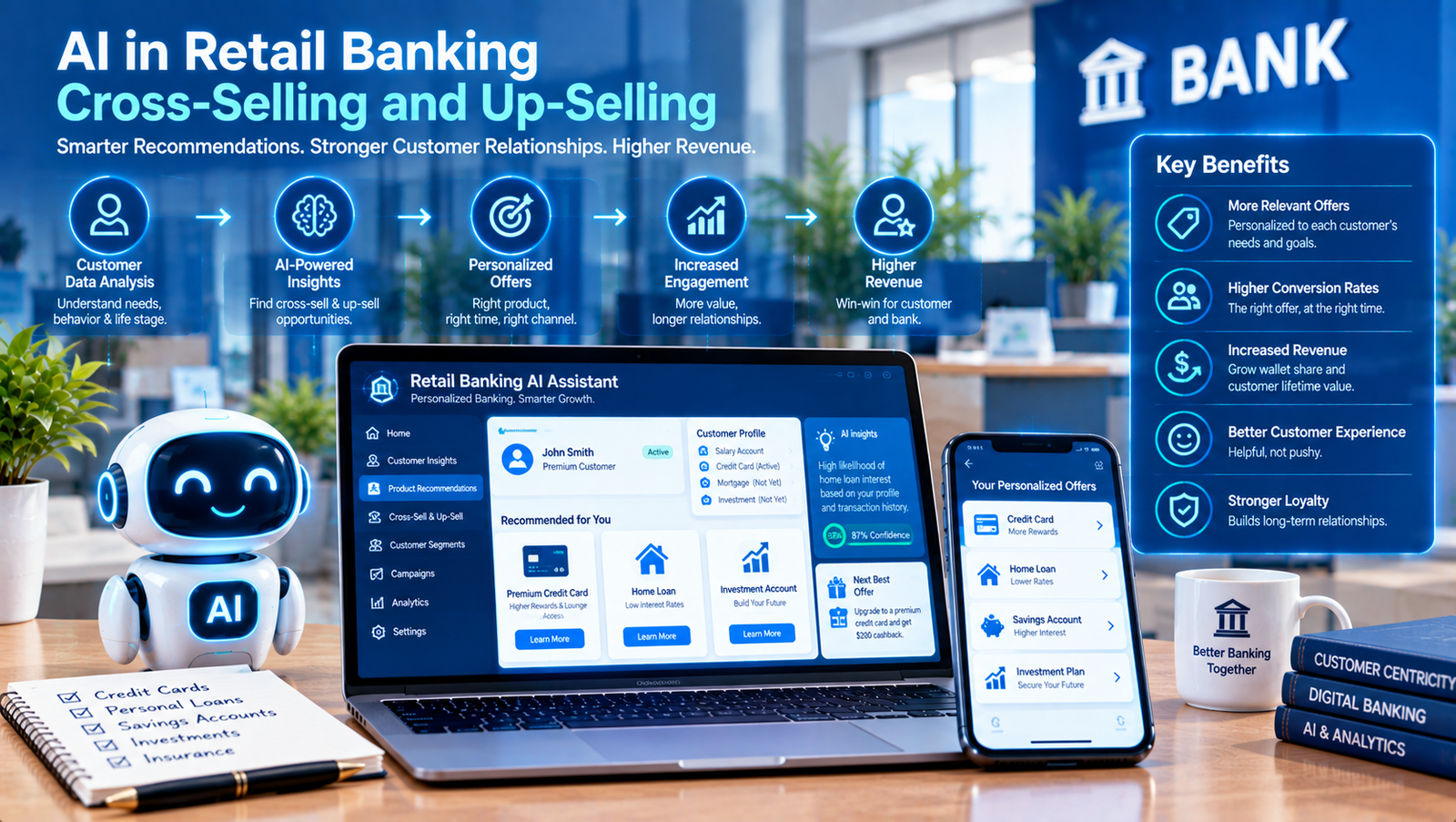
Primary topic: AI in Retail Banking Cross-Selling and Up-Selling: Research, Applications, Strategy and Future Trends
Research focus: Predictive analytics, banking product recommendation systems, transaction-based customer insights, next-best-action models, customer lifetime value, explainable AI, personalized offers, product suitability, digital banking engagement and responsible growth
Understanding AI-Powered Cross-Selling and Up-Selling in Retail Banking
Cross-selling means offering an existing customer an additional product that complements their current banking relationship. A customer with a checking account, for example, may also need a savings account, credit card, personal loan, mortgage, investment service or travel-related financial product.
Up-selling means encouraging a customer to move to a more suitable or higher-value version of a product they already use. Examples include moving from a basic account to a premium account, upgrading a credit card, selecting a higher service tier or choosing a savings product with features that better fit the customer’s goals.
AI can support both activities by analyzing customer behavior, financial activity, product usage, eligibility, service interactions and stated preferences. Instead of relying only on broad demographic segments or mass campaigns, a bank can estimate which product is relevant to a particular customer and identify a suitable moment to present it.
However, banking recommendations differ from ordinary retail product recommendations. A bank is not simply recommending a product that a customer might enjoy. Credit, insurance, investments and other financial products can create fees, repayment obligations, financial risk or long-term commitments. The recommendation system must therefore consider customer suitability, affordability, consent, fairness and applicable regulation alongside commercial outcomes.
Transactions, needs and product usage
Need, eligibility and propensity
Product, timing and channel
Customer response and value
The feedback loop should measure more than sales. It should also capture customer outcomes, complaints, cancellations, repayment performance and whether the offer was appropriate.
Why Traditional Banking Campaigns Are Losing Precision
Traditional cross-selling often relies on product ownership, age groups, income bands, account balances and historical campaign responses. These variables can help identify broad customer segments, but they may not reveal what a customer needs at a particular moment.
Two customers with similar salaries and account balances may have very different financial priorities. One may be saving for a home, while another is managing variable income or paying down debt. A campaign that promotes a credit card to both customers may generate a response from one while being irrelevant or harmful to the other.
AI can incorporate more detailed behavioral signals, including transaction categories, recurring payments, account balance changes, product engagement and customer-initiated searches. These signals can help a bank distinguish between a customer who is merely eligible for a product and one whose circumstances suggest a relevant need.
The challenge is to use those signals responsibly. A transaction should not automatically be interpreted as proof of a personal circumstance.
For example, a payment to a travel company may indicate travel-related activity, but it does not necessarily mean that the customer wants a travel credit card or insurance. A recommendation system should combine signals, respect customer preferences and provide a clear way to decline marketing.
Research Study: Deep Learning for Consumer Loan Cross-Selling
A study published in Annals of Operations Research examined whether transaction data could improve the prediction of consumer-loan cross-selling. The researchers analyzed almost 800,000 credit-card transactions and developed a method that used an autoencoder to extract features from transaction behavior before passing those features to a classification model.
The study addressed a practical limitation in traditional banking campaign models. Demographic information and previous marketing interactions can describe a customer at a broad level, but transaction histories can reveal patterns in how customers actually use financial services. By learning representations from transaction data, the model could capture behavioral information that was not easily represented by simple customer attributes.
The reported findings showed that transaction-derived features significantly improved predictive accuracy in the cross-selling task. This supports the use of customer activity as an input to banking recommendations, particularly when the bank wants to identify potential demand for a product rather than simply target customers who resemble previous buyers.
The result should not be interpreted as proof that transaction data will improve every cross-selling campaign. Performance depends on the dataset, product, target definition, model design and evaluation method. A model that predicts purchase likelihood also does not establish whether a product is affordable or suitable.
Practical implication: Banks should test whether transaction-derived features add measurable value beyond existing campaign and demographic models. The test should use a time-based holdout and should evaluate both conversion and customer outcomes.
Research Study: Machine Learning for SME Banking Product Recommendations
A 2024 research article in the International Journal of Intelligent Systems studied machine-learning methods for recommending financial products in SME banking. The work focused on customer transaction data associated with a bank’s current-account debt product and compared several modeling approaches.
The study reported that a Light Gradient Boosting Machine model achieved 84% accuracy, outperforming the other tested methods in that evaluation. The work illustrates how tree-based models can identify useful relationships in structured banking data without requiring a deep-learning architecture for every recommendation task.
The SME context is especially relevant because small businesses have financial patterns that differ from those of individual consumers. Account inflows, supplier payments, payroll, seasonal revenue, cash-flow gaps and borrowing activity can help identify potential needs for working-capital products or other business banking services.
For example, repeated short-term cash-flow pressure might indicate a need for a conversation about cash-flow management. It should not automatically trigger a loan offer. The bank would need to assess the cause of the pressure, the business’s repayment capacity and whether non-credit support would be more appropriate.
The reported accuracy is specific to the study’s data and task. Accuracy alone is not sufficient for a production recommendation engine, especially when positive purchase events are relatively rare. Banks should also evaluate precision, recall, calibration, ranking quality and the financial consequences of incorrect recommendations.
Practical implication: SME banks can use transaction analytics to identify relevant product opportunities, but recommendations should be tied to business context, affordability and the customer’s actual operating needs.
Source: Product Recommendation System With Machine Learning Algorithms for SME Banking, 2024
Research Study: Explainable AI for Personalized Retail Banking Recommendations
A 2026 study in Discover Artificial Intelligence examined how explainable AI could improve the transparency of retail-banking recommendation systems. The researchers used a dataset containing 15,168 rows and 12 demographic features, then evaluated techniques including SHAP, LIME and other model-interpretation tools.
The study reported that overall model accuracy increased from 0.86 to 0.91 following its feature-analysis and model-refinement process. Its SHAP-enhanced Random Forest approach was presented as a way to improve interpretability and help identify potentially problematic features.
The central contribution is not simply the reported accuracy improvement. It is the effort to make recommendation behavior easier to inspect. In banking, a model may recommend a credit product, savings account or other service based on several customer attributes. If the bank cannot explain which factors influenced the recommendation, it becomes harder to detect inappropriate patterns, investigate complaints or demonstrate responsible model governance.
Explainability also needs careful interpretation. A feature-attribution explanation describes how a model arrived at a prediction; it does not prove that the prediction is correct, that the feature is causally responsible for a customer’s need, or that the offer is suitable.
Practical implication: Retail banks should make explanation tools part of model development and monitoring. Customer-facing explanations should use clear language, while internal explanations should help risk, compliance and product teams investigate model behavior.
Research Study: AI-Driven Nudge Optimization in Digital Banking
A 2025 paper published in IEEE Access proposed a digital-banking recommendation approach combining Two-Tower Networks with a Multi-Armed Bandit method. The research addressed a weakness in static recommendation systems: they may select offers based on historical customer preferences but fail to adapt efficiently to new interactions.
Two-Tower Networks can represent customers and products in separate learned spaces, helping the system estimate which products are relevant to which customers. A Multi-Armed Bandit approach can then support the selection of different messages or recommendations while learning from observed responses.
The combination is relevant to banking because the same product can be presented in different ways and through different channels. A customer may respond to a savings goal in the mobile app but ignore an email. Another may prefer a comparison of account features rather than a promotional message. Adaptive systems can test these alternatives rather than assuming one campaign works equally well for everyone.
However, optimization must include guardrails. A bandit system that learns only from clicks or conversions may discover that urgent language, repeated prompts or aggressive credit offers generate short-term responses. Those outcomes do not necessarily represent customer benefit.
Practical implication: Banks can use adaptive experimentation to improve the relevance of messages and channels, but the optimization objective should include customer suitability, complaint rates, opt-outs and downstream outcomes rather than conversion alone.
Research Study: AI Marketing and Bank Customer Purchase Intentions
A 2024 study published in Kybernetes examined how AI-related marketing characteristics affect customer experience, brand preference and repurchase intention in banking. The researchers analyzed questionnaire data from 398 participants using structural equation modeling.
The study considered characteristics such as information, interactivity, accessibility and personalization. Its findings reported positive relationships between these AI marketing characteristics and customer experience, brand preference and repurchase intention. Customer experience also played a mediating role in the relationships examined.
This research adds an important customer-experience perspective to product recommendation design. A bank may have an accurate propensity model, but the way it presents an offer can still affect whether customers perceive the interaction as useful or intrusive. Personalization should therefore include the quality of the interaction, the clarity of the information and the ease with which customers can act or decline.
The study uses survey-based evidence, so it should not be treated as a direct measurement of incremental product sales from a live recommendation engine. Still, it helps explain why cross-selling performance depends on more than model accuracy.
Practical implication: Banks should evaluate the full customer journey, including message clarity, perceived relevance, customer trust and the ease of comparing product terms.
Source: The effect of bank artificial intelligence on consumer purchase intentions, Kybernetes, 2024
Research Study: Customer Digital Twins for Cross-Sell Personalization at Scale
A September 2026 working paper from Columbia Business School described a customer digital-twin approach designed to personalize cross-selling at scale. The researchers tested the approach through two field experiments involving approximately 330,000 customers of a global financial institution.
The system used first-party behavioral and transactional data to generate customer-specific cross-sell offers. According to the paper’s abstract, the experiments reported a 6% relative conversion uplift for credit-card offers and a 25% relative conversion uplift for payroll-portability offers compared with the control condition. The paper also reported prospective three-year gross-margin uplifts of 11% and 30%, respectively.
These results are particularly relevant because the evaluation used field experiments and actual conversion outcomes rather than relying only on offline model metrics. They suggest that customer-level personalization can influence commercial results when it is connected to real campaign delivery.
The findings nevertheless require context. The paper is a working paper, and the reported results concern specific offers, a particular financial institution and its experimental design. They should not be assumed to apply directly to every bank, product or market. Prospective gross-margin estimates are also different from realized long-term profit.
Practical implication: Banks should validate personalization through controlled experiments, measuring incremental conversion and realized value while monitoring customer complaints, opt-outs and product suitability.
What the Research Means for Banking Product Strategy
Across these studies, a few distinct lessons emerge. Transaction data can improve customer understanding, explainability can help teams inspect recommendation behavior, adaptive systems can refine how offers are presented, and field experiments can test whether personalization changes real customer actions.
These findings do not mean that every bank should immediately deploy a large generative AI system. In many cases, a well-designed gradient-boosted model, a clear product eligibility layer and a reliable experimentation framework may deliver more measurable value than a complex architecture.
| Research direction | What it contributes | What banks should validate |
|---|---|---|
| Transaction-based prediction | Behavioral features for product propensity | Incremental lift over existing targeting |
| SME product recommendation | Structured transaction analysis for business needs | Product fit, affordability and calibration |
| Explainable AI | Model interpretation and feature review | Explanation quality and subgroup performance |
| Adaptive nudging | Learning which message or channel works | Customer outcomes beyond clicks |
| Field experimentation | Evidence of real campaign impact | Incremental value and long-term effects |
High-Value AI Use Cases in Retail Banking
Next-Best-Product Recommendations
A next-best-product system estimates which product, if any, is most relevant to a customer at a particular point in time. It can consider product ownership, transaction behavior, account activity, eligibility and the customer’s expressed goals.
The system should be allowed to recommend no offer. This is an important design choice because the most suitable action may be to provide financial education, improve an existing service or avoid additional borrowing.
Next-Best-Action Decisioning
Next-best-action systems select an appropriate interaction rather than always selecting a product. Possible actions include a savings reminder, an explanation of account features, a service message, a financial check-in, a product comparison or a referral to a human adviser.
This approach is particularly useful when the bank wants to improve customer relationships rather than maximize the number of products held by each customer.
Credit Card Cross-Selling
AI can identify customers who may benefit from a credit card based on product eligibility, spending patterns, existing credit relationships and stated preferences. Before presenting an offer, the bank should apply affordability and suitability checks and avoid treating high spending as evidence that more credit is needed.
Savings and Deposit Recommendations
Account balance patterns, recurring deposits and customer-defined savings goals can help identify when a savings product may be useful. A bank can explain differences in access, interest, fees and withdrawal conditions instead of simply promoting the product with the highest commercial return.
Mortgage and Personal Loan Opportunities
AI can identify potential borrowing needs from customer-initiated activity, existing relationships and relevant financial patterns. These signals should trigger an invitation to explore options, not an assumption that the customer should borrow. Eligibility, affordability, repayment capacity and fair-lending requirements remain essential.
SME Banking and Cash-Flow Products
Business transaction analytics can identify recurring cash-flow gaps, payment patterns and changing operational needs. Recommendations might include cash-flow tools, invoicing services, merchant services, business savings or credit products, depending on the business’s circumstances.
How an AI Cross-Selling Engine Should Work
A production system should separate prediction from decision-making. The model can estimate customer interest, but a separate decision layer should check eligibility, suitability, consent, product rules and contact restrictions before an offer is delivered.
Core banking, CRM, transactions, app activity and consent records
Customer behavior, product usage, needs and lifecycle signals
Propensity, recommendation, response and value models
Eligibility, affordability, suitability, frequency and consent checks
Mobile app, email, web, contact center or relationship manager
Experiments, conversion, retention, complaints and customer outcomes
Propensity Is Not the Same as Incremental Impact
One of the most important technical distinctions in banking marketing is the difference between predicting who will buy and estimating who will buy because of a particular offer.
A propensity model may identify customers who are already likely to open a savings account. If the bank sends those customers an offer, many may convert even if they would have acted without the campaign.
An uplift model attempts to estimate the incremental effect of the intervention. It asks whether a particular customer is more likely to take an action when they receive the offer than when they do not.
This distinction can help banks avoid spending marketing resources on customers who would have converted anyway. It can also reduce unnecessary messages to customers who are unlikely to benefit from the offer.
| Model type | Question answered | Best use |
|---|---|---|
| Propensity | Who is likely to buy? | Prioritizing likely prospects |
| Uplift | Who may change behavior because of the offer? | Improving incremental campaign impact |
| Suitability | Is the product appropriate for this customer? | Responsible offer filtering |
| Lifetime value | What long-term relationship value may result? | Long-term portfolio and service planning |
These models should work together. A high-propensity customer should not automatically receive an offer if the product is unsuitable, and a potentially profitable customer should not be treated as a reason to bypass eligibility or customer-protection controls.
Customer Lifetime Value and Relationship-Level Optimization
Customer lifetime value, or CLV, estimates the economic value of a customer relationship over a defined period. In retail banking, it can reflect product revenue, balances, servicing costs, expected credit losses, retention, capital costs and the cost of acquiring or serving the customer.
AI can improve CLV estimation by modeling changes in product use, customer engagement, retention probability and service needs. It can also help estimate how a new product might affect the wider relationship.
However, a bank should distinguish between observed revenue and incremental value. A customer who opens a second product may generate additional revenue, but the product may also increase servicing costs, create credit risk or replace an existing product. A robust evaluation considers the net effect.
Fees, interest and service income
Acquisition and servicing
Expected losses and conduct risk
Relationship duration and activity
Decision principle: Optimize sustainable, risk-adjusted relationship value rather than short-term product count.
Real-Time Personalization and Event-Based Offers
A static campaign may contact a customer on a predetermined date, regardless of what has happened in their account. Event-based personalization instead responds to meaningful changes in customer activity.
McKinsey’s September 2026 analysis of AI-powered personalization describes how banks can complement existing analytical models with near-real-time triggers based on transactions and other customer activity.
The article gives examples such as savings or lending communications triggered by account-balance changes and travel-related offers triggered by travel purchases. It reports that leading banks use large numbers of triggers and that, in McKinsey’s experience, these can improve click-through rates by two to three times.
These are practitioner-reported observations, not a universal guarantee. Results depend on the bank, campaign, customer group and measurement design. Still, the direction is clear: personalization can become more context-aware when it responds to relevant events instead of relying only on static customer segments.
Responsible Personalization: Privacy, Fairness and Customer Trust
Banking personalization depends on sensitive financial information. A customer may reasonably expect their transactions to be used to provide account services, but may not expect every purchase to trigger a commercial offer.
Banks should make data use understandable, honor marketing preferences and limit access to customer information. They should also test whether recommendations differ unfairly across protected or vulnerable groups, including where proxy variables may reproduce historical disadvantages.
The UK Financial Conduct Authority’s 2026 review of AI in retail financial services identified changes to consumer journeys and competition alongside the amplification of fraud and cyber risks. The review also discussed consumer appetite for agentic AI in personal finance. These developments reinforce the need to treat personalization as both a commercial capability and a customer-protection issue.
Source: Financial Conduct Authority, Review into the impact of AI on retail financial services, July 2026
Key Risks and Controls
| Risk | How it appears | Control |
|---|---|---|
| Over-selling | Too many offers or repeated prompts | Contact caps, suppression rules and customer controls |
| Unsuitable products | High propensity but poor financial fit | Eligibility, affordability and suitability checks |
| Biased targeting | Unequal offer access or outcomes | Fairness testing and subgroup monitoring |
| Privacy concerns | Unexpected use of transaction data | Consent, transparency and data minimization |
| Model drift | Changing behavior reduces accuracy | Monitoring, retraining and challenger models |
| Misleading explanations | A prediction is presented as a fact about the customer | Careful wording and evidence-based explanations |
Expert Recommendation
Retail banks should build cross-selling and up-selling as a customer decision system, not as a campaign-volume engine. Start with one product family and one clearly defined customer need, then test whether AI improves incremental outcomes over the bank’s existing approach.
The recommended approach is to:
- Build a reliable customer and product data foundation before adding complex models
- Use transaction-derived features only where the data use is appropriate, transparent and permitted
- Separate purchase propensity from eligibility, affordability and suitability
- Use uplift modeling or randomized experiments to estimate incremental campaign impact
- Introduce explainability tools to investigate model behavior and support governance
- Measure long-term relationship value, not only immediate conversion
- Set limits on contact frequency and allow customers to manage marketing preferences
- Monitor complaints, cancellations, repayment outcomes and fairness alongside revenue
- Keep human review available for complex, high-impact or ambiguous recommendations
A bank should also establish a clear rule for when the system should not recommend a product. That rule protects customers from unnecessary offers and prevents the model from treating every financial interaction as a sales opportunity.
Expert Perspective
A useful principle for modern banking personalization is expressed in the title of McKinsey’s September 2026 article: “At last, customers first.”
The article argues that AI-powered personalization can help banks create value when customer data and timely interactions are used to make engagement more relevant. The practical interpretation is that commercial performance and customer relevance should be designed together. Personalization that customers experience as intrusive or unsuitable can damage trust even if it produces short-term clicks.
Source: McKinsey, September 2026
Implementation Roadmap
Build the Data Foundation
Connect the data needed for the selected use case, such as product ownership, transaction categories, account activity, customer preferences, campaign history and relevant eligibility information. Establish clear definitions, data quality checks and permissions before training a model.
Choose a Specific Recommendation Problem
Start with a focused question, such as which eligible customers may benefit from a savings product or which SME customers may need a cash-flow service. Avoid combining unrelated products into one broad model before the first use case has been validated.
Develop and Evaluate the Model
Compare a simple baseline with machine-learning approaches. Use time-based validation to reduce leakage from future customer behavior. Evaluate ranking quality, calibration and incremental performance, not only accuracy.
Add Decision and Suitability Controls
Before an offer is shown, apply product eligibility, affordability, suitability, consent, contact-frequency and suppression rules. Keep the decision layer separate from the model so that policy changes do not require retraining the entire system.
Run a Controlled Pilot
Use a randomized control group where feasible. Measure incremental conversion, net revenue, customer response, complaints, opt-outs and downstream product outcomes. Include enough follow-up time to detect cancellations or other negative effects.
Scale with Continuous Monitoring
Expand only when the pilot demonstrates reliable results. Monitor performance across customer groups, channels and product types, and review the model when customer behavior or product conditions change.
KPIs for AI Cross-Selling and Up-Selling
| Metric | What it measures |
|---|---|
| Incremental conversion | Additional product uptake attributable to the campaign |
| Risk-adjusted incremental value | Incremental value after relevant costs and risk |
| Offer relevance | Whether customers find the recommendation useful |
| Product activation | Whether opened products are actually used |
| Retention and cancellation | Whether the product relationship persists |
| Complaint and opt-out rate | Signals of poor timing, pressure or irrelevance |
| Fairness by customer group | Differences in exposure, offers and outcomes |
Future Outlook: 2027–2030
Real-Time, Event-Based Recommendations
Banks are likely to expand beyond monthly or quarterly campaigns toward recommendations triggered by meaningful customer activity. The challenge will be to distinguish useful moments from opportunities that merely increase marketing volume.
More Use of Generative AI in Offer Explanations
Generative AI may help explain product differences in plain language, summarize eligibility information and support customer questions. Banks should ground generated explanations in approved product data and prevent the system from inventing rates, benefits, eligibility terms or guarantees.
Customer-Level Personalization at Greater Scale
The September 2026 customer digital-twin working paper illustrates a direction in which models use first-party behavioral data to generate more individualized offers. Future systems may make this approach more operationally accessible, but banks will need strong controls around data use, model evaluation and customer transparency.
More Emphasis on Incrementality and Long-Term Value
Banks are likely to place greater weight on whether AI creates additional value compared with existing campaigns. Propensity alone will be less informative when a large share of likely buyers would have purchased without receiving an offer.
Stronger Governance of Automated Customer Journeys
As recommendation systems become more adaptive, banks will need to document how offers are selected, which safeguards apply, how customer preferences are honored and how outcomes are monitored. This is especially important when recommendations involve credit or other products with significant financial consequences.
Frequently Asked Questions
What is AI-powered cross-selling in retail banking?
AI-powered cross-selling uses customer data and machine-learning models to identify additional banking products that may be relevant to an existing customer. Examples include recommending a savings account to a customer who wants to build savings or presenting a suitable payment service to a small business.
How is AI up-selling different from cross-selling?
Cross-selling introduces an additional product, while up-selling encourages a customer to move to a different or higher-tier version of a product they already use. Both approaches should focus on customer needs and suitability rather than product count alone.
Which data can AI use for banking product recommendations?
Depending on the use case and applicable permissions, a bank may use product ownership, transaction categories, account activity, customer preferences, service interactions, previous campaign responses and relevant eligibility information. Data should be limited to what is necessary and appropriate for the recommendation.
Can AI increase banking cross-selling conversion rates?
Research and field experiments indicate that AI-based personalization can improve conversion in specific settings. Results vary by product, customer population, data quality and campaign design, so banks should validate incremental impact through controlled experiments rather than assume that published results will transfer directly.
Why is explainable AI important in banking recommendations?
Explainability helps banks understand which features influenced a recommendation, identify problematic model behavior and support internal governance. It does not prove that a recommendation is suitable, so it must be combined with product rules and customer-protection checks.
What is the difference between propensity modeling and uplift modeling?
Propensity modeling estimates the likelihood that a customer will purchase a product. Uplift modeling estimates how much an intervention, such as an offer, may change that customer’s behavior compared with not receiving the offer.
How should banks measure the success of AI cross-selling?
Banks should measure incremental conversion and risk-adjusted value alongside product activation, retention, complaints, opt-outs, suitability and fairness. A campaign that generates more applications but also creates poor customer outcomes should not be treated as a successful deployment.
Final Perspective
AI is changing retail banking cross-selling from broad campaign targeting toward more contextual, data-driven customer engagement. Research on transaction-based models shows that financial behavior can provide useful signals for product recommendations.
Work on explainable AI highlights the importance of understanding why models produce particular recommendations, while adaptive systems offer ways to improve message and channel selection. Recent field experiments also show how personalization can be evaluated against actual customer responses rather than relying only on offline prediction metrics.
The next stage is not simply to recommend more products. It is to build a system that understands the customer’s context, identifies a potentially useful action, checks whether the product is appropriate, communicates clearly and learns from the outcome.
For banks, the strongest implementation combines:
This approach can support growth while protecting the trust that makes a banking relationship valuable. Banks that treat AI recommendations as part of customer service, rather than as automated sales pressure, will be better positioned to build useful, measurable and sustainable personalization.
Research Sources
- Improving the predictive accuracy of the cross-selling of consumer loans using deep learning networks, Annals of Operations Research
- Product Recommendation System With Machine Learning Algorithms for SME Banking, 2024
- A mini-approach for retail banking with transparent recommendation system enabled by explainable AI, 2026
- AI-Driven Nudge Optimization: Integrating Two-Tower Networks and Multi-Armed Bandit With Behavioral Economics for Digital Banking Campaign, IEEE Access, 2025
- The effect of bank artificial intelligence on consumer purchase intentions, Kybernetes, 2024
- Customer Digital Twins in the Field: Cross-Sell Micro-Personalization at Scale, Columbia Business School, September 2026
- McKinsey, At last, customers first: AI-powered personalization can help banks create value, September 2026
- Financial Conduct Authority, Review into the impact of AI on retail financial services, July 2026

Leave a Reply