
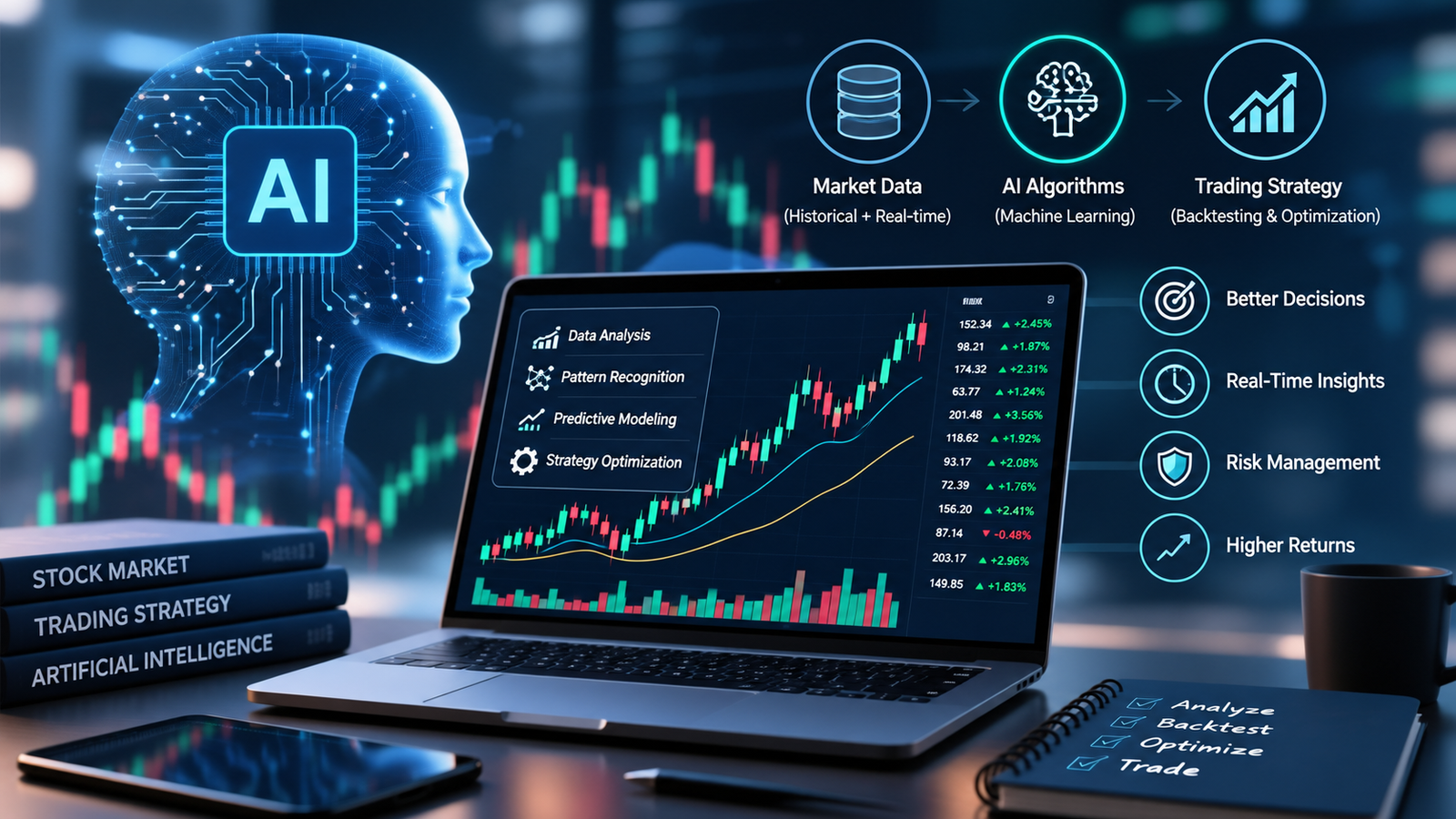
Primary topic: AI in Stock Market Trading Strategy Development
Research focus: Machine learning, deep learning, reinforcement learning, quantitative signals, technical analysis, alternative data, portfolio-aware strategy design, backtesting, transaction costs, execution, risk management, explainability, U.S. securities markets, and the future of AI-powered trading strategies.
What Is AI in Stock Market Trading Strategy Development?
AI in stock-market trading strategy development refers to the use of machine learning and related technologies to discover, evaluate, optimize, and sometimes automatically execute trading strategies.
Traditional strategy development often starts with a predefined rule.
For example:
- Buy when a moving average crosses another moving average.
- Buy stocks with strong recent momentum.
- Sell when volatility reaches a specified threshold.
- Trade around earnings announcements.
- Allocate capital according to predefined technical indicators.
AI changes the process by allowing the system to learn relationships from historical and alternative data instead of relying entirely on manually specified rules.
An AI strategy-development platform can analyze:
- Historical prices and returns.
- Trading volume and liquidity.
- Bid and ask information.
- Volatility.
- Technical indicators.
- Company fundamentals.
- Earnings and financial statements.
- Analyst estimates.
- News and sentiment.
- Economic data.
- Options-market information.
- Sector and industry relationships.
- Market-wide signals.
The objective is not necessarily to predict the exact future price.
A strategy may instead attempt to estimate:
- The probability of an upward or downward movement.
- Expected return.
- Expected volatility.
- Probability of a drawdown.
- Market regime.
- Expected transaction costs.
- Optimal portfolio weights.
- Optimal entry and exit timing.
This makes AI strategy development broader than AI price forecasting.
Market Data
↓
Feature Engineering
↓
AI Signal Generation
↓
Market Regime Detection
↓
Portfolio / Position Construction
↓
Transaction-Cost Analysis
↓
Backtesting
↓
Risk Controls
↓
Execution
↓
Live Monitoring & Model Updating
Why AI Is Becoming Important in Trading Strategy Development
Financial markets produce huge amounts of structured and unstructured information.
A human analyst cannot continuously process every price movement, earnings release, news article, filing, economic announcement, options signal, and sector relationship across thousands of securities.
AI can process these information streams at scale.
A 2024 systematic literature review examined 143 research articles covering AI techniques in financial trading. The review found that technical analysis was more commonly used than fundamental analysis, deep learning was the most frequently used AI approach, and only 16% of the selected studies fully automated the trading process. The review also identified a wide range of AI techniques and highlighted the need for better evaluation standards. Source: ScienceDirect, Artificial Intelligence techniques in financial trading: A systematic literature review
This finding is important because it shows that AI trading research is broader than simply creating automated bots.
Much of the field is still focused on developing better prediction, decision, optimization, and evaluation methods.
Research Study 1: AI Trading Research Has Expanded Across Many Model Families
A 2026 systematic review published in Computers & Electrical Engineering examined AI methods used in financial-market prediction from research published between 2013 and 2025.
The review covers a broad range of approaches, including:
- Recurrent neural networks.
- Long short-term memory networks.
- Convolutional neural networks.
- Transformers.
- Generative adversarial networks.
- Deep reinforcement learning.
- Hybrid AI architectures.
One of the most important conclusions is that financial markets generate non-stationary time series. A relationship that appears useful in one market environment may weaken or disappear in another.
The review also identifies an important gap between statistical prediction accuracy and practical trading profitability.
This distinction is critical for strategy developers.
A model may correctly classify price direction more often than a benchmark while still failing as a trading strategy once transaction costs, turnover, slippage, position sizing, and drawdowns are included.
The review argues that future financial forecasting systems need models capable of adapting to changing market conditions while also incorporating risk considerations.
Research Study 2: Machine Learning Research Is Moving Beyond Simple Price Forecasting
A comprehensive 2026 review in Discover Computing examined machine learning research in stock-market forecasting.
The review describes financial markets as noisy, nonlinear, non-stationary, and subject to structural breaks.
It covers several generations of AI approaches:
SVM, tree models and related methods
RNN, LSTM and CNN architectures
Transformers and attention-based systems
Prices, text and alternative data
Sequential trading decisions
This evolution matters because strategy development is becoming increasingly dynamic.
Instead of asking:
“What will tomorrow’s closing price be?”
a modern AI system can ask:
“Given the current market state, what action has the best expected risk-adjusted outcome?”
That shift moves AI closer to actual strategy optimization.
Source: Springer Nature, Machine learning in stock market forecasting: a comprehensive review
Research Study 3: Deep Learning for Algorithmic Trading
A 2025 systematic review examined the use of deep learning in algorithmic trading and analyzed architectures including RNNs, LSTMs, CNNs, and hybrid models.
The review highlights three recurring problems:
- Data noise: Financial data contains large amounts of randomness and temporary patterns.
- Overfitting: Complex models can learn historical patterns that do not persist.
- Interpretability: Some deep-learning models make it difficult to understand why a particular prediction or decision was produced.
These issues are particularly important for strategy development.
A model with millions of parameters can potentially identify complex relationships, but complexity also creates more opportunities for accidental relationships and unstable behavior.
The practical lesson is that model complexity should be justified by measurable improvement in out-of-sample performance.
A more complicated model is not automatically a better trading model.
Research Study 4: Reinforcement Learning Is Expanding Strategy Optimization
A 2025 review in Expert Systems with Applications examined recent advances in reinforcement learning for investment decision-making.
The review covers four major financial problems:
- Portfolio selection.
- Trade execution.
- Options hedging.
- Market making.
This is significant because reinforcement learning approaches the problem differently from ordinary supervised learning.
A supervised model may learn to predict a future return.
An RL system can instead learn a sequence of actions based on a reward function.
For trading, that could involve decisions such as:
- Buy.
- Sell.
- Hold.
- Increase exposure.
- Reduce exposure.
- Change portfolio weights.
- Delay execution.
The review emphasizes the importance of the state representation, action space, reward function, and neural architecture used by an RL system.
That means strategy design is not simply a matter of selecting PPO, SAC, DDPG, or another algorithm.
The environment and reward structure can have a major effect on what the AI learns to optimize.
Research Study 5: Trading Costs Can Completely Change the Strategy
One of the most important recent studies for AI trading strategy development appeared in the Review of Financial Studies in 2026.
The researchers introduced the concept of an implementable efficient frontier.
The central idea is straightforward:
A strategy should be evaluated according to what it can actually deliver after trading costs, not only according to its theoretical gross return.
The research shows that conventional machine-learning portfolio strategies can become heavily dependent on small, short-lived characteristics.
These signals may look attractive before trading costs.
But high turnover can make them expensive to implement.
The study found that standard ML portfolio approaches can have very high turnover and poor net-of-cost performance, while a trading-cost-aware approach can produce a more attractive implementable frontier.
This is one of the most important lessons for AI strategy development.
A model should not simply maximize predicted return.
It should consider:
- Expected return.
- Risk.
- Turnover.
- Transaction costs.
- Market impact.
- Portfolio constraints.
- Position concentration.
The research specifically concludes that investors and researchers should focus on out-of-sample performance net of trading costs rather than relying on cost-agnostic in-sample performance.
Source: Oxford Academic, Machine Learning and the Implementable Efficient Frontier
Research Study 6: Deep Reinforcement Learning Is Moving Toward Multi-Agent and Ensemble Systems
A 2026 systematic review examined 156 articles on deep reinforcement learning for automated equity portfolio management published from 2018 through 2025.
The researchers describe a four-stage evolution:
Single-agent RL
Actor-critic and policy-gradient methods
Multi-agent coordination
Ensemble and meta-optimization
The review reports improvements across the categorized literature, including higher average Sharpe ratios and lower maximum drawdowns as the field developed.
However, these numbers should be interpreted as a synthesis of the reviewed literature rather than a universal expectation for live trading. Different datasets, markets, assumptions, costs, and evaluation periods can produce very different outcomes.
The more important development is architectural.
AI trading research is moving toward systems that combine multiple agents, models, attention mechanisms, and optimization techniques instead of relying on a single neural network.
Research Evidence Dashboard
143 studies
A 2024 review examined 143 AI trading studies.
156 studies
A 2026 review analyzed 156 DRL portfolio-management papers.
2013–2025
Recent systematic review coverage spans more than a decade of AI-finance research.
Cost matters
Recent research shows gross ML performance can deteriorate after trading costs.
Non-stationarity
Changing market conditions remain a central AI-trading challenge.
LLM + RL
New research is exploring language models as part of financial decision systems.
Core AI Technologies for Stock Strategy Development
| Technology | Strategy-development role | Typical use |
|---|---|---|
| Random Forest / Gradient Boosting | Nonlinear feature relationships | Signal classification and ranking |
| LSTM / RNN | Sequential patterns | Return, trend and volatility forecasting |
| CNN | Pattern recognition | Market structures and transformed financial data |
| Transformer | Long-range relationships | Time series and multimodal signals |
| Reinforcement Learning | Sequential decisions | Trading, execution and portfolio allocation |
| LLMs | Unstructured information | News, filings, research and contextual features |
AI Signal Generation
A stock-market AI strategy can generate several different types of signals.
Directional signals estimate whether an asset is more likely to rise or fall.
Cross-sectional signals rank securities against each other.
Event signals identify potential opportunities around earnings, announcements, regulatory decisions, or other events.
Volatility signals estimate how much an asset may move.
Regime signals attempt to identify the broader market environment.
A sophisticated strategy can combine these signals rather than relying on a single prediction.
Price Data + Fundamentals + News + Market Data + Alternative Data
↓
AI Feature Layer
↓
Signal Ensemble
↓
Expected Return + Risk + Confidence
↓
Portfolio Construction
AI for Technical Analysis
Technical analysis remains one of the most common foundations for AI trading research.
Traditional indicators include:
- Moving averages.
- Relative strength index.
- MACD.
- Momentum.
- Bollinger Bands.
- Volume indicators.
- Volatility measures.
AI can treat these indicators as features rather than fixed trading rules.
For example, instead of:
“Buy whenever RSI falls below a fixed threshold.”
a machine-learning model could learn whether an RSI condition is more useful when combined with volatility, trend, volume, market regime, sector momentum, and broader market conditions.
This allows the strategy to learn conditional relationships.
However, technical indicators should not be assumed to create persistent alpha simply because an AI model finds a historical relationship.
AI for Fundamental and Quantitative Signals
AI can also analyze company fundamentals.
Potential features include:
- Revenue growth.
- Earnings growth.
- Profit margins.
- Cash flow.
- Debt levels.
- Valuation ratios.
- Analyst revisions.
- Guidance changes.
- Share buybacks.
- Balance-sheet quality.
The model can combine fundamental information with market behavior.
For example, a strategy may search for companies where strong earnings momentum is combined with improving price momentum and favorable liquidity.
This creates a more structured quantitative research process than using one variable independently.
AI and Financial News
Unstructured information is another major opportunity for AI.
Large language models and NLP systems can process:
- SEC filings.
- Earnings-call transcripts.
- Company announcements.
- Financial news.
- Analyst commentary.
- Management statements.
- Macroeconomic announcements.
The system can convert text into structured features such as:
The major challenge is timing.
A strategy must ensure that the information was actually available at the moment the model claims to have used it.
Otherwise, the backtest can suffer from look-ahead bias.
Alternative Data and Multimodal Trading Strategies
The next generation of strategy development is likely to use multiple information sources.
Possible inputs include:
- Financial filings.
- News.
- Market microstructure.
- Options activity.
- Web activity.
- Search trends.
- Satellite or geospatial information.
- Supply-chain information.
- Consumer activity.
The important question is not whether a dataset is unusual.
The important question is whether the information is legally obtainable, sufficiently timely, statistically useful, and economically valuable after implementation costs.
LLM-Enhanced Trading Strategy Development
LLMs are now being investigated as part of financial decision systems.
A 2026 survey reviewed 34 core studies published from 2023 to 2026 on LLM-enhanced reinforcement learning in financial markets.
The researchers classify LLM-RL integration into three broad approaches:
- Feature-based: LLMs convert text or contextual information into features for an RL system.
- Auxiliary-based: LLMs support the RL process without directly controlling the policy.
- Policy-based: LLMs are more tightly integrated into the decision-making process.
The survey identifies a trade-off.
Tighter integration may provide richer contextual reasoning but can increase computational complexity and training instability.
Simpler feature-based integration can be easier to scale but may provide less deep integration.
The review also highlights unresolved issues involving data leakage, look-ahead bias, standardized benchmarks, reliability, and regulatory alignment.
Source: Springer Nature, A survey on LLM-enhanced reinforcement learning in financial markets
Backtesting: The Most Important Development Stage
Backtesting allows a strategy to be evaluated using historical market data.
But a backtest is only useful when it represents the conditions under which the strategy will actually operate.
A robust AI backtest should include:
- Time-ordered data.
- Strict separation between training and testing.
- Realistic transaction costs.
- Slippage assumptions.
- Liquidity constraints.
- Position limits.
- Portfolio constraints.
- Corporate actions.
- Delisted securities where appropriate.
- Execution timing.
The biggest danger is overfitting.
If a researcher repeatedly changes the model until historical performance becomes excellent, the resulting backtest may describe the research process rather than a genuine market relationship.
Walk-Forward Validation
A stronger process is walk-forward testing.
Historical Window
Train Model
↓
Validate
↓
Test on Next Period
↓
Move Forward
↓
Retrain
↓
Test Again
This better reflects the fact that trading strategies operate in changing environments.
The objective is not to find a model that explains one historical period perfectly.
The objective is to determine whether the strategy remains useful across multiple unseen periods.
AI Strategy Evaluation Framework
| Metric | What it measures | Why it matters |
|---|---|---|
| Cumulative return | Total portfolio growth | Basic performance measure |
| Sharpe ratio | Return relative to volatility | Risk-adjusted comparison |
| Maximum drawdown | Largest peak-to-trough decline | Downside risk |
| Turnover | Trading activity | Cost and scalability |
| Net return | Return after costs | Real-world usefulness |
| Hit rate | Percentage of successful trades | Signal quality |
| Profit factor | Gross profit versus gross loss | Strategy economics |
| Capacity | How much capital the strategy can handle | Institutional scalability |
AI Trading Strategy Architecture
Market prices + volume + fundamentals + news + alternative data
↓
2. Data Quality Layer
Cleaning + timestamp validation + missing-data detection + corporate actions
↓
3. Feature Layer
Technical + fundamental + sentiment + volatility + cross-sectional features
↓
4. AI Model Layer
ML + LSTM + CNN + Transformer + RL + ensemble models
↓
5. Signal Layer
Expected return + probability + volatility + confidence + regime
↓
6. Portfolio Layer
Position sizing + diversification + exposure + constraints
↓
7. Cost Layer
Spread + commissions + slippage + market impact
↓
8. Risk Gateway
Exposure limits + drawdown limits + concentration limits + kill switch
↓
9. Execution
Broker connectivity + order routing + execution monitoring
↓
10. Monitoring
Performance + model drift + data drift + operational risk
Risk Matrix for AI Stock Trading Strategy Development
| Risk | Potential impact | Control |
|---|---|---|
| Overfitting | Excellent backtest, weak live results | Walk-forward and untouched test periods |
| Look-ahead bias | Artificially inflated performance | Strict point-in-time data |
| Data drift | Signal deterioration | Continuous monitoring |
| Model drift | Changing prediction quality | Benchmark and retraining policy |
| Transaction costs | Elimination of trading edge | Cost-aware optimization |
| Liquidity shock | Unexpected execution losses | Liquidity-aware limits |
| Black-box behavior | Difficult investigation and governance | Explainability and audit logs |
| Correlated AI strategies | Amplified market moves | Stress testing and strategy diversification |
U.S. Market and Regulatory Considerations
For a U.S.-focused trading product, AI strategy development must be designed around existing securities-market obligations rather than treating regulation as a later-stage feature.
FINRA states that algorithmic trading strategies, including high-frequency strategies, are widespread in U.S. securities markets and recommends controls covering risk assessment, software development, testing and validation, trading-system monitoring, and compliance.
Source: FINRA, Algorithmic Trading
For AI-based systems, FINRA also highlights model-risk management, data governance, privacy, cybersecurity, vendor management, explainability, supervisory controls, and ongoing model testing.
Its guidance recommends testing models under stressed and unusual conditions and maintaining model inventories, performance benchmarks, and monitoring processes.
Source: FINRA, Key Challenges and Regulatory Considerations for AI
This means a U.S. AI trading platform should build governance into its architecture.
It should not be added after the trading system has already been developed.
AI Trading and Market Stability
AI can improve trading efficiency, but widespread adoption can also create new market-structure risks.
Federal Reserve Governor Lisa Cook has discussed concerns including correlated trading, endogenous model behavior, market manipulation, and concentration.
At the same time, she has noted that AI-driven trading could potentially improve price discovery and produce strategies that are less susceptible to some forms of human herding.
The evidence is therefore mixed rather than one-directional.
Source: Federal Reserve, Speech by Governor Lisa Cook on AI, the economy, and the financial system
Expert Quotation
Source: Federal Reserve, Governor Lisa Cook, 2026
This principle is particularly relevant to AI trading.
The objective should not be to remove every human decision from the system.
The objective should be to make the overall decision process faster, more systematic, more measurable, and easier to monitor while keeping appropriate controls around autonomous behavior.
AI Strategy Development Maturity Model
Manual research
Rule-based quant strategies
Machine-learning signals
AI portfolio optimization
Adaptive AI strategy platform
The maturity model should not be interpreted as a requirement to reach the highest level.
For many organizations, a well-tested Level 3 or Level 4 system with strong governance can be more practical than a highly autonomous system with weak controls.
Expert Recommendation
The strongest approach for developing an AI stock-market strategy is to start with the economic problem, not the AI model.
A common mistake is:
Choose an AI model → find data → backtest → search for a profitable result.
A stronger process is:
Determine whether the strategy targets momentum, mean reversion, volatility, event trading, market making, execution, long-short selection, or another objective.2. Define the investment universe
Set liquidity, market-capitalization, sector, price, and tradability constraints.3. Define the information available at decision time
Prevent look-ahead bias by using only information that would have been available when the trade was made.
4. Establish a simple benchmark
Compare AI against a transparent baseline before introducing complex architectures.
5. Build the AI model
Use ML, deep learning, Transformer, RL, or ensemble methods only when justified by the problem.
6. Add trading costs
Model commissions, spreads, slippage, turnover and market impact.
7. Test across market regimes
Evaluate bull markets, bear markets, high-volatility periods, low-volatility periods and major market shocks.
8. Validate out of sample
Use walk-forward and genuinely untouched test periods.
9. Paper trade
Observe real-time behavior without immediately putting substantial capital at risk.
10. Deploy with independent risk controls
The trading engine should not be allowed to bypass predefined risk limits.
Implementation Roadmap
| Phase | Main work | Expected output |
|---|---|---|
| 1. Research | Define market, universe and strategy objective | Strategy specification |
| 2. Data | Build point-in-time market and alternative-data pipeline | Research-ready dataset |
| 3. Baseline | Create simple quantitative benchmark | Performance baseline |
| 4. AI | Train ML/DL/RL models | Candidate strategies |
| 5. Cost | Add execution and transaction-cost assumptions | Net performance |
| 6. Validation | Walk-forward and stress testing | Robustness evidence |
| 7. Simulation | Paper trading and live market simulation | Operational evidence |
| 8. Governance | Model inventory, approvals, audit and risk controls | Controlled deployment |
| 9. Production | Controlled capital deployment | Live strategy |
| 10. Monitoring | Track model, data, cost and market drift | Continuous strategy management |
Future Predictions: 2027–2030
2027: AI Trading Research Will Become More Multimodal
Trading models will increasingly combine numerical market data with text and other information sources.
Instead of maintaining separate systems for price forecasting and financial-news analysis, organizations will increasingly experiment with unified architectures.
The strongest systems will likely combine structured market information with contextual information while maintaining strict controls against data leakage.
2028: Trading-Cost-Aware AI Will Become More Important
The distinction between a profitable backtest and an implementable strategy will become increasingly important.
The research on the implementable efficient frontier shows why.
A strategy that produces attractive gross returns but requires excessive turnover may not survive in real markets.
Future AI strategy platforms are therefore likely to optimize directly for net outcomes.
2029: AI Will Move From Prediction Toward Decision Optimization
The role of AI will increasingly move from:
“Predict the next return.”
toward:
“Select the action that maximizes expected risk-adjusted economic value.”
This will increase the role of reinforcement learning, constrained optimization, portfolio-aware models, and execution-aware systems.
2030: Multi-Agent Trading Systems May Become More Common
Instead of one large model controlling every component, future systems may use specialized agents or models for:
- Market analysis.
- News interpretation.
- Regime detection.
- Signal generation.
- Portfolio construction.
- Execution.
- Risk management.
- Model validation.
A separate risk layer could challenge or reject a proposed trading decision before it reaches the execution system.
Potential Startup Opportunities
The growth of AI trading creates opportunities beyond selling an automated trading bot.
Potential products include:
- AI Quant Research Platforms: Tools that help analysts generate, test, compare and document quantitative strategies.
- AI Backtesting Platforms: Cloud systems designed around realistic point-in-time data and transaction-cost modeling.
- AI Signal APIs: APIs providing probability, momentum, volatility, sentiment and market-regime signals.
- AI Portfolio Optimizers: Systems that convert AI forecasts into constrained portfolio allocations.
- AI Trading-Risk Gateways: Independent systems that validate AI-generated orders against predefined limits.
- AI Model Monitoring: Platforms that identify model drift, data drift, performance deterioration and abnormal trading behavior.
- Financial LLM Infrastructure: Systems that turn filings, earnings calls and financial news into structured research features.
- AI Strategy Governance: Tools for model inventories, approvals, versioning, audit trails and deployment controls.
- AI Execution Optimization: Systems that choose execution timing and tactics based on liquidity and expected market impact.
Frequently Asked Questions
What is AI in stock-market trading strategy development?
AI in stock-market trading strategy development uses machine learning, deep learning, reinforcement learning, NLP, and related technologies to discover, evaluate, optimize, and potentially automate trading strategies.
Can AI create a profitable stock-trading strategy?
Research demonstrates that AI can identify predictive relationships in financial data, but predictive accuracy does not guarantee profitability. Trading costs, market impact, overfitting, changing market conditions and execution constraints can significantly change real-world results.
Which AI models are used in stock trading?
Common approaches include gradient boosting, support vector machines, neural networks, LSTMs, CNNs, Transformers, reinforcement learning, and ensemble models. LLMs are increasingly being researched for financial text and decision-support applications.
Is reinforcement learning useful for trading?
Reinforcement learning is particularly suited to sequential decision problems because it can optimize actions over time. Research has explored RL for portfolio selection, trade execution, options hedging and market making.
Why is backtesting not enough?
Historical backtests can be distorted by overfitting, look-ahead bias, survivorship bias, unrealistic transaction costs and other assumptions. A strategy needs out-of-sample testing and ideally paper trading before production deployment.
Why are transaction costs so important?
A trading strategy can have positive gross returns while losing money after commissions, spreads, slippage and market impact. Recent research therefore emphasizes evaluating strategies using net-of-cost performance.
Will AI replace quantitative traders?
AI is more likely to change the role of quantitative professionals than eliminate the need for them. Humans remain important for research design, model validation, risk management, governance, market interpretation and decisions about where AI should and should not be used.
What is the biggest challenge for AI trading?
One of the biggest challenges is generalization. Financial relationships change over time, so a model that performs well in historical data may not retain the same performance in a different market environment.
Final Perspective
AI is becoming an important technology for stock-market trading strategy development, but the field is moving beyond the idea that a sufficiently powerful neural network can simply predict the market.
Recent research paints a more complex picture. Systematic reviews show rapid development across machine learning, deep learning, Transformers, reinforcement learning, multimodal systems, and LLM-enhanced decision frameworks. Research involving hundreds of studies demonstrates the breadth of AI applications in financial trading, while newer work is increasingly focused on dynamic decision-making and strategy optimization.
At the same time, the strongest research findings repeatedly point toward the same limitations:
-
Financial markets are noisy and non-stationary.
-
Historical relationships can disappear.
-
Complex models can overfit.
-
Backtests can contain hidden biases.
-
Prediction accuracy does not necessarily produce trading profitability.
-
Transaction costs can turn an apparently successful strategy into an economically unattractive one.
The 2026 research on the implementable efficient frontier matters because it frames the practical problem clearly: an AI strategy’s value must ultimately be judged by what can be achieved after realistic trading costs and implementation constraints.
The future of AI stock-market strategy development is therefore likely to be less about finding one “perfect” model and more about building an integrated decision system.
→
AI Signals
→
Regime Detection
→
Portfolio Decision
→
Cost Optimization
→
Risk Control
→
Execution
→
Monitoring
Research Sources
- ScienceDirect: Artificial intelligence techniques in financial trading: A systematic literature review
- ScienceDirect: Artificial intelligence methods for financial market prediction: A systematic review
- Springer Nature: Machine learning in stock market forecasting: a comprehensive review
- ScienceDirect: Deep learning for algorithmic trading: A systematic review of predictive models and optimization strategies
- ScienceDirect: A Survey on recent advances in reinforcement learning for intelligent investment decision-making optimization
- Oxford Academic: Machine Learning and the Implementable Efficient Frontier
- Springer Nature: Systematic review of reinforcement learning for automated equity portfolio management from single agent to multi agent systems
- Springer Nature: A taxonomy of literature reviews and experimental study of deep reinforcement learning in portfolio management
- Springer Nature: A survey on LLM-enhanced reinforcement learning in financial markets
- ScienceDirect: Stock market prediction using artificial intelligence: A systematic review of systematic reviews
- ScienceDirect: Applications of machine learning in financial transactions: A method-centric review
- FINRA: Algorithmic Trading
- FINRA: Key Challenges and Regulatory Considerations for AI
- FINRA: GenAI: Continuing and Emerging Trends
- Federal Reserve: Speech by Governor Lisa Cook on AI, the economy, and the financial system
- Federal Reserve: Speech by Governor Lisa Cook on financial stability
Leave a Reply