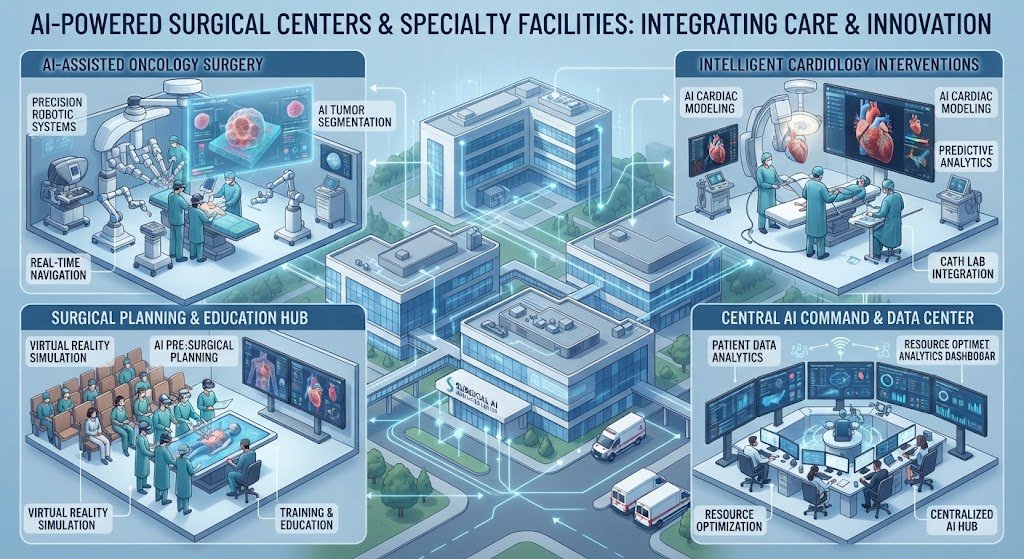
Primary topic: AI transformation in surgical centers and specialty facilities, with a focus on oncology and cardiology.
Research focus: Surgical computer vision, robotic surgery, perioperative prediction, oncology imaging and pathology, radiation oncology, cardiology AI, ECG analysis, clinical decision support, clinical trial matching, workflow automation, generative AI, AI agents, legacy modernization, governance, and future healthcare opportunities.
Why Surgical and Specialty Facilities Are Becoming AI-Ready
Surgical centers and specialty facilities generate some of the richest clinical data in healthcare. A single patient journey can produce imaging, pathology slides, ECG signals, operative video, anesthesia data, laboratory results, medications, clinical notes, device data, and longitudinal outcomes.
That makes these facilities particularly suitable for multimodal AI. Instead of building an isolated model that performs one prediction, organizations can increasingly connect multiple AI capabilities to the same clinical workflow.
The opportunity is especially significant in oncology and cardiology because both specialties depend heavily on imaging, pattern recognition, longitudinal risk assessment, multidisciplinary decision-making, and complex treatment pathways.
Key Research Findings
- Surgical video AI: Research shows deep-learning models can recognize surgical phases with reported accuracy ranging from 81% to 93.2% and anatomical structures from 71.4% to 98.1% in reviewed studies.
- Postoperative prediction: A systematic review reported pooled AUC values of 0.813 for anastomotic leak, 0.867 for mortality, 0.810 for prolonged hospital stay, and 0.802 for surgical-site infection.
- Oncology AI: A 2026 analysis found 149 of 1,008 FDA-authorized AI/ML devices had oncology-specific indications.
- Digital pathology: A large systematic review found mean sensitivity of 96.3% and specificity of 93.3% across included AI studies, although almost every included study had at least one important risk-of-bias or applicability concern.
- Pathology foundation models: CHIEF was validated across 19,491 whole-slide images from 32 independent slide sets and 24 hospitals/cohorts.
- Mammography: The MASAI randomized trial found AI-supported screening detected more invasive and in-situ cancers while reducing screen-reading workload by 44.2%.
- Cardiology: A review of FDA-authorized AI/ML devices found 277 of 1,016 devices had cardiology applications.
- ECG AI: A meta-analysis covering 13 studies and 218,202 participants reported pooled sensitivity of 0.93 and specificity of 0.95 for AI-enabled ECG detection of heart failure.
- Clinical trial matching: TrialGPT achieved 87.3% matching accuracy on 1,015 patient-criterion pairs and reduced screening time by 42.6% in a user study.
- Clinical readiness remains the bottleneck: Many AI studies remain retrospective or internally validated, meaning technical accuracy does not automatically translate into safe real-world deployment.
Research Evidence Dashboard
| Area | Research scale | Important result | Main opportunity |
|---|---|---|---|
| Surgical video | 122 studies | Phase recognition was the most common objective | Real-time OR intelligence |
| Postoperative AI | 18 studies | Mortality pooled AUC 0.867 | Early complication detection |
| Oncology AI devices | 149 oncology devices | 46% were in radiology | Imaging and treatment support |
| Digital pathology | 100 studies | 96.3% mean sensitivity | Cancer detection and classification |
| Cardiology AI | 277 FDA AI/ML devices | 65.3% involved imaging | Imaging, diagnosis and monitoring |
| AI ECG | 218,202 participants | 93% pooled sensitivity | Early cardiac risk detection |
Visual Research Comparison
Selected research metricsAI ECG heart-failure detection
93% pooled sensitivity
Digital pathology AI sensitivity
96.3% mean sensitivity
Digital pathology AI specificity
93.3% mean specificity
AI mammography workload reduction
44.2% workload reduction
TrialGPT screening-time reduction
42.6% reduction
Important interpretation: These numbers should not be treated as directly comparable clinical performance scores. They come from different studies, populations, endpoints, and workflows. Their value is to show where AI is demonstrating meaningful technical or operational potential.
1. AI Inside the Operating Room
Surgical computer vision is one of the most important areas of AI development for surgical centers. Cameras already capture large amounts of intraoperative information, creating an opportunity for models to understand what is happening during a procedure.
A systematic review of 21 studies reported deep-learning performance of 81% to 93.2% for surgical-phase recognition and 71.4% to 98.1% for anatomical structure recognition.
Operating Room AI Workflow
Preoperative data → Patient-specific planning → Real-time video analysis → Phase recognition → Anatomy/instrument detection → Decision support → Postoperative risk prediction → Outcome analysis
The larger scoping review included 122 studies. Surgical-phase recognition represented 40 studies, instrument recognition 28 studies, and enhanced intraoperative visualization 23 studies.
This suggests that the market is moving toward systems that understand the complete surgical workflow rather than simply detecting an isolated object.
- Recognize the current phase of surgery.
- Identify surgical instruments and their locations.
- Recognize important anatomical structures.
- Detect potentially unsafe movements or workflow deviations.
- Provide contextual information to the surgical team.
- Automatically create structured procedure data.
- Support postoperative quality analysis and training.
However, external validation remains a major weakness. Recent research found that intraoperative video AI literature is still dominated by retrospective and internally validated studies, while prospective and deployment-grade evaluation remains uncommon.
Source: Systematic review of AI in the operating room | Scoping review of 122 surgical video studies | External validation and clinical readiness
2. Robotic Surgery and AI Skill Assessment
Robotic and minimally invasive surgery creates another important AI opportunity because surgical systems can generate video and movement data at the same time.
A review of 247 studies identified 53 AI studies related to robotic surgical technical skills. Around 60% of the AI methods reported more than 90% accuracy in laboratory settings, while performance in real surgery ranged from 67% to 100%.
The difference between laboratory and real-world performance is important. A model can recognize a controlled surgical movement very accurately while struggling with unexpected anatomy, bleeding, camera movement, different surgical styles, or equipment variation.
- Automated surgical skill scoring.
- Resident and surgeon training analytics.
- Procedure-specific competency assessment.
- Video-based coaching.
- Robot motion analysis.
- Identification of inefficient movements.
- Simulation-based personalized training.
AI should therefore initially function as an assessment and decision-support layer rather than replacing surgeon judgment.
Source: AI and robotic surgery technical skill assessment review | AI assessment of minimally invasive surgical skills
3. Predicting Postoperative Complications
AI can also move value outside the operating room by identifying patients who may develop complications after surgery.
A systematic review of 18 studies found pooled AUC values of 0.813 for anastomotic leak, 0.867 for mortality, 0.810 for prolonged length of stay, and 0.802 for surgical-site infection.
| Outcome | Pooled AUC | Potential use |
|---|---|---|
| Mortality | 0.867 | Early escalation and monitoring |
| Anastomotic leak | 0.813 | Postoperative surveillance |
| Prolonged stay | 0.810 | Discharge planning |
| Surgical-site infection | 0.802 | Early intervention |
The practical opportunity is not simply predicting complications. The stronger product is a closed-loop system that connects prediction with monitoring, alerts, clinician review, and documented intervention.
Source: Systematic review of AI for postoperative colorectal complications
4. Oncology AI Is Becoming a Multimodal Platform
Oncology represents one of the largest AI opportunities because cancer care combines radiology, pathology, genomics, laboratory data, clinical notes, treatment history, radiation planning, and longitudinal outcomes.
A 2026 analysis of 1,008 FDA-authorized AI/ML devices found 149 devices with oncology-specific indications.
| Oncology AI finding | Result |
|---|---|
| Oncology-specific AI/ML devices | 149 of 1,008 |
| Radiology share | 46% |
| Radiation oncology share | 38% |
| Devices reporting clinical testing | 76% |
| Prospective testing | 5% |
The most important takeaway is that authorization and technical performance do not mean that the evidence base is equally strong across all oncology AI applications.
- Imaging AI is already a major deployment area.
- Radiation oncology is another large concentration of AI development.
- Clinical testing is common, but prospective testing remains uncommon.
- Clinician-in-the-loop evidence is still limited.
- Products need continuous monitoring after deployment.
Source: FDA-authorized oncology AI/ML device analysis
5. Digital Pathology and Cancer Detection
Digital pathology converts traditional glass slides into high-resolution whole-slide images that can be analyzed by AI.
A systematic review and meta-analysis identified 2,976 records, included 100 studies, and analyzed 48 studies quantitatively. More than 152,000 whole-slide images were represented.
Digital Pathology EvidenceMean sensitivity: 96.3%
Mean specificity: 93.3%
Important limitation: 99% of included studies had at least one high or unclear risk-of-bias or applicability concern.
This creates a clear product opportunity: AI pathology systems should combine strong image analysis with transparent validation, confidence scoring, audit trails, and pathologist review.
- Tumor detection.
- Cancer classification.
- Cell and tissue segmentation.
- Biomarker assessment.
- Rare cancer retrieval.
- Prognostic prediction.
- Pathology report assistance.
- Case prioritization.
Source: Digital pathology AI systematic review and meta-analysis
6. Pathology Foundation Models Change the Product Architecture
Foundation models create a different approach from traditional single-purpose pathology models.
CHIEF was developed using 60,530 whole-slide images covering 19 anatomical sites. It was validated on 19,491 whole-slide images from 32 independent slide sets and 24 hospitals or cohorts.
TITAN used 335,645 whole-slide images across 20 organs together with 182,862 medical reports and 423,122 synthetic captions.
Modern Oncology AI Architecture
Whole-slide images + Radiology + Clinical notes + Laboratory data + Genomics
↓
Multimodal foundation models
↓
Cancer detection + classification + prognosis + treatment support
↓
Oncologist / pathologist review
↓
Patient-specific care plan
The strategic implication is significant. Future oncology products may not need to train a completely new model for every hospital workflow. Instead, organizations can build application layers around validated foundation models while maintaining specialty-specific validation.
Sources: CHIEF pathology foundation model | TITAN multimodal pathology foundation model
7. Radiation Oncology and AI Treatment Planning
Radiation oncology contains multiple computationally intensive steps that are suitable for AI automation.
- Image reconstruction.
- Automatic anatomical segmentation.
- Tumor and organ-at-risk delineation.
- Radiotherapy dose prediction.
- Treatment planning optimization.
- Treatment response prediction.
- Toxicity prediction.
- Treatment quality assurance.
Reviews of AI in radiation oncology report applications across image reconstruction, segmentation, radiotherapy delivery, and treatment-response assessment. Deep learning can reduce planning and delivery time in appropriate workflows while maintaining quality, but robust validation and human oversight remain necessary.
Sources: AI in radiation oncology review | Deep-learning radiotherapy dose prediction review
8. Mammography Shows Both the Power and Risk of AI
The MASAI randomized trial provides a useful example of AI producing a measurable workflow benefit.
AI-supported screening detected 270 invasive cancers compared with 217 in the control group. In-situ cancer detection was 68 compared with 45. The screen-reading workload was reduced by 44.2%.
However, newer evidence also demonstrates why AI deployment must measure more than detection alone. A 2026 paired trial involving 31,301 women reported a 63.6% reduction in radiologist workload and a 15.2% higher cancer detection rate, but recall rate also increased by 14.8% and did not meet the study’s noninferiority criterion.
Sources: MASAI mammography randomized trial | 2026 mammography AI paired trial
9. Cardiology AI: From Imaging to Continuous Monitoring
Cardiology is another highly suitable environment for AI because clinical decisions increasingly depend on images, waveforms, wearable sensors, structured measurements, and longitudinal patient data.
A review of 1,016 FDA-approved or cleared AI/ML devices identified 277 cardiology applications. Imaging represented 65.3% and diagnostics 64.3% of cardiology applications.
| Cardiology AI area | Potential applications |
|---|---|
| ECG | Arrhythmia, heart failure, MI, pulmonary hypertension |
| Echo | Segmentation, measurements, function assessment |
| Cardiac CT | Calcium, plaque, stenosis, FFR, incidental findings |
| Cardiac MRI | Function, scar, strain, tissue characterization |
| Wearables | Continuous rhythm and risk monitoring |
| Remote monitoring | Early deterioration and escalation |
Source: FDA cardiology AI device scoping review
10. AI in Cardiac CT and MRI
A multisociety scientific statement describes AI opportunities throughout the cardiac CT and MRI pipeline, including patient selection, protocoling, image acquisition, reconstruction, interpretation, prognostication, and reporting.
Cardiac Imaging AI Pipeline
Patient selection → Protocoling → Acquisition → Reconstruction → Segmentation → Quantification → Interpretation → Risk prediction → Report generation
Examples include automated coronary calcium analysis, plaque assessment, stenosis detection, CT-derived fractional flow reserve, cardiac MRI segmentation, strain and scar quantification, incidental finding detection, prognosis, and report drafting.
The technology-readiness framework also shows that not every promising model is ready for clinical deployment. Some applications have reached advanced readiness, while many remain in development.
Source: Multisociety scientific statement on AI in cardiac CT and MRI
11. AI-Enabled ECG and Early Heart-Failure Detection
AI can extract information from ECG signals that may not be obvious during routine interpretation.
A systematic review and meta-analysis covering 13 studies and 218,202 participants reported pooled sensitivity of 0.93 and specificity of 0.95 for AI-enabled ECG detection of heart failure.
At the same time, individual study sensitivity ranged from 0.12 to 1.00 and specificity from 0.66 to 1.00. This variation highlights the importance of population diversity and external validation.
- Detect hidden cardiac abnormalities.
- Support early heart-failure screening.
- Identify arrhythmia patterns.
- Prioritize high-risk ECGs.
- Support wearable-device monitoring.
- Trigger clinician review when risk changes.
Source: AI ECG heart-failure systematic review and meta-analysis
12. Clinical Trial Matching for Oncology
Clinical trial matching is an excellent example of where generative AI and traditional structured systems can work together.
TrialGPT was evaluated using 183 synthetic patients and more than 75,000 trial annotations. The retrieval system recalled more than 90% of relevant trials while reducing the initial collection to less than 6% of the available trials. Matching accuracy reached 87.3% across 1,015 patient-criterion pairs.
A user study also found a 42.6% reduction in screening time.
AI Clinical Trial Matching
Patient EHR → Structured clinical data → NLP extraction → Eligibility rules → LLM-assisted matching → Trial ranking → Human verification → Patient discussion
The strongest architecture is therefore not an autonomous LLM deciding eligibility. It is a hybrid system combining structured rules, standardized data, retrieval, language models, and human review.
Sources: NIH TrialGPT | Cancer trial matching system | LLM clinical trial matching review
AI Use Cases Across Surgical Centers
| Stage | AI applications |
|---|---|
| Before surgery | Risk prediction, patient selection, imaging analysis, planning, scheduling |
| During surgery | Computer vision, phase recognition, instrument detection, navigation |
| After surgery | Complication prediction, deterioration alerts, discharge planning |
| Training | Skill scoring, simulation analytics, video coaching |
| Operations | OR scheduling, staffing, equipment utilization, documentation |
AI Use Cases Across Oncology Facilities
- Radiology image triage and cancer detection.
- Digital pathology analysis.
- Whole-slide tumor classification.
- Biomarker and molecular interpretation support.
- Radiation treatment planning.
- Automatic segmentation of tumors and organs at risk.
- Treatment response prediction.
- Toxicity prediction.
- Clinical trial matching.
- Multidisciplinary tumor-board summarization.
- Patient education and navigation.
- Longitudinal oncology risk prediction.
AI Use Cases Across Cardiology Facilities
- AI ECG interpretation.
- Arrhythmia detection.
- Heart-failure risk prediction.
- Cardiac CT analysis.
- Coronary calcium and plaque quantification.
- Cardiac MRI segmentation.
- Strain and scar quantification.
- Remote monitoring.
- Wearable-device analytics.
- Patient deterioration alerts.
- Automated cardiology reporting.
- Clinical decision support.
Cross-Specialty AI Capability Map
| AI capability | Surgery | Oncology | Cardiology |
|---|---|---|---|
| Computer vision | Very high | Very high | High |
| Predictive analytics | High | Very high | Very high |
| Generative AI | High | Very high | High |
| Workflow automation | Very high | Very high | Very high |
| Multimodal AI | High | Very high | Very high |
Modern Multimodal Healthcare AI Architecture
EHR + PACS + Pathology + ECG + Wearables + Lab + Notes + Surgical Video↓Integration Layer
FHIR + HL7 + DICOM + APIs + Data Warehouse + Event Streams↓
AI Layer
Computer Vision + ML + Foundation Models + NLP + Predictive Models + LLMs
↓
Clinical Intelligence Layer
Risk Scores + Image Findings + Recommendations + Alerts + Summaries
↓
Human Oversight
Surgeon + Oncologist + Radiologist + Pathologist + Cardiologist
↓
Action Layer
Treatment Planning + Workflow Automation + Patient Communication + Monitoring
Legacy Modernization: Where Healthcare Organizations Should Start
Many specialty facilities already have valuable systems but struggle because those systems operate in separate silos.
| Legacy problem | Modern AI approach |
|---|---|
| Disconnected systems | API and interoperability layer |
| Manual data entry | AI-assisted extraction and automation |
| Static reports | AI-generated structured summaries |
| Unstructured notes | Clinical NLP and information extraction |
| Unused historical data | Predictive analytics and research datasets |
| Manual scheduling | Predictive scheduling and optimization |
High-Value vs High-Risk AI Use Cases
| Category | Examples | Recommended approach |
|---|---|---|
| High value / lower risk | Documentation, scheduling, summarization, administrative automation | Deploy early with governance |
| High value / moderate risk | Image triage, risk prediction, clinical decision support | Human-in-the-loop deployment |
| High value / high risk | Treatment recommendations, autonomous intervention | Extensive validation and regulatory review |
| Experimental | Autonomous surgical actions, unrestricted agentic clinical decisions | Research environment only |
AI Maturity Ladder for Specialty Facilities
EHR, PACS, digital pathology, ECG systems and connected clinical data.Stage 2 — Connected
APIs, interoperability, centralized data and cross-system patient records.Stage 3 — Predictive
Risk scores, forecasting, patient deterioration detection and operational prediction.
Stage 4 — Assistive
Computer vision, clinical decision support, AI documentation and multimodal analysis.
Stage 5 — Intelligent
Agentic workflows, continuous monitoring, automated orchestration and adaptive clinical intelligence.
Goal: Most organizations should move through these stages rather than attempting full autonomous AI immediately.
AI Governance and Regulatory Readiness
Healthcare AI requires a different approach from ordinary enterprise software because model performance can affect clinical decisions.
- Define the intended use before selecting the model.
- Identify the clinical population and environment.
- Validate performance using representative data.
- Measure false positives and false negatives.
- Test external datasets before broad deployment.
- Maintain model-version tracking.
- Monitor performance after deployment.
- Provide clear human override mechanisms.
- Maintain audit logs for important clinical decisions.
- Define responsibility when AI recommendations are incorrect.
The FDA notes that different AI intended uses, including diagnosis, triage, prognosis, treatment response, therapy, image acquisition, and classification, can require different assessment metrics and reference standards.
The FDA’s 2026 discussion paper on generative-AI-enabled medical devices also highlights the need to consider risk assessment, premarket evaluation, postmarket monitoring, and risks that are unique to generative AI.
Sources: FDA AI regulatory evaluation | FDA 2026 generative AI medical-device discussion | FDA AI-enabled medical devices
Startup Opportunities
| Opportunity | Target facility | Product direction |
|---|---|---|
| OR computer vision | Surgical centers | Phase, instrument and anatomy recognition |
| Postoperative risk engine | Hospitals and surgery centers | Complication and deterioration prediction |
| Pathology AI | Cancer centers | Slide analysis and case prioritization |
| Trial matching | Oncology centers | EHR-to-trial matching platform |
| Cardiac AI platform | Cardiology centers | ECG, imaging and risk analytics |
| Clinical AI copilot | Specialty facilities | Documentation, summaries and workflow support |
Original Research Opportunity Matrix
| Research area | Current gap | Product opportunity |
|---|---|---|
| Surgical video | Limited prospective validation | Deployment-grade OR intelligence |
| Pathology | Bias and dataset variation | Multi-site pathology validation platform |
| Cardiology | Limited high-quality trials | Prospective cardiac AI evaluation |
| Clinical trials | Complex eligibility rules | Hybrid rules + LLM matching |
| Legacy systems | Data fragmentation | Healthcare AI integration layer |
Recommended Five-Stage Adoption Framework
Select one measurable clinical or operational problem.↓2. Integrate
Connect EHR, imaging, laboratory, device and workflow data.↓
3. Validate
Test accuracy, bias, safety, workflow impact and generalizability.
↓
4. Deploy
Introduce AI with clinician oversight, monitoring and auditability.
↓
5. Scale
Expand across specialties, locations and connected workflows.
2027–2030 Outlook
| Period | Expected direction |
|---|---|
| 2027 | More specialty-specific copilots, AI documentation, imaging support and workflow automation. |
| 2028 | Greater multimodal integration across imaging, EHR, pathology, ECG and longitudinal data. |
| 2029 | More agentic orchestration of administrative and clinical-support workflows. |
| 2030 | Specialty facilities increasingly operate as connected AI-assisted clinical ecosystems. |
Expert Recommendations for Healthcare Startups
- Start with a narrow clinical workflow instead of attempting to build an all-purpose healthcare AI platform.
- Build around existing clinical systems rather than forcing healthcare organizations to replace them.
- Design human oversight into the product from the beginning.
- Collect prospective evidence as early as commercially practical.
- Measure operational outcomes alongside model accuracy.
- Make model versions, confidence levels, and audit logs visible to appropriate users.
- Use multimodal AI only where combining multiple data types creates a meaningful clinical advantage.
- Use generative AI primarily as an assistant for high-value workflows before moving toward more autonomous actions.
Expert Recommendations for Existing Specialty Organizations
- Begin with data integration and interoperability before deploying advanced AI.
- Prioritize workflows with measurable cost, time, safety, or quality improvements.
- Create an AI governance committee involving clinical, technical, legal, security, and operational stakeholders.
- Establish baseline performance before deploying AI so improvements can be measured.
- Run pilots with real users instead of evaluating AI only in laboratory environments.
- Monitor model performance after deployment because patient populations and workflows change.
- Build reusable AI infrastructure instead of purchasing isolated point solutions for every department.
Frequently Asked Questions
What is the biggest AI opportunity for surgical centers?
The strongest opportunities are surgical computer vision, postoperative risk prediction, robotic skill assessment, operating-room workflow optimization, and AI-assisted documentation. Computer vision is particularly promising because operating-room video can provide structured information about surgical phases, instruments, anatomy, and workflow.
How is AI changing oncology facilities?
AI is expanding across radiology, digital pathology, radiation oncology, clinical decision support, treatment prediction, and clinical trial matching. The long-term direction is toward multimodal systems that combine imaging, pathology, clinical records, laboratory data, and longitudinal outcomes.
What are the most important cardiology AI applications?
ECG analysis, cardiac CT and MRI, echocardiography, arrhythmia detection, heart-failure prediction, remote monitoring, wearable analytics, and automated reporting are among the strongest areas.
Can AI replace surgeons, oncologists, cardiologists, or radiologists?
Current evidence does not support treating AI as a replacement for specialist clinical judgment. The stronger near-term model is AI-assisted care, where systems detect patterns, prioritize cases, summarize information, predict risk, or automate repetitive tasks while clinicians retain responsibility for important decisions.
Why is external validation important?
A model can perform extremely well on the data used to develop or internally test it but perform differently in another hospital, patient population, scanner, surgical environment, or demographic group. External validation tests whether the model generalizes beyond its development environment.
What should a healthcare startup build first?
A focused product solving one measurable problem is usually more practical than a broad autonomous healthcare platform. Strong starting areas include clinical documentation, imaging workflow, pathology triage, trial matching, postoperative monitoring, and specialty-specific decision support.
Original Research References
- AI in the operating room systematic review
- AI surgical video scoping review of 122 studies
- External validation and clinical readiness of intraoperative video AI
- AI robotic surgery technical skills review
- AI prediction of postoperative colorectal complications
- FDA-authorized oncology AI/ML device analysis
- Digital pathology AI systematic review and meta-analysis
- CHIEF pathology foundation model
- TITAN multimodal pathology foundation model
- AI in radiation oncology review
- MASAI mammography AI randomized trial
- 2026 mammography AI paired trial
- FDA cardiology AI device review
- AI in cardiac CT and MRI scientific statement
- AI ECG heart-failure meta-analysis
- NIH TrialGPT
- Cancer clinical trial matching system
- LLM clinical trial matching review
- FDA AI-enabled medical devices
- FDA AI regulatory evaluation
- FDA generative AI medical-device discussion paper
Relevant AI Development Capabilities
- AI Development for custom healthcare intelligence platforms.
- AI Integration and Deployment for connecting AI with existing healthcare systems.
- AI Workflow Automation for repetitive clinical and administrative processes.
- Machine Learning for predictive analytics and risk modeling.
- Computer Vision Development for surgical video, medical imaging, and pathology.
- Custom AI Model Development for specialty-specific clinical applications.
- Data Analytics and AI Insights for clinical and operational intelligence.
- Generative AI Development for clinical copilots, summarization, knowledge systems, and workflow assistants.
Leave a Reply