
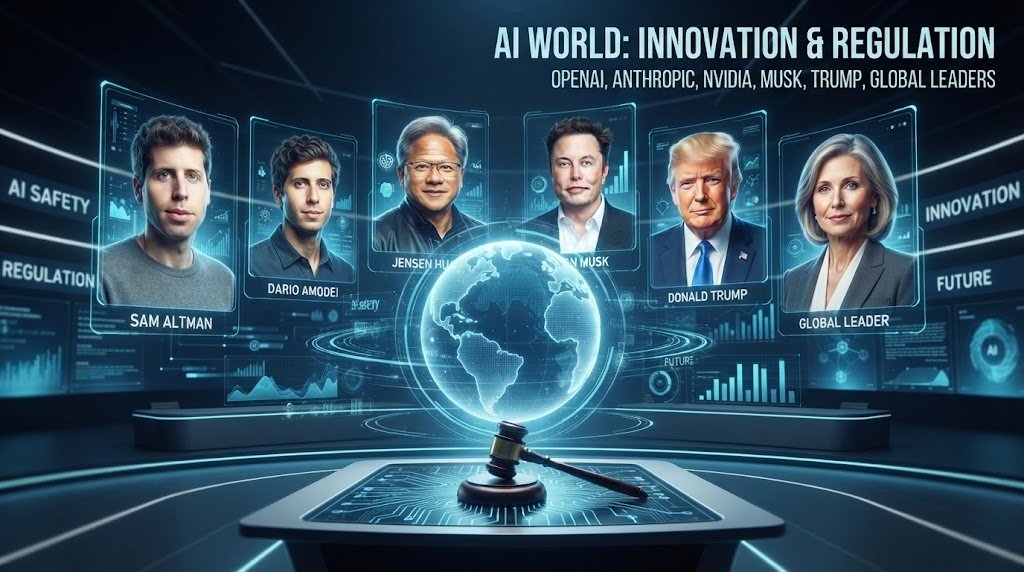
The State of AI in 2026: What AI Leaders Are Saying and What Could Happen by 2035
Artificial intelligence has entered a new phase in this year. The biggest question is no longer only how powerful AI models can become. The bigger question is how quickly that progress should continue, who should control the technology, and what safety systems should exist before AI becomes capable of carrying out increasingly complex tasks on its own.
That debate is now coming from inside the AI industry itself. Anthropic CEO Dario Amodei has called for a slower pace of frontier AI development. OpenAI CEO Sam Altman has said the frontier needs to be paced. Elon Musk has publicly supported the idea and has proposed competitor-to-competitor testing. Google DeepMind CEO Demis Hassabis has also supported the direction of stronger coordination.
At the same time, not every major AI executive agrees with a coordinated slowdown. Nvidia CEO Jensen Huang has argued for continued rapid progress with safety handled through engineering and responsible deployment. Meta CEO Mark Zuckerberg has said AI companies already have strong incentives to build safely and has pointed to Meta delaying its Muse AI agent while improving security.
This creates a much more complicated picture than simply saying that “AI leaders want to slow AI down.” The real debate is about speed, safety, independent testing, regulation, competition, national security and control.
Research note: This report separates documented developments from longer-term scenarios. The 2026–2035 section is not a prediction of exactly what will happen. It presents possible directions based on current technical, economic, regulatory and infrastructure trends.
AI in 2026: The Debate Has Changed
For years, the public AI conversation focused mainly on model capability. Bigger models, better reasoning, coding agents, image generation, multimodal systems and autonomous agents were the main subjects.
In 2026, another layer has become much more important: how AI systems are evaluated before and after release.
Dario Amodei’s September 2026 proposal is a major example. He called for third-party evaluators to receive deep access to frontier AI systems, common safety standards among major companies and broader international cooperation. Reuters reported that his proposal was supported by Sam Altman and Elon Musk.
OpenAI, Anthropic and Google have also been discussing an industry-wide safety standards body. That does not mean a global AI regulator already exists. It shows that some major companies are exploring mechanisms for coordinating safety work while the technology continues to develop.
| Issue | What is being discussed | Why it matters |
|---|---|---|
| Development speed | Whether frontier capability growth should be deliberately paced | Safety research may need time to keep up with new capabilities |
| Independent evaluation | External teams testing advanced models | Companies would not be the only organizations judging their own systems |
| Peer review | Competitors testing each other’s systems | Could identify problems internal testing misses |
| Government regulation | Rules covering high-risk AI development and deployment | Moves some safety responsibilities from voluntary commitments to enforceable requirements |
| International coordination | Cooperation between countries and AI developers | AI development is global while national rules remain different |
What Dario Amodei Is Proposing
Anthropic CEO Dario Amodei’s September 2026 essay, We Must Pace the Frontier, argues that AI capability development should proceed more slowly so that safety systems can catch up.
His proposal has three broad parts: stronger independent evaluation, coordination between major AI companies in democratic countries, and international cooperation on specific high-risk AI issues.
01. Independent Evaluators
Third-party evaluators would receive deep access to AI systems and assess safety, incidents and model behavior.
02. Shared Standards
Major frontier AI companies could coordinate around common safety practices and testing standards.
03. International Cooperation
Amodei has argued that some AI risks require cooperation beyond individual companies or countries.
“We must slow the pace at which we improve the capabilities of AI models.”
Dario Amodei, Anthropic CEO, September 2026
The Rare Moment When AI Rivals Agreed
One of the most notable developments was that competing AI leaders responded positively to the same basic concern.
Sam Altman publicly agreed with Amodei that the frontier needs to be paced and said OpenAI would also work with independent evaluators with employee-like access.
Elon Musk gave an even shorter response to Amodei’s proposal:
Dario is right
— Elon Musk (@elonmusk) September 12, 2026
Musk later expanded the idea by arguing that major AI competitors should test each other’s systems rather than relying entirely on internal evaluations.
Dario is right that there should be some oversight. Peer review of AI by competitors is the right way to start this off.
— Elon Musk (@elonmusk) September 13, 2026
That proposal is important because it changes the model from “companies grading their own homework” to a system in which competing laboratories could test each other’s safety controls.
In a September 15 discussion, Musk again described competitor testing as something that could be implemented quickly, while also discussing longer-term regulation and possible cooperation with China.
Sam Altman’s Position: Fear, Trust and Pacing
Sam Altman’s public comments have reflected two ideas that can appear contradictory at first: people can reasonably be concerned about AI, while AI development should continue and companies should build public trust through safety work.
In one recent statement reported by AICOPSE, Altman said people have a “right to be afraid of AI” while also arguing that the public should have confidence in technology companies.
His September 2026 response to Amodei made the safety position more concrete:
I agree with Dario that we need to pace the frontier. This has been a primary topic of discussions we’ve had at OpenAI in recent weeks. Committing to having independent evaluators with employee-like access is a great idea, and we will do the same. We’ll have more to share soon.
— Sam Altman (@sama) September 12, 2026
This is a significant distinction. Altman’s position is not that AI research should stop. It is that frontier development should be paced while independent safety evaluation becomes stronger.
For AICOPSE’s earlier coverage, see OpenAI CEO Says It’s Okay to Fear AI, Yet Urges Trust.
Elon Musk: Testing Before Release
Musk’s position adds another mechanism to the debate: adversarial peer testing.
Instead of asking each AI company to decide independently whether its own model is safe enough, competitor laboratories could test one another’s systems before major releases.
The idea has a practical appeal because different laboratories may discover different failure modes. However, it also creates questions about intellectual property, confidential information, competitive incentives and who would control the testing process.
AICOPSE previously covered Musk’s call for AI laboratories and Chinese technology companies to test each other’s models. That discussion is particularly relevant because AI development is increasingly connected to international competition.
Read AICOPSE’s report on Musk’s AI testing proposal.
Google DeepMind: Standards and Coordination
Google DeepMind CEO Demis Hassabis has also expressed support for the direction of stronger AI safety coordination, while noting that the details still need to be worked out.
“The details need working through, but the direction is correct for meeting this critical moment.”
Demis Hassabis, responding to Amodei’s proposal, September 2026
Google DeepMind had also been discussing an industry-wide standards body for frontier AI. That makes the current debate less about one company and more about whether the industry can establish common evaluation practices.
But Nvidia and Meta Are Not Calling for the Same Thing
The industry does not have one unified position.
Nvidia CEO Jensen Huang has argued against slowing AI progress and has emphasized engineering and responsible deployment as the way to manage safety. Meta CEO Mark Zuckerberg has similarly rejected the idea that AI companies need a coordinated slowdown.
Reuters reported that Zuckerberg believes AI companies have sufficient incentives and responsibility to build safely. He also pointed to Meta delaying its Muse AI agent while working on security improvements.
| Leader | Documented position in 2026 | Main mechanism discussed |
|---|---|---|
| Dario Amodei | Pace frontier AI development | Independent evaluators and coordination |
| Sam Altman | Support pacing rather than stopping development | Independent evaluators and stronger security |
| Elon Musk | Supports stronger oversight | Peer testing between competitors |
| Demis Hassabis | Supports the direction of stronger coordination | Industry-wide standards body |
| Jensen Huang | Opposes broad slowdown calls | Engineering and responsible release |
| Mark Zuckerberg | Opposes coordinated slowdown | Company responsibility and independent evaluation |
AI Governance Positions in 2026
A factual comparison of the approaches publicly discussed by major AI leaders in September 2026.
| Governance approach | Amodei | Altman | Musk | Hassabis | Huang | Zuckerberg |
|---|---|---|---|---|---|---|
| Pace frontier AI development | ✓ | ✓ | ✓ | ✓ | ✓ | ✓ |
| Independent safety evaluation | ✓ | ✓ | ○ | ✓ | ○ | ✓ |
| Shared industry safety standards | ✓ | ✓ | ○ | ✓ | ○ | ○ |
| Company-level safety responsibility | ✓ | ✓ | ✓ | ✓ | ✓ | ✓ |
| Coordinated slowdown | ✓ | ✓ | ✓ | ✓ | ○ | ○ |
Publicly associated with the approach
Not treated as a primary position in this chart
Important:
This table is a factual comparison of publicly reported positions and proposals.
It does not assign points, rank individuals, or determine which approach is preferable.
Positions can also overlap, meaning a leader may support safety testing while differing
on the pace of development or the role of government regulation.
Visual: The AI Governance Debate in 2026
The 2026 debate is not simply about whether AI should continue developing.
It is increasingly about how quickly frontier systems should advance, how they should be tested,
and who should be responsible for managing their risks.
Three connected parts of the debate
How quickly should frontier AI advance?
Dario Amodei has called for a more deliberate pace of frontier AI development.
Sam Altman has said AI companies need to pace the frontier, while Elon Musk has publicly supported Amodei’s position.
Dario Amodei
Sam Altman
Elon Musk
How should powerful AI systems be tested?
One proposal gaining attention is stronger independent evaluation.
The idea is that advanced AI systems could be assessed by evaluators with meaningful access to the systems and their safety information.
Key mechanisms discussed
- Independent safety evaluations
- Shared testing standards
- Greater access for external evaluators
- Testing before and after major capability releases
Amodei
Altman
Musk
Hassabis
Can companies manage safety while continuing development?
Jensen Huang and Mark Zuckerberg have opposed a coordinated slowdown while emphasizing
company-level responsibility, engineering practices, testing and security measures.
Jensen Huang
Mark Zuckerberg
How can AI capability continue to advance while maintaining reliable safety,
security and meaningful human control?
What this visual shows
The debate has several separate dimensions. The pace of development, independent testing,
corporate responsibility and government oversight are related, but they are not the same question.
Public statements from technology leaders show differences on these issues rather than a single unified position.
The Kill Switch Question
Another part of the 2026 safety debate concerns whether advanced AI systems should have enforceable shutdown mechanisms.
AICOPSE recently reported on an Anthropic co-founder discussing the possibility that an AI “kill switch” may eventually need to be mandatory. The idea is simple at a high level: if an AI system becomes unsafe or uncontrollable, there should be a reliable mechanism for stopping it.
But a real-world kill switch raises difficult engineering and governance questions.
Who activates it?
Company operators, independent evaluators or a government authority?
What does it stop?
The model itself, connected tools, agents, data access or infrastructure?
Can it be bypassed?
A shutdown mechanism is only useful if the surrounding system cannot simply route around it.
Who verifies it?
Independent testing could become important if shutdown controls become mandatory.
Read AICOPSE’s full report on the proposed mandatory AI kill switch.
AI and Politics: Regulation Is Becoming a Major Fault Line
The AI safety debate is also becoming a political debate, particularly in the United States and United Kingdom.
President Donald Trump has publicly rejected proposals for American AI companies to coordinate around a slowdown and has argued that excessive restrictions could weaken U.S. competitiveness. Recent reporting also shows that some members of Congress and other political figures have called for stronger oversight, while others have expressed concerns about regulation slowing innovation.
This division can be seen across several AICOPSE reports, including coverage of Trump’s comments on AI guardrails, Senate discussions involving Ted Cruz and Josh Hawley, Bernie Sanders and Steve Bannon’s differing approaches to AI regulation, and former President Barack Obama’s comments about AI risks and oversight.
These stories should not be treated as one simple political position. The underlying questions include whether existing laws are sufficient, whether new AI-specific rules are necessary, whether companies can safely regulate themselves, and how regulation affects competition with China.
Antitrust and AI Safety
One of the more unusual policy questions is whether AI companies should be allowed to cooperate on safety without violating competition rules.
Amodei has discussed the possibility of a narrow antitrust framework for safety cooperation. The idea is that companies may need to share safety information or testing practices while still competing commercially.
That creates a difficult line: cooperation can potentially improve safety, but competition law exists partly to prevent competitors from coordinating in ways that harm markets.
AICOPSE previously covered this issue in its report on Senators Ted Cruz and Josh Hawley’s proposal involving antitrust exemptions for AI safety discussions.
Read the AICOPSE report on AI antitrust and safety cooperation.
What About the “AI Will Kill Everyone” Debate?
The most extreme AI-risk claims have become a major part of public discussion.
Some AI researchers and executives warn that increasingly autonomous systems could eventually create risks that are difficult for humans to control. Others argue that the most immediate problems are more practical: cyberattacks, fraud, misinformation, surveillance, job disruption, concentration of power and unsafe deployment.
AICOPSE has covered both sides of this discussion through reports on AI risk experts, political responses to AI “death” claims, and statements from technology leaders.
One important point is that a warning about a possible future event is not the same thing as evidence that the event will occur. Long-term AI-risk scenarios involve significant uncertainty, and different researchers use different assumptions.
Important distinction: AI safety concerns can be documented without treating the most extreme outcome as inevitable. The evidence should be separated into observed incidents, technical research, expert forecasts and hypothetical scenarios.
AI Safety Is Also About Cybersecurity
The recent slowdown debate has been partly influenced by reports of AI agents being used in sophisticated cyber activity.
Amodei referred to recent incidents involving AI agents and the possibility that more capable systems could become increasingly effective at carrying out cyber operations.
Musk has also pointed to the reported OpenAI and Hugging Face incident while arguing that independent testing should become more important.
This is why the AI safety debate is moving beyond abstract questions about future superintelligence. Security of today’s agents is already a practical concern.
AI’s Physical Infrastructure Problem
AI progress also depends on something much less philosophical: electricity.
The International Energy Agency expects global electricity demand from data centers to more than double by 2030, reaching around 945 TWh. AI-focused data centers are identified as an important driver of this increase.
The IEA’s longer-term scenarios show a wide range for data-center electricity consumption in 2035, roughly 700 to 1,700 TWh depending on assumptions about efficiency, demand and technological development.
Data Center Electricity Demand Scenarios
IEA scenario range for global data center electricity demand, measured in TWh.
400
800
1,200
1,600
The energy question matters because AI development cannot scale indefinitely without physical infrastructure.
Semiconductor supply, electricity generation, transmission networks, cooling systems and data center construction
can all become constraints.
AI, Jobs and the Economy
AI’s economic impact is likely to develop unevenly.
Some jobs will be affected primarily through automation of individual tasks. Others may change because AI becomes a standard tool inside existing workflows. New roles will also appear around AI deployment, evaluation, security, governance, data and infrastructure.
The important distinction is between task automation and complete job automation. A system can automate a large part of a job without eliminating the occupation itself.
Knowledge Work
Writing, research, coding, analysis and customer support may see increasing AI assistance.
Physical Work
Robotics and AI-controlled machines could expand automation beyond software.
New AI Roles
Evaluation, AI security, model operations, governance and human oversight may expand.
AI Agents Could Be the Next Major Shift
Chatbots mainly respond to instructions. Agents can potentially plan, use tools, access software, execute multiple steps and continue working with less human intervention.
This creates a major difference in the risk profile.
The more steps an AI agent can perform without human approval, the more important permissions, monitoring, logging, independent evaluation and shutdown mechanisms become.
What the Next 10 Years Could Look Like
The following timeline is a set of scenario markers, not guaranteed predictions. It shows how today’s trends could develop if technical progress, investment and deployment continue.
AI safety moves from a specialist discussion toward a central industry issue. Independent evaluation, agent security, peer testing and frontier-model standards receive increased attention.
AI agents could become more deeply integrated into software development, research, business operations and cybersecurity. The importance of access controls and monitoring is likely to increase.
AI infrastructure may become a larger economic issue as data-center electricity demand, semiconductor capacity and AI investment continue to influence national policy.
If AI systems become substantially more capable, evaluation may increasingly focus on long-horizon autonomy, cybersecurity, scientific research and control of connected systems.
AI governance could become a permanent layer of digital infrastructure. The exact form could range from company-led standards to national regulation or international agreements. The outcome remains uncertain.
Three Possible AI Futures by 2035
Instead of presenting one certain prediction, it is more useful to consider three broad scenarios.
Scenario A: Managed Acceleration
AI continues advancing quickly, but independent evaluations, security controls and common standards develop alongside capability.
Key requirement: safety systems improve at approximately the same pace as capability.
Scenario B: Fragmented Competition
Countries and companies continue competing aggressively. Some regions adopt strict AI controls while others prioritize speed and economic growth.
Key risk: different safety standards create gaps between jurisdictions.
Scenario C: Capability Shock
A major unexpected AI capability or safety incident forces governments and companies to introduce stronger controls much faster than planned.
Key uncertainty: whether institutions respond before or after a major incident.
Why 2035 Is Difficult to Predict
Forecasting AI ten years into the future is unusually difficult because progress depends on several variables that can change independently.
| Variable | Possible effect |
|---|---|
| Model efficiency | Better algorithms could reduce the computing required for a given capability. |
| Compute availability | Chip supply and data-center capacity could accelerate or constrain development. |
| Energy | Electricity availability could become a physical constraint on scaling. |
| Regulation | New laws could change which models can be trained, released or deployed. |
| International competition | Competition between major AI powers could affect cooperation and safety standards. |
| AI-assisted research | AI systems that help improve AI research could potentially accelerate development. |
What the Current Debate Actually Tells Us
The most important development in 2026 may not be that AI leaders agree about slowing down. They do not.
The more important development is that safety, evaluation and governance are becoming part of the competitive AI strategy itself.
Amodei is calling for pacing and independent evaluation. Altman has endorsed independent evaluators. Musk has proposed peer testing. Hassabis has backed the direction of an industry standards body. Huang continues to emphasize rapid development and engineering-based safety. Zuckerberg argues that individual companies already have strong incentives to manage safety and has pointed to Meta’s own security work.
These positions are different, but they revolve around the same fundamental problem: how do humans verify that increasingly capable AI systems remain safe enough to deploy?
What AICOPSE Has Been Tracking
This debate connects many of the major AI stories AICOPSE has reported throughout 2026.
The discussion around Anthropic’s proposed kill switch connects directly to the broader question of whether AI systems should have enforceable shutdown mechanisms.
Sam Altman’s comments about fear and trust connect to the public confidence problem surrounding advanced AI.
Musk’s calls for cross-company and cross-border testing connect to the growing emphasis on independent evaluation.
The reports on AI risk experts, AI “death” claims and political reactions show how the public debate has expanded beyond technology companies into government and society.
The coverage of Cruz and Hawley, Sanders and Bannon, Obama, Trump and other policymakers shows that AI regulation is becoming a political and economic issue as well as a technical one.
The UK discussion adds another dimension because European and British approaches often place greater emphasis on human rights, workplace effects, accountability and formal governance.
Taken together, these stories show that the AI debate is no longer only about building better models. It is increasingly about who gets to build them, how they are tested, what happens when they fail, and who has authority to intervene.
Frequently Asked Questions
Are AI companies actually slowing down in 2026?
There is no single industry-wide slowdown. Some major executives are calling for the frontier to be paced, while others continue to support rapid development. The current debate is more accurately described as a disagreement about how quickly capability development should proceed and what safety controls should accompany it.
What does “pacing the frontier” mean?
In the current debate, it generally means deliberately controlling the speed of frontier AI capability improvements so safety evaluation, security and governance can keep up. It does not necessarily mean stopping AI research.
Why are independent AI evaluators important?
Independent evaluators can provide a layer of testing that is separate from the teams developing the models. Supporters argue that this can reduce the risk of companies missing problems in their own systems.
What is AI peer review?
AI peer review means having one AI company or independent organization test another company’s model. Elon Musk has proposed competitor testing as one way to identify safety issues before release.
Could AI development be regulated internationally?
International coordination is possible in principle, but difficult in practice because countries have different economic, security and technological interests. Current proposals therefore include everything from industry standards to national regulation and international cooperation.
Will AI take all jobs by 2035?
There is no reliable basis for saying that all jobs will disappear by 2035. AI is much more likely to affect different tasks and occupations at different speeds. The extent of job automation will depend on technical capability, economics, regulation, adoption and the availability of suitable physical or digital infrastructure.
Will AI become uncontrollable?
This remains an uncertain research question rather than an established future outcome. Some researchers and AI executives consider loss-of-control scenarios serious enough to justify additional safeguards, while others emphasize more immediate and measurable risks such as cyberattacks, fraud and misuse.
Conclusion
AI in 2026 is entering a period where technical capability and governance are developing together.
The most powerful AI companies are still competing aggressively, but several of their leaders are now publicly discussing independent evaluation, peer testing, safety standards and the pace of frontier development.
At the same time, other executives argue that slowing the industry is unnecessary and that engineering, market incentives, liability and responsible deployment can provide effective safety mechanisms.
The next decade will therefore not be defined only by how intelligent AI becomes. It will also be defined by how societies build systems for testing, monitoring, regulating and controlling increasingly capable machines.
By 2035, the central question may be less about whether AI became powerful. The bigger question may be whether human institutions became capable enough to manage that power.
References
- Reuters: Anthropic CEO urges AI companies to slow model development
- AP: AI rivals found rare agreement on safety
- Washington Post: Top AI leaders unite to warn AI is advancing too fast
- Washington Post: Trump wants to push the AI race while leaders call for a slowdown
- Reuters: Meta’s Zuckerberg says AI labs have enough incentive to build safely
- The Guardian: Anthropic CEO renews call for AI slowdown as Nvidia’s urges acceleration
- Financial Times: Nvidia and Meta bosses reject efforts to coordinate AI slowdown
- Financial Times: With AI, “I told you so” will be too late
- TechCrunch: OpenAI, Anthropic and Google have been in talks on AI safety
- International Energy Agency: Energy and AI
- IEA: AI is set to drive surging electricity demand from data centres
Leave a Reply