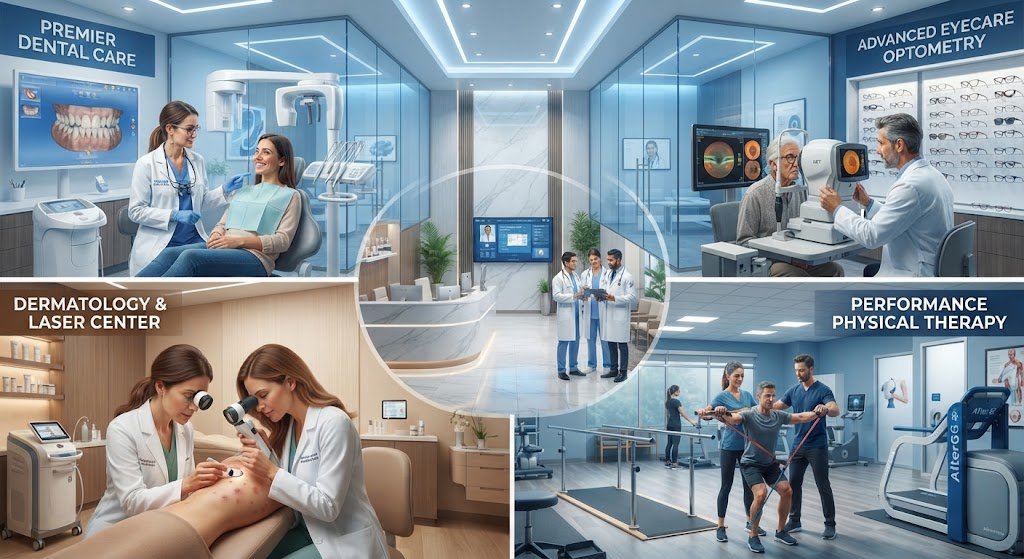
Primary topic: Artificial Intelligence in Specialty Clinics: Dental, Eyecare, Dermatology, and Physical Therapy
Research focus: AI adoption, clinical decision support, medical imaging, computer vision, predictive analytics, workflow automation, generative AI, remote monitoring, and healthcare modernization.
AI in Specialty Clinics: Dental, Eye, Skin & Physical Therapy
Specialty clinics operate differently from general medical practices. Each specialty has its own clinical workflows, imaging methods, measurements, documentation requirements, and patient journeys.
That makes specialty healthcare an especially interesting environment for artificial intelligence. AI can be trained or configured around a defined clinical problem rather than being asked to solve healthcare as a whole.
Dental clinics produce radiographs, intraoral photographs, scans, treatment plans, and structured clinical records. Eyecare clinics generate fundus photographs, optical coherence tomography images, visual measurements, and diagnostic reports.
Dermatology clinics work heavily with photographs, dermoscopic images, lesion histories, pathology results, and longitudinal skin monitoring. Physical therapy clinics collect movement assessments, range-of-motion measurements, exercise data, functional scores, and rehabilitation progress.
These data types create opportunities for Machine Learning, Computer Vision Development, Custom AI Model Development, Data Analytics & AI Insights, and Generative AI.
The opportunity is not simply to place a chatbot inside a clinic. A useful AI system should understand the workflow around the clinical task.
For example, an AI model that identifies a suspicious retinal image is only one part of the process. The clinic also needs image-quality checks, patient identification, clinician review, referral routing, documentation, and follow-up.
The same principle applies to dental, dermatology, and physical therapy applications.
AI should therefore be treated as a workflow capability rather than an isolated software feature.
Recent research provides evidence across all four specialties. The evidence is strongest for selected diagnostic and analytical tasks, while real-world implementation remains an important area for further validation.
Our Key Findings
Our review of current research across dental, eyecare, dermatology, and physical therapy produces eight important findings.
1. Specialty clinics are well suited to focused AI applications
Specialty clinics often perform repeatable tasks using structured or image-based information. This creates a strong environment for targeted AI systems.
A dental practice may repeatedly review bitewing radiographs. An eye clinic may repeatedly analyze retinal images. A dermatologist may evaluate skin lesions. A physical therapist may assess movement patterns across multiple sessions.
These repeated workflows can produce consistent datasets and measurable outcomes.
2. Computer vision is one of the most important capabilities
Computer vision can analyze photographs, radiographs, retinal images, dermoscopic images, and movement recordings.
This makes it particularly relevant to specialty healthcare.
The technology can identify patterns that require further professional assessment. It can also support segmentation, classification, measurement, and quality control.
3. AI can support specialists without replacing them
Several studies show that AI can improve or complement professional decision-making.
A prospective ophthalmology study found that a deep learning system improved diagnostic consistency among junior ophthalmologists.
A randomized dermatology trial also found that AI assistance improved diagnostic accuracy among nondermatology trainees.
The practical model is therefore human-AI collaboration.
4. Real-world performance can differ from laboratory performance
This is one of the most important findings for healthcare leaders.
A model can perform extremely well on a curated research dataset but behave differently with real patients, different cameras, different image quality, and different populations.
A 2026 prospective dermatology study demonstrated this problem clearly. Smartphone image capture failed for a meaningful proportion of lesions, and diagnostic performance varied by smartphone model.
5. AI should create an action, not just a score
A prediction has limited value if nobody knows what to do with it.
A useful AI workflow connects the prediction to an appropriate action.
That action could be clinician review, patient recall, referral, additional imaging, exercise modification, or follow-up.
6. Generative AI is strongest in language-heavy workflows
Generative AI can summarize records, prepare drafts, organize patient information, generate educational material, and assist with documentation.
It can also help specialty clinics manage repetitive communication.
However, clinical content requires appropriate review because generated information can be incomplete or incorrect.
7. Integration is as important as model accuracy
Specialty clinics already use practice-management systems, EHRs, imaging platforms, scheduling systems, patient portals, and billing software.
AI should work with these systems whenever possible.
AI Integration and Deployment can therefore determine whether a technically strong solution becomes a useful clinical product.
8. Evidence and governance will separate serious AI products from AI hype
Healthcare organizations increasingly need evidence before adopting AI.
They need to know how a system was validated, where it works, where it fails, and how performance will be monitored after deployment.
The FDA has emphasized lifecycle oversight and real-world performance monitoring for AI and machine-learning medical software. The WHO has also emphasized safety, ethics, human rights, accountability, and governance in healthcare AI.
Research Evidence: Five Major Specialty-Clinic Studies
The following research provides practical evidence for organizations evaluating AI in specialty healthcare.
Study 1: AI-Assisted Dental Caries Detection
The ADEPT study evaluated whether AI could help dentists identify enamel-only proximal caries on bitewing radiographs.
The study included 23 dentists. The researchers provided 24 bitewing radiographs containing 65 enamel-only carious lesions and 241 healthy proximal surfaces.
Dentists were divided into groups with and without AI assistance.
The control group detected 44.3% of the carious lesions. The AI-assisted group detected 75.8%.
That represents a substantial improvement in sensitivity.
However, the AI-assisted group also incorrectly identified more healthy surfaces as carious. False-positive identification occurred in 14.6% of healthy surfaces compared with 3.7% in the control group.
| Measure | Without AI | With AI |
|---|---|---|
| Carious lesions detected | 44.3% | 75.8% |
| Healthy surfaces incorrectly flagged | 3.7% | 14.6% |
| Dentists included | 23 dentists | |
| Radiographs evaluated | 24 bitewings | |
The lesson is important. AI can increase detection, but higher sensitivity can also produce additional false positives.
Dental AI should therefore assist clinical interpretation rather than automatically determine treatment.
Original research: The ADEPT study on AssistDent AI and enamel-only proximal caries.
Study 2: AI Diagnostic Support for Dental Caries
A separate randomized clinical trial examined AI-based diagnostic support for proximal caries detection on bitewing radiographs.
The study involved 22 dentists. Each dentist evaluated bitewing images with and without AI assistance.
The AI system used a fully convolutional neural network.
The researchers compared dentist performance against an expert reference standard.
The study is valuable because it evaluated AI inside the diagnostic process rather than simply measuring an algorithm on a dataset.
This distinction matters for clinical adoption.
A model may produce a strong technical score, but the more useful question is whether professional performance changes when the model is introduced into the workflow.
A 2024 randomized study also examined how AI changed dentists’ visual attention during caries detection. Dentists using AI showed more fixations on teeth with restorations, suggesting that AI can influence how clinicians inspect images.
These findings support the idea that AI changes human decision processes rather than simply producing an independent answer.
Original research: Artificial intelligence for caries detection: Randomized trial.
Related research: Impact of artificial intelligence on dentists’ gaze during caries detection.
Study 3: AI-Assisted Ophthalmology Diagnosis
A prospective multicenter clinical trial evaluated a deep learning system designed to assist junior ophthalmologists in diagnosing 13 major fundus diseases.
The researchers prospectively collected 1,493 fundus images from 748 patients across five tertiary hospitals.
Nine junior ophthalmologists participated in the study.
The diagnostic consistency of junior ophthalmologists was 72.9% without AI. With AI assistance, consistency increased to 84.9%.
The improvement was approximately 12 percentage points.
The researchers also reported that AI-assisted clinicians achieved sensitivities ranging from 72.2% to 100% across the 13 diseases.
Specificities ranged from 90.8% to 98.7%.
The AI system itself achieved 95.7% sensitivity and 87.2% specificity for detecting any fundus abnormality.
| Measure | Without AI | AI-Assisted |
|---|---|---|
| Diagnostic consistency | 72.9% | 84.9% |
| Improvement | Baseline | Approximately +12 percentage points |
| Any fundus abnormality sensitivity | Not applicable | 95.7% |
| Any fundus abnormality specificity | Not applicable | 87.2% |
This study demonstrates a strong use case for Computer Vision Development.
The model does not need to replace the ophthalmologist. It can provide another layer of information that helps a clinician reduce missed findings.
Original research: Prospective multicenter clinical trial of deep learning for 13 fundus diseases.
Study 4: AI for Skin Cancer Assessment
Dermatology is another specialty where computer vision has significant potential.
A randomized controlled trial evaluated whether AI could improve the diagnostic accuracy of physicians assessing suspicious skin lesions.
The study used 576 consecutive cases with suspicious lesions.
The AI-assisted group achieved 53.9% diagnostic accuracy. The unaided group achieved 43.8%.
The difference was statistically significant.
The improvement was particularly strong among less-experienced nondermatology trainees.
Their accuracy increased from 30.7% without AI to 54.7% with AI.
However, the researchers also reported a 12.2% decrease in Top-1 accuracy when all three AI predictions were incorrect.
This is an important safety lesson.
Clinicians can benefit from AI, but incorrect AI suggestions can also influence human decisions.
The system therefore needs careful interface design, clinical training, monitoring, and professional oversight.
Original research: Randomized controlled trial of AI-assisted diagnosis of skin neoplasms.
Study 5: Real-World Smartphone AI for Skin Cancer
A 2026 prospective diagnostic accuracy study evaluated an AI-based smartphone application for skin cancer detection.
The study included 1,458 participants with 1,904 lesions of concern.
Researchers identified 185 skin cancers, including 32 melanomas.
The study provides an especially useful real-world perspective because it examined photographic conditions, smartphone models, and user-generated images.
Image capture failed in 16.6% of lesions even under optimal conditions.
For successfully captured lesions, the AI achieved 82.5% sensitivity and 76.8% specificity for skin cancer detection.
When teledermatology review was combined with the AI output, specificity increased to 86.8%, while sensitivity was 75.3%.
The researchers also found important differences between smartphone models.
This demonstrates why healthcare AI should not be evaluated only in controlled laboratory datasets.
| Study Measure | Reported Result |
|---|---|
| Participants | 1,458 |
| Lesions assessed | 1,904 |
| Skin cancers identified | 185 |
| Melanomas identified | 32 |
| Image capture failure | 16.6% |
| CNN sensitivity | 82.5% |
| CNN specificity | 76.8% |
| CNN + teledermatology specificity | 86.8% |
Original research: Prospective smartphone AI study for skin cancer detection.
Study 6: Computer Vision for Physical Therapy
Physical therapy presents a different AI opportunity.
Instead of analyzing a static medical image, AI can analyze movement over time.
Researchers developed a computer-vision system using a modular neural network to assess physical therapy rehabilitation activities.
The system included one module for exercise recognition and another for measuring how correctly an exercise was performed.
Both modules achieved more than 90% accuracy in recognition and validation.
The approach used visual signals to track body joints during rehabilitation exercises.
This could support remote rehabilitation by giving therapists structured information about exercise performance.
The value is particularly relevant for home-based therapy.
A therapist may not be physically present during every exercise session. Computer vision could help collect additional information between clinical appointments.
However, the study should not be interpreted as proof that AI can replace a physical therapist.
The clinical value depends on how movement data is interpreted and how the therapist responds.
Original research: Computer vision for automatic assessment of physical therapy rehabilitation activities.
Research Data Visualization
The following visualization compares selected findings from the research discussed in this report.
Selected AI Research Indicators
Dental caries detection with AI assistance
AI-assisted ophthalmology diagnostic consistency
Dermatology AI-assisted diagnostic accuracy
Physical therapy exercise recognition accuracy
Note: These results come from different studies, populations, technologies, reference standards, and clinical tasks. They are not directly comparable measures of AI quality.
Dental Clinics: How AI Is Transforming Care
Dental AI is already moving beyond simple administrative automation.
The strongest opportunities are connected to imaging, detection, treatment planning, patient communication, and practice operations.
AI Analysis of Dental Radiographs
AI can examine bitewing, panoramic, and other dental radiographs for specific findings.
Potential applications include caries detection, bone-level assessment, periapical findings, and other image-based tasks where appropriate validation exists.
The system can highlight areas that deserve closer inspection.
The dentist can then confirm the finding and make the clinical decision.
Orthodontic Planning
Computer vision can identify cephalometric landmarks on radiographs.
It can then support automated measurements and digital treatment planning.
A 2024 umbrella review found that AI performance in cephalometric landmark identification varies significantly between landmarks and imaging approaches.
This means orthodontic AI should remain an assistive technology where professional review is required.
Research source: Automatic cephalometric landmark identification with AI.
Dental Practice Automation
AI can also automate nonclinical workflows.
Useful applications include:
- Appointment scheduling and rescheduling.
- Patient reminder automation.
- Insurance and documentation assistance.
- Clinical note drafting.
- Patient education content.
- Post-treatment communication.
- Recall campaign prioritization.
- Treatment-plan explanations.
- Review and feedback analysis.
- Practice performance analytics.
Eyecare Clinics: Computer Vision and AI Screening
Eyecare is one of the strongest areas for computer vision because many diagnostic workflows rely on images.
Fundus photography, optical coherence tomography, slit-lamp images, and other imaging technologies can create datasets suitable for AI analysis.
Retinal Disease Screening
AI can evaluate retinal images for selected diseases and abnormalities.
Diabetic retinopathy is an important example.
A 2026 prospective validation study evaluated AI-assisted diabetic retinopathy screening in primary care.
The researchers studied 183 patients and 336 images.
When all images were included, the AI-assisted workflow achieved 73.7% sensitivity, 90.2% specificity, and an AUC of 0.82.
After excluding poor-quality images, sensitivity increased to 80.0% and AUC increased to 0.84.
The study also found that image quality had a meaningful effect on performance.
This is exactly why an effective Computer Vision Development project needs an image-quality layer.
Multi-Disease Fundus Analysis
AI can potentially screen for multiple retinal conditions from the same imaging workflow.
The prospective multicenter ophthalmology study discussed earlier evaluated 13 major fundus diseases.
The AI system showed sensitivities between 83.3% and 100% across the diseases evaluated.
Such systems could help prioritize cases for specialist review.
They may be particularly valuable in clinics where specialist capacity is limited.
Patient and Workflow Support
Eyecare AI can also support:
- Pre-screening before clinician examination.
- Image-quality assessment.
- Retinal abnormality detection.
- Clinical report drafting.
- Patient education.
- Referral prioritization.
- Follow-up reminders.
- Population screening analytics.
- Longitudinal image comparison.
- Operational demand forecasting.
Dermatology Clinics: AI for Skin Assessment
Dermatology is another image-rich specialty.
Skin photographs and dermoscopic images can be analyzed by computer vision models trained for specific diagnostic tasks.
Lesion Classification
AI can classify suspicious lesions into risk categories or diagnostic classes.
This can help clinicians decide which cases deserve closer attention.
Research has shown that AI can perform at levels comparable with clinicians for selected skin-lesion classification tasks.
A 2025 systematic review and meta-analysis of AI for skin conditions reported a pooled melanoma sensitivity of 86% and specificity of 94%.
However, the researchers also identified substantial risk of bias in many studies.
This means strong headline accuracy should not be treated as proof of universal clinical performance.
Real-World Image Quality
The 2026 prospective smartphone study provides a practical example.
More than one in six lesions could not be successfully captured even under optimal conditions.
User-generated photographs created additional challenges.
This means an AI dermatology product should include clear image-capture guidance and quality assessment.
Longitudinal Skin Monitoring
AI can also compare images over time.
A system could identify changes in size, shape, color, or other visual characteristics.
The clinician can then decide whether the change requires further assessment.
This creates an opportunity for Custom AI Model Development because different clinics may use different imaging equipment and follow different monitoring protocols.
Physical Therapy Clinics: AI for Movement and Rehabilitation
Physical therapy has a different relationship with AI.
The main data is often movement rather than static imagery.
Cameras, smartphones, wearables, force platforms, and motion sensors can create information about how a patient moves.
Computer Vision Exercise Assessment
Computer vision can estimate body-joint positions during exercises.
The system can compare movement against a defined exercise pattern.
It can then identify possible deviations for therapist review.
This can support home-based rehabilitation.
It can also provide structured data between in-person sessions.
Progress Monitoring
AI can compare movement measurements across sessions.
For example, a system could track:
- Range of motion.
- Movement symmetry.
- Exercise repetitions.
- Exercise completion.
- Movement speed.
- Balance indicators.
- Gait characteristics.
- Functional movement patterns.
- Patient adherence.
- Changes in performance over time.
The objective is to give the therapist more useful information.
The objective is not to remove the therapist from the rehabilitation process.
Predicting Rehabilitation Outcomes
Machine learning can also support prognosis.
A 2024 study involving 353 patients with spinal cord injury evaluated machine-learning methods for predicting gait recovery.
Random forest and decision-tree models produced root mean squared errors of 1.09 and 1.24 for the full participant group.
The study also identified initial functional ambulation as the most influential predictor.
This demonstrates how clinical data can support personalized rehabilitation planning.
Research source: Prediction of gait recovery using machine learning algorithms.
Industry Trends and Transformation
1. AI is moving into the clinical workflow
Healthcare AI is increasingly being used during real clinical work.
The 2026 American Medical Association physician survey found that 81% of surveyed physicians reported using AI professionally.
The most common uses included research summarization, documentation, chart summaries, patient communication, translation, and assistive diagnosis.
This shows that AI adoption is moving from experimentation toward routine professional use.
Source: American Medical Association 2026 Physician Survey.
2. Multimodal AI is becoming more relevant
Specialty clinics rarely depend on one data type.
A dermatologist may need an image and clinical history.
An ophthalmologist may need retinal images and patient information.
A physical therapist may need movement data, functional scores, and treatment history.
Multimodal AI can combine several information types.
This creates opportunities for Custom AI Model Development and Generative AI.
3. AI is becoming an infrastructure layer
The future clinic may not have one AI tool.
It may have multiple AI capabilities connected through a shared infrastructure.
The system could connect clinical records, imaging, scheduling, analytics, patient communication, and workflow automation.
This makes AI Integration and Deployment a strategic capability.
4. Remote care is expanding AI’s role
Smartphones and connected devices allow patients to generate healthcare data outside the clinic.
This can support remote monitoring.
Physical therapy is a strong example because movement can potentially be captured at home.
Dermatology can use patient-submitted photographs.
Eyecare can use portable imaging systems.
Dental workflows can use digital imaging and connected records.
5. AI agents will move beyond individual tasks
The next phase will involve multi-step workflow automation.
An AI agent could identify a care task, collect relevant information, prepare a draft, create a workflow task, and request professional approval.
The final clinical action can remain under human control.
Maximum AI Use Cases for Specialty Clinics
Specialty clinics can evaluate AI across clinical, operational, and patient-facing workflows.
Clinical Decision Support
AI can summarize relevant clinical information and highlight findings that deserve attention.
The clinician can then evaluate the evidence and make the final decision.
Medical Image Analysis
Computer vision can analyze dental radiographs, retinal photographs, dermoscopic images, and other validated clinical images.
Possible capabilities include classification, detection, segmentation, measurement, and image-quality assessment.
AI-Powered Triage
AI can collect patient information before an appointment.
It can organize symptoms and relevant history.
It can identify predefined escalation criteria and route cases according to approved clinical protocols.
Documentation Automation
Generative AI can convert clinician-patient conversations into draft notes.
It can structure information according to the clinic’s documentation format.
The clinician should review and finalize the note.
Patient Communication
AI can help create clear patient messages.
Examples include:
- Appointment preparation instructions.
- Post-treatment guidance.
- Exercise instructions.
- Eye examination explanations.
- Dental treatment explanations.
- Skin-care education.
- Follow-up reminders.
- Frequently asked questions.
- Multilingual communication.
- Administrative notifications.
Referral Automation
AI can identify missing referral information.
It can summarize relevant records.
It can organize supporting documentation.
It can also help prioritize referrals according to approved rules.
Patient Recall and Follow-Up
AI can identify patients who may need follow-up.
Dental clinics can use this for recall workflows.
Eyecare clinics can use it for screening reminders.
Dermatology clinics can use it for monitoring appointments.
Physical therapy clinics can use it for missed sessions or rehabilitation follow-up.
Revenue Cycle and Administrative Automation
AI can support documentation and coding workflows.
It can identify missing information before submission.
It can summarize records for administrative review.
These workflows can reduce repetitive manual work without changing the clinical decision itself.
Data Analytics and AI Insights
AI can analyze clinic-level information.
Useful metrics include appointment demand, cancellation rates, treatment volume, referral turnaround, patient retention, clinician workload, and service utilization.
The system can turn raw data into actionable operational insights.
Personalized Care Planning
Machine learning can identify patterns across patient characteristics and previous outcomes.
The resulting insights can support personalized treatment planning.
Clinical teams should still determine whether an AI-generated recommendation is appropriate for the individual patient.
AI Capability Map for Specialty Clinics
| AI Capability | Specialty Application | Primary Value |
|---|---|---|
| AI Development | Specialty-specific healthcare products | Product differentiation |
| AI Integration and Deployment | EHR, imaging, scheduling, and patient systems | Workflow adoption |
| AI Workflow Automation | Scheduling, referrals, recalls, and communication | Operational efficiency |
| Machine Learning | Risk prediction and outcome forecasting | Proactive care |
| Computer Vision Development | Radiographs, retinal images, skin images, and movement | Detection and measurement |
| Custom AI Model Development | Specialized diagnostic and operational tasks | Domain-specific performance |
| Data Analytics & AI Insights | Clinical and operational intelligence | Better decisions |
| Generative AI | Documentation, communication, and summaries | Lower administrative burden |
AI Workflow for Specialty Clinics
A practical specialty-clinic AI system should connect data, intelligence, professional review, and workflow action.
Patient Data
↓
AI Analysis
↓
Risk or Clinical Insight
↓
Professional Review
↓
Workflow Action
↓
Patient Follow-Up
↓
Outcome Measurement
For example, an eye clinic could capture a retinal image and run an AI quality check.
The system could then analyze the image and identify whether the predefined screening criteria are met.
A qualified professional could review the result before the patient is referred or cleared according to the clinic’s approved workflow.
This structure keeps AI connected to a real clinical process.
AI Integration and Legacy Modernization
Existing specialty clinics often have technology accumulated over many years.
A dental clinic may have a practice-management platform and separate imaging software.
An eye clinic may use several diagnostic devices.
A dermatology practice may store photographs in different systems.
A physical therapy clinic may use separate scheduling, assessment, and patient-management tools.
Replacing everything is rarely the best starting point.
AI Integration and Deployment can connect existing systems with new AI capabilities.
Existing Healthcare Systems
↓
Integration Layer
↓
AI Models + Analytics + Generative AI
↓
Clinical Workflow
↓
Professional Review
↓
Outcome Tracking
This approach allows organizations to modernize incrementally.
A clinic can begin with one workflow and measure the result before expanding.
AI Opportunities for Healthcare Startups
Healthcare startups should begin with a specific problem rather than beginning with an AI model.
A dental startup could develop image-based caries decision support.
An eyecare startup could build retinal screening infrastructure.
A dermatology startup could create validated lesion-monitoring workflows.
A physical therapy startup could develop movement-analysis and remote rehabilitation software.
The strongest startup opportunity often sits between the AI model and the workflow.
That layer can handle data preparation, model inference, user interaction, professional review, alerts, reporting, and outcome measurement.
A startup should also determine early whether its product is a general wellness tool, clinical decision-support system, or medical device.
That distinction can affect validation, documentation, risk management, and regulatory requirements.
Where AI Should Not Operate Alone
Healthcare AI should not independently make high-risk clinical decisions without appropriate validation, governance, and professional oversight.
Important risks include:
- Incorrect clinical predictions.
- Hallucinated information from generative AI.
- False-positive findings.
- False-negative findings.
- Image-quality failures.
- Algorithmic bias.
- Population differences.
- Privacy and security risks.
- Model drift after deployment.
- Weak integration with clinical systems.
- Unclear accountability.
- Patient misunderstanding of AI outputs.
The FDA’s AI and machine-learning action plan emphasizes good machine-learning practices, patient-centered transparency, and real-world performance monitoring.
The WHO also recommends an ethical and governance approach that places safety, accountability, human rights, and responsible use at the center of healthcare AI.
Healthcare organizations should therefore define governance before scaling AI across multiple specialties.
FDA source: FDA Artificial Intelligence and Machine Learning Action Plan.
WHO source: WHO Ethics and Governance of Artificial Intelligence for Health.
Future Predictions for AI in Specialty Clinics
Prediction 1: AI will become part of normal clinical software
Clinicians are unlikely to use AI as a separate destination for every task.
AI capabilities will increasingly appear inside existing clinical applications.
The user experience will become more important than the AI model itself.
Prediction 2: Multimodal AI will connect different clinical data
Future systems will combine images, clinical notes, measurements, laboratory results, audio, and patient-generated data.
This will allow specialty clinics to build richer patient profiles.
The challenge will be ensuring that every data source is reliable and appropriately validated.
Prediction 3: Computer vision will expand remote monitoring
Smartphone cameras and connected devices can turn patients into participants in data collection.
Physical therapy is particularly suitable for movement monitoring.
Dermatology can use photographs for longitudinal observation.
Eyecare can use portable imaging.
Dental care can use connected imaging workflows.
Prediction 4: AI agents will automate complete workflows
AI will increasingly perform sequences of related administrative tasks.
An agent could receive a patient request, gather information, prepare a draft, update a task queue, and request staff approval.
Sensitive clinical actions should continue to require appropriate human oversight.
Prediction 5: Custom models will become more valuable
General-purpose models are useful for broad language tasks.
Specialty clinics often need narrower capabilities.
A model trained or adapted for a particular imaging device, clinical population, or workflow can provide more relevant functionality.
This creates an opportunity for Custom AI Model Development.
Prediction 6: Evidence will become a competitive advantage
Healthcare organizations will increasingly ask for evidence before deployment.
They will want to know whether an AI system works in their environment.
They will also want to understand failure conditions.
Companies that publish transparent validation data can build stronger credibility than companies that rely only on marketing claims.
Industry Expert Recommendations
Recommendation 1: Start with a measurable workflow
Choose a problem that already has a measurable baseline.
Good examples include documentation time, screening throughput, referral turnaround, patient recall, exercise adherence, or image-review workload.
Measure the current process before introducing AI.
Recommendation 2: Keep clinicians in control of high-risk decisions
AI should provide useful information without creating false confidence.
The appropriate level of human review should depend on clinical risk.
The higher the potential harm from an incorrect decision, the stronger the validation and oversight should be.
Recommendation 3: Build for integration from the beginning
An AI tool should fit into the clinic’s existing environment.
EHR connectivity, imaging integration, scheduling access, authentication, audit logs, and data security should be considered during product design.
Integration should not be treated as a final technical task.
Recommendation 4: Build an AI governance process
Every specialty clinic using AI should define clear operational rules.
These rules should cover:
- Approved AI use cases.
- Permitted data sources.
- Patient privacy requirements.
- Human review requirements.
- Model validation.
- Performance monitoring.
- Incident reporting.
- Vendor accountability.
- Access control.
- Model change management.
Recommendation 5: Measure the complete outcome
A model’s accuracy is only one part of the evaluation.
Healthcare leaders should measure whether the complete workflow becomes safer, faster, more useful, or more affordable.
| Category | Recommended Metrics |
|---|---|
| Clinical | Diagnostic yield, missed findings, treatment outcomes, safety events |
| Operational | Waiting time, throughput, documentation time, referral turnaround |
| Patient | Access, satisfaction, communication quality, follow-up completion |
| Staff | Workload, cognitive burden, adoption, task completion time |
| Financial | Cost per encounter, utilization, productivity, AI return on investment |
Original Research Asset: Specialty Clinic AI Opportunity Matrix
The following matrix provides a practical framework for healthcare startups and established clinics evaluating AI opportunities.
| Specialty | AI Opportunity | Technology | Primary KPI |
|---|---|---|---|
| Dental | Caries detection | Computer Vision + ML | Detection accuracy |
| Dental | Cephalometric analysis | Computer Vision | Landmark accuracy |
| Eyecare | Retinal screening | Computer Vision | Sensitivity and specificity |
| Eyecare | Image quality assessment | Computer Vision | Gradable-image rate |
| Dermatology | Lesion assessment | Computer Vision + ML | Diagnostic performance |
| Dermatology | Longitudinal monitoring | Computer Vision | Change detection |
| Physical Therapy | Exercise assessment | Computer Vision | Movement accuracy |
| Physical Therapy | Outcome prediction | Machine Learning | Functional outcome |
| All specialties | Documentation | Generative AI | Documentation time |
| All specialties | Workflow automation | AI Workflow Automation | Task completion time |
A Five-Stage AI Adoption Framework
Healthcare organizations can use a practical five-stage approach.
Stage 1 — Identify
Find the workflow creating the greatest clinical or operational friction.
Stage 2 — Validate
Determine whether AI can realistically improve that workflow.
Review the available data, clinical risk, expected users, and measurable outcome.
Stage 3 — Integrate
Connect the AI capability with the existing healthcare environment.
The integration should support authentication, data exchange, workflow triggers, auditability, and appropriate access controls.
Stage 4 — Deploy
Introduce the system with appropriate professional oversight.
Begin with a controlled deployment when the clinical risk or operational complexity is significant.
Stage 5 — Measure
Track performance after deployment.
Measure safety, quality, productivity, patient experience, adoption, and financial impact.
What This Means for Healthcare Startups
For new healthcare startups, specialty clinics offer opportunities to build focused AI products with clear use cases.
A startup does not necessarily need to build a general-purpose healthcare model.
It can solve one specific problem better.
Dental imaging, retinal screening, skin lesion analysis, rehabilitation monitoring, documentation, and patient communication are examples of focused product areas.
The strongest products will combine several capabilities.
A computer vision model may identify a finding. Machine learning may estimate risk. Generative AI may explain the result. Workflow automation may create the next task.
This creates a complete product rather than an isolated algorithm.
Startups should also design validation into the product roadmap.
A useful development cycle is:
This approach makes it easier to demonstrate practical value.
What This Means for Existing Healthcare Organizations
Established healthcare providers have a different advantage.
They already have clinical workflows and historical data.
They may also have established relationships with clinicians and patients.
Their challenge is usually integration.
Legacy modernization does not always require replacing every existing platform.
An organization can add AI capabilities around existing systems.
For example, an imaging system can connect to an AI analysis service.
The result can return to the clinician’s existing workflow.
A scheduling system can connect to predictive analytics.
A patient portal can connect to a controlled generative AI communication workflow.
A physical therapy platform can connect movement data with an outcome prediction model.
This allows modernization without requiring an immediate technology replacement.
Frequently Asked Questions
How is AI used in specialty clinics?
AI is used for medical image analysis, clinical decision support, documentation, patient communication, predictive analytics, workflow automation, screening, treatment planning, remote monitoring, and operational intelligence.
How is AI used in dental clinics?
Dental AI can assist with caries detection, radiograph analysis, cephalometric landmark identification, treatment planning, documentation, patient communication, recall management, and practice analytics.
How can AI help eyecare clinics?
AI can analyze retinal images and other ophthalmic images for selected screening and diagnostic tasks. It can also support image-quality assessment, referral prioritization, documentation, and patient follow-up.
How is AI used in dermatology?
Dermatology AI can analyze skin photographs and dermoscopic images for selected lesion-classification and screening workflows. It can also support longitudinal monitoring and patient communication.
How can AI help physical therapy clinics?
AI can analyze movement, monitor exercises, support remote rehabilitation, predict functional outcomes, track progress, and help therapists organize patient data.
Can AI replace dentists, ophthalmologists, dermatologists, or physical therapists?
AI should generally be viewed as a support technology rather than a replacement for qualified healthcare professionals. The appropriate level of professional oversight depends on the clinical risk and intended use of the system.
What is computer vision in healthcare?
Computer vision is a branch of AI that allows software to analyze visual information. In specialty healthcare, it can process radiographs, retinal photographs, skin images, movement recordings, and other clinical images.
What is machine learning used for in specialty clinics?
Machine learning is useful for prediction and classification. It can support risk scoring, outcome prediction, demand forecasting, patient monitoring, treatment-response estimation, and workflow prioritization.
What is Generative AI used for in specialty healthcare?
Generative AI is particularly useful for language-based tasks. It can draft clinical notes, summarize records, prepare patient messages, organize referral information, and generate educational material for professional review.
Why is AI integration important for healthcare?
Integration allows AI to operate within existing clinical workflows. This reduces the need for clinicians to move between disconnected systems and makes AI easier to adopt.
How should specialty clinics evaluate an AI product?
Clinics should evaluate technical performance, clinical validity, workflow impact, safety, usability, privacy, integration requirements, and post-deployment performance.
What is the biggest AI opportunity for specialty clinics?
The biggest opportunity is usually found where a repetitive clinical or operational task has valuable data and a measurable outcome. Imaging, documentation, screening, monitoring, and workflow automation are strong areas to evaluate.
Credible Data Sources and References
- American Medical Association: 2026 Physician Survey on Augmented Intelligence. The survey reports that 81% of physicians use AI professionally. View the AMA research.
- Dental AI: The ADEPT study evaluated AI-assisted detection of enamel-only proximal caries using bitewing radiographs. View the original study on PubMed.
- Dental AI: Randomized clinical research evaluated AI-supported proximal caries detection using dental radiographs and professional interpretation. View the original randomized trial.
- Dental AI: A 2024 randomized study examined how AI changed dentists’ gaze behavior during caries detection. View the research on PubMed.
- Eyecare AI: A prospective multicenter trial evaluated deep learning assistance for 13 major fundus diseases. View the original ophthalmology study.
- Eyecare AI: A prospective 2026 study evaluated AI-assisted diabetic retinopathy screening in primary care. View the original validation study.
- Dermatology AI: A randomized controlled trial evaluated AI assistance for skin-neoplasm diagnosis. View the original dermatology trial.
- Dermatology AI: A 2026 prospective diagnostic study evaluated a smartphone AI application for skin cancer detection in 1,458 participants and 1,904 lesions. View the original study.
- Dermatology AI: A 2025 systematic review and meta-analysis evaluated AI accuracy for skin conditions encountered in primary care. View the systematic review and meta-analysis.
- Physical Therapy AI: Computer vision and a modular neural network were evaluated for automatic assessment of physical therapy rehabilitation activities. View the original rehabilitation study.
- Physical Therapy AI: A 2024 machine-learning study evaluated gait-recovery prediction after spinal cord injury. View the original study.
- Physical Therapy AI: A 2024 scoping review mapped machine-learning applications across physical therapy, including diagnosis, prognosis, movement analysis, patient monitoring, and personalized care planning. View the research review.
- Physical Rehabilitation AI: A systematic review identified randomized controlled trials and assessed clinical effects and implementation barriers in AI-supported physical rehabilitation. View the systematic review.
- WHO: WHO guidance explains ethical and governance principles for artificial intelligence in health. View the WHO guidance.
- FDA: The FDA’s AI and Machine Learning Action Plan describes its approach to oversight, transparency, good machine-learning practices, and real-world performance monitoring. View the FDA Action Plan.
Internal AI Development Resources
Healthcare organizations exploring specialty-clinic AI can evaluate capabilities such as AI development, custom machine learning, computer vision, generative AI, workflow automation, and AI integration as part of a broader digital transformation strategy.
Leave a Reply