
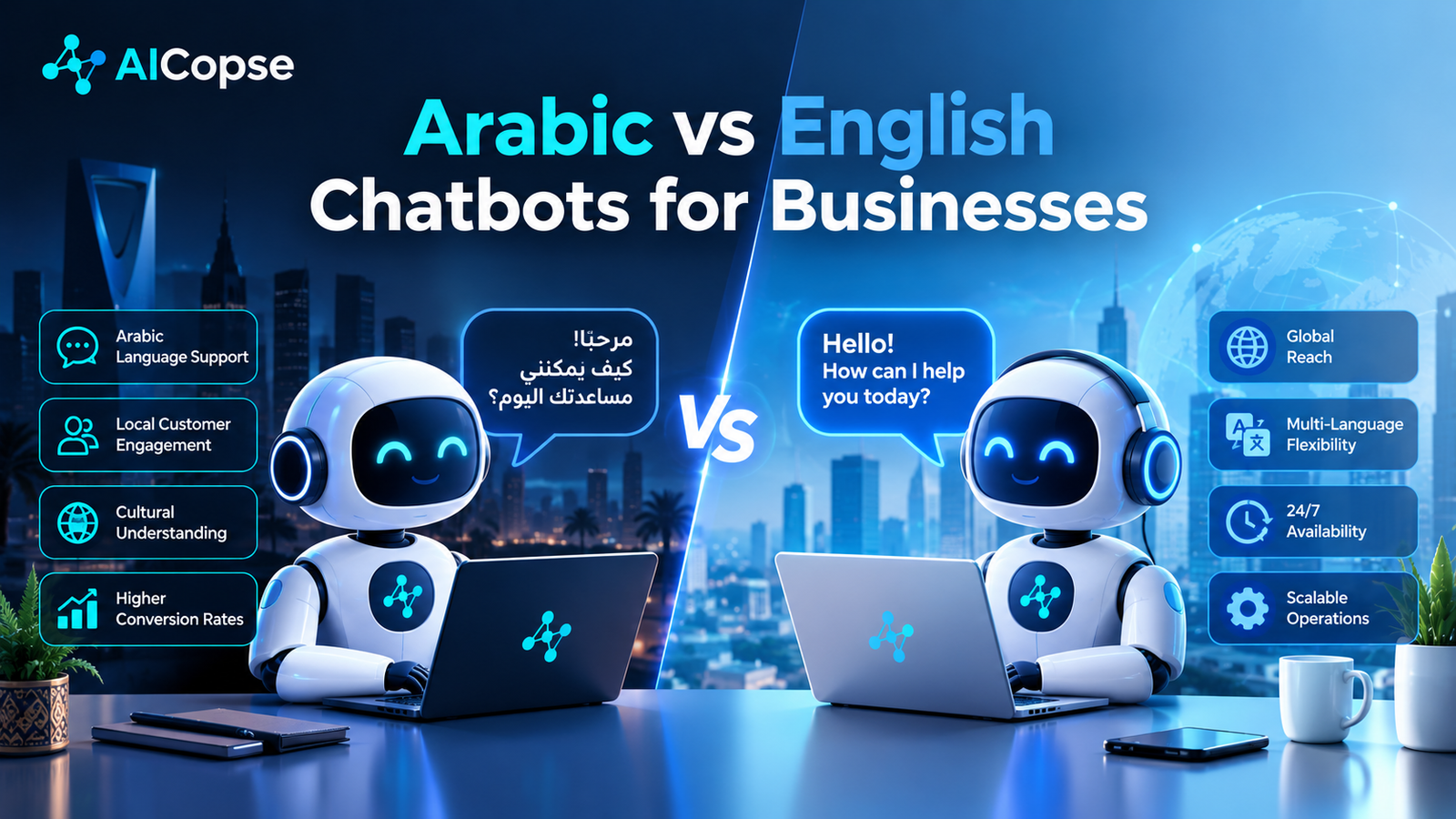
AICOPSE Research Report | 2026
Arabic vs. English Chatbots for Businesses: Market Size, Design, Integration, and Testing Requirements and Uses
A research-led guide to language quality, market opportunities, chatbot architecture, business integration, evaluation benchmarks, and the practical decisions companies need to make before deploying bilingual conversational AI.
Arabic NLP
Enterprise integration
Testing and evaluation
Executive Summary
English chatbots often benefit from mature language resources, extensive software documentation, and broad commercial deployment. Arabic chatbots, however, serve a large audience whose communication needs cannot be met reliably through literal translation alone. Arabic morphology, regional dialects, right-to-left interfaces, mixed Arabic-English conversations, local terminology, and cultural context all affect how well a chatbot works.
For most businesses serving both Arabic-speaking and English-speaking customers, the strongest long-term strategy is not to choose one language and neglect the other. It is to build a shared business system with language-aware interfaces, reliable retrieval, controlled integrations, separate evaluation datasets, and human escalation. The objective is equal service quality where the business promises bilingual support, not merely the ability to generate sentences in both languages.
Key Findings at a Glance
Sources: UNESCO, Grand View Research, BALSAM, and Shawarma Chats.
Table of Contents
- Market Size and Business Opportunity in 2026
- Arabic vs English Chatbots: Core Differences
- Arabic Dialects, Language Design, and User Experience
- Chatbot Architecture and Integration Requirements
- Business Uses and Industry Applications
- Six Research Studies and What They Reveal
- Major Events and Industry Developments
- Testing Requirements and Evaluation Framework
- Security, Privacy, and Governance
- Implementation Roadmap for Developers and Startups
- Expert Recommendations and Future Predictions
- Frequently Asked Questions
- Research Sources
Market Size and Business Opportunity
Businesses are moving beyond fixed-menu chatbots toward conversational systems that can answer questions, search company knowledge, explain policies, qualify leads, schedule appointments, and complete approved transactions. This change creates an opportunity for both English and Arabic chatbot providers. The opportunity is especially relevant for organizations that serve multilingual customers but still depend on separate call centers, repetitive support tickets, and manually translated website content.
Arabic is not a small niche language. UNESCO describes it as a language used daily by more than 400 million people and recognizes its many forms of expression and regional variation. The potential customer base extends across the Gulf, the Levant, North Africa, and Arabic-speaking communities worldwide. English remains important for international commerce, software documentation, cross-border business, and customers who prefer English for technical or professional interactions.
The commercial question is therefore not simply how many people speak each language. Businesses need to know which customers use each language, what those customers ask, which channels they prefer, and whether the chatbot can resolve their needs accurately. A large language audience does not automatically translate into revenue. Revenue depends on adoption, successful task completion, integration quality, trust, and the cost of operating the service.
Global conversational AI market estimates
Grand View Research estimates that the global conversational AI market reached approximately US$14.3 billion in 2025 and could reach US$17.7 billion in 2026. Its forecast places the market at US$78.9 billion by 2033, with a projected compound annual growth rate of 23.8% from 2026 to 2033. These figures describe the wider conversational AI market, not a separately measured Arabic chatbot market.
Other research providers publish different forecasts because they use different definitions, forecast periods, included technologies, and market models. Some include voice assistants, contact-center automation, and enterprise conversational platforms, while others use narrower categories. These estimates should not be combined as though they measure the same market.
Global Conversational AI Market: One 2026 Forecast
Source: Grand View Research, Conversational AI Market. Bars compare the reported values visually; they are not Arabic-versus-English market shares.
Why a separate Arabic chatbot market number is difficult to establish
Market research commonly categorizes conversational AI by software type, deployment model, industry, geography, or business function. It rarely separates revenue by the language used in each customer conversation. A single enterprise platform can handle Arabic and English through the same subscription, so assigning its full revenue to one language would distort the picture.
A responsible market analysis should distinguish three measurements:
- Total addressable market: the broader spending opportunity for conversational AI platforms, implementation, integrations, and related services.
- Serviceable bilingual market: the portion of that opportunity relevant to companies that need Arabic-English support in specific countries, industries, or channels.
- Obtainable market: the revenue a particular vendor or startup could realistically win based on its product, distribution, implementation capacity, and competitive position.
For a startup, the third measurement matters most. A small provider specializing in Arabic-English customer support for clinics, real estate companies, travel operators, or online retailers may have a stronger commercial position than a general chatbot product competing across every industry.
How to estimate the opportunity for a specific business
Instead of assigning an invented dollar value to the Arabic chatbot segment, calculate demand from actual customer and operational data. Consider a business receiving 20,000 support conversations every month, of which 45% are in Arabic and 55% are in English. If 60% of Arabic conversations and 70% of English conversations are suitable for automation, the potential automation pool is 12,300 conversations per month.
| Planning input | Arabic | English |
|---|---|---|
| Monthly conversations | 9,000 | 11,000 |
| Estimated automation suitability | 60% | 70% |
| Suitable conversations | 5,400 | 7,700 |
| Combined monthly automation pool | 13,100 conversations | |
The example above is illustrative, not a market statistic. The result changes according to language mix, query complexity, policy restrictions, and the proportion of conversations that require a human. The business should then test actual containment, customer satisfaction, cost per resolution, and repeat-contact rates before estimating savings.
Arabic vs English Chatbots: Core Differences
Both languages can support customer service, sales, appointment booking, product discovery, and internal knowledge assistance. The main difference is the engineering and evaluation effort required to make each interaction reliable. English-language systems often benefit from abundant training material and software examples. Arabic systems must handle a broader range of written forms and regional expressions while preserving the same business rules and safety standards.
| Dimension | English chatbot | Arabic chatbot | Business implication |
|---|---|---|---|
| Language data | Broad digital and technical resources | Resources vary by task and dialect | Validate performance on real user questions |
| Grammar and morphology | Relatively familiar patterns for many NLP tools | Rich word forms, agreement, clitics, and spelling variation | Test more than keyword matching |
| Dialect variation | Regional variation remains important | MSA and regional dialects can differ substantially | Choose dialect coverage by customer location |
| Interface direction | Usually left-to-right | Right-to-left, with mixed-direction content | Design and test layout independently |
| Code-switching | May include other languages and technical terms | Arabic and English may appear in the same sentence | Preserve product names and technical vocabulary |
| Voice support | Depends on accent, noise, and speaking style | Depends on dialect, accent, pronunciation, and noise | Test speech recognition separately from text generation |
| Quality assurance | Needs task and safety tests | Needs task, dialect, cultural, and script tests | Maintain separate language scorecards |
Does English always produce better chatbot results?
No. Results depend on the model, the task, the source material, and the evaluation method. English may perform better on many general-purpose benchmarks, but an Arabic-specialized model or a carefully grounded system can outperform a generic multilingual model on a narrow Arabic business task. A chatbot that retrieves the correct company policy and presents it clearly in Arabic may be more useful than a fluent English chatbot that gives an incorrect answer.
Businesses should therefore compare models on their own representative tasks. General language benchmarks are useful for selecting candidates, but they cannot replace tests of product questions, refund rules, local terminology, regional dialects, and actual customer workflows.
Arabic Dialects, Language Design, and User Experience
Arabic chatbot design starts with a decision that English-first projects may not face to the same extent: which form of Arabic should the product support? Modern Standard Arabic is broadly understood in formal contexts, including official communications, news, educational content, and many written service interactions. However, everyday speech varies across countries and regions. Gulf Arabic, Egyptian Arabic, Levantine Arabic, and Maghrebi varieties differ in vocabulary, phrasing, pronunciation, and common expressions.
A system trained or evaluated mainly on formal Arabic can struggle when customers write in dialect, use abbreviated spelling, omit punctuation, or mix Arabic and English. Conversely, a chatbot that speaks too casually may appear unprofessional when explaining a bank policy, legal notice, medical instruction, or government requirement.
Modern Standard Arabic
Best suited to formal notices, policy explanations, official instructions, and broadly understood written content.
Gulf Arabic
Relevant to customer-facing products serving Gulf markets. Local vocabulary and politeness norms require native-speaker review.
Egyptian Arabic
Important for Egyptian customer bases and informal conversation. Popular expressions may not transfer cleanly to other regions.
Levantine and Maghrebi varieties
Need dedicated evaluation when serving customers in the Levant or North Africa rather than assuming one Arabic style fits all.
Choose a language policy before choosing a model
A business should define its language policy in terms of user needs, not model convenience. The policy should answer four questions: whether the chatbot follows the customer’s language automatically, whether users can switch language at any time, which dialects are supported, and which subjects require formal wording.
- Use formal Arabic when precision matters. Policy explanations, contract terms, eligibility criteria, and official notices should use reviewed wording.
- Support natural customer language. Allow dialectal input even when the final response uses a more formal register.
- Preserve mixed-language terms. Product names, account labels, software features, model numbers, and error messages should not be translated inconsistently.
- Make language switching easy. A customer should not need to restart the conversation after switching between Arabic and English.
- Use human review for sensitive language. Native speakers should review important financial, legal, healthcare, and government content.
Right-to-left design is a functional requirement
Arabic support involves more than translating labels. The entire interface must behave correctly when the direction changes. Buttons, chat bubbles, icons, form fields, validation messages, timestamps, and mixed-language text can become confusing if directionality is handled inconsistently.
Developers should use appropriate bidirectional text support rather than manually reversing strings. In web interfaces, the HTML dir="rtl" attribute and CSS logical properties such as margin-inline-start can help maintain a layout that adapts to the selected language. Numbers, phone numbers, email addresses, URLs, and English product names should be tested inside Arabic sentences because they may display differently from ordinary text.
Example: One customer question, two language experiences
“Can I change my delivery address after placing the order?”
“هل يمكنني تغيير عنوان التوصيل بعد تأكيد الطلب؟”
Both users should receive the same correct business policy, adapted to the language of the conversation. The Arabic interface must also render the text, links, order numbers, and action buttons correctly from right to left.
Chatbot Architecture and Integration Requirements
The language model is only one component of a business chatbot. A production system also needs a user interface, language handling, company knowledge, identity and permissions, business-system integrations, observability, evaluation, and a safe way to hand off difficult conversations. Weakness in any of these components can undermine otherwise impressive language performance.
Recommended architecture for an Arabic-English business chatbot
Language preference, dialect cues, script direction, session context
Prompt rules, permissions, tool selection, escalation, validation
FAQs, policies, product content
CRM, orders, booking, billing
Access checks, audit, data protection
Reference architecture for planning. The final design should reflect the organization’s risk, scale, channels, and regulatory requirements.
The essential integration components
| Component | Purpose | Important control |
|---|---|---|
| Language router | Identifies or remembers the user’s language | Allow explicit user override |
| Knowledge retrieval | Finds approved company information | Measure retrieval quality in both languages |
| CRM and ticketing | Creates or updates customer records and cases | Verify identity and enforce permissions |
| Transaction APIs | Supports orders, bookings, payments, or returns | Validate inputs and confirm irreversible actions |
| Monitoring | Tracks latency, failures, quality, and cost | Break down metrics by language and task |
| Human handoff | Escalates unresolved or sensitive cases | Transfer context and language preference |
Retrieval-augmented generation for business knowledge
Retrieval-augmented generation, often called RAG, connects a language model to a controlled collection of company information. When a customer asks about delivery, eligibility, pricing, or a product feature, the system searches the approved knowledge base and uses relevant passages to construct an answer.
For bilingual systems, retrieval quality deserves special attention. The customer may ask in Arabic while the source document is in English, or the reverse. A bilingual retrieval pipeline should be tested on both same-language and cross-language searches. It may use multilingual embeddings, translated query expansion, language-specific indexes, or a combination of methods. The correct approach depends on the documents, the model, and the business domain.
- Keep an approved source of truth for policies, prices, service limits, and eligibility criteria.
- Maintain consistent terminology across Arabic and English content, including dates, currencies, measurements, and product names.
- Attach source identifiers to retrieved passages so answers can be audited and grounded.
- Test whether an Arabic question retrieves the right English document and whether an English question retrieves the right Arabic document.
- Return a clarification or escalate when the retrieved evidence is incomplete or contradictory.
Build, buy, or combine existing platforms?
A company does not always need to train its own language model. Many projects can start with an existing multilingual model, a controlled knowledge base, and a small set of business integrations. A specialized model or fine-tuning may become useful when the company has a substantial volume of high-quality domain data, a repeatable performance gap, strict deployment constraints, or a measurable need for lower inference cost.
| Approach | Suitable when | Main trade-off |
|---|---|---|
| Commercial chatbot platform | Speed and managed operations are priorities | Customization, usage fees, and vendor dependence |
| Multilingual model plus RAG | The business has useful documents and needs control | Retrieval, security, and evaluation require engineering |
| Arabic-specialized model | Arabic tasks or dialects expose persistent quality gaps | Hosting, maintenance, and task-specific benchmarking |
| Hybrid architecture | Different tasks need different models or tools | Routing, monitoring, and consistency become more complex |
Business Uses and Industry Applications
The best chatbot use cases are repetitive enough to automate, valuable enough to justify integration, and bounded enough to test. Language coverage should be evaluated alongside business value. A company may discover that Arabic support produces the largest improvement in customer access, while English support produces the greatest reduction in technical support workload. The result will vary by customer base and workflow.
Retail and e-commerce
Product discovery, delivery tracking, return eligibility, order changes, stock checks, and multilingual shopping assistance.
Measure: resolution rate, completed purchases, return-policy accuracy, and repeat contacts.
Banking and fintech
General product information, branch and service guidance, transaction explanations, and secure routing to human support.
Measure: policy accuracy, successful routing, authentication failures, and compliance incidents.
Healthcare
Appointment scheduling, clinic directions, preparation instructions, administrative FAQs, and follow-up reminders.
Measure: booking completion, instruction accuracy, privacy incidents, and safe escalation.
Travel and hospitality
Reservation questions, cancellation policies, itinerary information, local guidance, and guest support.
Measure: booking conversion, response time, policy compliance, and successful handoff.
Real estate
Property searches, viewing appointments, location questions, project information, and lead qualification.
Measure: qualified leads, appointment attendance, and factual listing accuracy.
Government and public services
Explaining service steps, identifying required documents, navigating digital portals, and answering common questions.
Measure: task completion, accessibility, answer accuracy, and equitable language performance.
Government use cases demonstrate why language access is more than a marketing feature. The UAE’s official digital government platform provides an example of AI-supported public service access through U-Ask. The UAE Government has also published a digital customer and digital government service policy focused on user experience, connected systems, service continuity, and trust. These initiatives are evidence of public-sector interest in AI-enabled digital services, but they do not prove that every chatbot deployment will deliver the same outcomes.
Sources: UAE Government: ChatGPT and U-Ask and Digital Customer and Digital Government Service Policy.
Six Research Studies and What They Reveal
Arabic-English chatbot decisions should be informed by published research rather than product demonstrations alone. The studies below examine different aspects of the problem, including bilingual model performance, benchmark coverage, dialect variation, and the reliability of generated conversations. They do not all measure customer-service outcomes directly, so their results should be applied within the scope of each study.
What the six studies collectively tell businesses
1. Benchmark languages separately
An English score cannot establish Arabic quality.
2. Evaluate more than one task
Knowledge, retrieval, dialogue, and reasoning need different tests.
3. Include regional varieties
Formal Arabic alone does not represent every customer.
4. Use native-speaker review
Human review helps detect unnatural wording and cultural errors.
5. Keep private tests
Held-out examples provide a more credible measure of real improvement.
6. Test actual business workflows
Public benchmarks do not replace policy, transaction, and escalation tests.
Major Events and Industry Developments
Several developments through 2025 and 2026 help explain why Arabic-English chatbot strategy is becoming more relevant. The most useful signals are not hype about chatbots alone. They include new Arabic evaluation resources, public-sector digital service programs, commercial investment in Arabic speech technology, and the broader expansion of conversational AI platforms.
Bilingual evaluation research highlighted measurable language gaps
The bilingual benchmark study published in 2024 reported a substantial difference between ChatGPT’s performance on its English and Arabic test questions. The result is a reminder that multilingual claims should be supported by task-level evidence rather than general fluency demonstrations.
Arabic NLP benchmarks expanded
Research projects such as BALSAM, Shawarma Chats, and AraDiCE added more structured ways to examine Arabic tasks, multi-turn dialogue, dialects, and cultural context. Together, they provide a stronger foundation for evaluating Arabic systems than a handful of translated prompts.
Arabic-first voice AI attracted new commercial investment
A report published by The Wall Street Journal in October 2026 described UAE-based CNTXT AI expanding into Silicon Valley after developing Arabic-first AI models. The report noted its Munsit speech technology, which supports more than 25 Arabic dialects, and discussed the company’s expansion and investment activity. This is a company-specific example of commercial interest in Arabic speech, not proof that every dialect is equally solved.
UAE digital government continued to expand AI-enabled services
The UAE’s digital government policies and official AI information pages describe initiatives to make services more connected, proactive, and accessible. Such programs create a practical reason to test Arabic and English service journeys together, especially when users need to move between a chatbot and an official digital transaction.
Conversational AI market forecasts pointed to continued expansion
Grand View Research estimated the overall conversational AI market at US$17.7 billion in 2026. The estimate reflects broad market activity rather than a language-specific revenue total. For buyers, the important implication is to plan for more model and platform choices while preserving the ability to evaluate language quality independently.
What these developments mean for businesses
- Arabic speech and dialect support are becoming active areas of product development, but vendor claims still need independent testing.
- Benchmark datasets are improving, which makes it easier to build more disciplined Arabic evaluation plans.
- Government and enterprise deployments place greater importance on accessibility, privacy, consistency, and reliable escalation.
- Market growth may expand vendor choice, but companies should avoid selecting a platform based only on market size or a polished demo.
Testing Requirements and Evaluation Framework
A chatbot should not launch simply because it can answer a few questions in Arabic and English. It should pass a structured evaluation that tests language understanding, factual correctness, business rules, integration behavior, safety, interface usability, and performance under realistic traffic. Testing should continue after launch because customer vocabulary, company policies, model versions, and source documents change over time.
Build a balanced bilingual test set
Start by collecting representative questions from support tickets, sales inquiries, call-center transcripts, search logs, and user research. Only use data when collection and reuse are permitted, and remove or protect personal information. The test set should include common requests, rare but important cases, ambiguous questions, adversarial inputs, and conversations that move between Arabic and English.
| Test category | Examples | What to measure |
|---|---|---|
| Language understanding | Formal Arabic, dialect, spelling variation, mixed language | Intent accuracy and correct interpretation |
| Knowledge retrieval | Policy, product, pricing, and service questions | Retrieval precision and source coverage |
| Answer correctness | Questions with known correct answers | Factual accuracy and unsupported claims |
| Multi-turn context | Follow-up questions, corrections, language switching | Context retention and task completion |
| Integration | Booking, refund request, ticket creation, order lookup | Correct API use and valid state changes |
| Safety and security | Prompt injection, unauthorized requests, sensitive data | Policy violations and access-control failures |
| Interface usability | Mobile RTL, mixed text, forms, keyboard use | Task success and usability defects |
| Performance | Peak load, slow tools, service outages | Latency, timeout rate, and recovery |
Recommended language coverage matrix
For a business serving the UAE, Saudi Arabia, Egypt, and international customers, an evaluation matrix could include the following groups. These are suggested planning categories, not a universal minimum required for every deployment.
English
Standard queries, informal language, abbreviations, and technical terms.
Modern Standard Arabic
Formal questions, official policies, and service instructions.
Gulf Arabic
Local expressions and region-specific customer language.
Egyptian Arabic
Colloquial questions, informal spelling, and local terms.
Levantine or Maghrebi
Add when supported markets and customer data justify coverage.
Code-switching
Arabic sentences containing English product, technical, or business terms.
Key chatbot metrics
| Metric | How to calculate or assess it | Why it matters |
|---|---|---|
| Task completion rate | Successful tasks divided by eligible attempts | Measures whether the customer actually achieves the goal |
| Correct answer rate | Correct answers divided by evaluated answers | Tracks factual reliability |
| Language parity gap | English success rate minus Arabic success rate | Shows whether one language receives poorer service |
| Escalation rate | Conversations sent to people divided by total conversations | Helps identify coverage gaps and risk controls |
| Repeat-contact rate | Users who return for the same issue within a defined window | Can expose incomplete or misleading resolutions |
| Latency | Measure median and high-percentile response time | Affects usability and abandonment |
| Cost per successful resolution | Total operating cost divided by successful resolutions | Connects AI spending to business outcomes |
Do not set targets without measuring a baseline. A business might begin by aiming for at least 90% accuracy on a defined set of low-risk, frequently asked questions, but that is a proposed internal acceptance threshold, not a universal industry standard. High-impact tasks should have stricter controls, more human review, and explicit tests for incorrect or unsupported answers.
A sample evaluation scorecard
The following scorecard is an example of how a company could organize its acceptance criteria. The weights and thresholds should be adjusted for the domain, risk, and user expectations.
| Evaluation area | Example weight | Evidence needed before launch | |
|---|---|---|---|
| Factual and policy accuracy | 25% | Reviewed test answers and source grounding | |
| Language and dialect quality | 20% | Native-speaker assessment in supported varieties | |
| Task completion | 20% | End-to-end workflow tests | |
| Safety and permissions | 20% | Security tests and access-control verification | |
| Usability and performance | 15% | Mobile, RTL, latency, and accessibility checks |
Weighted scores are useful for comparing candidate systems, but a high average must not hide a serious safety failure. A chatbot should not pass acceptance if it leaks private information, performs an unauthorized transaction, or gives dangerous advice merely because it performs well on ordinary questions.
Security, Privacy, and Governance
A bilingual chatbot often processes names, addresses, account details, order numbers, health questions, financial information, or confidential company documents. The language used does not change the need for access controls, data minimization, retention limits, secure integrations, and incident response. Arabic support also creates additional testing needs because safety filters and data-loss detection must work across supported dialects, scripts, and mixed-language messages.
Core security requirements
- Authentication: Verify a customer’s identity before revealing account information or allowing account-specific actions.
- Authorization: Check permissions on the server for every sensitive action. Never rely on the model’s decision alone.
- Prompt-injection defense: Treat user messages and retrieved documents as untrusted input. Restrict what tools can do and which data they can access.
- Data minimization: Collect only the information needed for the task, and avoid sending unnecessary personal data to external model providers.
- Logging and retention: Set clear retention rules, protect logs, and prevent sensitive content from being exposed through analytics or debugging tools.
- Human escalation: Transfer high-risk, disputed, or unresolved cases to an appropriately trained human team.
- Language-aware safety testing: Test prohibited requests, manipulation attempts, and privacy violations in Arabic, English, dialect, and mixed-language input.
- Change management: Re-test the system after model changes, prompt edits, knowledge-base updates, or integration changes.
Businesses operating in regulated sectors should also assess the laws and contractual obligations relevant to their customers and data locations. Applicable requirements can differ by jurisdiction and industry. A legal or compliance review should happen before a chatbot is allowed to make consequential decisions or handle regulated data.
Human handoff is part of the product
A reliable chatbot must recognize when it cannot answer safely. It should be able to explain that it needs assistance, transfer the conversation with useful context, preserve the user’s language preference, and avoid making the customer repeat information unnecessarily. This is especially important when the issue concerns a disputed charge, a medical concern, a legal deadline, account access, or a complaint that the chatbot has already failed to resolve.
Companies should track not only how many conversations are escalated, but also whether escalation occurs at the right time. An unusually low escalation rate can mean that the chatbot is resolving many requests successfully. It can also mean that the chatbot is confidently answering questions it should not handle. Review conversation samples and task outcomes before interpreting the metric.
Implementation Roadmap for Developers, Startups, and Businesses
A phased rollout reduces the risk of investing in a large system before the business understands its language mix, customer needs, and integration constraints. Start with one useful workflow, measure it in both languages, and expand only after the results justify the next step.
Discover
- Audit language demand
- Identify repetitive queries
- Define risk boundaries
- Record current support metrics
Build a pilot
- Select model and channels
- Prepare bilingual knowledge
- Integrate one workflow
- Add permissions and handoff
Test
- Run language-specific tests
- Review with native speakers
- Test security and failures
- Fix high-impact defects
Launch and improve
- Launch to a limited audience
- Monitor language parity
- Collect feedback
- Expand based on evidence
Illustrative schedule for a relatively bounded project. Complex enterprise integrations, regulated workloads, and voice systems may need substantially longer.
Guidance for developers
- Keep business rules in deterministic application code or approved services rather than relying entirely on natural-language instructions.
- Use structured API schemas and validate every model-generated tool argument before execution.
- Build a repeatable evaluation pipeline that runs after changes to models, prompts, retrieval, and business APIs.
- Use language metadata and trace IDs to investigate Arabic and English failures without unnecessarily retaining personal content.
- Implement RTL layout using direction-aware design patterns and test the interface on real mobile devices.
- Separate model quality from retrieval quality and integration quality so teams can find the actual cause of failures.
Guidance for startups
- Choose a specific market and workflow instead of attempting to support every Arabic dialect and every industry on day one.
- Interview real customers and support agents to identify the questions that consume the most time.
- Build a small, reviewed bilingual test set before investing heavily in fine-tuning or proprietary model development.
- Use commercial models or existing platforms where they meet the requirements, then invest in differentiated workflow design, local language quality, and domain knowledge.
- Measure willingness to pay and customer outcomes rather than relying on the total conversational AI market forecast.
Guidance for established businesses
- Set an accountable owner for language quality, data protection, integration reliability, and customer outcomes.
- Compare Arabic and English resolution rates, customer satisfaction, repeat contacts, and escalation outcomes separately.
- Require vendor demonstrations to use the company’s own questions, policies, and realistic workflows.
- Keep a fallback path for outages, uncertain answers, and transactions the chatbot is not authorized to complete.
- Review whether the vendor stores prompts, uses customer data for model improvement, supports required data locations, and provides adequate audit controls.
Budgeting: estimate the total cost, not just the model fee
The cost of a bilingual chatbot includes more than tokens or platform subscriptions. It can include integration development, Arabic content preparation, native-speaker review, evaluation, security testing, monitoring, human escalation, and ongoing maintenance. Voice products may add speech recognition, speech generation, telephony, and call-recording costs.
| Cost category | What to include | Common planning mistake |
|---|---|---|
| Platform and model | Subscriptions, input and output usage, hosting | Estimating only average prompts, not peak use |
| Knowledge preparation | Document cleanup, translation review, terminology | Assuming machine translation is always adequate |
| Integration | CRM, ticketing, orders, identity, workflow logic | Ignoring legacy system complexity |
| Testing and governance | Evaluation, security, legal and compliance review | Treating launch as the end of testing |
| Operations | Monitoring, support, model updates, human handoff | Ignoring ongoing ownership and maintenance |
Expert Recommendations and Future Predictions
The following predictions are evidence-based assessments, not guaranteed outcomes. They draw on the expansion of conversational AI, recent Arabic evaluation research, the development of dialect-focused datasets, and reported commercial investment in Arabic speech technology. Businesses should use them for planning and review them as new benchmark results and vendor capabilities emerge.
Language parity becomes a procurement requirement
Buyers will increasingly ask vendors to demonstrate Arabic and English performance on the same business tasks rather than relying on generic multilingual claims.
Dialect-specific testing expands
As benchmarks improve, enterprise teams will be better able to specify which dialects are supported and measure performance for each customer market.
Voice and text converge
More products are likely to combine speech recognition, text chat, voice responses, and human handoff, increasing the need for end-to-end testing.
Grounded answers gain importance
Businesses will put more emphasis on source-backed responses, approved knowledge, and auditable transactions than on conversational style alone.
Domain-specific solutions compete with general platforms
Providers with strong sector knowledge, carefully reviewed Arabic content, and dependable integrations may compete effectively against larger general-purpose tools.
Continuous evaluation becomes standard practice
Teams will increasingly rerun language, safety, retrieval, and integration tests when models or business data change.
Recommendations ranked by practical priority
| Priority | Recommendation | Reason |
|---|---|---|
| 1 | Define supported languages and dialects | Prevents vague claims of universal Arabic support |
| 2 | Build a private bilingual evaluation set | Measures performance on real business needs |
| 3 | Ground answers in approved knowledge | Reduces unsupported policy and product claims |
| 4 | Secure every business action | Prevents unauthorized data access and transactions |
| 5 | Test RTL and mixed-language interfaces | Prevents language support from failing at the interface level |
| 6 | Monitor quality after launch | Detects regressions and changing customer needs |
Frequently Asked Questions
1. Are Arabic chatbots more expensive to build than English chatbots?
Not always. Costs depend on the platform, language quality requirements, supported dialects, integration complexity, voice features, and review process. Arabic projects may need additional investment in dialect evaluation, native-speaker review, content preparation, and right-to-left interface testing. A shared architecture can reduce duplicated engineering work across both languages.
2. Should a business use Modern Standard Arabic or a local dialect?
It depends on the audience and task. Modern Standard Arabic is often suitable for formal written information, while a local dialect may feel more natural for conversational support. A strong design can accept dialectal questions and provide clear, consistent answers in an appropriate register. The decision should be validated with local users.
3. Is there a reliable market-size figure for Arabic chatbots in 2026?
A single widely accepted global revenue figure for Arabic chatbots specifically is not established by the broad market reports cited here. Global conversational AI estimates cover multiple languages and product types. Businesses should estimate their addressable market using customer language demand, industry spending, and the serviceable workflows they can realistically support.
4. Can one model handle Arabic and English in the same conversation?
Yes, many multilingual models can process mixed-language conversations, but actual quality varies. Test language switching, mixed scripts, product terminology, retrieval, and context retention. The system should preserve the customer’s preference and avoid changing important details during translation or language switching.
5. Is fine-tuning required for an Arabic chatbot?
No. Many projects can begin with a multilingual model, retrieval from approved company content, carefully designed prompts, and a good evaluation set. Fine-tuning may help when testing reveals a consistent gap that cannot be solved effectively through retrieval, configuration, or workflow changes.
6. How should a company test Arabic chatbot quality?
Use real and representative Arabic queries, cover the dialects the business promises to support, include multi-turn conversations, and review outputs with competent Arabic speakers. Measure factual correctness, task completion, retrieval quality, escalation, latency, and safety separately from English performance.
7. What industries benefit most from Arabic-English chatbots?
Retail, travel, real estate, banking, healthcare administration, education, and public services can benefit when customers need reliable support in both languages. The strongest use case is usually a frequent, well-defined workflow where better language access can improve resolution, conversion, or service availability.
8. What is the most important mistake to avoid?
Do not treat the ability to generate Arabic text as proof that the chatbot is ready for Arabic customers. The system must understand real customer language, retrieve correct information, follow the same business rules, protect data, and complete tasks reliably. These outcomes require testing and ongoing monitoring.
Conclusion: Build for Equal Outcomes, Not Just Two Languages
In 2026, the business case for Arabic-English chatbots rests on a practical combination of market reach, customer experience, operational efficiency, and reliable digital service. English remains important for global business and technical workflows, while Arabic support helps organizations serve a large and linguistically diverse audience. Neither language should be treated as a simple translation layer added after the product is built.
The research points to a consistent lesson. Bilingual performance must be measured, Arabic dialects must be considered explicitly, and model selection should be based on actual tasks rather than promotional demonstrations. Benchmarks such as BALSAM, Shawarma Chats, AraDiCE, and DialectalArabicMMLU provide useful evaluation ideas, while business-specific tests establish whether a system can answer real customer questions and complete approved workflows.
For developers and startups, the most practical route is to begin with a bounded use case, an approved knowledge base, secure integrations, and a representative bilingual test set. For established companies, the priority is to measure outcomes separately by language, make escalation reliable, and ensure that privacy and access controls work across every supported interaction. A chatbot should be considered successful when customers can complete their tasks accurately and safely, not simply when it can hold a conversation.
For more AI research, technology analysis, and industry updates, visit AICOPSE.
Research Sources and Further Reading
The report draws on academic papers, an industry market estimate, and official digital-government resources. Market forecasts are estimates, and benchmark findings should be interpreted within each study’s scope.
- UNESCO. World Arabic Language Day and information on Arabic’s global reach. Read source.
- Grand View Research. Conversational AI Market Size and Share Report, 2026–2033. Read market report.
- PeerJ Computer Science. A bilingual benchmark for evaluating large language models, 2024. Read study.
- Association for Computational Linguistics. BALSAM: A Platform for Benchmarking Arabic Large Language Models, ArabicNLP 2025. Read study.
- Association for Computational Linguistics. Shawarma Chats: A Benchmark for Arabic Dialogue, ArabicNLP 2025. Read study.
- Association for Computational Linguistics. AraDiCE: Benchmarks for Dialectal and Cultural Capabilities in LLMs, COLING 2025. Read study.
- arXiv. Evaluating Arabic Large Language Models: A Survey of Benchmarks, Methods, and Gaps, 2025. Read survey.
- arXiv. DialectalArabicMMLU: Benchmarking Dialectal Capabilities in Arabic and Multilingual Language Models, 2025. Read study.
- The Wall Street Journal. U.A.E.-Based AI and Data Startup Expands Into Silicon Valley, October 2026. Read report.
- UAE Government. Digital Customer and Digital Government Service Policy. Read policy.
- UAE Government. Artificial intelligence and U-Ask information. Read source.
Research and Market Data Disclaimer
This report is intended for research and business planning. Market forecasts are estimates from the cited provider, not guaranteed outcomes. Academic benchmark results apply to the datasets and models evaluated by the researchers and should not be interpreted as current scores for every chatbot. Business deployment decisions should be based on current vendor documentation, representative testing, security review, and applicable legal requirements.

Leave a Reply